Seated cat cow is the same exercise as cat cow, just done at the edge of a chair instead of in tabletop on the floor. Same breath pattern, same segmental spinal articulation, same benefits for stiff backs. The only thing it gives up is the loaded shoulder and wrist work from the tabletop position.
The trade-off is access. You can do seated cat cow in an office, on a flight, in a meeting (assuming you don't mind looking slightly weird for ten seconds), or any other moment where the floor isn't an option. For most desk workers, that access matters more than the extra shoulder load.
The big use case: hourly desk breaks. Eight slow reps, ninety seconds, back to work. Over a workday those breaks add up to ten minutes of spinal mobility that you would otherwise not have done.
Quick Facts: Seated Cat Cow
- Equipment needed: Chair
- Difficulty: Beginner
- Modality: Dynamic mobility / Stretching
- Body region: Spine, core, shoulders
- FitCraft quest category: Mobility
Areas Stretched & Mobilized
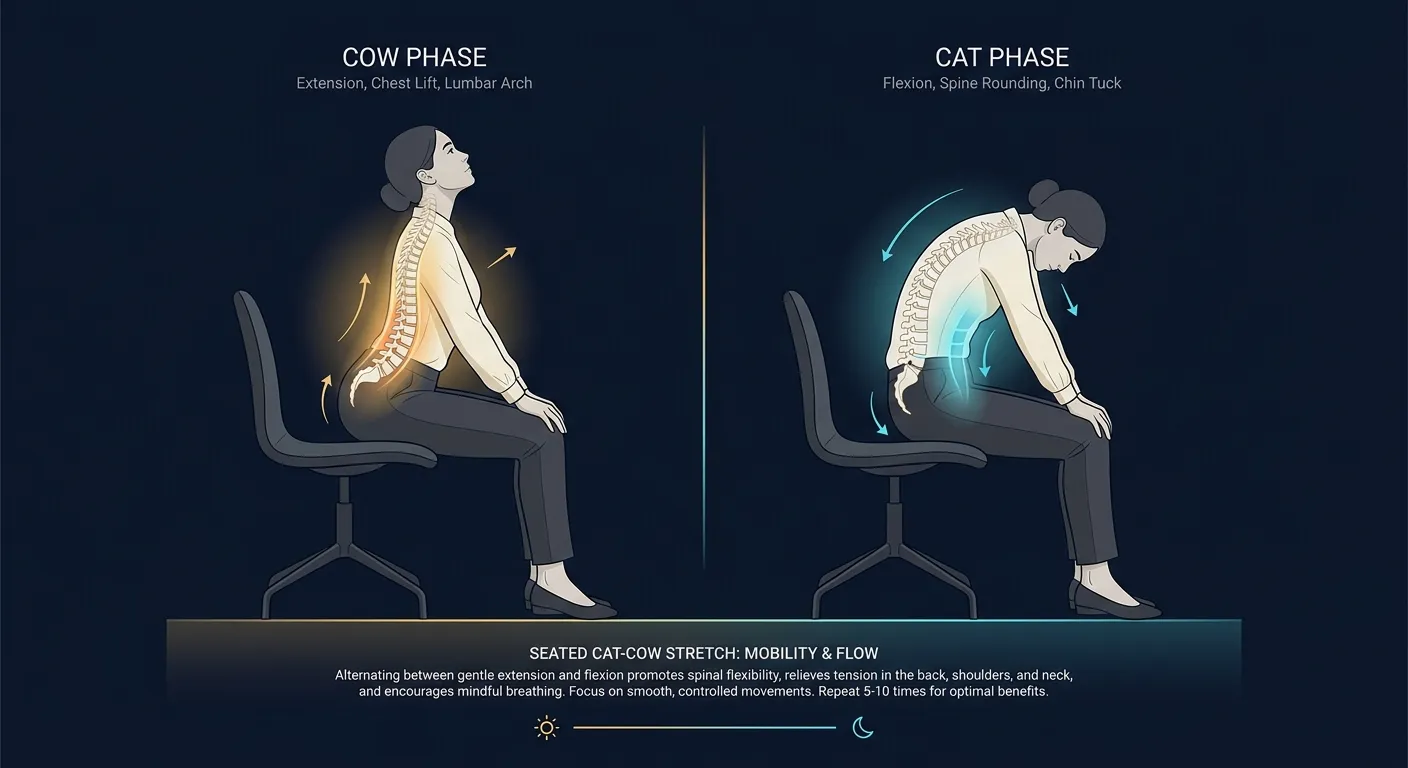
Primary areas mobilized: the entire spinal column from the cervical (neck) through the thoracic (mid-back) into the lumbar (lower back). The erector spinae group (the long muscles running parallel to your spine) shortens concentrically during seated cow and lengthens eccentrically during seated cat. The rectus abdominis does the opposite, contracting concentrically during cat and lengthening during cow. Every rep cycles both sides of the trunk through an active range.
Secondary areas worked: the rhomboids and lower trapezius assist with scapular retraction during seated cow, and the serratus anterior helps with scapular protraction during seated cat (especially when you actively press into your hands on your knees). The hip flexors lengthen slightly during cow as the pelvis tips forward, and the deep gluteal muscles briefly engage during cat as the pelvis tucks under. Because the chair supports the body's weight, none of these muscles are heavily loaded.
Stabilizers: stretching and mobility drills usually don't require active stabilization, but seated cat cow still asks the deep core (transverse abdominis) and the legs (anchoring through the feet) to keep the lower body still while the spine moves. This light bracing is what prevents the movement from collapsing into the lower back alone.
Mechanism (why the seated version still works for spinal health): the spinal discs are avascular, meaning they don't have direct blood supply. They get their nutrients through imbibition: compression squeezes fluid out, decompression draws fresh fluid in. Seated cat cow alternates compression and decompression across each segment of the spine, just at a smaller range than the floor version. The reason hourly desk breaks work so well is that long static sitting accumulates spinal stiffness much faster than most people realize; even 90 seconds of articulation every hour interrupts that accumulation and keeps the segments moving. A 2017 study in the Journal of Physical Therapy Science (Park et al., 2017) demonstrated functional benefits in chronic low back pain patients from spinal mobilization exercises; the mechanism applies equally to the seated version, just at a more modest scale per rep.
Step-by-Step: How to Perform Seated Cat Cow
The cues below apply to office chairs, dining chairs, gym benches, and most other seated surfaces with a firm seat. Avoid soft couches; they make it hard to feel the pelvis tilt.
Step 1: Set Your Starting Position
Sit at the front edge of your chair with both feet flat on the floor, hip-width apart. Place your hands on your knees with arms relaxed. Your spine starts in a neutral upright position. Sit tall enough that there is no slouch into the chair back.
Coach Ty's cue: "Slide forward so you're sitting on the front third of the chair. Feet flat, knees over ankles, hands resting on the thighs just above the knees."
Step 2: Inhale into Seated Cow
As you breathe in, lift your chest forward and up. Roll your shoulders back and down. Allow a gentle natural arch through your lower back as your pelvis tips slightly forward. Let your gaze drift up at a comfortable angle.
Ty's cue: "Lead with the chest. Imagine someone gently tugging a string attached to the center of your sternum upward and slightly forward."
Step 3: Exhale into Seated Cat
As you breathe out, round your spine in the opposite direction. Tuck your chin toward your chest, draw your belly button in toward your spine, and let your shoulders round forward. Press gently into your hands on your knees to help the upper back round more.
Ty's key cue: "Push through your hands to round your upper back. Most people only round their lower back and skip the thoracic. The hand pressure is what gets the mid-back to participate."
Step 4: Flow Between Positions
Keep alternating. Inhale, cow. Exhale, cat. 8 to 12 reps. Let the breath set the pace. The whole spine should participate, not just the neck and shoulders.
As Ty coaches it: "Move slow enough that one transition takes a full breath cycle. If you're going faster than that, you're not mobilizing your spine."
Step 5: Return to Upright Neutral
After your last rep, return to a neutral upright seated position. Take one normal breath. Your spine should feel less stiff than when you started. If it doesn't, do another round.
Ty's reminder: "This is meant to feel small and gentle. Cranking into deep range while seated tends to load the lumbar in an unhelpful way. Keep the range moderate, the tempo slow, and the breath steady."
Get this exercise in a personalized workout
FitCraft, our mobile fitness app, uses its AI coach Ty to program mobility work like this into your plan at the right volume and intensity, based on your level, goals, and equipment. Ty was designed and trained by Domenic Angelino, MPH (Brown University) and NSCA-CSCS, with research published in the Journal of Strength and Conditioning Research and Medicine & Science in Sports & Exercise.
Take the Free Assessment Free · 2 minutes · No credit card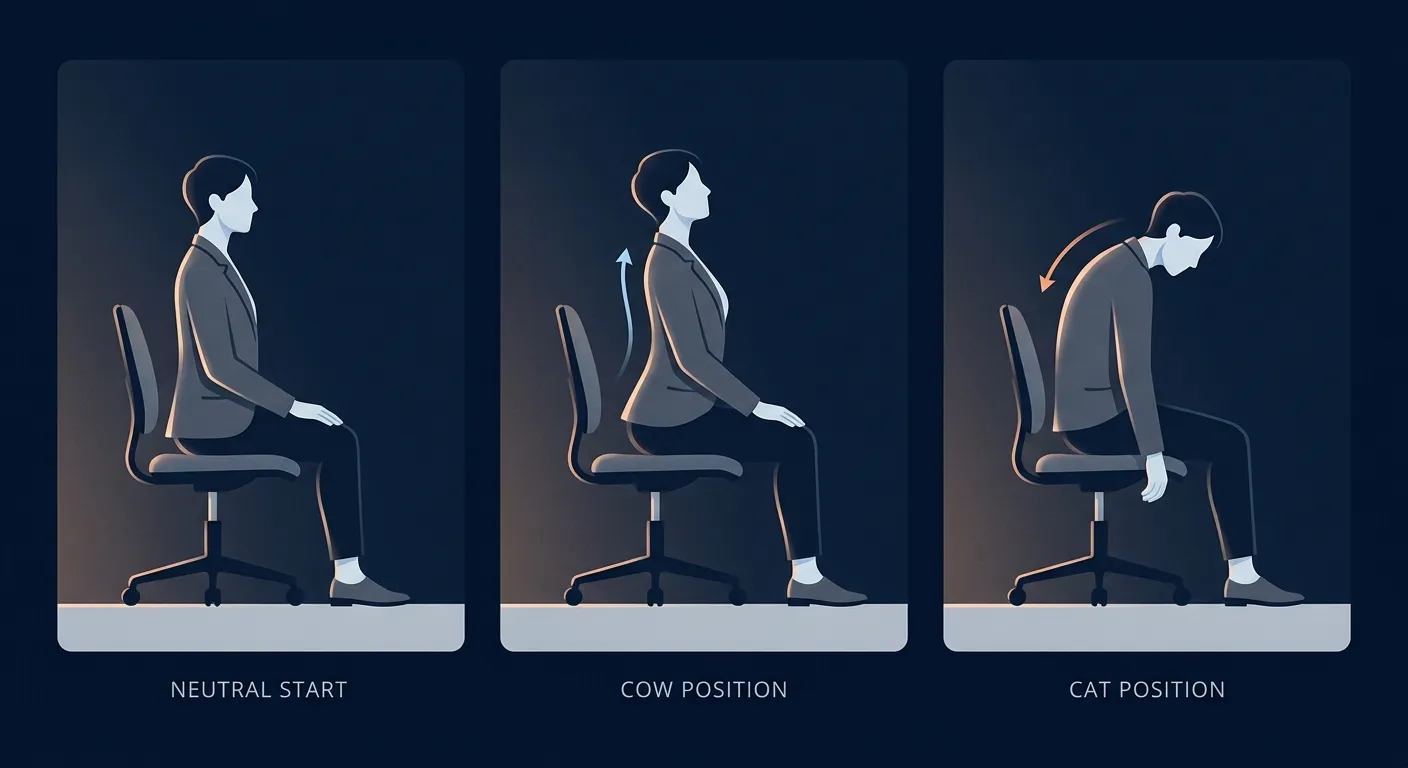
Common Mistakes (and How to Fix Them)
Here are the mistakes Ty corrects most often during the seated version.
- Slouching into the chair back. If you're leaning against the backrest, your pelvis can't tilt freely and the movement turns into a head-and-neck-only exercise. Fix: slide forward so you're sitting on the front third of the chair with no contact between your back and the chair.
- Moving only the neck and shoulders. The most common error. The head bobs up and down while the lumbar and thoracic spine stay locked. Fix: initiate every transition from the pelvis. Tip the pelvis forward to start cow; tuck the pelvis under to start cat. The rest of the spine follows.
- Not using the hands. The hands on the knees are not just for balance. Pressing through the hands during cat is what helps the upper back round. Fix: in cat, actively press into your knees to drive your shoulders forward and round the thoracic spine.
- Cranking into deep range. Forcing a big arch in cow can pinch the lumbar facet joints when you're seated. Fix: keep the range moderate. The seated version is meant to be gentle. If you want bigger range, do the floor version.
- Going too fast. Reps in 5 seconds each defeat the purpose. Fix: one full breath cycle per transition. Roughly 3 to 4 seconds in each position.
- Holding the breath. Especially common when concentrating on form. Fix: inhale on cow, exhale on cat, every single rep. The breath drives the depth.
Seated Cat Cow Variations: Regressions and Progressions
Most desk workers stay with the basic version because it does the job. But a few variations are useful for specific situations.
Seated Cat Cow (Standard)
The version described above. Hands on knees, edge of chair, eight to twelve reps. This is the version to do every hour at your desk.
Seated Cat Cow with Arm Reach (Intermediate)
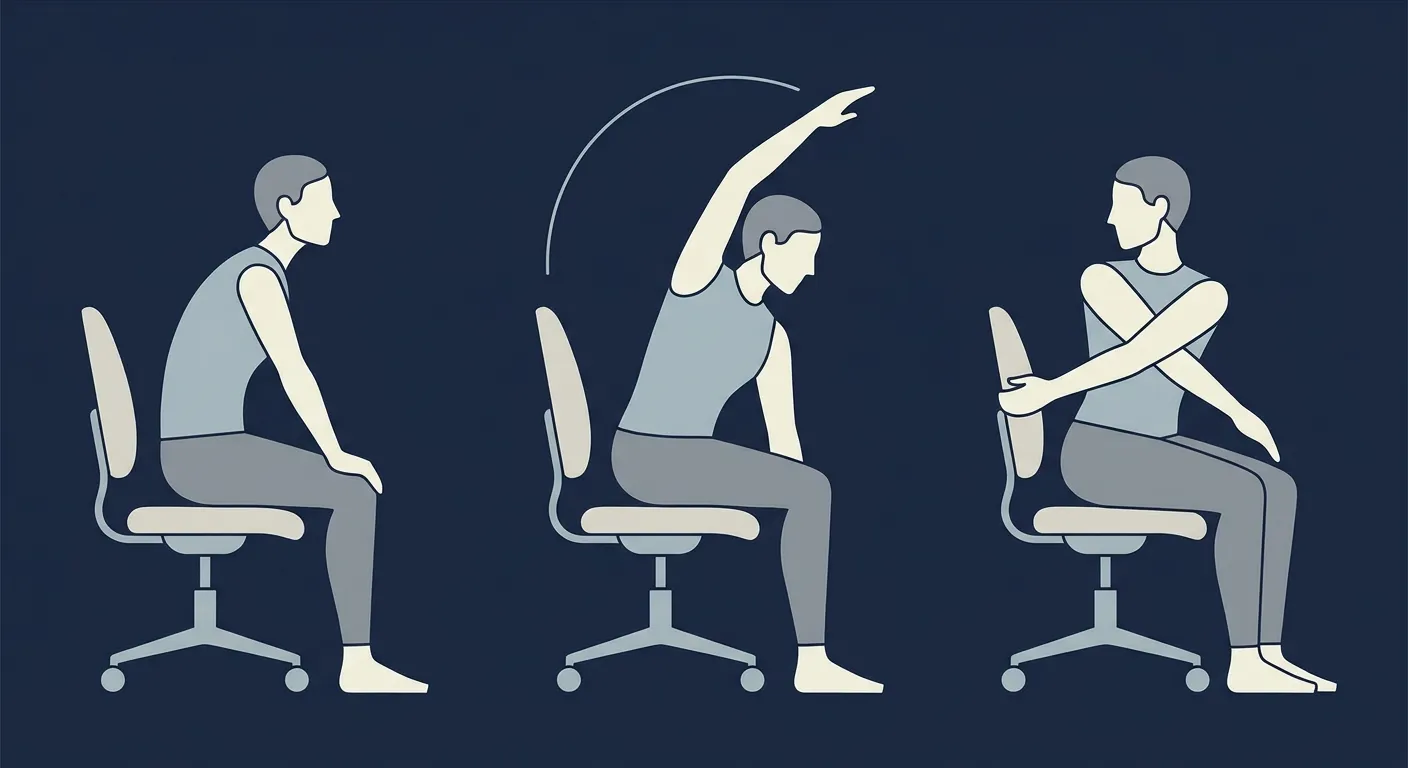
During the cow phase, reach both arms up and back overhead with the chest. During the cat phase, bring the arms forward and round them in front of you, palms together. The added arm sweep increases shoulder mobility on top of the spinal work.
Seated Cat Cow with Thread the Needle (Intermediate)
Between cat-cow cycles, add a thoracic rotation. From the upright seated start, reach your right arm up and over your head, then thread it down and across your body toward your left hip. Alternate sides. This adds rotational mobility to the flexion and extension.
Floor Cat Cow (Progression)
The full version on hands and knees. Adds loaded shoulder and wrist work, deeper spinal range, and the segmental wave is easier to feel from a tabletop position. Progress to this when you have the time and floor space, or use it as part of a longer warm-up.
When to Avoid or Modify Seated Cat Cow
Seated cat cow is one of the safest exercises in any program. It's used in post-surgical rehab protocols, prenatal classes, and geriatric mobility groups. But a few specific conditions still call for modification. Always consult a qualified healthcare provider or physical therapist before starting or returning to any exercise program, especially if any of the following apply.
- Acute disc herniation or active sciatica. Aggressive spinal flexion can compress the anterior portion of the disc and worsen a posterior herniation. While the seated version uses a smaller range than tabletop, the principle still applies. Skip the cat (flexion) phase and work only the cow (extension) and neutral positions, in a small comfortable range. Clear progression with a spine specialist before adding the cat half back in.
- Recent abdominal or spinal surgery. Get clearance from your surgeon before doing any spinal flexion or extension work. Most post-operative protocols start with neutral-spine work like deadbugs and bird-dogs before introducing spinal articulation drills.
- Pain that sharpens during the movement. Mobility work should never feel like it's making things worse. If a specific position sharpens lower-back pain or sends pain down a leg, stop and consult a physical therapist. Pain that improves over the course of a few reps is normal stiffness easing; pain that worsens with each rep is a signal.
- Late-pregnancy (third trimester). Seated cat cow is generally safer than the floor version during pregnancy because there's no weight on the wrists or knees. The caveat: as the belly grows, the cow (extension) phase can feel uncomfortable. Stay in a gentle range and avoid forced extension. Consult your obstetrician or a prenatal-trained PT for individual guidance.
- Hypermobility (Ehlers-Danlos, joint hypermobility spectrum disorder). If your spine already moves more than average, the goal isn't more range but better control. Work the movement in a small, controlled range and add gentle isometric holds at the end of each position rather than pushing depth. A PT with hypermobility experience can program appropriate parameters.
Related Exercises
If seated cat cow is part of your routine, these movements complement or extend the same spinal-health pattern:
- Floor progression: Cat Cow on hands and knees adds loaded shoulder and wrist work plus a deeper spinal range. Do this version when you have the time and floor space; the seated version when you don't.
- Stability counterpart: Bird Dog trains the opposite quality, maintaining a neutral spine while extending opposite arm and leg. The classic pair is mobility first (cat cow) then stability (bird dog).
- Spinal extension specialist: Cobra Pose isolates the extension half of cat cow from a prone position. Useful when you specifically need more thoracic and lumbar extension (most desk workers do).
- Rotational complement: Spinal Twist and Quadruped Thread the Needle add the rotational plane that cat cow's sagittal-only movement misses. Pair all three for a full 3D spinal warm-up.
- Anti-extension core foundation: Deadbugs teach the deep core to resist extension, which is the bracing pattern that keeps a slouching posture from creeping in when you sit back down.
How to Program Seated Cat Cow
Seated cat cow programming is different from resistance training. Mobility work prioritizes hold time, breath quality, and consistency over weeks rather than sets and reps for strength. The American College of Sports Medicine (ACSM) Position Stand on resistance training notes that mobility and flexibility work can be performed daily, with intensity rather than volume as the primary progression lever (Ratamess et al., 2009).
| Level | Reps × Hold | Sets | Frequency |
|---|---|---|---|
| Beginner (gentle range, light tension) | 6–10 × 2-3 sec each position | 1–2 | 5–7 sessions/week (or hourly desk breaks) |
| Intermediate (working into resistance) | 8–12 × 3-4 sec each position | 2–3 | Daily (hourly desk breaks recommended) |
| Advanced (deeper range, active engagement) | 10–15 × 4-5 sec, optional 15-30 sec end-range hold | 2–4 | Multiple times daily; pair with arm-reach or thread-the-needle variations |
Where in your workout: Seated cat cow's best use is as a desk-break, not a workout component. Set a phone or calendar timer for every 60 to 90 minutes during a long sitting day. Eight to ten slow reps takes about 90 seconds, after which you go back to work. The cumulative effect across a workday is meaningful spinal mobility you would not have otherwise done. It also works as a gentle warm-up before seated work (writing, reading, driving) when the floor version isn't practical.
Form floor over rep targets: if you're moving so fast that the segmental wave disappears, slow down even if it means fewer reps. The point isn't to hit 12 reps. The point is to mobilize each vertebra. Six clean reps beat 15 sloppy ones, every time.
How FitCraft Programs This Exercise
Knowing how to do seated cat cow is step one. Knowing when to slot it in (and how often to remind yourself) is where most desk workers fall off.
FitCraft's AI coach Ty handles that. During your personalized diagnostic assessment, Ty maps your fitness level, mobility needs, and daily schedule. Then Ty builds a program that includes seated mobility breaks at the right cadence for your workday.
As your mobility improves, Ty adjusts the variation and frequency to match your needs. The basic version becomes the arm-reach or thread-the-needle variation when you want more challenge. And on days when you have the time and floor space, Ty swaps in the full floor version for deeper work.
Frequently Asked Questions
Can I do seated cat cow with an acute disc herniation or active sciatica?
Be cautious. Aggressive spinal flexion can compress the anterior portion of the disc and worsen a posterior herniation, so the cat (flexion) phase should be modified or skipped while you have an active herniation or sciatica. Stay with the cow (extension) and neutral positions only, in a small comfortable range, and clear any progression with a spine specialist before adding the flexion half back in. Pain that sharpens during the movement is a signal to stop.
How often should I do seated cat cow at my desk?
Every 1 to 2 hours during a long sitting day. Set a phone or calendar timer. Eight to ten slow reps takes about 90 seconds and meaningfully reduces accumulated spinal stiffness from prolonged sitting. The cumulative effect across a workday is larger than a single longer mobility session.
Does seated cat cow really do anything compared to the floor version?
Yes, with a small caveat. Seated cat cow gets you most of the spinal flexion and extension benefit of the floor version, especially when you move slowly and let each vertebra participate. What it misses is the shoulder and wrist loading from the tabletop position. If those aren't a priority, the seated version is functionally similar. If you can do the floor version, do it. If you can only do the seated version, that is still meaningful spinal mobility work.
Can I do seated cat cow if I have lower back pain?
Seated cat cow is one of the gentlest ways to introduce spinal motion when your back is stiff or sore. Stay in a small comfortable range and avoid forcing depth on either end. If a specific position sharpens pain, stop and consult a physical therapist. Pain that worsens during the movement is a signal.
What is the difference between seated cat cow and the floor version?
Seated cat cow is done at the edge of a chair with hands on knees. The floor version is done in tabletop on hands and knees. Same spinal movement, same breath pattern. The floor version adds loaded shoulder and wrist work plus a deeper range; the seated version is more accessible and works as an hourly desk break with no setup.