Quadruped thread-the-needle is the go-to thoracic mobility drill for anyone who hasn't yet built the hip-hinge stability for the standing version. You set up on all fours, thread one arm under your torso, and let your upper back rotate while the floor supports the rest of your body. No balance demand. No hamstring tightness in the way. Just the upper back, doing exactly what it's supposed to do.
It comes from physical therapy and yoga in roughly equal measure, which is part of why it works for almost everyone. PTs use it to restore thoracic rotation after a stiff or painful episode. Yoga instructors cue it as a counter-pose to backbends and as a transition into deeper twists. Strength coaches put it in warm-ups before pressing or pulling days, because thoracic mobility directly affects shoulder function and a few breaths in this position primes the joints far better than a few arm circles.
Below is the form breakdown, the most common mistakes, two regressions and two progressions, and the FitCraft framing for when and how to program it.
Quick Facts: Quadruped Thread-the-Needle
- Equipment needed: None (yoga mat helpful for shoulder/head contact)
- Difficulty: Beginner
- Modality: Bodyweight dynamic mobility / thoracic rotation
- Body region: Upper back, posterior shoulder, obliques
- FitCraft quest category: Mobility, Warm-Up, Desk-Worker Recovery
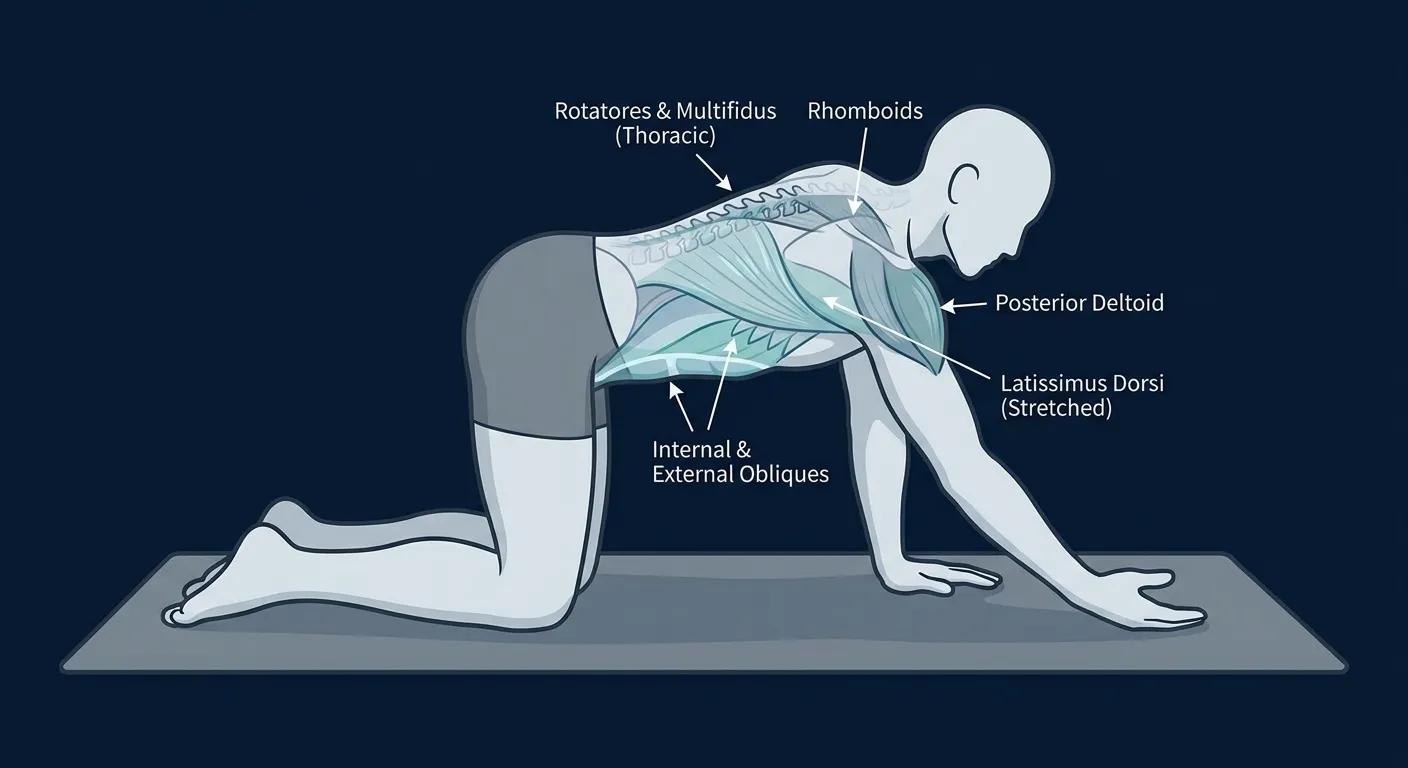
Areas Stretched and Mobilized
Primary mobilizers. Quadruped thread-the-needle is a thoracic spine rotation drill. The deep rotators of the spine (the rotatores and multifidus between adjacent vertebrae) and the internal and external obliques drive the rotation. The closing phase (arm threading horizontally under the torso) loads the obliques on the threading side; the optional open-book finish loads the opposite side. Both phases articulate the thoracic vertebrae through transverse-plane motion that desk-bound spines rarely see.
Secondary movers. The posterior deltoid and rhomboid on the threading side lengthen as the shoulder lowers toward the mat. The latissimus dorsi on the threading side gets a passive stretch when the arm reaches across. On the supporting side, the serratus anterior fires to keep the shoulder blade from collapsing into the body, and the triceps work isometrically to keep the elbow extended without locking out.
Stabilizers. The hips, glutes, and quadriceps work isometrically to hold the tabletop position level. The core (rectus abdominis and transverse abdominis) braces lightly to prevent the lumbar spine from collapsing or rotating along with the thoracic. Stability matters more here than in the standing version because the same-side hip wants to drop as the shoulder threads through.
Mechanism. Thoracic rotation depends on the orientation of the facet joints in the upper back. Each thoracic vertebra is structured to allow several degrees of rotation, summing to roughly 30-35 degrees of total transverse-plane range from T1 to T12 in a healthy adult. When that range shrinks (commonly from prolonged sitting), the lumbar spine and shoulders compensate, which is one mechanism behind chronic lower back stiffness and shoulder impingement. Quadruped thread-the-needle isolates this range while removing the balance, hamstring, and hip-hinge demands of the standing bent-over reach-through, making it the most accessible thoracic rotation drill on the spectrum.
Step-by-Step: How to Perform Quadruped Thread-the-Needle
Set up slowly. The position of the supporting hand and the height of the hips set up the rotation; get those right and the rest takes care of itself.
Step 1: Set up tabletop position
Begin on all fours with your wrists directly under your shoulders and your knees directly under your hips. Your back is flat and neutral, eyes looking down at the floor between your hands. Spread your fingers wide and press evenly through the whole palm.
Coach Ty's cue: "Stack the joints. Wrists under shoulders, knees under hips. If you're off-stack, you're loading the wrong tissues before you even start."
Step 2: Thread the arm under and across
Exhale and slide your right arm horizontally under your left arm, palm facing up, reaching as far across as you comfortably can. Let your right shoulder and the right side of your head lower toward or rest on the mat. The left arm stays planted to support the body.
Ty's cue: "Palm faces up as you thread. That external rotation of the shoulder is what makes the stretch find the right tissue."
Step 3: Hold and breathe
Hold the position for 20-30 seconds. Breathe slowly through your nose. On each exhale, allow your right shoulder to settle a little deeper into the mat without forcing it. The rotation should be felt through the mid-back and the back of the right shoulder.
Ty's key cue: "Hips stay level. If you feel your right hip dropping or your left hip lifting, you're rotating from the wrong place."
Step 4: Reverse and open up (optional open-book)
On an inhale, lift the right arm and rotate it up toward the ceiling, letting your eyes follow the hand. Open your chest as far as your mobility allows. This optional open-book finish drives the thoracic spine through its full rotational range in both directions.
As Ty coaches it: "Follow your hand with your eyes. The eye-tracking adds the cervical rotation that pulls a few extra degrees out of the thoracic."
Step 5: Return and switch sides
Return your right hand to the mat and reset in tabletop. Repeat the entire sequence on the left side. Complete 3-5 holds per side, alternating, before transitioning to your next warm-up drill or training block.
Ty's reminder: "Symmetry matters. If one side feels noticeably tighter, give it an extra hold rather than skipping."
Get this exercise in a personalized workout
FitCraft, our mobile fitness app, uses its AI coach Ty to program mobility work like this into your plan at the right volume and intensity, based on your level, goals, and equipment. Ty was designed and trained by Domenic Angelino, MPH (Brown University) and NSCA-CSCS, with research published in the Journal of Strength and Conditioning Research and Medicine & Science in Sports & Exercise.
Take the Free Assessment Free · 2 minutes · No credit card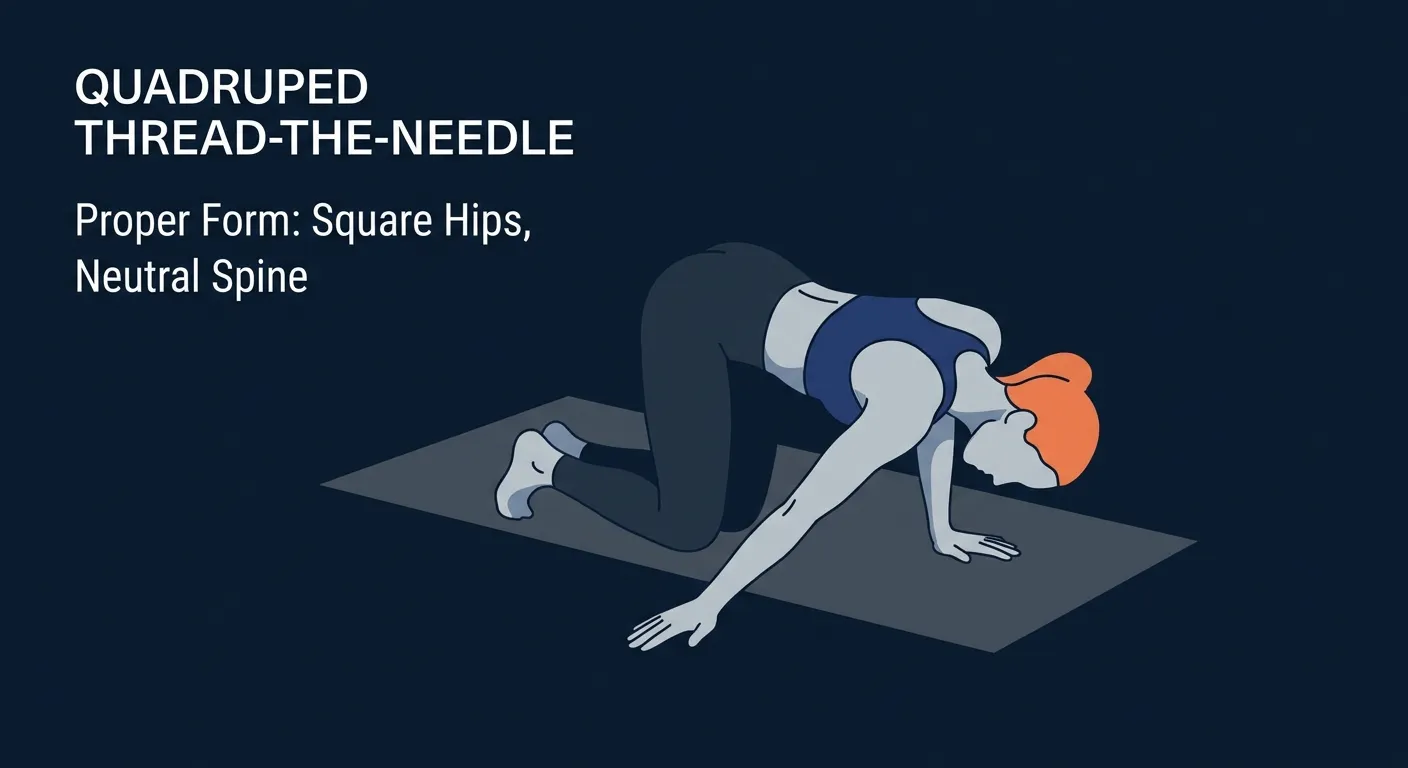
Common Mistakes (and How to Fix Them)
Here are the mistakes Ty corrects most often.
- Hips collapsing to the threading side. When you thread the arm under, the same-side hip tends to drop and the opposite hip lifts. That shifts the rotation into the lumbar spine and away from the thoracic. Fix: imagine balancing a glass of water on your sacrum. If the glass tips, the hip is dropping. Drive evenly through both knees and keep the hips parallel to the floor.
- Forcing the depth on the first breath. The body needs a few breaths to release into the position. If you jam the shoulder into the mat on rep one, the tissues guard against the stretch and you get less range, not more. Fix: settle into the position at about 70% of your end range, then let the next 3-4 exhales deepen it on their own.
- Loading the supporting wrist. If your weight crashes onto the heel of the supporting hand, the wrist takes the load and the shoulder disengages from the rotation. Fix: press evenly through the whole palm of the supporting hand, fingers spread, knuckles down. Think of pulling the floor toward you rather than pressing it away.
- Rotating from the neck instead of the thoracic spine. If your head is craning to look at the threading hand, you're using neck rotation as a substitute for upper-back rotation. Fix: keep the gaze gentle and down. The eyes don't lead this stretch. The mid-back does.
- Holding the breath. Bracing without breathing reduces the available rotation range. Fix: slow nasal breathing throughout, with the exhale doing the depth work. If you can't breathe smoothly in the position, you're too deep.
- Skipping the open-book finish. Many people thread-the-needle and stop there. The optional open-up phase (Step 4) trains the thoracic spine through the opposite rotation, which prevents one-direction-only mobility gains. Fix: alternate between hold-only sets and full open-book sets across the week.
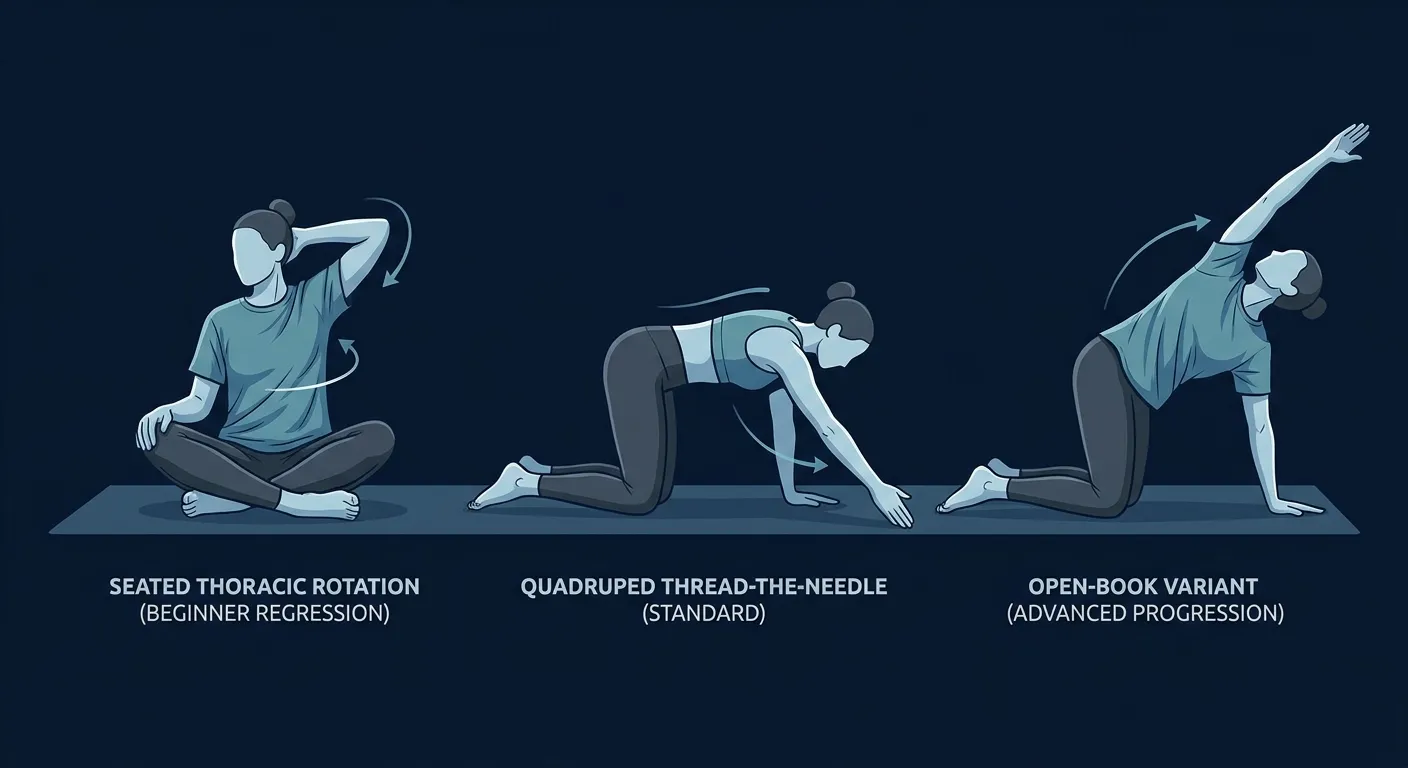
Quadruped Thread-the-Needle Variations: Regressions and Progressions
Start where you are and progress when your form is solid at the current level.
Seated Thoracic Rotation (Easier Regression)
Sit cross-legged on the floor with one hand behind your head. Rotate the elbow across the body, then back up toward the ceiling. Easier than the quadruped version because there is no shoulder or wrist loading. Useful for anyone with acute shoulder pain who still needs thoracic mobility work.
Quadruped Thread-the-Needle with Open-Book (Standard)
The full version described above, including the optional Step 4 open-up phase. Hold and breathe on the closing rotation, then drive the elbow up toward the ceiling and follow with your eyes for the open-book finish. Trains rotation in both directions from a single setup.
Side-Lying Open Book (Intermediate Progression)
Lie on your side with knees stacked and bent at 90 degrees. Stretch both arms forward at shoulder height, palms touching. Slowly open the top arm across the body toward the floor behind you, letting your gaze and chest follow. The top knee stays pressed down to lock the pelvis in place. A more elegant way to bias pure thoracic rotation without any wrist or shoulder loading.
Bent-Over Reach-Through (Standing Progression)
The same rotational pattern from a standing hip-hinge position. Adds an isometric posterior-chain load (glutes, hamstrings, erector spinae) on top of the thoracic mobility work. Graduate to this once your hip hinge is stable and you can hold the bent-over position comfortably for a full set.
When to Avoid or Modify Quadruped Thread-the-Needle
Quadruped thread-the-needle is one of the safer mobility drills available, but a few conditions warrant modification. None of these are permanent restrictions. They're starting points. Always consult your physician or physical therapist for personalized guidance.
- Wrist pain or carpal tunnel. The supporting wrist takes some load in tabletop. Try forearm-down quadruped (supporting forearm flat on the mat, opposite hand still planted), use push-up handles for a neutral wrist, or substitute the seated thoracic rotation regression entirely. High-incline alternatives also work if you can prop the supporting hand on a low bench or step.
- Acute shoulder injury or recent shoulder surgery. The threading side moves through external rotation and adduction, both of which can aggravate rotator cuff irritation or post-surgical tissue. Get clearance from your surgeon or PT. Use seated rotations or supine thoracic rotations until cleared.
- Knee pain in the quadruped position. Knees-down kneeling can aggravate patellar tendinopathy, meniscus issues, or post-surgical knees. Double up the mat under the knees, kneel on a folded towel, or move to the seated regression.
- Hypermobility or connective tissue disorders (e.g., Ehlers-Danlos). Avoid pushing into end-range rotation. Stay in the controlled middle range and emphasize active engagement of the rotators rather than passive stretch. Consult a PT with hypermobility expertise.
- Second or third trimester pregnancy. Relaxin loosens the SI joint and pelvic ligaments. Stay shallow on the rotation, avoid the open-book finish if the chest opening feels strained, and use seated rotations as a substitute if the quadruped position becomes uncomfortable around the belly.
- Acute neck pain or recent cervical injury. Keep the gaze fixed down and let only the thoracic spine rotate. Skip the eye-following cue and the open-book finish until the neck settles.
Related Exercises
If quadruped thread-the-needle is part of your warm-up routine, these movements complement or extend the same training pattern:
- Standing progression of the same pattern: Bent-Over Reach-Through trains the same thoracic rotation from a standing hip-hinge position. Graduate to this once the quadruped version feels easy and your hip hinge is stable.
- Same area, different mobility direction: Cat-Cow mobilizes the spine in the sagittal plane (flexion and extension). Pair the two for full three-dimensional spinal warm-up.
- Static rotation alternative: Spinal Twist (supine or seated) is a static rotation hold that complements the dynamic thread-the-needle. Use it post-workout for sustained tension.
- Upright rotation alternative: Standing Twists train rotation from a fully upright position. Less specific to thoracic rotation since the lumbar contributes more freely, but useful as a movement break during long sitting bouts.
- Hip flexor + thoracic combo: Half-Kneeling Triplanar Stretch combines hip flexor opening with thoracic rotation in a half-kneeling stance. Useful for desk workers who need both at once.
- Movement this prepares for: Push-ups, shoulder press, and any pulling pattern benefit from primed thoracic rotation. Use thread-the-needle before upper-body sessions to unlock more shoulder range.
How to Program Quadruped Thread-the-Needle
Mobility work follows different programming logic than resistance training. The American College of Sports Medicine (ACSM) Position Stand on resistance training (Ratamess et al., 2009) treats flexibility and mobility as complementary to strength work, with daily frequency tolerated when load is low. For active mobility drills like thread-the-needle, hold time, breath count, and consistency matter more than intensity.
| Level | Hold per side | Sets per side | Frequency |
|---|---|---|---|
| Beginner (gentle range, no open-book finish) | 15-30 seconds | 1-2 | 5-7 sessions/week |
| Intermediate (full range, open-book finish included) | 30-60 seconds | 2-3 | 5-7 sessions/week |
| Advanced (deep range, active engagement, 5-10 controlled reps) | 30-90 seconds (or active 5-10 reps per side) | 2-4 | Daily |
Where in your workout: Quadruped thread-the-needle belongs at the start, during your dynamic warm-up. Thoracic mobility directly affects shoulder function, so do it before any upper-body pressing, pulling, or overhead work. A 2022 randomized controlled trial found that thoracic spine mobility exercises reduced neck pain and improved cervical range of motion in office workers (Lee et al., 2022). It also works as a movement break between long sitting bouts or as a transition into deeper rotational yoga poses.
Form floor over rep targets: if your hips drop, your supporting wrist crashes, or your breath gets shallow, stop the hold and reset. Hitting a 60-second target with collapsed hips trains the wrong pattern. Three quality 20-second holds beat one sloppy 60-second hold.
How FitCraft Programs This Exercise
Knowing how to do quadruped thread-the-needle is step one. Knowing when to do it, how long to hold each side, and when to graduate to the standing version is where most people get stuck.
FitCraft's AI coach Ty handles that. During your personalized diagnostic assessment, Ty maps your fitness level, mobility goals, and any flagged restrictions (desk-bound posture, shoulder restriction, history of back pain). Then Ty slots thread-the-needle into your warm-up flows on the days when it matters most: upper-body training days, full-body sessions, and dedicated mobility blocks.
As your thoracic mobility improves, Ty adjusts the variation and progression to match your level. Quadruped becomes side-lying open book. Side-lying becomes the standing bent-over reach-through. Every program is designed by an Ivy League-trained exercise scientist and NSCA-certified strength coach using evidence-based mobility programming, then adapted to you by the AI.
Frequently Asked Questions
Can I do quadruped thread-the-needle with wrist pain?
The supporting wrist takes some load in the tabletop position, which can aggravate carpal tunnel, wrist strain, or arthritic wrists. Modifications: try forearm-down quadruped (place the supporting forearm flat on the mat, with the opposite hand still planted), use push-up handles for a neutral wrist, or skip the quadruped version entirely and substitute the seated thoracic rotation regression. If pain persists in any modified position, see a physical therapist or occupational therapist.
What does quadruped thread-the-needle stretch?
The quadruped thread-the-needle stretches and mobilizes the thoracic spine (upper back) through rotation, along with the rear deltoid and rhomboid of the threading side. The lats get a passive stretch and the obliques engage to drive the rotation. The hips, glutes, and core work isometrically to keep the tabletop position stable.
How long should I hold quadruped thread-the-needle?
Hold each side for 20-30 seconds, breathing slowly. For dedicated mobility sessions, 30-60 seconds per side. The hold time matters more than the depth. Force depth and you tense up; relax and breathe and the mid-back will settle deeper on its own over a few breaths.
Is quadruped thread-the-needle the same as the bent-over reach-through?
They train the same rotational pattern but from different positions. Thread-the-needle is performed on all fours, removing the hip-hinge demand and balance challenge. The bent-over reach-through is the standing version, which combines the rotation with an isometric hip-hinge hold. Thread-the-needle is the regression most people start with before progressing to the standing version.
Should I do thread-the-needle before or after my workout?
Before, during your dynamic warm-up. Thoracic mobility directly affects shoulder function, so doing it before upper-body pressing, pulling, or overhead work primes the joints. It also works as a movement break during long sitting bouts. Static post-workout holds are fine too, just keep the rest of the warm-up dynamic.