The spinal twist is one of the simplest ways to restore rotation after long hours of sitting, lifting, running, or training in straight lines. You lie on your back, let your knees fall to one side, and keep your shoulders heavy on the floor.
The move only works when it stays gentle. If you yank your knees down or chase the floor, the stretch can shift into the low back instead of spreading through the ribcage, side body, and upper spine. Smaller range usually works better.
Think of it as a breathing drill with rotation built in. Set the position, support the knees if needed, and let each exhale make the twist feel less guarded.
Quick Facts: Spinal Twist
- Equipment needed: None (yoga mat, pillow, or bolster optional)
- Difficulty: Beginner to Intermediate
- Modality: Mobility / Static stretch
- Body region: Spine, side body, hips, and chest
- FitCraft quest category: Mobility
Areas Stretched & Mobilized
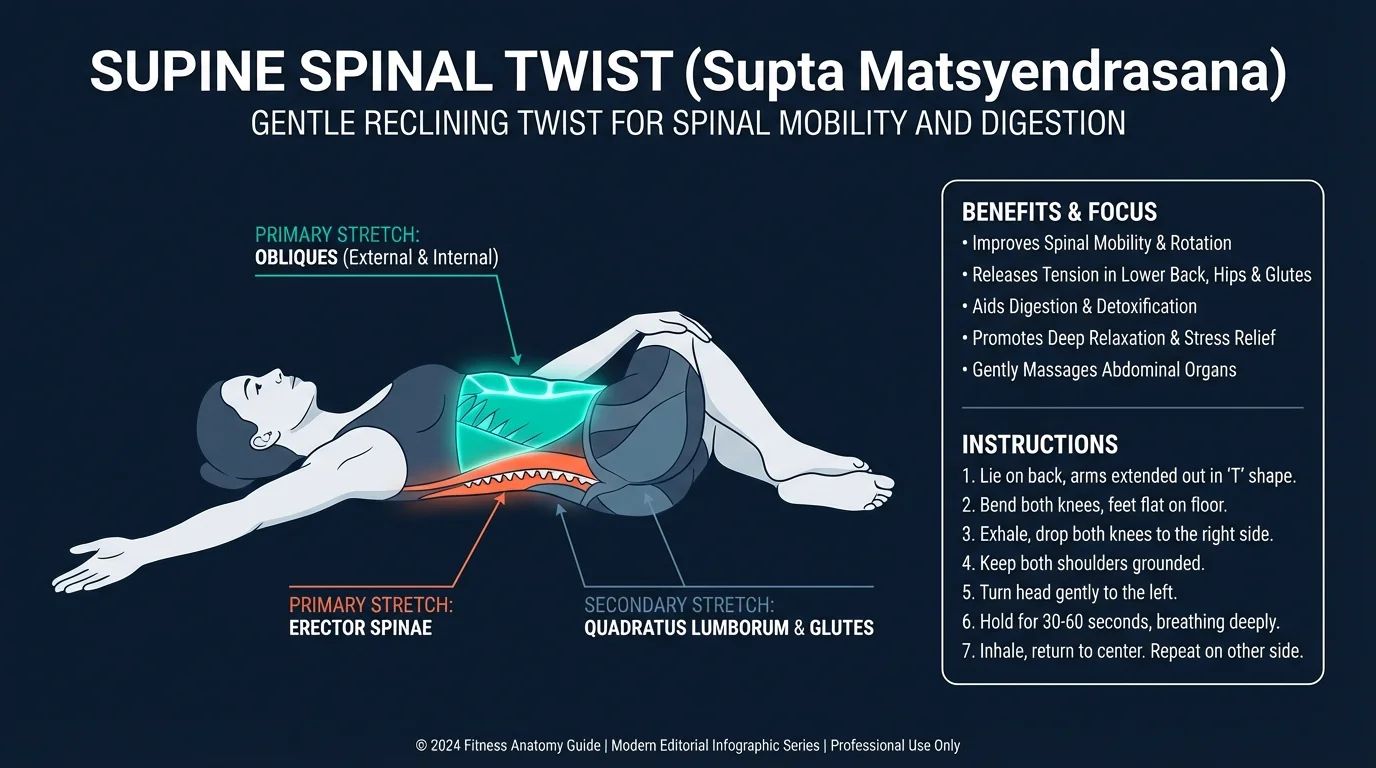
Primary tissues stretched: the obliques, quadratus lumborum, erector spinae, and outer glute muscles. As the knees move to one side, these tissues lengthen through the side body, low back, and hip on the opposite side of the twist.
Secondary areas: the chest, anterior shoulder, intercostal muscles between the ribs, and lats may also open as the arms stay in a T-shape. The stretch often feels strongest along the ribs because the shoulder stays anchored while the pelvis rotates.
Stabilizers: spinal twists are mostly passive, so they don't demand much active stabilization. The deep core and hip muscles do light isometric work when you lower the knees with control instead of dropping them quickly.
Why the setup matters: the supine position supports the pelvis and lets you adjust the stretch with knee height. More knee drop increases rotation; more support under the knees lowers the intensity. For mobility work, smooth breathing and relaxed tissue tension matter more than reaching the deepest possible position.
How to Do a Supine Spinal Twist (Step-by-Step)
- Start on your back with knees bent. Lie flat on a mat with your knees bent and feet flat, hip-width apart. Extend your arms out to the sides at shoulder height like a T, palms facing the ceiling. Let your ribs and pelvis feel heavy before you move.
- Draw your knees up to 90 degrees. Lift both feet and pull your knees toward your chest until your thighs are roughly perpendicular to your torso. Stack your knees and ankles together so your legs move as one unit. Coach Ty's cue: "Keep the knees glued together before you rotate."
- Lower your knees to the right. Exhale and let both knees drop toward the right side. Move slowly. Your left shoulder blade should stay grounded, even if that means your knees hover well above the floor. Coach Ty's cue: "Shoulders stay heavy. The floor doesn't matter."
- Turn your head only if it feels good. Gently look toward your left hand if your neck stays relaxed. If your neck feels tight, keep your gaze straight up. The trunk rotation is the priority.
- Hold, breathe, and switch sides. Stay in the twist for 5 to 10 slow breaths. Inhale to bring your knees back to center, then repeat on the left side. Match the time and range on both sides.
Get this exercise in a personalized workout
FitCraft, our mobile fitness app, uses its AI coach Ty to program mobility work like this into your plan at the right volume and intensity, based on your level, goals, and equipment. Ty was designed and trained by Domenic Angelino, MPH (Brown University) and NSCA-CSCS, with research published in the Journal of Strength and Conditioning Research and Medicine & Science in Sports & Exercise.
Take the Free Assessment Free · 2 minutes · No credit card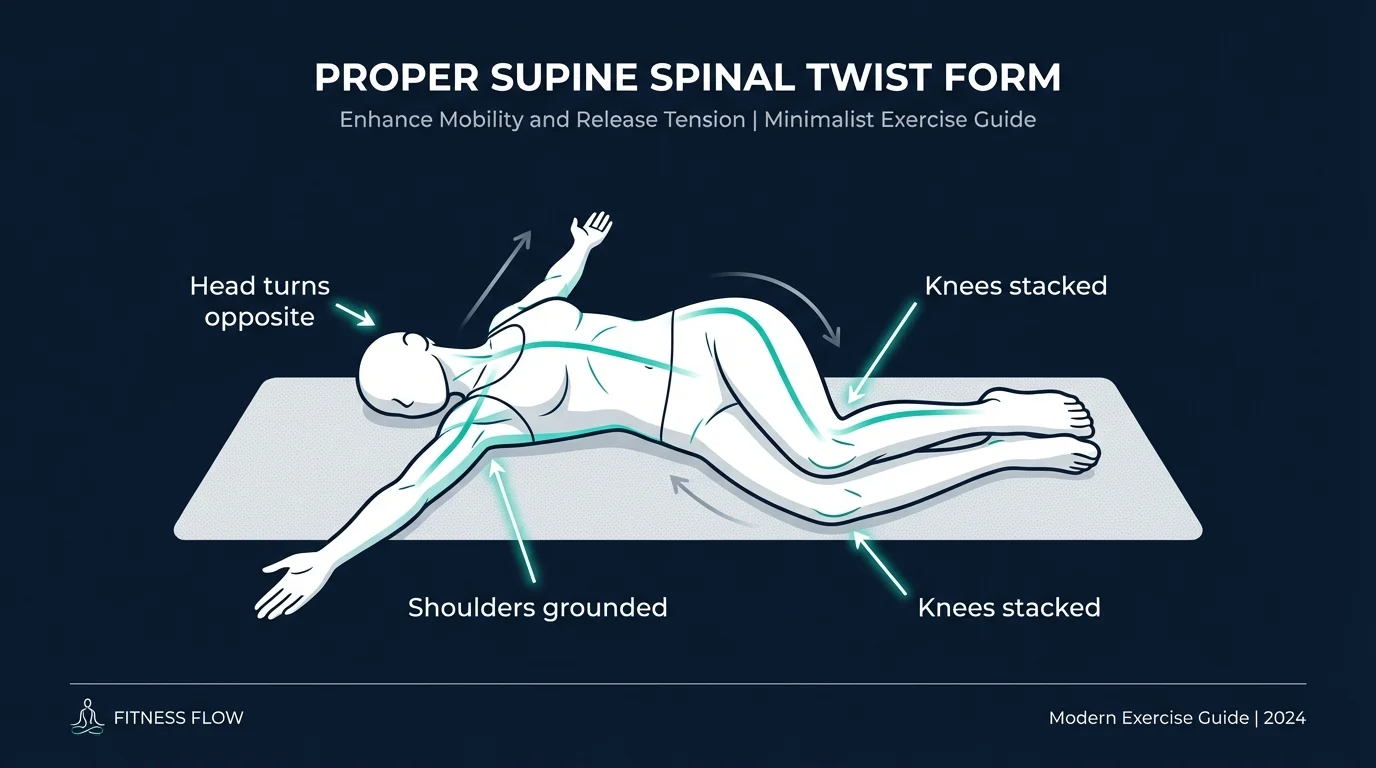
Common Mistakes to Avoid
- Chasing knees-to-floor depth. Treat the floor as optional. If your opposite shoulder lifts, support your knees with a pillow or keep them higher.
- Forcing the twist with your abs or hands. This should feel like a relaxed stretch. Let the legs get heavy and use your breath to settle into the position.
- Holding your breath. Twists compress part of the ribcage, so shallow breathing is common. Slow nasal breathing helps the side body release.
- Turning the head aggressively. The head turn is optional. If it bothers your neck, look up and keep the stretch in the trunk.
- Ignoring nerve symptoms. Pinching, tingling, numbness, or pain that travels down the leg means the position is too much. Come out and choose a smaller range.
Spinal Twist Variations: Regressions and Progressions
Supported Spinal Twist
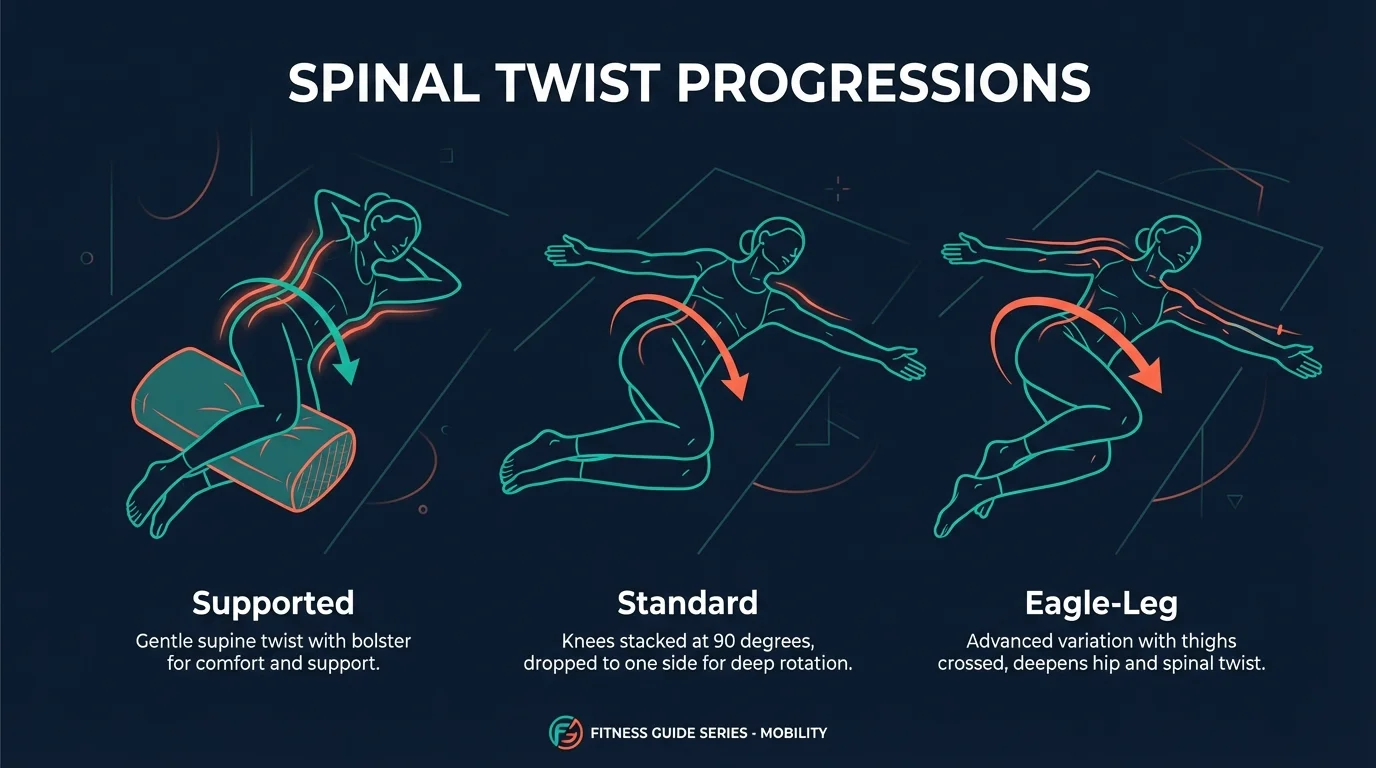
Place a pillow, bolster, or folded blanket under your knees on the twisting side. This lowers the stretch intensity and helps both shoulders stay grounded.
Single-Leg Spinal Twist
Keep one foot on the floor and cross only the opposite knee over your body. This reduces rotational load and works well for sensitive low backs.
Standard Stacked-Knee Spinal Twist
Lift both knees to roughly 90 degrees, keep them together, and lower them as one unit. This is the main version for most daily mobility sessions.
Eagle-Leg Spinal Twist
Cross one thigh over the other before lowering the knees. This deepens the outer-hip and side-body stretch, so only use it after the standard version feels easy.
Straight-Leg Spinal Twist
Extend the top leg as it crosses the body. This adds a stronger hamstring and glute stretch on top of the rotation and should stay pain-free.
When to Avoid or Modify Spinal Twist
Spinal twists are safe for most healthy adults when they stay gentle, but a few situations call for a smaller range or a different drill. Always consult your physician or physical therapist if you're returning after injury, surgery, pregnancy, or nerve symptoms.
- Disc irritation, active sciatica, or radiating symptoms. Avoid deep rotation while symptoms are active. Use cat-cow or bird-dogs if unloaded neutral-spine movement feels better.
- Recent spine, hip, or abdominal surgery. Wait for medical clearance before adding twisting. Rotation can stress healing tissue before it's ready.
- Pregnancy, especially the second and third trimesters. Use a very small range and avoid aggressive end-range twisting near the pelvis and SI joint.
- Hypermobility or connective tissue disorders. Avoid hanging passively at end range. Keep the twist active, short, and supported.
- Sharp low-back or hip pinching. Support your knees, reduce depth, or switch to seated cat-cow until the position feels smooth.
Related Exercises
- Cat-cow: active spinal flexion and extension that pairs well with spinal rotation.
- Quadruped thread-the-needle: a kneeling thoracic rotation drill with more shoulder involvement.
- Standing twists: upright rotation practice with less floor setup.
- Seated side bend: side-body mobility that complements the rib opening in a spinal twist.
- Deadbugs: neutral-spine core control for people who need stability before deeper rotation.
How to Program Spinal Twist
The ACSM resistance-training position stand from Ratamess et al., 2009 supports progressive exercise prescription based on training level, recovery, and tolerance. Mobility work uses the same logic with a different target: hold time, breathing quality, and consistent range matter more than load.
| Level | Hold time | Sets | Frequency |
|---|---|---|---|
| Beginner | 15-30 seconds per side | 1-2 | 5-7 sessions/week |
| Intermediate | 30-60 seconds per side | 2-3 | 5-7 sessions/week |
| Advanced | 30-90 seconds per side | 2-4 | Daily |
Where it fits: use spinal twists after training, during a cooldown, before bed, or as a short mobility break after long sitting. If you use them before a workout, keep the holds short and pair them with active mobility like cat-cow.
Form floor over hold time: end the hold early if your shoulder lifts, your breath gets tight, or the stretch turns into nerve symptoms. A supported 20-second twist beats a forced 90-second hold.
Frequently Asked Questions
What areas does a supine spinal twist stretch?
A supine spinal twist stretches the obliques, quadratus lumborum, erector spinae, glutes, chest, and intercostal muscles while mobilizing thoracic rotation. The stretch should feel broad through the side body and upper back, not sharp in the low back.
Can I do spinal twists with disc pain or sciatica?
Avoid deep spinal twists during active sciatica, disc irritation, recent spine surgery, or symptoms that travel down the leg. Use a smaller range, support your knees, and get clearance from a physical therapist or spine clinician before adding rotation back in.
How long should I hold a spinal twist?
Hold a supine spinal twist for 30 to 90 seconds per side, or roughly 5 to 10 slow breaths. Beginners can start with 15 to 30 seconds per side and support the knees so the position stays relaxed.
Why does my shoulder lift off the floor in a spinal twist?
Your shoulder lifts when the twist is too deep for your current trunk, hip, or chest mobility. Reduce the range by placing a pillow or yoga block under your knees. Keeping both shoulders grounded matters more than getting your knees to the floor.
Can I do a spinal twist every day?
Yes, most healthy adults can practice gentle spinal twists daily. Keep the effort low, breathe slowly, and stop if you feel pinching, radiating pain, numbness, or symptoms that worsen after the stretch.