
Stiffness sneaks up on you. You notice it when you get down on the floor to play with a kid and need a hand on the couch to get back up, or when the top shelf feels a little further away than it used to.
So you search for a mobility routine and find a 45-minute video of thirty stretches in no particular order. You do it twice. Then a busy week comes along, and the stiffness carries on as if you'd never started.
The routines that work are short enough to repeat. Ten exercises, about ten minutes, done most days, will do more for your body mobility than an hour once a week. This page is the full-body list. Each exercise links to a deeper guide for that joint when you want more.
What Mobility Exercises Train
Mobility is the range of motion you can reach and control with your own muscles. Flexibility is part of it, but a joint can be flexible when someone pushes it and still lack control at the end of that range. Mobility exercises close that gap by moving slowly into the end position and making you hold or return from it under control.
That's why most of the moves below are active. You'll hold some positions, but most of the work is moving in and out of them. Our hip mobility exercises guide explains the difference between mobility, flexibility and stability in more detail.
The 10 Best Mobility Exercises, From the Ankles Up
The list runs from the ground up, so it also works as a checklist for which joint feels stiffest. The last column points to the guide that covers each area in depth.
| Exercise | Main area | Dose | Go deeper |
|---|---|---|---|
| 1. Ankle rocks | Ankles, calves | 10 per side | Ankle mobility |
| 2. Deep squat hold | Ankles, knees, hips | 30 to 60 seconds | Squat to reach |
| 3. 90/90 hip switches | Hip rotation | 8 to 10 switches | Hip mobility |
| 4. Half-kneeling triplanar stretch | Hip flexors, side body | 20 seconds per direction, each side | Triplanar stretch |
| 5. Walk-outs | Hamstrings, shoulders, core | 5 to 6 reps | Walk out |
| 6. Cat-cow | Whole spine | 8 to 10 breaths | Cat-cow |
| 7. Thread the needle | Upper back rotation | 6 to 8 per side | Thread the needle |
| 8. Wall slides | Shoulders, upper back | 8 to 10 reps | Shoulder mobility |
| 9. World's greatest stretch | Ankles, hips, upper back | 5 per side | World's greatest stretch |
| 10. Chin tucks | Neck | 10 reps, 5-second holds | Posture |
1. Ankle rocks
Kneel on one knee with the front foot about a hand's width from a wall. Push the front knee forward toward the wall while the whole heel stays on the floor, then ease back. Do 10 slow reps per side. Ankle range decides how deep you can squat with your heels down, so it goes first. The ankle guide has a simple test to measure yours.
2. Deep squat hold
Stand with your feet a little wider than your hips, toes turned slightly out, and sit down as low as you can with your heels flat. Use your elbows to ease your knees out and keep your chest up. Hold for 30 to 60 seconds, standing up to rest when you need to. If your heels lift, put a folded towel under them for now. Standing up and reaching one arm overhead turns it into the squat to reach.
3. 90/90 hip switches
Sit on the floor with both knees bent to 90 degrees, one leg in front of you and one out to the side. With your hands behind you for support, lift both knees and rotate them to the other side so the legs swap roles. Do 8 to 10 slow switches. It trains the hip to turn inward and outward, two rotations that sitting and walking rarely ask for.
4. Half-kneeling triplanar stretch
Kneel on one knee, tuck your pelvis under and shift forward until the front of the back hip stretches. Then reach the same-side arm overhead and lean away from it. Finally, turn your chest toward the front leg. Spend about 20 seconds in each direction on each side. The half kneeling triplanar stretch works the hip flexors, the side of the trunk and the lats in one position.
5. Walk-outs
Stand tall, hinge forward with soft knees until your hands reach the floor, then walk your hands out to a high plank and back again. Stand up slowly. Do 5 to 6 reps. The hinge lengthens the hamstrings, and the plank asks your shoulders and core to hold the far position. The walk out page shows the form.
6. Cat-cow
On all fours, breathe out as you round your back toward the ceiling and tuck your chin. Then breathe in as you let your belly drop and lift your chest. Move slowly for 8 to 10 breaths. Cat-cow is the simplest way to move every part of your spine in both directions.
7. Thread the needle
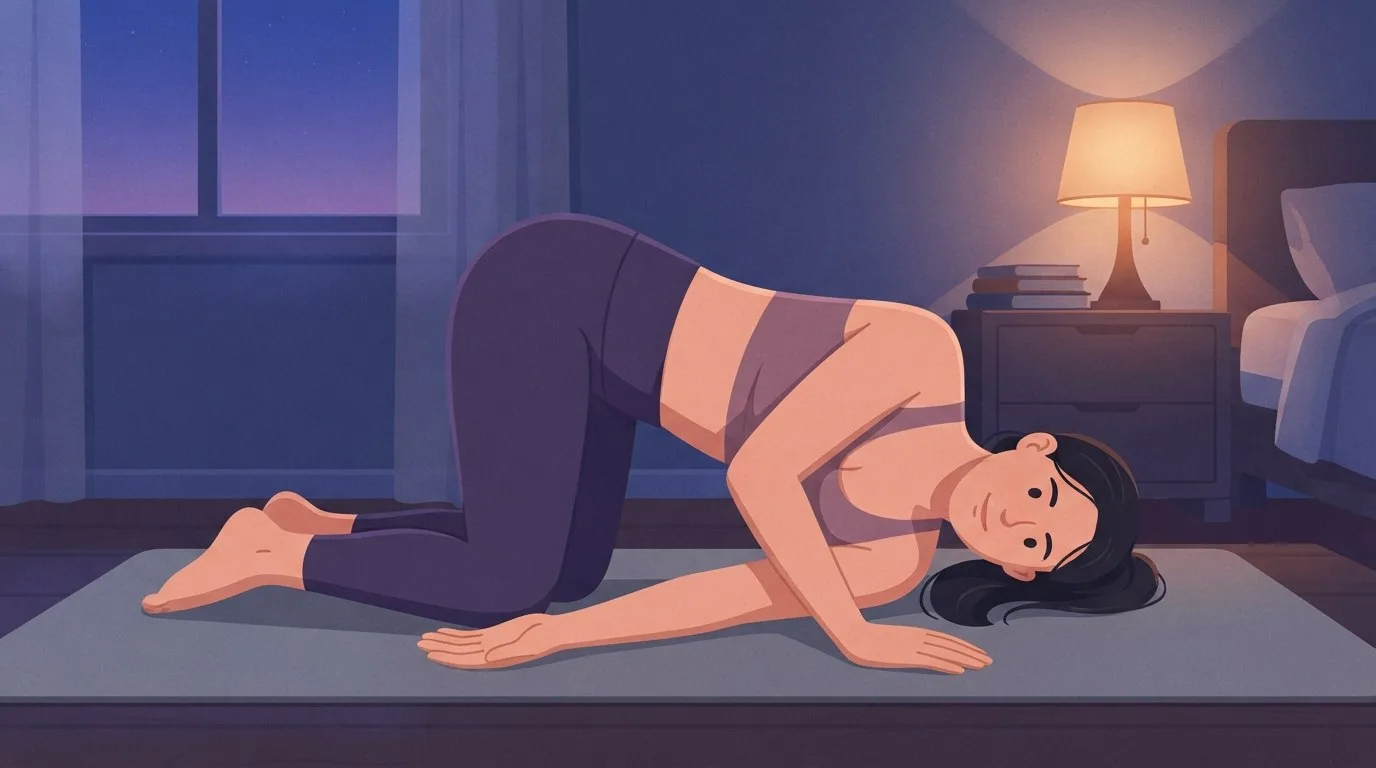
From all fours, slide one arm under your body along the floor, palm up, until your shoulder and the side of your head rest on the mat. Pause, then sweep the same arm up toward the ceiling and follow it with your eyes. Do 6 to 8 per side. The rotation in thread the needle comes from the upper back, the part of your spine designed to twist.
8. Wall slides
Stand with your back, head and arms against a wall, elbows bent at 90 degrees like a goalpost. Slide your arms up as far as they'll go without your lower back arching or your wrists leaving the wall, then slide them down. Do 8 to 10 slow reps. Most people find their overhead range is shorter than they thought, and the shoulder guide explains which part of the chain is usually responsible.
9. World's greatest stretch
Step your right foot forward into a long lunge and put your left hand on the floor. Drop your right elbow toward the inside of your right foot, then turn and reach your right arm to the ceiling. Do 5 per side. It moves the ankle, both hips, the hamstrings and the upper back in one sequence. Our world's greatest stretch guide shows how to do it without straining your lower back.
10. Chin tucks
Sit or stand tall and draw your head straight back over your shoulders, as if making a double chin, with your eyes level. Hold for 5 seconds and relax. Do 10 reps. It trains the deep neck muscles that hold your head up after a day at a screen.
A 10-Minute Full Body Mobility Routine
This daily mobility routine strings the ten exercises together in an order that flows: floor first, then kneeling, then standing. It takes about ten minutes and needs a mat and a wall.
| Order | Exercise | Dose | Time |
|---|---|---|---|
| 1 | Cat-cow | 8 slow breaths | 1 minute |
| 2 | Thread the needle | 6 per side | 1.5 minutes |
| 3 | 90/90 hip switches | 8 switches | 1 minute |
| 4 | Half-kneeling triplanar stretch | 20 seconds per direction, each side | 2 minutes |
| 5 | Walk-outs | 5 reps | 1 minute |
| 6 | World's greatest stretch | 3 per side | 1 minute |
| 7 | Deep squat hold | 45 seconds | 1 minute |
| 8 | Ankle rocks | 8 per side | 1 minute |
| 9 | Wall slides, then chin tucks | 8 of each | 1 minute |
Move at a pace where you can breathe through your nose. Every exercise should feel like effort near the end of your range, never sharp pain. If one area always feels worst, spend an extra minute there and follow the link in the table above for a routine built for it.
A 5-Minute Morning Mobility Routine
Mornings call for a gentler version, because your back is more sensitive to bending in the first hour or so after you get up. The evidence comes from a trial by Snook and colleagues (1998), published in Spine. They randomly assigned 85 people with persistent or recurring low back pain either to learn to limit lower-back bending in the early morning or to do sham exercises. Pain intensity fell in the group that limited morning bending, with a central estimate of 33 percent, and not in the sham group.
Those were people with back pain, so treat the finding as a sensible default rather than a rule for everyone. A morning routine that leaves deep forward folds and toe touches for later in the day costs you nothing:
- Cat-cow: 6 breaths, keeping the rounding small at first.
- Thread the needle: 4 per side.
- Half-kneeling hip flexor stretch: 30 seconds per side, the first part of the triplanar stretch only.
- Wall slides: 8 slow reps.
- Ankle rocks: 8 per side.
Save the walk-outs, the deep squat and the world's greatest stretch for later in the day, or do the full routine in the evening.
Find out what's really holding you back
FitCraft, our mobile fitness app, pairs you with an AI coach who builds you a personalized plan around your goals, schedule, and fitness level. Every FitCraft program is designed by Domenic Angelino, MPH (Brown University) and NSCA-CSCS, with research published in the Journal of Strength and Conditioning Research and Medicine & Science in Sports & Exercise.
Take the Free Assessment Free • 2 minutes • No credit cardShould Mobility Be Done Every Day?
Yes, for most people a short daily session is both safe and the most effective schedule. A review by Thomas and colleagues (2018), in the International Journal of Sports Medicine, reviewed 23 studies and found range of motion improved when stretching reached at least 5 minutes per week for each muscle group, spread over 5 or more days. Total time across the week mattered more than how long each session lasted.
Ten minutes a day clears that bar for every area on this list. Our hip mobility guide breaks the weekly dose down further if you want to plan it precisely.
Weighted Mobility Exercises: Does Strength Training Count?
It does, as long as the exercise goes through a full range. A meta-analysis by Afonso and colleagues (2021), in Healthcare, pooled 11 randomized trials with 452 participants. Strength training and stretching improved range of motion by similar amounts, with no meaningful gap between them.
A small 2024 trial shows what that looks like in practice. Rosenfeldt and colleagues, in BMC Sports Science, Medicine and Rehabilitation, gave 18 adults eight weeks of either slow straight-leg deadlifts or static stretching for the same muscles. Sit-and-reach scores improved by 6.6 cm in the deadlift group and 6.1 cm in the stretching group. Only the deadlift group got stronger, gaining 145 newtons of pulling force near the end of their range while the stretching group lost 16.
So a Romanian deadlift with a pair of dumbbells is a mobility exercise for the hamstrings as well as a strength exercise. The same goes for a goblet squat paused at the bottom and a slow split squat. Lower the weight slowly and use the deepest position you can control.
Why Full Body Mobility Matters More After 40
The clearest real-world test of full body mobility is getting down to the floor and back up. Brito and colleagues (2014), in the European Journal of Preventive Cardiology, scored 2,002 adults aged 51 to 80 on how much support they needed to sit on the floor and stand again, on a scale from 0 to 10. Over about six years, each point lower went with a 21 percent higher risk of death. People scoring 0 to 3 had about five times the risk of those scoring 8 to 10. Our page on the sit-to-stand test explains how to score yourself.
Flexibility itself tracks the same way. Araujo and colleagues (2024), in the Scandinavian Journal of Medicine & Science in Sports, measured range of motion in 20 movements across 7 joints in 3,139 adults aged 46 to 65 and followed them for about 13 years. After adjusting for age, body size and health, men with the lowest scores had 1.87 times the risk of dying, and women 4.78 times.
Both are observational studies. They show that people who move well tend to live longer, not that a stretching routine will add years. Still, the abilities they measure are the ones daily mobility work keeps in practice. If you're older or getting back into exercise, the same routine works with support: hold a chair for the squat, use a wall for balance and put a cushion under your knees.

What Exercises Can Improve My Posture and Mobility?
Four exercises on this list do most of the work for posture: chin tucks for the neck, wall slides for the shoulders, thread the needle for the upper back and the half-kneeling stretch for the front of the hips. Pair them with rows or other pulling exercises, which strengthen the upper back muscles that hold the shoulders in place.
Posture changes less than most people expect, and slouching is less harmful than its reputation. Our guide to exercises for posture reviews what the research shows these exercises can and can't change.
What Are the 7 Main Exercises?
Coaches usually group exercises into seven basic movement patterns: squat, hinge, lunge, push, pull, rotate and carry. Strength programs are built from them, and each one needs range at particular joints. That's why mobility work makes strength training feel better and strength training keeps your mobility. The table matches each pattern to the exercises on this list that prepare for it.
| Pattern | Example with dumbbells or bodyweight | Range it needs | Mobility exercises that help |
|---|---|---|---|
| Squat | Goblet squat | Ankles, hips | 1, 2 |
| Hinge | Romanian deadlift | Hamstrings, hips | 5 |
| Lunge | Split squat | Hip flexors, ankles | 4, 9 |
| Push | Push-up, overhead press | Shoulders, upper back | 7, 8 |
| Pull | Dumbbell row | Shoulders, upper back | 6, 7 |
| Rotate | Standing twist | Upper back, hips | 3, 7, 9 |
| Carry | Farmer's carry | Upright trunk and neck | 6, 10 |
These are the best functional movement exercises to build a routine around because they match what daily life asks of you: getting up from a chair, picking things up, stepping onto a curb, lifting a bag overhead and carrying groceries.
Full Body Mobility Exercises for Beginners
- Start with five. Cat-cow, thread the needle, 90/90 hip switches, ankle rocks and wall slides take about five minutes. Add the rest once those feel familiar.
- Go slowly. Mobility work should feel like effort near the end of your range. Sharp or pinching pain means you've gone too far.
- Use support. A towel under your heels for the squat, a cushion under your knee for kneeling and a chair for balance are all fine.
- Judge it by weeks. Range builds gradually with regular practice, so compare how you move after a month, not after one session.
Most people don't quit mobility work because it's hard. They quit because ten minutes on the floor is easy to skip. FitCraft offers mobility and yoga workouts alongside strength and cardio, with a 3D AI coach showing every movement on an interactive model you can pinch to zoom. Streaks and calendar rewards give the daily session a reason to happen. If you want that structure at home, a bodyweight workout app for home covers mobility alongside strength, and our guide to yoga and mobility at home compares how apps handle it.
The Bottom Line
The best mobility exercises move each joint through the range you need and train you to control it. Ten moves, from ankle rocks to chin tucks, make a full body mobility routine that takes about ten minutes. Doing it most days matters more than doing it for long, and full-range strength training adds to it.
You don't need flexibility you've never had. You need a short routine you'll repeat, so getting off the floor and reaching the top shelf stay easy for years to come. If you also run, our best stretches for runners covers the warm-up and cooldown side.
Frequently Asked Questions
What are the 5 best exercises for mobility?
If you only have time for five, pick the 90/90 hip switch, thread the needle, the deep squat hold, ankle rocks and wall slides. Together they cover hip rotation, upper back rotation, the bottom of a squat, ankle bend and overhead shoulder range. Five minutes of them most days covers the main joints.
What are the only 5 exercises you need?
No five exercises cover everything, but a squat, a hinge, a push, a pull and a carry train most of the body's main movement patterns. With dumbbells, that could be goblet squats, Romanian deadlifts, push-ups, rows and farmer's carries. Add a few minutes of mobility work so each one moves through its full range.
How many days a week should I do mobility?
Five or more days a week works best for most people. A review of 23 studies found range of motion improved when stretching reached at least 5 minutes per week per muscle group, spread over 5 or more days, and the weekly total mattered more than session length. A 10-minute daily routine clears that easily.
What are some good hip mobility exercises?
Good hip mobility exercises include 90/90 hip switches for rotation, a half-kneeling hip flexor stretch for the front of the hip, the deep squat hold for flexion and the world's greatest stretch, which combines several directions. Do 8 to 10 slow reps or 30 to 60 seconds of each, most days of the week.
What is a good 10 minute morning mobility routine?
A good 10-minute morning mobility routine starts gently on all fours with cat-cow and thread the needle, then moves to a half-kneeling hip flexor stretch, ankle rocks, wall slides and a deep squat hold. Save deep forward folds and toe touches for later in the day, because limiting early-morning bending reduced pain in a trial of people with chronic low back pain.
What's the difference between mobility and flexibility?
Flexibility describes the range a joint reaches when something else moves it, such as gravity, a strap or a partner. Mobility is the share of that range you can reach and control using your own muscles. Mobility exercises train both, which is why most of them are slow active movements rather than long passive holds.