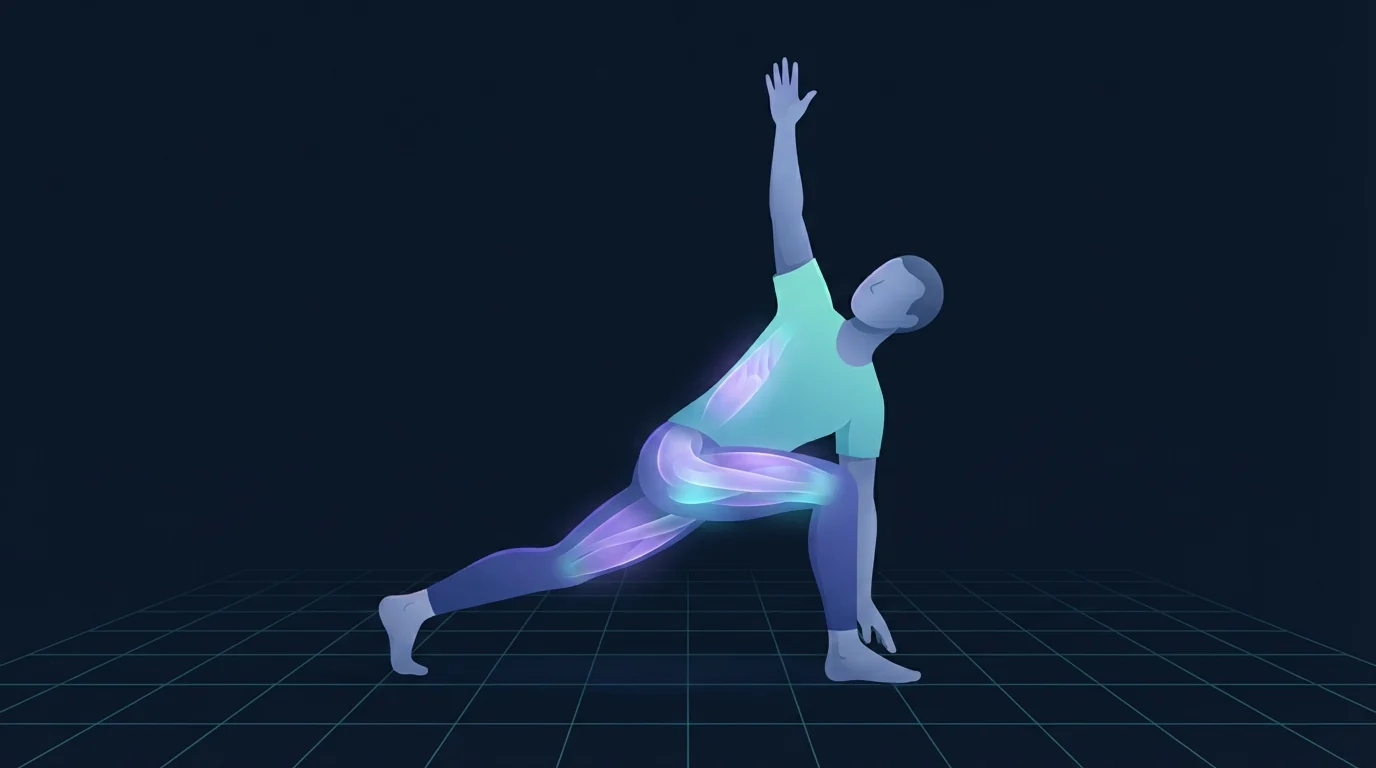
You've watched someone do it at the end of a warm-up video. They step into a lunge, drop an elbow beside their foot, twist, reach an arm at the ceiling, straighten the front leg, and move on looking like a person whose hips work. You copy it. You feel a stretch somewhere, though you couldn't say where, and your low back does something you didn't ask it to do.
Then comes the part nobody says out loud: you don't know whether you did it right. There's no rep count, no load, no clear endpoint. It just ends when you stand up. So it stays in your warm-up as a thing you perform rather than a thing that does anything, and after a few weeks you quietly drop it.
Here's the reframe. You're not too stiff for this drill. The sequence is doing five separate jobs in one shape, and nobody told you which of those jobs is yours. Once you know which position you're actually getting something from, the drill takes twenty seconds and earns its place. And if it turns out your limiter is somewhere the sequence barely touches, you'll know that too.
What the Worlds Greatest Stretch Actually Is
It's a lunge with four things stacked on top of it. The name is coaching-floor hyperbole, not a claim anybody tested, and the drill's real value is efficiency: it's the shortest path through five joint actions that most people lose from sitting.
Run it like this, one side at a time.
- Step into a long lunge. Right foot forward, foot flat, back leg straight with the knee off the floor and the heel pushed back. Hands down on either side of the front foot.
- Press the hips forward. Keep the back knee straight and the pelvis tucked slightly under. This is the position that loads the back-leg hip flexor, and it's the one most people skip by letting the pelvis tip forward instead.
- Drop the right elbow toward the right instep. The front hip goes into deep flexion with a bit of adduction, which is what reaches the adductors and the back of the hip. Go as low as you can without the front heel lifting.
- Rotate and reach. Left hand stays on the floor, right arm opens toward the ceiling, eyes following the hand. The turn comes from the ribcage.
- Sweep the hamstring. Bring the hand back down, shift your hips backward, and straighten the front leg with the toes pulled up, hinging from the hip with a flat back. Then step through into the next rep.
| Position | What it loads | The cue that makes it work |
|---|---|---|
| Long lunge, hips pressed forward | Back-leg hip flexors, front of the thigh | Tuck the pelvis under before you press, not after |
| Elbow to instep | Front hip in deep flexion, adductors, glutes | Front heel stays down the whole time |
| Front shin angle | Ankle dorsiflexion | Let the knee travel past the toes, heel glued down |
| Arm reach to the ceiling | Thoracic rotation, shoulder | Turn the ribs, keep the pelvis still |
| Straight-leg sweep | Hamstrings, calf | Hinge at the hip with a flat back, no bouncing |
Does the Worlds Greatest Stretch Actually Work?
Honest answer first: nobody has run a trial on the named sequence. What exists is evidence on its pieces, and one study that lands close enough to be worth your attention.
Ehresman and colleagues (2025), publishing in the International Journal of Sports Physical Therapy, took 23 healthy young adults with measured hip flexor tightness and had the intervention group perform five minutes of a daily lunge-and-reach stretch for six weeks. That's the first half of the worlds greatest stretch, held rather than flowed. The intervention group improved by an average of 5.92 degrees on the Modified Thomas Test and 12.39 cm on a single-leg broad jump. Gluteal strength and single-leg bridge endurance didn't move.
Two things are worth pulling out of that. The hip flexor position produced real, measurable range in six weeks. And it did that at five minutes a day, which is roughly fifteen times the dose you get from three reps in a warm-up. The sequence in a warm-up and the sequence as a flexibility intervention are different drugs at different doses.
The warm-up case is separate and it's solid. Opplert and Babault (2018), reviewing the dynamic stretching literature in Sports Medicine, found that dynamic stretching before activity generally preserves or slightly improves subsequent performance, in contrast to long static holds. Behm and colleagues (2016) put a number on the other side of that: static stretches held longer than 60 seconds produced consistent acute reductions in strength and power, while shorter holds inside a full warm-up did not. A flowing lunge sequence sits on the right side of that line. Our review of static versus dynamic stretching works through the rest of that evidence.
And warm-ups themselves earn their minutes. Thorborg and colleagues (2017), pooling six cluster-randomised trials in the British Journal of Sports Medicine, found structured exercise-based warm-up programmes cut overall football injury risk by 25 percent, with the FIFA 11+ programme specifically showing a 39 percent reduction. Those programmes are mobility, balance and strength drills done before play, which is the category the worlds greatest stretch belongs to.
How to Do It Without Annoying Your Low Back
Four errors account for most of what goes wrong, and three of them are the same error wearing different clothes: a joint that doesn't move borrows range from a joint that does.
Rotating from the low back instead of the ribs. The lumbar spine has very little rotation available and the thoracic spine has plenty. If you initiate the reach by throwing the arm, the pelvis follows and your low back does the turning. Fix it by planting the down hand hard, keeping both hip bones pointed at the floor, and starting the turn from the sternum.
Letting the front heel lift. This one is an ankle problem pretending to be a hip problem. Macrum and colleagues (2012), writing in the Journal of Sport Rehabilitation, artificially restricted ankle dorsiflexion with a forefoot wedge during squatting and found it reduced knee flexion and increased knee valgus and medial knee displacement. Restrict the ankle and the knee drifts inward. If your heel lifts in the lunge, work the ankle directly with ankle mobility exercises and put a small plate under the heel in the meantime.
Leaving the back knee bent and the pelvis tipped. A bent back knee with an anterior pelvic tilt takes almost all the tension off the hip flexors, which is the position most people default to because it feels easier. Straighten the back leg, tuck the tailbone under, then press. If that changes the sensation from "vague front of thigh" to "genuinely uncomfortable at the crease of the hip", you were skipping the position.
Bouncing the hamstring sweep. The sweep is a hinge, not a bob. Push the hips back, keep a flat back, pull the toes up, and hold the end position for two seconds. If your back rounds to get there, you're stretching your lumbar spine rather than your hamstrings, and you'll get more out of the positions in our guide to the best stretches for hamstrings.
Find out what's really holding you back
FitCraft, our mobile fitness app, pairs you with an AI coach who builds you a personalized plan around your goals, schedule, and fitness level. Every FitCraft program is designed by Domenic Angelino, MPH (Brown University) and NSCA-CSCS, with research published in the Journal of Strength and Conditioning Research and Medicine & Science in Sports & Exercise.
Take the Free Assessment Free • 2 minutes • No credit card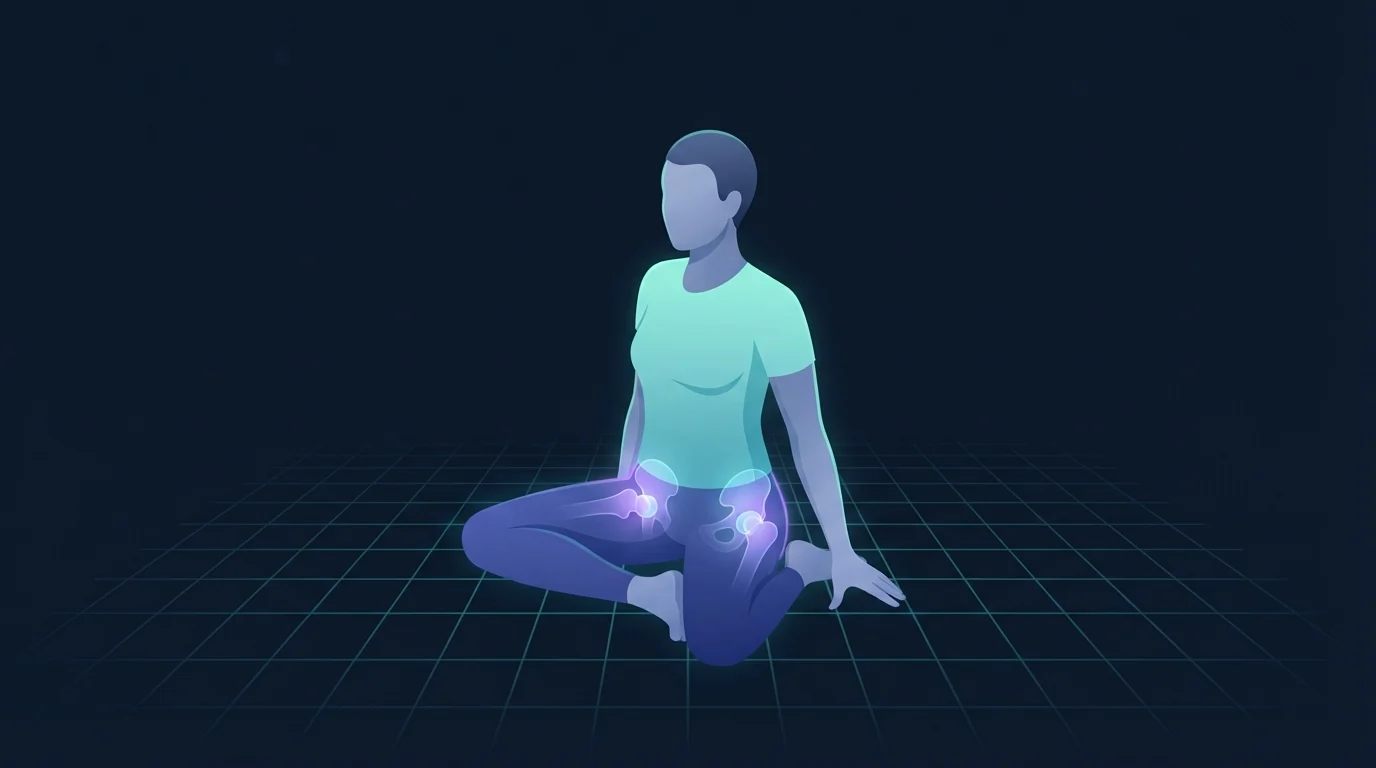
How Often, and How Many Reps
Three to five reps per side, moving continuously, two or three seconds in each position. That's 60 to 90 seconds total, placed after a couple of minutes of general movement and before your first working set or your first fast running.
Reps beat long holds in a warm-up because the job is getting joints through their available range with the muscles still switched on. Lasting range is a separate job with much bigger numbers. The dose question only changes if you want the range to stick, and then the numbers get much bigger. Ingram and colleagues (2025), in a meta-regression of 189 studies and 6,654 adults, found chronic stretching gains flattened out near four minutes per session and about ten minutes per week per muscle group. Konrad and colleagues (2024), pooling the chronic stretching literature in the Journal of Sport and Health Science, found meaningful range improvements across protocols with no strong evidence that one stretch type wins.
| Goal | Dose | Where it goes |
|---|---|---|
| Warm-up before lifting or running | 3-5 reps per side, continuous | After general movement, before the first hard set |
| Desk-day movement break | 5 reps per side, twice a day | Any time, no warm-up needed |
| Actually changing hip flexor range | Hold the lunge position 4-5 min per side | A separate session, most days of the week |
| Post-workout cool-down | 3 reps per side, slower | After the last set, not instead of one |
The 90 90 Stretch: When Rotation Is the Limiter
The 90 90 stretch is a seated position: front leg bent to 90 degrees in front of you, back leg bent to 90 degrees out to the side. The front hip sits in external rotation, the back hip in internal rotation, and you get both at once. That's a joint action the worlds greatest stretch barely touches, which makes the 90 90 the natural companion rather than a competitor.
Use it if any of this sounds like you: sitting cross-legged leaves your knees up near your chest, your feet turn out at the bottom of a squat, or getting a knee across your body in a figure-4 is a fight. Those are rotation problems, and a lunge sequence won't fix them no matter how many reps you do.
How to run it: sit tall in the shape, hands behind you if you can't stay upright, and hold for 30 to 45 seconds per position. Then add the harder version, which is lifting the back shin a few centimetres off the floor and holding for five seconds, five times. That turns a stretch into strength at the end of the range, which is what tends to actually stick. Transitioning side to side without using your hands is the progression after that.
One honest caveat on the rotation-and-back-pain story you've probably heard. Avman and colleagues (2019), reviewing the hip range of motion literature in Musculoskeletal Science and Practice, found limited hip internal rotation was the only movement impairment significantly associated with nonspecific low back pain, and then explicitly cautioned that the supporting evidence is very low quality. Train hip rotation because it makes squatting, changing direction and sitting on the floor easier. Don't sell it to yourself as back pain insurance.
The Couch Stretch: When the Front of the Hip Is the Limiter
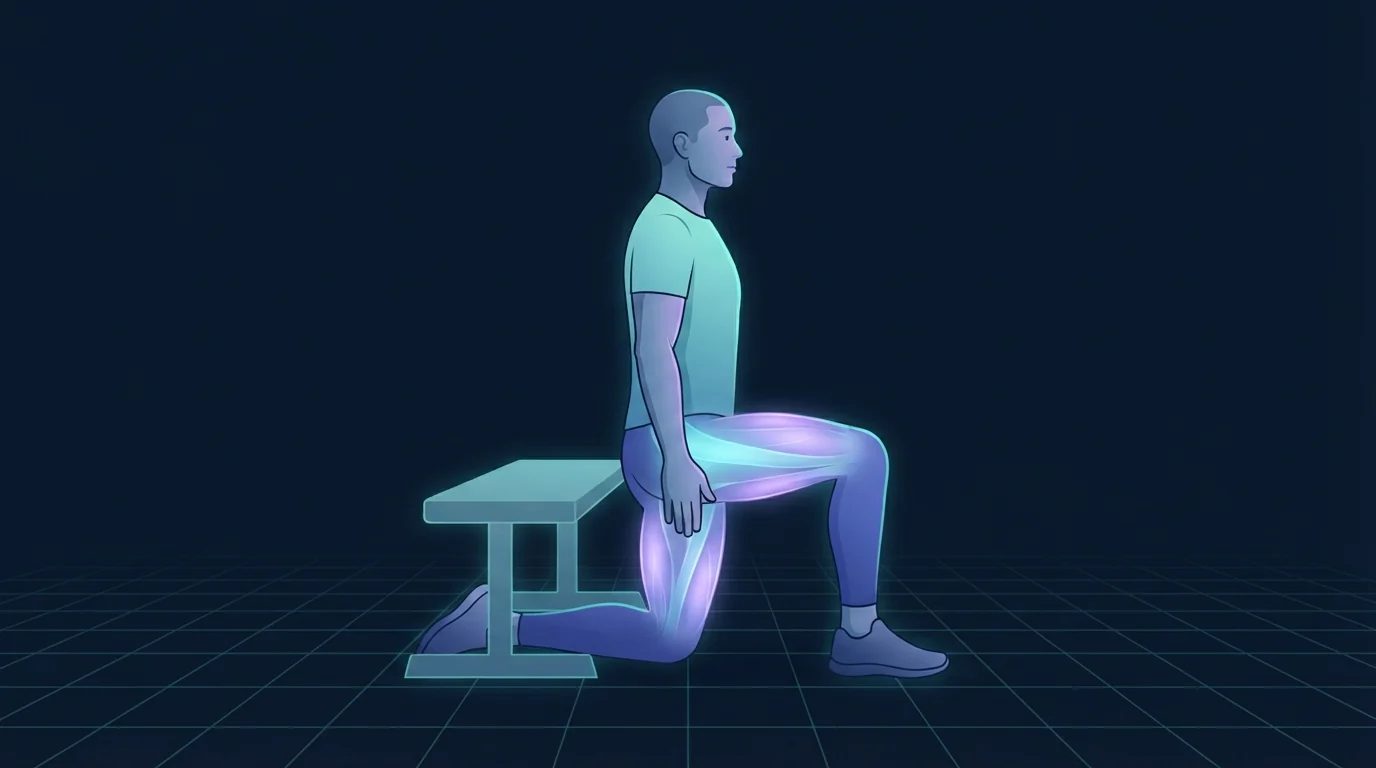
The couch stretch puts your back foot up on a couch, a wall or a bench with the knee under the hip, front foot planted ahead of you. Because the rectus femoris crosses both the hip and the knee, bending the knee fully while extending the hip stacks tension on it in a way a flat-footed lunge never does. That's the whole point of the position, and it's why it feels dramatically harder than the lunge in the worlds greatest stretch.
Set-up matters more here than anywhere else in this article. Put a folded towel under the back knee. Tuck your pelvis under first, then rise up tall, and stop the moment your low back starts arching to buy you more depth. Thirty to sixty seconds per side is plenty on the first few attempts. If the knee complains, drop the back foot onto a low step instead of a couch so the knee bend is shallower.
Want to know whether the front of your hip is genuinely your limiter before you spend weeks on it? The modified Thomas test is the standard field check: lie back on the edge of a table holding one knee to your chest and see whether the other thigh rests flat. Peeler and Anderson (2008) in the Journal of Athletic Training reported acceptable within-rater reliability for it, and Vigotsky and colleagues (2016) in PeerJ showed the result is invalid unless pelvic tilt is controlled, because the pelvis will rotate to hide a short hip flexor. Have someone hold your pelvis still, or the test tells you nothing. Our guide to tight hip flexors covers the full testing and loading progression.
Which One Do You Actually Need?
Pick by limiter, not by popularity.
| Drill | Best for | Position | Typical dose |
|---|---|---|---|
| Worlds greatest stretch | General warm-up, five joints in one shape | Standing lunge, flowing | 3-5 reps per side |
| 90 90 stretch | Hip internal and external rotation | Seated on the floor | 30-45 sec per position, plus lift-offs |
| Couch stretch | Rectus femoris and the front of the hip | Kneeling, back foot elevated | 30-60 sec per side |
| Straight-leg hinge | Hamstrings in isolation | Standing or supine | 4 min per side per week, split up |
Most people need the sequence as a warm-up and exactly one of the targeted positions as homework. Doing all four every day is how mobility work becomes a chore you abandon in a fortnight.
What to Expect
Week one is mostly coordination. You'll feel unsteady in the rotation and you'll cheat the hip press without noticing, and that's normal for a drill with five checkpoints. Film one rep from the side on your phone. It's faster than any cue.
By week three the sequence stops being something you think about and starts being something you do, which is the actual win in a warm-up: it costs you nothing to keep. If you've also been holding the lunge position as homework, the Modified Thomas Test is where you'd expect to see a change around the six-week mark, based on the Ehresman timeline.
What won't happen is a transformation in how you move from three reps before training. That's the honest boundary. If your goal is lasting range, you need the bigger weekly dose, and if your goal is a body that holds positions rather than just visits them, you need loading as well as lengthening. A structured plan makes that sequencing somebody else's problem: a home workout app that needs no equipment can put mobility work and strength work in the same week without you having to design it.
The Bottom Line
The worlds greatest stretch is a good warm-up and an oversold flexibility program. Five positions, three to five reps a side, before you train. Rotate from the ribs, keep the front heel down, and straighten the back leg before you press the hips forward. That's the whole drill.
If you've been doing it for months and nothing feels different, you probably don't have a technique problem. You have a dose problem, or you have a limiter the sequence doesn't reach. Find out which, spend four minutes a side on that one thing, and leave the sequence where it belongs: at the front of your session, doing its twenty seconds of quiet work.
Frequently Asked Questions
What is the worlds greatest stretch?
The worlds greatest stretch is a five-position lunge sequence: a long lunge, a hip press to load the back-leg hip flexor, an elbow driven toward the front instep, a thoracic rotation with one arm reaching up, and a straight-leg hamstring sweep before you step through. It covers hip extension, deep hip flexion, ankle dorsiflexion, mid-back rotation and hamstring length in roughly 20 seconds per side, which is why it shows up in so many warm-ups. It's movement preparation, not a flexibility program.
How many reps of the worlds greatest stretch should I do?
Three to five reps per side before training, moving continuously with two or three seconds in each position, which comes to about 60 to 90 seconds total. Reps beat long holds here because the sequence is a warm-up: you want the joints moved through range with the muscles still switched on. If you want lasting range at one joint, that's a separate job with a much bigger weekly dose.
Is the worlds greatest stretch backed by research?
No trial has tested the named sequence itself. The closest direct evidence is Ehresman and colleagues (2025), who had adults with hip flexor tightness perform five minutes of a daily lunge-and-reach stretch for six weeks: the intervention group gained an average of 5.92 degrees on the Modified Thomas Test and 12.39 cm on a single-leg broad jump, with no significant change in gluteal strength or single-leg bridge endurance. The wider case for dynamic warm-ups is stronger than the case for this specific drill.
What is the 90 90 stretch and when should I use it instead?
The 90 90 stretch is a seated position with the front leg bent 90 degrees in front of you and the back leg bent 90 degrees out to the side, which puts the front hip in external rotation and the back hip in internal rotation at the same time. Use it when rotation is your limiter: you sit cross-legged with your knees high, your squat turns your feet out, or you can't get your knee across your body. The worlds greatest stretch barely touches hip internal rotation, so a 90 90 fills a real gap.
What is the couch stretch and is it better for tight hip flexors?
The couch stretch puts your back foot up on a couch, wall or bench with the knee under the hip, so the rectus femoris is lengthened across both the knee and the hip at once. It loads the front of the thigh harder than the lunge position in the worlds greatest stretch does, which makes it the better pick if the front of your hip is the limiter and you can tuck your pelvis under without arching your low back. It's intense, so start with 30 seconds per side and a folded towel under the knee.
Should I do the worlds greatest stretch before or after a workout?
Before. It's a dynamic sequence that moves joints through range without the long static holds that can blunt force production, and dynamic stretching in a warm-up preserves or slightly improves performance in the literature Opplert and Babault reviewed in 2018. Use it after the general warm-up and before your first working set or your first fast running. Save long holds for a separate session or the end of a workout.