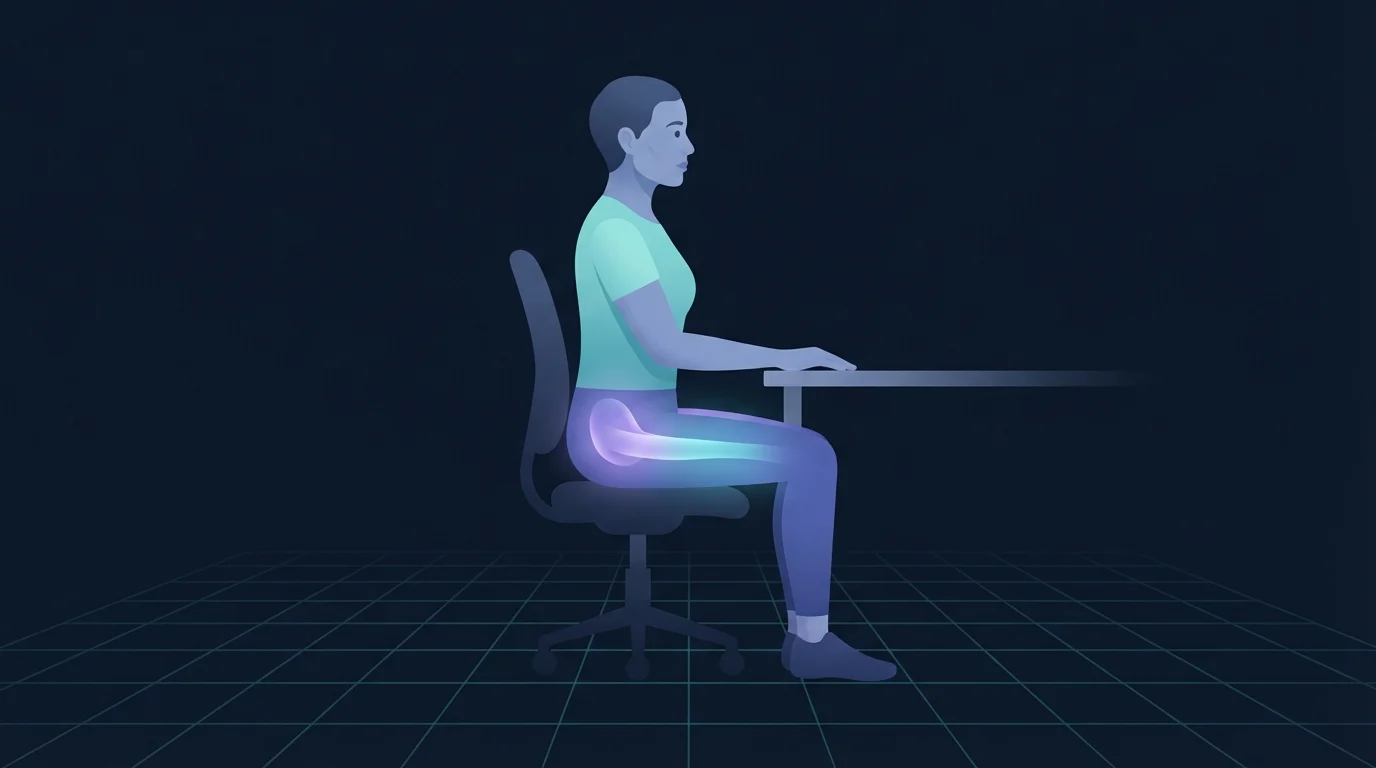
You stand up after a long call and the front of your hips feels welded shut. Two steps in it loosens. By the time you reach the kitchen it's gone, and it comes back tomorrow. If you have googled tight hip flexors you have been told it is the psoas, that sitting is the new smoking, and that you should stretch for two minutes a side every day forever.
Some of that is close to right. Most of it skips the question that decides whether your stretching does anything: tight compared with what? A muscle can feel tight because it's genuinely stiff, because it is weak at the end of its range, or because your nervous system is capping the range on purpose. Three different causes, three different fixes, one identical sensation.
Here is how to tell them apart, what the research actually supports, and a routine short enough that you will still be doing it in March.
What "Tight Hip Flexors" Actually Means
Your hip flexors are a group, not a muscle. The iliopsoas (psoas major plus iliacus) crosses from the lumbar spine and the inside of the pelvis to the top of the femur and is the deepest of them. Rectus femoris runs from the front of the pelvis down to the kneecap, so it flexes the hip and extends the knee, which is why knee position changes how a hip stretch feels. Tensor fasciae latae and sartorius sit on the outside and the front. Whichever one you are feeling, "tight" is a sensation, and sensation and muscle length are not the same measurement.
Stiffness is not shortness
When someone stretches for six weeks and gains range, the intuitive story is that the muscle got longer. The evidence doesn't support that story for most people. A landmark review by Weppler and Magnusson (2010) in Physical Therapy examined the mechanisms behind range-of-motion gains and concluded that short-term stretching programs increase extensibility mainly by modifying sensation, not by adding sarcomeres or permanently changing tissue length. Your tolerance to the stretch goes up. The hip flexor is roughly the same hip flexor.
That matters practically. If the gain is a tolerance gain, then pushing into pain buys you nothing extra, and consistency matters more than intensity.
Weakness that feels like tightness
The second cause is the one most people never consider. A muscle that is weak at the end of its range will pull you out of that range rather than let you sit in it. If your glutes do not hold the hip in extension, the front of the hip stays half-on all the time, and a muscle that never fully switches off reads as tight. This is why people stretch for months and the feeling comes straight back every afternoon.
Guarding, which is a nervous system decision
The third cause is protective. After a strain, a long layoff, or a run of high training stress, the nervous system will restrict range in a joint it doesn't currently trust. Stretching that hip aggressively is a poor argument. Loading it gently through a range it can control is a much better one, which is the logic behind every rehab program that adds strength work before it adds flexibility work.
How to Test Your Hip Flexors at Home
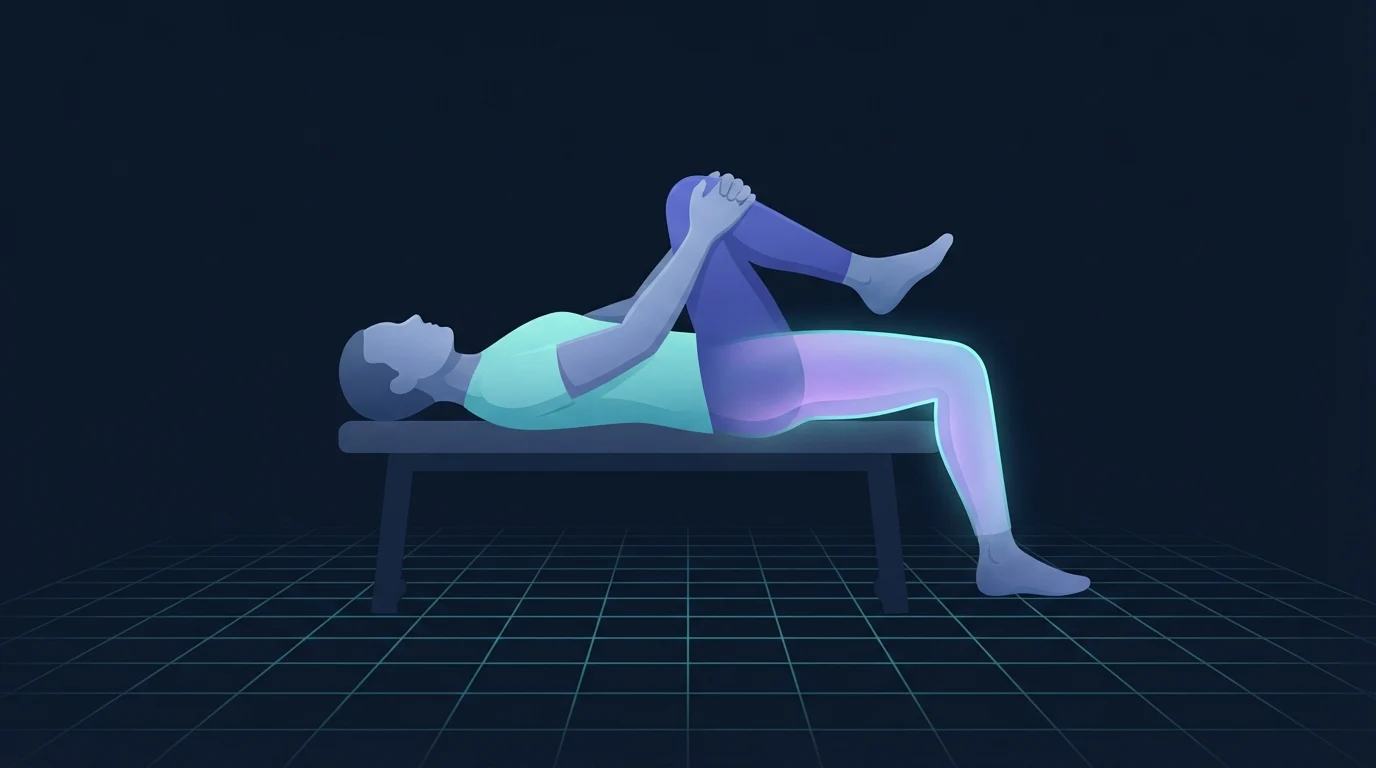
The Thomas test is the standard screen and you can run it on a bed, a bench or a sturdy table.
- Sit at the very end of the surface so the backs of your thighs are just off the edge.
- Hug one knee firmly to your chest and roll back until you are lying flat, keeping that knee held.
- Let the other leg hang. Do nothing with it.
- Have someone look from the side, or film it. If the hanging thigh rests level with the surface, hip extension is fine. If it floats above the surface, that side is limited.
A second reading: if the hanging knee bends to roughly 80 degrees on its own, rectus femoris is behaving. If the lower leg swings forward toward straight, rectus femoris is the stiffer part of the group.
Now the honest part. The test is useful and it isn't precise. Peeler and Anderson (2008) had three experienced clinicians test 54 physically active adults twice, a week apart, and reported kappa values of 0.40 within a rater and 0.33 between raters for pass or fail scoring, with a standard error of measurement of 7 degrees when they used a goniometer. Fair to moderate, in other words, with enough measurement noise to flip a borderline call.
It gets stricter. Vigotsky and colleagues (2016) compared the modified Thomas test against a criterion measure in 29 adults and found a sensitivity of 31.8 percent for detecting real hip extension deficits. It missed roughly two thirds of them. When the researchers controlled pelvic tilt, agreement jumped to r = 0.98. Translation: the test works if your pelvis stays still, and your pelvis doesn't stay still unless someone holds it there.
Use it as a before-and-after for yourself, filmed the same way each time. Don't use it to diagnose yourself with a problem.
What Actually Causes Tight Hip Flexors
Three inputs cover almost every case.
Sitting, and specifically sitting plus inactivity. Boukabache and colleagues (2021) measured passive hip extension with the modified Thomas test in 144 adults and grouped 98 of them by habits. The group that sat less than four hours a day and met activity guidelines had 6.1 degrees more passive hip extension than the group that sat more than seven hours and was inactive, and the difference across groups was significant at p < 0.001. Worth noticing what the comparison actually isolates: the high-activity group that also sat a lot fell in between. Sitting matters, and moving appears to offset a lot of it.
Running and sprinting volume. Runners aren't sitting all day and still report tight hips. The hip flexors fire hard on every stride to swing the leg through, and most running never asks them to produce force at long lengths. High volume with no strength work at end range is a reliable way to build a hip that feels short.
Training that never visits end range. If your lower body work lives in a narrow band (quarter squats, seated machines, short-step lunges), the front of the hip is never loaded near full extension. Range you don't use is range you slowly stop defending.
One thing that is not on the list is posture as a moral failing. Anterior pelvic tilt gets blamed constantly, and Herrington (2011) measured pelvic angle in 120 healthy asymptomatic adults and found 85 percent of men and 75 percent of women standing in anterior pelvic tilt with no symptoms at all. If the majority of pain-free people have the thing, the thing is not the diagnosis. Our guide on how to fix anterior pelvic tilt covers when it does deserve attention.
Find out what's really holding you back
FitCraft, our mobile fitness app, pairs you with an AI coach who builds you a personalized plan around your goals, schedule, and fitness level. Every FitCraft program is designed by Domenic Angelino, MPH (Brown University) and NSCA-CSCS, with research published in the Journal of Strength and Conditioning Research and Medicine & Science in Sports & Exercise.
Take the Free Assessment Free • 2 minutes • No credit cardStretching or Strengthening? The Research Says Both
The stretching-versus-strengthening argument has a surprisingly clean answer. Afonso and colleagues (2021) pooled 11 randomised controlled trials covering 452 participants and found no significant difference between strength training and stretching for improving range of motion (effect size -0.22, 95% CI -0.55 to 0.12). Sub-analyses by active versus passive range and by joint did not change the picture.
Strength training through a full range wins on points anyway, because it gives you range plus the ability to hold it. A stretch that adds five degrees you cannot control is a worse trade than five degrees you own.
On dosing, Konrad and colleagues (2024) meta-analysed 77 stretching studies and 186 effect sizes and found static and PNF stretching outperformed ballistic stretching for long-term range, while volume, intensity and frequency showed no significant moderating effect. That's permission to stop grinding. The related work by Thomas and colleagues (2018) puts the practical floor at roughly 5 minutes per muscle group per week, which is 45 seconds a side, most days.
What about foam rolling? Wilke and colleagues (2020) pooled 26 trials and found foam rolling produced a large acute improvement in range of motion compared with doing nothing, and no advantage over stretching. Useful before a session, not a substitute for the rest. If you want the wider picture on warm-up choices, see our review of static versus dynamic stretching.
Eight Exercises for Tight Hip Flexors, With Dosing
Four open the front of the hip. Four teach it to hold the new position. Don't do all eight every day.
| Exercise | What it does | Dose |
|---|---|---|
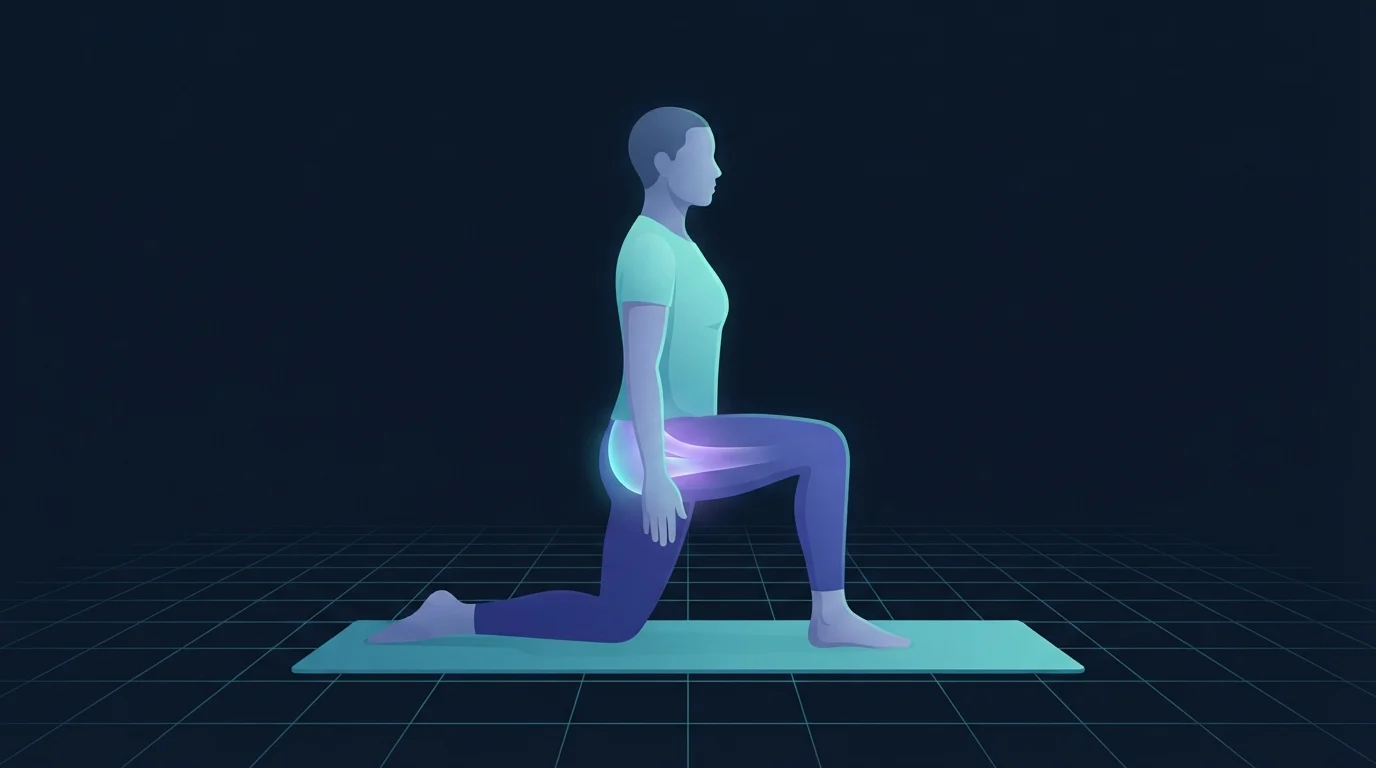
| Half-kneeling hip flexor stretch | The main event. Tuck the pelvis under and squeeze the back glute before you shift forward | 2 x 45 sec per side, most days |
| Couch stretch | Same position with the back foot up on a chair or sofa, which adds knee flexion and reaches rectus femoris | 2 x 30 sec per side, 3 days a week |
| Half-kneeling triplanar stretch | Adds a side bend and a rotation away from the down knee, which catches tensor fasciae latae | 5 slow reps each direction per side |
| 90/90 hip switch | Moves the hip through rotation rather than holding one position, good as a daily reset | 8 switches, 1 to 2 rounds |
| Glute bridge | Teaches the hip to reach extension using the glute instead of the low back. Progress to one leg | 3 x 12, 3 days a week |
| Bulgarian split squat | Loads the rear hip near full extension with a dumbbell. The single best long-length option | 3 x 6 to 10 per side, 2 days a week |
| Reverse lunge | Trains the same range with less balance demand, easier to add load early | 3 x 8 per side, 2 days a week |
| Dead bug | Strengthens the hip flexor at short range while the ribs stay down, which is the missing half | 3 x 6 slow reps per side |
Two cues decide whether any of this works. First, the pelvis tucks before you move, not after. If your low back is doing the extending, the hip is not. Second, stretch at about a 6 out of 10 intensity. Hard stretching doesn't buy extra range and it does make people quit.
The 10-Minute Daily Hip Flexor Routine
This is the version that survives a real week. Two blocks, one short and daily, one longer and twice weekly.
Daily, about 5 minutes. Half-kneeling hip flexor stretch, 2 x 45 seconds per side. 90/90 hip switches, 8 reps. Glute bridge, 1 x 15. Do it after a shower or at the end of the workday. The timing matters less than the trigger being something you already do.
Twice a week, about 12 minutes added to your lower body session. Bulgarian split squat or reverse lunge, 3 working sets. Single-leg glute bridge, 3 x 10 per side. Dead bug, 3 x 6 per side. Finish with the couch stretch, 2 x 30 seconds per side.
Expect to feel different within a session and to measure different in four to six weeks. Ehresman and colleagues (2025) had a group perform one daily lunge-and-reach stretch, five reps of 30 seconds per leg, for six weeks. The stretching group gained 5.92 degrees of hip extension on the modified Thomas test and 12.39 cm on a single-leg broad jump, while the control group moved 2.59 degrees and 4.83 cm. The trial was small, 23 adults across both groups, so treat the exact numbers as a direction rather than a promise. The dose is the interesting part: two and a half minutes a day.
If you want the rest of the hip covered rather than just the front, our hip mobility exercises routine handles rotation, the adductors and the posterior hip in the same 10 minutes.
Hip Flexor Exercises That Load the Hip, Not Just Lengthen It
The table earlier in this guide pairs stretches with glute and trunk work, which is the standard prescription and the right place to start. This section is the piece that prescription leaves out: hip flexor exercises that load the hip flexors themselves rather than the muscles around them. Hip flexion is a movement we perform thousands of times a day and almost nobody trains on purpose.
The case for loading is not a philosophical one. Alizadeh and colleagues (2023) pooled 55 studies in Sports Medicine and found resistance training increased range of motion with an effect size of 0.73, with no significant difference against stretch training (0.08) and no extra benefit from bolting stretching onto resistance training. One detail in that paper decides how you use it: programs that used body mass alone did not significantly improve range of motion. The external load is doing the work, which is why a block of stretches and a block of loaded work are not interchangeable.
Training hip flexion directly also transfers. Deane and colleagues (2005) ran 24 physically active but untrained adults through an 8-week hip flexor resistance program in the Journal of Strength and Conditioning Research. Hip flexion strength rose 12.2 percent, 40-yard dash time dropped 3.8 percent and shuttle run time dropped 9.0 percent, with no change in a matched control group of 24. Two months of work on a muscle group almost nobody programs, and sprint and agility times moved.
| Exercise | What it does | Dose |
|---|---|---|
| Lunge and reach | The movement from the Ehresman trial. Step into a long lunge and reach the same-side arm overhead and slightly back, so the hip lengthens under active control rather than hanging | 5 x 30 sec per leg, daily |
| Reverse Nordic (kneeling lean-back) | Kneel tall, squeeze the glutes, lean back slowly and stop where you can still control the return. Loads rectus femoris at its longest length, which no passive stretch does | 2 x 5 slow reps, 2 days a week |
| Standing loaded knee drive hold | Drive one knee above hip height and hold it against a band or a light dumbbell resting on the thigh. Trains hip flexion above 90 degrees, the range walking and running never reach | 3 x 20 sec per side |
| Hanging leg raise | The strongest hip flexor loading available with nothing but a bar. Tuck the pelvis first so the hip lifts the leg instead of the low back swinging it | 3 x 6 to 10, 2 days a week |
| Lying leg raise | The floor regression for anyone who cannot hang yet. Press the low back into the floor and end the set the moment it lifts away | 3 x 10 to 12, 2 days a week |
| Reverse lunge with knee drive | Pairs the long-length rear hip position with a hip flexion rep on the way up, so one movement covers lengthening and loading | 3 x 8 per side, 2 days a week |
| Marching in place | The cheap daily version. Tall posture, knee above hip height, slow and deliberate rather than jogged | 2 x 45 sec, most days |
Two of these deserve a warning label. The reverse Nordic is much harder than it looks, and a first session should stop at a lean of a few inches, because rectus femoris cramps readily when it gets loaded long for the first time. On both leg raise variations, the low back peeling off the floor or the ribs flaring is the set ending, not a rep to grind out. Why long-length loading is worth the care is covered in our review of stretch-mediated hypertrophy.
A 10-minute hip flexor strength session
Run this twice a week, ideally attached to a lower body day. It is the loading half of the plan. The daily stretching block in the section above is the lengthening half, and neither one replaces the other.
- Reverse lunge with knee drive, 3 x 8 per side. About 4 minutes.
- Hanging or lying leg raise, 3 x 8. About 3 minutes.
- Reverse Nordic, 2 x 5 slow reps. About 2 minutes.
- Standing loaded knee drive hold, 2 x 20 sec per side. About 1 minute.
Add load before you add reps. On the leg raises that means slowing the lowering phase first, then adding a light ankle weight. On the knee drive hold it means a heavier band. If the sets never get harder, the hip has no reason to defend any new range the stretching bought you.
Psoas Release: What It Is, and What the Evidence Supports
Psoas release is three different things wearing one name. A clinician pressing into the lower abdomen to reach the muscle by hand. A ball or similar tool used on yourself against the front of the hip. And positional work such as constructive rest, where you lie down with the knees bent and breathe. The risk profiles are not the same, and the evidence behind them is thinner than the confidence with which it gets sold.
Start with where the muscle is. As the anatomy review by Sajko and Stuber (2009) lays out, psoas major runs from the bodies and discs of the lower thoracic and lumbar spine, down behind the abdominal contents, across the front of the pelvis to the inside of the femur, and it contributes to lumbar stability as well as hip flexion. Reaching it by hand means pressing through the abdominal wall and past organs and vessels. That is why the manual version belongs to trained clinicians, and why driving a hard ball into your own midline is a bad idea rather than a shortcut.
Now the word release. Behm and Wilke (2019) reviewed the mechanisms behind rollers and similar tools in Sports Medicine and concluded there is insufficient evidence that they release myofascial restrictions at all. What the tools plausibly do is neural: they activate skin and fascial mechanoreceptors and type III and IV afferents, shift sympathetic and parasympathetic activity, and recruit the body's own pain modulation systems. The authors went as far as calling the term self-myofascial release misleading. Nothing is being released. Something real is happening, and it is happening in the nervous system.
That reframing predicts the results, which are decent and temporary. Wilke and colleagues (2020), cited earlier on this page, found a large acute range-of-motion gain from rolling versus doing nothing and no advantage over stretching. For lasting change, Konrad and colleagues (2022) pooled 11 trials and 290 participants and found a moderate effect on joint range of motion (0.823), but only in programs that ran longer than four weeks, and the gains were specific to the joint being worked. Rolling is a warm-up tool and a slow flexibility tool. It is not a replacement for either of the two blocks above.
The two versions worth doing yourself
The ball method. Lie face down with a soft ball just inside the front point of the hip bone, on the meaty side and well away from the midline of the abdomen. Let your body weight settle rather than driving in. Breathe slowly for 60 to 90 seconds a side, and move the down leg gently to change the tissue under the ball. Sharp pain, a pulsing sensation or any nausea means stop and get the hip looked at instead.
Constructive rest. Lie on your back with the knees bent and the feet flat, hands resting on the lower ribs, and spend five minutes breathing slowly with a longer exhale than inhale. The plausible mechanism is the one Zaccaro and colleagues (2018) mapped in Frontiers in Human Neuroscience: slow breathing consistently shifts autonomic balance toward parasympathetic activity and lowers arousal. Given that a share of hip tightness is protective guarding, turning the alarm down is a reasonable thing to try. Be clear about the evidence, though. No controlled trial has tested constructive rest against a stretching control for hip extension range. Treat it as a cheap way to down-regulate, not as a treatment.
The honest summary is that psoas release changes how the hip feels, usually for minutes to an hour, through the nervous system rather than through the muscle. That is genuinely useful before a session or at the end of a long sitting day. It is not the thing that makes the range stick. The stretching dose and the loaded work are.
When Tight Hip Flexors Are a Symptom of Something Else
Stiffness that behaves like stiffness responds to the routine above. Stiffness that is a symptom doesn't, and it tends to come with a tell.
- A sharp pinch in the hip crease at the bottom of a squat or when you pull your knee to your chest. That is a joint-shaped complaint, not a muscle-shaped one. Femoroacetabular impingement and labral irritation both present this way, and stretching into the pinch usually makes them angrier.
- Clicking, catching or a sense the hip is about to give way. Worth a clinical opinion before you load it heavier.
- Pain that wakes you at night, or stiffness that is dramatically worse in the morning and eases after an hour. Inflammatory patterns look different from mechanical ones and get a different workup.
- One side only, unchanged after six weeks of consistent work. Asymmetry that will not move is usually structural or a lingering strain, not a flexibility problem.
- Recent hip flexor strain. Strained tissue guards. Load it progressively first, then stretch it later, not the other way round.
- Numbness, tingling or pain running down the leg. That is a nerve conversation and belongs with a clinician.
Nothing on that list is an emergency. All of it is a reason to get eyes on the hip rather than stretch harder for another two months.
The Bottom Line
Tight hip flexors are rarely short hip flexors. They are usually a hip that spends the day at 90 degrees, a glute that is not holding extension, or a nervous system playing it safe. Give it 45 seconds of half-kneeling stretching per side most days, load the front of the hip at long lengths twice a week, and check yourself with the same filmed Thomas test in six weeks.
You're not broken and you weren't born stiff. You have a hip that is very good at the position you put it in most, and it will get good at a new one if you keep asking. If sticking with a 10-minute routine is the actual obstacle, our home workout app for no equipment page covers how a guided plan handles the consistency part.
Frequently Asked Questions
What causes tight hip flexors?
Long hours in hip flexion is the most common driver. A 2021 cross-sectional study measured passive hip extension in 144 adults and found 6.1 degrees more available extension in people who sat under four hours a day and hit activity guidelines than in people who sat more than seven hours and were inactive. High running or sprinting volume is the second driver, because the hip flexors work hard every stride and rarely get loaded at long lengths. And a large share of what people call tightness is a muscle working hard to stabilize a joint, not a muscle that got short.
How do I know if my hip flexors are actually tight?
The Thomas test is the standard screen: lie on the end of a bench, hug one knee to your chest, and let the other leg hang. If the hanging thigh floats above horizontal, hip extension is limited on that side. Treat one result as a rough signal rather than a diagnosis. A 2008 reliability study of 54 adults found only fair to moderate agreement between raters, and a 2016 validity study found the test misses most real hip extension deficits unless pelvic tilt is controlled.
How long does it take to loosen tight hip flexors?
Most people feel different within one session and measure different in four to six weeks. A 2025 controlled trial had 23 adults perform a daily lunge-and-reach stretch, five reps of 30 seconds per leg, for six weeks. The stretching group gained 5.92 degrees of hip extension on the modified Thomas test and added 12.39 cm to a single-leg broad jump, while the control group did not change meaningfully. That is about two and a half minutes a day.
Should I stretch or strengthen tight hip flexors?
Both work, and strength training works about as well for range of motion. A 2021 meta-analysis of 11 randomised trials in 452 participants found no significant difference between strength training and stretching for improving range of motion. Strength work through a full range gives you the extra range plus the ability to control it, so the practical answer is to stretch the front of the hip and load it at long lengths in split squats and lunges.
What are the best hip flexor exercises?
The best hip flexor exercises pair one that lengthens the front of the hip with one that loads it. For lengthening, the lunge and reach is the movement with the cleanest trial behind it, at five reps of 30 seconds per leg daily. For loading, hanging or lying leg raises, a reverse lunge with a knee drive, the reverse Nordic and a standing loaded knee drive hold cover hip flexion above 90 degrees and rectus femoris at long lengths. Alizadeh and colleagues (2023) pooled 55 studies and found resistance training improved range of motion as much as stretching did, with one catch: programs using body mass alone did not, so the loaded work needs actual load.
Does psoas release actually work?
It changes how the hip feels, and not by releasing anything. Behm and Wilke (2019) reviewed the mechanisms behind rollers and similar tools and concluded there is insufficient evidence that they release myofascial restrictions, calling the term misleading. The effects look neural: mechanoreceptor activation, autonomic shifts and the body's own pain modulation. Rolling produces a large acute range-of-motion gain with no advantage over stretching, and a moderate lasting gain only in programs running longer than four weeks. Use it before a session or after a long sitting day, and keep hard pressure away from the midline of the abdomen.
Do tight hip flexors cause lower back pain?
Sometimes, but far less often than the internet suggests. Anterior pelvic tilt is the usual mechanism people cite, and a study of 120 healthy pain-free adults found 85 percent of men and 75 percent of women already stood in anterior pelvic tilt with no symptoms at all. If back pain travels with stiffness, treat the stiffness as one input among several rather than the cause.
Is it safe to stretch tight hip flexors every day?
Yes for healthy adults, and daily is the easiest dose to remember. A 2024 meta-analysis of 77 stretching studies found that static and PNF stretching beat ballistic stretching for long-term range of motion, and that volume, intensity and frequency did not significantly change the result. Consistency matters more than heroic sessions, so 60 to 90 seconds per side most days beats one long session a week.
When should tight hips be checked by a professional?
See a clinician if you feel a sharp pinch at the front of the hip crease in deep flexion, if the hip clicks or catches painfully, if pain wakes you at night, if it followed a specific injury, or if stiffness sits on one side only and has not changed after six weeks of consistent work. Those patterns point at the joint, the labrum or a tendon rather than a short muscle, and stretching harder tends to make them worse.