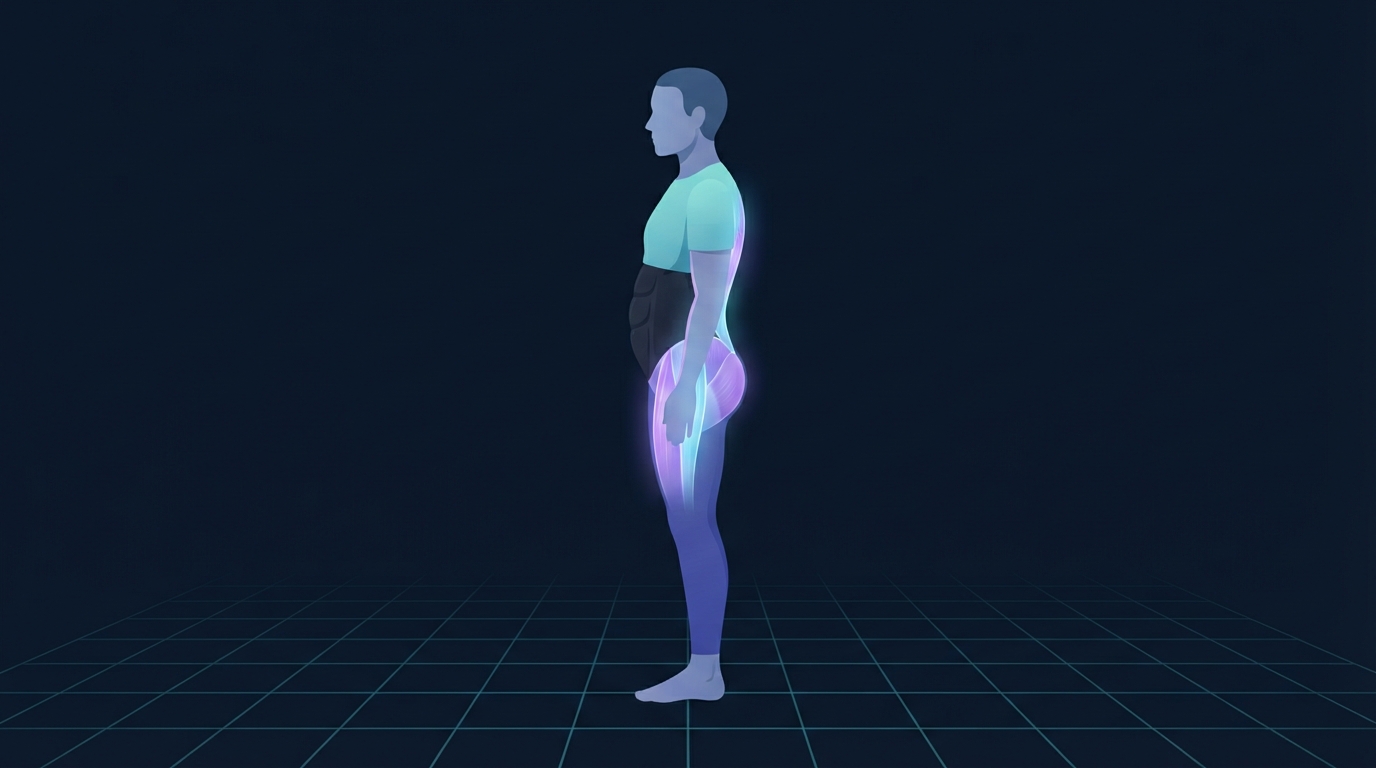
Lower cross syndrome is the pelvic half of a model Czech neurologist Vladimir Janda built in the 1970s to explain why some people's aches never matched their scans. The idea is elegant. Two diagonals cross at the pelvis. Hip flexors in front and spinal erectors behind pull the pelvis into a forward tip. Abdominals in front and glutes behind, on the opposite diagonal, are supposed to resist that and fail to.
The model became the backbone of a whole industry of corrective exercise, and it is genuinely useful as a teaching shorthand. The trouble started when it got treated as a mechanism. Every link in that chain makes a testable prediction, and researchers have now tested several of them.
Here is what the measurements say about pelvic tilt in people who feel fine, what the lumbar curve actually looks like in people with back pain, whether short hip flexors really switch a glute off, and which parts of the standard corrective program are worth your training time anyway.
What Lower Cross Syndrome Describes
The pattern names four muscle groups and assigns each to a role.
Said to be short and overactive: the iliopsoas and rectus femoris at the front of the hip, and the lumbar erector spinae running up either side of the lower spine. The hip flexors shorten from hours of sitting. The erectors are said to compensate by pulling the back of the pelvis down.
Said to be long and inhibited: gluteus maximus and gluteus medius behind, rectus abdominis and the deep abdominal wall in front. These are the muscles that would tuck the pelvis back under if they were doing their job.
The predicted appearance is a pelvis rotated forward, an exaggerated inward curve at the lower back, a belly carried ahead of the hip joints, and glutes that look flat. If you have read anything about tight hip flexors, you have met this diagram. Our guide on tight hip flexors covers the practical assessment and routine. This page is about whether the mechanism is real.
The Research: What Studies Show
Herrington 2011: The Forward Tip Is the Norm, Not the Exception
Herrington (2011) in Manual Therapy did the study that should have been done first. He measured pelvic tilt with a PALM palpation meter in 120 healthy, symptom-free adults, 65 men and 55 women, average age 23.8 years. The point was to work out what normal looks like before clinicians keep calling deviations abnormal.
- Men: 85 percent anterior tilt, 6 percent posterior, 9 percent neutral.
- Women: 75 percent anterior tilt, 7 percent posterior, 18 percent neutral.
- Magnitude: most of the anterior tilts sat within about 7 degrees of neutral.
Every one of those people was asymptomatic. If four in five pain-free young adults stand with a forward-tipped pelvis, then a forward-tipped pelvis is what a pelvis mostly does. Finding one on yourself is not a finding.
Chun 2017: Back Pain Travels With Less Curve, Not More
Chun, Lim, Kim, Hwang and Chung (2017) in The Spine Journal pooled the observational literature comparing lumbar lordotic curvature in people with and without low back pain. The lower cross model predicts back pain should come with more lordosis, since the forward pelvic tip deepens the curve. The meta-analysis found the reverse. People with back pain, especially those with disc pathology, had significantly attenuated lumbar lordosis compared with pain-free controls.
The authors are careful about what that means. Heterogeneity between studies was high at 65 percent, risk of bias was not low, and observational data cannot establish which came first. A flatter curve could be a consequence of guarding against pain rather than a cause of it. What the analysis does rule out is the simple version of the story where a deeper curve is the problem.
Mills 2015: Short Hip Flexors Changed Strategy, Not Strength
The mechanical heart of the model is reciprocal inhibition: a short hip flexor is supposed to switch off its opposite number, the gluteus maximus. Mills and colleagues (2015) in the International Journal of Sports Physical Therapy tested that directly. They used a modified Thomas test to split 40 college-aged female soccer players into a restricted hip flexor group and a normal-length group, then measured electromyography and biomechanics during a landing task.
The restricted group did show less gluteus maximus activation and a lower gluteus maximus to biceps femoris co-activation ratio. But isometric gluteus maximus strength was the same between groups, as were hip and knee extension moments. The restricted group produced the same output using a different mix of muscle. That's a coordination difference, and calling it a switched-off glute overstates it considerably. Our guide on glute activation exercises works through where that idea came from and how much warm-up time it deserves.
Sadler 2019: The Gluteus Medius Finding That Does Survive
Not everything in the model fails. Sadler, Cassidy, Peterson, Spink and Chuter (2019) in BMC Musculoskeletal Disorders reviewed 24 studies comparing 1,088 people with low back pain against 998 without. People with back pain had consistently reduced gluteus medius strength and more trigger points in that muscle. Findings on activation level, fatigability, activation timing, cross-sectional area and thickness were all inconclusive.
So the side-of-the-hip muscle really is weaker in this population. Whether that weakness caused the pain or followed it is unresolved, and the review says so plainly. Either way it is a trainable deficit and hip abduction work is cheap to program.
Dimitrijevic 2022: Corrective Exercise Does Move the Curve
Dimitrijevic, Scepanovic, Milankov, Milankov and Drid (2022) in International Journal of Environmental Research and Public Health pooled 10 trials with 482 participants on corrective exercise and lumbar lordotic angle. The pooled effect was moderate and clearly significant, at a standardized mean difference of 0.55 with a confidence interval from 0.36 to 0.75. Lumbar stabilization work, Williams flexion training, sling exercise, core stability combined with stretching, and pilates all produced reductions. Younger participants responded slightly better than older ones.
Worth being precise about what was measured. The outcome was the angle, not pain, not function, not anything a person would notice in daily life. The curve is trainable. That is not the same as the curve being the thing that needed treating.
Is Anterior Pelvic Tilt a Problem at All?
Only when it comes with something else. That is the honest summary, and it follows from two bodies of evidence.
Swain, Pan, Owen, Schmidt and Belavy (2020) in the Journal of Biomechanics ran an umbrella review, a systematic review of systematic reviews, asking whether spinal postures or physical exposures cause low back pain. Despite a large number of available reviews, they found no consensus on causality. Associations exist. Causation has not been demonstrated, and the quality of the reviews making the claim was mixed.
Meanwhile the treatment literature keeps landing in the same place. Saragiotto and colleagues (2016) in a Cochrane review of 29 trials and 2,431 participants found motor control exercise clinically better than minimal intervention for chronic non-specific back pain, but no better than other types of exercise. If correcting a specific postural fault were the active ingredient, the exercise style that targets it should beat the ones that do not. It doesn't.
What that leaves is a simpler and more defensible position. A pelvis tipped forward is normal. Weak hip abductors, low trunk endurance, and a hip that cannot extend under load are real and measurable, and they respond to training. Chase the capacity, not the alignment. Our review of exercise for lower back pain research goes into what actually helps once symptoms are present.
Get an evidence-based plan built for you
FitCraft, our mobile fitness app, pairs you with an AI coach who builds you a personalized plan around your goals, schedule, and fitness level. Every FitCraft program is designed by Domenic Angelino, MPH (Brown University) and NSCA-CSCS, with research published in the Journal of Strength and Conditioning Research and Medicine & Science in Sports & Exercise.
Take the Free Assessment Free • 2 minutes • No credit cardWhy the Pelvic Pattern Is Not the Neck Pattern
Janda described a mirror-image pattern at the shoulder girdle, and the two are usually taught as one idea applied twice. The evidence treats them very differently, and the reason is load and bone.
The pelvis sits between two ball-and-socket joints whose orientation is fixed skeletal anatomy. Femoral anteversion, acetabular angle and the shape of the sacrum vary enormously between people and set much of the resting tilt before any muscle contributes. On top of that, the pelvis carries your entire upper body weight in every standing minute, and the hip flexors that supposedly distort it cross two joints, so their length is confounded by knee position in every measurement. That's a lot of noise for a muscle-balance model to cut through, and it's why Herrington found most healthy people sitting on the "abnormal" side of the line.
The shoulder girdle has none of those constraints, which is why intervention trials there produce much cleaner results. Our review of upper cross syndrome research covers those trials in detail. Read the two together and the pattern becomes obvious: the same model works far better where the bone gets out of the way.
Common Misconceptions
Misconception: "Anterior pelvic tilt means your glutes are not working"
Tilt and gluteal function are much less connected than the diagram implies. Mills 2015 found normal isometric gluteus maximus strength in the group with restricted hip flexors. Sadler 2019 found reduced gluteus medius strength in people with back pain but could not establish direction. A visible tilt tells you almost nothing about what a muscle can produce. Test the strength directly instead of inferring it from a silhouette.
Misconception: "Stretch the hip flexors and the pelvis will drop back"
Stretching alone rarely shifts resting tilt, because resting tilt is not primarily a length problem. Dimitrijevic 2022 found angle changes from programs that combined stabilization or core work with stretching, not from stretching by itself. Treat hip flexor length work as one ingredient that makes loaded hip extension feel better, not as the intervention.
Misconception: "A deeper lumbar curve is what hurts your back"
Chun 2017 found the opposite association, with flatter curves in the back pain groups, and Swain 2020 found no causal consensus for spinal posture generally. If a person with back pain also has a big lordosis, those are two facts about them, not one fact explaining the other.
What a Lower Cross Program Should Actually Contain
Strip the model back to what has evidence behind it and a short, boring, effective program is left. All of it works at home with no equipment beyond a mat.
Load Hip Extension Through Range
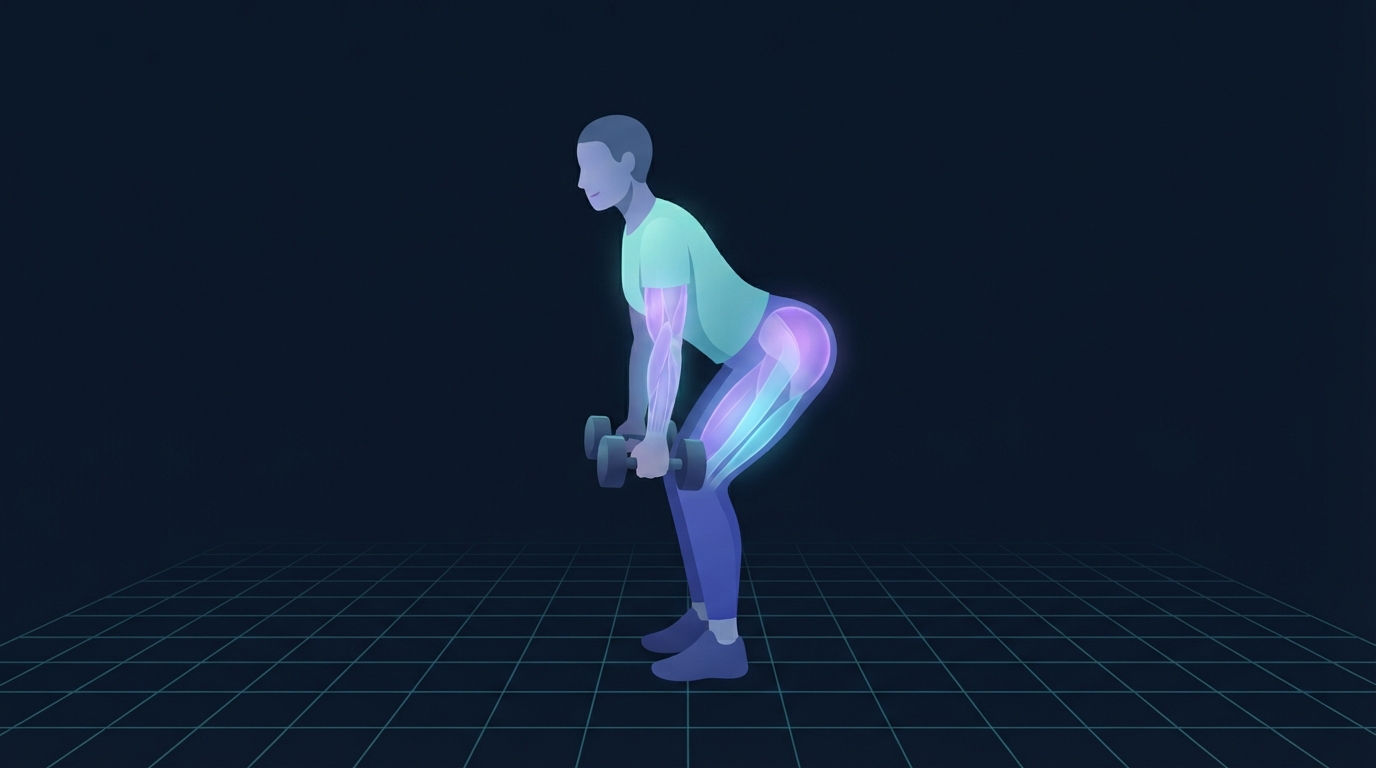
- Hip hinges: Romanian deadlifts with dumbbells, or a hip hinge to a wall touch if you have none. Two to four sets of 8 to 12, adding load over weeks via progressive overload.
- Glute bridges and single-leg bridges: two to three sets of 10 to 15 with a two-second hold at the top.
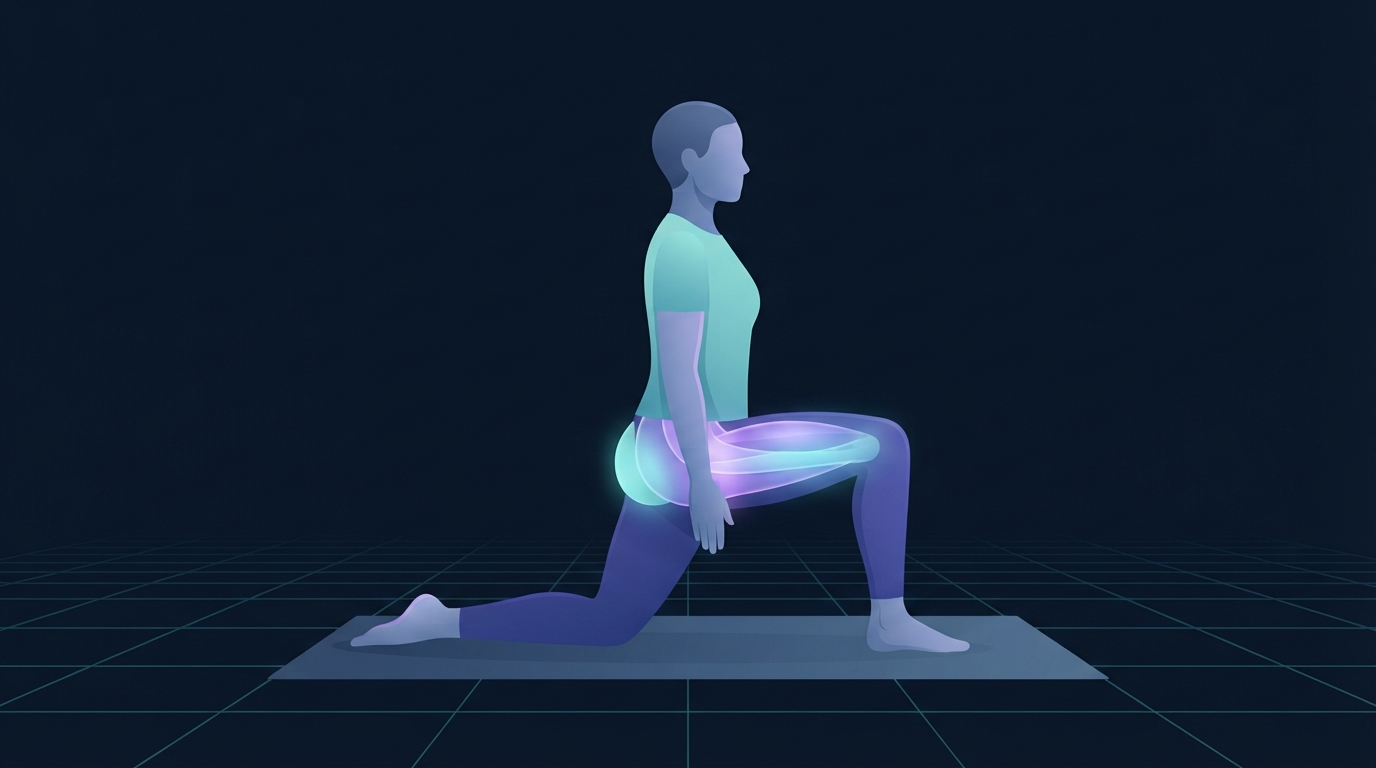
- Split squats and step-ups: these load hip extension and hip flexor length at the same time, which is more time-efficient than doing each separately.
Train Hip Abduction Directly
- Side-lying abduction and side planks with hip abduction: this is the one deficit Sadler 2019 found consistently, so it earns dedicated sets rather than a spot in the warm-up.
- Dose: two to three sets of 12 to 15 per side, twice a week, progressed by adding a band or slowing the lowering phase.
Build Trunk Endurance, Not Just Tension
- Side planks, dead bugs and bird dogs: the motor control family that Saragiotto 2016 found clinically useful. Hold for time and add time rather than chasing harder variations early.
- Frequency: two to three sessions a week for at least eight weeks, which is the shortest window any of the successful trials used.
If the barrier is that none of this fits between a commute and a work day, that is a programming problem rather than a motivation problem. Our guide to a home workout app with no equipment covers the options for training this pattern in a living room, and our core stability exercises guide has the trunk progressions in order.
What the Research Suggests Going Forward
A few things would settle this literature, and none of them have been done.
Nobody has run a prospective study that measures pelvic tilt in pain-free adults and follows them long enough to see who develops back pain. Until that exists, every claim about tilt causing anything is inference from cross-sectional snapshots.
The measurement tools are also weaker than the confidence around them. Palpation meters, inclinometers and photographic markers all depend on finding bony landmarks through soft tissue, and reliability drops as body composition varies. Radiographic measurement is accurate and nobody's irradiating healthy people to check their posture.
There is also a definition problem. Trials recruiting for this pattern use different angle thresholds, different tests for hip flexor length, and different criteria for calling a glute weak. That makes pooling results across studies harder than the tidy forest plots suggest.
What all of this adds up to is not "ignore your hips". Hip abductor strength, hip extension under load and trunk endurance are worth training on their own merits, and the exercises the model recommends are mostly good exercises. The part to let go of is the diagnosis, the urgency, and the idea that a photograph of your standing profile is telling you something important about your future.
References
- Herrington L. "Assessment of the degree of pelvic tilt within a normal asymptomatic population." Man Ther. 2011;16(6):646-648. doi:10.1016/j.math.2011.04.006
- Chun SW, Lim CY, Kim K, Hwang J, Chung SG. "The relationships between low back pain and lumbar lordosis: a systematic review and meta-analysis." Spine J. 2017;17(8):1180-1191. doi:10.1016/j.spinee.2017.04.034
- Mills M, Frank B, Goto S, et al. "Effect of restricted hip flexor muscle length on hip extensor muscle activity and lower extremity biomechanics in college-aged female soccer players." Int J Sports Phys Ther. 2015;10(7):946-954. PMID: 26673683
- Sadler S, Cassidy S, Peterson B, Spink M, Chuter V. "Gluteus medius muscle function in people with and without low back pain: a systematic review." BMC Musculoskelet Disord. 2019;20(1):463. doi:10.1186/s12891-019-2833-4
- Dimitrijevic V, Scepanovic T, Milankov V, Milankov M, Drid P. "Effects of Corrective Exercises on Lumbar Lordotic Angle Correction: A Systematic Review and Meta-Analysis." Int J Environ Res Public Health. 2022;19(8):4906. doi:10.3390/ijerph19084906
- Swain CTV, Pan F, Owen PJ, Schmidt H, Belavy DL. "No consensus on causality of spine postures or physical exposure and low back pain: A systematic review of systematic reviews." J Biomech. 2020;102:109312. doi:10.1016/j.jbiomech.2019.08.006
- Saragiotto BT, Maher CG, Yamato TP, et al. "Motor control exercise for chronic non-specific low-back pain." Cochrane Database Syst Rev. 2016;(1):CD012004. doi:10.1002/14651858.CD012004
Frequently Asked Questions
What is lower cross syndrome?
Lower cross syndrome is a pelvic muscle pattern described by Vladimir Janda. One diagonal, the hip flexors at the front and the spinal erectors at the back, is said to be short and overactive. The crossing diagonal, the abdominals at the front and the gluteals at the back, is said to be long and underactive. The predicted result is a pelvis tipped forward, a deeper lumbar curve and a belly that sits ahead of the hips. It is a teaching model rather than a diagnosis, and several of its specific mechanical claims have not survived testing.
Does lower cross syndrome cause lower back pain?
The evidence points the other way on the central claim. Chun and colleagues (2017) pooled the lumbar lordosis literature in The Spine Journal and found that people with low back pain tended to have a flatter lumbar curve than pain-free controls, not a deeper one, which is the opposite of what the lower cross model predicts. Swain and colleagues (2020) reviewed the systematic reviews on spinal posture and back pain and found no consensus on causality at all. Posture is associated with symptoms in places. It has not been shown to cause them.
Is anterior pelvic tilt something you need to fix?
For most people, no. Herrington (2011) measured pelvic tilt with a palpation meter in 120 healthy, symptom-free adults and found 85 percent of the men and 75 percent of the women stood in anterior pelvic tilt, with only 9 percent of men and 18 percent of women sitting neutral. A forward-tipped pelvis is the statistical norm in people who feel fine. Treat a tilt as a finding worth training around only when it comes with symptoms, a strength deficit, or a movement problem you can actually measure.
Do tight hip flexors switch off your glutes?
Not in the way the model claims. Mills and colleagues (2015) compared 20 female soccer players with restricted hip flexor length against 20 with normal length using a modified Thomas test. The restricted group showed lower gluteus maximus activation and a lower gluteus maximus to hamstring co-activation ratio, but no difference in isometric gluteus maximus strength, hip extension moment or knee extension moment. Short hip flexors were associated with a different muscular strategy, not a weaker or deactivated glute.
What exercises actually help lower cross syndrome?
The interventions with real supporting data are loaded hip extension, trunk endurance work, and hip abduction strengthening. Dimitrijevic and colleagues (2022) pooled 10 trials and 482 participants and found corrective exercise reduced the lumbar lordotic angle with a moderate effect, with stabilization work, core stability plus stretching, sling exercise and pilates all producing results. Saragiotto and colleagues (2016) in a Cochrane review of 29 trials and 2,431 participants found motor control exercise clinically better than minimal intervention for chronic back pain, though no better than other forms of exercise.