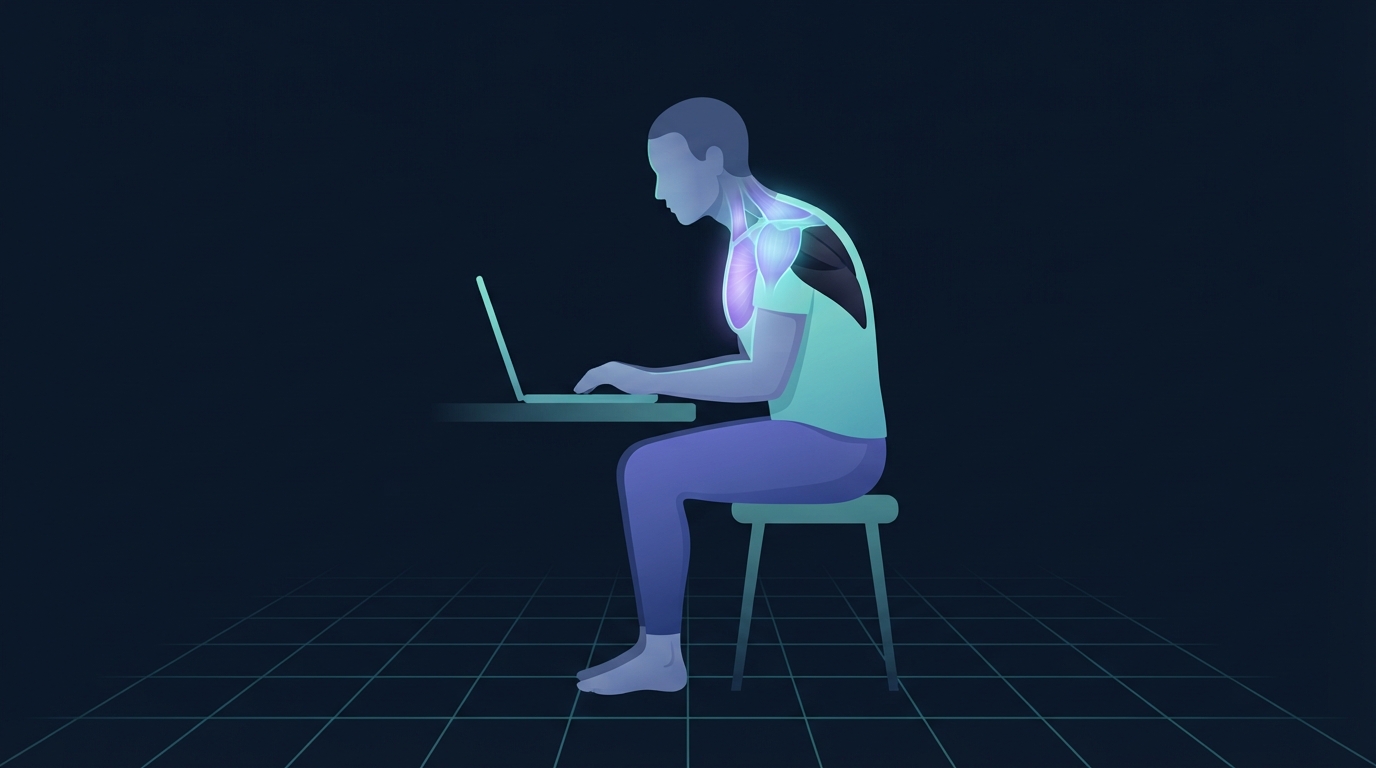
Upper cross syndrome describes a specific trade the shoulder girdle makes when you spend most of your waking hours with your arms in front of you. One diagonal of muscle gets short and busy. The opposite diagonal gets long and quiet. Draw a line from the chest up through the upper trapezius and levator scapulae, then draw a second line from the deep neck flexors down to the middle trapezius, lower trapezius and serratus anterior, and the two lines cross behind your collarbone. That crossing is where the name comes from.
The Czech neurologist Vladimir Janda described the pattern in the 1970s while working with patients whose neck and shoulder complaints did not match any structural finding. He was not describing a disease. He was describing a habit the nervous system settles into, which is a useful distinction, because habits respond to practice and diseases usually do not.
What follows is the actual evidence: which trials moved which angles, how much, how long the change lasted, and where the honest limits sit. Anyone who tells you this pattern is the cause of your neck pain is ahead of the data. Anyone who tells you it does not matter at all has not read the intervention trials.
What Upper Cross Syndrome Actually Describes
The pattern has two halves, and the half people ignore is the one that matters most.
The short, facilitated diagonal: pectoralis major and minor at the front, upper trapezius and levator scapulae across the top, and sternocleidomastoid at the front of the neck. These muscles are not stronger than they should be. They are simply the ones your nervous system reaches for first, over and over, until they sit at a shorter resting length and fire earlier than the job requires.
The long, inhibited diagonal: the deep cervical flexors that sit behind your throat and nod your head, plus middle trapezius, lower trapezius and serratus anterior across the mid back. These are the muscles that pull the shoulder blade back, down and flat against the ribs. A day spent reaching forward asks nothing of them.
Three visible consequences follow, and they are what most people actually notice: the head drifts forward of the shoulders, the shoulders roll in so the backs of the hands face forward, and the upper back rounds. Our guide on how to fix rounded shoulders covers the day-to-day version of the same problem. This page is about what the trials found.
The Research: What Studies Show
Seidi 2020: Eight Weeks Moved Every Angle Measured
Seidi, Bayattork, Minoonejad, Andersen and Page (2020) in Scientific Reports ran the cleanest intervention trial on this pattern to date. They randomized 24 men with upper crossed syndrome into a comprehensive corrective exercise group and a control group, then ran eight weeks of training at three roughly hour-long sessions per week. The program combined stretching for the short diagonal, strengthening for the long one, and drills that trained the two together.
- Forward head angle: 46.71 degrees down to 39.52 degrees.
- Forward shoulder angle: 54.36 degrees down to 45.45 degrees.
- Thoracic kyphosis angle: 47.90 degrees down to 36.34 degrees.
- Upper to middle trapezius activation ratio: 1.96 down to 0.96, meaning the upper trapezius stopped dominating the movement.
- After four weeks of detraining: the angles drifted back only slightly, to 40.57, 46.46 and 38.17 degrees.
That activation ratio is the most interesting number in the paper. Posture photographs can improve because someone learned to hold themselves differently for a camera. An electromyography ratio cannot be faked that way. The upper trapezius genuinely handed work back to the middle and lower trapezius, and the serratus anterior came online across every phase of the movement.
Sepehri 2024: Twenty-Two Trials Pointing the Same Way
Sepehri, Sheikhhoseini, Piri and Sayyadi (2024) in BMC Musculoskeletal Disorders screened 4,625 records and pooled 22 studies covering 903 participants. Therapeutic exercise produced statistically significant improvement in forward head posture, rounded shoulder and thoracic kyphosis, all at p = 0.001. No single exercise style won. Stretching plus strengthening, scapular stabilization protocols, and mixed corrective programs all moved the needle.
The authors flag two limits worth repeating. Almost none of the included trials followed participants long enough to know whether the change persists, and most measured posture angles only, not the muscle tightness, weakness and scapular dyskinesia that the syndrome is actually defined by. So the honest read is that exercise reliably changes the shape and we do not yet know how durable that is.
Mahmoud 2019: Forward Head Posture Tracks Pain in Adults, Not Teenagers
Mahmoud, Hassan, Abdelmajeed, Moustafa and Silva (2019) in Current Reviews in Musculoskeletal Medicine pooled 15 cross-sectional studies on head posture and neck pain. Adults and older adults with neck pain carried the head measurably further forward than pain-free controls, a mean difference of 4.84 degrees, and greater forward head posture correlated with both pain intensity and disability. In adolescents, the difference vanished. The pooled estimate ran slightly the other way and was not significant.
That age split is the single most useful finding in the posture literature. If forward head posture caused pain mechanically, teenagers who spend hours on phones would be the worst affected group on earth. They are not. A more plausible reading is that years of accumulated load, deconditioning and pain-related guarding all push adults toward the same shape, and the shape is a marker rather than a cause.
Andersen 2008: Train the Painful Muscle, Not Around It
Andersen and colleagues (2008) in Arthritis & Rheumatism recruited 48 women with chronic trapezius myalgia from computer-intensive workplaces and randomized them to 10 weeks of specific strength training for the painful trapezius, general fitness training on a leg cycle ergometer, or a reference group. Specific strength training for the neck and shoulder produced a marked and prolonged drop in pain. Leg cycling produced a small acute reduction that did not hold.
This matters for anyone who reads "upper cross syndrome" and reaches for more cardio and more stretching. Loading the muscle that hurts, under supervision and at a sensible starting dose, outperformed working around it. Stretching the chest does not ask the middle trapezius for anything.
Yaghoubitajani 2022: The Same Program, Two Settings, Different Results
Yaghoubitajani, Gheitasi, Bayattork and Andersen (2022) in International Archives of Occupational and Environmental Health randomized 36 office workers with the pattern into online-supervised corrective exercise, workplace corrective exercise, or a control group, then ran the identical eight-week program at three sessions per week.
Both intervention groups improved forward head angle. Only the online-supervised group improved neck and shoulder pain, rounded shoulder angle, physical and mental work ability, and upper trapezius activity against control. The workplace group beat control on rounded back angle only. Supervision and setting changed how much of the program actually landed, which is a useful reminder that the exercise list is the easy part.
Does Forward Head Posture Actually Cause Neck Pain?
Probably not on its own, and the evidence against a simple causal story is stronger than most posture content admits.
Damasceno and colleagues (2018) in European Spine Journal assessed 150 young adults aged 18 to 21 while they texted, grading neck posture by self-report and by physiotherapist judgement, then measured neck pain with the Young Spine Questionnaire. They found no association between so-called text neck and neck pain. The posture was common. The pain did not follow it.
Put that beside the Mahmoud age split and a coherent picture appears. The forward head shape is nearly universal and mostly harmless on its own. In adults it travels with neck pain, but adults also bring decades of cumulative exposure, lower neck and shoulder strength, and the protective stiffening that pain itself produces. Correlation at 4.8 degrees is a real signal and a weak one.
The practical consequence: train the pattern because a weak middle trapezius and a weak deep neck flexor group are worth fixing regardless of how you look in a photograph. Don't promise yourself that a straighter profile will end your neck pain, and don't conclude that your posture is the reason you hurt. Our review of exercise and anxiety research covers another route by which sitting, tension and neck symptoms feed each other.
Get an evidence-based plan built for you
FitCraft, our mobile fitness app, pairs you with an AI coach who builds you a personalized plan around your goals, schedule, and fitness level. Every FitCraft program is designed by Domenic Angelino, MPH (Brown University) and NSCA-CSCS, with research published in the Journal of Strength and Conditioning Research and Medicine & Science in Sports & Exercise.
Take the Free Assessment Free • 2 minutes • No credit cardHow the Upper Pattern Differs From the Lower One
Janda described a matching pattern at the pelvis, and the two get discussed as though they were one condition wearing two hats. They are not, and the reason is anatomical.
The shoulder blade is a free-floating bone. Nothing but the small acromioclavicular joint anchors it to the rest of the skeleton, so its resting position is set almost entirely by the balance of muscle pulling on it. That is why eight weeks of scapular work produced a nine-degree change in forward shoulder angle in Seidi 2020. There was nothing bony standing in the way. The cervical spine also carries very little load compared with the lumbar spine, so the cost of a small alignment change is correspondingly small.
The pelvis is the opposite case. It is wedged between two hip joints whose socket orientation is fixed bone, it carries body weight in every standing minute, and its tilt is heavily influenced by femoral and spinal geometry you cannot train. Our review of lower cross syndrome research covers that evidence, which turns out to be far more skeptical than this one. Reading them together is the fastest way to see why "muscle imbalance" is a better description at the shoulder than at the hip.
Common Misconceptions
Misconception: "Upper cross syndrome is a medical diagnosis"
It is a clinical description with no diagnostic criteria, no prevalence data and no ICD code. Trials that study it define entry with arbitrary angle thresholds, and they don't all pick the same ones. Yaghoubitajani 2022 required a forward head angle of 45 degrees or more, a rounded shoulder angle of 52 degrees or more and a rounded back of 42 degrees or more. Another group would choose different numbers. The pattern is real and the label is soft.
Misconception: "Stretching your chest will fix it"
Stretching is the easiest half and the less important one. Every trial that produced meaningful change combined lengthening work with strengthening for the middle trapezius, lower trapezius, serratus anterior and deep neck flexors. The Seidi 2020 activation data shows why: the change that mattered was the upper trapezius handing work over, and a stretch doesn't teach a different muscle to take it.
Misconception: "Sitting up straight all day is the fix"
Holding one position is a strength problem dressed as a willpower problem, and holding any position for hours is its own stressor. The literature supports building capacity in the muscles that hold the shoulder blade, not policing yourself into rigidity. Frequent position changes plus two or three focused sessions a week is what the trials actually tested.
What an Evidence-Based Upper Cross Program Looks Like
Every trial that worked used the same four ingredients in roughly the same proportions. Nothing exotic, and nothing that needs a gym.
Strengthen the Quiet Diagonal
- Deep neck flexors: chin nods held for 10 seconds, 8 to 10 repetitions. An isometric hold against your own hand works once the unloaded version feels easy.
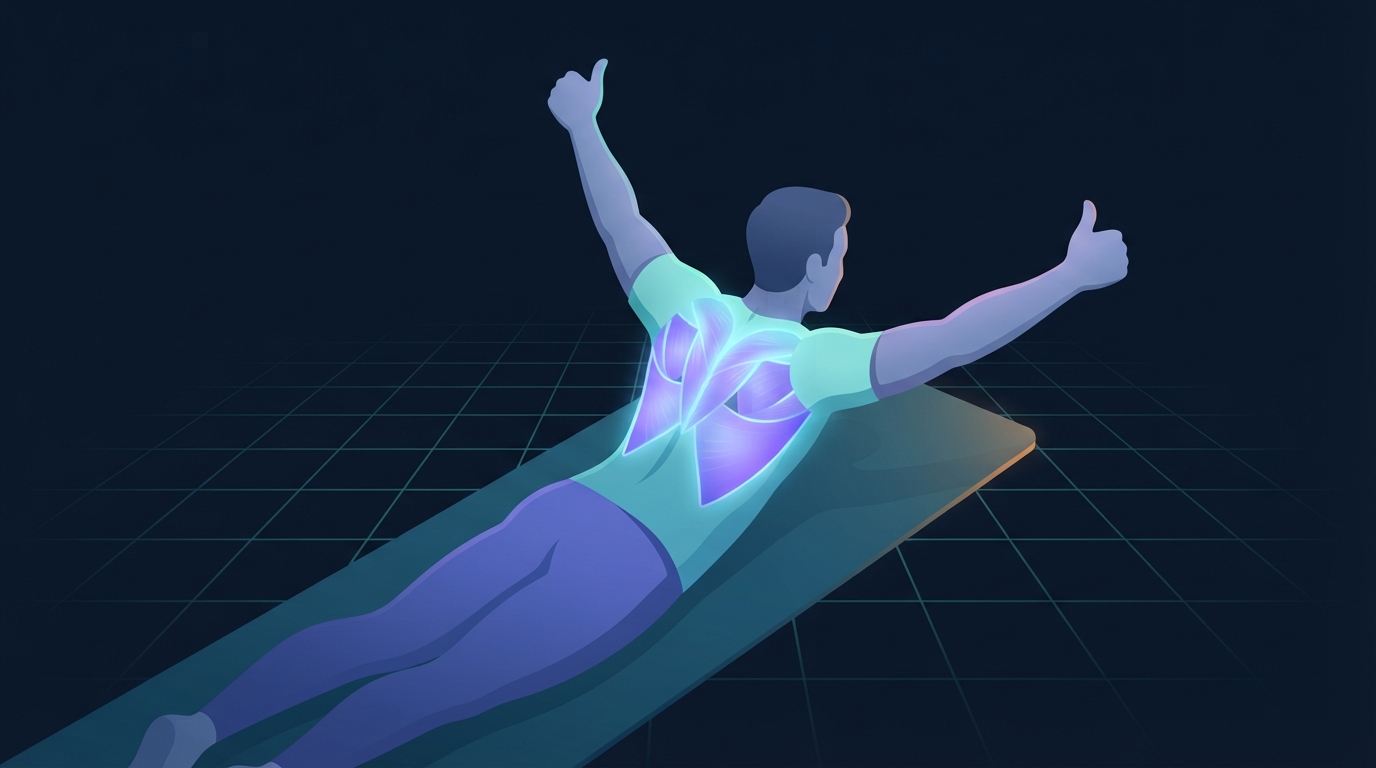
- Middle and lower trapezius: prone Y and T raises, face pulls with a band, and prone horizontal abduction. Two to three sets of 10 to 15, slow enough that the upper trapezius doesn't take over.
- Serratus anterior: wall slides with a band around the forearms, and push-up plus reaches at the top of a push-up.
- Frequency: three sessions a week is what almost every successful trial used, run for at least eight weeks.
Lengthen the Busy Diagonal
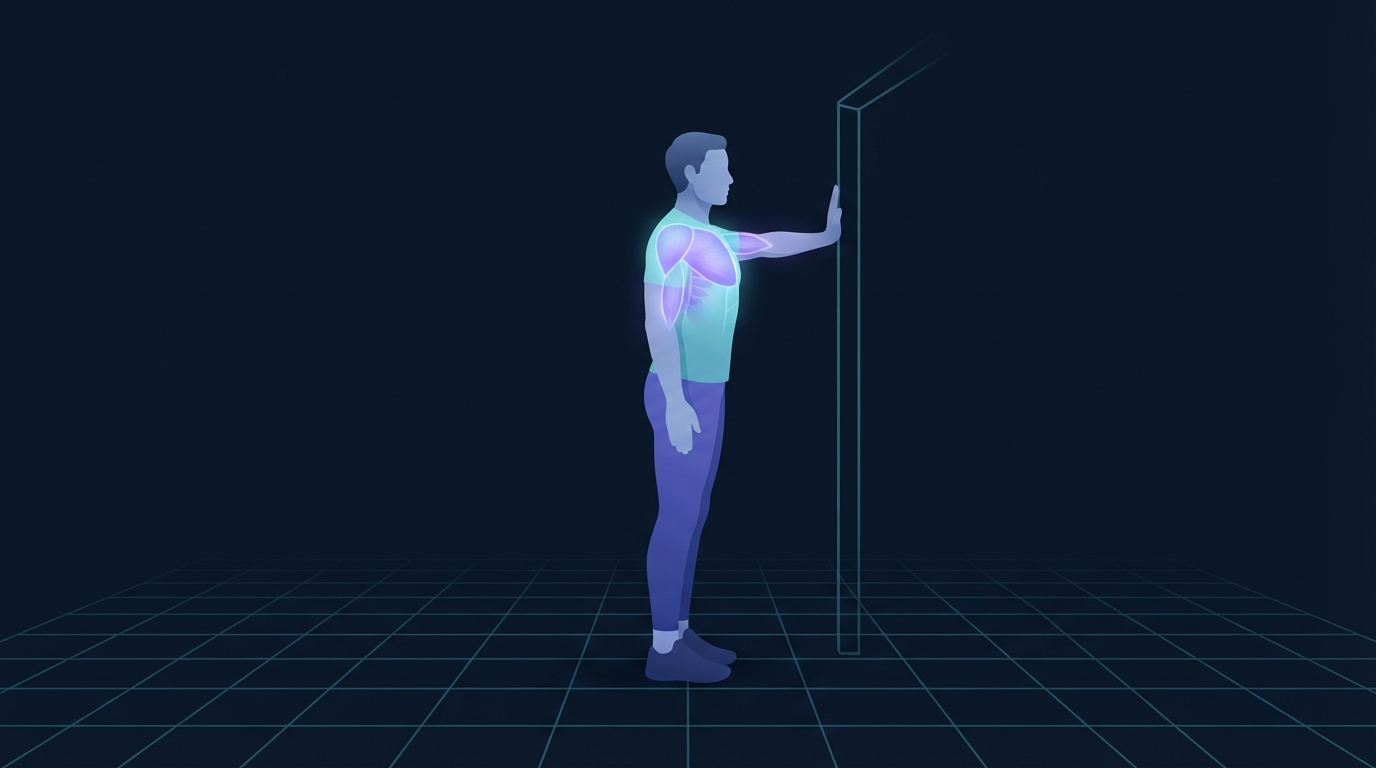
- Pectoralis major and minor: a doorway or corner stretch, 30 seconds per side, two to three rounds.
- Levator scapulae and upper trapezius: gentle side bend and rotation holds, same dose. Our shoulder mobility exercises guide has the full sequence.
- Order: lengthen first, strengthen second. The trials that reported an order did it that way so the strengthening happens through a fuller range.
The hardest part is not the exercise list. It is that the pattern comes from a work day and the program has to survive the same work day. Yaghoubitajani 2022 found the supervised remote group beat the workplace group on almost every outcome with the identical program, which says a lot about adherence. If your training has to fit around desk hours, our roundup of the best workout apps for busy professionals compares the options honestly, and our posture exercises guide sets realistic expectations for how much a spine actually changes shape.
What the Research Suggests Going Forward
Four caveats belong on any honest summary of this literature.
First, the samples are small and narrow. Seidi 2020 studied 24 men. Yaghoubitajani 2022 studied 36 office workers. These are the two strongest trials on the pattern, and neither would be considered large in any other area of exercise science.
Second, the outcome that gets measured is rarely the outcome people care about. Most trials report photographic angles. Fewer report pain. Almost none report whether someone felt different at work six months later. Sepehri 2024 named this gap explicitly.
Third, the causal arrow between posture and symptoms remains unproven in both directions. Pain changes how people hold themselves, and how people hold themselves may change their pain. Cross-sectional data cannot separate those, and no long prospective study has tried.
Fourth, the mechanism Janda proposed is more specific than the evidence supports. Reciprocal inhibition, where a short muscle actively switches off its opposite number, is a clean story that the electromyography data only partly backs. What Seidi 2020 showed is that the activation ratio can be retrained. Why it drifted in the first place is still an assumption.
None of this argues against training the pattern. A strong middle trapezius, a serratus that holds the blade on the ribs, and neck flexors that can hold a nod are worth having whether or not they change a photograph. It argues against selling the program as a cure for neck pain.
References
- Seidi F, Bayattork M, Minoonejad H, Andersen LL, Page P. "Comprehensive corrective exercise program improves alignment, muscle activation and movement pattern of men with upper crossed syndrome: randomized controlled trial." Sci Rep. 2020;10:20688. doi:10.1038/s41598-020-77571-4
- Sepehri S, Sheikhhoseini R, Piri H, Sayyadi P. "The effect of various therapeutic exercises on forward head posture, rounded shoulder, and hyperkyphosis among people with upper crossed syndrome: a systematic review and meta-analysis." BMC Musculoskelet Disord. 2024;25:105. doi:10.1186/s12891-024-07224-4
- Mahmoud NF, Hassan KA, Abdelmajeed SF, Moustafa IM, Silva AG. "The Relationship Between Forward Head Posture and Neck Pain: a Systematic Review and Meta-Analysis." Curr Rev Musculoskelet Med. 2019;12(4):562-577. doi:10.1007/s12178-019-09594-y
- Yaghoubitajani Z, Gheitasi M, Bayattork M, Andersen LL. "Corrective exercises administered online vs at the workplace for pain and function in office workers with upper crossed syndrome: randomized controlled trial." Int Arch Occup Environ Health. 2022;95(8):1703-1718. doi:10.1007/s00420-022-01859-3
- Andersen LL, Kjaer M, Sogaard K, Hansen L, Kryger AI, Sjogaard G. "Effect of two contrasting types of physical exercise on chronic neck muscle pain." Arthritis Rheum. 2008;59(1):84-91. doi:10.1002/art.23256
- Damasceno GM, Ferreira AS, Nogueira LAC, Reis FJJ, Andrade ICS, Meziat-Filho N. "Text neck and neck pain in 18-21-year-old young adults." Eur Spine J. 2018;27(6):1249-1254. doi:10.1007/s00586-017-5444-5
Frequently Asked Questions
What is upper cross syndrome?
Upper cross syndrome is a descriptive pattern of the shoulder girdle, first named by Czech neurologist Vladimir Janda. Two lines of muscle cross at the upper back. One line runs from the chest through to the upper trapezius and levator scapulae and tends to be short and overactive. The other runs from the deep neck flexors at the front of the throat down to the middle trapezius, lower trapezius and serratus anterior, and tends to be long and underused. The visible result is a head carried forward of the shoulders, shoulders rolled in, and a rounded upper back. It is a clinical shorthand, not a formal medical diagnosis with an ICD code.
Can you fix upper cross syndrome with exercise?
The measurable angles do change. Seidi and colleagues (2020) in Scientific Reports put 24 men through an eight-week corrective program of three sessions per week and saw forward head angle improve from 46.7 to 39.5 degrees, forward shoulder angle from 54.4 to 45.5 degrees, and thoracic kyphosis from 47.9 to 36.3 degrees, with the gains still present four weeks after training stopped. Sepehri and colleagues (2024) pooled 22 trials covering 903 participants and found significant improvement in all three angles. What no trial has shown is that the angle change is the reason people feel better.
Does upper cross syndrome cause neck pain?
The link is real in adults and absent in teenagers, which is a strong hint that posture alone is not the cause. Mahmoud and colleagues (2019) pooled 15 cross-sectional studies and found adults with neck pain carried the head further forward than pain-free adults, with a mean difference of 4.84 degrees, while adolescents showed no difference at all. Damasceno and colleagues (2018) measured texting posture in 150 young adults and found no association with neck pain. Posture is better treated as one input among many than as the single cause.
How long does it take to change upper cross syndrome?
Most of the trials that produced clear postural change ran eight weeks at three sessions per week, which is about 24 sessions. Andersen and colleagues (2008) saw meaningful neck pain relief from 10 weeks of specific strength training for the trapezius in 48 women with chronic trapezius myalgia. Nothing in the literature supports a quick fix, and nothing supports a permanent one either. The follow-up data in Seidi 2020 held for four weeks after training stopped, which is the longest detraining window anyone has published on this pattern.
Is upper cross syndrome the same as lower cross syndrome?
They come from the same author and the same idea, but they are not the same problem. Upper cross syndrome sits in the shoulder girdle, where the shoulder blade is a free-floating bone held in place almost entirely by muscle, so training the middle and lower trapezius genuinely moves its resting position. Lower cross syndrome sits at the pelvis, where hip socket geometry and spinal shape set much of the baseline and muscle work moves it less. The exercises, the evidence base, and the honest expectations are different for each.