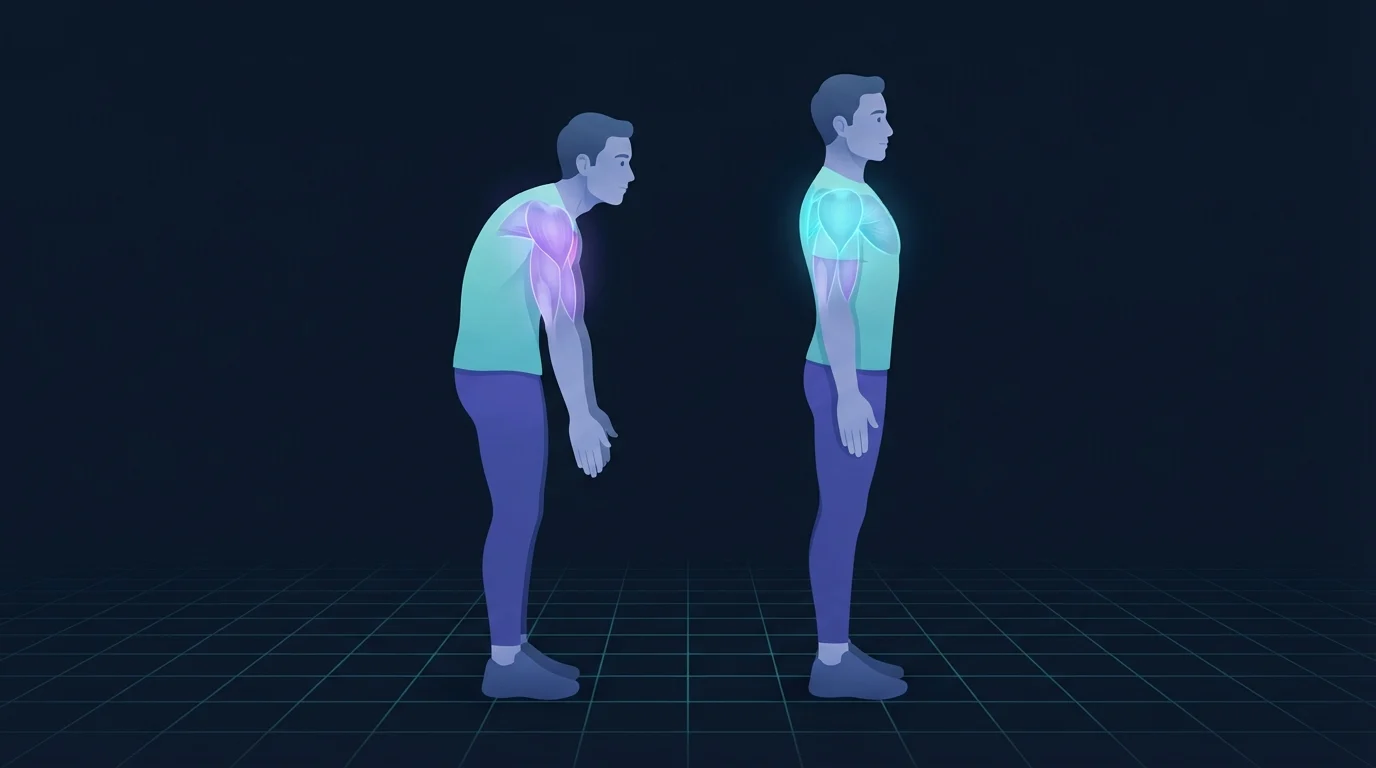
Most people find out about their shoulders by accident. A photo from a wedding, a reflection in a train window, a video call where you look like you are folding in on yourself. The reaction is usually the same: sit up, pull the shoulders back, hold it for about ninety seconds, then forget.
That cycle is the whole problem in miniature. You can put your shoulders wherever you like for a minute. Holding a position all day is a strength question, and nobody ever answered it by remembering harder.
The good news is that the answer is short, the exercises are boring, and none of them need a gym. The less convenient news is that the reason usually given for doing them, that rounded shoulders are causing your pain, is on much shakier ground than you have been told. Both things can be true, and the plan below works either way.
What Rounded Shoulders Actually Are
Your shoulder blade is not bolted to anything. It floats on the back of the ribcage, held there by muscle, and it slides as your arm moves. Rounded shoulder posture, sometimes called protracted or forward shoulder posture, describes a resting position where that blade sits further forward and tipped down at the front, which rolls the whole arm inward.
The muscles doing the pulling
On the front, pectoralis minor runs from the ribs up to the coracoid process, a small hook on the front of the shoulder blade. When it sits short, it tips the blade forward. Borstad and Ludewig (2005) compared healthy adults with long versus short pectoralis minor resting lengths and found the short group showed measurably different scapular rotation during arm elevation. The front of the shoulder and the lats contribute too, both pulling the arm into internal rotation.
On the back, the middle and lower trapezius pull the blade back and down, the rhomboids pull it toward the spine, and the serratus anterior holds it flat against the ribs while it rotates upward. These are the muscles a desk job never asks for, and they are the reason this article is mostly about pulling.
What rounded shoulders are not
They are not a deformity, they are not permanent, and they are not evidence that you are broken. They are also not rare. Look around an office and you will see the pattern on most people, including plenty who have never had a sore shoulder in their life. That last point turns out to matter a great deal.
Do Rounded Shoulders Actually Cause Pain?
This is where honest guides and clickbait guides separate, so here is the evidence rather than the vibe.
Barrett and colleagues (2016) systematically reviewed ten studies on thoracic spine posture and shoulder symptoms. They found a moderate level of evidence of no significant difference in thoracic kyphosis between groups with and without shoulder pain. The single study that did show more kyphosis in the painful group was rated at high risk of bias. Their conclusion is worth quoting plainly: thoracic kyphosis may not be an important contributor to the development of shoulder pain.
The neck literature points the same way. Richards and colleagues (2016) photographed 1,108 seventeen-year-olds and used cluster analysis to sort them into four real sitting postures, including a slumped thorax with forward head. There was no significant difference in the odds of neck pain or headache across the clusters. In a separate study, Damasceno and colleagues (2018) assessed 150 young adults texting on a phone and found no association between neck posture and neck pain, whether posture was judged by the participant or by a physiotherapist. Zoom out to the spine as a whole and Swain and colleagues (2020) reviewed the systematic reviews and reported no consensus that spinal posture causes low back pain.
So why bother? Two reasons, both evidence-based.
First, movement beats position as a predictor. Hickey and colleagues (2018) pooled five prospective studies covering 419 pain-free athletes and found that those with scapular dyskinesis, meaning abnormal shoulder blade motion during arm movement, went on to develop shoulder pain at 35 percent versus 25 percent over 9 to 24 months, a 43 percent increase in relative risk. How the blade moves is trainable. Where it parks at rest is mostly not the point.
Second, Barrett's review also found strong evidence that maximum shoulder range of motion is greater in an erect posture than a slouched one, in people with and without pain. If you press anything overhead, reach a high shelf, or swim, available range is a practical benefit you can feel in a week.
Train the upper back because the strength and the range are worth owning. The posture change is real and it arrives as a side effect.
The 30-Second Self-Check
Three quick tests. None is diagnostic on its own, and together they tell you whether this article is for you.
- The wall test. Stand with your heels a few inches from a wall and let your head, upper back and glutes touch it without forcing anything. Slide a hand behind your lower back. A palm-width gap is normal. If the back of your head cannot reach the wall without you craning, the pattern is present.
- The thumb test. Stand relaxed and look down at your hands. If your thumbs point at each other or your palms face behind you, the arms are sitting in internal rotation. Thumbs facing forward is the neutral version.
- The side photo. Have someone photograph you from the side while you look at your phone as usual. If the point of your shoulder sits well in front of your ear and your hands hang forward of your hip bones, that is rounded shoulder posture on camera.
Retake the same photo in the same spot in four weeks. Your memory of how you used to stand is not a measurement.
Find out what's really holding you back
FitCraft, our mobile fitness app, pairs you with an AI coach who builds you a personalized plan around your goals, schedule, and fitness level. Every FitCraft program is designed by Domenic Angelino, MPH (Brown University) and NSCA-CSCS, with research published in the Journal of Strength and Conditioning Research and Medicine & Science in Sports & Exercise.
Take the Free Assessment Free • 2 minutes • No credit cardEight Exercises for Rounded Shoulders, With Dosing
Six pull, two open. That ratio is deliberate, because strength holds a position and stretching mostly changes how a position feels.
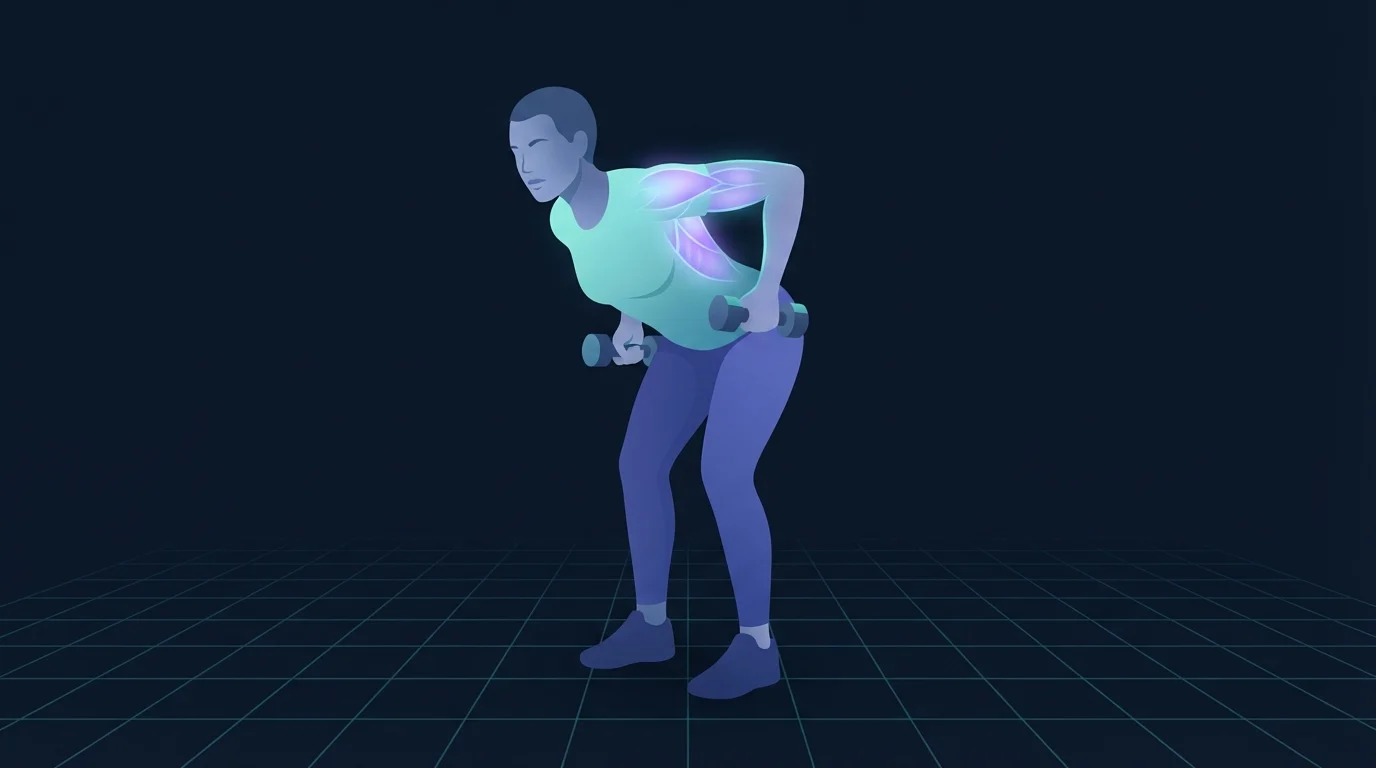
Exercise selection here is not a matter of taste. Cools and colleagues (2007) measured electromyography in 45 healthy adults across 12 common scapular exercises and ranked them by how much lower and middle trapezius they produced relative to upper trapezius. Side-lying external rotation, side-lying forward flexion, prone horizontal abduction with external rotation and prone extension came out on top. Those four shapes are what the table below is built from.
| Exercise | What it does | Dose |
|---|---|---|
| Bent-over dumbbell row | The main strength driver. Pause for a beat with the elbows past the ribs and the blades drawn together | 3 x 8 to 12, 2 to 3 days a week |
| Band pull-apart | High-rep rear shoulder and mid-back work you can do anywhere. Keep the elbows soft and the shoulders down | 3 x 15 to 20, most days |
| Face pull | Band anchored at eye height, pull toward your forehead and rotate the hands back. Trains external rotation at the same time | 3 x 12 to 15, 2 to 3 days a week |
| Prone Y raise | Lower trapezius in its best position. Lift with the arms in a Y, thumbs up, and stop when the ribs want to flare | 3 x 10 to 12, 2 to 3 days a week |
| Rear delt raise | Isolates the back of the shoulder, which rows tend to under-use once the arms take over | 3 x 12 to 15, 2 days a week |
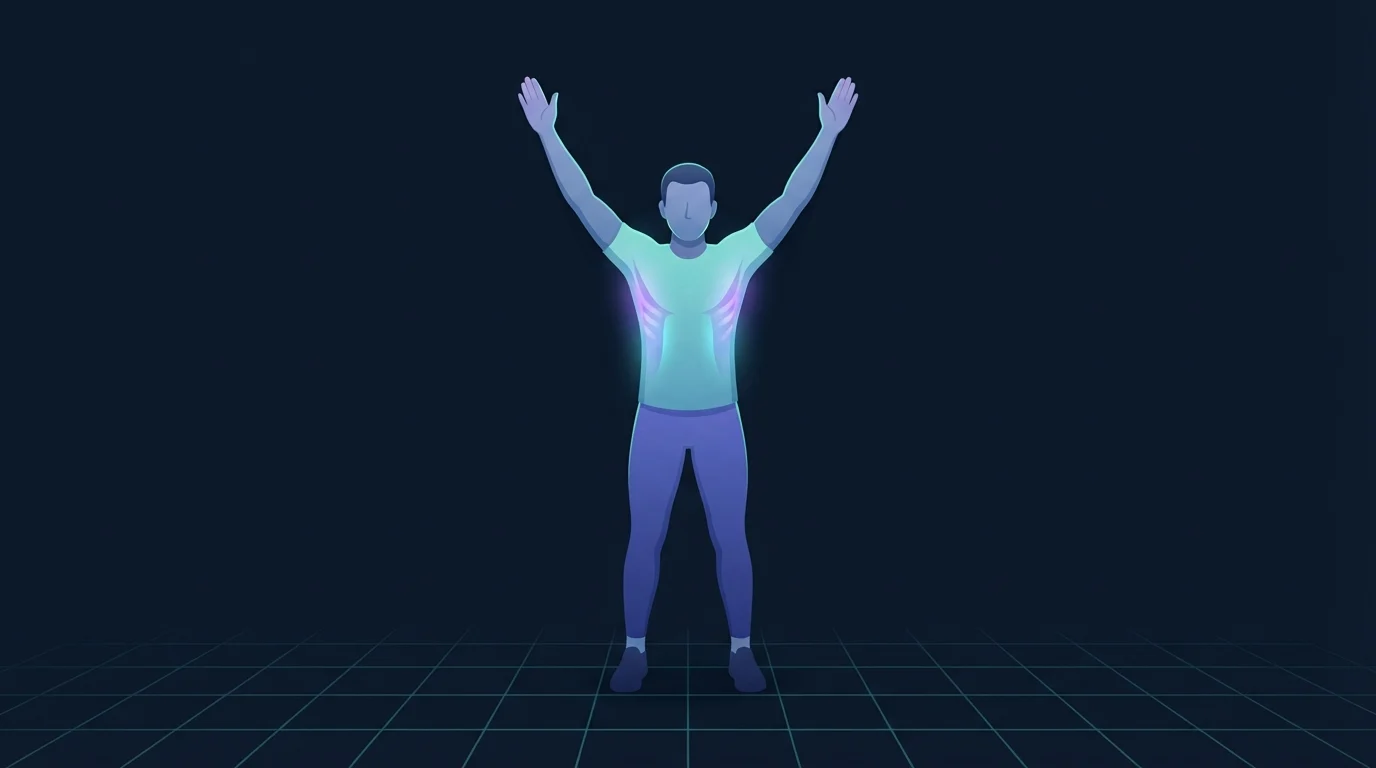
| Wall slide | Teaches the shoulder blade to rotate upward as the arm goes overhead. Forearms stay in contact, ribs stay down | 2 x 8 slow reps, most days |
| Doorway pec stretch | Forearm on the frame at shoulder height, step through, turn away. Do one set at shoulder height and one higher | 2 x 30 sec per side, daily |
| Thread the needle | Thoracic rotation, which is the range that makes the rest of it feel available | 6 reps per side, most days |
The wall slide earns its place on measurement rather than tradition. Hardwick and colleagues (2006) compared it against the push-up plus and scapular plane elevation in 20 adults and found serratus anterior activity climbed as the arm went higher during the wall slide, while the push-up plus plateaued near 90 degrees. Overhead is exactly where rounded shoulders run out of room, so the slide trains the range you are missing.
Two honest notes on the stretch. Rosa and colleagues (2017) ran a daily pectoralis minor stretching protocol for six weeks in 25 people with shoulder pain and 25 without. Pain and arm function improved significantly in the symptomatic group, and pectoralis minor length did not change in either group, nor did scapular kinematics. The stretch helps and the reason is probably not the one on the tin. Keep it, keep it brief, and do not expect it to do the job alone.
The 4-Week Plan
Two tracks. A daily 3-minute reset you do at your desk, and three short strength sessions that attach to whatever training you already do.
| Week | Strength sessions (3 per week) | Daily reset (3 minutes) |
|---|---|---|
| 1 | Row 3 x 10 light, band pull-apart 2 x 15, prone Y 2 x 10 | Doorway pec stretch 2 x 30 sec per side, wall slide 8 reps |
| 2 | Row 3 x 10 heavier, band pull-apart 3 x 15, prone Y 3 x 10, face pull 2 x 12 | Same, plus thread the needle 6 per side |
| 3 | Row 3 x 8 heavier, face pull 3 x 12, prone Y 3 x 12, rear delt raise 2 x 15 | Same |
| 4 | Row 4 x 8, face pull 3 x 15, prone Y 3 x 12, rear delt raise 3 x 15 | Same, then retake the side photo |
Two rules hold the whole thing together. Load the rows properly, because a set of 12 that never got hard changes nothing. And keep the ribs down on everything overhead, since arching the lower back is how the body fakes shoulder range it does not have.
Four weeks will make you feel different and will not finish the job. Ruivo and colleagues (2016) randomised 130 adolescents with forward head and protracted shoulder posture into a 32-week resistance and stretching program or a control group. The exercise group significantly improved both cervical and shoulder angles, and after 16 weeks with no training the gains were still there. That is the real timeline: months to change the resting position, and the change sticks once you have it.
If dumbbells are what you have at home, our dumbbell workout app page covers how a guided plan sequences pulling volume across a week. For the band-only version, the evidence on load equivalence is covered in our review of resistance band training research.
Desk Habits That Matter, and the Ones That Do Not
Ergonomics gets treated as the main event. It is a supporting act.
- Screen height. Top of the monitor at roughly eye level. A laptop on a desk puts your head down for eight hours, and a stand plus a separate keyboard is the cheapest fix in this article.
- Forearm support. Unsupported arms hang about 4 kg off each shoulder girdle all day. Armrests or a desk edge under the forearms removes that load.
- Phone height. Bring the phone up rather than the head down. You will not do this consistently, and it still helps when you remember.
- Move every 30 minutes. Two minutes standing or walking. The purpose is not calories, it is breaking the length of time in any one loaded position.
- Posture braces. Fine as a short cue, useless as a strategy. A brace holds the position for you, which is the opposite of training the muscles that should.
- Expensive chairs. A good chair is nice. No chair has ever strengthened a lower trapezius.
The broader posture picture, including standing desks and what results to expect, is covered in our guide to exercises for posture. If your shoulders feel stiff rather than weak, start with shoulder mobility exercises instead and come back to this plan once the range is there.
The Bottom Line
Rounded shoulders are a strength problem wearing a posture costume. Three sessions a week of rows, pull-aparts, prone Y raises and face pulls, a daily doorway stretch and a wall slide, and a photo every four weeks. That is the entire program, and it works whether or not your shoulders ever hurt.
You are not slouching because you lack discipline. You are slouching because the muscles that hold the other position have not been asked to do anything in years. Ask them, on a schedule, and they answer. If the schedule is the part that keeps collapsing, that is the problem worth solving first.
Frequently Asked Questions
How do you fix rounded shoulders?
Train the muscles that pull the shoulder blades back and down, and give the front of the chest something to lengthen into. The practical version is three upper back sessions a week built on rows, band pull-aparts, prone Y raises and wall slides, plus a daily doorway pec stretch. A randomised controlled study of 130 adolescents found that a structured resistance and stretching program significantly improved measured shoulder and cervical angles, and the improvement survived 16 weeks without training.
How long does it take to fix rounded shoulders?
Expect to feel taller within two weeks and to see a photo-visible change in about eight to twelve. The two-week change is mostly strength and awareness rather than structure. The trials that measured real change in shoulder angle ran for months, not days, which is the honest timeline for anyone selling you a two-week fix.
Do rounded shoulders cause pain?
The evidence is mixed and weaker than most people assume. A systematic review of thoracic posture and shoulder pain found moderate evidence of no significant difference in thoracic kyphosis between people with and without shoulder pain, and a study of 1,108 adolescents found no difference in the odds of neck pain across four distinct posture clusters. How the shoulder blade moves is a better predictor than where it sits: a meta-analysis of 419 athletes found scapular dyskinesis raised the risk of a future shoulder pain episode by 43 percent.
What muscles cause rounded shoulders?
Pectoralis minor and the front of the shoulder pull the shoulder blade forward and down, while the middle and lower trapezius, rhomboids and serratus anterior are the muscles that hold it back and flat against the ribs. Research on pectoralis minor resting length shows that a shorter resting length changes how the shoulder blade rotates during arm elevation. The useful target is the back side, because you can strengthen it, and strength changes are more durable than stretch changes.
What is the best exercise for rounded shoulders?
Prone or side-lying exercises that hit the lower and middle trapezius without recruiting the upper trapezius. An electromyography study of 45 healthy adults tested 12 common scapular exercises and found side-lying external rotation, side-lying forward flexion, prone horizontal abduction with external rotation and prone extension produced the most favourable ratios. In plain terms, a prone Y raise and a slow bent-over row beat shrug-heavy pulling every time.
Do posture correctors fix rounded shoulders?
A brace can remind you where your shoulders are, but it cannot make the muscles that hold them there any stronger. Wearing one as a cue for short stretches while you build the strength work is harmless. Relying on it instead of the strength work means you are renting a position rather than owning it, and the position leaves when the brace does.
Can you fix rounded shoulders at a desk job?
Yes, and the desk matters less than the training does. Set the top of your screen at eye level, get your forearms supported, and stand or walk for two minutes every half hour. Those changes reduce the amount of time you spend in one loaded position. The strength work is what changes the position you return to.