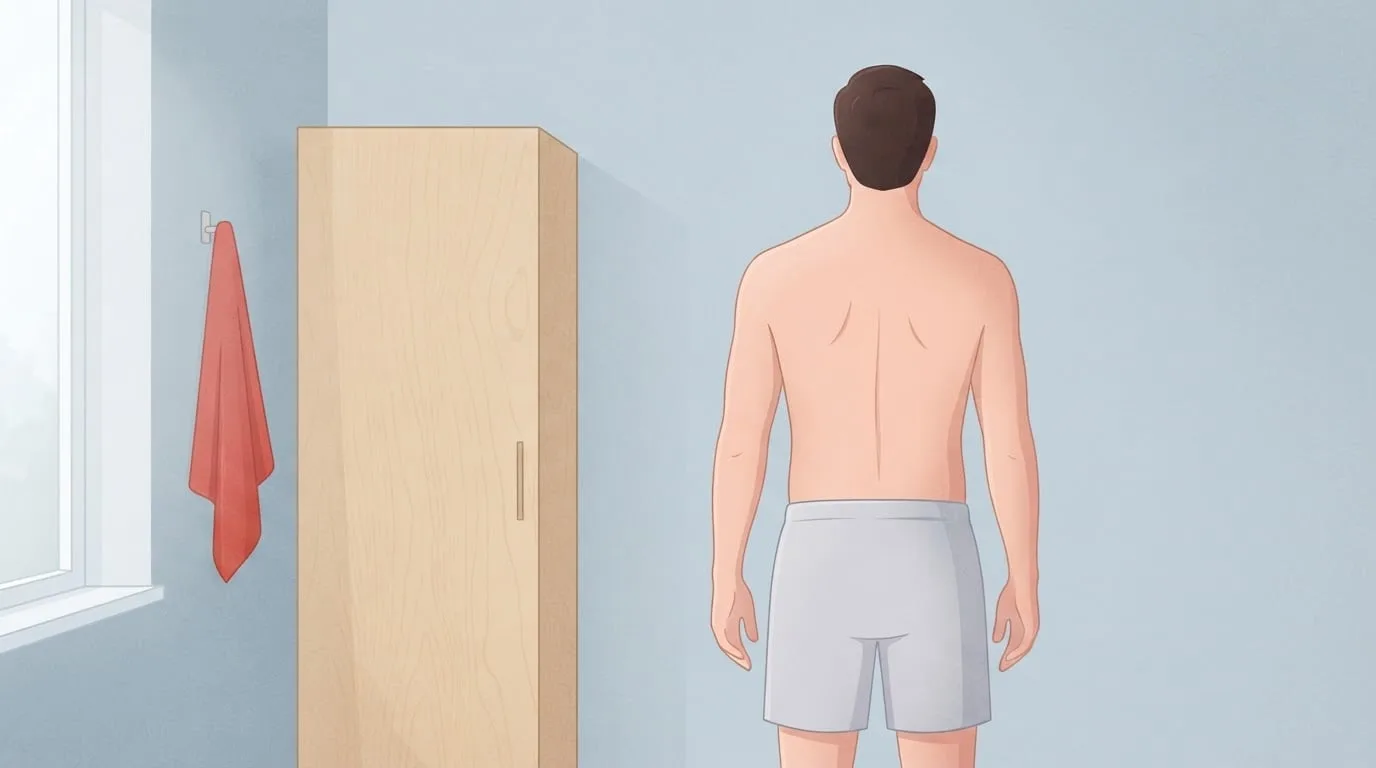
You usually notice it in a photo first. One strap of your top sits lower, one collarbone looks higher, or a shirt seam pulls toward one side. Once you've seen it, you see it in every mirror and every shop window.
Then the worry starts. Is your spine crooked? Did you do something wrong at the gym? Will it get worse? Most advice online jumps straight to a stretch for the high shoulder, without asking why that shoulder is high in the first place.
Uneven shoulders are rarely a sign that something is broken. Most of the time they're a record of how you use your body: the hand you write with, the shoulder your bag lives on, the side you tense when you're stressed. Change those inputs, train both sides on purpose, and the line usually evens out. Below you'll find the causes, what's normal, a mirror and photo check, the red flags, a 6-step plan and an honest timeline.
What Causes Uneven Shoulders?
The causes fall into two groups: how you use your body, which you can change, and how your skeleton is built, which exercise can't change. Here they are in rough order of how often they show up.
Hand dominance and one-sided sports
Your dominant arm does more of the lifting, carrying, throwing and reaching, and the shoulder adapts to that work. In skilled tennis players, Priest and Nagel (1976) described a lower shoulder on the playing side and put it down to stretched shoulder-lifting muscles and a heavier, more muscular arm. Oyama and colleagues (2008) measured resting shoulder blade position in 43 healthy college athletes who throw, hit or serve overhead. On the dominant side the shoulder blade sat more rotated and tipped forward, and in the tennis players it also sat further around the ribcage. The authors concluded that this kind of asymmetry may simply be normal in people who use one arm far more than the other.
Carrying a bag on one shoulder
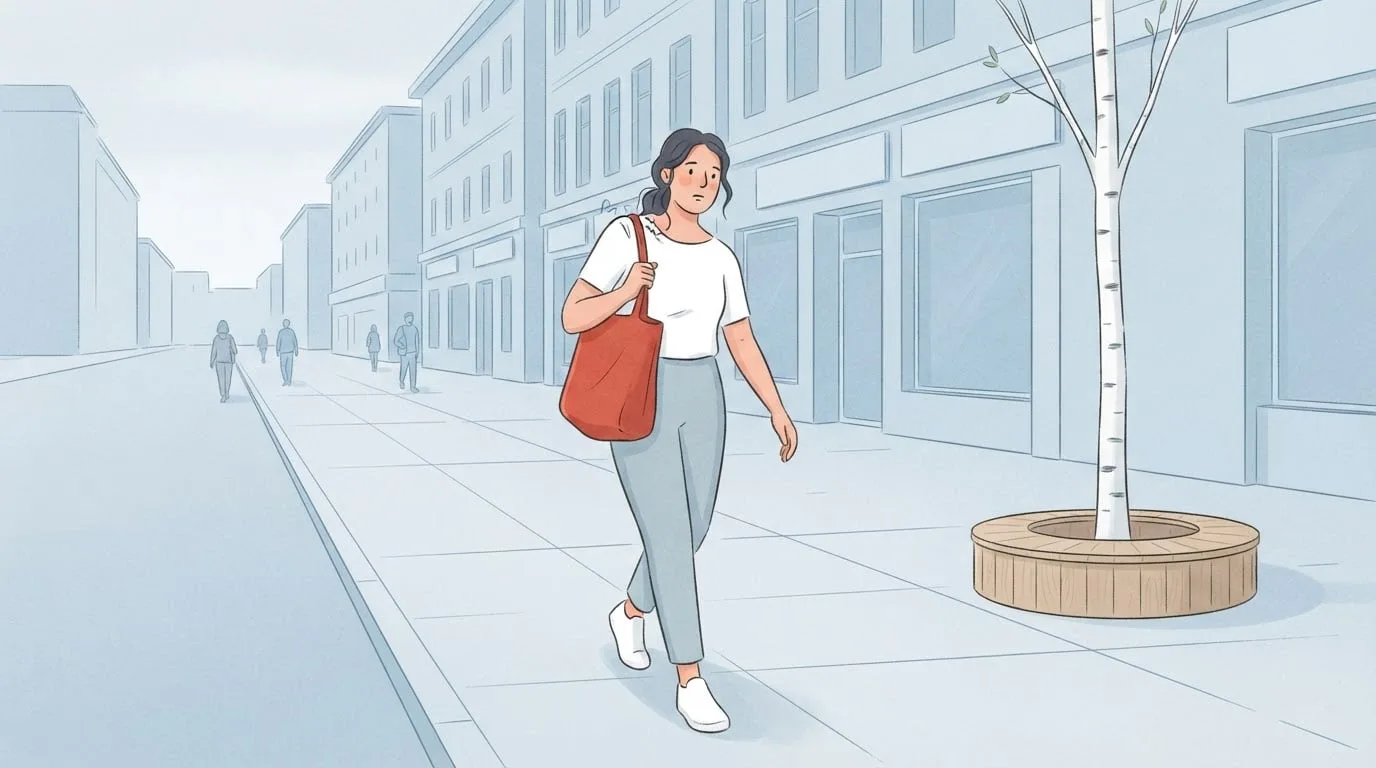
A bag that always hangs from the same shoulder makes that shoulder hitch up to hold it. Pascoe and colleagues (1997) filmed children aged 11 to 13 carrying school bags in different ways. With a one-strap bag over one shoulder, the shoulder line tilted about 17.6 degrees from level, compared with about 2 degrees carrying nothing and 3.4 degrees with a backpack worn on both shoulders. The spine also bent sideways by about 8.5 degrees. That was posture while carrying, not a permanent change, but it shows how hard one strap pulls the shoulder line out of level, several times a day, for years. Cradling a phone between your ear and shoulder, a laptop bag on the same side every commute and a toddler always on the same hip work the same way.
A tense upper trap on one side
The upper trapezius lifts the shoulder, and stress switches it on. Lundberg and colleagues (1994) recorded trapezius activity in 62 women and found that two mental stress tasks, mental arithmetic and a color-word test, raised it significantly with no physical work involved. It rose further when the stress came on top of a physical task. If you hold one shoulder up while you type, drive or concentrate, that side's trap gets hours of practice at being short and busy. This is often what people mean when they say one trap is higher than the other.
Where the shoulder blade sits
The height of your shoulder is really the height of your shoulder blade, which floats on the back of your ribcage, held in place by muscle. If one blade rests a little lower, more rotated or further around the ribs, that shoulder looks lower or more forward. Clinicians call uneven shoulder blade movement scapular dyskinesis, and it's common in people without any pain. Plummer and colleagues (2017) examined 135 adults and saw it in 67% of those with shoulder pain and in 53% to 62% of those without it, a difference too small to be statistically significant. They suggested that some of it is ordinary variation in how people move.
Scoliosis and a leg-length difference
These two are structural, so exercise won't change them. Adolescent idiopathic scoliosis is a sideways curve of the spine that shows up during growth, and it affects between 0.47% and 5.2% of young people depending on the study (Konieczny and colleagues, 2013). Larger curves are far more common in girls. Curves are common later in life too: in volunteers with an average age of 70.5, 68% had a curve of more than 10 degrees on an X-ray (Schwab and colleagues, 2005).
A difference in leg length tilts the pelvis, and the spine above it bends to keep your head level, which can show up at the shoulders. Small differences are nearly universal. A review by Knutson (2005) found that about 90% of people have one, averaging 5.2 mm, and that it doesn't seem to matter clinically for most people until it reaches about 20 mm, roughly three-quarters of an inch.
Is It Normal to Have One Shoulder Higher Than the Other?
Yes, within limits. Akel and colleagues (2008) photographed 91 healthy teenagers aged 10 to 18 and took a chest X-ray at the same visit. Every one of them said on a questionnaire that their shoulders were level. The photos showed that only 17 of them, 18.7%, actually had level shoulders, and the average height difference was 7.5 mm, just under a third of an inch. The authors put it plainly: in healthy adolescents, shoulder balance often doesn't exist.
So a small difference you only spot in photos sits inside the normal human range. What matters more is whether the gap is big enough to see at a glance, whether it's growing, whether it comes with a curve in your back, and whether anything hurts or feels weak. Steps 1 and 2 below sort that out.
Why Is One Shoulder Bigger Than the Other?
Usually because one arm has done more work for longer. Sanchis-Moysi and colleagues (2012) used MRI to measure arm muscle volume in 7 boys of about 11 who played tennis and 7 inactive boys. The tennis players' dominant arm had 13% more muscle than their other arm, and their dominant deltoid, the muscle that caps the shoulder, was 11% bigger. The inactive boys had a 3% difference between arms. A bigger shoulder can also look higher, because the extra muscle sits on top of the joint.
A size difference built by years of one-sided use isn't a problem in itself. If it bothers you, the approach is the same as for height: train the smaller side through its full range, match the reps on both sides, and give it months rather than weeks.
Step 1: Check Your Shoulders With a Mirror and a Photo
Your eyes get used to your own reflection, which is why every teenager in the Akel study believed their shoulders were level. A photo is more honest, and it gives you a starting point to compare against.
- Set up. Stand barefoot on a hard floor, feet hip-width apart, arms hanging loose, eyes straight ahead. Don't straighten up for the camera. Take a few breaths and let your shoulders settle where they usually sit.
- Compare the bony landmarks. Look at the tops of your shoulders, the line of your collarbones and the distance from each earlobe down to the top of the shoulder on that side.
- Check your hands. Notice whether one hand hangs lower against your thigh, or further in front of your hip, than the other.
- Check your waist and hips. Compare the gap between each arm and your waist, then rest your hands on the bony fronts of your hips. A bigger gap on one side, or one hip clearly higher, points lower down, toward the spine or the legs.
- Take two photos. Take one from the front and one from behind, with the camera at chest height on a shelf and a timer running so your arms stay down. In the back view, see whether one shoulder blade sits higher, lower or sticks out further than the other.
- Do the forward bend with a partner. Bend forward from the hips with your arms hanging and your knees straight while someone looks along your back from behind. One side of the ribcage or lower back sitting higher than the other is the sign doctors look for when they screen for scoliosis.
Write down which shoulder is higher and roughly by how much. Then decide which side is doing what. The higher shoulder isn't always the one at fault: it may be held up by a busy trap, or the other side may droop because its muscles are weaker. A trap that feels tight and tender while you're relaxed is usually being held up. A shoulder that hangs lower, with a longer line from neck to shoulder tip, is usually drooping. The plan below trains both sides either way. Retake the same photos in the same spot and light every four weeks, because comparing photos beats comparing memories.
Step 2: Rule Out the Causes Exercise Can't Fix
See a doctor or physical therapist before you try to fix it yourself if any of these apply:
- The forward bend shows a rib hump, or one side of the back sitting clearly higher.
- The person with uneven shoulders is a child or teenager who's still growing, because that's when scoliosis is usually found and when a curve can progress.
- The difference is new, or clearly bigger than it was a few months ago.
- One hip, one waist crease or one leg looks clearly different from the other, or you walk with a limp.
- One shoulder blade sticks out like a wing, or one shoulder started drooping after a neck injury or neck surgery.
- Pain wakes you at night, or you have numbness, tingling or weakness in an arm.
An X-ray or a measured leg length answers the structural question in one visit. If it turns out to be scoliosis, general exercise isn't a treatment for the curve. A 2024 Cochrane review of 13 randomized trials and 583 adolescents (Romano and colleagues) was very uncertain whether therapeutic exercise reduces the curve at all, so any scoliosis-specific program belongs with a specialist who's monitoring it. Staying strong and active is still worth it, and your specialist can tell you what's safe. For a real leg-length difference, a clinician can measure it and decide whether a shoe lift makes sense.
Step 3: Change the Habits That Load One Side
A few training sessions a week can't outvote a habit you repeat all day, so start here.
- Use both straps, or switch sides. In the Pascoe study, a backpack on both shoulders tilted the shoulder line about 3.4 degrees, against 17.6 degrees for a one-strap bag. If your bag has one strap, wear it across your body, swap shoulders at every stop, or carry it by the handle and swap hands.
- Lighten the bag. Carry what you need today, not everything you might need this week. A lighter bag gives that shoulder less reason to hitch.
- Stop cradling the phone. Use the speaker or earbuds for long calls instead of trapping the phone between your ear and shoulder.
- Bring the mouse closer. A mouse parked far out to one side holds that arm forward and that shoulder up for hours. Keep it next to the keyboard. OSHA's workstation guidance has elbows close to the body and bent between 90 and 120 degrees.
- Catch the stress shrug. Pick a cue you hit many times a day, such as sending a message or stopping at a red light. Breathe out slowly and let both shoulders drop.
- Share chores between sides. Carry groceries in both hands, alternate the hip you hold a child on, and switch the side you vacuum, rake or shovel from.
Desk setup matters for the rest of your posture too. Our guide on how to stop slouching covers chair height, screen height and phone habits in detail.
Find out what's really holding you back
FitCraft, our mobile fitness app, pairs you with an AI coach who builds you a personalized plan around your goals, schedule, and fitness level. Every FitCraft program is designed by Domenic Angelino, MPH (Brown University) and NSCA-CSCS, with research published in the Journal of Strength and Conditioning Research and Medicine & Science in Sports & Exercise.
Take the Free Assessment Free • 2 minutes • No credit cardStep 4: Train One Side at a Time With Dumbbells
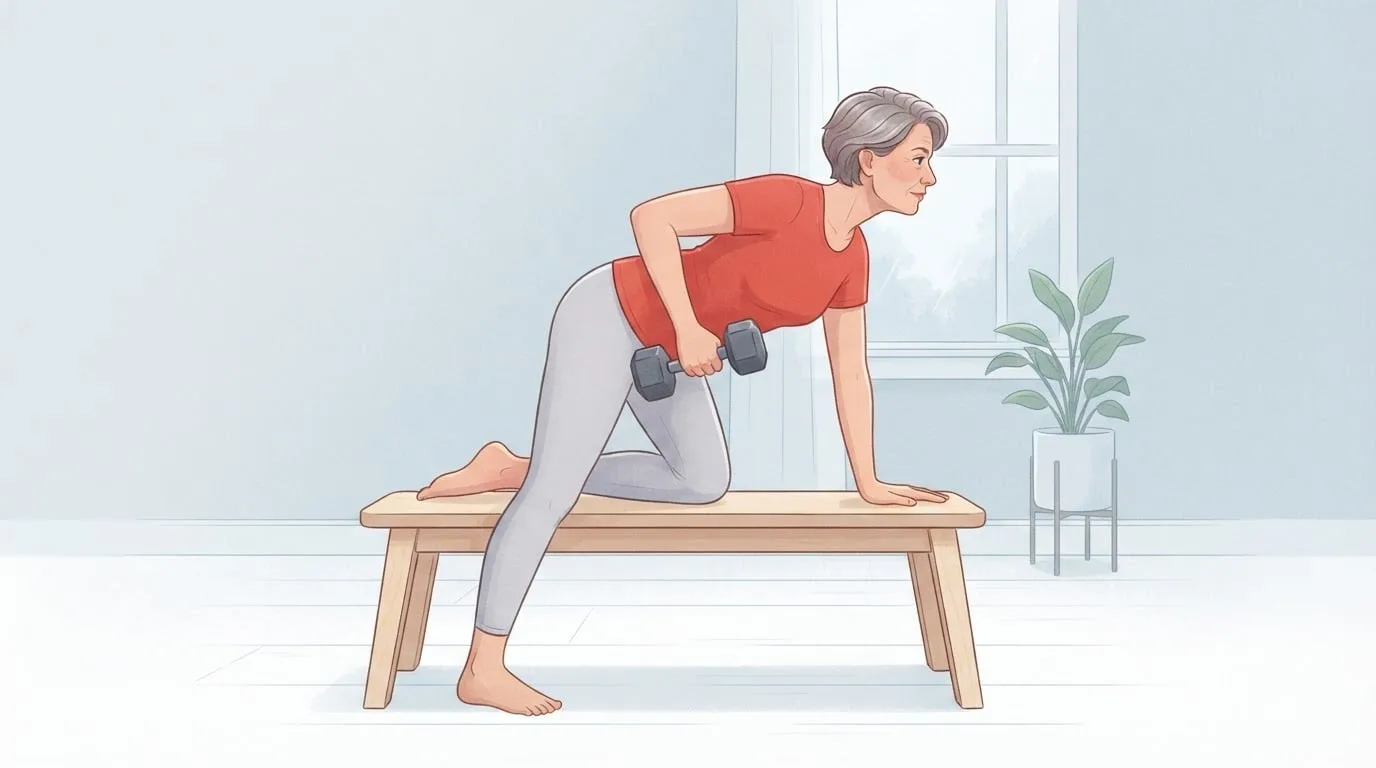
Two-handed exercises let your stronger side quietly do more of the work. One-arm exercises make each side carry its own load, and they show you the gap: the side that runs out of reps first, or needs a lighter dumbbell, is the one to bring up. Four rules keep it fair:
- Start every exercise with the weaker side, then stop the stronger side at the same number of reps, even if it could do more.
- Use the weight the weaker side can handle with good form, on both sides.
- Add one extra set for the weaker side only if it's still more than a couple of reps behind after two or three weeks.
- Face a mirror for the first few sessions so you can see whether the working shoulder creeps up toward your ear.
Training one side also helps the other side a little. A meta-analysis of 16 controlled studies (Carroll and colleagues, 2006) found that training one limb raised strength in the untrained limb by about 8% of its starting strength, around half of what the trained side gained. That effect is called cross-education, and it comes mostly from the nervous system. It's one reason a side-to-side gap closes slowly: both sides improve, and the weaker side gains ground only because it works a little harder.
| Exercise | Why it helps | Dose |
|---|---|---|
| One-arm dumbbell row | Each side's mid back and lats pull on their own. Pause at the top with the shoulder blade drawn back and down. | 3 sets of 8 to 12 per side |
| Half-kneeling one-arm dumbbell press | Each shoulder presses overhead alone while your trunk resists leaning to the side. | 3 sets of 8 to 10 per side |
| One-arm prone Y raise | Works the lower trapezius, which pulls the shoulder blade down and around the ribs. Thumb up, neck long. | 2 sets of 10 per side |
| Side plank | Trains the muscles along each side of the trunk that keep the ribcage level under the shoulders. | 3 holds of 20 to 30 seconds per side |
| Upper trap stretch on the high side | Eases a trap that's been held up all day. Tilt your ear away and let that shoulder sink. | 2 holds of 30 seconds, daily |
Do the strength exercises two or three times a week on non-consecutive days. With the carries in Step 5, the whole session takes about 15 to 20 minutes.
If you'd like this kind of work planned for you, FitCraft's strength workouts use dumbbells and bodyweight, and an AI coach demonstrates each exercise on an interactive 3D model with pinch-and-zoom camera control, so you can study a row or a press from more than one angle before you start. Workouts adjust as you progress, and streaks reward the steady sessions a slow fix like this needs. Our page on the dumbbell workout app explains how the programs progress. As one user, Tim, put it: "I didn't think an app could replace my trainer. My AI coach proved me wrong."
Step 5: Add Single-Side Carries
A suitcase carry is a walk with one dumbbell held at your side. The weight tries to pull you down toward it, so the muscles on the opposite side of your trunk and the shoulder holding the weight both have to work to keep you level. It turns standing evenly into a skill you practice under load. Our review of farmer's carry research covers the muscle-activity data on suitcase carries compared with two-handed carries.
Keep the load moderate. McGill and colleagues (2013) calculated spine loading in six people walking with buckets. Carrying 30 kg in one hand put more than 2,800 newtons of compression on the low back, against 1,570 newtons when the same 30 kg was split between both hands, and even 30 kg in each hand loaded the spine less than 30 kg in one. That one-sided pull is exactly what trains your trunk, which is why the weight should stay modest. Start with a dumbbell you could hold at your side for about a minute.
- Hold a dumbbell at your side with your arm straight, both shoulders level and your ribs stacked over your hips.
- Walk 20 to 30 steps, or about 30 seconds, without leaning toward or away from the weight. Don't let the loaded shoulder drop or shrug.
- Put the dumbbell down, switch hands and walk back.
- Do 3 or 4 rounds per side at the end of your dumbbell session.
Walk toward a mirror or a dark window for the first few rounds so you can see whether both shoulders stay level.
Step 6: Keep Training Both Sides of the Upper Back
Uneven shoulders and rounded shoulders often turn up together, and the two-sided upper-back work for that's already laid out on this site. Our guide on how to fix rounded shoulders gives rows, band pull-aparts, prone Y raises and wall slides with dosing and a 4-week plan, and our guide to exercises for posture explains what that kind of routine does and doesn't change. Keep one or two of those moves in each session alongside the one-sided work above, so you're evening out the two sides without neglecting the back as a whole.
How Long Does It Take to Fix Uneven Shoulders?
It depends on the cause, which is why Step 1 and Step 2 come first.
- Habit-driven gaps (a one-strap bag, a phone on the shoulder, a stress shrug) can look better within a few weeks of changing the habit, because the muscles are holding a position rather than the bones having changed.
- Strength gaps usually need two to three months of training two or three times a week before the difference in your photos is clear. The posture trials summarized in our guide to exercises for posture measured their changes at 8 to 12 weeks and beyond.
- Muscle-size gaps from years of one-sided sport take months to narrow and may never match exactly, which is fine.
- Structural causes such as scoliosis or a real leg-length difference won't change with exercise. A professional manages those.
Retake your photos at weeks 4, 8 and 12. If you've changed the habits, trained consistently and nothing has moved at 12 weeks, that's a good reason to get checked.
The Bottom Line
To fix uneven shoulders, find the cause before you pick an exercise. Check yourself relaxed in a mirror and in photos, rule out scoliosis and a real leg-length difference, and change the habits that load one side, such as one-strap bags and phone cradling. Then train each side on its own with one-arm rows and presses, side planks and suitcase carries two or three times a week, weaker side first, and keep some two-sided upper-back work in the mix.
A small difference is normal, and a perfectly level line isn't the goal. A stronger, more even pair of shoulders that you've trained on purpose is. Give it 8 to 12 weeks, compare the photos, and let the evidence tell you whether it's working.
Frequently Asked Questions
Why are my shoulders always raised?
Shoulders that ride up toward your ears are usually held there by the upper trapezius, and stress is a common trigger. In a lab study of 62 women, mental stress tasks raised trapezius muscle activity even when they weren't doing any physical work. A desk or armrests set too high, cold and a long day of concentration add to it. Pick a cue you hit often, breathe out slowly and let both shoulders drop.
Can one shoulder being higher than the other cause neck pain?
There's no good evidence that a small height difference causes neck pain on its own. Most people have one, usually without pain: only 18.7% of 91 healthy teenagers in one study had truly level shoulders. Pain can also work the other way, with a sore neck making you hold that shoulder up. If neck pain lasts more than a few weeks, spreads into the arm or comes with numbness or weakness, see a doctor or physical therapist.
Can a chiropractor fix uneven shoulders?
A chiropractor, physical therapist or doctor can check for the structural causes, such as scoliosis or a leg-length difference, and that check is worth having. There's no trial evidence that spinal manipulation permanently changes how high a shoulder rests. What lasts is changing the one-sided habits behind the gap and training each side on its own for a few months.
Why is one trap higher than the other?
One trap usually looks higher because that shoulder is being held up, by a bag strap, a phone cradled against your ear or a stress shrug, or because the muscle is bigger on your dominant side. Less often, a curve in the spine tilts the shoulder line. Check yourself relaxed in a mirror and a photo, change the habit that hikes that side, and train both sides one at a time with the same reps.
Why is one collarbone higher than the other?
Your collarbone follows your shoulder blade, so one collarbone sitting higher usually means that whole shoulder rests higher, for the same reasons as uneven shoulders in general: hand dominance, one-sided carrying or a tense upper trap. A collarbone that healed after a break can also sit differently. A difference you can see at a glance, or one that comes with a curve in the back or a rib hump, should be checked by a professional.
How do you fix misaligned shoulders?
Find out which kind of misalignment you have first. If one shoulder sits higher, change the one-sided habits behind it and train each side alone with one-arm dumbbell rows, presses, side planks and suitcase carries. If both shoulders roll forward, the fix is upper-back strengthening on both sides. If a professional finds scoliosis or a leg-length difference, follow their plan, because exercise alone doesn't straighten bone.