The farmer's carry is deeply unglamorous. You pick up two heavy objects, you walk, you put them down. There is no eccentric-tempo prescription, no rep range to obsess over, no periodization spreadsheet that transforms the exercise. It is the closest thing modern strength training has to actual manual labor. That is also why it works, and why the exercise-science literature has been quietly building a case for it for two decades.
What most people miss about carries is not that they are hard. It is that they are unusually efficient for how simple they are. In a single 40-meter walk, the same load challenges the forearms and hands (grip endurance under fatigue), the trunk (continuous anti-lateral-flexion and anti-rotation work while the body swings side to side with each step), the lower back and hips (posture maintenance under a heavy pulling load), and the lower body (stance-phase force absorption and swing-phase propulsion). Very few other exercises hit all four of those systems in the same set.
This article walks through what the actual research on farmer's carries and loaded carries shows, where the evidence is strong (grip, trunk activation, functional force output), where it is more nuanced (transfer to running, hypertrophy claims, spinal loading), and how to program the exercise for someone who is not planning to compete at the World's Strongest Man.
The Research: What Studies Show
Winwood 2014: Biomechanics vs. the Deadlift
The most direct biomechanical comparison between the farmer's walk and a "reference" barbell lift is Winwood, Cronin, Brown, and Keogh (2014), published in the International Journal of Sports Science and Coaching. Six experienced male strongman athletes performed both farmer's walks and conventional deadlifts at 70 percent of their deadlift 1RM. Motion capture and force plates measured joint kinematics and ground reaction forces at the lift-off phase, knee pass, and lockout.
Two findings from that study matter for how you should think about the exercise. First, the farmer's walk produced significantly greater mean vertical and anterior ground reaction forces than the matched deadlift. That is counterintuitive on face because the deadlift is the heavier compound movement, but the walk generated higher forces because each stride is essentially a repeated single-leg lift under load, which stacks impact and propulsion forces on top of the static load. Second, at knee pass, the farmer's walk showed greater trunk extension, thigh angle, knee flexion, and ankle dorsiflexion than the deadlift, meaning the athlete was in a more upright posture with more knee bend. The authors interpret that as potentially reducing lumbar shear compared with the more hip-hinged deadlift position. Carries are one piece of a larger picture, and our guide on how to increase grip strength shows where they sit alongside dead hangs, towel work and plate pinches.
Compared with unloaded walking, the same paper found that farmer's walks produce greater peak forces, greater stride rate, shorter stride length, shorter ground contact time, and shorter swing time. In practical terms, the carry forces you into a faster, choppier gait pattern under load, and it does so with much higher force output at each foot strike than a normal walk. If you have wondered whether a farmer's carry "counts" as cardiovascular work in addition to strength work, this data is part of why the honest answer is yes.
McGill 2009: How the Trunk Actually Works Under Load
The foundational EMG paper on strongman-style loaded carries is McGill, McDermott, and Fenwick (2009), published in the Journal of Strength and Conditioning Research. The team recorded surface EMG on multiple torso and hip muscles plus kinematics during eight strongman events, including the farmer's walk, the yoke, the suitcase carry, the keg walk, and the Atlas stone lift. The muscle activation data was fed into an anatomically detailed torso model to estimate low-back load, lumbar stiffness, and hip torque.
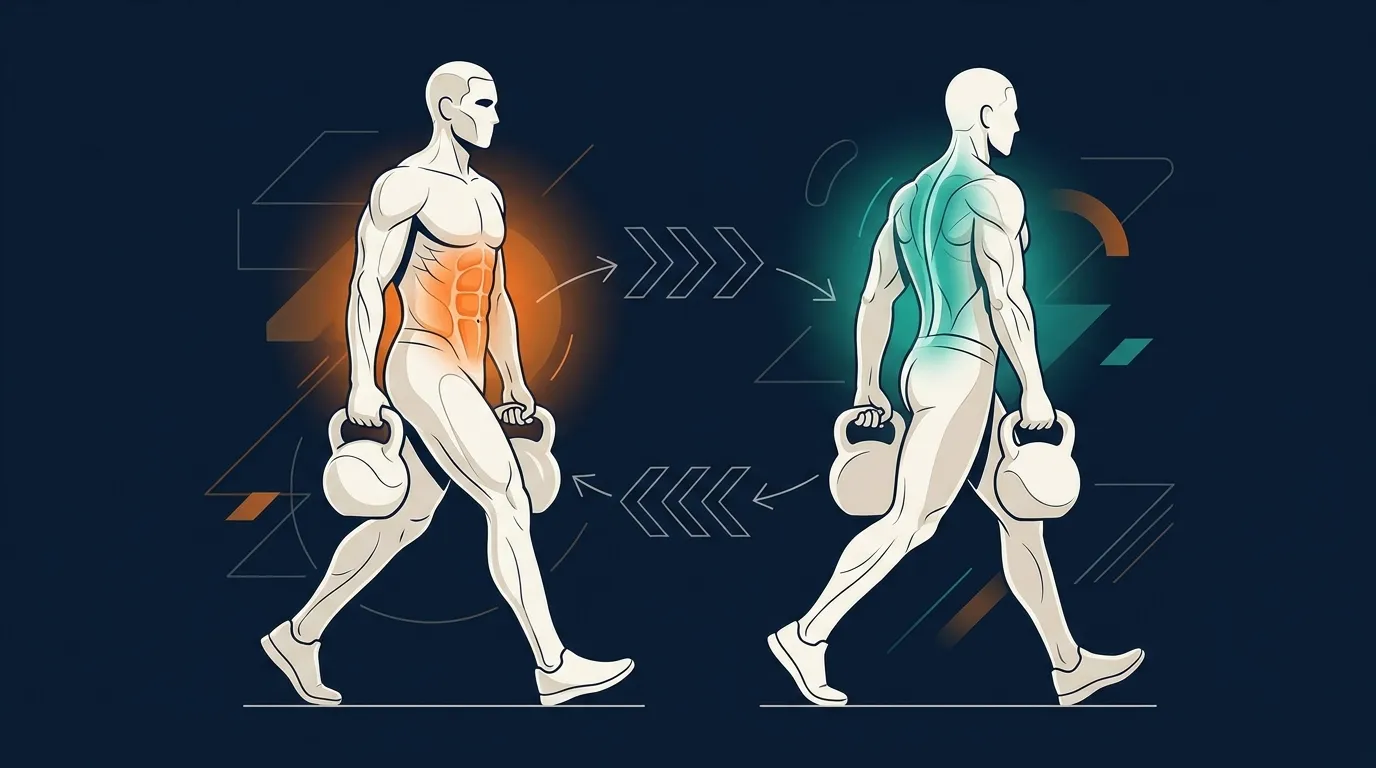
The pattern that matters for the farmer's walk is the temporal choreography of trunk activation across the gait cycle. Peak activation of the rectus abdominis and external obliques happened during stance phase, when the loaded leg was on the ground and the trunk had to resist collapsing toward that side. Peak activation of the latissimus dorsi, thoracic erector spinae, and lumbar erector spinae happened during swing phase, when the same-side arm and the load were driving forward and the spine had to resist rotation. The trunk is essentially working in two coordinated modes on every stride: anti-lateral-flexion on stance, anti-rotation on swing.
That is a different training pattern than a plank, a dead bug, or a Pallof press produces. A plank asks the trunk for a sustained isometric hold. A carry asks it for continuous rapid stabilization against a load that is trying to twist and pull the spine out of neutral, ten to twenty times per set, under whatever total mass you loaded into your hands. Both belong in a well-built program. The carry is closer to how the trunk actually has to work in life and sport, which is why it made the McGill list of "big three plus loaded carries" for spine-safe training.
Ellestad 2024: Carrying Beats Holding
One of the underappreciated questions about carries is whether the walking itself matters, or whether standing in one place holding the same load would do the same thing. Ellestad, Holcomb, Swiergol, Holmstrup, and Dicus (2024), published in the International Journal of Exercise Science, tested that directly. Participants completed time- and intensity-matched randomized sets of a plank, a farmer's carry, a suitcase carry, a farmer's hold, and a suitcase hold, with surface EMG on the rectus abdominis, external obliques, longissimus, and multifidus bilaterally.
The finding: the farmer's carry produced higher bilateral activation of the longissimus, multifidus, rectus abdominis, and external obliques than the matched farmer's hold. The suitcase (unilateral) carry produced increased activation on top of the bilateral pattern, particularly on the ipsilateral side. Standing still with the same weight was measurably less demanding on the trunk than walking with it, and the unilateral load added a targeted lateral stability challenge that the bilateral version did not.
That result answers a common program-design question. If you have five minutes at the end of a session and can either add planks, farmer's holds, or farmer's carries, the carries win on trunk activation per unit of time. If you also want to expose left-right asymmetries in trunk stability, the suitcase carry is the more specific tool.
Loaded carries also show up as a scored 200-metre station in fitness racing, which is why plenty of recreational lifters now train them for distance rather than for time: our guide to the eight stations in a HYROX race lists the loads each division has to move.
Winwood 2011: What the Practitioners Actually Do
Ergogenic literature is not the only useful evidence. Practice patterns from athletes who have to make the exercise work in the real world under a strength coach's supervision are also informative. Winwood, Keogh, and Harris (2011), publishing in the Journal of Strength and Conditioning Research, surveyed 167 strongman competitors across local, national, and international levels about their training practices.
Ninety-six point four percent reported training the farmer's walk. That is a higher adoption rate than any other implement event in the survey, higher than the yoke, log press, tire flip, or Atlas stones. Ninety-seven percent of competitors included maximal strength training in their overall program and ninety percent included power training, meaning the carry was not being used as a filler exercise; it was being used alongside heavy pulls and presses as a core training tool for the sport itself.
The practical read-across for a non-competitor is that if the exercise is broad enough and specific enough to be nearly universal among the people who load it the heaviest for a living, the exercise has clear utility even at the more modest loads a general population will use.
Leong 2015 PURE Study: Grip Strength as a Longevity Signal
The strongest general population data underneath carries is not a training study at all. It is the epidemiology on grip strength as an all-cause mortality predictor. Leong, Teo, Rangarajan, and colleagues (2015), publishing in The Lancet as part of the Prospective Urban Rural Epidemiology (PURE) study, followed 139,691 adults from 17 countries for a median of about 4 years. Grip strength was measured at baseline with a handheld dynamometer.
Each 5 kg reduction in baseline grip strength was associated with a 16 percent higher risk of all-cause mortality, a 17 percent higher risk of cardiovascular mortality, a 17 percent higher risk of non-cardiovascular mortality, a 7 percent higher risk of myocardial infarction, and a 9 percent higher risk of stroke. In the same dataset, grip strength was a stronger predictor of both all-cause mortality and cardiovascular mortality than systolic blood pressure was.
Two important caveats. First, PURE is observational. The finding is that grip strength is a marker of overall physiological reserve, not that gripping harder in the gym directly extends your life. Second, most people who have low grip strength also have lower overall muscle mass, lower physical activity, and often lower socioeconomic status, all of which independently predict worse outcomes. Grip is a signal, not the mechanism. What it is a signal of, though, is exactly what a farmer's carry trains: whole-body strength, forearm mass, and the capacity to sustain load. Building that capacity is one of the more defensible things a program can chase for someone in the second half of life.
Hindle 2019: The Systematic Review
The best synthesis paper in this space is Hindle, Lorimer, Winwood, and Keogh (2019), publishing in Sports Medicine - Open. The review pulled together the biomechanical and applied literature on strongman implements including the farmer's walk. Two practical points came out of it that a program designer should know.
First, higher performing athletes in the farmer's walk were characterized by greater stride length and greater stride rate with reduced ground contact time. The exercise rewards technique, not just raw carrying strength. Second, on the anthropometric side, flexed arm girth, muscle mass, and total system force were reported as the biggest performance determinants. The carry is not primarily a technique exercise; it is a muscle mass and force expression exercise, wrapped in a technique that lets you sustain that expression for distance.
The review also flagged the loaded carry's relevance to occupational and military populations that have to move heavy objects over distance in the real world, an application space where the barbell lifts do not translate as cleanly and where the carry is one of the closest lab-friendly analogs.
How Farmer's Carries Actually Work
The mechanism is not one thing. It is four things happening at the same time under a single external load, and the training effect is the sum.
Grip. Holding two heavy weights for 30 to 40 meters is a sustained maximal isometric contraction of the forearm flexors and finger flexors. The load does not come down between reps. That produces a training stimulus grip-specific work with a dumbbell or a static hold at the top of a deadlift cannot easily match, because those either end quickly or use a lighter load. The Leong PURE data connects that grip capacity to global strength and to mortality risk stratification, which is one of the reasons grip training keeps showing up in longevity-focused programs.
Trunk. Every stride under load requires the trunk to resist a load that is trying to bend the spine sideways toward the stance-leg foot and rotate the torso toward the swing-leg shoulder. Both of those forces reset with every step. The McGill (2009) data shows the abdominals and obliques firing hardest on stance and the erectors and lats firing hardest on swing, meaning the trunk is doing anti-lateral-flexion and anti-rotation work in alternating rhythm across an entire walk. The Ellestad (2024) EMG data shows the walking version doing this more than the static hold does. This is closer to the trunk's real job in sport and life than most isolation ab work is.
Posterior chain and lower body. The Winwood (2014) biomechanics data measured greater mean vertical and anterior ground reaction forces than a 70 percent 1RM deadlift, because each stride is a mini single-leg lift under load. The stance phase requires the glutes and quads to absorb and re-express force at a higher magnitude than an unloaded walk while the erectors keep the spine neutral. Over a 40-meter set, that is a lot of accumulated single-leg force under a heavy static load.
Aerobic and metabolic load. The heart rate response to a heavy 40-meter carry is substantial, though not the primary reason to do them. Sustained near-maximal forearm contractions plus large-muscle-group work under load elevate demand on the cardiorespiratory system in a way that is closer to a heavy prowler push than to a warm-up set. Loaded carries can act as a strength-endurance stimulus that pushes the aerobic base without dedicated cardio programming, which is one reason they are common in tactical and general-preparation contexts.
Why This Matters for Your Fitness
The farmer's carry is one of the most time-efficient exercises available for anyone whose goal is to be strong, capable, and injury-resilient rather than to move a maximum barbell weight for one rep. It builds grip, trunk stability, and lower-body force output under a single stimulus, and it does so in a movement pattern that maps directly onto the demands of ordinary life: picking things up, carrying things over distance, not falling over while carrying things.
For older adults, the case is arguably even stronger. Grip strength is one of the highest-priority training targets in populations at risk for sarcopenia and age-related muscle loss, and the Leong (2015) mortality data adds a second reason to care about it. Carries load the whole system in a way that respects the joint tolerances of most older adults, in that the spine stays vertical, the joints move through short ranges, and the load is easy to drop safely if a step goes wrong. Compared with heavy bilateral barbell work, carries are relatively low-risk per unit of training stimulus.
For runners, the transfer story is more nuanced. The gait pattern of a heavy farmer's walk (short strides, high stride rate, upright posture, high vertical impact) is not a running gait, so the exercise does not directly train running mechanics. What it can do is build the trunk stability, hip strength, and posterior-chain resilience that supports running economy and reduces the impact-load penalty of long training weeks. Combined with more running-specific work like a structured run-walk build-up or basic single-leg strength, carries are a good general-preparation piece for a runner without being a running-specific tool.
For a beginner just trying to get consistent, carries are probably not the first exercise to prioritize. Getting to the gym three times a week matters more than which exercises you do when you get there, and consistency beats specific exercise selection by a wide margin over the first six months. Once you have a base and want to add one exercise that returns disproportionate value for the time it takes, the farmer's carry is one of the better answers.
For anyone lifting to build muscle, carries are supplemental, not primary. The hypertrophy literature does not identify loaded carries as a top-tier hypertrophy driver for any single muscle group. They will build some forearm and trap mass at heavy loads over time. They will not substitute for direct arm, back, or leg training in a program targeting muscle growth.
Get an evidence-based plan built for you
FitCraft, our mobile fitness app, pairs you with an AI coach who builds you a personalized plan around your goals, schedule, and fitness level. Every FitCraft program is designed by Domenic Angelino, MPH (Brown University) and NSCA-CSCS, with research published in the Journal of Strength and Conditioning Research and Medicine & Science in Sports & Exercise.
Take the Free Assessment Free • 2 minutes • No credit cardHow to Use Farmer's Carries in Practice
A defensible carry protocol for a general population, translated out of the study designs and coaching practice:
- Load: about a third of bodyweight per hand as a starting benchmark, progressing toward half of bodyweight per hand. For a 180-pound adult, that is 60 pounds per hand to start and 90 pounds per hand as a strong intermediate target. The Winwood (2014) trained-strongman protocol used 70 percent of deadlift 1RM per hand, which is enormously heavy and appropriate for that population only.
- Distance: 30 to 40 meters per set. Long enough that grip becomes the limiting factor in the last few strides. Short enough that trunk position does not collapse into a hunched, leaning-forward posture. If you finish 40 meters and your grip still has 30 seconds left, the load is too light.
- Sets: two to four per session, once or twice per week. That is enough total volume to produce a training effect on grip and trunk without dominating a session. Carries recover reasonably well, but they are not free. Pair them with a lighter, more skill-based day; do not stack them with heavy deadlifts on the same session for beginners.
- Rest: two to three minutes between sets. The grip fatigues fast and recovers slowly. Rushing the rest interval means the second set is not a carry at a heavier load, it is a walk at a load your grip cannot hold.
- Posture cues: tall, ribs down, shoulders packed away from ears, gaze forward. The load will try to round the upper back and drag the shoulders forward. Resisting that is the training effect.
- Implement: dumbbells, kettlebells, or dedicated farmer's handles. Trap-bar loaded low also works. A common at-home approach is two heavy dumbbells or two loaded backpacks with the handles gripped low. No specialized equipment is required, which is one of the reasons the exercise ports easily out of the gym.
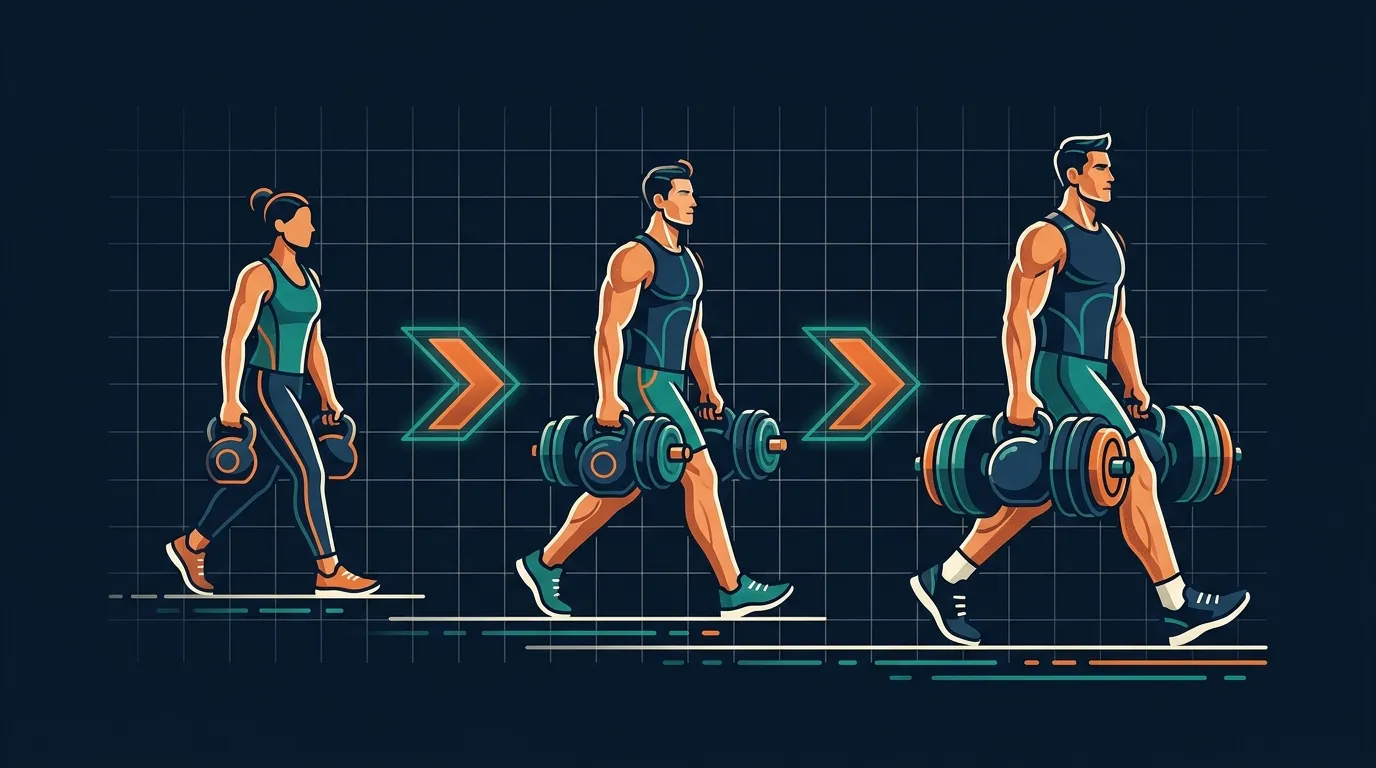
- Progression: add distance first, then add load. Move from 30 meters to 40 to 50 with the same weight before adding weight. The set becomes a grip-endurance stimulus first, a maximal-load stimulus second. Both are useful; the endurance version is more forgiving for a general population.
- Variations to rotate in: suitcase carry (one hand, unilateral trunk stability), front-rack carry (kettlebells in the front-rack position, higher trunk demand), overhead carry (heavy shoulder-stability challenge, use only if healthy shoulders). Rotating variations exposes and trains different weaknesses without changing the underlying exercise pattern.
- Not the whole session. Carries are one exercise among several. Pair with a primary compound lift (squat, hinge, or press) and one or two accessories. They are the espresso shot, not the coffee.
Individual Variation: Who Responds Most
Training Status
Trained and untrained lifters both respond to carries, but the entry load and progression rate differ substantially. Untrained trainees typically hit grip failure well before trunk failure, meaning the first several weeks of carries are almost entirely a grip-training stimulus. As grip catches up, trunk and lower-body demands become the limiting factors and the exercise starts producing broader adaptations. That transition usually happens between weeks 4 and 8 of regular carrying.
Sex
Absolute loads differ. Relative response does not appear to differ meaningfully in the biomechanical or EMG literature. The Winwood strongman survey and the biomechanics study were male-dominated, so the sport-specific data is skewed, but general population trunk EMG and grip response to loaded carries look similar across sexes at matched relative loads. The bodyweight-fraction benchmarks in the protocol section scale sensibly across a wide range of body sizes.
Age
Older adults with intact joints tolerate carries well and are one of the populations that arguably benefits most, given the Leong grip-strength data. Loads should start lower (a quarter to a third of bodyweight total, split across two hands) and progress slowly. The upright posture and the ability to safely drop the load makes carries lower-risk per unit of stimulus than heavy bilateral barbell work in a spine that is stiff or that has prior injury history. Someone with severe osteoarthritis of the hip or knee should still consult a clinician before adding load; the same is true of any progressive resistance program in that population.
Injury History
Low-back injury history is a nuanced case. The Winwood (2014) finding of a more vertical trunk position at knee pass compared with a matched deadlift suggests carries may load the lumbar spine more forgivingly than a hip-hinge dominant lift at the same relative intensity, but the loaded carry still puts a large compressive and shear demand on the spine. A rehab-appropriate carry protocol usually starts with unloaded walking, then adds a light suitcase or bilateral load at short distances, and progresses gradually. Someone with active or recent radicular symptoms should be cleared by a clinician before loading carries.
Common Misconceptions
Misconception 1: "Farmer's carries are cardio."
They elevate heart rate and they produce a metabolic response, but the primary training stimulus is strength and trunk stability, not aerobic conditioning. Programming a heavy carry the way you would program a steady zone 2 session (30 to 45 continuous minutes) is a recipe for grip failure without much aerobic adaptation. Program carries as strength work, with rest, and let the elevated heart rate be a bonus.
Misconception 2: "You need a special farmer's handle to do them right."
Two heavy dumbbells work. Two kettlebells work. A trap bar loaded low works. Two loaded gym bags work. The specialized farmer's handles used in strongman competition let you load heavier weights with better balance, and if you are training for strongman that matters, but no home or general-population program requires them. The training stimulus is in the load, distance, and posture, not in the specific hardware.
Misconception 3: "Carries replace the need for direct core work."
They replace some of it. They are one of the highest-return trunk-stability exercises available, per the Ellestad (2024) EMG data and the McGill (2009) activation pattern data. But specific direct work like Pallof presses, dead bugs, or heavy sled work still has value for exposing and training specific trunk positions carries do not fully load. A well-built program uses carries as a core anchor, not as the only core work.
Misconception 4: "Farmer's carries build big biceps and forearms."
They build meaningful forearm mass and grip capacity over time. They do very little for the biceps, because the elbow stays essentially straight throughout the exercise. If arm size is a specific goal, direct arm work will produce more hypertrophy per unit of training time than a carry-heavy program will.
Misconception 5: "The heavier the better."
Only up to the point where posture holds. The training effect of a carry is inseparable from a tall, ribs-down, shoulders-packed trunk position over the full walk. A load so heavy that you finish the set hunched forward with shoulders rolled and neck jutted is not producing the trunk stability adaptation you came for. It is producing an accidental compensatory movement pattern the trunk will learn to reproduce next session. Load the exercise heavy enough to be genuinely challenging while your posture holds; not heavier.
What the Research Suggests Going Forward
The loaded-carry literature is in a strange spot. The biomechanical and EMG basis for the exercise is clear and consistent across the main studies. The elite-athlete practice data (Winwood 2011) shows near-universal adoption among the population that trains it the heaviest. The general-population evidence on the specific outcome that most reliably transfers from carries (grip strength) sits inside one of the most cited longevity papers in cardiology (Leong 2015 PURE). What is thinner is randomized-controlled training data on general population outcomes specifically from a carry-inclusive program versus a carry-free program.
That gap is filled, in practice, by mechanistic reasoning: carries load grip, they load the trunk, they load the posterior chain, they do so under a movement pattern that matches real-world loading, and they do so time-efficiently. All four of those adaptations are individually well-supported by the broader resistance-training and grip-strength literature. Waiting for a definitive RCT on "does adding two sets of farmer's walks twice a week to your program measurably move general strength and function" is a long wait for evidence a program can act on today.
The other genuinely open questions:
- Whether the mortality signal in grip strength studies partly reflects a direct causal effect of grip training, or is entirely a marker of overall muscle mass and physical activity. This is a hard question to answer without a very long randomized trial.
- Whether loaded carries specifically transfer to endurance performance (running, cycling) more than a matched volume of general-preparation strength work. The mechanistic case is there; the direct trial data is thin.
- Whether unilateral loaded carries (suitcase, offset-carry) are meaningfully better than bilateral carries for trunk asymmetry correction, or whether both are equivalent trunk stabilizers with different flavors. Ellestad (2024) is a start, but longer training studies are needed.
- Whether carries add hypertrophy stimulus meaningful enough to justify their time in a mass-building program, or whether they are strictly a strength-endurance and functional-strength tool. Current evidence leans toward the latter.
The bottom line for a general population program: farmer's carries are one of the few exercises where the risk-reward profile is unusually favorable. The load is easy to control, the movement pattern is safe when posture holds, the training effect covers four systems in one set, and the specific adaptation carries deliver (grip and trunk under load) is one of the more defensible things a program can chase for both performance and long-term health. Two to four sets of 30 to 40 meters, once or twice per week, at a load that challenges the last 10 meters, is enough. That is a tiny time commitment for what the exercise returns.
And carries only work if you actually do them consistently. The best exercise is the one that gets done. Small habits that fit into a real week beat an optimally-designed program that gets skipped.
References
- Leong DP, Teo KK, Rangarajan S, Lopez-Jaramillo P, Avezum A Jr, Orlandini A, et al. "Prognostic value of grip strength: findings from the Prospective Urban Rural Epidemiology (PURE) study." Lancet. 2015;386(9990):266-273. doi:10.1016/S0140-6736(14)62000-6
- McGill SM, McDermott A, Fenwick CMJ. "Comparison of different strongman events: trunk muscle activation and lumbar spine motion, load, and stiffness." J Strength Cond Res. 2009;23(4):1148-1161. doi:10.1519/JSC.0b013e318198f8f7
- Winwood PW, Keogh JWL, Harris NK. "The strength and conditioning practices of strongman competitors." J Strength Cond Res. 2011;25(11):3118-3128. doi:10.1519/JSC.0b013e318212daea
- Winwood PW, Cronin JB, Brown SR, Keogh JWL. "A Biomechanical Analysis of the Farmers Walk, and Comparison with the Deadlift and Unloaded Walk." Int J Sports Sci Coach. 2014;9(5):1127-1143. doi:10.1260/1747-9541.9.5.1127
- Hindle BR, Lorimer A, Winwood P, Keogh JWL. "The Biomechanics and Applications of Strongman Exercises: A Systematic Review." Sports Med Open. 2019;5(1):49. doi:10.1186/s40798-019-0222-z
- Ellestad SH, Holcomb TP, Swiergol AM, Holmstrup ME, Dicus JR. "The Quantification of Muscle Activation During the Loaded Carry Movement Pattern." Int J Exerc Sci. 2024;17(1):102-114. doi:10.70252/NWUE9985
Frequently Asked Questions
Does the farmer's carry actually build core strength?
Yes, more than most people expect. Ellestad and colleagues (2024, International Journal of Exercise Science) recorded surface EMG from the rectus abdominis, external obliques, longissimus, and multifidus during a bilateral farmer's carry, a suitcase (unilateral) carry, and matched static holds. The dynamic carries produced higher bilateral activation across all four muscle groups than the holds did. McGill and colleagues (2009, Journal of Strength and Conditioning Research) reached the same conclusion from a different angle: during a strongman-style farmer's walk, peak abdominal activation happened during the stance phase and peak erector and lat activation during the swing phase, meaning the trunk works continuously to resist rotation, side-bending, and flexion under load. Carries train the anti-motion role of the core the way a plank does, only under a heavier load and while walking.
How heavy should a farmer's carry actually be?
For general fitness, start around a third of your bodyweight in each hand and progress toward roughly bodyweight total (half in each hand). The Winwood biomechanical analysis (2014, International Journal of Sports Science and Coaching) used 70 percent of the participants' deadlift 1RM for each hand in trained strongmen, but that is a competitive protocol, not an entry point. A useful non-athlete benchmark: pick a load you can carry for 30 to 40 meters with a solid trunk position and a grip that survives the walk. If the load hits the floor before 20 meters, drop weight. If your posture stays perfect for 60 meters, add weight.
Are farmer's carries good for grip strength and longevity?
Grip strength is one of the most reliable single measurements in longevity epidemiology, and loaded carries are one of the most direct ways to train it. Leong and colleagues (2015, Lancet) followed 139,691 people from 17 countries in the PURE study and found that each 5 kg reduction in grip strength was associated with a 16 percent higher risk of all-cause mortality, a 17 percent higher risk of cardiovascular mortality, and a 7 to 9 percent higher risk of myocardial infarction and stroke. Grip strength was a stronger predictor of all-cause and cardiovascular mortality than systolic blood pressure. The Leong data does not prove that training grip strength directly extends life. It does establish that grip is a robust marker of overall strength and physiological reserve, and carries are one of the most efficient exercises for loading it.
Farmer's carry vs. deadlift, which is better?
They complement each other rather than compete. Winwood and colleagues (2014, International Journal of Sports Science and Coaching) had experienced male strongman athletes perform both at 70 percent of their deadlift 1RM. The farmer's walk generated significantly greater mean vertical and anterior forces than the deadlift and put the trunk in a more upright position at knee pass, which the authors interpreted as potentially lower shear stress on the lumbar spine. The deadlift produces a bigger single-rep force output. The farmer's carry produces sustained force output with continuous trunk stabilization and grip load. If you can only do one, the deadlift builds more raw strength. If you can do both, the carry adds a stimulus the deadlift does not.
What is the difference between a farmer's carry and a suitcase carry?
A farmer's carry loads both hands symmetrically. A suitcase carry loads one hand only, so the trunk has to resist side-bending toward the loaded side across the entire walk. Ellestad and colleagues (2024, International Journal of Exercise Science) found that the suitcase carry produced additional ipsilateral core activation on top of the bilateral pattern the farmer's carry drives, meaning the unloaded side works harder to hold the ribcage over the pelvis. Both belong in a program. The farmer's carry lets you move the heaviest load; the suitcase carry exposes and trains lateral trunk asymmetries and works well at lighter loads.