You set up for a set of rows, the weight feels fine for the first six reps, and then your fingers start peeling open. The back muscles you were actually trying to train have plenty left. The set ends anyway, because your hands voted.
It happens with grocery bags, with luggage, with a toddler carried on one hip for ten minutes. Grip is the quiet bottleneck on a surprising amount of ordinary life, and almost nobody trains it on purpose. It's assumed to be a byproduct of everything else.
It isn't, and the training data says so. Grip responds well and fast to direct work, and it's one of the few strength qualities where six weeks of honest effort produces a change you can measure in your kitchen. Here's how to do it, what the three grip types are, and why the mortality research everyone quotes is more interesting than it is actionable.
Grip Strength Isn't One Thing: The Three Types
Grip-sport athletes have known this for a century, and most gym advice still ignores it. Training one type transfers only partly to the others, which is why someone who can close a heavy gripper still drops a loaded carry after 20 seconds.
Crush grip
Closing your hand around an object and squeezing. A handshake, a hand gripper, a barbell you're trying to bend. This is the one a dynamometer measures, so it's the one every research paper reports. It's driven mostly by the finger flexors in the forearm working through the long tendons that run into your fingers.
Pinch grip
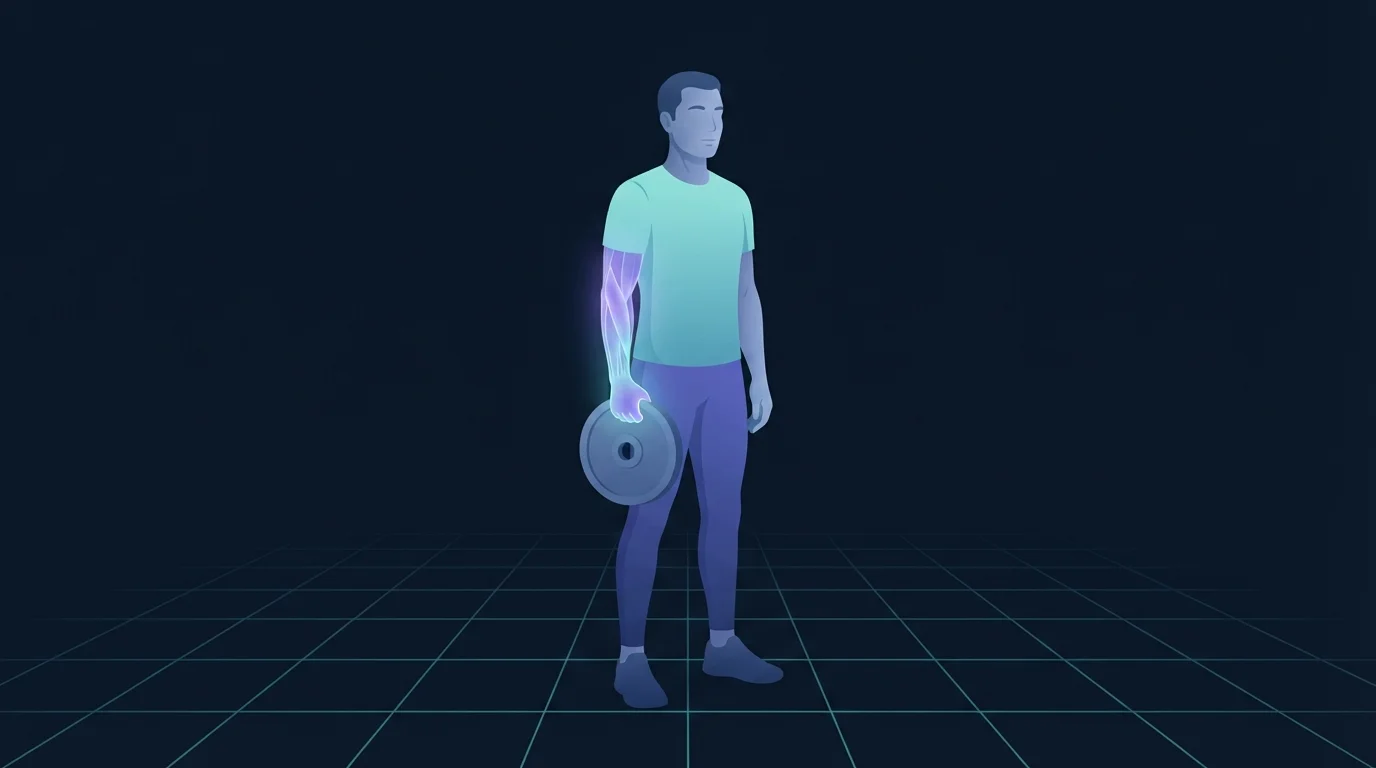
Thumb on one side, fingers on the other, nothing wrapping around. Holding a weight plate by its smooth face, carrying a sheet of plywood, picking up a heavy book by the cover. Pinch is the weakest of the three by a wide margin and the most neglected. It's also the one that trains the thumb, which most people have never loaded deliberately in their lives.
Support grip
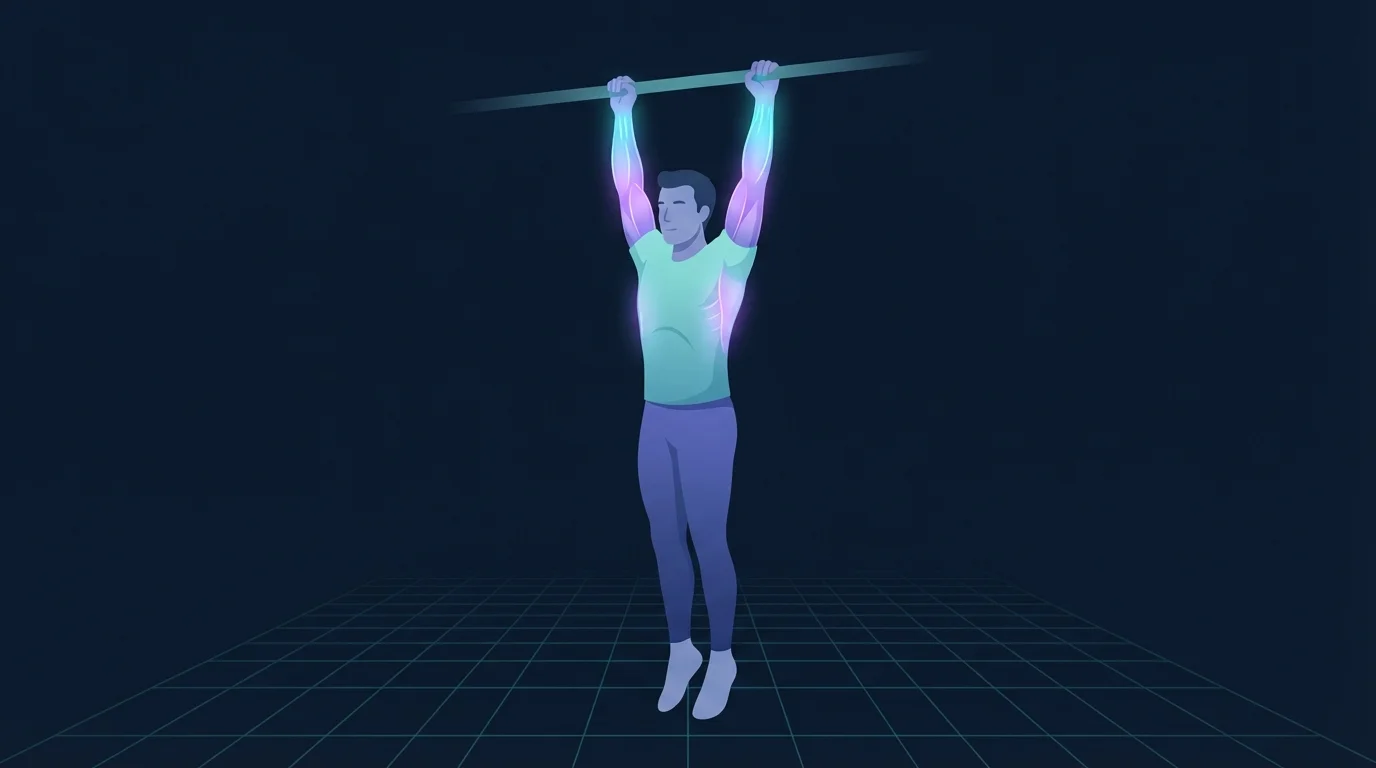
Holding on to something for time while it tries to pull out of your hands. Hanging from a bar, carrying dumbbells, holding the last rep of a set of rows. This is the type that fails you in real life and in the gym, and it's the one that responds best to simple, boring work. Our review of the dead hang research covers what hanging does for the shoulder and the hand beyond raw endurance.
There's a fourth thing worth naming, even though it isn't a grip: the extensors on the back of the forearm, which open the hand. Nothing in normal life trains them, and the imbalance between heavily used flexors and untrained extensors is a common contributor to elbow pain in people who suddenly start doing grip work. Two sets of finger extensions against a rubber band, twice a week, is enough.
Why Grip Predicts Health, and What That Doesn't Mean
Grip strength has become the most quoted number in longevity medicine, and the underlying research is genuinely strong. In the Prospective Urban Rural Epidemiology study, Leong and colleagues (2015) followed 139,691 adults across 17 countries and found that each 5 kg reduction in grip strength was associated with a 16 percent higher risk of all-cause mortality, a 17 percent higher risk of cardiovascular death and a 7 percent higher risk of myocardial infarction. Grip predicted death better than systolic blood pressure did.
The finding replicated at enormous scale. Celis-Morales and colleagues (2018), working with 502,293 UK Biobank participants over a mean 7.1 years, found grip strength associated with all-cause mortality plus incidence of and death from cardiovascular disease, respiratory disease, chronic obstructive pulmonary disease and cancer. A dose-response meta-analysis of 48 studies covering more than 3.1 million people put the useful range for all-cause mortality risk reduction between roughly 26 and 50 kg, close to linear (Lopez-Bueno et al., 2022).
Here's the part that gets lost. Grip is a marker, not a mechanism. It's cheap to measure and it quietly summarises total muscle mass, nutrition, neurological function and general robustness, which is exactly what makes it such a good predictor. Squeezing a spring until your dynamometer score rises does not carry the same meaning as being a person whose whole body is strong enough to produce that score. Our deeper review of the grip strength and longevity research works through what the association can and can't tell you. Treat that page as the why, and this one as the how.
Find out what's really holding you back
FitCraft, our mobile fitness app, pairs you with an AI coach who builds you a personalized plan around your goals, schedule, and fitness level. Every FitCraft program is designed by Domenic Angelino, MPH (Brown University) and NSCA-CSCS, with research published in the Journal of Strength and Conditioning Research and Medicine & Science in Sports & Exercise.
Take the Free Assessment Free • 2 minutes • No credit card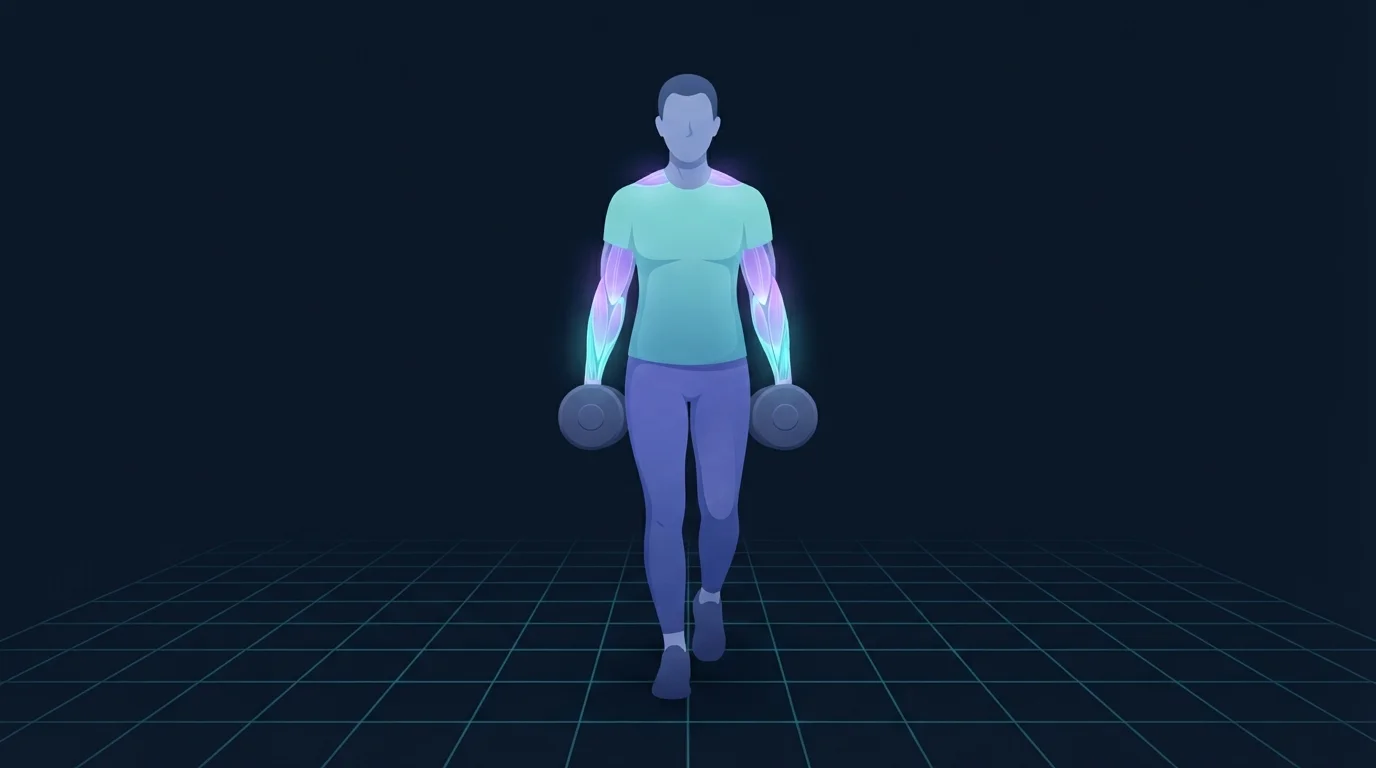
The Home Exercises That Actually Build Grip
You need a pull-up bar and a pair of dumbbells. Everything below works with those, and most of it works with household objects if you have neither.
- Dead hangs. Hang from a bar with straight arms and shoulders slightly engaged, not fully slumped. Stop two seconds before your hands open rather than at true failure, which spares the tendons. Three sets, two to three minutes rest. This is the single highest-value grip exercise for most people.
- Dumbbell farmer carries. A heavy dumbbell in each hand, walk for 30 to 40 seconds with the shoulders down and the ribs stacked over the hips. If you have no room to walk, stand and hold. Load matters more than distance: pick a weight where the last five seconds are genuinely uncertain. The farmer carry research covers the loading and the carryover to the rest of the body.
- Towel work. Loop a folded hand towel over the bar and hang from the two ends, or wrap a towel around a dumbbell handle and row it. Thick, soft, compressible surfaces make the fingers work far harder than a knurled bar does, and they punish a lazy thumb. Start with half the hang time you manage on a bare bar.
- Plate pinches. Pinch a smooth weight plate between your thumb and fingers and hold it at your side for time. Two plates face to face is the classic progression. Nothing else trains the thumb like this, and nothing else exposes how weak it is.
- Finger extensions. Loop a thick rubber band around all five fingertips and open your hand against it for 15 slow reps. This is the antagonist work that keeps your elbows quiet once the rest of the plan starts biting.
- Wrist and forearm accessory work. Hammer curls load the brachioradialis and the forearm in a way that supination-heavy curls don't, and they pair well with carries on the same day.
Two rules run through all of it. Never use lifting straps on a set whose purpose is grip, because straps exist specifically to remove the stimulus. And don't take every set to the point where your hands physically open, because that trains failure and irritates tendons without adding much.
A 6-Week Grip Plan
Attach this to the end of your existing training, or run it as a standalone ten-minute block. Two sessions a week for the first fortnight, three after that, always with at least 48 hours between hard grip days.
| Weeks | Frequency | Support grip | Crush grip | Pinch grip |
|---|---|---|---|---|
| 1-2 | 2 sessions | Dead hang, 3 x 20-30 s | Dumbbell carry, 3 x 30 s | Plate pinch, 2 x 15 s each hand |
| 3-4 | 3 sessions | Dead hang, 3 x 35-45 s | Towel-wrapped dumbbell row, 3 x 8 | Plate pinch, 3 x 20 s each hand |
| 5-6 | 3 sessions | Towel hang, 3 x 20-30 s | Heavier carry, 4 x 40 s | Two-plate pinch, 3 x 20 s each hand |
Add two sets of 15 finger extensions against a rubber band at the end of every session, from day one. That's not optional padding. It's the reason your elbows will still be cooperating in week six.
Progression is simple and it's the same idea as progressive overload everywhere else: add five seconds to a hold, or add the smallest dumbbell increment you own, whenever you hit the top of a rep range on two consecutive sessions. Never add both in the same week. If a session feels flat, repeat the previous week rather than pushing, because forearm tendons take longer to catch up than forearm muscles do.
How to Test Progress Without a Dynamometer
Hand dynamometers are the research standard and they're not expensive, but you don't need one. What you need is a repeatable test with a stopwatch, run under identical conditions every time.
- Max dead hang, both hands. The primary test. Same bar, same grip width, no chalk (or chalk every time), arms straight, stop when your hands open. Roughly speaking, 30 seconds is a beginner, 60 seconds is a solid general-fitness standard for a healthy adult, and 90 seconds or more is strong.
- Timed carry at a fixed load. Pick one dumbbell weight and never change it for testing. Record how long you can hold or walk before setting it down. This isolates support grip better than a hang does, because the load is fixed rather than tied to your bodyweight.
- Plate pinch hold. One plate, one hand, stopwatch. This test is brutally sensitive to real change because the thumb has nowhere to hide.
- Towel hang. Once your bare-bar hang passes a minute, switch to a towel and start a second, harder baseline.
Test at the start of a session, never at the end, and never after a heavy pulling workout. Re-test every three weeks rather than weekly, because grip test scores bounce around with sleep, caffeine and how warm your hands are. If you do want dynamometer numbers for context, normative data from twelve British studies covering 49,964 people put peak median grip at about 51 kg for men aged 29 to 39 and about 31 kg for women aged 26 to 42, with a decline from midlife onward (Dodds et al., 2014).
Mistakes That Stall Grip Progress
Assuming general lifting will do it. It helps, but far less than people expect. A meta-analysis of 24 trials in 3,018 older adults by Labott and colleagues (2019) found that a wide range of exercise programs produced only a small effect on handgrip strength, a standardised mean difference of 0.28. Grip transfers weakly from everything else. Train it directly.
Living on straps. Straps are a legitimate tool for heavy pulling when the goal is the back, not the hands. Using them on every set means your grip never receives a stimulus, and over a year that adds up to a real deficit.
Only ever training crush. A spring gripper on the desk is fine and it's also one third of the picture. If you can close a hard gripper and still fail a 45-second carry, you've trained the type that isn't limiting you.
Skipping the extensors. The fastest way to turn a promising grip block into six weeks of elbow tendon pain is to train only the muscles that close the hand. The band work is cheap insurance.
Going to failure every session. Fingers recover faster than the tendons and attachments they pull on. Two hard sessions and one easy session a week beats three maximal ones, and it beats daily hanging by a wide margin.
Reading a grip score as total-body strength. It isn't one. Comparing handgrip with knee extension strength across five cohorts, Yeung and colleagues (2018) found only low to moderate agreement, with correlations as low as 0.35 to 0.45 in healthy adults. A strong grip does not mean strong legs, and a weak grip does not mean you're frail.
The Bottom Line
Grip strength is trainable, fast, and almost entirely neglected. Three grip types, two or three sessions a week, hangs and carries and pinches, band work for the muscles that open the hand, and a stopwatch instead of a gadget. Six weeks of that will change what you can hold. Twelve will change what you look like from the elbow down.
And if the reason you're here is the longevity research, keep the right end of it in view. The people in those cohorts did not have strong hands because they squeezed things. They had strong hands because they had bodies that worked, and grip was the cheapest way to notice. If you want the whole-body version of that, a dumbbell program is the most efficient route from a standing start, and our roundup of the best dumbbell workout apps compares how the main options handle progression.
Frequently Asked Questions
How long does it take to increase grip strength?
Two to three weeks of direct grip work produces a noticeable change in hang time and carry time, most of it neural. Measurable strength gains in the forearm muscles themselves take six to twelve weeks. Connective tissue in the fingers and elbows adapts slower still, which is why the six-week plan on this page adds volume before it adds load.
Do hand grippers actually work?
Grippers build crush grip, which is one of three grip types, and they do it well. They do almost nothing for support grip (holding on to something heavy for time) or pinch grip (thumb against fingers), and those are the two that show up in daily life. Use a gripper as one item in a program, never as the whole program.
What is a good grip strength for my age?
Normative data pooled from 49,964 people across twelve British studies put peak median grip strength at about 51 kg for men between ages 29 and 39 and about 31 kg for women between ages 26 and 42, declining from midlife onward. Those are dynamometer numbers. Without a dynamometer, a 60-second two-handed dead hang is a reasonable working target for a healthy adult.
Can you train grip strength every day?
Low-intensity grip work such as short hangs and light carries can be done most days, but hard sets taken close to failure need 48 hours between sessions. The forearm muscles recover reasonably fast; the finger tendons and elbow attachments don't. Two or three focused grip sessions a week produces better results than daily grinding, because daily grinding is how people end up with medial elbow pain.
Does grip strength really predict how long you will live?
It predicts, but it doesn't necessarily cause. In the PURE study of 139,691 adults across 17 countries, each 5 kg lower grip strength was associated with a 16 percent higher risk of death from any cause and a 17 percent higher risk of cardiovascular death. Grip is a cheap window into total muscle mass, nutrition and neurological health, so squeezing harder on a dynamometer is not itself the goal. Being the kind of person whose grip is strong is.
How do I increase grip strength at home without equipment?
Hang from any sturdy bar or door frame pull-up bar for time, carry heavy household objects such as full water containers or loaded bags for 30 to 40 seconds at a time, and pinch two hardback books together at your side. Add finger extensions against a thick rubber band to train the opposing muscles. Three short sessions a week of that combination will move your hang time within a month.