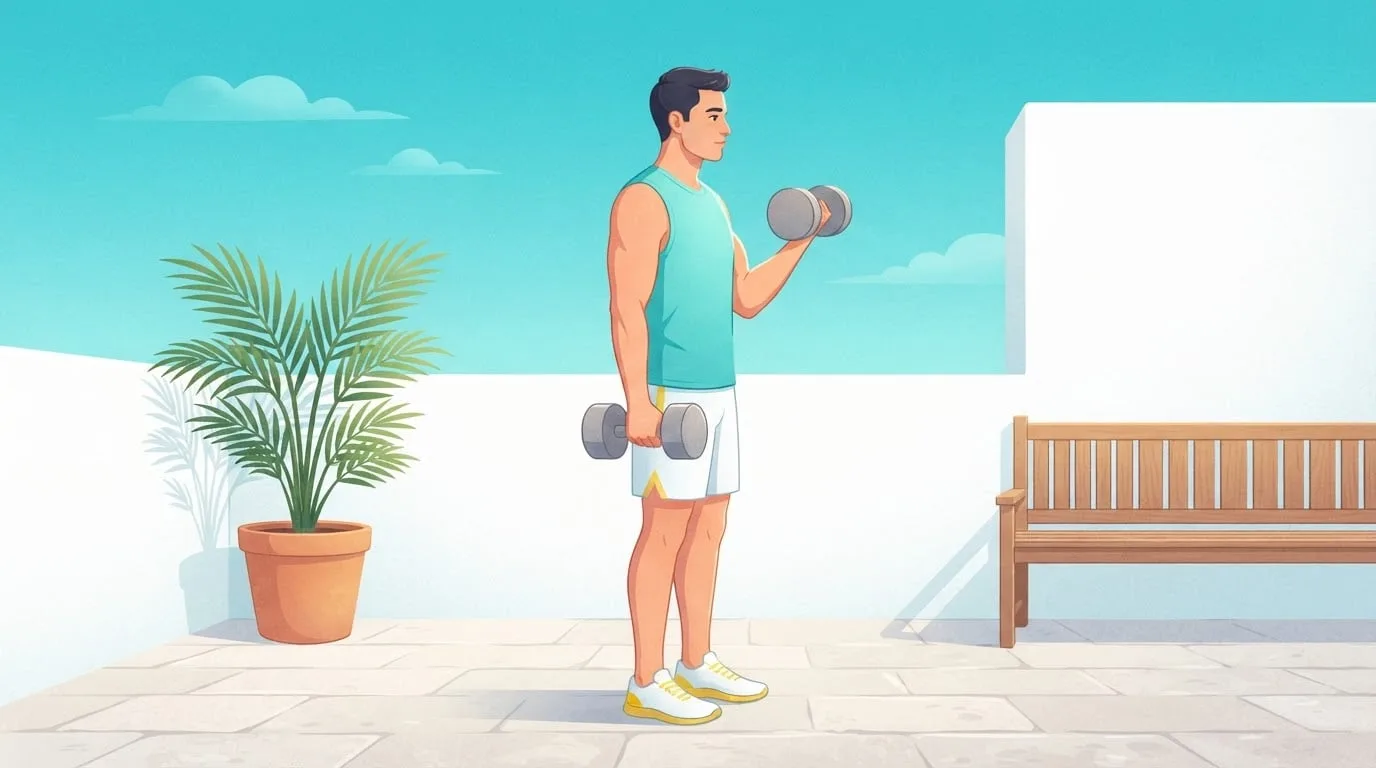
Maybe you've been lifting for a while and your upper arms have changed, but your forearms still look like they belong to someone who has never touched a dumbbell. Rolled-up sleeves are where it shows.
It's a common frustration, and it usually has a simple cause. Most forearm workouts are an afterthought: a few rushed wrist curls at the end of arm day, done when you're tired, and skipped when you're short on time. The forearms get used in nearly every lift but trained hard in almost none.
The fix is a short, specific forearm workout done two or three times a week for a couple of months. Below you'll find what's in your forearm, the seven exercises that build it, the sets and reps that work, and why some people's forearms grow faster than others.
Forearm Muscles: What You're Actually Training
Your forearm holds around 20 muscles, but for size they sort into three groups:
- The flexors (inner forearm). These sit on the palm side and make up most of the forearm's bulk. They bend your wrist toward your palm and close your fingers, so they do the gripping. Wrist curls and every kind of heavy holding train them.
- The extensors (outer forearm). These sit on the back of the forearm and lift the back of your hand, open your fingers and hold your wrist steady while you grip. They're smaller and weaker, and almost nothing in daily life loads them. Reverse wrist curls and reverse curls train them.
- The brachioradialis. This long muscle runs from the upper arm, just above the elbow, down the thumb side of the forearm to the wrist. It bends the elbow and gives the top of the forearm its thickness. Hammer curls and reverse curls train it best.
The brachioradialis is an odd muscle. Murray and colleagues (2000), in the Journal of Biomechanics, measured the muscles that cross the elbow in 10 arms. The brachioradialis had the longest muscle fibers, at 17.7 cm, and the smallest cross-sectional area, at 1.2 square centimeters against 14.9 for the triceps. Its long lever still lets it produce a useful share of elbow-bending force. That long, thin shape is why it shows so clearly near the elbow once it grows.
Hand position decides how much it works. Kleiber and colleagues (2015), in Frontiers in Physiology, recorded the biceps and brachioradialis in 16 people bending the elbow with the palm up, the palm down and the thumb up. The brachioradialis's share of the work changed significantly when the palm faced down, while biceps activity stayed the same, because the palm-down position puts the biceps at a mechanical disadvantage. That's the case for reverse curls on top of hammer curls.
The 7 Best Exercises for Forearms
These seven exercises cover all three muscle groups and need only dumbbells, a bar to hang from and a towel. Sets and reps are starting points; the forearm workout further down puts them in order.
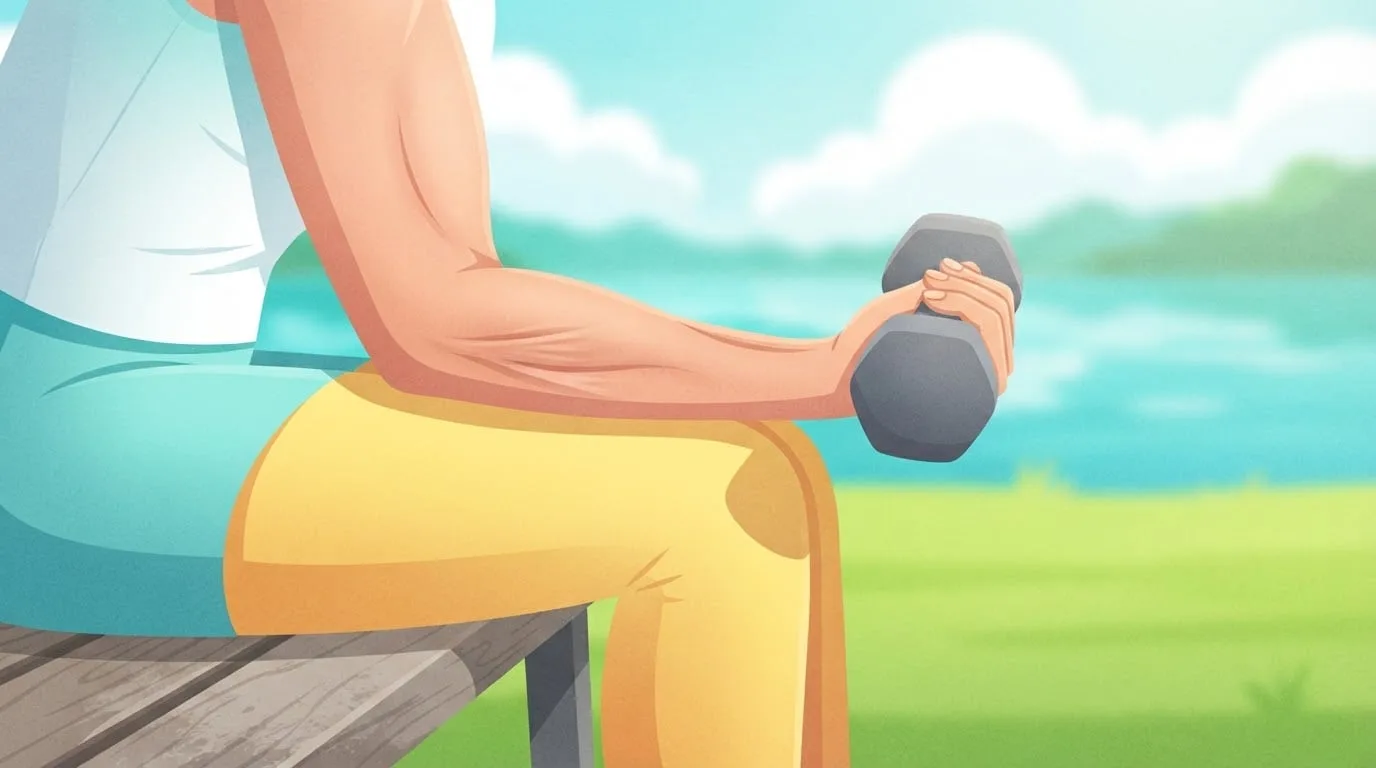
- Dumbbell wrist curl (palms up). Sit on a bench with your forearms resting on your thighs, palms up and wrists just past your knees. Let the dumbbell roll down to your fingertips, close your hand around it, then curl your wrist up as far as it goes. This is the main exercise for the inner forearm. Do 12 to 20 reps.
- Reverse wrist curl (palms down). Same position with your palms facing down. Lift the back of your hand toward the ceiling, pause, and lower slowly. The extensors are much weaker than the flexors, so use a far lighter dumbbell. Do 15 to 20 reps.
- Reverse curl. Stand holding dumbbells with an overhand grip, palms facing back, and curl them to your shoulders with your elbows pinned to your sides. It loads the brachioradialis and the extensors together. Do 10 to 15 reps.
- Hammer curl. Hold the dumbbells with your thumbs on top and your palms facing your thighs, and curl them up without turning your wrists. It trains the brachioradialis and the brachialis, a muscle under the biceps. Our hammer curl guide covers the form step by step. Do 8 to 12 reps.
- Farmer carry. Pick up the heaviest pair of dumbbells you can hold with good posture and walk for 30 to 40 seconds, or stand and hold them if you have no room. It loads the flexors hard for time. Do 3 carries.
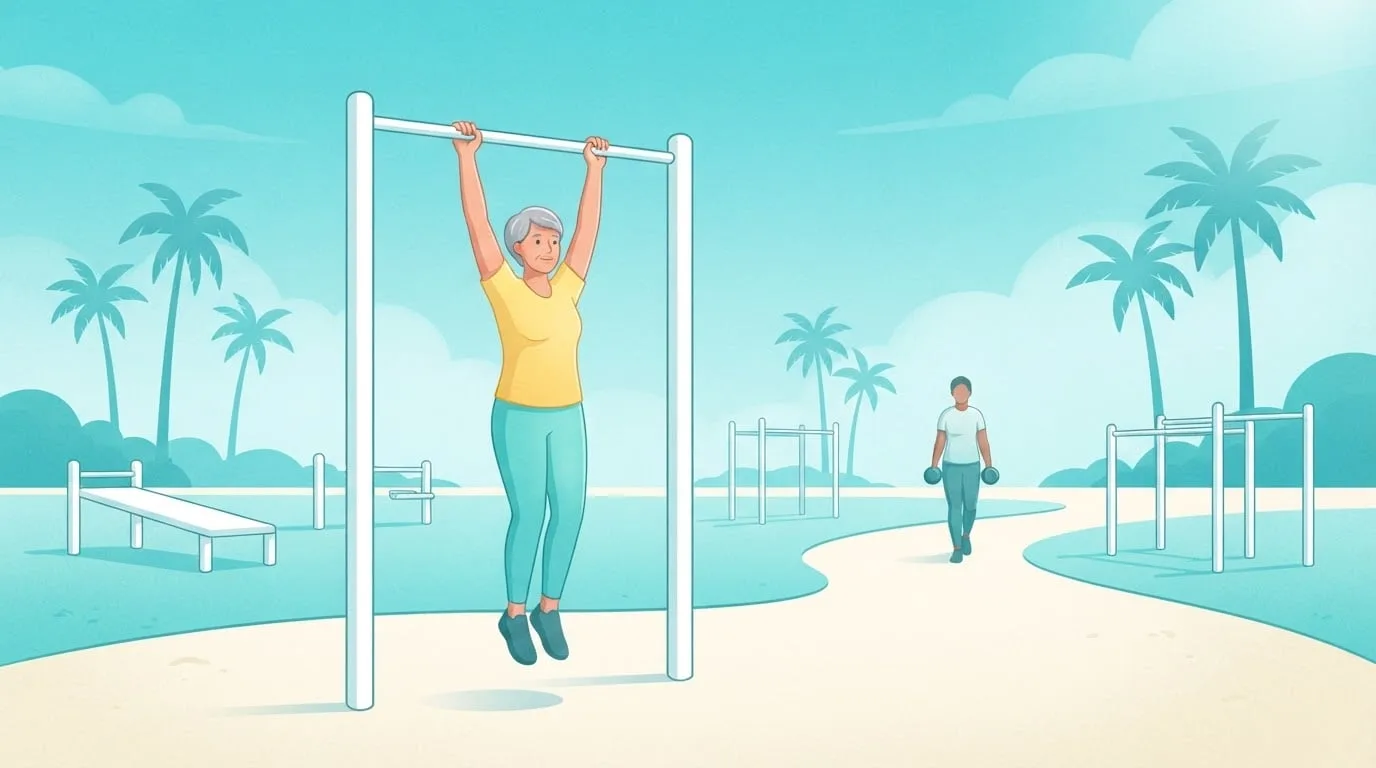
- Dead hang. Hang from a pull-up bar with straight arms and your shoulders gently engaged. Stop a couple of seconds before your hands open. It's the best bodyweight forearm exercise and needs nothing but a bar, and our dead hang guide covers the setup. Do 3 hangs of 20 to 45 seconds.
- Towel hold. Wrap a hand towel around a dumbbell handle and hold it at your side, or loop a towel over a bar and hang from the two ends. The thick, soft grip makes your fingers work much harder than a bare handle. Do 2 to 3 holds of 20 to 30 seconds.
Do You Need Direct Forearm Work?
If you already do rows, pull-ups and curls, your forearms are working. They're just not being pushed hard enough to grow to their full size.
Coletta and colleagues (2025), in the Journal of Strength and Conditioning Research, compared nine national and international arm wrestlers with nine strength-trained athletes. Both groups averaged more than a decade of strength training, and there was no difference between them in upper-arm circumference or biceps thickness. The arm wrestlers, whose sport loads the forearm directly, had much bigger forearms, with a large effect size of 1.54. Years of general lifting had not given the strength athletes the same forearms.
Direct work also pays off quickly, even in people whose forearms are already trained. Andersen and colleagues (2026), in Frontiers in Physiology, had 22 advanced climbers train their finger flexors twice a week for five weeks, either with heavy loads or with light loads and a blood-flow-restriction cuff. Forearm circumference rose by 0.6 cm in the heavy group and 0.8 cm in the light group, with no difference between them.
Grip strength is a related but separate goal. If what you want is hands that don't give out on carries and rows, our guide on how to increase grip strength covers the three grip types, how to test grip without a dynamometer and a six-week grip plan. On this page, carries, hangs and towel holds are in the plan for the forearm size they add.
Forearms are also one of three regions of the arm. If you want the biceps and triceps to grow along with them, our guide on how to build bigger arms covers weekly sets, curl and extension choices, and why arm position changes how much a muscle grows.
How to Train Forearms: Sets, Reps and How Often
Forearm muscles follow the same rules as every other muscle. Three numbers matter.
Reps: anywhere from about 8 to 25, close to failure
A 2017 meta-analysis of 21 studies by Schoenfeld and colleagues, in the Journal of Strength and Conditioning Research, found that light loads (60 percent of your one-rep max or less) and heavy loads built similar muscle when every set was taken to failure. Heavy loads built more maximal strength. For forearms that's useful, because the wrist is a small joint that tolerates light, high-rep work better than heavy, grinding sets. Use 12 to 25 reps for wrist curls and reverse wrist curls, and 8 to 15 for hammer curls and reverse curls. End each set within one or two reps of failure.
Sets: about 10 to 15 hard sets a week to start
More weekly sets build more muscle, with smaller returns as the number climbs. Pelland and colleagues (2026), in Sports Medicine, pooled 67 studies and 2,058 people and found growth was predicted best when exercises that only partly train a muscle counted as half a set. For forearms, count wrist curls, reverse wrist curls, hammer curls and reverse curls as full sets, and your rows, pull-ups and regular curls as roughly half. Start with 10 to 15 direct sets a week split across the three muscle groups, and add 2 to 4 if nothing has changed after two months.
Frequency: two or three sessions, 48 hours apart
The same meta-analysis found that, with weekly sets held equal, training a muscle more often added little extra growth. So the reason to split forearm work into two or three sessions is quality: fresher sets and less strain on the elbows. The forearm muscles recover quickly, but the tendons where they attach near the elbow adapt more slowly. Leave about 48 hours between hard forearm sessions, and back off for a week if the inside or outside of your elbow starts to ache.
Find out what's really holding you back
FitCraft, our mobile fitness app, pairs you with an AI coach who builds you a personalized plan around your goals, schedule, and fitness level. Every FitCraft program is designed by Domenic Angelino, MPH (Brown University) and NSCA-CSCS, with research published in the Journal of Strength and Conditioning Research and Medicine & Science in Sports & Exercise.
Take the Free Assessment Free • 2 minutes • No credit cardA Sample Forearm Workout: Eight Weeks, Two or Three Days a Week
This forearm workout takes 15 to 20 minutes and fits at the end of an upper-body or full-body session. Day A and Day B are the core. Add Day C from week 4 if your elbows feel fine. Rest 60 seconds between sets.
| Day | Exercises (sets x reps) |
|---|---|
| Day A | Dumbbell wrist curl 3 x 12-20 · Reverse wrist curl 2 x 15-20 · Hammer curl 3 x 8-12 · Farmer carry 3 x 30-40 seconds |
| Day B | Reverse curl 3 x 10-15 · Dumbbell wrist curl 2 x 15-25 · Dead hang 3 x 20-45 seconds · Towel hold 2 x 20-30 seconds |
| Day C (optional) | Hammer curl 2 x 10-15 · Reverse wrist curl 2 x 15-20 |
Days A and B give you 13 direct sets for the curls and wrist curls, plus carries, hangs and holds. Day C brings it to 17. Progress in three steps:
- Weeks 1 and 2: do two sets of everything and stop about three reps short of failure. Your elbows and wrists need time to adjust to the new work.
- Weeks 3 to 5: do the full sets in the table and take the last set of each curl close to failure.
- Weeks 6 to 8: add Day C if you haven't already, and add 5 seconds to each carry, hang and hold.
Move up a dumbbell once you reach the top of the rep range on every set. Then measure your forearm at its widest point and compare it with your week 1 number.
If you'd like this to sit inside a full program instead of a list you keep yourself, our comparison of the best dumbbell workout apps covers how the main options handle exercise demos and progression. FitCraft's strength workouts use dumbbells and bodyweight, an AI coach demonstrates each exercise on an interactive 3D model, and the workouts adjust as you progress.
How Can I Make My Forearms Bigger at Home?
You can build forearms at home with a pair of dumbbells, and you can make real progress with no equipment at all. Forearm exercises at home work because the muscles need time under load more than they need heavy weights.
- Wrist curls and reverse wrist curls with a filled water bottle, a can or a backpack strap, done for high reps.
- Carries with full water jugs, shopping bags or a loaded backpack in each hand.
- Dead hangs and towel hangs from a doorway pull-up bar, a sturdy tree branch or a playground bar.
- Reverse curls and hammer curls with a resistance band anchored under your feet.
- Fingertip work such as holding a plank on your fingertips for a few seconds, once your wrists are used to the load.
Without dumbbells, the main limit is how much load you can add, so lean on more reps, slower lowering and longer holds. The same weekly set targets from the section above apply.
Are Forearms Hard to Grow? Genetics and Muscle Belly Length
Forearms grow like any other muscle, but some people's forearms grow faster and look bigger than others' on the same plan. Genetics is a large part of that.
Muscle size is partly inherited. In a study of 706 postmenopausal female twins, Arden and Spector (1997), in the Journal of Bone and Mineral Research, estimated that genes explained about 52 percent of the variation in lean body mass and about 30 percent of the variation in grip strength. The response to training varies too. In Hubal and colleagues' (2005) study of 585 adults, published in Medicine & Science in Sports & Exercise, upper-arm muscle size changed by anything from a 2 percent loss to a 59 percent gain after the same 12 weeks of training.
Forearm anatomy itself varies more than most people realize. Pooling 26 studies, Yammine (2013), in Clinical Anatomy, found that about 20 percent of people tested were missing the palmaris longus, a small wrist flexor, though hand tests may overcount it. Nobody chooses that, and it shows how differently two forearms can be built.
Muscle belly length matters most for how forearms look. Each forearm muscle is a fleshy belly near the elbow that turns into a long tendon before the wrist, and where that switch happens differs from person to person. No study has compared forearm growth by belly length directly, but the geometry is simple. A muscle can only grow where it has muscle fibers, so someone whose bellies run far down toward the wrist has more muscle to build there, and their forearms look fuller along their whole length. Someone with short bellies and long tendons can grow the upper forearm a lot while the lower forearm stays slim.
You can't change your tendon length, but you can fill the muscle you have. Short bellies mean your best result looks different from someone else's, not that training won't work.
How Long Does It Take to Build Forearms?
Strength comes first. In the first two or three weeks, your wrist curls and hangs improve quickly as your nervous system learns the movements. Size follows later.
The climbers in the Andersen study gained 0.6 to 0.8 cm of forearm girth in five weeks, but they were trained athletes starting a new kind of loading. For most people, a tape measure picks up the first change at around 8 weeks, and a change other people notice takes 4 to 6 months of steady training. Those are coaching estimates rather than trial results, and the Hubal range above is a reminder that your own pace can sit well outside them.
Measure your forearm around its widest point, a few centimeters below the elbow, with your hand open and relaxed. Measure the same arm, at the same time of day, every four weeks.
The Bottom Line
Your forearms are three muscle groups: flexors, extensors and the brachioradialis. Train each one directly with wrist curls, reverse wrist curls, hammer curls and reverse curls, add carries and hangs, and use 10 to 15 hard sets a week across two or three sessions. Then give it at least two months before you judge the result.
Genetics sets the shape, but the work fills it in. As one FitCraft user, Tim, put it: "I didn't think an app could replace my trainer. My AI coach proved me wrong."
Frequently Asked Questions
How much rest do forearms need?
Give your forearms about 48 hours between hard sessions, which works out to two or three forearm workouts a week. The muscles recover quickly, but the tendons at the elbow adapt more slowly, and they're what complain first when you train forearms hard every day. Light grip work such as short hangs can fill the days in between.
What's stronger, forearms or biceps?
For bending the elbow, the biceps and the brachialis under it are stronger than any single forearm muscle. Murray and colleagues (2000) measured the elbow muscles in 10 arms and found the brachioradialis had the smallest cross-sectional area of the group, though its long lever lets it add a useful share of elbow-flexing force. Gripping is a different job that only the forearm muscles can do, so the two aren't really competing.
What are some good exercises for the wrist?
Dumbbell wrist curls and reverse wrist curls are the core wrist exercises, because they move the wrist through its full range against load in both directions. Add hammer curls and reverse curls for the muscles on the thumb side of the forearm, and farmer carries for grip. Start light, use slow reps, and stop any exercise that causes sharp pain in the wrist or elbow.
How to train every muscle in your arm?
Train the arm in three regions: curls for the biceps and brachialis, overhead and lying extensions for the triceps, and wrist curls, reverse wrist curls, hammer curls and carries for the forearms. Use more than one grip on your curls, because the palm-up, palm-down and thumbs-up positions shift the work between the biceps and the brachioradialis. Two sessions a week covering all three regions trains every muscle in your arm.
Can you train forearms every day?
You can do light forearm work most days, but hard sets need about 48 hours between sessions. Pelland and colleagues (2026) found that training a muscle more often added little extra growth once the weekly number of sets was the same, so daily training gives you no size advantage over two or three sessions and it raises the risk of sore elbows.
Do pull-ups and rows build forearms?
Pull-ups and rows work the forearm muscles because you have to grip the bar or dumbbell, but they rarely build forearms to their full size. Coletta and colleagues (2025) found that arm wrestlers, who train the forearm directly, had much bigger forearms than strength-trained athletes with similar biceps and, on average, more than a decade of lifting. Direct forearm work is what closes that gap.