You have been curling for two years. The dumbbells have gone up, the sets get done, and the tape measure has not moved since the first six months.
That's a particular kind of demoralising, because arm size is the most visible thing in lifting and the one people assume tracks effort directly. When it stalls, the instinct is to add exercises. More curl variations, a new finisher, a technique someone posted about. None of that addresses what is actually capping you.
Here's the reframe. Arm growth is governed by four variables, and none of them is which curl you picked. It's a dosing problem wearing an exercise-selection costume. Fix the dose, the position and the patience, and the same movements you already own start working again.
Arms Muscle Groups: What You Are Actually Growing
The upper arm is two muscle groups wearing one tape measure, and they're not the same size.
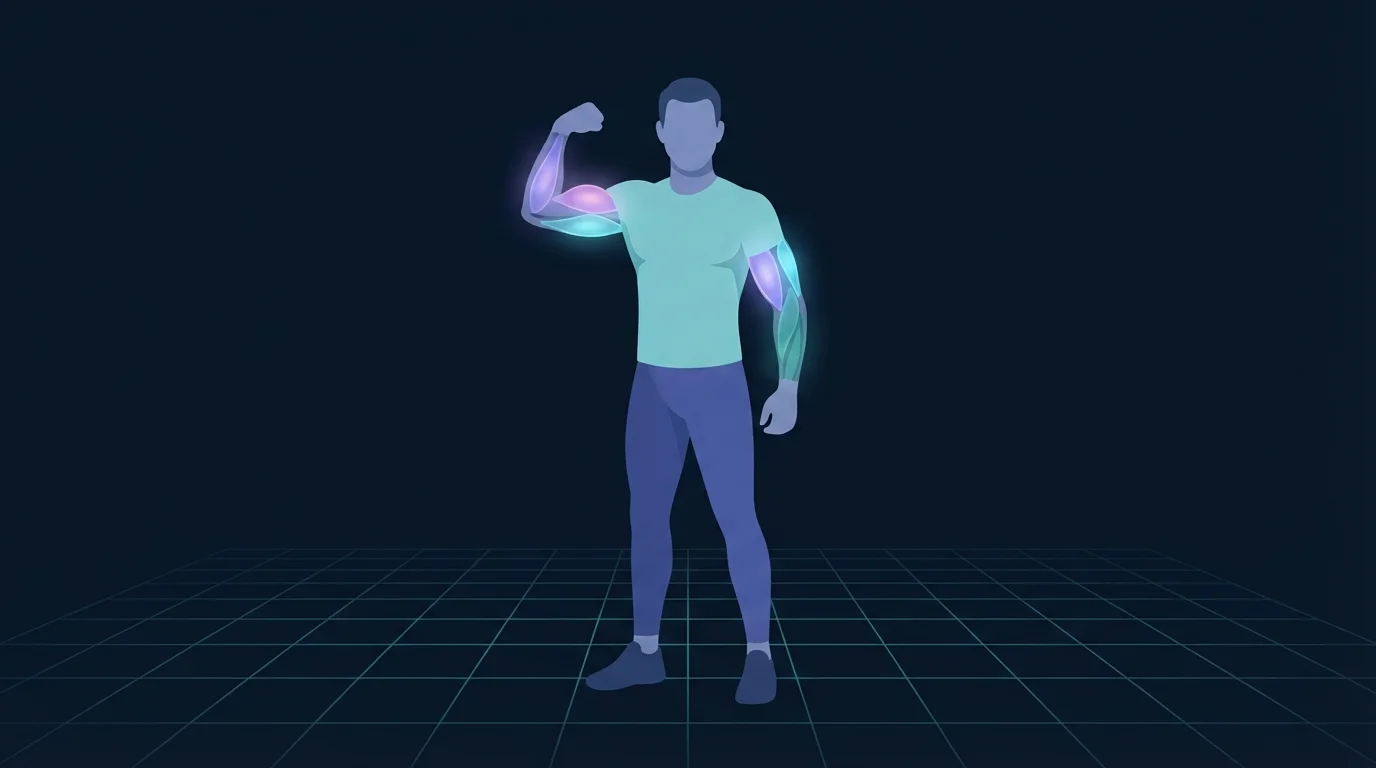
On the back sits the triceps brachii: a long head that crosses both the shoulder and the elbow, plus a lateral and a medial head that cross only the elbow. It's the bigger of the two groups and it decides how thick your arm looks from the side. On the front sits the biceps brachii with its two heads, and underneath it the brachialis, which flexes the elbow regardless of what your forearm is doing. Along the thumb side of the forearm runs the brachioradialis, which also crosses the elbow and contributes to the upper-arm silhouette once you train it directly.
Grip changes which of those does the work. Coratella and colleagues (2023), publishing in Sports, had ten competitive bodybuilders perform biceps curls with supinated, pronated and neutral forearms while recording surface electromyography. The synergy between the biceps and the brachioradialis shifted with the handgrip rather than staying constant. That's the argument for including more than one grip, and the argument against believing any single curl covers the whole front of the arm.
The practical consequence is uncomfortable if you have been running a biceps-heavy routine: the larger of your two arm muscles is usually the one getting fewer direct sets. Our guide to the best exercises for triceps covers the selection side of that in detail, including why arm position changes the result.
Lever 1: Enough Weekly Sets, Counted Honestly
Volume is the lever with the most evidence behind it and the one most people get wrong in both directions.
Schoenfeld, Ogborn and Krieger (2017), analysing 34 treatment groups from 15 studies in the Journal of Sports Sciences, found a significant graded relationship between weekly sets and muscle size, with a threshold around 10 weekly sets per muscle group for near-maximal growth. Fewer than 5 sets produced the smallest gains. More than 10 kept helping, with diminishing returns.
Here's the part people skip: your arms are already getting sets you aren't counting. Every row, chin-up and pulldown loads the biceps. Every bench press, overhead press and dip loads the triceps. A reasonable accounting rule is to count half of your pressing sets as triceps volume and half of your pulling sets as biceps volume, then add direct work on top until you reach 10 to 20.
| Your week | Indirect arm sets | Direct sets to add |
|---|---|---|
| 2 upper-body sessions, 6 press and 6 pull sets each | About 6 per arm muscle | 6 to 10 per arm muscle |
| 3 full-body sessions, 3 press and 3 pull sets each | About 4 to 5 per arm muscle | 8 to 12 per arm muscle |
| Bodyweight only, push-ups and rows | About 5 per arm muscle | 6 to 10 per arm muscle |
Does the direct work actually matter, or would the compounds get you there on their own? The honest answer is that it depends who you ask and how you test it. de Franca and colleagues (2015), in Applied Physiology, Nutrition, and Metabolism, took 20 trained men and ran eight weeks of either multi-joint work alone or multi-joint plus single-joint arm work. Both groups improved elbow flexion and extension strength and arm circumference, and the difference between groups was not significant.
Compare that with Mannarino and colleagues (2021) in the Journal of Strength and Conditioning Research, who put ten untrained men through eight weeks of unilateral dumbbell rows on one arm and unilateral biceps curls on the other. Elbow flexor thickness rose 11.06 percent on the curl side and 5.16 percent on the row side. Head to head, the isolation exercise roughly doubled the result.
Reconciling those is straightforward. Adding curls to an already-substantial program for eight weeks is hard to detect with a tape measure. Asking which exercise grows the muscle more, measured with ultrasound, gives a clear answer. Direct arm work isn't magic, it's just the cheapest way to add the volume your compounds are not supplying.
Lever 2: Train Both Arm Muscles at Long Lengths
If volume is how much, this is where. Loading a muscle while it's lengthened produces more growth than loading it while it's short, and for arms the effect is large enough to be worth restructuring around.
Sato and colleagues (2021), in Frontiers in Physiology, ran a five-week unilateral curl study in untrained young adults. One protocol worked through a 0 to 50 degree elbow range, with the arm mostly straight. The other worked through 80 to 130 degrees, with the elbow already bent. The range size was identical, only the position differed. Muscle thickness in the trained arm rose 8.9 percent in the extended-elbow group against 3.4 percent in the flexed one, and only the extended group showed a significant strength increase.
The triceps story is the same shape and comes from a different lab. Maeo and colleagues (2023) trained 21 adults for 12 weeks with one arm extending overhead and the other extending at the side, and the overhead arm gained 19.9 percent whole-triceps volume against 13.9 percent. Same conclusion, opposite side of the arm. We work through the triceps half of that evidence, and the exercise order it implies, on the best exercises for triceps page.
What this looks like in practice is two changes and no new equipment:
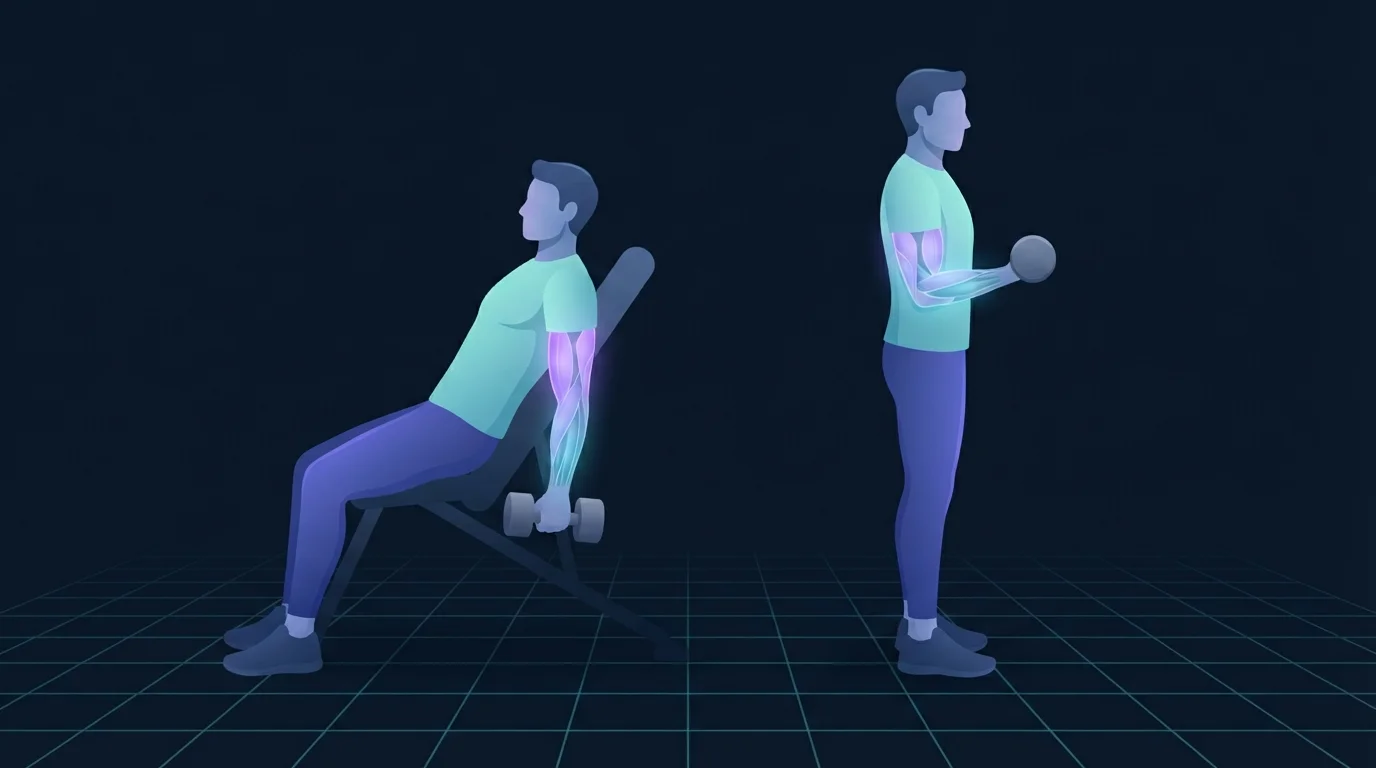
- Biceps. Put the elbow behind your torso. Incline dumbbell curls with the bench at 45 degrees, or a standing curl with the upper arm drifting slightly back, both load the stretched position. A preacher curl does the opposite.
- Triceps. Put the arm overhead. Two-handed dumbbell extensions behind the head, or single-arm versions, rather than pushdowns with the elbows pinned to your ribs.
- Both. Control the lowering phase for two to three seconds and go all the way to a straight arm at the bottom. Cutting the last few degrees is cutting the part that matters most.
Find out what's really holding you back
FitCraft, our mobile fitness app, pairs you with an AI coach who builds you a personalized plan around your goals, schedule, and fitness level. Every FitCraft program is designed by Domenic Angelino, MPH (Brown University) and NSCA-CSCS, with research published in the Journal of Strength and Conditioning Research and Medicine & Science in Sports & Exercise.
Take the Free Assessment Free • 2 minutes • No credit cardLever 3: Add Load, and Get Close Enough to Failure
A set only counts as a hard set if it was actually hard. That's the vaguest sentence in lifting, so here is what the evidence pins down.
The weight matters less than people assume. Morton and colleagues (2016), in the Journal of Applied Physiology, trained 49 resistance-trained men for 12 weeks on either 8 to 12 reps at heavy loads or 20 to 25 reps at light ones, every set to failure, and found the same hypertrophy in both groups. For arms that's genuinely useful, because light dumbbells at 20 reps are available to everyone and heavy curls are not.
How close to failure? Refalo and colleagues (2023), reviewing 15 hypertrophy studies in Sports Medicine, found only a trivial advantage for training to momentary failure over stopping short of it. So one or two reps in reserve on most sets, with the occasional set taken all the way on an isolation exercise where the risk is low. Our breakdown of training to failure versus reps in reserve covers where the line sits by exercise type.
Progression is the part that quietly disappears. Arms progress in small increments, and most dumbbell sets jump by two and a half or five kilos, which for a curl is a 15 to 25 percent increase. That's why people stall: the next weight up is unliftable for weeks. The fix is to progress reps first. Take a weight you can do for 8, add a rep a week until you reach 12 across all sets, then move up and start again at 8. Written down, it works. Kept in your head, it does not.
Lever 4: Eat Enough Protein, Then Give It Months
Morton and colleagues (2018), meta-analysing 49 studies and 1,863 participants in the British Journal of Sports Medicine, found protein supplementation significantly increased gains in fat-free mass during resistance training, with the benefit plateauing at around 1.6 grams per kilogram of bodyweight a day. For an 80 kilogram adult that's roughly 130 grams. Our guide to how much protein per day breaks the number down by bodyweight and training status.
Energy availability is the other half. Slater and colleagues (2019), reviewing the question in Frontiers in Nutrition, concluded that a modest energy surplus supports hypertrophy, while a large one mostly adds fat without adding muscle any faster. Beginners and people carrying extra body fat can add arm size while eating at maintenance or slightly below. Lean, trained lifters usually need to eat a little more than they burn to keep adding size.
Then there's the part nobody sells: time. Arm circumference is a blunt instrument measuring something that changes by millimetres per month. The research on how long it takes to build muscle puts the first measurable changes at around 8 weeks and the first changes other people notice considerably later.
How to Get Bigger Biceps
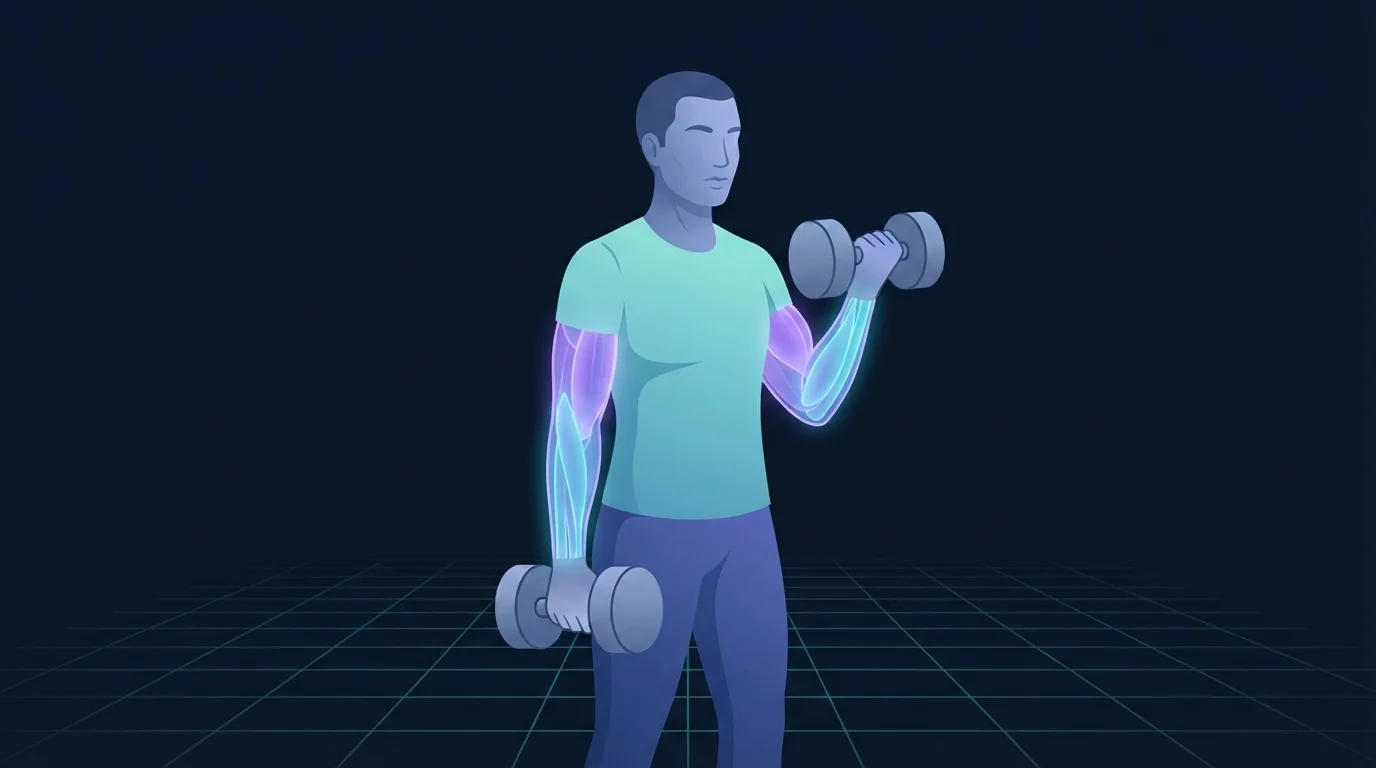
Three positions cover the front of the arm, and they differ by where your elbow sits relative to your torso.
| Exercise | Elbow position | What it emphasises | Sets and reps |
|---|---|---|---|
| Incline dumbbell curl | Behind the torso | The stretched position, biceps long head | 3 x 8-12 |
| Standing dumbbell curl | Level with the torso | Balanced loading, easiest to progress | 3 x 10-15 |
| Hammer curl | Level, neutral grip | Brachialis and brachioradialis | 3 x 10-15 |
| Chin-up | In front, heavy load | Biceps under the most weight available | 3 x 5-10 |
Pick two or three, not all four. An incline curl plus a hammer curl is a complete week for most people, and the chin-up earns a place if you have a bar, because it puts more absolute load through the elbow flexors than any curl you own. The hammer curl and standard curl pages have the setup and the two faults that turn a curl into a shoulder exercise.
The most common mistake is swinging. If your torso moves, the load is travelling through your hips and your biceps are along for the ride. Lighter weight, controlled lowering, elbow still.
How to Get Bigger Triceps
The back of the arm is two thirds of the problem and it gets a fraction of the attention, so the short version is this: put one overhead exercise first in your session, add a lying extension or a press, and stop treating pushdowns as the centrepiece. That single reordering is what the Maeo trial is about.
The full exercise list, ranked by how much of the muscle each move reaches, along with the dumbbell-only version and the bodyweight version, lives on our best exercises for triceps guide. Everything on this page about sets, failure and progression applies to those exercises unchanged.
Arm Day Workout or Spread the Sets?
Both work. One works slightly better.
Schoenfeld and colleagues (2016), meta-analysing training frequency in Sports Medicine, found that when weekly volume is held equal, muscles trained twice a week grew more than muscles trained once a week. Sixteen sets on a single arm day is a lot of sets to perform well, and the last four of them are usually worse than the first four. Two exposures of eight land better. There's more on why in our review of training frequency research.
| Day | Arm work | Sets |
|---|---|---|
| Upper body A | Incline curl, overhead dumbbell extension | 3 + 3 |
| Upper body B | Hammer curl, lying dumbbell extension | 3 + 3 |
| Optional third session | Chin-ups, diamond push-ups or dips | 3 + 3 |
That's 6 to 9 direct sets per arm muscle per week, which lands you in the 10 to 20 range once the indirect volume from your presses and rows is counted. If you prefer the ritual of a dedicated arm day, keep it and attach three or four sets to a second session rather than piling everything into one. The 30-minute version of that session, with warm-up and elbow-pain rules, is our dumbbell arm workout.
Arms Home Workout: What Changes Without a Gym
Less than you would expect. The Morton finding, that light loads to failure match heavy loads, is the reason a pair of adjustable dumbbells covers almost everything on this page.
What bodyweight training genuinely struggles with is loading the biceps in a stretched position, because there's no bodyweight movement that puts your elbow behind your torso under load. Chin-ups and towel rows solve the strength half and leave the stretched half undone, which is why two dumbbells are the single best purchase for arm growth at home. The roundup of the best arm exercises without weights ranks the no-equipment options honestly, including where each one runs out of road, and the push-up progression gives you the triceps loading ladder.
The harder problem at home isn't equipment, it's structure. Nobody counts their weekly sets on a whiteboard in their living room, which is how six months of enthusiastic curling turns into four sets a week. A strength training app that holds the weekly plan, the set counts and the progression is doing the one job your gym membership used to do for free.
How to Measure Arm Growth Without Fooling Yourself
Measure cold, not after training. A pumped arm can read a full centimetre larger than the same arm the next morning, which is how people convince themselves a new routine worked in week one.
The protocol: same day of the week, first thing in the morning, arm relaxed at your side and then flexed, tape at the midpoint between shoulder and elbow, same tension every time. Write both numbers down. Measure every four weeks, never every week, because the month-to-month signal is smaller than the day-to-day noise.
Calibrate your expectations against the trials. The Sato group gained 8.9 percent in muscle thickness in five weeks. The Maeo overhead arm gained 19.9 percent in triceps volume in twelve. Those are impressive percentages of a single muscle, and they still translate to something like half a centimetre to a centimetre and a half on a tape measure around the whole arm, in people who were new to the exercise. If you're already trained, halve it. Progress photos in the same light and the same pose are a better record than the tape.
What a Year of Arm Training Looks Like
Months one and two are mostly learning. Weights go up quickly because your nervous system is getting better at the movement, and almost none of the change is new muscle. The soreness is dramatic and the tape doesn't move.
Months three to six are where the measurements start agreeing with the mirror. This is also where most people quit, because the rate of visible change slows exactly when the work stops feeling novel. Keeping a written log through this stretch is the single highest-leverage habit in the whole plan.
Months seven to twelve are when other people notice. Sleeve fit changes before the number on the tape does anything impressive, and the arm looks different from the side first, because that's where the triceps lives. A year of 12 to 15 weekly sets per muscle, trained at long lengths, with protein handled, is a genuinely different arm. Two years is a different silhouette.
The Bottom Line
How to build bigger arms: 10 to 20 hard sets a week for biceps and for triceps, counting what your presses and rows already contribute. Train both at long muscle lengths, elbow behind the body for curls and arm overhead for extensions. Progress reps before load, stopping one or two reps short of failure. Eat about 1.6 grams of protein per kilogram a day and let it run for six months before you judge it.
Your arms are not the exception to how muscle works. They have just been getting a fraction of the dose, in the wrong position, measured too often.
Frequently Asked Questions
How do you build bigger arms?
Four things decide it. Get 10 to 20 hard sets per week into the biceps and the triceps, counting the curling and pressing you already do. Train both muscles in positions where they're stretched, which means the elbow behind the body for biceps and the arm overhead for triceps. Add load or reps week to week and stop one or two reps short of failure rather than grinding every set. Eat roughly 1.6 grams of protein per kilogram of bodyweight a day. Everything else, including exercise selection, is a smaller lever than those four.
How long does it take to get bigger arms?
Expect the first visible change at about 8 to 12 weeks and a change other people notice at 6 months. In controlled trials, 8 to 12 weeks of direct arm work produced roughly 9 to 20 percent growth in elbow flexor or triceps size in people new to that exercise, which translates to a fraction of a centimetre on a tape measure rather than a new sleeve size. Trained lifters move slower than that. Nobody adds an inch to their arms in a month.
How many sets per week do arms need?
Ten to twenty hard sets per muscle per week, counting indirect volume. Schoenfeld, Ogborn and Krieger (2017) pooled 34 treatment groups and found a graded dose-response between weekly sets and growth, with the curve flattening near 10 sets per muscle group. Every row and chin-up already loads the biceps and every press already loads the triceps, so count about half of those before you add curls and extensions. Six to ten direct sets per muscle on top of a normal training week usually lands in the right range.
How do you get bigger biceps?
Curl with your elbow behind your body, not in front of it. Sato and colleagues (2021) trained one group through a 0 to 50 degree elbow range and another through 80 to 130 degrees, matched for range size, for five weeks: muscle thickness rose 8.9 percent in the extended-elbow group against 3.4 percent in the flexed one. So an incline dumbbell curl with the arm hanging back beats a standing curl for the same sets. Add a neutral or pronated grip variation for the brachialis and brachioradialis, and train the muscle twice a week.
Can you build bigger arms at home without a gym?
Yes, with two dumbbells or a bar to hang from. Growth responds to how close a set gets to failure rather than to the absolute weight: Morton and colleagues (2016) found sets of 20 to 25 built the same muscle as sets of 8 to 12 when both were taken to failure. Light dumbbells at higher reps work, chin-ups and towel rows cover the biceps, and diamond push-ups and bench dips cover the triceps. The one thing bodyweight training struggles with is loading the biceps in a stretched position, so a pair of dumbbells earns its space.
Should you train arms on their own day?
An arm day is fine, but two shorter exposures beat one long one. Schoenfeld and colleagues (2016) meta-analysed training frequency and found that with weekly sets held equal, muscles trained twice a week grew more than muscles trained once. If you like the ritual of an arm day, keep it and add a few sets of curls and extensions to a second session later in the week. If you don't, attach 3 or 4 arm sets to the end of your two upper-body days and skip the dedicated session entirely.