
You hang from the bar, pull, and nothing moves. Or you finally get a chin-up, turn your hands around to try a pull-up, and you're stuck again. Then someone tells you chin-ups don't really count.
It's a frustrating spot. One question about grip starts to feel loaded, and you wonder whether you're wasting weeks on the wrong exercise or setting your shoulders up for trouble.
The good news is that this question has real answers. EMG studies have measured what each grip asks of your muscles, and strength research explains why one grip feels so much harder than the other. Neither exercise is the right one for everybody. What matters is picking the grip that fits your goal and your shoulders, then practicing it often enough to improve. People who stall at the bar rarely lack willpower. They lack a progression.
Pull-Up vs Chin-Up vs Neutral Grip: Quick Comparison
Three grips cover nearly every vertical pull you'll see. Here's how they compare on the points that matter when you choose one.
| Pull-up | Chin-up | Neutral grip | |
|---|---|---|---|
| Grip | Overhand, palms facing away from you | Underhand, palms facing you | Palms facing each other on parallel handles |
| Usual hand width | Shoulder-width or a little wider | Shoulder-width or a little narrower | Set by the handles, usually near shoulder-width |
| Lats | Very high | Very high, no measured difference | Very high, similar to both |
| Extra emphasis | Lower and middle trapezius | Biceps and chest | Elbow flexors in their strongest position |
| Difficulty for most people | Hardest of the three | Easier | Usually close to the chin-up |
| Shoulder notes | Shoulder-width grip showed the least risky shoulder motion in one small study; very wide grips did not | Showed more extreme shoulder rotation in that study | Not tested in that study; many lifters find it comfortable |
| Best for | Upper-back emphasis and tests that require an overhand grip | Your first reps, more total reps and extra biceps work | Sore elbows or wrists, and a bridge from chin-ups to pull-ups |
What Is the Difference Between Pull-Ups and Chin-Ups?
The difference between pull-ups and chin-ups is the direction your palms face. For a pull-up you grab the bar overhand, with your knuckles toward your face and your palms facing away. For a chin-up you grab it underhand, with your palms toward your face. Everything else stays the same: you start from a straight-arm hang, pull until your chin reaches the bar, and lower under control.
The grip changes how your arms travel. On a chin-up your elbows stay in front of your body and drive down toward your ribs. On a pull-up they travel a little more out to the sides. The underhand grip also lets the elbows bend further. Youdas and colleagues (2010), in the Journal of Strength and Conditioning Research, measured about 101 degrees of elbow motion in the chin-up against 93 degrees in the pull-up.
Hand width matters less than people think. A chin-up grip is usually shoulder-width or a touch narrower, and a pull-up grip shoulder-width or a touch wider. Very wide grips shorten the range of motion and, as you'll see below, may be harder on the shoulders. For a full technique breakdown of the underhand version, see our chin-up form guide.
Pull-Ups vs Chin-Ups: Muscles Worked
Both exercises are lat exercises first. The grip only changes which helpers do more of the work. Three EMG studies show the pattern.
The 2010 Youdas study
Youdas's team recorded seven muscles in 21 men and 4 women doing pull-ups, chin-ups and a rotating-handle version. The latissimus dorsi was the most active muscle in every version, at 117 to 130 percent of its maximal isometric contraction, and the lats didn't differ between grips. The differences were in the helpers. The chin-up produced significantly more activity in the biceps and the pectoralis major, and the pull-up produced significantly more in the lower trapezius. The rotating handles added nothing over a plain bar.
The 2017 Dickie study
Dickie and colleagues (2017), in the Journal of Electromyography and Kinesiology, tested 19 strength-trained men on underhand, overhand, neutral and rope pull-ups and recorded eight muscles of the shoulder, arm and forearm. Over a full rep, activity was similar across the hand positions. The one clear difference was the middle trapezius, which reached a peak of 60.1 percent of maximum with the overhand grip and 37.1 percent with the neutral grip. The lifting half of every rep also produced more biceps, brachioradialis and chest activity than the lowering half.
A lat pulldown study that points the other way
One machine study is often quoted as proof that pull-ups hit the lats harder. Lusk and colleagues (2010) had 12 men do lat pulldowns at 70 percent of their one-rep max and found more lat activity with an overhand grip than an underhand one, whatever the grip width. That's a fair point for the pulldown. On the actual bar, though, Youdas found no lat difference between the grips, so the lat gap is small at most.
Put together, the muscles worked line up like this:
- Lats: the main muscle in all three grips, at about the same level.
- Biceps: more in the chin-up.
- Chest: more in the chin-up, mainly early in the pull.
- Lower and middle trapezius: more in the overhand pull-up.
- Forearms and grip: hard in all of them, because you hold your whole body weight.

Are Pullups or Chin-Ups Easier?
Chin-ups are easier for most people, and the main reason is your elbow flexors. With the palms down, the muscles that bend your elbow work at a disadvantage. Kohn, Smart and Jakobi (2018), in Physiological Reports, measured maximal elbow flexion in 11 men with the forearm in three positions. They produced about 214 newtons with the palms up, 244 with the palms facing in and only 114 with the palms down. Voluntary activation also dropped, from 93 to 96 percent in the first two positions to about 71 percent with the palms down.
That study measured a seated, isometric pull at one elbow angle, not a pull-up, so the exact gap won't carry over to the bar. The direction does. Turn your palms down and the biceps lose much of their pulling power, which leaves more of the job to your back and the smaller elbow flexors. The chin-up also gets more help from the chest, according to the Youdas data.
Why Can I Do Chinups but Not Pullups?
If you can do chin-ups but not pull-ups, your back is probably strong enough and your arms are losing the fight in the palms-down position. That's normal, and it closes with practice. Keep your chin-ups, add slow pull-up negatives and short holds at the top of an overhand pull-up, and use the neutral grip as a middle step. For many people, the first overhand rep arrives once their chin-ups reach a clean set of five.
Neutral Grip Pull-Ups: The Middle Option
A neutral grip pull-up uses parallel handles, so your palms face each other. Many wall-mounted and doorway bars include a pair of these handles, and gymnastic rings let your hands turn into the same position on their own.
Neutral grip pull-up muscles worked are the same team as the other two versions. The lats lead. The biceps, brachialis and brachioradialis bend the elbows, and the trapezius, rhomboids and rear deltoids hold the shoulder blades in place. In the Dickie study, neutral grip activity matched the other grips over a full rep, apart from less middle trapezius than the overhand grip.
Are neutral grip pull-ups easier? Usually. The Kohn data put elbow flexion at its strongest with the palms facing in, so most people can do about as many neutral grip reps as chin-ups. Compared with a regular pull-up, the neutral grip trades a little upper-back emphasis for a friendlier position. Many lifters with cranky elbows or wrists find it the most comfortable of the three. That last point comes from coaching experience rather than a trial, so let your own joints decide.
Find out what's really holding you back
FitCraft, our mobile fitness app, pairs you with an AI coach who builds you a personalized plan around your goals, schedule, and fitness level. Every FitCraft program is designed by Domenic Angelino, MPH (Brown University) and NSCA-CSCS, with research published in the Journal of Strength and Conditioning Research and Medicine & Science in Sports & Exercise.
Take the Free Assessment Free • 2 minutes • No credit cardWhich Grip Is Easier on Your Shoulders?
Hanging and pulling raise your arms high overhead, which narrows the space under the bony roof of the shoulder. Prinold and Bull (2016), in the Journal of Science and Medicine in Sport, tracked the shoulder blades of 11 people who did pull-ups regularly. They compared a shoulder-width overhand grip, an underhand grip and a wide overhand grip. The wide and underhand versions showed movement patterns that are linked to a higher risk of shoulder impingement. The underhand grip had extreme rotation at the shoulder joint, and the wide grip reduced how freely the shoulder blades could move.
Read that with care. It was a small study of movement patterns, and nobody in it got hurt. It doesn't show that chin-ups injure shoulders. It does suggest two practical rules:
- Skip very wide grips. They add shoulder stress and shorten the range without adding much.
- Use the grip that feels pain-free. If underhand feels pinchy, try neutral or a shoulder-width overhand grip. Any sharp pain means you stop.
If you have a rotator cuff injury, get cleared by a doctor or physical therapist before you hang from a bar at all. The same researchers suggested weight-assisted pull-ups for weaker trainees, which is one more reason to use the assisted options below while you build up.
How to Get From Zero to Your First Rep
Start with the chin-up. It's the version you'll get first, and the strength carries over to the other grips. Our guide to your first pull-up lays out a full 12-week plan. The short version comes down to four tools.
1. Hangs
Hang from the bar with straight arms and your shoulders pulled down away from your ears. Work up to three hangs of 20 to 30 seconds. Hanging builds grip endurance and teaches the start position of every rep.
2. Top holds
Step or jump to the top position, chin at the bar, and hold it. The top chin hold trains the exact spot where most failed reps stall. Isometric training builds strength mostly at the joint angle you train, according to Lum and Barbosa's (2019) review in the International Journal of Sports Medicine, so holding the top builds strength right where you need it. Do 3 holds of 5 to 20 seconds and end each one when your chin starts to drop.
3. Negatives
Start at the top and lower yourself as slowly as you can, aiming for 3 to 5 seconds. Chin-up negatives work because you can lower more weight than you can lift. A meta-analysis of 20 randomized trials by Roig and colleagues (2009), in the British Journal of Sports Medicine, found that high-intensity lowering-focused training increased total strength more than lifting-focused training. Do 3 sets of 3 to 5 negatives, and end the set when you can no longer control the speed.
4. Assisted reps
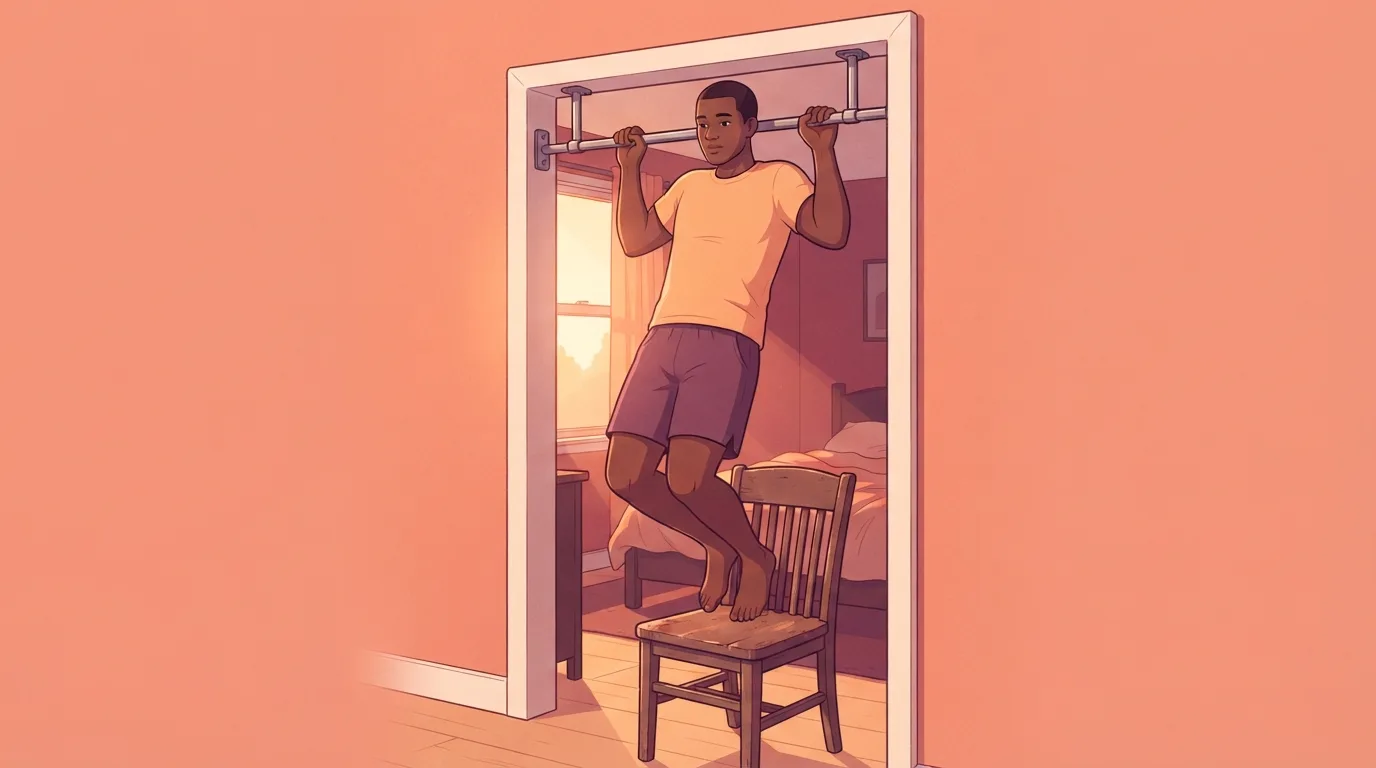
Put a sturdy chair or box under the bar and rest one or both feet on it. Pull with your arms and push with your legs only as much as you need. Over the weeks, use your legs less. This lets you practice the whole motion, up and down, with a load you can manage.
Once you can do 5 clean chin-ups, start mixing in neutral grip reps and overhand negatives. When those feel solid, try a full pull-up. Dumbbell rows on your other training days build the same lats and biceps without a bar.
How to Program Pull-Ups and Chin-Ups
The American College of Sports Medicine's position stand on progression (2009) recommends 2 to 3 resistance sessions a week for novices, with 8 to 12 reps per set as a starting range. With bodyweight pulls, you adjust the exercise instead of the weight. Use the hardest version you can do for clean reps, and step down to an assisted or lowering-only version when you can't.
| Your level | Main pulling work | Sessions per week |
|---|---|---|
| No chin-up yet | Hangs, 3 top holds, 3 sets of 3 to 5 negatives, assisted reps | 2 to 3, with a rest day between |
| 1 to 5 chin-ups | Several short sets of chin-ups well short of failure, plus negatives | 2 to 3 |
| 5 or more chin-ups | Rotate chin-ups, neutral grip and pull-ups, 3 to 4 sets each | 2 to 3 |
| 12 or more clean reps | Add a pause at the top, a slower lowering or extra weight | 2 to 3 |
Short sets spread across the week work well for this kind of skill. It's the idea behind greasing the groove: frequent sets that stop well before fatigue.
Can you build muscle with chin-ups? Yes. A 2017 meta-analysis of 21 studies by Schoenfeld and colleagues, also in the Journal of Strength and Conditioning Research, found that muscle growth was similar across light and heavy loads when sets were taken to failure. Heavy loads still won for one-rep-max strength. So bodyweight pulls build muscle well as long as most sets end close to failure, and adding load makes sense once your reps climb past about 12.
Which Should You Do: Pull-Ups or Chin-Ups?
Most people should do both and rotate them. If you have to pick one, use your goal:
- Choose chin-ups if you're working toward your first rep, want more total reps per session or want extra biceps work.
- Choose pull-ups if you want more upper-back work, already have five clean chin-ups or face a test that requires an overhand grip.
- Choose the neutral grip if your elbows, wrists or shoulders complain about the other two.
Whichever grip you choose, the result depends on doing it twice a week for months, and that's where most plans fall apart. FitCraft's strength workouts use bodyweight and dumbbells, and an AI coach demonstrates each exercise on an interactive 3D model. Workouts adjust as you progress. Streaks and leaderboards help keep those sessions on the calendar. If you're weighing your options, our ranking of the best strength training apps compares FitCraft with the alternatives.
The Bottom Line
Pull-ups and chin-ups are the same exercise with a different grip. Both train the lats hard. The chin-up adds biceps and chest, the pull-up adds lower and middle trapezius, and the neutral grip sits in between. Chin-ups are easier for most people because the elbow flexors are much stronger with the palms up or facing in.
As one FitCraft user, Mike, 23, put it after four months of training: "The streak system got me hooked. I didn't want to break my chain." Your first rep comes the same way, through short, regular practice. You're not too weak for the bar. You just need the right progression.
Frequently Asked Questions
Do chin-ups count as pullups?
In everyday training, yes: a chin-up is a pull-up done with an underhand grip, and both are vertical pulls that lift your full body weight to the bar. Fitness tests and competitions are different, because their rules often name the grip. If a test calls for an overhand pull-up, practice the overhand version before test day.
Can you build muscle with chin-ups?
Yes. Chin-ups load the lats and biceps with your whole body weight, and a 2017 meta-analysis of 21 studies found that muscle growth was similar across light and heavy loads when sets were taken to failure. Do 2 or 3 sessions a week, take most sets close to failure, and add a slow lowering, a pause or extra weight once you can do more than about 12 clean reps.
Can I do pull ups with rotator cuff injury?
Not until a doctor or physical therapist has cleared you. Hanging and pulling load the rotator cuff with your arms overhead under your full body weight, and a small motion-capture study linked wide-grip and underhand pull-ups to shoulder movement associated with impingement. Once you're cleared, rebuild with rows and short hangs, use whichever grip is pain-free, and stop at any shoulder pain.
How many pullups should a 200lb man be able to do?
There's no research standard for pull-ups by body weight. A heavier person lifts more total load on every rep, so the same number of reps is harder at 200 pounds than at 150. The useful benchmark is your own: one strict rep, then a clean set of five, then ten, adding reps only while every rep reaches the bar without kipping.
What muscles do neutral grip pull ups work?
Neutral grip pull-ups work the lats most, with the biceps, brachialis and brachioradialis bending the elbows and the trapezius, rhomboids and rear deltoids controlling the shoulder blades. A 2017 EMG study of 19 trained men found muscle activity over a full rep was similar to the overhand and underhand versions, with less middle trapezius activity than the overhand pull-up.
Are neutral grip pull-ups easier?
For many people, yes. Elbow flexion strength is highest with the palms facing each other: a 2018 study measured about 244 newtons in that position against about 114 with the palms down. Neutral grip pull-ups usually feel closer to chin-ups than to overhand pull-ups, which makes them a useful bridge between the two.