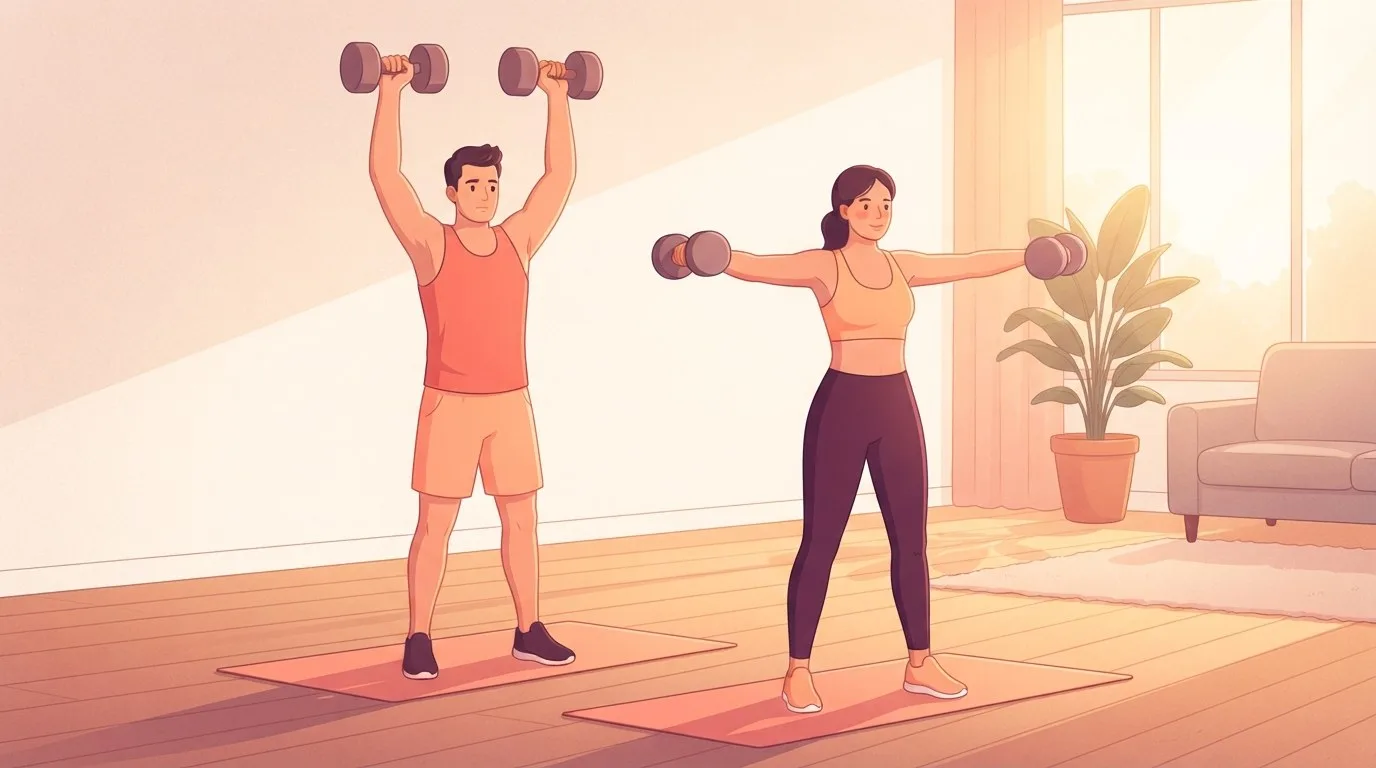
Compound vs isolation exercises is one of the oldest arguments in lifting, and it usually splits into two camps. One says compound lifts are all you need and curls are a waste of time. The other builds whole workouts out of single-joint moves for every muscle. The trials say each camp is half right.
If you train at home with a pair of dumbbells, the question has a practical edge. Your time is limited, your equipment is limited, and a workout that runs 90 minutes because it has nine exercises is a workout you'll start skipping by the third week. Choosing well between compound lifts vs isolation work is mostly about getting the most growth out of the sessions you'll actually show up for.
This guide covers what the head-to-head trials found, where each type of exercise clearly wins, dumbbell and bodyweight examples of both, the question of which to do first, and a simple way to combine them. For the one-paragraph definitions, see our glossary entries for compound exercises and isolation exercises.
Compound vs Isolation Exercises: The Quick Comparison
| Feature | Compound exercises | Isolation exercises |
|---|---|---|
| Joints that move | Two or more, such as hip, knee and ankle | One, such as the elbow in a curl |
| Muscles trained per rep | Several at once, with one or two doing most of the work | One main muscle, with little help |
| Load you can lift | Heavier, because more muscle shares it | Lighter, because one muscle carries it |
| Time to train the whole body | 3 to 5 exercises | 10 or more exercises |
| Learning curve | Steeper, with more technique to learn | Shallow, and easy to do well from day one |
| Strength gains (Paoli 2017) | Larger, even on the isolation lift | Smaller at the same total volume |
| Muscle growth in trials | Similar for most muscles | Similar for most muscles, and better for a few |
| Fixing one lagging muscle | Hard to aim at one muscle | Easy to aim, and easy to add sets |
| Best spot in a workout | First, while you're freshest | After the compound lifts |
| Dumbbell examples | Goblet squat, Romanian deadlift, row, chest press | Curl, lateral raise, chest fly, overhead triceps press |
| Bodyweight examples | Push-up, split squat, inverted row, pike push-up | Calf raise, glute bridge, donkey kick, leg raise |
What the Trials Comparing Them Found
Only a handful of training studies have put compound and isolation exercises head to head, and most of them measured the arms, because the elbow flexors are easy to scan and every upper-body pull trains them. Here's what those trials show and where they stop.
Gentil 2013 and 2015: pulldowns grew the biceps as much as curls
Paulo Gentil's lab in Brazil ran the two best-known early tests in untrained young men. In the first, Gentil et al. (2013) compared lat pulldowns and bench presses alone against the same program plus biceps curls and triceps extensions for 10 weeks. Elbow flexor thickness rose 6.5 percent without the arm work and 7.04 percent with it, a difference that wasn't significant. In the second, Gentil, Soares and Bottaro (2015) had one group do only pulldowns and the other only curls, twice a week for 10 weeks. Biceps thickness rose 6.10 and 5.83 percent respectively, again with no difference.
Both reports describe 29 untrained men training for 10 weeks, and the compound-only group's elbow flexor strength gain is identical in both reports (10.40 percent), so they may share participants. Treat them as one piece of evidence, not two independent trials.
de França 2015: extra arm work didn't help trained men either
The obvious objection is that beginners grow from anything. de França et al. (2015) tested 20 men with at least two years of lifting experience for 8 weeks, comparing a compound-only upper-body program with the same program plus curls and triceps work. Arm strength and arm size changed by similar amounts in both groups, and the authors concluded that compound-only training was the more time-efficient approach.
Paoli 2017: the same work, bigger strength gains from compound lifts
Paoli et al. (2017) asked a different question. They split 36 active men into a compound-only group (bench press, squat and similar) and an isolation-only group (dumbbell flys, knee extensions and similar), matched total work volume, and trained both three times a week for 8 weeks. Both groups lost fat and gained lean mass by similar amounts. The compound group improved more on every performance test: VO2 max 12.5 versus 5.1 percent, bench press 10.9 versus 8.1 percent and squat 13.8 versus 8.3 percent.
The detail I find most telling is the knee extension test. The isolation group trained knee extensions directly and the compound group never did them, yet knee extension strength rose 18.9 percent in the compound group against 12.4 percent in the isolation group.
Mannarino 2021: the trial where isolation won
Not every trial ends in a draw. Mannarino et al. (2021) trained 10 untrained men for 8 weeks with a split-body design: one arm did unilateral dumbbell rows and the other did biceps curls, 4 to 6 sets to failure twice a week. The curl arm's elbow flexors grew 11.06 percent, against 5.16 percent for the row arm. Strength followed specificity, so each arm got better at the exercise it practiced.
Where the evidence stops
A review by Gentil, Fisher and Steele (2017) pulled together 23 studies. Muscle activation of the prime movers looked similar in compound and isolation exercises for the arms and legs, long-term trials in the upper limbs found no extra benefit from adding isolation work, and the lower back muscles were the exception that seemed to benefit from isolation training. The trials behind those conclusions are small, short and mostly in young men, and nearly all of them measured the arms.
You'll also see a set of trials by Barbalho and colleagues cited on this question, several of which reported no benefit from adding single-joint exercises. I've left them out. Outside researchers, including some of the lab's own co-authors, raised concerns about the data in 2020, and two of the lab's papers have since been retracted, one of them on exactly this question.
Find out what's really holding you back
FitCraft, our mobile fitness app, pairs you with an AI coach who builds you a personalized plan around your goals, schedule, and fitness level. Every FitCraft program is designed by Domenic Angelino, MPH (Brown University) and NSCA-CSCS, with research published in the Journal of Strength and Conditioning Research and Medicine & Science in Sports & Exercise.
Take the Free Assessment Free • 2 minutes • No credit cardWhen Compound Exercises Win
Compound lifts are the better default for most of your training, for four reasons the evidence supports.
- They save time. Iversen et al. (2021) reviewed time-efficient training and recommended building short programs around bilateral, multi-joint exercises, with at least one leg pressing movement, one upper-body pull and one upper-body push.
- They build more strength and fitness per unit of work. Paoli's compound group beat the isolation group on every strength test and more than doubled its VO2 max gain at the same total volume.
- They cover the helpers for free. A row trains the biceps and rear delts along with the back, which is why adding curls changed so little in the Gentil and de França trials. Our breakdown of how many sets per muscle group per week shows how to count that assisting work toward your weekly total.
- They teach patterns you use every day. Squatting, hinging, pushing and pulling are the shapes of getting off the floor, lifting a bag and carrying groceries, so practicing them under load has obvious carryover.
If you're new to lifting, or you only have 30 minutes, a workout made only of compound exercises is a complete workout. Isolation work is what you add once that base is in place.
When Isolation Exercises Win
Isolation exercises earn their place in specific jobs that compound lifts do badly.
Muscles the compound lifts barely load
Kubo, Ikebukuro and Yata (2019) used MRI to measure leg muscle volume after 10 weeks of squat training. Full squats grew the vasti (the main quadriceps muscles), the adductors and the glutes, but neither squat depth changed the rectus femoris or the hamstrings. Because a squat leaves the hamstrings at almost the same length from top to bottom, they need a hinge such as a Romanian deadlift or a bridge-type isolation move. The same logic applies to the side delts, which presses and push-ups mostly skip, and to the calves, which squats and lunges leave largely alone.
Training a muscle in its stretched position
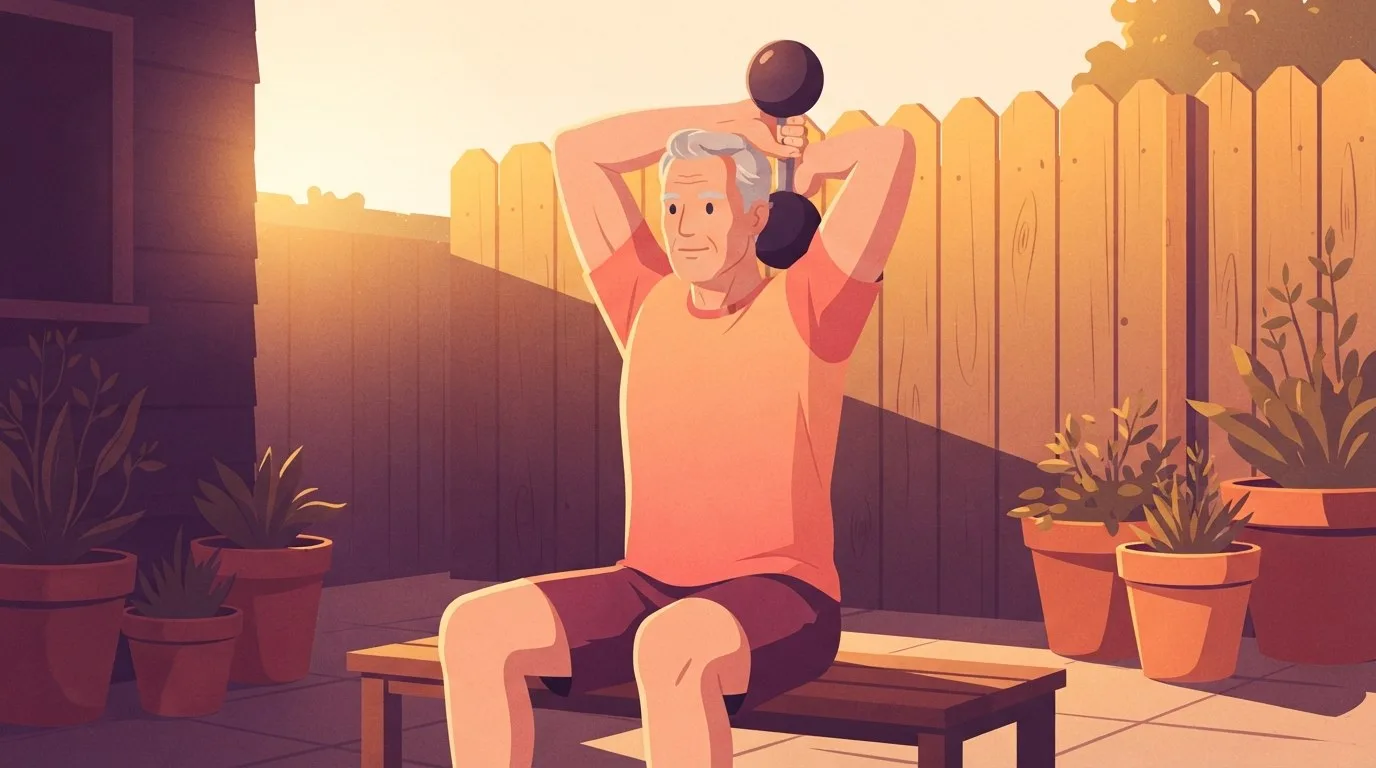
Maeo et al. (2023) had 21 adults train triceps extensions with one arm overhead and the other arm at their side for 12 weeks. The overhead arm grew the long head of the triceps 28.5 percent against 19.6 percent, and the whole triceps about 1.4 times as much, even though it lifted lighter loads. That trial used a cable machine, but a dumbbell overhead triceps press puts the arm in the same overhead position. Push-ups and presses don't, so this is growth you only get from an isolation exercise.
Bringing up one muscle, or training around a sore joint
Mannarino's curl arm grew twice as much as the row arm, which is the strongest case in the literature for direct arm work when arm size is the goal. Isolation moves also let you keep training a muscle when a joint elsewhere complains. A sore knee rules out split squats for a few weeks, but it rarely rules out calf raises or Romanian deadlifts with a soft knee bend.
Isolation vs Compound Exercises With Dumbbells and Bodyweight
Here are both types for every major muscle group, using only dumbbells and your body weight. Each exercise links to a full form guide.
| Muscle group | Compound options | Isolation options |
|---|---|---|
| Chest | Push-ups, dumbbell chest press | Chest fly |
| Back | Bent-over row, inverted row, chin-up | Overhead pullover |
| Shoulders | Dumbbell shoulder press, pike push-up | Lateral raise, rear delt raise, front raise |
| Biceps | Every row and chin-up | Biceps curl, hammer curl |
| Triceps | Close-grip push-up, bench dip | Overhead triceps press, triceps kickback |
| Quads | Goblet squat, split squat, Bulgarian split squat | Leg extension (a gym machine, so at home the split squat does this job) |
| Hamstrings and glutes | Romanian deadlift, single-leg deadlift | Glute bridge, donkey kick, fire hydrant |
| Calves | Some work from squats and lunges | Calf raise |
Two things stand out. Every muscle except the quads has a home isolation option, and every muscle except the calves has a strong compound option. That's why a dumbbell program built on compound lifts needs only a few isolation moves to cover everything.
Is It Better to Start With Compound or Isolation Exercises?
Start with whichever lift you most want to get stronger at, which for most people is a compound lift. Nunes et al. (2021) pooled 11 studies on exercise order and found strength gains were largest in whichever exercises came first in the session. Compound strength improved more when compound lifts went first, and isolation strength improved more when isolation lifts went first. Muscle growth was the same either way.
So the order is a strength decision, not a size decision. Putting compound lifts first is the sensible default because they're the heavier, more technical lifts and the ones that suffer most from fatigue. If your goal for a block is bigger arms and your elbows feel better after a few warm-up curls, starting with curls costs you nothing in growth.
How to Combine Compound and Isolation Exercises in One Workout
The structure that works for most people at home is simple.
- Open with 2 or 3 compound lifts: one lower-body move, one push and one pull, each for 3 or 4 hard sets.
- Finish with 2 or 3 isolation moves for the muscles your compound lifts shortchange, each for 2 or 3 hard sets.
- Rotate the isolation slots across the week so the hamstrings, side delts, arms and calves each get direct work at least twice.
- Count the assisting work before you add more arm exercises, because every row and push-up already trains the arms.
A 45-minute dumbbell session on that template looks like this: goblet squat 3 sets, dumbbell chest press 3 sets, bent-over row 3 sets, Romanian deadlift 3 sets, then lateral raise 2 sets, overhead triceps press 2 sets and calf raise 2 sets. About two-thirds of the sets are compound, and the last third fills the gaps the trials point to. Take every set to within about 3 reps of failure, and add weight or reps when the top of your range gets easy.
If you'd rather follow a plan than write one, FitCraft's dumbbell workout app has strength programs built from dumbbell and bodyweight exercises, with interactive 3D exercise demos you can rotate and zoom before your first set.
The Bottom Line
Compound lifts should make up most of your training, because they build strength and muscle across several muscle groups in the time it takes to train one with isolation work. Isolation exercises are the finishing tool for the hamstrings, side and rear delts, calves and arms. Neither is better in general. Each one is better at its own job.
The bigger risk is a plan so long or so complicated that you stop following it. As Katie, a FitCraft user, put it: "I've tried everything. This is the first time I've stuck with something past two weeks." A short workout with the right mix, done every week, beats a perfect one you quit.
Frequently Asked Questions
Are pushups compound or isolation?
Push-ups are a compound exercise. Every rep bends and straightens the elbows while the shoulders move, so the chest, front delts and triceps all share the work, and the abs and glutes hold the body in a plank. Close-grip push-ups shift more of the load to the triceps, and pike push-ups shift it to the shoulders, but both stay compound.
Is split squat a compound or isolation exercise?
The split squat is a compound exercise. The hip, knee and ankle all bend and extend on every rep, which trains the quads and glutes together, with the adductors and calves helping. It's one of the best compound leg exercises for home training, because one pair of dumbbells or just your body weight makes it hard enough, and the Bulgarian version with the back foot raised makes it harder.
Are hip thrusts compound or isolation?
Hip thrusts sit on the line between the two. The movement happens almost entirely at the hip while the knee angle stays roughly fixed, which is why many coaches file hip thrusts and glute bridges under isolation exercises for the glutes. The hamstrings, quads and trunk still work hard to hold that position, so others call them compound. For counting weekly sets the label doesn't matter: treat a bridge or hip thrust as a full set for the glutes and about half a set for the hamstrings.
What are some isolation exercises?
Common isolation exercises with dumbbells are biceps curls, hammer curls, lateral raises, rear delt raises, front raises, chest flys, overhead triceps extensions and triceps kickbacks. Bodyweight isolation exercises include calf raises, glute bridges, donkey kicks, fire hydrants and leg raises. Each one moves a single joint, so the target muscle does nearly all of the work.
Can you build muscle with only compound exercises?
Yes, for most of your body. In trials of untrained and trained men, adding curls and triceps work to a program of pulldowns, rows and presses produced no extra arm growth over 8 to 10 weeks. The gaps show up in muscles compound lifts barely load: squats left the hamstrings and the rectus femoris unchanged in one 10-week MRI study, and side delts and calves get little from presses and squats.
What is the most neglected muscle?
No study ranks neglected muscles, but compound-only programs reliably under-train a few. The hamstrings top the list, because squats barely change their length, followed by the side and rear delts, which presses and push-ups mostly skip, and the calves. One or two isolation exercises for each of those, such as Romanian deadlifts, lateral raises, rear delt raises and calf raises, closes the gap.