The dumbbell front raise is one of those exercises that looks almost too simple to be useful. Grab two dumbbells, lift them in front of you, put them back down. But the anterior deltoid is the primary mover in shoulder flexion, and the front raise is the most direct way to isolate it. Every pressing movement you do, from push-ups to bench press to overhead press, recruits the anterior deltoid as a synergist. The front raise lets you train it as the star of the show.
The problem is that most people treat front raises like an ego exercise. They grab heavy dumbbells, lean back, swing the weight up with momentum, and wonder why their lower back hurts more than their shoulders. This guide covers the actual technique, what Coach Ty watches for when you do front raises in FitCraft, the mistakes that quietly kill your results, and how to progress from light dumbbells to advanced variations that torch the anterior deltoid.
Quick Facts: Dumbbell Front Raise
- Equipment needed: Pair of dumbbells (5-20 lb for most lifters)
- Difficulty: Beginner (seated, alternating) to Advanced (incline bench, plate)
- Modality: Strength (hypertrophy-focused)
- Body region: Upper body (shoulders)
- FitCraft quest category: Strength
Muscles Worked
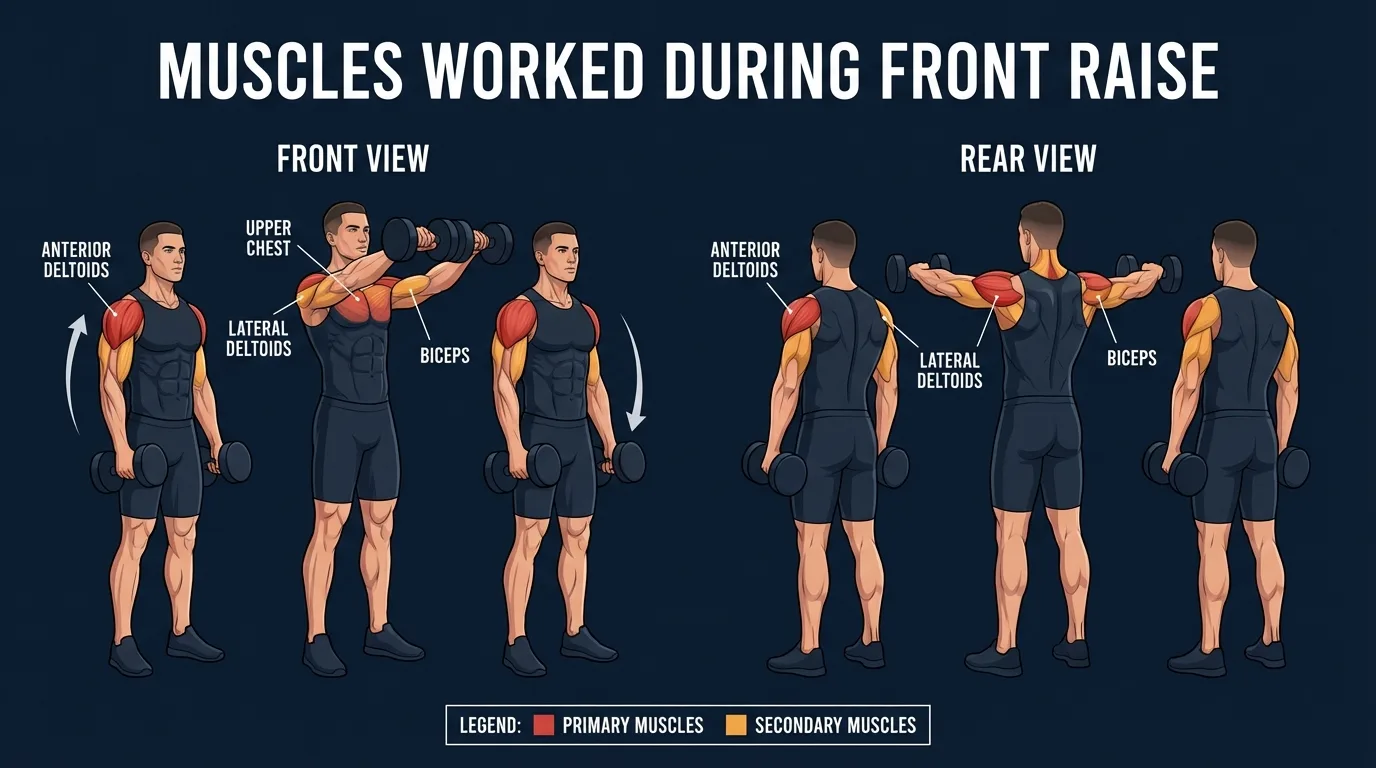
Primary movers: the anterior (front) deltoid drives the entire movement through shoulder flexion. It shortens concentrically as you raise the dumbbells from your thighs to shoulder height, and lengthens under load eccentrically as you lower them back down. That eccentric phase produces a significant portion of the hypertrophy stimulus, which is why tempo matters so much on this exercise.
Secondary movers: the medial (side) deltoid assists when the arms are slightly abducted from the centerline. The upper pectoralis major (clavicular head) contributes to shoulder flexion, especially in the first half of the lift. The serratus anterior protracts and upwardly rotates the scapula to allow clean arm elevation, and the upper trapezius assists with scapular upward rotation past about 90 degrees of shoulder flexion.
Stabilizers: the rotator cuff (supraspinatus, infraspinatus, teres minor, subscapularis) holds the humeral head centered in the glenoid throughout the lift, preventing anterior translation. The middle and lower trapezius work to keep the shoulder blades packed down against shrug pressure. The anterior core (rectus abdominis, transverse abdominis, obliques) and erector spinae work isometrically to hold the torso vertical and resist the forward-loading torque the dumbbells create.
Evidence and mechanism: Dicus et al. (2018) compared loading modalities for shoulder isolation and found that dumbbell front raises produced 63.3% normalized EMG activity in the anterior deltoid, significantly higher than kettlebell variations at 57.9%. The dumbbell wins because the stable load lets the working muscle drive the motion without compensating for implement instability. The long lever arm of an extended elbow also means a relatively light dumbbell produces a large torque demand at the shoulder, which is why front raises feel disproportionately hard for their absolute weight.
How to Do a Front Raise (Step-by-Step)
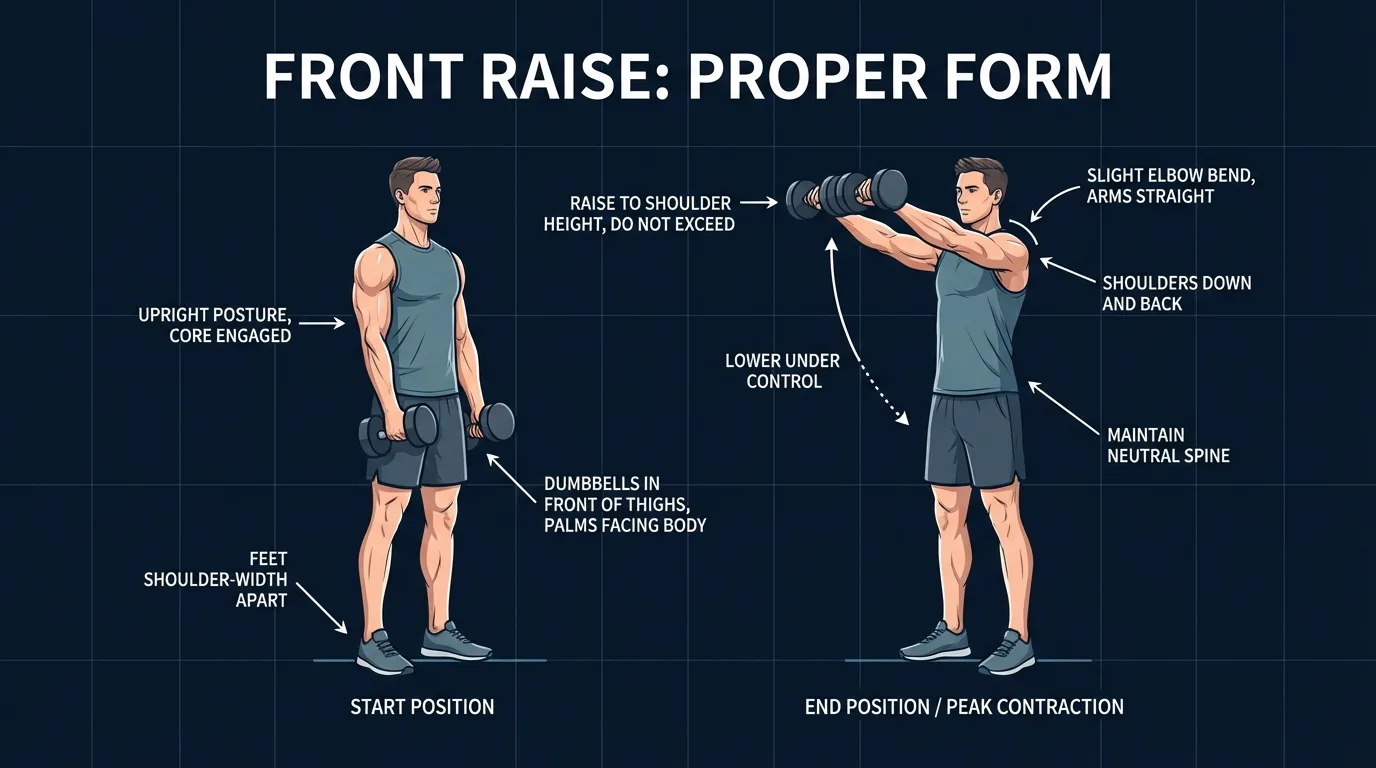
- Stand tall with dumbbells in front of your thighs. Feet shoulder-width apart, a dumbbell in each hand, palms facing your body (pronated grip). Pull your shoulders down and back, then brace your core. Put a slight bend in your elbows, about 10-15 degrees. That angle is locked in for the entire set. Think of your arms as two slightly curved steel rods. Once you set that bend, it doesn't change.
Coach Ty's cue: "Lock the elbow angle before you start. If you let it change mid-rep, you're cheating the load off the front delt." - Raise the dumbbells in front of your body. Exhale and lift both dumbbells directly in front of you in a smooth arc. Lead with your knuckles, keeping your wrists neutral the entire time. As the ACE exercise library notes, your elbows and upper arms should rise together, staying slightly ahead of your forearms. Stop when your arms reach shoulder height. Not above. Shoulder height is where the anterior deltoid peaks.
Ty's cue: "Push the weight forward and up, like you're handing something to a person standing in front of you. That intent keeps the front delt working and the traps quiet." - Pause at shoulder height. Hold the top position for a full second. Arms parallel to the floor, elbows still slightly bent, wrists neutral. Your torso stays perfectly upright. Zero lean-back. If you have to arch your lower back to get the weight up, it's too heavy. Drop down and own it.
- Lower with control. Inhale and take 2-3 seconds to bring the dumbbells back to the starting position. Fight gravity the entire way down. This eccentric phase generates a large portion of the muscle-building stimulus. Letting the weight just drop throws away half the exercise.
Ty's cue: "Slow it down on the way back. Two seconds up, one second hold, three seconds down. That's the tempo that builds the front delt." - Reset and repeat. At the bottom, let the dumbbells lightly touch your thighs, reset your shoulder blade position, and go again. Beginners: 3 sets of 12-15 reps with light weight. If 5-pound dumbbells challenge you for 15 clean reps, that's exactly where you should be. There is no shame in light weight done right.
Common Mistakes to Avoid
The front raise has a short learning curve, but four mistakes turn a solid anterior deltoid builder into a lower-back exercise (or a ticket to shoulder pain).
- Leaning back during the lift. This is the number one mistake. When the weight is too heavy, people compensate by arching their lower back to create momentum. That turns the front raise into a standing incline press using your spine as the bench. The fix: stand with your back against a wall for a few sets. If the dumbbells can't get to shoulder height without your lower back peeling off the wall, the weight is too heavy.
- Using momentum and swinging. Every rep should start from a dead stop. No hip thrust, no bouncing at the bottom, no body English. If the dumbbells need a running start, you're past the point of productive training. Drop the weight. A slow, controlled 10-pound front raise does more for your anterior deltoid than a swinging 20-pounder.
- Going above shoulder height. Raising the dumbbells above parallel shifts the load from the anterior deltoid to the upper trapezius and increases the risk of subacromial impingement. Shoulder height is the ceiling. The anterior deltoid peaks there, and everything above that point is trap work with added joint stress.
- Shrugging the shoulders. When your traps take over, the anterior deltoid gets a free ride. You'll see this as a shoulder shrug at the top of the movement. The cue that fixes it: think about pushing the dumbbells forward and away from your body, rather than lifting them straight up. That horizontal intent keeps the traps quiet and the front delts working. It works the same way it does on lateral raises.
- Letting the wrists flex or extend under load. Your forearm, wrist, and hand should form one straight line through the entire rep. Wrist deviation under load is how you get overuse injuries in the forearm. Lock it in and forget about it.
Get this exercise in a personalized workout
FitCraft, our mobile fitness app, uses its AI coach Ty to program isolation exercises like this into your plan at the right volume and intensity, based on your level, goals, and equipment. Ty was designed and trained by Domenic Angelino, MPH (Brown University) and NSCA-CSCS, with research published in the Journal of Strength and Conditioning Research and Medicine & Science in Sports & Exercise.
Take the Free Assessment Free · 2 minutes · No credit cardVariations: Beginner to Advanced
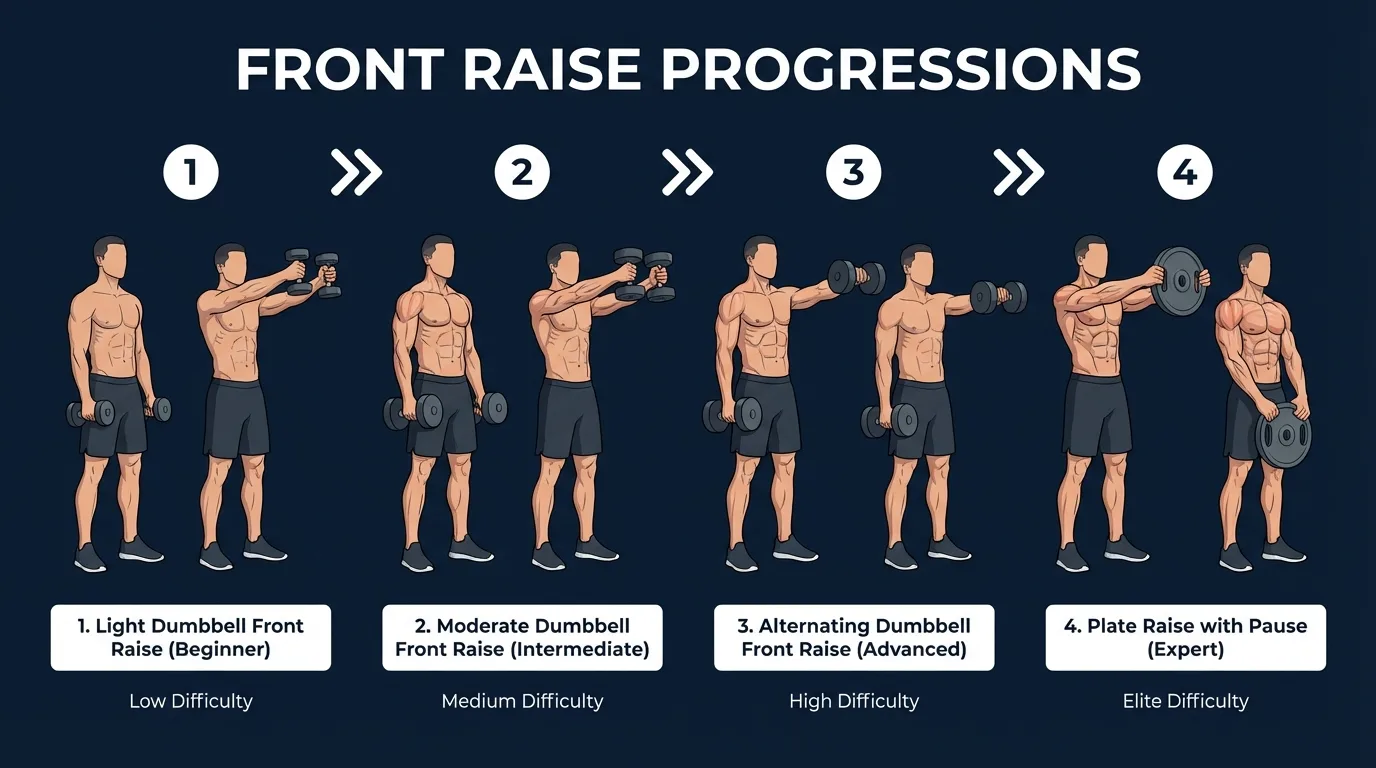
Seated Dumbbell Front Raise (Beginner)
Sit on a bench with back support, holding light dumbbells at your sides with palms facing inward. Raise one arm at a time to shoulder height using the same form cues as the standing version. The bench eliminates the temptation to lean back and swing, which makes it a great option for learning the movement pattern. Start with 3 sets of 12-15 reps per arm. If you can do all reps without any torso movement, you're ready for the standing version.
Standard Dumbbell Front Raise (Intermediate)
This is the version covered in the step-by-step above. It's what Coach Ty programs as the default in FitCraft. Moderate weight, 10-15 reps, strict form. You can do these bilaterally (both arms at once) or alternating. Alternating gives you slightly more core engagement and lets you focus on one shoulder at a time. Both work. Pick the one that lets you maintain the best form.
Plate Front Raise (Intermediate to Advanced)
Hold a weight plate with both hands at the 3 and 9 o'clock positions. Raise it in front of you to shoulder height using the same tempo. The plate version forces a neutral grip (palms facing each other) which some people find more comfortable on the shoulder joint. It also trains both anterior deltoids to work together, which builds coordination for overhead pressing movements like the shoulder press.
Incline Bench Front Raise (Advanced)
Lie face-down on an incline bench set to about 30-45 degrees. Let the dumbbells hang straight down, then raise them in front of you to shoulder height. This variation eliminates all possibility of momentum and changes the resistance curve so the anterior deltoid is loaded through a greater range of motion, especially at the bottom where the standard version provides minimal tension. Use about 50-60% of your normal standing front raise weight. It's significantly harder than it sounds.
When to Avoid or Modify Front Raises
Front raises are safe for most healthy adults, but a few conditions warrant modification, lighter loading, or temporarily swapping in shoulder-health drills instead. None of these are permanent restrictions. They're starting points. Always consult your physician or physical therapist for personalized guidance.
- Active shoulder impingement or rotator cuff irritation. Front raises load the anterior deltoid through the same overhead arc that pinches the supraspinatus tendon under the acromion. Stop standard front raises, work only within a pain-free range below shoulder height, and substitute scapular health drills like Y-raises, T-raises, and W-raises that build rotator cuff capacity. If symptoms persist for more than a week or two, see a physical therapist before progressing.
- Acute AC joint sprain or chronic AC arthritis. The shoulder-height endpoint of a front raise loads the acromioclavicular joint at exactly the angle that flares AC symptoms. Modify by stopping at 60 degrees of shoulder flexion (about halfway up), reducing load, and prioritizing rotator cuff isolation with pull-aparts until symptoms resolve.
- Recent shoulder, elbow, or wrist surgery. Get clearance from your surgeon before any loaded shoulder isolation work. Most post-surgical protocols start with isometric scapular work and active range-of-motion drills before introducing dumbbell front raises on a controlled timeline.
- Bicipital tendinopathy. The long head of the biceps runs through the bicipital groove at the front of the shoulder, and the front raise loads it in a vulnerable position. Stop the set when symptoms increase, use a lighter load with higher reps (15-20), and try the neutral-grip plate variation instead of the pronated dumbbell version.
- Lower-back pain that flares when standing under load. If your hips drift forward and your lumbar arches every time you raise the weight, the front raise is loading your spine more than your shoulder. Switch to the seated variation against a bench back, drop the weight by 30-50%, and rebuild core bracing with deadbugs, bird-dogs, and forearm planks before returning to the standing version.
- Uncontrolled high blood pressure. The combination of arms-raised overhead and breath-holding (Valsalva) under load can spike systolic blood pressure. If your blood pressure is not well-controlled, get medical clearance before loaded shoulder isolation work, breathe through every rep, and start with the seated variation at light loads.
Related Exercises
If front raises are part of your shoulder routine, these movements complement or extend the same training pattern:
- Same shoulder head (anterior deltoid, compound): the shoulder press is a compound movement that heavily recruits the anterior deltoid along with the medial deltoid and triceps. Program it before front raises in the same session.
- Complementary shoulder head (medial deltoid isolation): lateral raises target the medial deltoid for complete shoulder development. Pair them with front raises in the same session.
- Antagonist isolation (rear deltoid): bent-arm lateral raises and pec-squeeze crossovers balance front-loaded shoulder work with posterior chain isolation. Most lifters need more rear-delt volume than they think.
- Rotator cuff and scapular health: Y-raises, T-raises, W-raises, I-raises, and pull-aparts protect the shoulder joint that front raises load heavily. Program 2-3 sets of one of these as a warm-up before any pressing or front raise session.
- Compound pressing carryover: push-ups, chest press, and the Arnold press all recruit the anterior deltoid as a synergist. Front raises serve as a finisher for the front delt after these compound lifts.
How to Program Front Raises
Front raise programming follows the same evidence-based ranges as any single-joint isolation exercise. The American College of Sports Medicine (ACSM) Position Stand on resistance training recommends roughly 8-15 reps per set for hypertrophy and shorter rest intervals (45-90 seconds) for isolation work, with at least 48 hours between sessions training the same muscle group (Ratamess et al., 2009).
| Level | Sets × Reps | Rest between sets | Frequency |
|---|---|---|---|
| Beginner (seated, alternating) | 2-3 × 10-15 | 45-60 seconds | 2-3 sessions/week |
| Intermediate (standing, bilateral) | 3-4 × 8-15 | 60-90 seconds | 2-4 sessions/week |
| Advanced (incline bench, plate, drop sets) | 3-4 × 6-15 (intensity-dependent) | 60-120 seconds | 2-4 sessions/week |
Where in your workout: front raises belong late in the session, after compound pressing work like push-ups, bench press, or shoulder press. Isolation work is accessory by design. If you put it first, you'll fatigue the anterior deltoid and underload your main compound lifts. In a shoulder-focused session, do the shoulder press first, then lateral raises, then front raises as the third or fourth movement. Keep total weekly anterior deltoid isolation volume between 6-10 sets, since pressing exercises already provide significant front-delt stimulus.
Form floor over rep targets: if your last 2 reps of a set break form (torso lean, shrugged shoulders, momentum swing, wrists collapsing), stop the set there. Hitting a target rep count with broken form is worse than hitting fewer reps cleanly. The front raise rewards strict execution more than almost any other shoulder exercise.
How FitCraft Programs This Exercise
Knowing how to do a front raise is step one. Knowing when to do it, how many reps, and when to progress is where most people get stuck.
FitCraft's AI coach Ty handles that. During your personalized diagnostic assessment, Ty maps your fitness level, goals, and available equipment. Then Ty builds a personalized program that slots front raises into a balanced training plan at the right variation and load for your level.
As you get stronger, Ty adjusts the variation and volume to match your level. Seated alternating becomes standing bilateral. Standing dumbbells progress to plate or incline bench variations. Volume adjusts based on your recovery and consistency. Every program is built around evidence-based periodization and balanced shoulder volume, so the anterior deltoid work complements your pressing rather than overloading the front of the joint.
Frequently Asked Questions
Can I do dumbbell front raises with shoulder impingement or rotator cuff pain?
Not at full standing load. Front raises load the anterior deltoid through the same overhead arc that pinches the supraspinatus tendon under the acromion, which can flare impingement and rotator cuff irritation. If you have active symptoms, stop standard front raises, work within a pain-free range below shoulder height, and substitute scapular health drills like Y-raises, T-raises, and W-raises that build rotator cuff capacity. If pain persists more than a week, see a physical therapist before progressing back to loaded front raises.
What muscles do front raises work?
Front raises primarily target the anterior (front) deltoid, the muscle responsible for lifting your arm forward at the shoulder. Secondary muscles include the medial deltoid, upper pectoralis major (clavicular head), serratus anterior, and upper trapezius. The trunk works isometrically to keep you vertical, and the rotator cuff stabilizes the glenohumeral joint throughout the lift.
How heavy should dumbbell front raises be?
Lighter than most people use. The front raise uses a long lever arm that multiplies the effective load on the anterior deltoid. Most men start with 10-15 lb dumbbells, most women with 5-10 lbs. If you need to lean back or swing the weight up, drop the load. Controlled reps with moderate weight build the anterior deltoid far better than heavy, sloppy ones.
Should I raise the dumbbells above shoulder height on front raises?
No. Raising the dumbbells above shoulder height shifts the work to the upper trapezius and increases the risk of shoulder impingement. Stop when your arms are parallel to the floor. That is the peak contraction point for the anterior deltoid, and going higher adds risk without meaningful benefit.
Are front raises or lateral raises better for shoulders?
They target different parts of the deltoid and both belong in a complete shoulder program. Front raises emphasize the anterior deltoid (front of the shoulder), while lateral raises emphasize the medial deltoid (side of the shoulder). Most pressing exercises already train the anterior deltoid, so lateral raises often get more programming priority. But if your front delts are lagging or you want balanced shoulder development, front raises fill that gap.
How often should I do front raises?
One to two dedicated sessions per week is enough for most people. The anterior deltoid already gets significant work during pressing exercises like push-ups, bench press, and shoulder press. Adding 6-10 total sets of front raises per week on top of your pressing volume is usually plenty for hypertrophy. Space sessions at least 48 hours apart for recovery.