The bent arm lateral raise is the same movement pattern as a standard lateral raise with one key difference. Your elbows stay bent at 90 degrees throughout the entire rep. That single change shortens the lever arm at your shoulder, which reduces the torque demand on the joint and lets you use heavier dumbbells without sacrificing control. For beginners, it is one of the most accessible ways to start building the medial deltoid. For experienced lifters dealing with shoulder sensitivity, it is a way to keep training side delts without aggravating anything.
The biomechanics are straightforward. A longer lever arm (straight arm) means more torque at the shoulder for a given dumbbell weight. A shorter lever arm (bent arm) means less torque. Coratella et al. (2020) found that straight-arm lateral raises produced slightly higher medial deltoid EMG activation than bent-elbow variations, which makes sense because the longer lever forces the muscle to work harder per pound of dumbbell. But the practical tradeoff matters: the bent arm version lets you use heavier weight and maintain stricter form, which means more total mechanical tension on the muscle across a set. Both versions build shoulders. The bent arm version is just more forgiving.
This guide covers the exact technique, Coach Ty's real-time cues, the mistakes that turn this into a trap exercise, and how to progress from beginner to advanced variations.
Quick Facts: Bent Arm Lateral Raise
- Equipment needed: Pair of dumbbells (3-20 lb depending on level)
- Difficulty: Beginner to advanced (scales by load and unilateral progression)
- Modality: Single-joint isolation, bilateral or single-arm, shoulder abduction
- Body region: Shoulders (medial deltoid primary)
- FitCraft quest category: Strength · Shoulder hypertrophy · Shoulder-friendly training
Muscles Worked
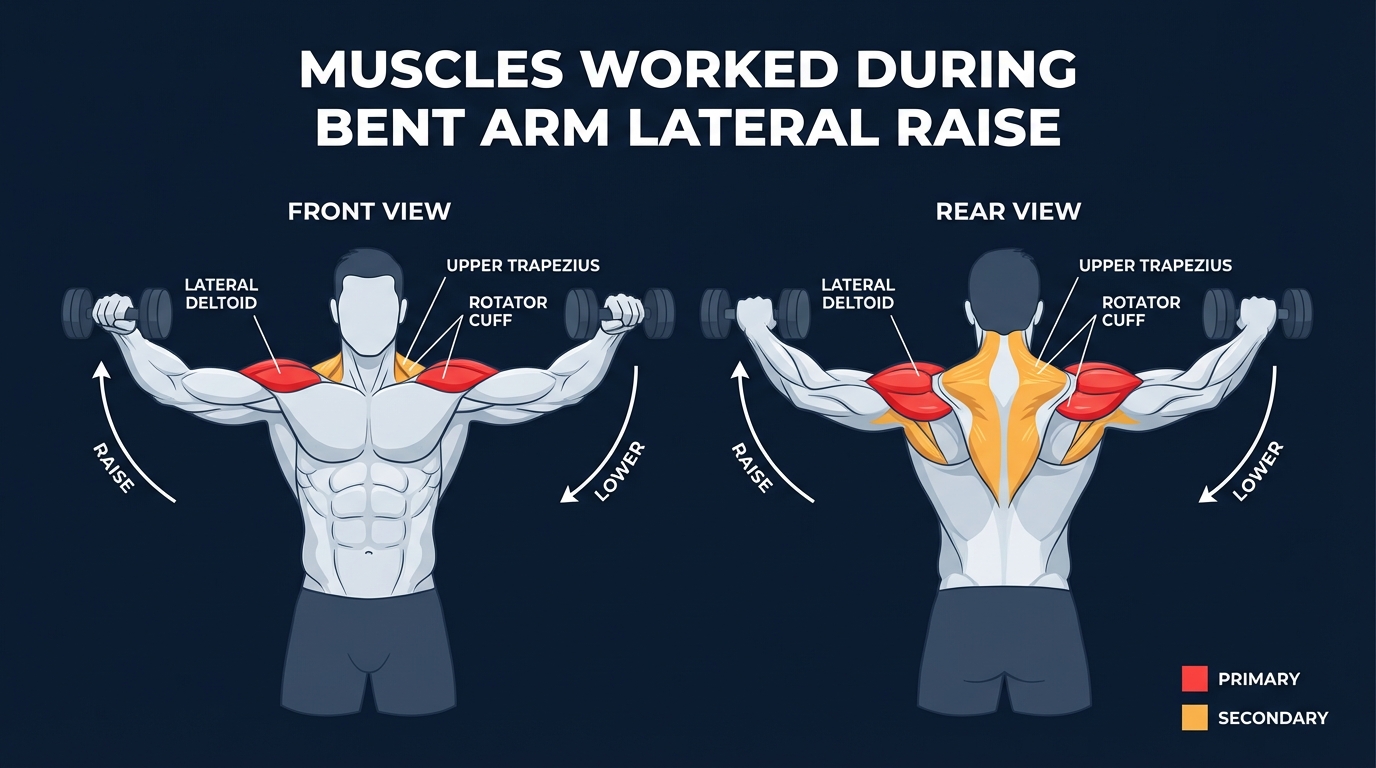
Primary movers. The medial (lateral) deltoid drives the rep. It contracts concentrically as you raise the elbows out to shoulder height, and it controls the eccentric phase as you lower under gravity. This head of the deltoid is what creates the visual width of the shoulder, and the lateral raise pattern (bent or straight arm) is the most direct way to load it in isolation.
Secondary movers. The anterior deltoid assists, especially in the first 30 degrees of arm elevation. The supraspinatus, one of the four rotator cuff muscles, initiates shoulder abduction from a dead-hang start and shares load with the medial deltoid through the lower portion of the range. If your shoulders are protracted forward (rounded posture), the anterior deltoid takes a disproportionate share of the work.
Stabilizers. The upper trapezius and serratus anterior coordinate scapular position throughout the rep. The cue "shoulders down and back" exists because the upper trap will happily take over the lift if you let it shrug. The rotator cuff (subscapularis, infraspinatus, teres minor) keeps the humeral head centered in the glenoid during abduction. The core stays neutral. This is not a trunk-loaded exercise, but a stable trunk keeps the shoulder mechanics clean.
Evidence. Coratella et al. (2020) measured deltoid EMG across lateral raise variations and found that straight-arm lateral raises produced slightly higher medial deltoid activation than bent-elbow variants, attributable to the longer external moment arm. The bent arm version trades a small reduction in per-rep EMG for the ability to handle heavier absolute loads and tighter scapular control, which is the basis of its use as a beginner-friendly and shoulder-friendly substitute.
How to Do a Bent Arm Lateral Raise (Step-by-Step)
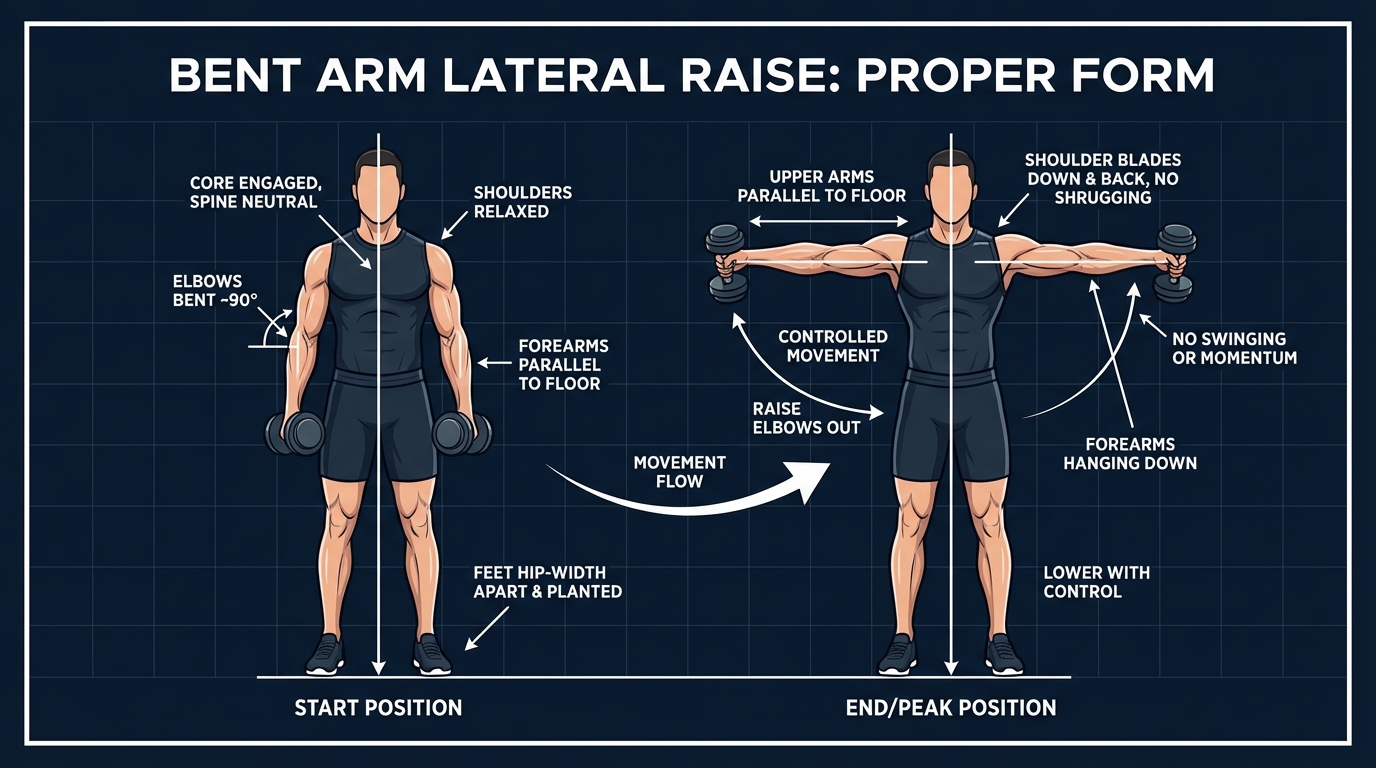
- Stand with dumbbells at your sides, elbows bent 90 degrees. Feet shoulder-width apart, a dumbbell in each hand. Bend your elbows to a right angle so your forearms point straight down toward the floor. Palms face inward, toward your body. Pull your shoulders down and back. This 90-degree elbow angle stays locked for the entire set. Think of your arms as two L-shaped brackets. Once you set that bend, it does not change.
- Raise your elbows out to shoulder height. Leading with your elbows, raise both arms out to your sides. Your forearms hang straight down throughout the movement. The motion happens at the shoulder joint only. Stop when your upper arms are parallel to the floor, elbows at shoulder height. Not above. Going higher shifts the load to your traps. Coach Ty's cue: "Think about driving your elbows toward the ceiling, not lifting the dumbbells. Your hands are along for the ride."
- Pause at the top. Hold it for a full second. Your upper arms should be parallel to the floor, forearms dangling straight down, elbows at shoulder height. Your body should look like a goalpost from the front. If you cannot hold this position without swinging or shrugging, the weight is too heavy.
- Lower with control. Take 2-3 seconds to bring your elbows back down to your sides. Maintain that 90-degree bend throughout. Fight gravity on the way down. The eccentric phase matters. Letting the weight just drop is throwing away stimulus.
- Reset and repeat. At the bottom, let your arms settle briefly, reset your shoulder blades down and back, and go again. Exhale on the way up, inhale on the way down. Beginners: 3 sets of 12-15 reps. If you are using 8-pound dumbbells and it burns by rep 10, you are in the right range.
Common Mistakes to Avoid
The bent arm lateral raise is more forgiving than the straight-arm version, but that does not mean it is mistake-proof. These four errors are what turn a solid deltoid builder into wasted effort.
- Letting the elbow angle change. This is the most common mistake by far. People start with a 90-degree bend and end with nearly straight arms at the top. When the elbow opens up, the lever arm gets longer, and the body compensates by recruiting the traps and using momentum. The fix: pick a lighter weight and consciously maintain that right angle from bottom to top. If your forearms are not pointing straight down at the top of the rep, the angle has drifted.
- Shrugging the shoulders. When the traps take over, the medial deltoid barely works. You end up building your neck instead of your shoulders. The fix: before each set, actively depress your shoulder blades. Think about making your neck as long as possible. If you feel the burn in the top of your shoulders near your neck, you are shrugging.
- Going above shoulder height. Raising your upper arms above parallel to the floor shifts work to the upper trapezius and increases impingement risk. The medial deltoid peaks at shoulder height. Everything above that is a different exercise.
- Using momentum. Swinging the dumbbells up with a hip thrust or body rock means the weight is too heavy. Every rep should start from a dead stop. No bouncing at the bottom. If the movement is slow and controlled and a little boring, you are probably doing it right.
Get this exercise in a personalized workout
FitCraft, our mobile fitness app, uses its AI coach Ty to program isolation exercises like this into your plan at the right volume and intensity, based on your level, goals, and equipment. Ty was designed and trained by Domenic Angelino, MPH (Brown University) and NSCA-CSCS, with research published in the Journal of Strength and Conditioning Research and Medicine & Science in Sports & Exercise.
Take the Free Assessment Free · 2 minutes · No credit cardVariations: Beginner to Advanced
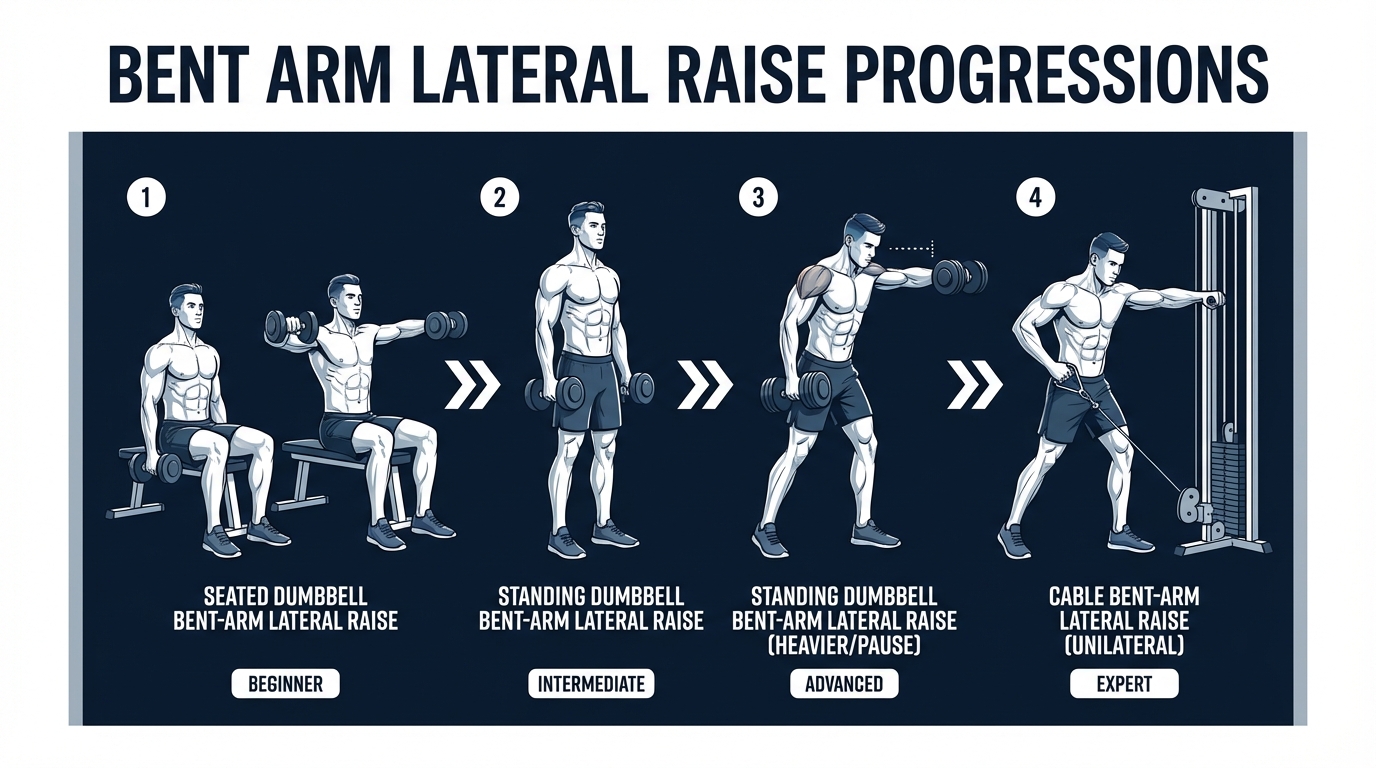
Seated Bent Arm Lateral Raise (Beginner)
Sit on a bench or sturdy chair with your feet flat on the floor. Performing the bent arm lateral raise seated eliminates any help from your lower body. You cannot swing, you cannot use momentum, and you cannot cheat. That makes it the best starting point for beginners who need to learn what the medial deltoid actually feels like when it is working. Use light dumbbells, 3-8 pounds. Focus on a 2-second lift, 1-second pause, and 3-second lower. Once you can complete 3 sets of 15 reps with a clear burn in the side of your shoulder, move to the standing version.
Standing Bent Arm Lateral Raise (Intermediate)
This is the standard version described in the step-by-step above. Standing adds a small stability demand. Moderate weight, 10-15 reps, strict form. Coach Ty programs this as the default bent arm lateral raise variation in FitCraft. The key at this level is consistency. You should feel a deep burn in the side delts by rep 10. If you do not, slow down the tempo or add a 2-second pause at the top.
Single-Arm Bent Arm Lateral Raise (Advanced)
Hold a sturdy surface with one hand for balance and perform the movement one arm at a time. Single-arm work lets you focus completely on the working shoulder, eliminates any side-to-side compensation, and lets you identify strength imbalances. Use about 80% of the weight you would use for the bilateral version. 3-4 sets of 10-12 reps per arm.
Alternative Exercises
If bent arm lateral raises do not suit you, these alternatives hit the same muscle:
- Standard lateral raises: The straight-arm version produces slightly higher medial deltoid EMG activation per Coratella et al. (2020), but requires lighter weight and more shoulder joint tolerance. If your shoulders feel fine with it, it is an excellent companion or replacement.
- Shoulder press: A compound movement that hits all three deltoid heads plus the triceps. Does not isolate the medial deltoid as well as lateral raise variations, but builds overall shoulder strength and size efficiently.
When to Avoid or Modify Bent Arm Lateral Raises
Bent arm lateral raises are safe for most healthy adults, but a few conditions warrant modification or a different exercise. Always consult your physician or physical therapist if you have any of the following, especially before adding load or increasing volume.
- Active shoulder impingement or subacromial pain. Raising the upper arms to shoulder height compresses the subacromial space. If this position reproduces pain, regress to lower-elevation work (raise only to 60-70 degrees of abduction), substitute scapular health drills like the W-raise and Y-raise, and see a sports physical therapist.
- Rotator cuff tendinopathy or recent strain. The supraspinatus shares load with the medial deltoid during abduction. An irritated cuff will be aggravated. Reduce load, work in a pain-free range, prioritize rotator cuff mobility and isometric cuff work, and consult a PT.
- Post-shoulder-surgery rehab. Get surgeon clearance before reintroducing loaded abduction. Rehab progressions typically run isometric → bodyweight active range → light load before returning to standard dumbbell work.
- Cervical (neck) issues or chronic upper-trap tightness. If you cannot keep your shoulders depressed during the rep without neck strain, lower the load and consider building scapular control with pull-aparts and T-raises first.
- Uncontrolled high blood pressure. Holding a top-of-rep contraction with the breath held (Valsalva) spikes systolic pressure. Breathe out on the lift and avoid breath-holding. If your blood pressure is uncontrolled, defer loaded shoulder work until cleared.
- Pregnancy (third trimester) or recent abdominal surgery. Standing with dumbbells loads the core and can affect balance. Switch to the seated variation and use the lightest weight that still creates a stimulus.
Related Exercises
- Same target muscle (medial deltoid): Lateral raises (straight-arm version with longer lever arm and slightly higher EMG per Coratella et al. 2020), scissor raises (continuous tension variant).
- Anterior deltoid focus: Front raise isolates the anterior deltoid through shoulder flexion.
- Compound shoulder builders: Shoulder press and Arnold press hit all three deltoid heads with multi-joint loading. Pair compounds first, isolation work after.
- Shoulder and scapular health: W-raise, Y-raise, T-raise, I-raise, and pull-aparts train scapular retraction, rotator cuff health, and external rotation. Cheap insurance for anyone loading the shoulders heavily.
- Mobility and warm-up: Shoulder rolls, rotator cuff stretch, and seated rear delt stretch prepare the shoulder for loaded work.
How to Program Bent Arm Lateral Raises
Programming follows the Ratamess et al., 2009 ACSM Position Stand on Resistance Training, scaled to the single-joint isolation context. The medial deltoid is a small muscle that responds well to moderate-to-high rep ranges and short rest periods.
| Level | Sets × Reps | Rest between sets | Frequency |
|---|---|---|---|
| Beginner | 2-3 × 12-15 | 45-60s | 2-3 sessions/week |
| Intermediate | 3-4 × 10-15 | 60-90s | 2-4 sessions/week |
| Advanced | 3-4 × 8-15 (single-arm or drop sets) | 60-120s | 2-4 sessions/week |
Where in your workout. Place bent arm lateral raises late in the session, after compound shoulder or upper-body pressing work like shoulder press, Arnold press, push-ups, or chest press. Isolation work is an accessory. Doing it first will fatigue the medial deltoid and underload your main compound lifts. Total weekly volume of 10-20 sets for the side delts (across all lateral raise variations) is the general hypertrophy range.
Form floor over rep targets. If you can't hit the rep target with locked-in 90-degree elbow angle, no shrugging, and a controlled 2-3 second descent, drop the weight by one increment and restart the set. Hitting "8 reps" with momentum builds your traps and forearms, not your medial delts. Slow, boring, and burning is the right feel.
How FitCraft Programs Bent Arm Lateral Raises
Ty programs bent arm lateral raises based on your assessment results and adjusts the weight, reps, and tempo as you progress. The 3D demonstrations show the elbow angle and arm path from multiple angles so you can see what 90 degrees looks like before you pick up a dumbbell.
Frequently Asked Questions
What muscles does the bent arm lateral raise work?
The bent arm lateral raise primarily targets the medial (side) deltoid, which is the muscle responsible for shoulder width. Secondary muscles include the anterior deltoid, upper trapezius, and supraspinatus. The 90-degree elbow bend shortens the lever arm compared to a straight-arm lateral raise, which reduces the torque demand at the shoulder while still effectively loading the medial deltoid.
Is the bent arm lateral raise easier than a straight arm lateral raise?
Yes. Bending the elbow to 90 degrees shortens the lever arm, which reduces the torque your shoulder has to produce at any given dumbbell weight. That means you can use heavier dumbbells or complete more reps with the same weight compared to the straight-arm version. This makes the bent arm lateral raise a good starting point for beginners or anyone returning from a shoulder issue.
How heavy should bent arm lateral raises be?
Because the shorter lever arm makes the exercise more manageable, most people can use slightly heavier dumbbells than they would for straight-arm lateral raises. Men typically start with 10-20 lb dumbbells, women with 5-12 lbs. If you cannot pause at the top for a full second without swinging, the weight is too heavy. Control always beats load on this exercise.
Should I do bent arm or straight arm lateral raises?
Both versions effectively target the medial deltoid. Coratella et al. (2020) found that straight-arm lateral raises produced slightly higher medial deltoid EMG activation due to the longer lever arm. But the bent arm version allows heavier loading and is more shoulder-friendly, making it better for beginners, people with shoulder sensitivity, or anyone who wants to prioritize mechanical tension over isolation.
Can I do bent arm lateral raises every day?
The medial deltoid recovers relatively quickly, but daily training of any muscle is not recommended. Two to three sessions per week with at least 48 hours between sessions allows proper recovery and adaptation. Total weekly volume of 10-20 sets for the side delts is the general hypertrophy recommendation, and bent arm lateral raises can share that volume with other shoulder exercises.
Can I do bent arm lateral raises with shoulder impingement or rotator cuff pain?
If you have active shoulder impingement, rotator cuff tendinopathy, or pain during shoulder abduction, see a physical therapist before continuing. The bent arm version is more shoulder-friendly than straight-arm because the shorter lever arm reduces torque, but raising the upper arms to shoulder height still loads the subacromial space. Many people can substitute scapular health work (W-raise, Y-raise, T-raise, pull-apart) in the short term and reintroduce lateral raise patterns once symptoms settle and a clinician clears overhead loading.