The prone I raise is performed lying face down on the floor with both arms extended straight overhead, forming the shape of a letter I from feet to fingertips. You lift both arms off the mat by squeezing the lower trapezius and upper back, hold briefly, then lower with control. It primarily trains the lower and middle trapezius, with secondary work from the rear deltoids, rhomboids, and serratus anterior. A 2007 study in the American Journal of Sports Medicine identified prone arm-elevation exercises as among the most effective for selectively activating the lower trapezius with low upper-trap interference (Cools et al., 2007). Scale from short partial-range lifts as a beginner to weighted prone I raises or extended isometric holds for advanced lifters.
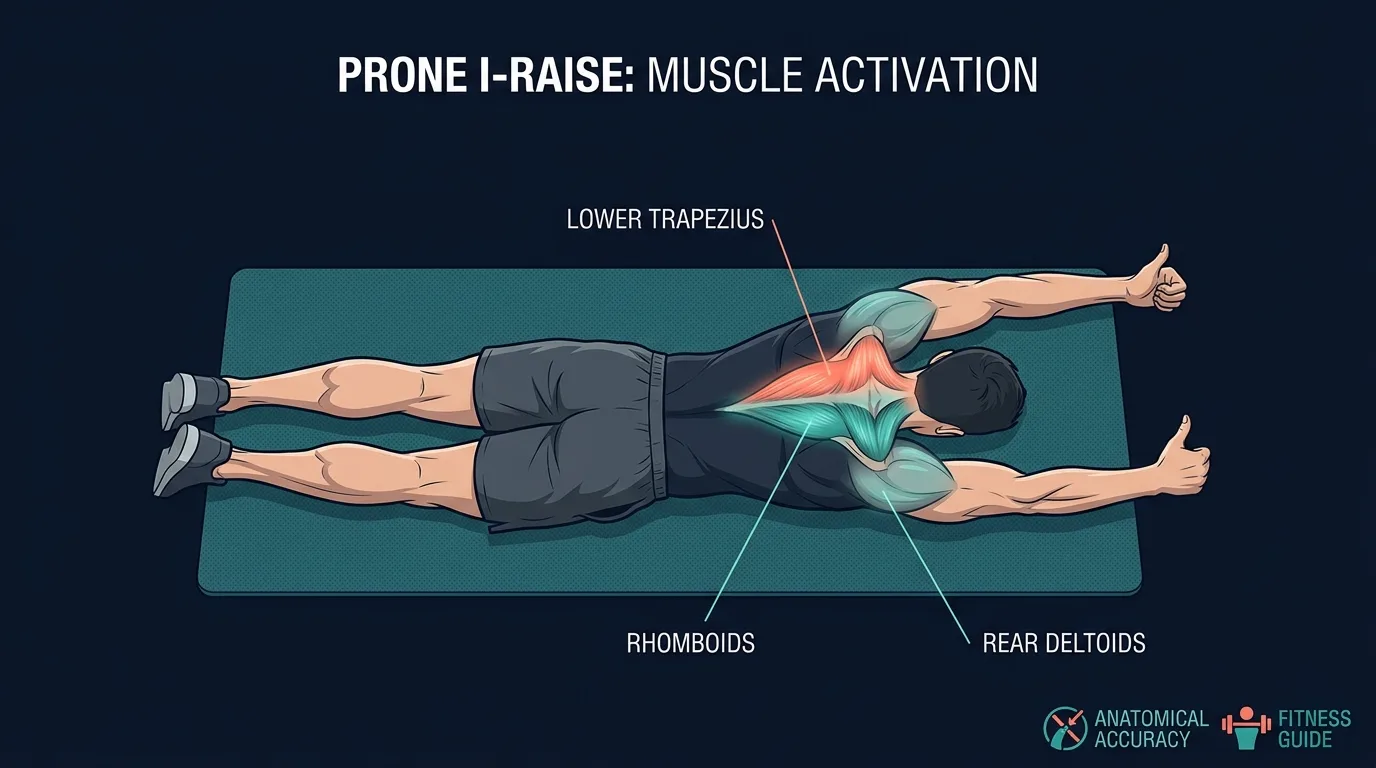
Almost every exercise that involves raising the arms is done standing up, which means the lower trapezius barely participates. Lie face down, extend your arms overhead, and the physics change entirely. Gravity now pulls directly against the lift. The lower traps can't hide. That's why physical therapists prescribe prone raises, and why they're standard in shoulder rehab and prehab programs worldwide.
The I raise is the first movement in the classic YTW series: I, then Y, then T, then W, each changing the arm angle to hit a slightly different region of the upper back and rear deltoid. You can do all four back to back for a complete scapular warmup, or program them individually as shoulder health accessories.
Quick Facts: Prone I Raise
- Equipment needed: None (mat optional for comfort)
- Difficulty: Beginner-friendly; scales to advanced with light load or extended isometric holds
- Modality: Bodyweight isolation, low-load scapular stability and activation
- Body region: Upper back and shoulders (lower and middle trapezius primary)
- FitCraft quest category: Posture and Shoulder Health
Muscles Worked
Primary movers. The lower trapezius and middle trapezius drive the lift. As the arms travel from the floor toward the ceiling, the lower traps pull the shoulder blades down and the middle traps pull them inward toward the spine. Both fibers fire concentrically through the lift phase and eccentrically as you lower with control, which is where the time-under-tension stimulus comes from on the descent.
Secondary movers. The rear deltoids assist with the horizontal-abduction component of the lift, and the rhomboids help retract the scapulae at the top of each rep. The infraspinatus and teres minor of the rotator cuff contribute external rotation to keep the thumbs pointing up.
Stabilizers. The serratus anterior fires isometrically to upwardly rotate the scapula as the arms travel overhead, which is the same scapulohumeral coupling that healthy overhead pressing depends on. The deep core (transverse abdominis) and glutes work isometrically to keep the spine neutral and prevent the lower back from arching.
Evidence. Cools et al. (2007) measured EMG activity across 12 commonly prescribed scapular rehab exercises and identified prone arm-elevation patterns (including overhead arm elevation in the I-shape position) as producing high lower-trapezius activity with a favorable lower-trap to upper-trap ratio. A follow-up study by Arlotta et al. (2011) looked specifically at five isometric exercises for selectively recruiting the lower trapezius and confirmed that prone arm-elevation positions maximally activate the lower trap fibers in healthy subjects. The takeaway is that the prone setup, not the standing version, is what makes this exercise work for lower-trap training.
Step-by-Step: How to Do a Prone I Raise
- Lie face down. Get on the floor face down (prone). Use a mat if you want. Extend both arms straight overhead in line with your body, palms facing each other, thumbs pointing toward the ceiling. Your body forms one long I from feet to fingertips.
- Set your position. Lightly brace your core and squeeze your glutes to protect your lower back. Rest your forehead on the mat or keep your gaze at the floor. Don't crane your neck. Shoulders stay relaxed and away from your ears.
Coach Ty's cue: "Long neck, soft shoulders, tight glutes. Get those three locked in before the arms move."
- Lift both arms off the floor. Drive both arms upward off the mat by squeezing your lower trapezius and upper back. Keep your arms completely straight. The moment you bend the elbows, the exercise becomes something else entirely. Even a few inches of clearance is enough.
Coach Ty's cue: "Think about pulling your shoulder blades into your back pockets. The arms follow."
- Squeeze at the top. At the top of the movement, actively pull your shoulder blades down and together. Hold for 1 to 2 seconds and feel the tension between and below the shoulder blades.
- Lower with control. Take 2 to 3 seconds to bring your arms back to the mat. Touch down gently. Don't drop them. Repeat without fully resting the arms between reps.
Common Mistakes (And How to Fix Them)
Bending the Elbows
What it looks like: Arms flex at the elbow as they lift off the floor.
Why it's a problem: Shortens the lever and reduces lower trap demand. The exercise becomes a partial row instead of a scapular lift.
The fix: Think "arms like steel rods." If you can't lift with straight arms, you're either fatigued or trying too hard. Lower the reps and reset.
Hyperextending the Lower Back
What it looks like: The lumbar spine arches hard off the floor as the arms lift.
Why it's a problem: The lower back is doing the work the upper back should be doing. No scapular benefit, plus potential for back strain.
The fix: Brace your core and lightly squeeze your glutes before every rep. That tension keeps your spine in a safe neutral position through the lift.
Cranking the Neck Up
What it looks like: Head lifts high off the mat, chin pointed at the wall in front.
Why it's a problem: Compresses the cervical spine and creates unnecessary strain. The neck isn't part of this exercise.
The fix: Gaze at the floor a few inches in front of your nose. Think "long neck." Your head can rise slightly as the arms lift, but don't lead with your chin.
Arms Too High Relative to Body
What it looks like: Arms drift out at a 30-45 degree angle instead of straight ahead in line with the body.
Why it's a problem: Changes it from an I raise into a Y raise. Both are valid, but they train different muscle angles. Know which one you're doing.
The fix: Before you start, look at your arms from above (or check a mirror on the floor). They should point straight ahead, 12 o'clock, no angle out.
Get this exercise in a personalized workout
FitCraft, our mobile fitness app, uses its AI coach Ty to program isolation exercises like this into your plan at the right volume and intensity, based on your level, goals, and equipment. Ty was designed and trained by Domenic Angelino, MPH (Brown University) and NSCA-CSCS, with research published in the Journal of Strength and Conditioning Research and Medicine & Science in Sports & Exercise.
Take the Free Assessment Free • 2 minutes • No credit card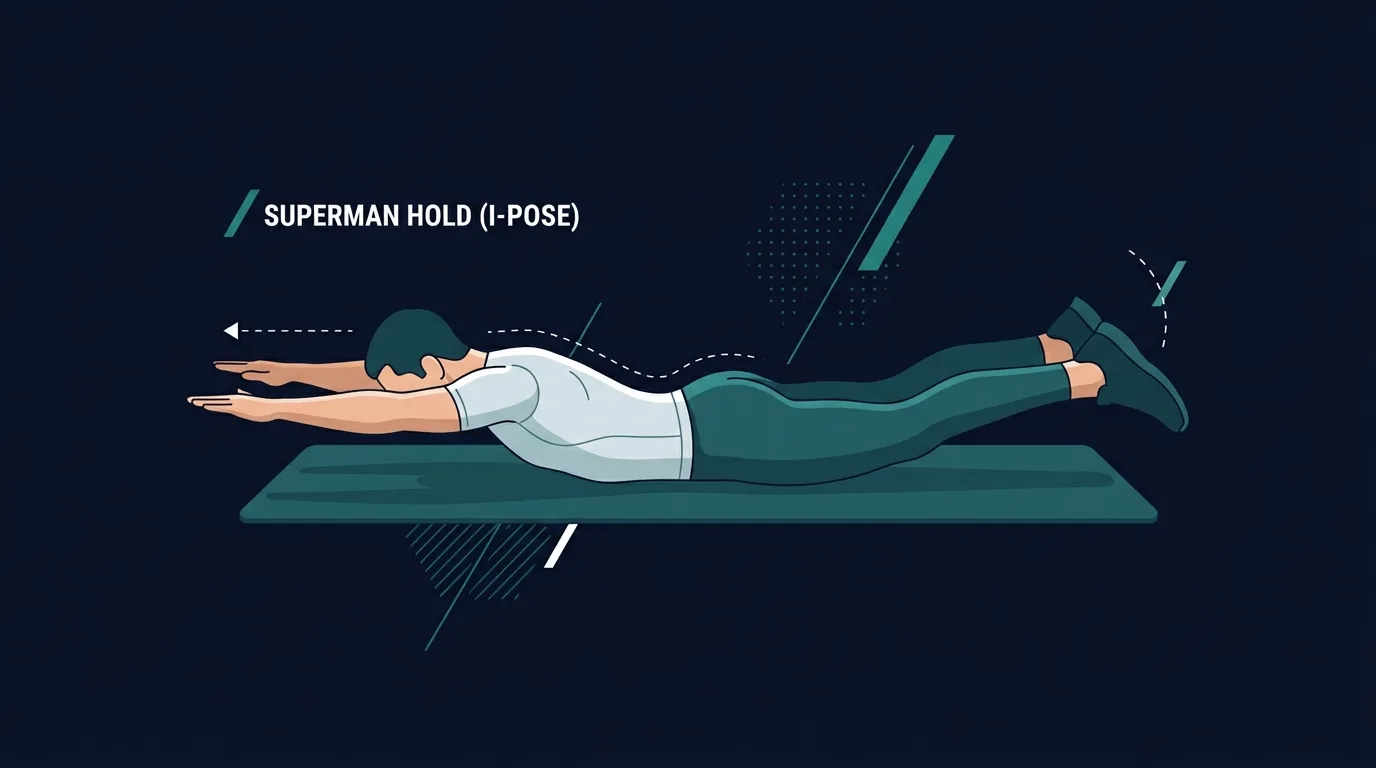
Variations
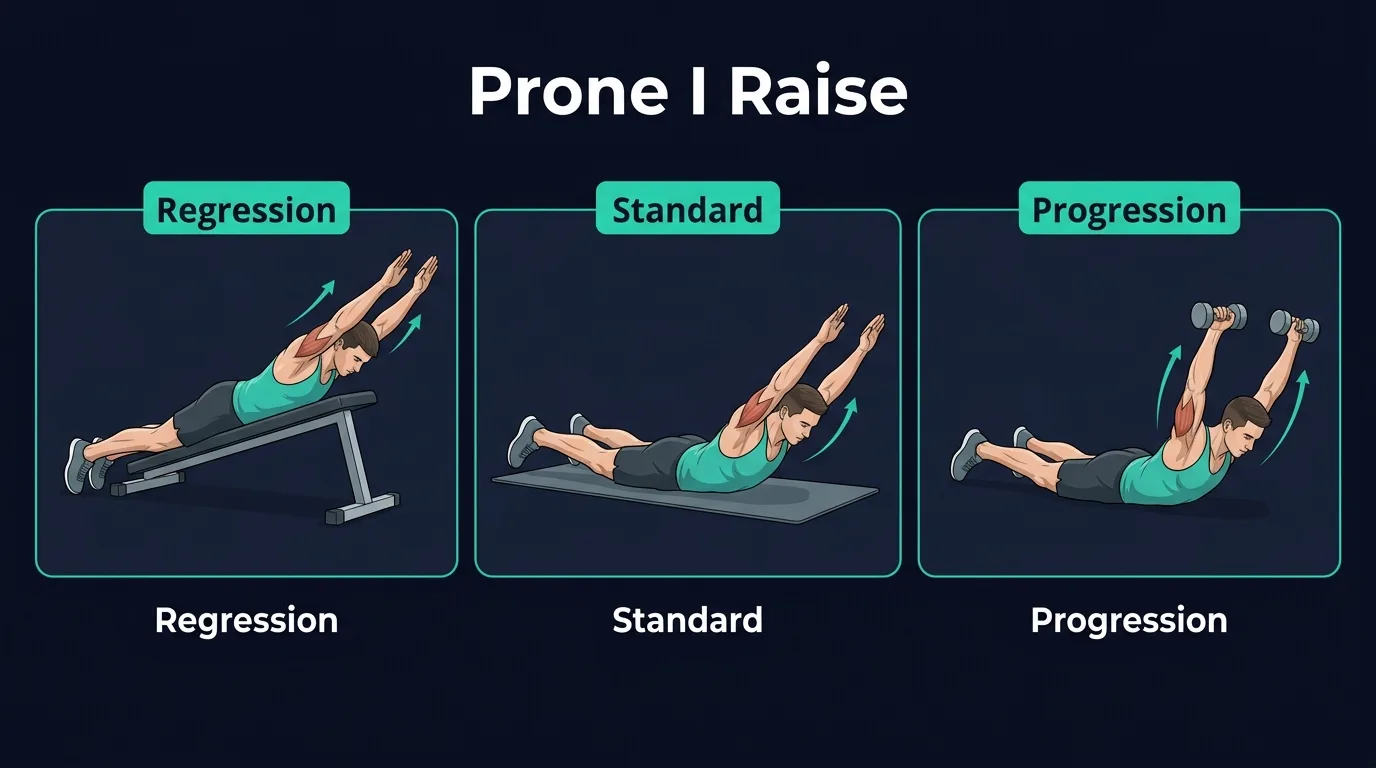
Easier (Regression)
- Incline I Raise. Lie on a low incline bench (chest-supported). The angle reduces how far gravity pulls on your arms, making the first lift easier while still training the lower traps.
- Partial Range. Lift your arms only a few inches off the mat and hold. Build strength in the shortened range before pushing for height.
Harder (Progression)
- Weighted Prone I Raise. Hold very light dumbbells, plates, or water bottles. Even 2.5 to 5 pounds makes the lower traps work significantly harder. Start lighter than you think you need to.
- Extended Hold. Lift the arms and hold at the top for 3 to 5 seconds instead of 1 to 2. Isometric time under tension is a demanding way to progress without adding weight.
- YTW Circuit. Flow directly from I raises into Y raises, then T raises, then W raises without resting. A complete scapular warmup in under 3 minutes.
When to Avoid or Modify Prone I Raises
The prone I raise is one of the lowest-load exercises in any program and is safe for most healthy adults. Always consult a qualified healthcare provider or physical therapist before starting or returning to any exercise program, especially in any of the situations below.
- Active shoulder impingement or rotator cuff tear. Lifting both arms overhead can reproduce symptoms. Work in a pain-free range, regress to single-arm partial lifts, or substitute with W raises until cleared.
- Acute lower-back pain or recent lumbar injury. The prone position and any compensatory back arching can aggravate symptoms. Place a pillow under the hips to reduce lumbar extension or skip the exercise entirely during the acute phase.
- Recent shoulder surgery (labrum, rotator cuff, AC joint). Get surgeon clearance and follow your physical therapist's protocol. Isolation scapular work typically starts with isometric setups long before active overhead lifts.
- Late-stage pregnancy. Lying prone is uncomfortable or contraindicated after the first trimester for most people. Substitute with a standing band pull apart or seated Y raise against a wall.
- Severe thoracic kyphosis or limited shoulder flexion. If you can't extend your arms overhead in line with the body while prone, lift only to the range you can reach pain-free. Pair with daily cat-cow and thoracic mobility work to expand range over time.
- Cervical disc issues. Don't extend the neck to look forward. Keep your forehead on the mat or gaze straight at the floor. If symptoms persist, switch to a seated, chest-supported variation.
Related Exercises
- Same series (YTW scapular stability): Y Raise, T Raise, W Raise
- Same muscle group (lower trap and posterior shoulder): Bent-Arm Lateral Raise, Pull Apart
- Compound that recruits the same muscles: Bent-Over Rows, Corner Row
- Antagonist isolation (front delts and chest): Front Raises, Chest Fly
- Postural foundation: Bird Dogs, Back Extensions, Cat-Cow
How to Program Prone I Raises
The American College of Sports Medicine Position Stand on resistance training (Ratamess et al., 2009) recommends matching set, rep, and rest prescriptions to training level. Because the prone I raise is a low-load isolation movement, the ranges sit at the higher-rep, shorter-rest end of the isolation spectrum.
| Level | Sets × Reps | Rest between sets | Frequency |
|---|---|---|---|
| Beginner | 2 × 10-12 (1 sec hold) | 45-60 seconds | 2-3 sessions / week |
| Intermediate | 3 × 12-15 (2 sec hold) | 45-60 seconds | 2-4 sessions / week |
| Advanced | 3-4 × 12-15 (2-3 sec hold, optional 2.5-5 lb load) | 60-90 seconds | 2-4 sessions / week |
Where in your workout. Program prone I raises early in the session as part of an upper-body warmup, before any pressing or overhead work. They're low enough load that they prime the lower traps without fatiguing them for the main lifts. They also slot in well as accessory work after pulling-focused training days.
Form floor over rep targets. If you can't keep the arms straight, hit a clean shoulder-blade squeeze at the top, and lower with control over 2 to 3 seconds, cut the set short. The lower trap responds to controlled, isolated tension, not to grinding through sloppy reps. A clean set of 8 beats a dirty set of 15 for this exercise.
How FitCraft Programs This Exercise
FitCraft's AI coach Ty includes prone I raises in upper-body warmup and shoulder-health sequences, programmed at a volume and progression that matches your fitness level and goals. Ty adjusts the variation (partial range, full, weighted, or YTW circuit) and hold duration to match how you've been training. The personalized diagnostic at signup determines whether scapular stability work belongs in your plan based on your history, posture goals, and the kind of pressing or overhead work you're doing elsewhere in the program.
Frequently Asked Questions
Can I do prone I raises if I have shoulder impingement or rotator cuff pain?
Often yes, but work in a pain-free range and clear it with a physical therapist if symptoms are active. Prone I raises are routinely used in shoulder rehab because they strengthen the lower trapezius and improve scapular control, which helps reduce impingement long-term. If lifting both arms reproduces sharp pain, regress to single-arm lifts or partial range, lower the rep target, and avoid going above the level where pain begins. Sharp pain at any range means stop and see a clinician.
What muscles does the prone I raise work?
The prone I raise primarily targets the lower and middle trapezius, with secondary work from the rear deltoids and rhomboids. The serratus anterior also fires to help upwardly rotate the scapula as the arms lift. Because gravity pulls straight down on the outstretched arms, the lower traps must work hard to lift them, something they rarely get to do in typical standing exercises.
Why do I raise lying down instead of standing?
The prone position dramatically increases the difficulty for the lower trapezius. When you lie face down with arms overhead, gravity acts directly against the lift, and the lower traps have to generate real force to raise the arms even a few inches. The standing version, by contrast, involves mostly the front delts and offers almost no lower trap challenge.
Is the prone I raise good for posture?
Yes. The lower trapezius is chronically underactive in people who sit for long periods, and it plays a critical role in keeping the shoulder blade properly positioned during overhead movement. Strengthening it with the prone I raise directly counters the forward rounding that builds up from desk work.
How is the I raise different from the Y raise and T raise?
All three are prone floor exercises in the YTW scapular stability series. The I raise has arms straight overhead (0 degrees from the body), the Y raise is at 45 degrees, and the T raise is straight out to the sides at 90 degrees. Each angle emphasizes a slightly different region of the trapezius and rear deltoid.
How often should I do prone I raises?
Prone I raises are low-load and safe to do daily as a mobility and activation drill. For strength, program 2 to 3 times per week as part of your upper body warmup or shoulder accessory work.