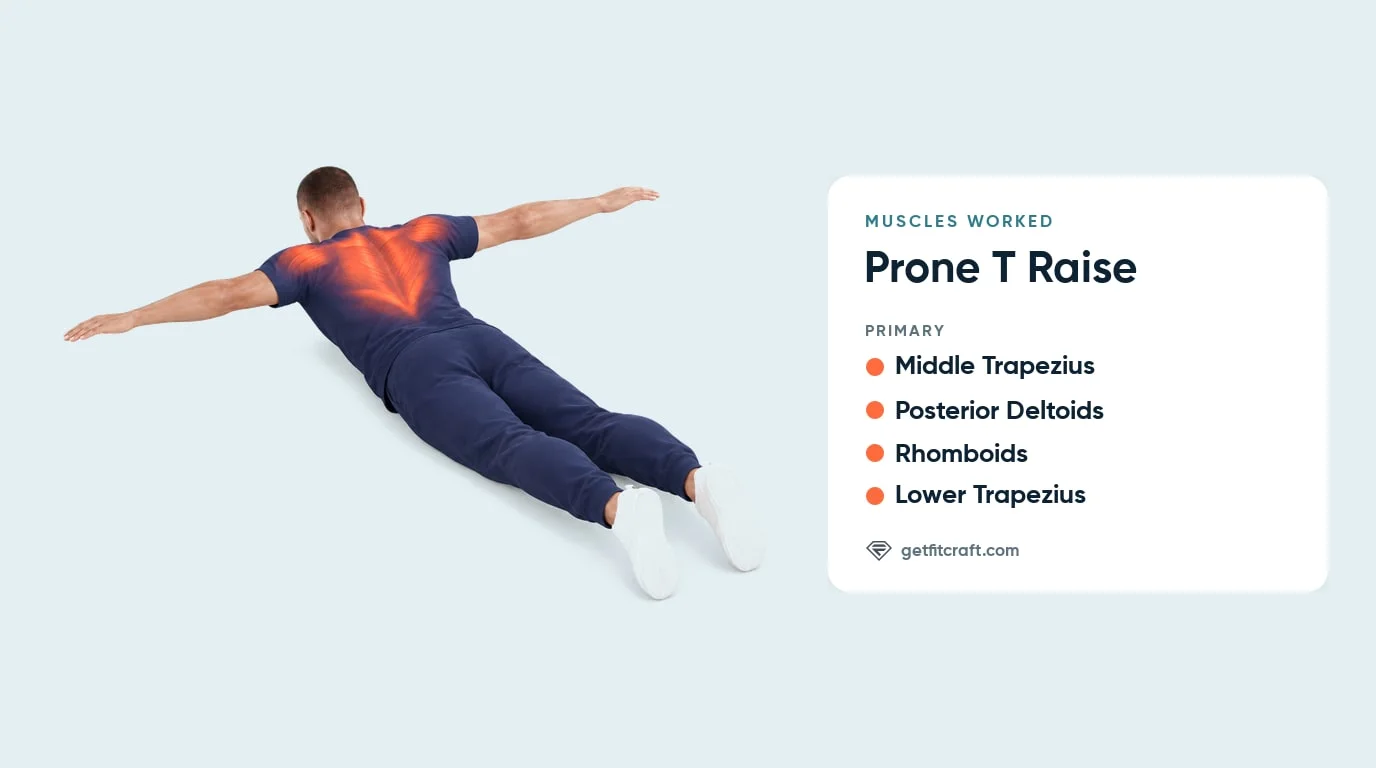
The prone T raise is a face-down shoulder and upper-back exercise where your arms extend straight out to the sides, palms facing down, then lift until they are level with your shoulders and hold there. It works the middle trapezius, which pulls your shoulder blades together, and the posterior (rear) deltoids, which hold your arms up. The rhomboids squeeze your shoulder blades toward your spine, and the lower trapezius keeps them down. The defining cue is simple: keep the chest down, keep the lower back quiet, and keep the shoulder blades squeezed together for the whole hold. Beginners can bend their elbows to make the hold lighter, while advanced lifters can hold very light dumbbells or use the T in a full YTW circuit.
Prone T raises are useful when your upper back needs more work between the shoulder blades, but bent-over raises make your lower back take over. The floor gives your torso a stable base. That lets you focus on a clean shoulder-blade squeeze instead of fighting posture.
Quick Facts: Prone T Raises
- Equipment needed: Exercise mat or firm floor surface
- Difficulty: Beginner (harder with light dumbbells)
- Modality: Strength, shoulder stability, posture support
- Body region: Shoulders and upper back
Muscles Worked
Primary: The middle trapezius draws the shoulder blades toward the spine and keeps them there. The posterior (rear) deltoids, at the back of the shoulders, hold the straight arms up level with the shoulders. The rhomboids, between the shoulder blades, work with the middle trapezius to squeeze the shoulder blades together. The lower trapezius keeps the shoulder blades from riding up toward the ears and holds them down and back while the arms are lifted.
During the hold, all four keep working without moving so the arms do not drop. If you add very light dumbbells, the same muscles work harder because the long arm lever increases the demand quickly.
Evidence: Lim et al. (2015) measured the trapezius in this face-down raise with the arms at 90 degrees from the body, the T position, using only the weight of the arms. The middle trapezius worked at about 30 to 39% of its maximum whichever way the hands were turned, while the lower trapezius worked more with the thumbs up (about 46%) than in a neutral position (about 36%). Ekstrom et al. (2003) ranked the thumbs-up prone T, done with a dumbbell, among the top two exercises for the middle trapezius. Both studies used lifts rather than long holds.
Step-by-Step: How to Do a Prone T Raise
- Lie face down and make a T shape. Get on a mat or firm floor with your legs straight and your arms straight out to the sides at shoulder height. Keep your palms facing the floor. Form tip: keep your face down and your neck long.
- Set your neck, ribs, and shoulders. Keep your gaze down, brace lightly, and pull your shoulders away from your ears. Your chest stays heavy on the floor.
- Lift both arms from the shoulder blades. Raise your arms until they are level with your shoulders, about parallel to the floor, by drawing the shoulder blades together. Keep the elbows straight and the palms facing down.
- Hold the position. Keep your arms level with your shoulders for the set time and breathe steadily. Feel the squeeze across your upper back, between the shoulder blades, and in the backs of your shoulders. Form tip: keep your shoulder blades pinched together for the whole hold.
- Lower and rest. When the time is up, lower your arms to the floor, rest, and start the next hold. End a hold early when your form starts to fade.
Get this exercise in a personalized workout
FitCraft, our mobile fitness app, uses its AI coach Ty to program isolation exercises like this into your plan at the right volume and intensity, based on your level, goals, and equipment. Ty was designed and trained by Domenic Angelino, MPH (Brown University) and NSCA-CSCS, with research published in the Journal of Strength and Conditioning Research and Medicine & Science in Sports & Exercise.
Take the Free Assessment Free • 2 minutes • No credit card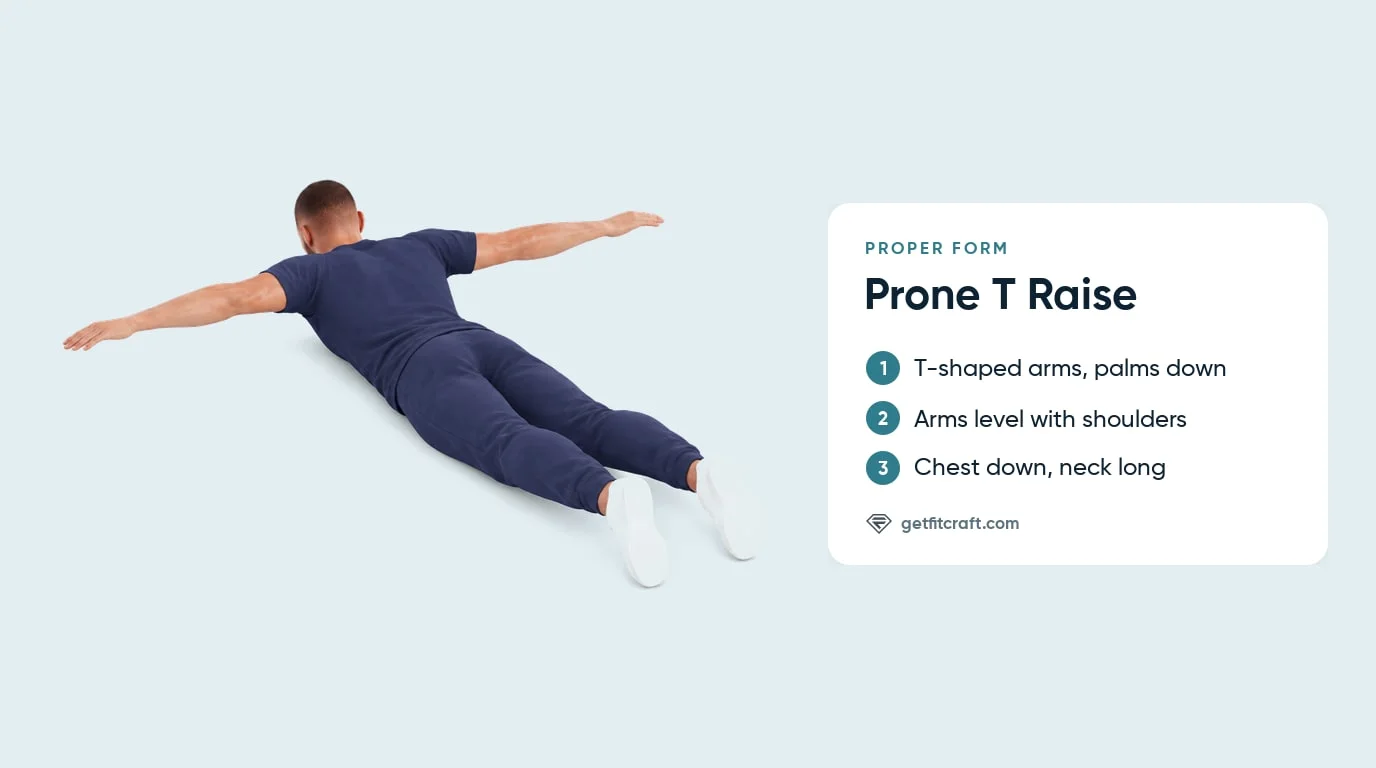
Common Mistakes and How to Fix Them
Holding Your Breath
What it looks like: You brace and stop breathing while the arms are up, especially during longer holds.
Why it matters: Holding your breath raises the pressure in your abdomen, which makes the position feel more stable, so it is an easy habit to fall into. It also makes the set harder to sustain and pulls the effort away from the upper back.
The fix: Breathe steadily for the whole hold. If you cannot keep breathing, lower the arms and shorten the hold.
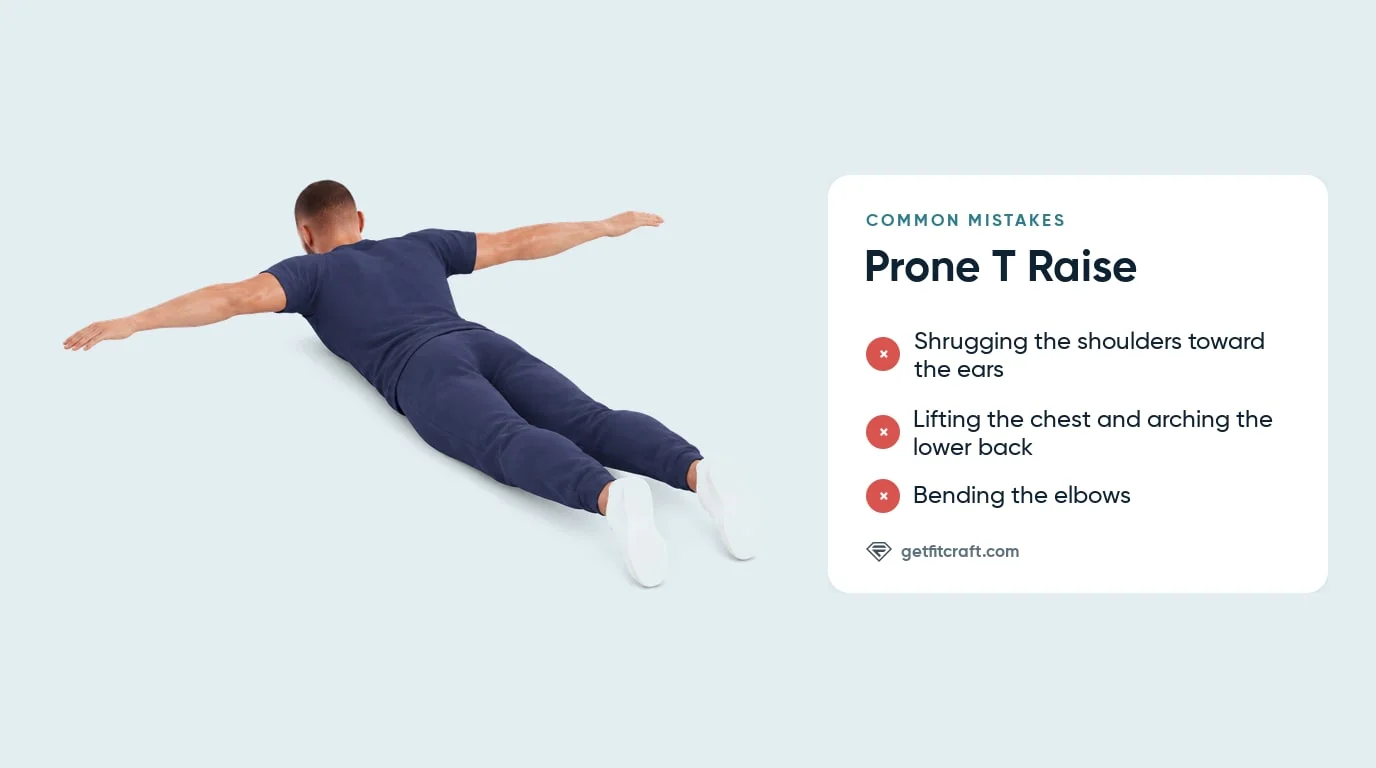
Shrugging Toward the Ears
What it looks like: The shoulders creep up and the upper traps dominate the lift.
Why it matters: The exercise stops feeling like mid-back work and turns into a tense neck drill.
The fix: Pull the shoulders down before each hold. Think about sliding the shoulder blades into your back pockets.
Bending the Elbows
What it looks like: The arms fold as they rise, making the lever shorter.
Why it matters: Shortening the lever makes the movement easier and takes tension off the target muscles.
The fix: Keep a long arm from shoulder to knuckle. If the elbows bend, end the hold, or use the bent-arm version on purpose.
Lifting the Chest Off the Floor
What it looks like: The chest peels up and the lower back arches during the lift.
Why it matters: Spinal extension replaces shoulder-blade control, which defeats the purpose of the prone setup.
The fix: Keep the ribs and chest heavy. Lift the arms until they are level with your shoulders, but no higher than you can without moving the torso.
Prone T Raise Variations: Regressions and Progressions
Bent-Arm T Raise Hold
Use the same setup but bend your elbows, which shortens the arms and lightens the hold. This is the best starting point if your shoulders feel stiff or start shrugging toward your ears quickly.
Lift-and-Lower T Raise
Instead of holding, lift your arms until they are level with your shoulders, pause briefly, and lower them under control for reps. Keep breathing and stop before your neck or lower back joins the effort.
Incline Bench T Raise
Lie chest-down on a low incline bench. The bench gives your arms more space to move and can feel smoother for people who do not like the floor setup.
Weighted Prone T Raise
Hold very light dumbbells. Even a small weight adds a lot because straight arms create a long lever. Keep the shoulder blades squeezed for the whole hold.
YTW Circuit
Move from Y raises to prone T raises to W raises, then add I raises if you can keep each angle clean. Use this as a shoulder-blade warm-up before upper-body training.
When to Avoid or Modify Prone T Raises
Prone T raises are safe for most healthy adults, but shoulder isolation still needs a few guardrails. Always consult your physician or a qualified physical therapist before starting or returning to exercise, especially after injury, surgery, or unexplained joint pain.
- Active shoulder pain or inflammation. If the front, top, or deep part of the shoulder hurts, stop. Use seated rear delt stretches for gentle mobility while symptoms calm down.
- Recent shoulder, neck, or upper-back surgery. Get clearance before using repeated shoulder abduction. Rehab usually progresses from isometrics to active range, then to light loaded raises.
- Neck tension during the lift. If the exercise turns into upper-trap or neck work, shorten the set and lower the arms. Keep the gaze down and the shoulders away from the ears.
- Numbness, tingling, or radiating symptoms. Stop the exercise and get medical guidance. Those symptoms need a different decision tree than normal muscle fatigue.
- Low-back arching you cannot control. Use shorter holds, the bent-arm version, or the incline variation. The chest should stay supported so the movement trains the shoulder blades, not lumbar extension.
Related Exercises
- Same scapular family: Y raises, W raises, and I raises train nearby shoulder-blade positions.
- Shoulder health accessory: Pull-aparts add band resistance for scapular retraction and rear-delt endurance.
- Rear-delt mobility: Seated rear delt stretches help if the back of the shoulder feels tight before T raises.
- Shoulder isolation pairings: Lateral raises and front raises train the side and front delts.
- Compound pull pairing: Bent-over rows load the upper back through a heavier pulling pattern.
How to Program Prone T Raises
Use prone T raises as low-load shoulder accessory work, then progress volume gradually. Ratamess et al., 2009, the ACSM Position Stand on resistance training progression, supports matching sets, reps, rest, and weekly frequency to training level. The T raise is taught as a timed hold, and the hold times below are the ones suggested in the video above.
| Level | Sets x Hold | Rest between sets | Frequency |
|---|---|---|---|
| Beginner | 3-4 x 30-45 second holds, elbows bent if needed | 45-60 seconds | 2-3 sessions/week |
| Intermediate | 3-4 x 30-45 second holds, arms straight | 60-90 seconds | 2-3 sessions/week |
| Advanced | 3-4 x 30-45 second holds with light dumbbells | 60-120 seconds | 2-3 sessions/week |
Place prone T raises early as a shoulder activation drill or late as accessory isolation work after heavier pulling and pressing. If you use them before compound work, keep the sets easy enough that your upper back feels awake.
Form is the floor. End the hold when the elbows bend, the shoulders shrug, the neck takes over, or the chest starts lifting from the floor.
Frequently Asked Questions
Can I do prone T raises with shoulder pain?
Stop if shoulder pain appears at the front, top, or deep inside the joint. When you try again, use a smaller range, or swap to a seated rear delt stretch until symptoms calm down. If the pain keeps coming back or follows a recent injury, work with a physical therapist before loading the pattern.
What muscles do prone T raises work?
Prone T raises work the middle trapezius, which draws your shoulder blades together, the posterior (rear) deltoids, which hold your arms up and out to the sides, the rhomboids, which squeeze your shoulder blades toward your spine, and the lower trapezius, which keeps your shoulder blades down.
Should your palms face down during prone T raises?
Yes. Keep your palms facing the floor with your arms straight out to the sides at shoulder height, the way the FitCraft trainer does it. Lift from your upper back by squeezing your shoulder blades together, not by rotating your arms. Research versions often turn the thumbs up instead, which works the lower trapezius a little more, while the middle trapezius works about the same either way.
How many prone T raises should I do?
Start with 3 to 4 holds of 30 to 45 seconds with your arms level with your shoulders, the hold times suggested in the video on this page. End a hold early when the squeeze disappears or your shoulders creep toward your ears. To make it harder, hold very light dumbbells; to make it easier, bend your elbows. Lifting and lowering for reps is a common alternative to the hold.
Are prone T raises good before upper-body workouts?
Yes. They work well as a low-load shoulder and upper-back activation drill before presses, rows, pull-ups, or posture-focused sessions. Keep the volume moderate so your traps feel awake, not tired.