The dumbbell front raise isolates the anterior (front) deltoid through shoulder flexion. You stand tall with a dumbbell in each hand, lift one arm straight in front of you to shoulder height with a small fixed bend at the elbow, then lower with control. The anterior deltoid does the lifting work, with significant assistance from the upper chest, serratus anterior, and middle deltoid. Most lifters get enough front delt stimulus from pressing alone, so direct front raises sit in the accessory category at moderate volume. Scale from seated light-dumbbell variations as a beginner to standing both-arm or plate front raises as an advanced lifter.
Almost every press you do (bench, overhead, push-ups) already loads the front of the shoulder. The front raise exists to add isolated front-deltoid work for people who want shoulder hypertrophy beyond what pressing alone provides, or who need a low-skill, equipment-flexible accessory at the end of an upper-body session.
Most lifters get plenty of anterior deltoid stimulus from compound pressing. That's why front raises typically sit at modest volume in well-designed programs: 1 to 2 sets a couple times a week as accessory work, not a centerpiece movement.
Quick Facts: Dumbbell Front Raise
- Equipment needed: Pair of dumbbells (5-25 lb per hand depending on training level); plate or kettlebell variations also work
- Difficulty: Beginner-friendly with light load; scales to intermediate and advanced with heavier dumbbells or plate variations
- Modality: Strength, single-joint isolation
- Body region: Shoulders (anterior deltoid primary)
- FitCraft quest category: Strength and Hypertrophy
Muscles Worked
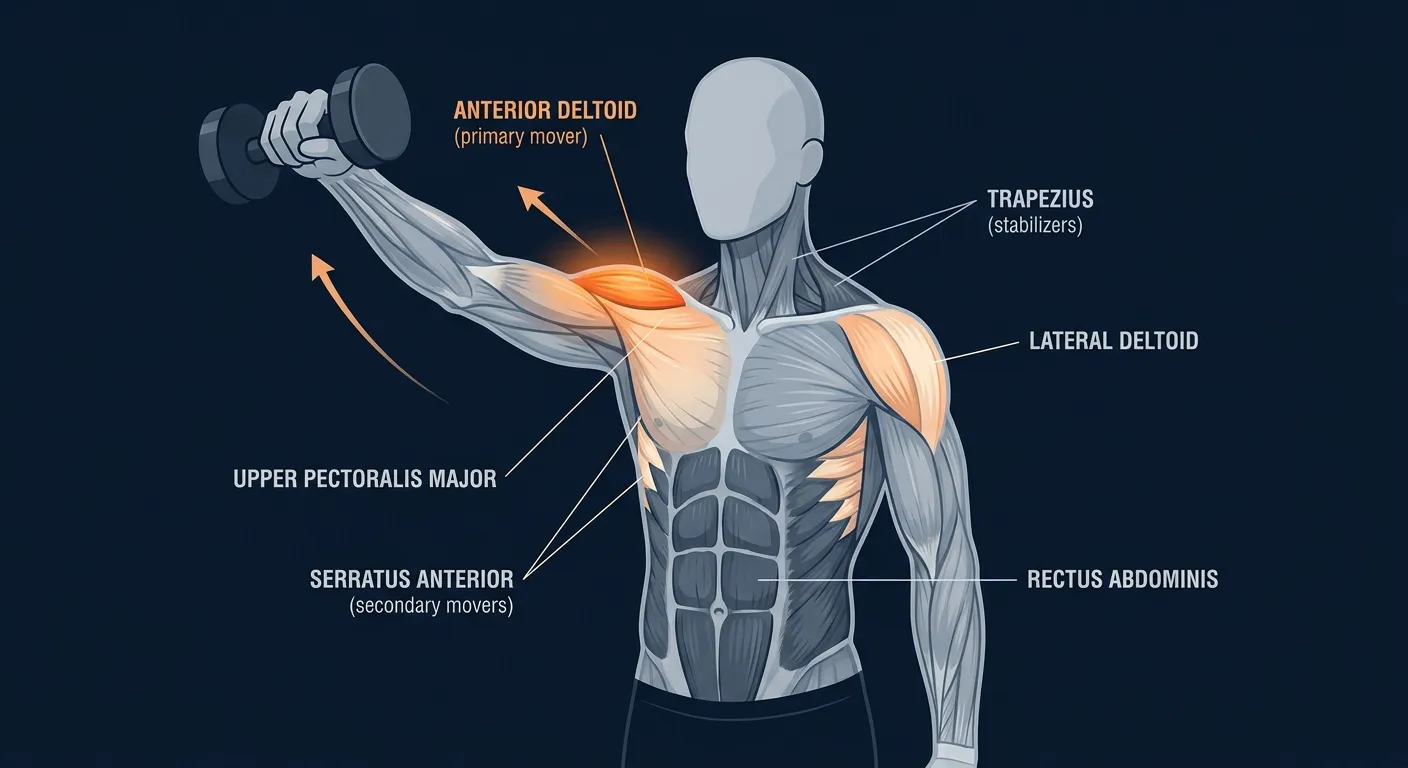
Primary movers. The anterior deltoid drives the lift. As the arm travels from the front of the thigh up to shoulder height, the anterior deltoid contracts concentrically to flex the shoulder. On the descent, it works eccentrically to control the weight back to the starting position, which is where most of the hypertrophy stimulus comes from.
Secondary movers. The clavicular head of the pectoralis major (upper chest) assists the shoulder flexion, especially in the bottom half of the lift. The serratus anterior fires to upwardly rotate the scapula as the arm passes through 90 degrees. The middle deltoid contributes near the top of the lift, and the biceps brachii helps maintain the elbow's slight bend throughout.
Stabilizers. The rotator cuff (supraspinatus, infraspinatus, teres minor, subscapularis) keeps the humeral head centered in the glenoid as the arm raises. The trapezius and rhomboids stabilize the scapula. The core (rectus abdominis, transverse abdominis, obliques) and erector spinae work isometrically to prevent the load in front of the body from pulling the spine into extension. The glutes stay lightly engaged to maintain a neutral pelvis.
Mechanism. The front raise is a pure shoulder-flexion isolation lift. Because the dumbbell sits in front of the body throughout the lift, the lever arm at the shoulder is at its longest when the arm reaches roughly parallel to the floor, which is where the front deltoid is working hardest. This is also why even modest weights feel heavy at the top compared to other shoulder movements: peak tension hits at peak mechanical disadvantage. Going past shoulder height shifts work toward the upper traps and reduces direct front-delt loading, so most programs cap the range at horizontal.
Step-by-Step: How to Do a Dumbbell Front Raise
- Set your stance. Stand tall with feet shoulder-width apart, knees slightly soft, core lightly braced. Hold a dumbbell in each hand at the front of the thighs with a pronated grip (palms facing the body). Roll your shoulders down and back.
Coach Ty's cue: "Tall posture, ribcage stacked over the pelvis. If your lower back is arching before you lift, you're already cheating."
- Set a small elbow bend. Bend the elbows 10 to 15 degrees and lock that angle. The elbows do not extend or flex during the lift. This protects the elbow joint and keeps the load on the front deltoid instead of the biceps.
- Lift one arm to shoulder height. Exhale and raise one arm straight in front of you until the dumbbell reaches shoulder height (parallel to the floor). Keep the wrist neutral, thumb leading slightly upward. Don't swing the torso or use momentum.
Coach Ty's cue: "The shoulder lifts the dumbbell. Not the hips. Not the back. If you're using body english, drop the weight."
- Pause and lower under control. Pause briefly at the top with the dumbbell at shoulder height. Inhale and lower the dumbbell to the starting position over 2 to 3 seconds. Don't let the weight drop.
- Alternate arms. As the first arm finishes its descent, begin lifting the other arm. Continue alternating for the prescribed reps.
Common Mistakes (And How to Fix Them)
Swinging the Torso to Cheat the Weight Up
What it looks like: Hips push forward, lower back arches, torso leans back as the dumbbell lifts.
Why it's a problem: Body english removes the front deltoid from the lift and shifts load to the lower back. You're moving more weight but training less muscle, and the lumbar spine takes the cost.
The fix: Drop the weight by 5 to 10 pounds. Brace the core, glutes, and quads before each rep. If you can't lift with a still torso, the dumbbell is too heavy.
Lifting Above Shoulder Height
What it looks like: The dumbbell travels past parallel, often up to head or overhead level.
Why it's a problem: Past 90 degrees of shoulder flexion, the upper trapezius takes over the work and the front delt's contribution drops. Many people also pinch the supraspinatus tendon in this range.
The fix: Stop at parallel. Film a set from the side to check the actual height. The dumbbell should reach the height of the shoulder joint, not the chin or forehead.
Letting the Dumbbells Drop on the Eccentric
What it looks like: Quick, uncontrolled lowering. Three seconds up, half a second down.
Why it's a problem: The eccentric phase (the descent) is where most muscle damage and growth stimulus comes from. Dropping the weight throws away half the rep.
The fix: Count "one, two, three" as you lower. The descent should take twice as long as the lift.
Bending and Straightening the Elbows During the Lift
What it looks like: Elbow starts bent, straightens as the dumbbell reaches the top.
Why it's a problem: Turns the front raise into a poor-form upright press, recruiting the biceps and triceps and reducing front-delt isolation.
The fix: Set the 10 to 15 degree elbow bend at the start and treat the elbow as a fixed hinge. The arm pivots at the shoulder only.
Wrist Flexion at the Top
What it looks like: Wrist bends downward at the top, dumbbell tilts toward the floor.
Why it's a problem: Loads the wrist flexors and strains the wrist tendons. Doesn't help the front delt.
The fix: Keep the wrist neutral throughout. Imagine driving the knuckles forward at the top instead of letting the dumbbell tip down.
Holding the Breath
What it looks like: Lifter takes a big breath, lifts and lowers the dumbbell without breathing, then exhales after the rep.
Why it's a problem: Spikes blood pressure during a lift where there's no benefit (no heavy compound load to support). Lightheadedness on multiple reps.
The fix: Exhale on the lift, inhale on the descent. Simple steady breathing rhythm matches the tempo.
Get this exercise in a personalized workout
FitCraft, our mobile fitness app, uses its AI coach Ty to program isolation exercises like this into your plan at the right volume and intensity, based on your level, goals, and equipment. Ty was designed and trained by Domenic Angelino, MPH (Brown University) and NSCA-CSCS, with research published in the Journal of Strength and Conditioning Research and Medicine & Science in Sports & Exercise.
Take the Free Assessment Free • 2 minutes • No credit card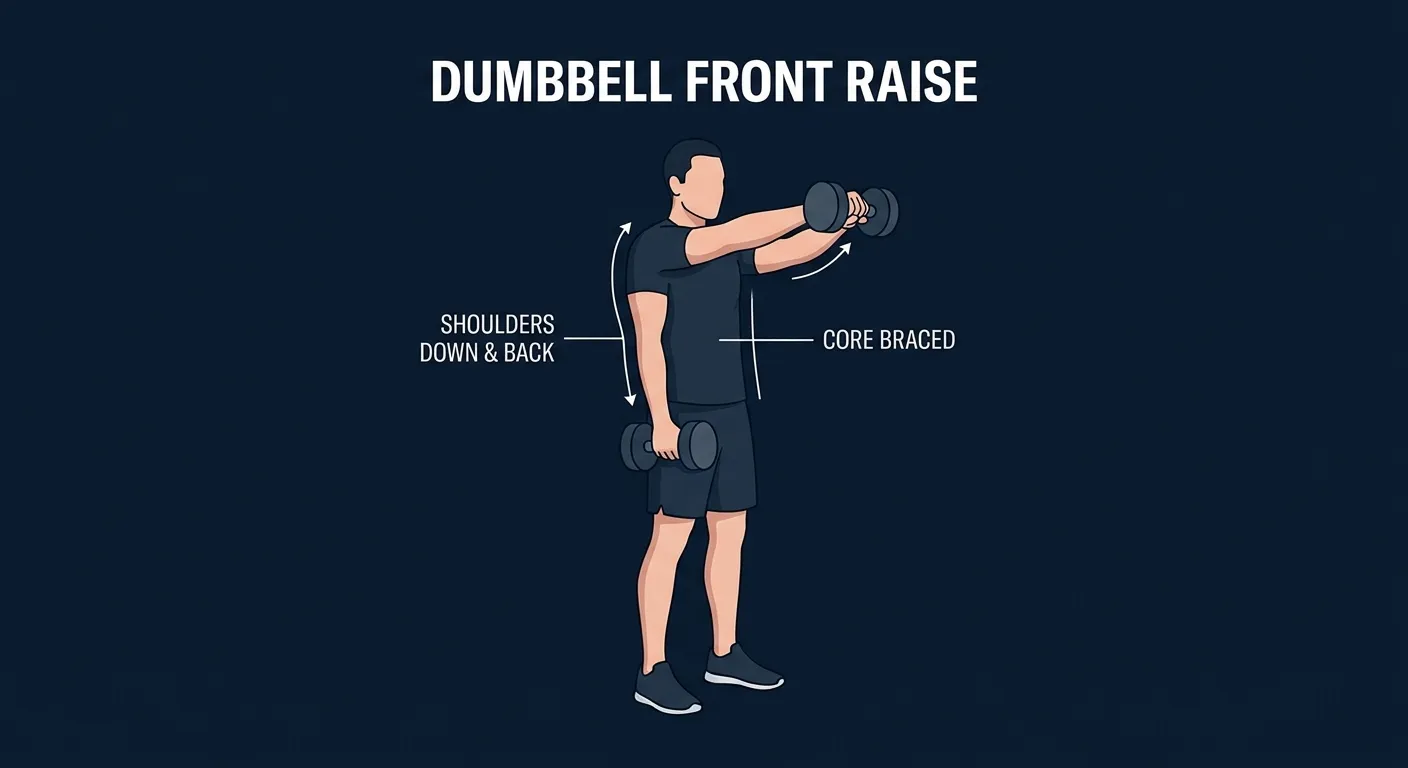
Variations
Easier (Regression)
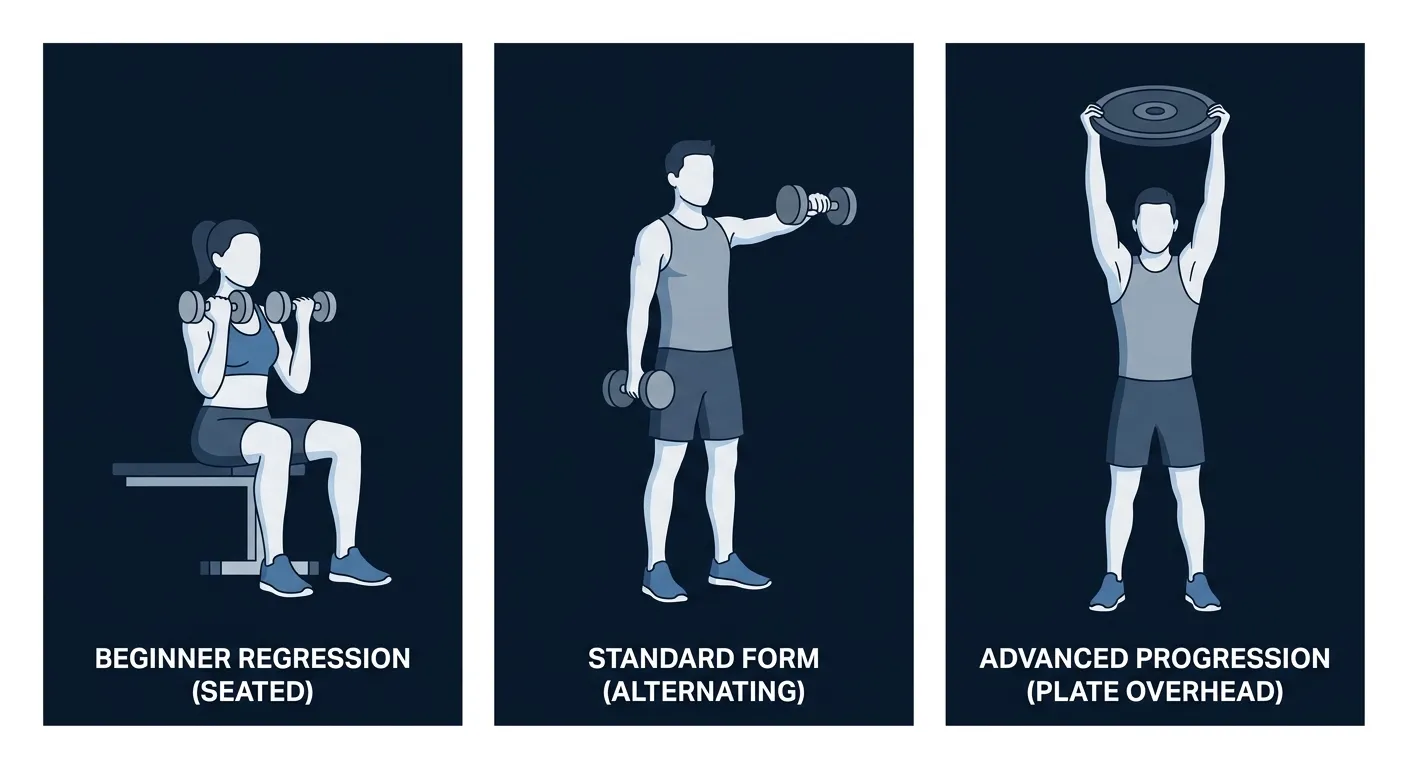
- Seated Dumbbell Front Raise. Sit on a bench with back support. The seated position prevents torso swing and isolates the front deltoid more strictly. Useful for learning the path with light load.
- Single-Arm Front Raise (Wall-Assisted). Stand with your free side against a wall to prevent leaning. Lift one arm at a time using the wall as a posture cue.
- Cable Front Raise (Low Pulley). Use a low-cable pulley with a D-handle. The cable provides constant tension and removes the temptation to swing.
Harder (Progression)
- Both-Arm Dumbbell Front Raise. Lift both dumbbells together. Doubles the load on the spine; requires a strong braced core. Use when single-arm work has plateaued and core integrity is solid.
- Plate Front Raise. Hold a single weight plate (10-45 lb) with both hands at the edges. The shared grip makes both arms lift the same weight in sync.
- Kettlebell Front Raise. A kettlebell's offset center of mass adds a stabilization demand on the rotator cuff and forearm. Use moderate weight.
- Tempo Front Raise. Slow the eccentric to 4 to 5 seconds, hold 1 to 2 seconds at the top. Increases time under tension without adding load.
When to Avoid or Modify Front Raises
The dumbbell front raise is a relatively low-load isolation lift and is safe for most healthy adults. Always consult a qualified healthcare provider or physical therapist before starting or returning to any exercise program, especially in any of the situations below.
- Active shoulder impingement or rotator cuff tendinopathy. The front raise passes through the painful arc near 90 degrees. Stop the lift below shoulder height, use light load, or substitute with the scaption variation (lifting at a 30-degree angle to the body) until cleared. The Y raise and I raise are also good substitutions during recovery.
- AC joint pain. The position at the top of the lift compresses the acromioclavicular joint. Reduce range, lower load, or skip during flare-ups.
- Bicipital tendinopathy. The biceps long head assists slightly during front raises. Active tendinopathy may flare; use lighter load and stop the set when symptoms increase.
- Acute lower-back pain. The load in front of the body pulls the spine into extension. Substitute with seated front raises (back-supported) or skip during the acute phase.
- Recent shoulder surgery (labrum, rotator cuff, AC joint). Follow your physical therapist's protocol. Isolated shoulder-flexion work typically waits until isometric and active-range milestones are met.
- Uncontrolled high blood pressure. The isometric grip and Valsalva risk during heavy isolation lifts can spike blood pressure. Get medical clearance and prioritize light load with steady breathing.
Related Exercises
- Same target muscle (anterior deltoid): Arnold Press, Diamond Press
- Compound that recruits the same muscle: Chest Press, Diamond Push-Ups
- Antagonist isolation (posterior shoulder and upper back): I Raise, Y Raise, T Raise, W Raise, Bent-Arm Lateral Raise
- Lateral shoulder isolation (pairs well in the same session): Bent-Arm Lateral Raise
- Shoulder health and scapular stability: Pull Apart, I Raise
How to Program Front Raises
The American College of Sports Medicine Position Stand on resistance training (Ratamess et al., 2009) recommends matching set, rep, and rest prescriptions to training level. Because the front raise is a low-load isolation accessory and the anterior deltoid gets significant indirect work from compound pressing, volume sits modestly across all levels.
| Level | Sets × Reps | Rest between sets | Frequency |
|---|---|---|---|
| Beginner | 2 × 10-12 (light load, seated) | 45-60 seconds | 1-2 sessions / week |
| Intermediate | 3 × 10-12 (alternating, controlled tempo) | 60-90 seconds | 1-2 sessions / week |
| Advanced | 3-4 × 8-12 (both-arm or plate variation) | 60-90 seconds | 1-2 sessions / week |
Where in your workout. Program front raises as accessory work, late in the upper-body session, after compound pressing. Putting front raises first will pre-fatigue the anterior deltoid and undermine your main pressing lifts.
Form floor over rep targets. If you can't keep the torso still, lift cleanly to shoulder height with a fixed elbow bend, and lower under control over 2 to 3 seconds, cut the set short. Clean reps with moderate weight beat sloppy reps with heavier weight every time on isolation lifts.
How FitCraft Programs This Exercise
FitCraft's AI coach Ty includes dumbbell front raises in upper-body accessory blocks, programmed at the volume and progression that match your training level and equipment. Ty adjusts the variation (seated, standing alternating, both-arm, plate) and load based on how you've been training and what compound pressing already exists in your week. The personalized diagnostic at signup determines whether direct front-delt work belongs in your plan based on your goals, posture profile, and pressing volume.
Frequently Asked Questions
Can I do front raises if I have shoulder impingement or rotator cuff pain?
Often yes, but stop the lift at the height that stays pain-free (usually below shoulder height) and clear it with a physical therapist if symptoms are active. Front raises pass through the impingement arc near 90 degrees, which can pinch an inflamed supraspinatus tendon. Use light loads, slow tempo, and consider the scaption variation (lifting at a 30-degree angle to the body instead of straight in front), which gives the rotator cuff more clearance.
What muscles do front raises work?
Front raises primarily target the anterior (front) deltoid, with significant assistance from the clavicular head of the pectoralis major (upper chest) and the serratus anterior. The middle deltoid contributes as the dumbbell passes through 90 degrees of shoulder flexion. The trapezius and rotator cuff act as stabilizers, and the core works isometrically to keep the spine neutral against the load in front of the body.
How high should I lift the dumbbells on a front raise?
To shoulder height (parallel to the floor) for most lifters. Going higher than shoulder level shifts the work to the upper traps and increases impingement risk for many people. Some advanced programs use overhead front raises with light load to bias serratus anterior, but for standard hypertrophy and strength work, stop at shoulder level.
What is the difference between alternating and both-arm front raises?
Alternating front raises (one arm at a time) reduce the load on the lower back because only one dumbbell is unsupported in front of the body at any moment. Both-arm front raises (lifting both dumbbells simultaneously) double the load on the spine but allow you to use slightly more total weight per side. Alternating is the safer default; both-arm is appropriate when the lower back is healthy and the core can stay rigid.
How often should I do front raises?
1 to 2 times per week as accessory work is plenty for most lifters. The anterior deltoid gets significant indirect work from any horizontal or overhead pressing (bench press, overhead press, push-ups), so direct front raise volume should stay moderate. Adding too much front raise work on top of heavy pressing can lead to anterior shoulder overuse.