Most chest exercises train the pectoralis major through a pushing motion. The diamond press adds something they don't: a constant inward squeeze. You press two dumbbells together and keep them locked in contact from the first rep to the last. That horizontal adduction component (actively driving the weights toward each other) fires the inner chest fibers in a way that a standard dumbbell chest press can't match.
The result is an exercise that makes light weight feel brutally heavy. You'll use maybe half of what you normally press, and that's the point. The isometric contraction demands constant tension through the entire range of motion. No momentum. No dead spots. Your chest is working the whole time, and your triceps are doing overtime on the lockout.
If you've done diamond push-ups and liked the triceps burn, think of the diamond press as the weighted, chest-focused cousin. Same close-grip emphasis, but with dumbbells and a bench you can progressively overload it in a way bodyweight can't replicate.
Quick Facts: Diamond Press
- Equipment needed: Pair of dumbbells (hex/hexagonal preferred for flat contact surfaces); flat bench optional (floor variation works without one)
- Difficulty: Intermediate (floor) to Advanced (incline, press-fly combo)
- Modality: Strength
- Body region: Upper body (chest, triceps, anterior shoulders)
- FitCraft quest category: Strength
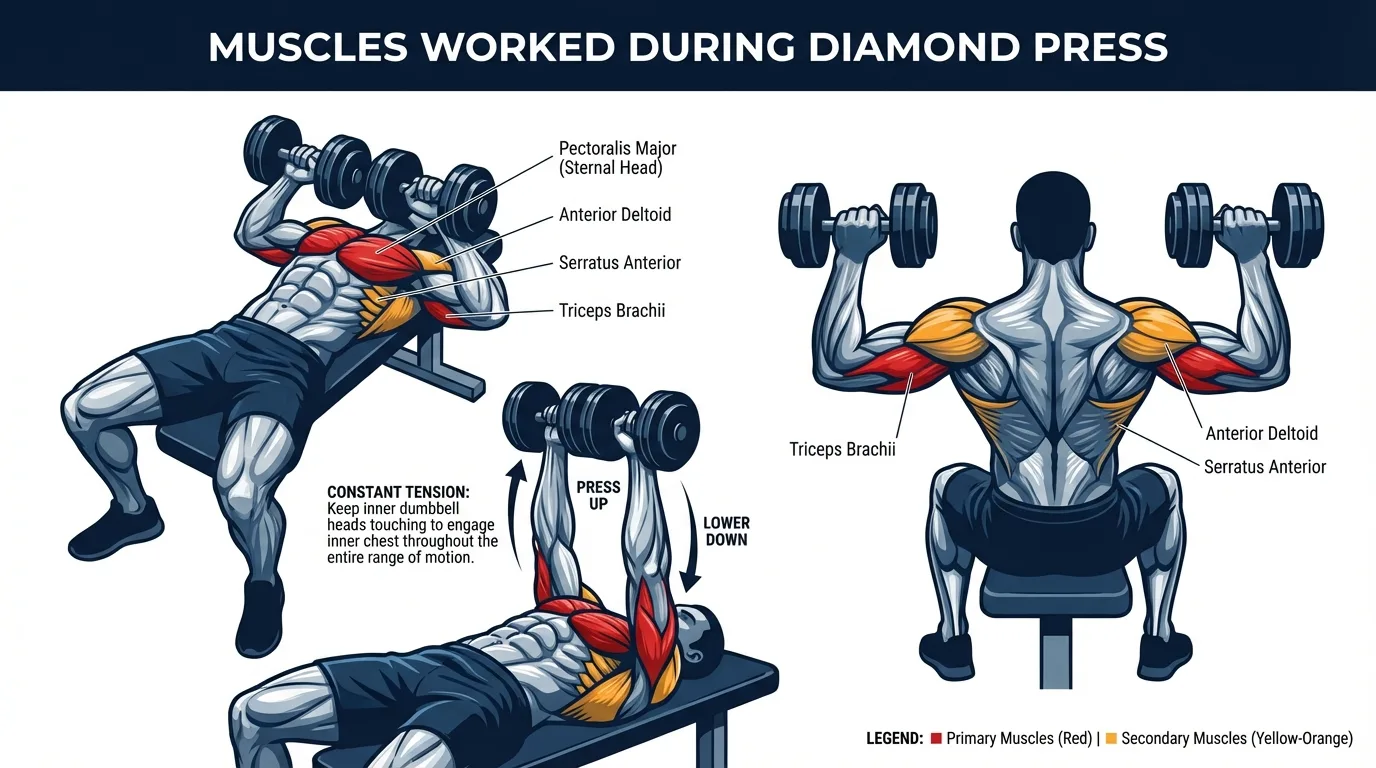
Muscles Worked
Primary movers: the pectoralis major (with extra emphasis on the sternal/inner fibers from the constant inward squeeze), the triceps brachii (which handle the elbow extension on the lockout), and the anterior deltoids (which assist the press). The pecs shorten on the way up (concentric) and lengthen under tension on the way down (eccentric); the constant isometric squeeze layered on top keeps them under load through the entire range.
Secondary movers: the serratus anterior (which protracts the shoulder blade at the top of the press) and the subscapularis (a rotator cuff muscle that contributes to the internal rotation pattern when the dumbbells are squeezed together).
Stabilizers: the rotator cuff as a group (supraspinatus, infraspinatus, teres minor, subscapularis) controls the humeral head during the press path, while the upper back (rhomboids, mid-traps) holds the shoulder blades retracted and depressed against the bench. The core (rectus abdominis, transverse abdominis, obliques) braces isometrically to prevent the lower back from arching off the bench. The grip works hard the entire set to maintain the inward squeeze on the dumbbells.
Mechanism (why the squeeze matters): a standard chest press loads the pectoralis major primarily through elbow flexion and shoulder horizontal flexion. The diamond press adds horizontal adduction (actively driving the arms toward the midline) as a constant isometric layer on top of the press. This is the same action a chest fly trains, but here it runs continuously through the entire rep instead of only at the bottom of the stretch. The sternal (inner) fibers of the pectoralis major are the primary horizontal adductors, which is why the diamond press emphasizes inner chest contraction in a way standard pressing cannot. Because the dumbbells stay locked together, there's no rest at the top or bottom of the rep; the muscle is loaded throughout, which makes light weight feel heavy and is the reason you'll typically use 40 to 60 percent of your normal dumbbell press load.
How to Do the Diamond Press (Step-by-Step)
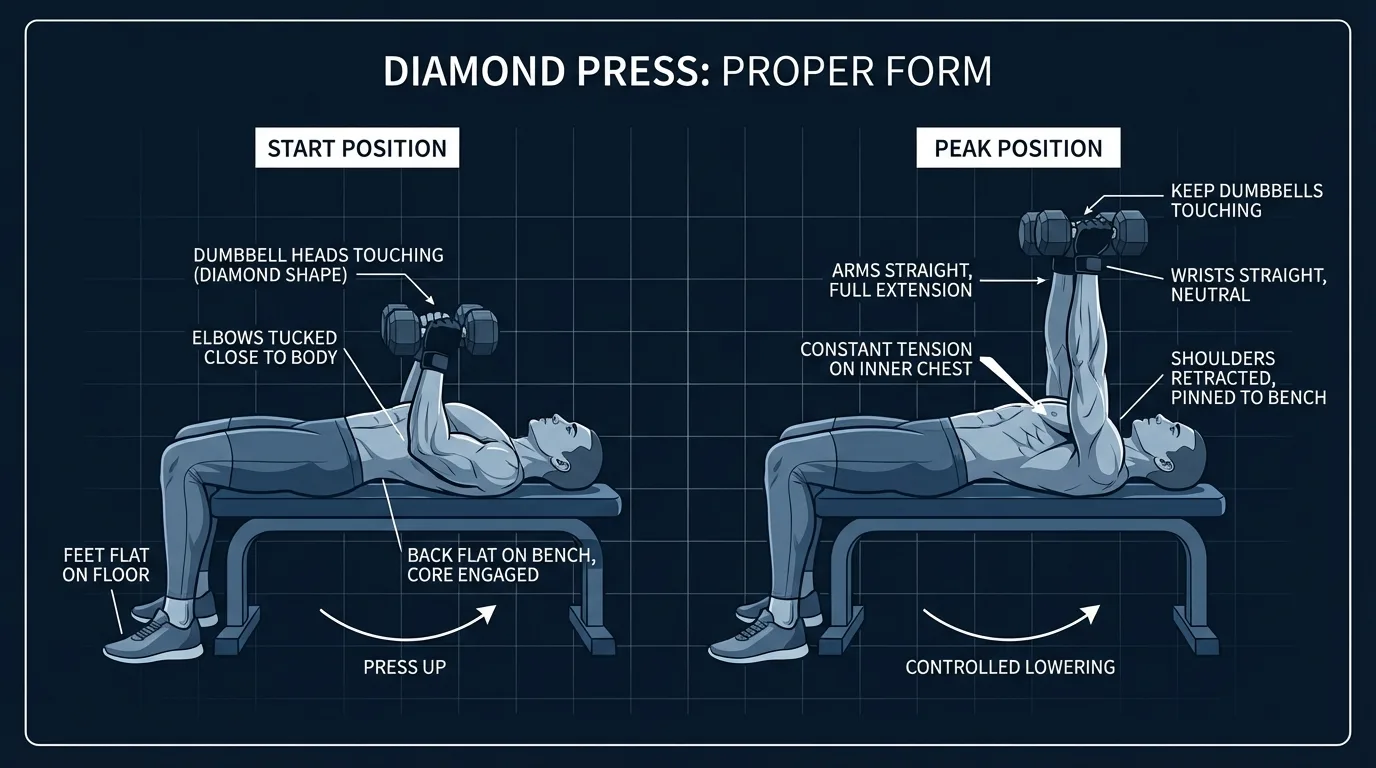
- Set up on the bench. Sit on a flat bench with a dumbbell in each hand. Lie back and bring the dumbbells together over your mid-chest using a neutral grip (palms facing each other). If you're using hex dumbbells, press the flat sides firmly together. With round dumbbells, press the handles and inner edges together as tightly as possible. Retract your shoulder blades, press them into the bench, and plant your feet flat on the floor.
Ty's cue on load selection: "If you normally press 50 lb dumbbells for chest, start with 25s on the diamond press. The constant isometric contraction eliminates momentum and rest points. Every inch of every rep is under tension." - Initiate the squeeze. Before you move anything, squeeze the dumbbells together hard. Think about trying to crush them into each other. This isometric contraction is the defining element of the diamond press. You should feel your inner chest fibers engage immediately. Maintain this inward force for every single rep; if the dumbbells separate, you've lost the exercise.
Coach Ty's cue: "Crush them together, then press. The squeeze is the exercise; the press is just the delivery system." - Lower with control. Bend your elbows and lower the dumbbells toward your sternum while keeping them pressed together. Your elbows should stay tucked close to your torso, roughly 30 to 45 degrees from your sides. Lower until the dumbbells touch your chest or you reach a comfortable depth. Take 2 to 3 seconds on the way down. The descent should feel controlled and deliberate.
Ty's cue on elbow path: "Elbows tucked, not flared. Think about pointing them toward your hips. Flared elbows shift work to the shoulders and kill the inner chest emphasis."
Ty's cue on the bottom: "Pause with the dumbbells on your chest for a one-count. No bouncing. Every rep starts from a dead stop. This is brutal, and it's exactly what builds the chest control the diamond press is designed for." - Press back up. Drive the dumbbells straight up by extending your elbows and contracting your chest. The dumbbells travel in a straight vertical path (unlike the arc of a standard chest press) because they're locked together. Squeeze hard at the top for a one-count. Don't fully lock your elbows; keep a slight bend to maintain tension on the chest and triceps.
Ty's cue: "Straight up. Don't try to widen them at the top or pull them apart on the way back down. They stay locked together for every inch of every rep." - Breathe and repeat. Inhale as you lower. Exhale as you press. Check the squeeze after every rep. If you notice the dumbbells wobbling or separating, the weight is too heavy or you're fatigued. Drop the weight or end the set. Quality matters more than volume on this exercise. Start with 3 sets of 10-15 reps.
Common Mistakes to Avoid
The diamond press is straightforward in concept but demanding in execution. These are the errors that undermine the exercise most:
- Losing the squeeze. This is the number one mistake. The moment the dumbbells separate, even slightly, you've turned a diamond press into a regular narrow-grip chest press. The isometric squeeze is the entire point. If you can't maintain it for the full set, use lighter dumbbells. There's no shame in 15-pounders when the squeeze is genuine.
- Going too heavy. The diamond press is not a maximal loading exercise. It's a contraction exercise. Using heavy dumbbells forces you to break form and lose the squeeze just to move the weight. Stick to 40 to 60 percent of your normal chest press weight. If your ego can't handle that, remember: the inner chest activation from a properly executed diamond press with 25s will outperform a sloppy one with 50s.
- Flaring the elbows. When elbows drift out wide, the exercise turns into a hybrid fly-press that loads the shoulder joint. The close-grip position should naturally keep elbows tucked, but fatigue breaks this down fast. Keep elbows at 30 to 45 degrees from your torso. If they start flaring, end the set.
- Bouncing off the chest. Using momentum at the bottom eliminates the hardest (and most valuable) part of the range of motion. Lower for 2 to 3 seconds, pause briefly, and press from a dead stop. This is an exercise built for time under tension, not speed.
- Uneven squeeze pressure. If one dumbbell is pushing harder than the other, the dumbbells will slide or rotate during the press. Both arms need to apply equal inward force. Watch the dumbbells; if they're rotating or shifting, focus on balancing the pressure before adding weight.
Get this exercise in a personalized workout
FitCraft, our mobile fitness app, uses its AI coach Ty to program compound strength exercises like this into your plan at the right volume and intensity, based on your level, goals, and equipment. Ty was designed and trained by Domenic Angelino, MPH (Brown University) and NSCA-CSCS, with research published in the Journal of Strength and Conditioning Research and Medicine & Science in Sports & Exercise.
Take the Free Assessment Free · 2 minutes · No credit cardVariations: From Floor to Incline
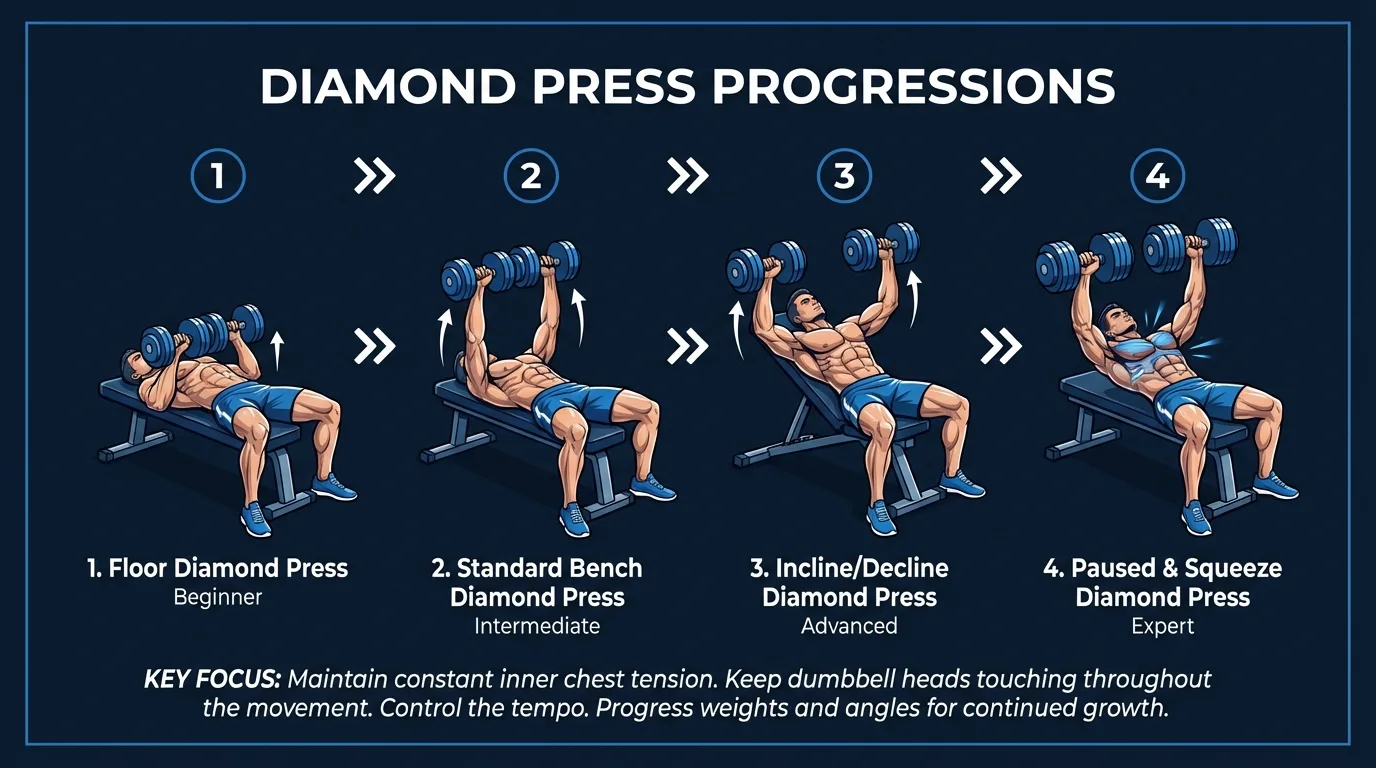
Floor Diamond Press (Intermediate)
No bench? Lie on the floor with your knees bent and feet flat. The floor limits your range of motion by stopping your elbows at ground level, which removes the deepest portion of the stretch. The squeeze component stays identical. This is actually a solid starting point because the reduced range of motion lets you focus entirely on maintaining inward pressure without worrying about shoulder depth. Once you can do 3 sets of 15 reps with a clean squeeze on the floor, graduate to the bench version.
Incline Diamond Press (Advanced)
Set the bench to 30 to 45 degrees. The incline shifts emphasis toward the clavicular (upper) head of the pectoralis major while maintaining the inner chest squeeze. EMG research consistently shows that incline angles between 30 and 45 degrees increase upper pec activation compared to flat pressing (Rodriguez-Ridao et al., 2020). Use about 20 percent less weight than your flat diamond press. The same squeeze rules apply: dumbbells together, elbows tucked, controlled tempo.
Diamond Press to Fly Combo (Advanced)
Press the dumbbells together at the top, then separate them into a fly as you lower. Bring them back together at the bottom and squeeze them on the way up. This hybrid adds an eccentric stretch to the pecs during the lowering phase while preserving the isometric contraction on the concentric. It's demanding on the shoulder stabilizers, so use lighter weight than a standard diamond press.
When to Avoid or Modify the Diamond Press
The diamond press is safe for most healthy adults who have a baseline of dumbbell pressing strength, but a few conditions call for modification or temporarily swapping the flat-bench version for a friendlier variation. None of these are permanent restrictions; they're starting points. Always consult your physician or physical therapist for personalized guidance, especially if any of the scenarios below describe you.
- Active rotator cuff irritation or shoulder impingement. Full-range flat diamond press can compress the supraspinatus tendon at the bottom of the rep, particularly under the inward squeeze load. Switch to the floor variation (stops the elbows at ground level and removes the deepest portion of the descent), keep elbows tucked at 30 to 45 degrees, and work only within a pain-free range. If symptoms persist for more than a week or two, see a physical therapist before returning to flat or incline bench versions.
- Recent shoulder, elbow, wrist, or chest surgery. Get clearance from your surgeon before any loaded pressing exercise. Most post-surgical protocols start with isometric scapular work and bodyweight or band variations before introducing dumbbells. The diamond press's constant inward squeeze adds rotator cuff demand on top of the press, so reintroduce it later in the progression rather than first.
- Uncontrolled hypertension or known cardiovascular disease. The squeeze plus press pattern encourages breath-holding (Valsalva), which spikes blood pressure. Use lighter loads with deliberate exhale-on-press breathing, longer rest, and avoid grinding reps. Follow your cardiologist's exercise guidance.
- Pregnancy (especially second and third trimester). Avoid supine bench positions after the first trimester (vena cava compression). Substitute a seated chest press or standing band press, both of which preserve the chest stimulus without the supine constraint.
- First 6 to 8 weeks postpartum or active diastasis recti. The bench position plus heavy bracing increases intra-abdominal pressure and can widen abdominal separation. Restore deep-core function first with deadbugs and bird-dogs, then progress to light seated or standing chest work before returning to the bench.
- Acute lower-back pain that worsens when bracing. If you can't hold a stable bench position without lumbar discomfort, drop to the floor variation, which removes any tendency to over-arch. Rebuild bracing strength with forearm planks, deadbugs, and bird-dogs first.
Related Exercises
If the diamond press is part of your routine, these movements complement or extend the same training pattern:
- Same muscle group (push): Dumbbell Chest Press for the standard pressing pattern with greater range of motion and heavier loading, and Dumbbell Chest Fly for pure horizontal-adduction work without the press component.
- Tricep-focused complement: Diamond Push-Ups hit the same close-grip emphasis with bodyweight, useful when dumbbells aren't available or for triceps-biased volume.
- Shoulder-focused press: Dumbbell Shoulder Press and Arnold Press shift the press path overhead and bias the anterior deltoid, useful for a complete pressing program.
- Inner-chest isolation accessory: Pec Squeeze Crossovers isolate the horizontal-adduction pattern that the diamond press layers on top of the press. Good as a finisher or pre-activation.
- Bodyweight regression of the press: Incline Push-Ups teach the basic pressing pattern at a load you can scale by changing the angle. A useful baseline if 25 lb dumbbells still feel heavy.
- Core foundation for the bench position: Forearm Planks and Deadbugs build the bracing strength that keeps your lower back flat on the bench during pressing.
How to Program the Diamond Press
Diamond press programming follows the same evidence-based ranges as any compound pressing exercise. The American College of Sports Medicine (ACSM) Position Stand on resistance training recommends roughly 8 to 12 reps per set for hypertrophy and 12 to 20 for muscular endurance, with at least 48 hours between sessions training the same muscle group (Ratamess et al., 2009). Because the diamond press is a time-under-tension exercise rather than a maximal-load one, default to the higher end of the rep range.
| Level | Sets × Reps | Rest between sets | Frequency |
|---|---|---|---|
| Beginner (floor, 10 to 20 lb dumbbells) | 2 to 3 × 10 to 12 | 60 to 90 seconds | 1 to 2 sessions/week |
| Intermediate (flat bench, 20 to 35 lb dumbbells) | 3 to 4 × 10 to 15 | 90 to 120 seconds | 1 to 2 sessions/week |
| Advanced (incline, press-fly combo, supersets) | 3 to 4 × 12 to 15 | 90 to 120 seconds | 1 to 2 sessions/week |
Where in your workout: the diamond press works best as a secondary chest exercise after a heavier compound press, not as your main lift. Run a standard dumbbell chest press first (when you're fresh and can move the most absolute load), then use the diamond press as the second movement to drive inner-chest activation under fatigue. Advanced lifters can also use it as a pre-activation exercise: 1 to 2 light sets before heavy pressing to get the inner-chest fibers firing. It pairs well with pulling exercises (rows, pull-ups) in the same session for balanced upper-body volume.
Form floor over rep targets: the moment the dumbbells separate or your elbows flare, the set is over. Hitting a target rep count with a broken squeeze defeats the entire point of the exercise. If your last 2 reps would force the dumbbells apart, stop the set there. Better to log 10 clean reps with a maintained squeeze than 15 sloppy ones.
How FitCraft Programs This Exercise
Knowing how to do a diamond press is step one. Knowing when to do it in your week, which variation to use, and how to progress from floor to flat bench to incline is where most people get stuck.
FitCraft's AI coach Ty handles that. During your personalized diagnostic, Ty maps your fitness level, goals, equipment (including which dumbbell increments you actually have), and any limitations. Then Ty builds a personalized program that slots the diamond press into a balanced training plan at the right variation for your level.
As you get stronger, Ty adjusts the variation and volume to match your level. Floor becomes flat bench. Flat bench gets paired with an incline diamond press on a separate day. Load and rep targets shift as your standard dumbbell press strength climbs. Every program is designed by an Ivy League-trained exercise scientist and NSCA-certified strength coach using evidence-based periodization, then adapted to you by the AI.
Frequently Asked Questions
What muscles does the diamond press work?
The diamond press primarily works the pectoralis major (with extra emphasis on the sternal/inner fibers due to the constant squeeze), the triceps brachii (which handle the lockout portion), and the anterior deltoids. Secondary stabilizers include the rotator cuff muscles, serratus anterior, and upper back. The isometric inward squeeze recruits the chest differently than a standard press, making it effective for inner chest development.
Is the diamond press the same as a hex press?
Yes. The diamond press, hex press, squeeze press, and crush press are all names for the same exercise. The name "hex press" comes from using hexagonal dumbbells whose flat sides press together easily. The movement and muscle activation are identical regardless of what you call it.
How heavy should I go on the diamond press?
Start with roughly 40-60 percent of what you use for a standard dumbbell chest press. The isometric squeeze component makes the exercise significantly harder than the weight alone suggests. Most intermediate lifters use 20-40 lb dumbbells. If you cannot maintain the squeeze throughout the full range of motion, the weight is too heavy.
Is the diamond press good for building inner chest?
The diamond press is one of the most effective exercises for emphasizing inner chest activation. The constant isometric squeeze forces the pectoralis major fibers to contract through horizontal adduction throughout the entire rep, which standard presses do not achieve. Combined with a standard chest press and fly, it provides comprehensive chest development.
Can I do the diamond press on the floor?
Yes. The floor diamond press works well and is actually a good starting point. The floor limits your range of motion, which reduces shoulder stress while preserving the inner chest squeeze that defines this exercise. You will lose the deep stretch at the bottom, but the isometric contraction benefit remains. It is also useful if you do not have a bench.
Can I do the diamond press if I have shoulder pain?
If you have active rotator cuff irritation or shoulder impingement, the full-range flat diamond press can compress the supraspinatus tendon at the bottom and aggravate symptoms. Switch to the floor diamond press, which stops the elbows at ground level and removes the deepest portion of the descent while preserving the inner chest squeeze. Keep elbows tucked at 30 to 45 degrees and stay within a pain-free range. If symptoms persist for more than a week or two, see a physical therapist before progressing to flat or incline bench variations.