Pec squeeze crossovers take the standing dumbbell fly one step farther. Instead of stopping when your hands meet, you cross one arm over the other and squeeze your chest in the shortest position you can control.
That makes the exercise useful, but narrow in scope. It is not a heavy chest builder. It is a light isolation finisher for lifters who already have solid shoulder control and can keep tension on the pecs without turning the movement into a front raise.
If regular flyes still feel mostly like front shoulders, stay with chest presses, push-ups, and basic flyes first. Pec squeeze crossovers work best after the base pattern is already reliable.
Quick Facts: Pec Squeeze Crossovers
- Equipment needed: Light dumbbells
- Difficulty: Intermediate to Advanced
- Modality: Strength
- Body region: Upper body
- FitCraft quest category: Strength
Muscles Worked
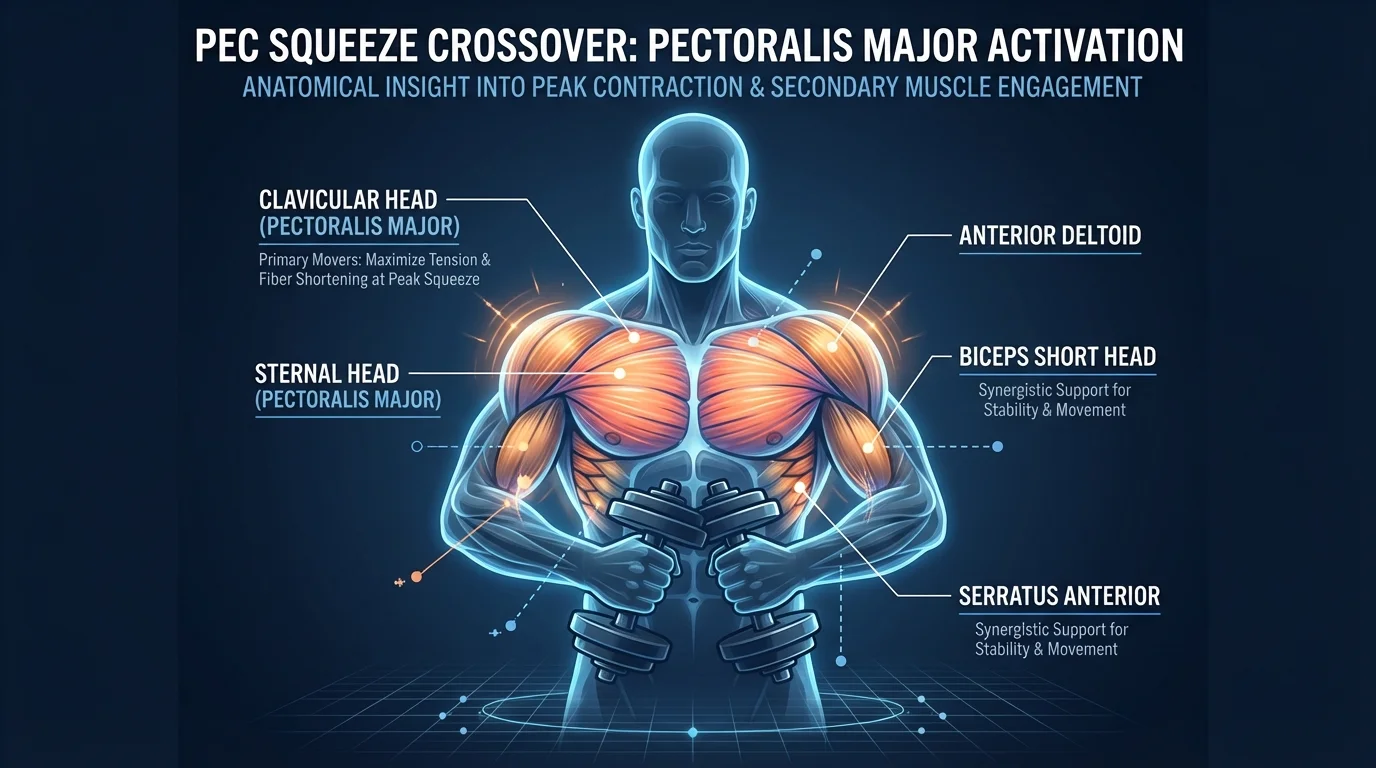
Primary movers: the pectoralis major, especially the sternal fibers that pull the upper arm across the body. The pecs shorten as your arms sweep forward and cross past the midline, then lengthen under control as you open back to the start.
Secondary movers: the anterior deltoids help keep the arms raised at shoulder height, while the serratus anterior helps the shoulder blades glide around the rib cage. The short head of the biceps can assist shoulder flexion and helps steady the arm through the crossover.
Stabilizers: the rotator cuff, lower traps, rhomboids, and trunk all work isometrically so the upper arm moves without the shoulder shrugging forward. Your core is not the target, but it keeps your ribs stacked over your pelvis while the dumbbells pull you forward.
Why the crossover changes the feel: a standard dumbbell fly stops near the midline. Pec squeeze crossovers keep moving into cross-body adduction, which shortens the pecs further and makes the peak contraction easier to feel. There is no high-confidence pec squeeze crossover EMG citation in the FitCraft library, so this section uses anatomy and movement mechanics rather than a proxy study.
How to Do a Pec Squeeze Crossover (Step-by-Step)
Step 1: Set Your Stance and Posture
Stand tall with your feet about hip-width apart and your knees slightly bent. Hold a light dumbbell in each hand, brace your abs, and set your shoulders down and back before your arms move.
Coach Ty's cue: "Ribs down, shoulders quiet, chest ready to squeeze."
Step 2: Raise Your Arms to the Start
Bring both arms out to the sides at shoulder height with palms facing forward or slightly inward. Keep a soft 10-15 degree elbow bend. That elbow angle stays fixed for the entire rep.
Coach Ty's cue: "Freeze the elbow bend before you start the arc."
Step 3: Sweep Forward in a Wide Arc
Move both dumbbells forward as if you were hugging a large ball. Keep the motion smooth and controlled, with the chest leading the squeeze and the shoulders staying low.
Coach Ty's cue: "Hug forward, don't punch forward."
Step 4: Cross and Squeeze
When your hands meet in front of your chest, keep going until one forearm crosses over the other. Hold the squeeze for one full count and alternate which arm is on top every rep.
Coach Ty's cue: "Cross the line, squeeze, then switch sides next rep."
Step 5: Return Under Control
Open the arms back to the start over two to three seconds. Stop the set if the dumbbells pull your shoulders forward, your elbows straighten, or you lose the chest squeeze.
Coach Ty's cue: "Own the way back. The return is part of the rep."
Get this exercise in a personalized workout
FitCraft, our mobile fitness app, uses its AI coach Ty to program isolation exercises like this into your plan at the right volume and intensity, based on your level, goals, and equipment. Ty was designed and trained by Domenic Angelino, MPH (Brown University) and NSCA-CSCS, with research published in the Journal of Strength and Conditioning Research and Medicine & Science in Sports & Exercise.
Take the Free Assessment Free · 2 minutes · No credit card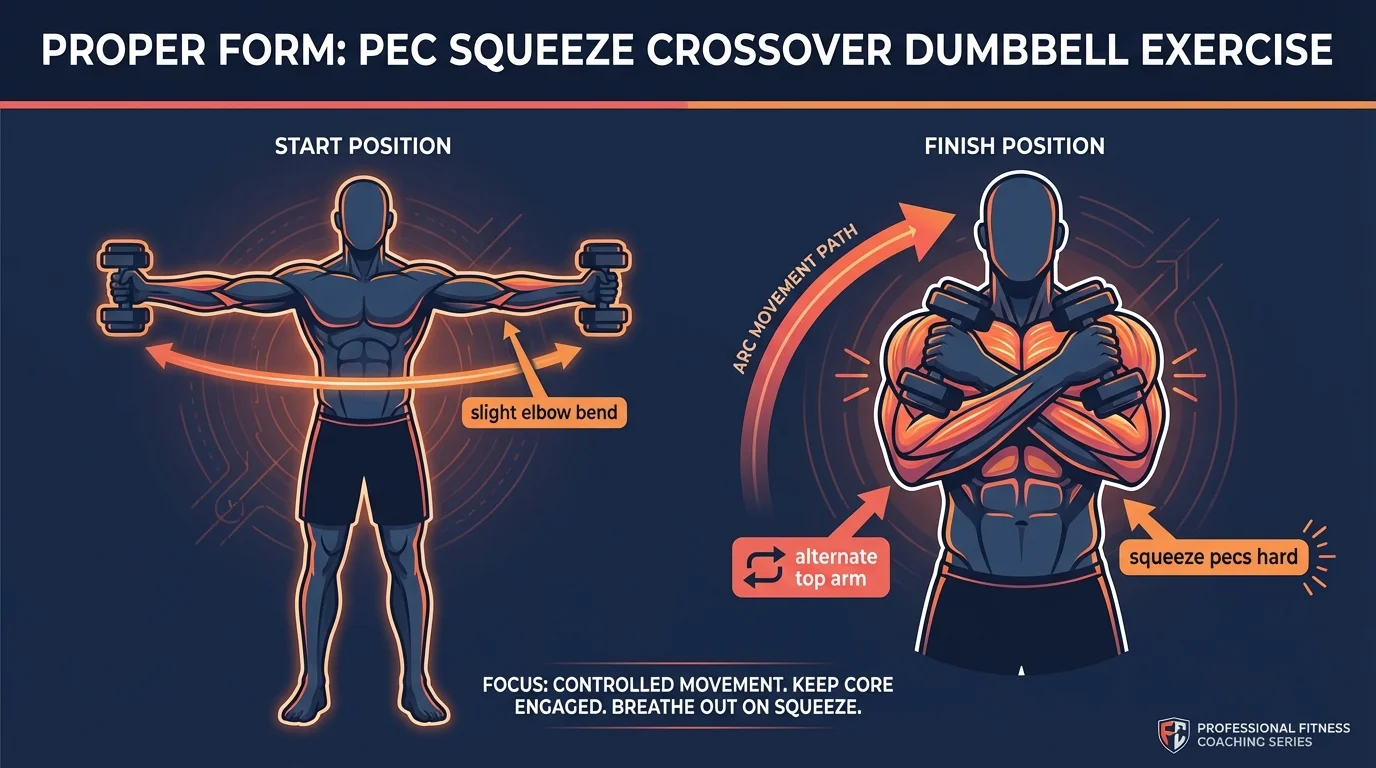
Common Mistakes (and How to Fix Them)
- Turning it into a front raise. Straight elbows and heavy dumbbells shift the work into the anterior deltoids. Fix it by using lighter weights and keeping the same soft elbow bend from start to finish.
- Stopping at hands-together. If your hands only meet, you did a standing fly. Fix it by crossing one forearm over the other and alternating the top arm every rep.
- Shrugging through the arc. Traps take over when your shoulders climb toward your ears. Reset your shoulder blades down and back before each rep, then lower the load if you cannot hold that position.
- Using momentum. Swinging the dumbbells forward hides the chest contraction. Slow the forward arc, hold the peak squeeze for one count, and take two to three seconds on the return.
- Going too heavy. Pec squeeze crossovers are accessory work. If you cannot feel the chest at the top, choose a lighter pair of dumbbells and treat the squeeze as the goal.
- Always crossing the same arm on top. Repeating the same top arm can build a small range-of-motion bias. Alternate sides each rep so both pecs train through the same pattern.
Pec Squeeze Crossover Variations: Regressions and Progressions
Use the easiest version that lets you feel the pecs without shoulder irritation. Progress only when the shoulder position stays quiet and controlled.
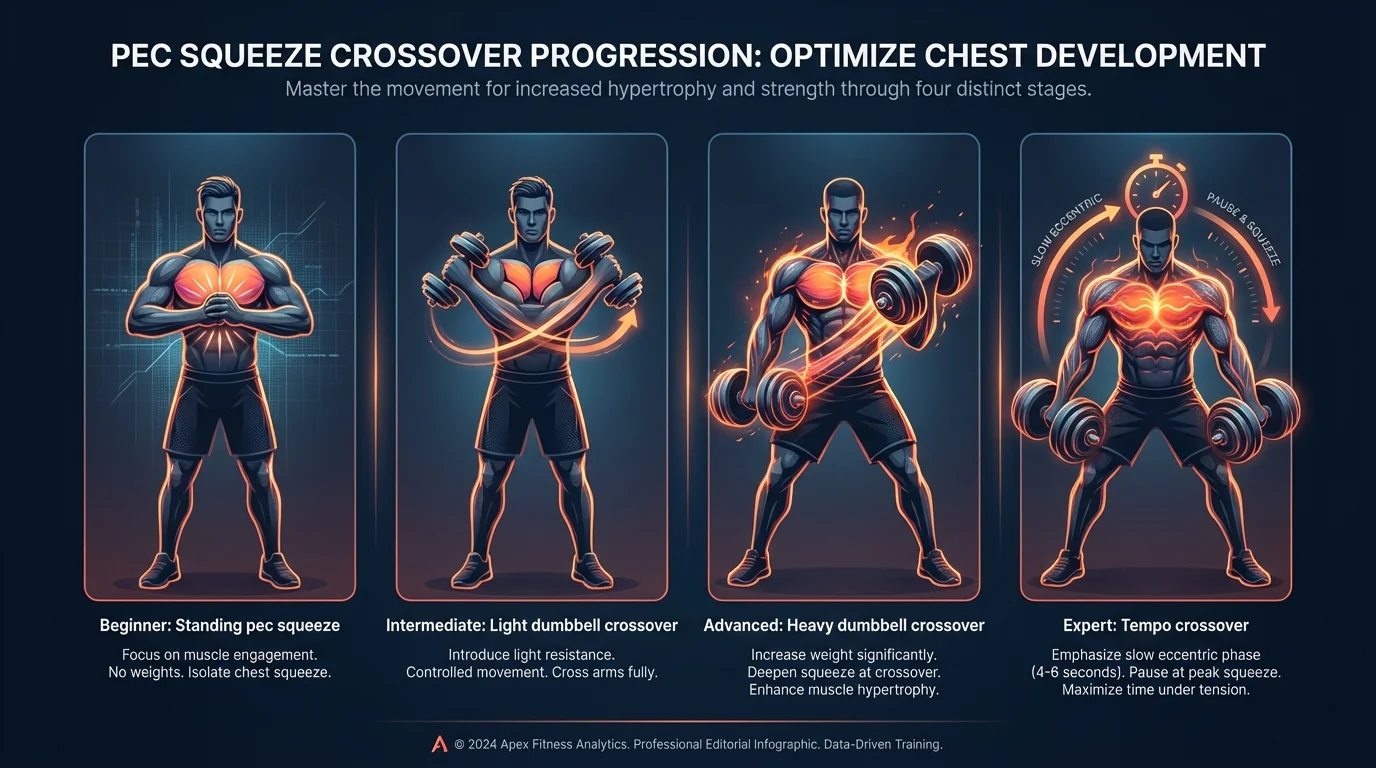
Standing Chest Squeeze (Beginner Regression)
Use no weights. Extend your arms, sweep forward, cross at the midline, and squeeze your chest hard. This teaches the path before external load enters the movement.
Light Dumbbell Crossover (Intermediate)
Use 5-10 lb dumbbells and focus on a clean arc. This is the best starting point for most lifters who already know how to perform a basic chest fly.
Standard Pec Squeeze Crossover (Advanced)
Use a moderate load only after light reps feel stable. Keep the exercise late in the workout after heavier pressing or fly work, where it can serve as a chest finisher.
Tempo Pec Squeeze Crossover (Expert)
Use a 3-1-3 tempo: three seconds forward, one-count squeeze, three seconds back. Expect to reduce load. The slower tempo makes momentum obvious and forces tighter control.
When to Avoid or Modify Pec Squeeze Crossovers
Pec squeeze crossovers are safe for many healthy lifters, but the shoulder-height arm position can be irritating when the shoulder or chest is already sensitive. Use these modifications as starting points, and consult your physician or physical therapist for personalized guidance.
- Shoulder impingement symptoms or painful arc. Skip the loaded crossover if raising your arm to shoulder height causes pinching. Use chest press or floor-based chest fly variations in a pain-free range.
- Recent shoulder, chest, biceps, or elbow strain. Isolation work can aggravate healing tissue. Start with isometric chest squeezes, then light range-of-motion work once symptoms settle and you have clinical clearance.
- Recent shoulder, elbow, or chest surgery. Follow your surgeon or physical therapist's protocol. Most return-to-training plans rebuild range, isometrics, and pressing tolerance before loaded fly or crossover work.
- Bicipital tendinopathy. The shoulder-height arm position can irritate the front of the shoulder. Reduce load, shorten the range, or substitute diamond press if the crossover increases symptoms.
- Poor scapular control under load. If your shoulders roll forward or shrug every rep, use W-raises, Y-raises, and pull-aparts to build shoulder-girdle control first.
Related Exercises
These exercises support the same chest pattern or balance the shoulder work around it:
- Same target muscle: Chest Fly trains the same horizontal-adduction pattern with more support and less standing balance demand.
- Compound press foundation: Chest Press and Push-Ups build the pressing strength that should sit underneath isolation work.
- Inner-chest accessory: Diamond Press creates a chest squeeze during a pressing motion and is often easier to control than a standing crossover.
- Shoulder/scapular health: W-Raise, Y-Raise, and Pull-Apart train the shoulder-girdle control this movement depends on.
- Antagonist balance: Bent-Over Rows balance chest isolation with horizontal pulling volume.
How to Program Pec Squeeze Crossovers
Pec squeeze crossover programming follows the evidence-based ranges used for accessory resistance training. The American College of Sports Medicine (ACSM) Position Stand recommends matching load, volume, and rest to training status, with roughly 8-12 reps for strength-focused work and 10-15 or more reps for hypertrophy and local muscular endurance in many accessory patterns (Ratamess et al., 2009).
| Level | Sets × Reps | Rest between sets | Frequency |
|---|---|---|---|
| Beginner (no weight) | 2-3 × 10-15 | 45-60 seconds | 2-3 sessions/week |
| Intermediate (light dumbbells) | 3-4 × 8-15 | 60-90 seconds | 2-4 sessions/week |
| Advanced (standard or tempo) | 3-4 × 6-15 | 60-120 seconds | 2-4 sessions/week |
Where in your workout: use pec squeeze crossovers late in a chest session, after your heavier press or fly work. Isolation work is accessory. Doing it first can fatigue the chest and reduce the quality of your main lifts.
Form floor over rep targets: stop the set when the squeeze disappears, your shoulders shrug, or your elbows start changing angle. Clean crossovers with light dumbbells beat heavier reps that shift into the front shoulders.
How FitCraft Programs This Exercise
FitCraft uses the free assessment to understand your level, goals, and available equipment, then builds a personalized program around movement patterns you can perform well.
Ty can demonstrate exercises in the app and help you follow the plan, but pec squeeze crossovers are still an advanced accessory. A balanced program will usually place them after pressing strength and basic fly control are already in place.
Frequently Asked Questions
What muscles do pec squeeze crossovers work?
Pec squeeze crossovers primarily work the pectoralis major, especially the sternal fibers that create horizontal adduction. The anterior deltoids, serratus anterior, biceps short head, rotator cuff, and upper-back stabilizers assist and keep the shoulder joint controlled.
Are pec squeeze crossovers an advanced exercise?
Yes. The exercise asks you to hold shoulder-height arm position, keep a fixed elbow bend, and cross past the midline without shrugging or swinging. Start with no-weight chest squeezes and light dumbbell flyes before adding loaded crossovers.
How heavy should I go on pec squeeze crossovers?
Use a light load you can control for every inch of the arc. Most lifters do better with 5-25 lb dumbbells than with heavy weights. If you can't hold the peak squeeze for one count or your elbows straighten, the load is too heavy.
Can I do pec squeeze crossovers with shoulder pain?
Modify or skip pec squeeze crossovers if shoulder pain increases when your arms are out at shoulder height or crossing in front of your chest. Use no-weight chest squeezes, floor chest flyes, or chest presses in a pain-free range, and see a physical therapist if symptoms persist.
Pec squeeze crossover vs cable crossover: which is better?
Cable crossovers usually give more consistent tension through the peak contraction because the cable keeps pulling as your hands cross. Dumbbell pec squeeze crossovers are more accessible for home training and can still work well as a light, controlled chest finisher.