The name is a little misleading. This stretch does not mainly lengthen the small rotator cuff muscles. It opens the front of the shoulders and chest while the cuff helps keep the upper arm centered in the socket. That makes it useful before upper-body training, after desk work, or anytime your shoulders feel pulled forward.
Quick Facts: Rotator Cuff Stretch
- Equipment needed: None; small towel or strap optional
- Difficulty: Beginner to intermediate
- Modality: Mobility and flexibility
- Body region: Shoulders, chest, and upper body
- FitCraft quest category: Mobility
Areas Stretched & Mobilized
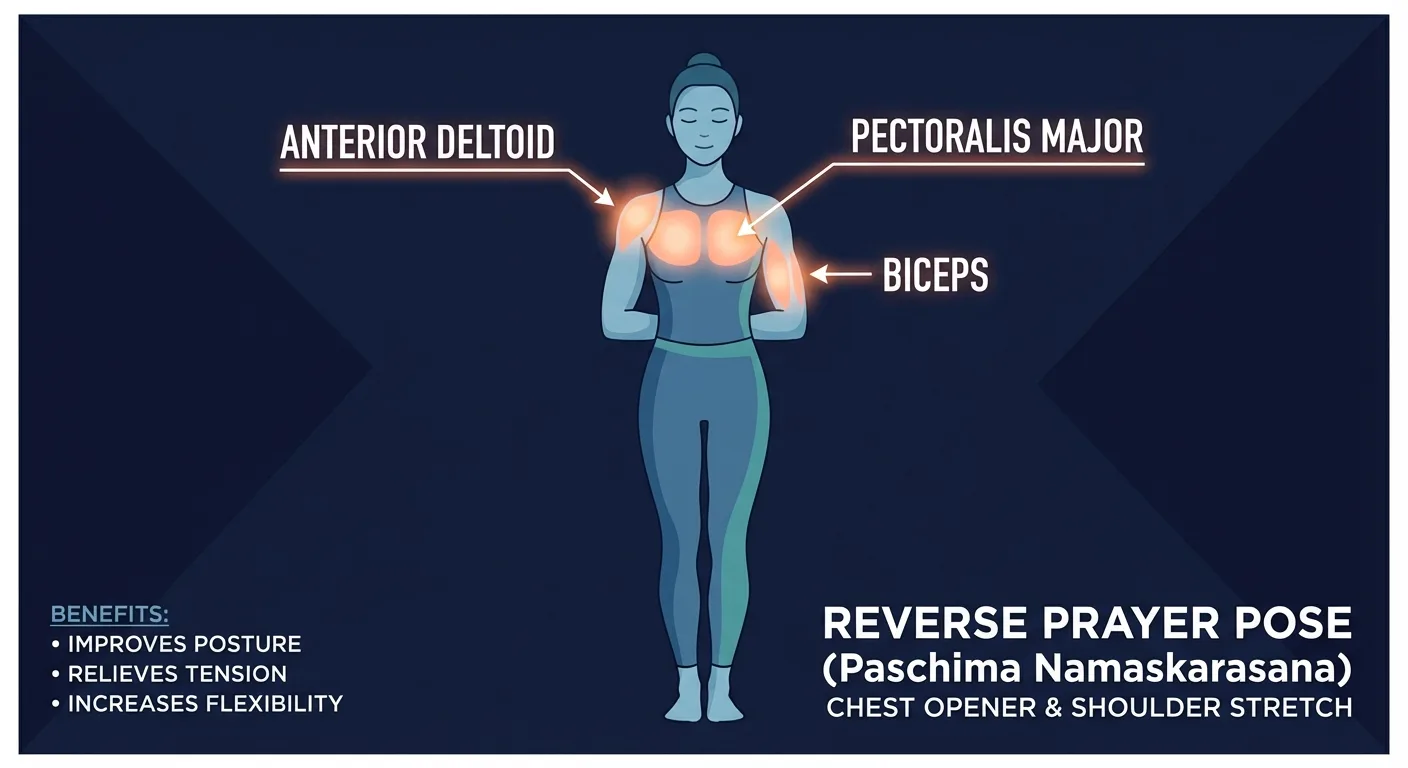
The primary tissues lengthened are the anterior deltoid, pectoralis major, pectoralis minor, and long head of the biceps. These tissues cross the front of the shoulder and chest, so shoulder extension with straight arms creates the main stretch.
The rotator cuff works more as a positioning system than as the main target. Infraspinatus, teres minor, supraspinatus, and subscapularis help guide the head of the humerus while the shoulder moves behind the body.
Because this is a low-load mobility drill, stabilization demands stay small. The upper back lightly retracts the shoulder blades, the deep core keeps the ribs from flaring, and the neck stays relaxed so the stretch does not turn into a trap shrug.
Mechanically, the stretch combines shoulder extension, gentle external rotation, and scapular retraction. That combination counters the rounded-shoulder posture created by long periods of typing, scrolling, driving, and pressing work.
Step-by-Step: How to Do the Rotator Cuff Stretch
- Stand tall with soft knees. Set your feet hip-width apart and keep a slight bend in the knees. Stack your ribs over your hips before you reach back.
Coach Ty's cue: "Start tall before you chase range."
- Clasp your hands behind your back. Reach both arms behind you and interlace your fingers. If your hands do not meet, hold a small towel or strap between them.
Coach Ty's cue: "The towel counts. Clean position beats forced fingers."
- Straighten your elbows. Lengthen both arms without aggressively locking the joints. Keep the hands low enough that the front of the shoulder feels open, not pinched.
Coach Ty's cue: "Long arms, calm shoulders."
- Open the chest. Gently lift your hands away from your lower back and draw your shoulder blades toward each other. Breathe into the ribs while your neck stays long.
Coach Ty's cue: "Chest broad, traps quiet."
- Hold and release. Hold for 20 to 30 seconds, then release and shake out your shoulders. Repeat 1 to 3 rounds, switching which thumb sits on top each round.
Coach Ty's cue: "Leave the stretch feeling better than when you started."
Get this exercise in a personalized workout
FitCraft, our mobile fitness app, uses its AI coach Ty to program mobility work like this into your plan at the right volume and intensity, based on your level, goals, and equipment. Ty was designed and trained by Domenic Angelino, MPH (Brown University) and NSCA-CSCS, with research published in the Journal of Strength and Conditioning Research and Medicine & Science in Sports & Exercise.
Take the Free Assessment Free • 2 minutes • No credit card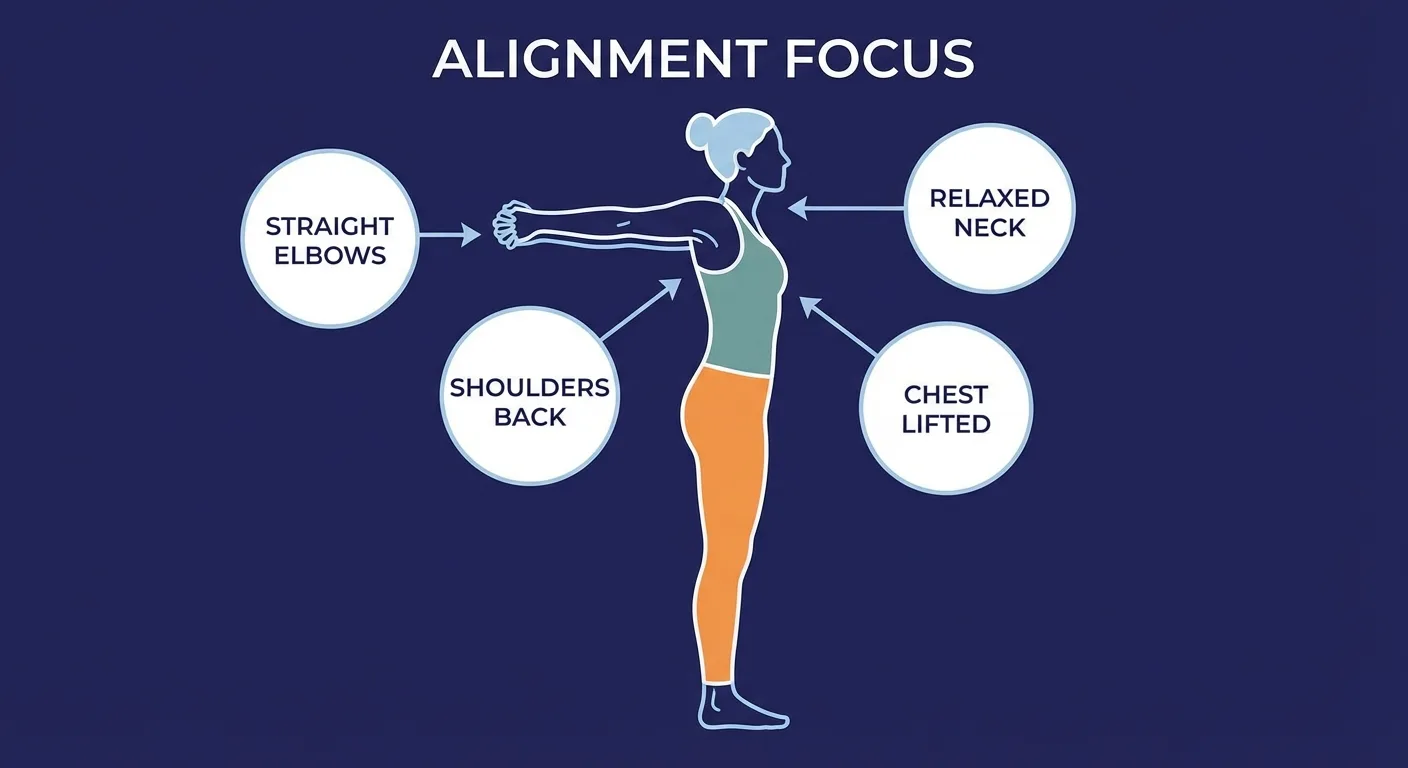
Common Mistakes and How to Fix Them
Forcing the hands too high
What it looks like: You yank the clasped hands as high as possible and feel a sharp pinch in the front of the shoulder.
Why it is a problem: The stretch stops feeling like chest mobility and starts loading irritated shoulder tissue.
The fix: Lower the hands, use a towel, and stay in a mild stretch. Range improves through repeated calm exposure.
Hunching the shoulders
What it looks like: The shoulders creep up toward the ears as the hands lift away from the back.
Why it is a problem: Shrugging adds neck tension and reduces the chest-opening effect.
The fix: Reset the shoulder blades down before each hold. Think long neck, quiet traps, easy breath.
Flaring the ribs
What it looks like: The chest appears open because the lower back arches and the ribs shoot forward.
Why it is a problem: You borrow motion from the spine instead of improving shoulder position.
The fix: Lightly brace the abs and keep the ribs stacked over the pelvis. Open through the shoulders.
Holding your breath
What it looks like: The jaw clenches and the stretch becomes a tense 30-second fight.
Why it is a problem: Breath-holding keeps the chest and neck tense, which limits the exact area you want to relax.
The fix: Inhale through the nose, then use a slow exhale to soften into the stretch without forcing it.
Rotator Cuff Stretch Variations: Regressions and Progressions
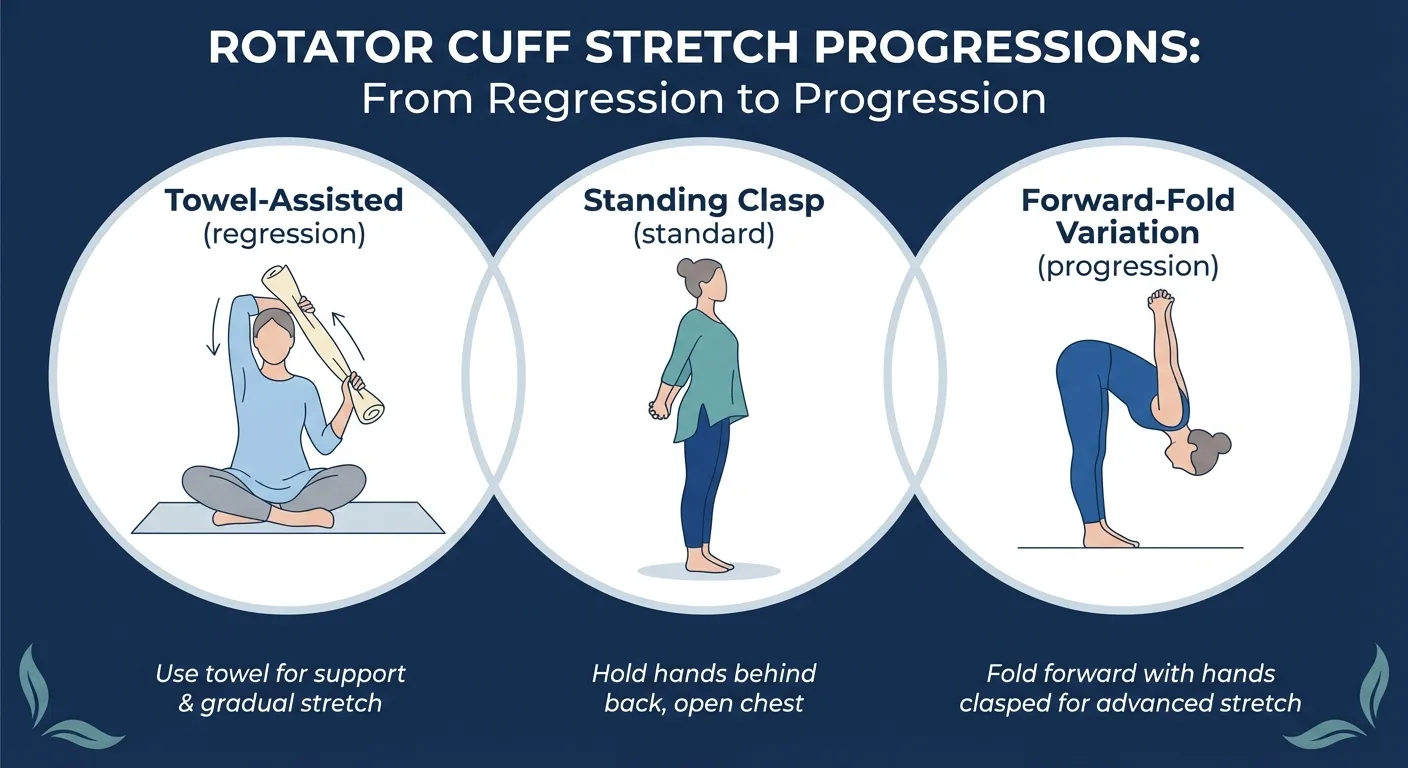
Towel-assisted rotator cuff stretch
Hold a towel or strap between your hands instead of clasping fingers. This is the best starting version if shoulder extension is limited or your hands cannot meet behind your back.
Standard clasped-hands rotator cuff stretch
Interlace the fingers behind the back, straighten the elbows, and gently lift the hands away from the lower back. Keep the stretch smooth across the front of the shoulders and chest.
Forward-fold variation
From the standing clasp, hinge at the hips and let the arms move overhead as gravity deepens the stretch. Keep a small knee bend and come out slowly if the shoulders feel crowded.
Cow-face arms
Reach one arm overhead and the other behind the back, then work toward clasping the hands. This unilateral version is deeper and less forgiving, so use a towel until both shoulders feel even.
When to Avoid or Modify the Rotator Cuff Stretch
The rotator cuff stretch is safe for most healthy adults, but shoulder tissue can be sensitive at end range. Always consult your physician or physical therapist if pain, surgery history, or a diagnosed condition changes how your shoulder moves.
- Acute shoulder injury or recent shoulder surgery. Skip the clasped-hands version until cleared. Use clinician-approved range-of-motion drills first.
- Sharp pinching in the front of the shoulder. Reduce the range, use a towel, or switch to shoulder rolls until the shoulder calms down.
- Hypermobility or connective tissue disorders. Avoid passive end-range holds. Favor active control work and keep the stretch well short of your maximum range.
- Acute pec, biceps, or front-shoulder strain. Let the irritated tissue settle before stretching it. Reintroduce gentle mobility only after the acute phase.
- Numbness, tingling, or radiating symptoms. Stop the stretch and get assessed. Nerve-like symptoms are not normal stretching sensations.
- Pregnancy or generalized ligament laxity. Keep the stretch mild and avoid chasing maximum range. Daily comfort matters more than depth.
Related Exercises
- Same shoulder complex: Shoulder Rolls add gentle active motion before or after the static stretch.
- Posterior shoulder pairing: Seated Rear Delt Stretch balances the front-shoulder opening with a posterior shoulder stretch.
- Lat and triceps pairing: Tricep and Lat Stretch targets the overhead shoulder position this stretch does not cover.
- Upper-body mobility sequence: Cat-Cow and Cobra Pose pair well for a desk-break reset.
- Strength prerequisite: Shoulder Press benefits from better front-shoulder mobility, but it still needs active control and strength.
How to Program the Rotator Cuff Stretch
Ratamess et al., 2009 outlines progression principles for resistance training, but mobility work is programmed differently: hold quality, stretch intensity, breathing, and weekly consistency matter more than load.
| Level | Sets x hold | Rest between sets | Frequency |
|---|---|---|---|
| Beginner | 1-2 sets x 15-30 seconds | 30-60 seconds | 5-7 sessions/week |
| Intermediate | 2-3 sets x 30-60 seconds | 30-60 seconds | 5-7 sessions/week |
| Advanced | 2-4 sets x 30-90 seconds or 5-10 active reps | 30-90 seconds | Daily if recovery stays good |
Place it after a general warm-up, between upper-body sets as a light reset, after training, or during desk breaks. Before heavy pressing, keep the hold short and gentle so the shoulder feels prepared rather than loose and sleepy.
Use a form floor over a time target. If you need to shrug, arch your back, hold your breath, or push through pinching to reach a longer hold, the set is already done.
FitCraft, our mobile fitness app, uses its AI coach Ty to program mobility work like this into your plan at the right volume and intensity, based on your level, goals, and equipment. Ty was designed and trained by Domenic Angelino, MPH (Brown University) and NSCA-CSCS, with research published in the Journal of Strength and Conditioning Research and Medicine & Science in Sports & Exercise.
Frequently Asked Questions
What muscles does the rotator cuff stretch actually stretch?
This clasped-hands version mainly stretches the anterior deltoid, pectoralis major, pectoralis minor, and the long head of the biceps. The rotator cuff helps position the shoulder, but the main sensation should be across the front of the shoulders and chest.
I cannot clasp my hands behind my back. What should I do?
Use a small towel or strap between your hands. Keep the grip wide enough that you can stand tall, breathe, and feel a gentle stretch without pinching. Over time, slide your hands closer together only if the shoulder stays calm.
How long should I hold the rotator cuff stretch?
Start with 15 to 30 seconds for 1 to 2 rounds. If the stretch feels smooth, build toward 30 to 60 seconds for 2 to 3 rounds. Stop the hold if you feel sharp, pinching, or nerve-like symptoms.
Can this stretch help with rounded shoulders?
It can help open the front of the shoulders and chest, which often feels tight with desk-heavy posture. Pair it with upper-back and rear-shoulder strengthening, such as rows or rear-delt work, for a more complete posture plan.
Can I do the rotator cuff stretch with shoulder pain?
Avoid the clasped-hands version during acute shoulder pain, recent shoulder surgery, or any sharp pinching in the front of the joint. Use a smaller towel-assisted range only if it feels comfortable, and get guidance from a qualified clinician when pain is active.