Scissor raises look simple because the setup is simple: lie on your back, lift your legs, and alternate them up and down. The hard part is keeping your pelvis still while long, moving legs try to pull your lower back away from the floor.
That is why this exercise belongs in the core category as much as the hip-flexor category. Your hip flexors move the legs, but your abs control the pelvis. When the abs lose that fight, the back arches and the exercise changes completely.
Use scissor raises after you already own easier anti-extension work like deadbugs and heel taps. Then build range and tempo slowly.
Quick Facts: Scissor Raises
- Equipment needed: None, though an exercise mat helps
- Difficulty: Intermediate to Advanced
- Modality: Core strength
- Body region: Core and hip flexors
- FitCraft quest category: Core
Muscles Worked
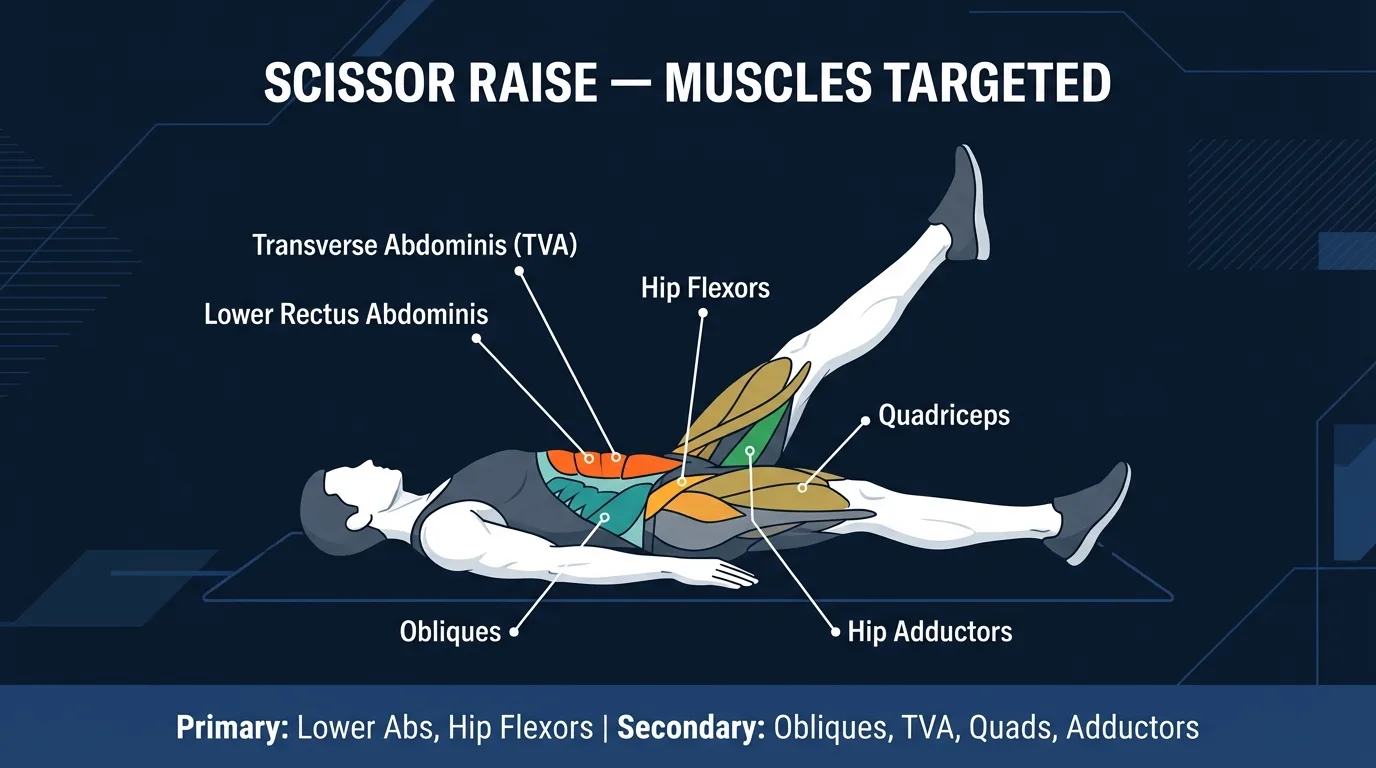
Primary movers: the rectus abdominis and hip flexors. The hip flexors lift and lower the legs through the scissor pattern, while the rectus abdominis works hard to keep the pelvis tucked and the lower back pinned to the mat.
Secondary movers: the obliques, quadriceps, and hip adductors. The obliques help prevent side-to-side rocking, the quadriceps keep the knees long, and the adductors help control the crossing or close-leg scissor path.
Stabilizers: the transverse abdominis, diaphragm, pelvic floor, and spinal erectors. These muscles create the deep-core brace that keeps the trunk quiet while the legs move. Exhaling as one leg rises helps reinforce that brace.
Why the exercise feels so demanding: straight legs create a long lever arm. The lower the bottom leg gets, the more your abs have to resist anterior pelvic tilt. That is the mechanism behind the exercise. If your back cannot stay down, the range is too low for your current strength.
How to Do Scissor Raises (Step-by-Step)
- Set your back position. Lie on your back with legs extended. Place your hands under your glutes or press your palms into the floor beside you, then gently tuck your pelvis so your lower back stays in contact with the mat. Coach Ty's cue: "Ribs down, back flat, legs long."
- Lift both legs. Raise both legs a few inches from the floor with a slight bend at the knees. If your back lifts right away, bring your legs higher until the position is clean. Coach Ty's cue: "Earn the low angle. Start higher if your back needs it."
- Start the scissor pattern. Raise one leg toward about 45 degrees while the other leg lowers toward the floor. Keep the movement smooth and stop the bottom leg before your pelvis tips forward.
- Alternate continuously. Switch leg positions in a controlled rhythm. Exhale as one leg rises, inhale as it lowers, and keep your heels off the floor until the set is finished.
- Stop before form breaks. End the set when your lower back starts to arch, your ribs flare, or your legs speed up. Quality reps matter more than chasing a number.
Get this exercise in a personalized workout
FitCraft, our mobile fitness app, uses its AI coach Ty to program core stability work like this into your plan at the right volume and intensity, based on your level, goals, and equipment. Ty was designed and trained by Domenic Angelino, MPH (Brown University) and NSCA-CSCS, with research published in the Journal of Strength and Conditioning Research and Medicine & Science in Sports & Exercise.
Take the Free Assessment Free · 2 minutes · No credit card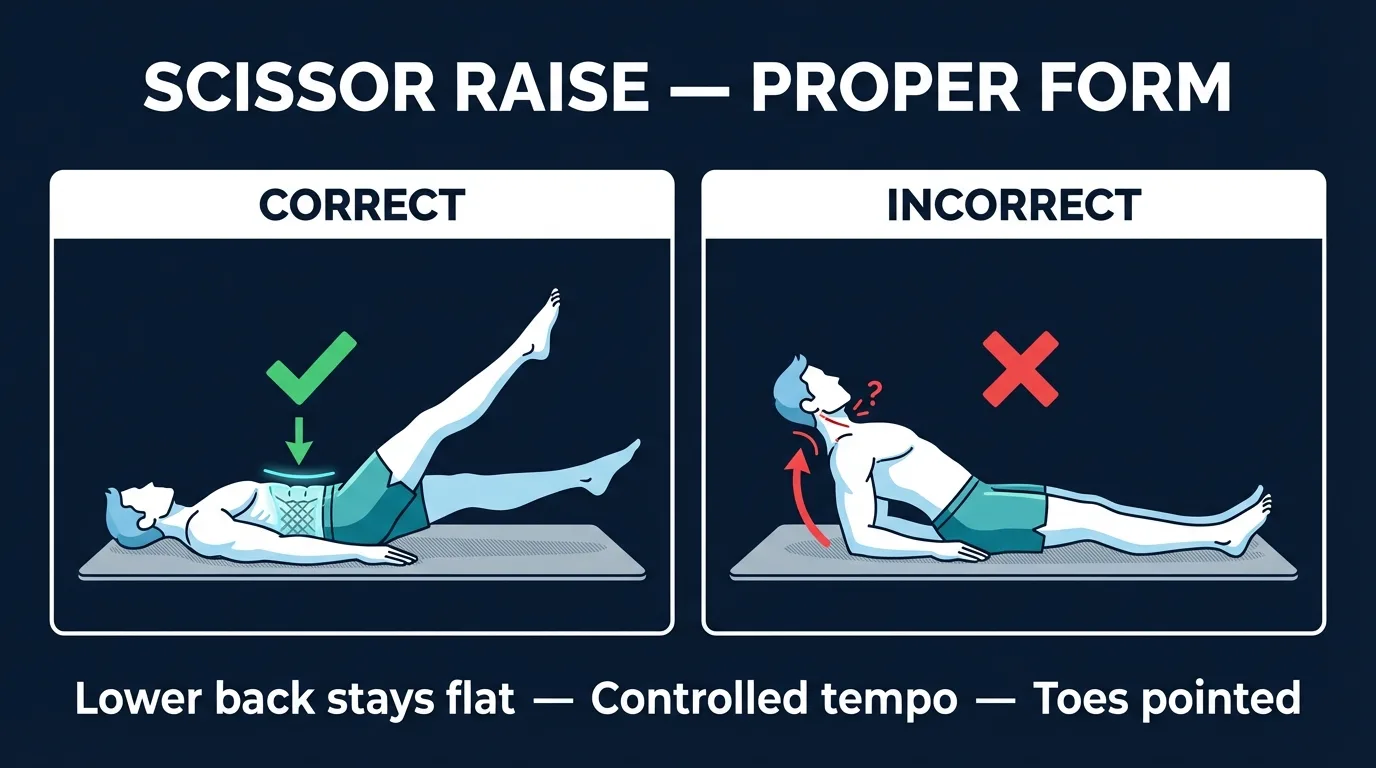
Common Mistakes to Avoid
- Arching the lower back. This is the main form error. It means the leg angle is too low, the set has gone too long, or your core is not ready for straight legs yet. Fix it by raising the legs, bending the knees, or switching to deadbugs.
- Moving too fast. Speed turns the exercise into momentum. Slow the switch between legs so your abs have to control the pelvis through the whole rep.
- Dropping the heels to the floor. Touching down gives the abs a rest and usually leads to a bounce into the next rep. Keep both feet hovering until you intentionally end the set.
- Holding your breath. Breath-holding can spike pressure and make the movement feel more braced than it is. Use a steady exhale as one leg rises and inhale as it lowers.
- Pulling from the neck or shoulders. Your head and shoulders stay relaxed unless you are doing a deliberate crunch-combo progression. If the neck tenses, reset your arms and lower the difficulty.
Scissor Raise Variations: Regressions and Progressions
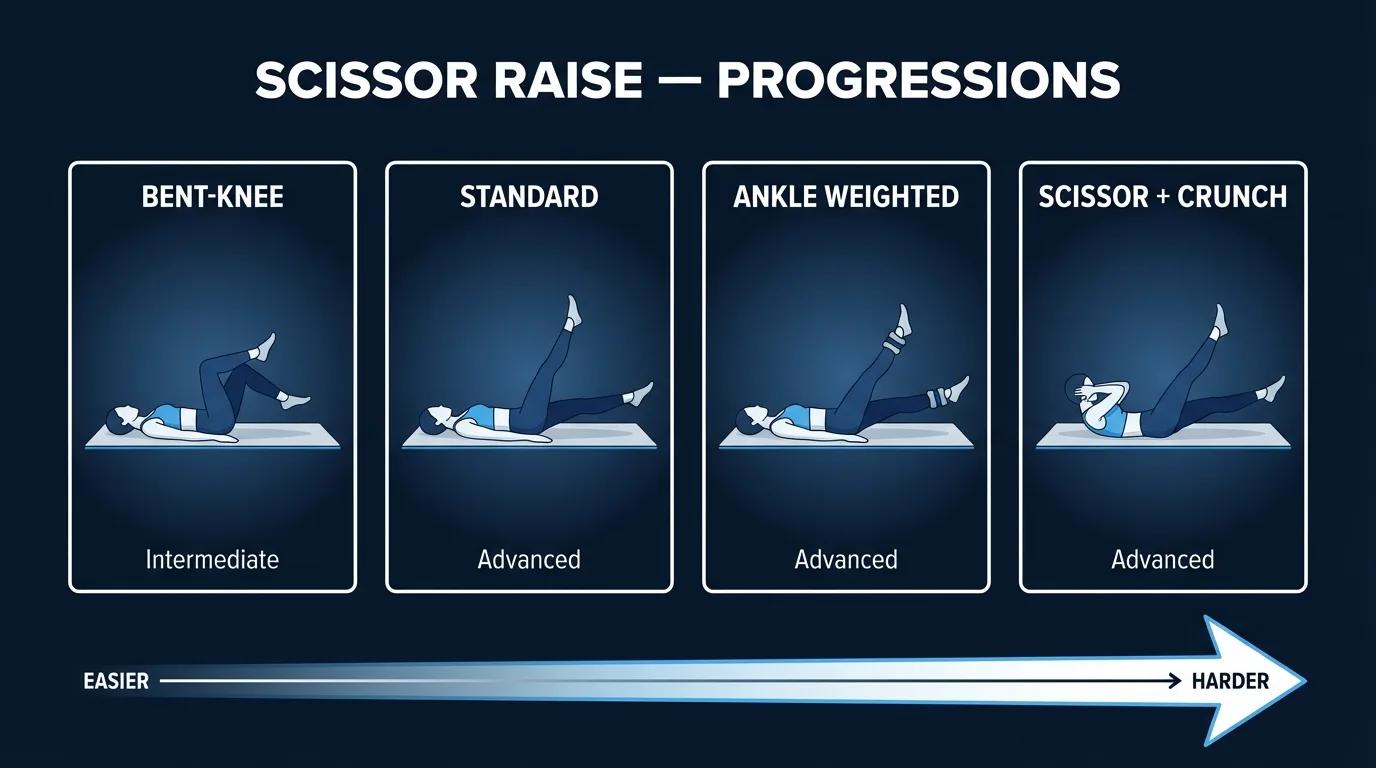
Bent-Knee Scissor Raises
Bend both knees to about 90 degrees and use the same alternating pattern. This shortens the lever arm and makes it easier to keep the lower back flat.
Standard Scissor Raises
Use straight legs, pointed or relaxed toes, and a slow alternating tempo. Master 3 sets of clean reps before you make the range lower or the tempo slower.
Ankle-Weighted Scissor Raises
Add light ankle weights only after the standard version is controlled. Because the resistance sits at the end of the lever, even a small load changes the exercise quickly.
Scissor Raise to Crunch Combo
Add a small crunch as one leg reaches the top position. This adds spinal flexion on top of the anti-extension demand, so use it only if your back position stays clean.
When to Avoid or Modify Scissor Raises
Scissor raises are safe for many healthy adults, but the straight-leg lever can be too aggressive when the trunk cannot keep the pelvis controlled. Always consult your physician or physical therapist for personalized guidance.
- Acute lower-back pain or known disc pathology. Full scissor raises can pull the lumbar spine into extension if the abs cannot hold the pelvis down. Start with deadbugs, heel taps, or bent-knee scissors.
- First 6-8 weeks postpartum or active diastasis recti. Straight-leg lowering can raise abdominal pressure and create doming. Rebuild with breathing drills, gentle bracing, bird-dogs, and deadbugs first.
- Recent abdominal surgery. Get clearance from your surgeon before loaded bracing or leg-lowering work. Most return-to-training plans start with breathing and low-intensity bracing before long-lever core work.
- Hernia symptoms or pelvic-floor dysfunction. If pressure, bulging, heaviness, or leakage appears during the set, stop and use lower-pressure alternatives under professional guidance.
- Hip-flexor pinching or front-of-hip pain. Reduce the range, bend the knees, and pair core work with glute bridges so the hip flexors are not doing all the work.
Related Exercises
- Same pattern: Leg Raises train a similar lower-ab and hip-flexor pattern with both legs moving together.
- Easier regression: Heel Taps shorten the lever and make it easier to learn pelvic control.
- Foundation for spinal bracing: Deadbugs and Bird-Dogs build the deep-core control scissor raises require.
- Advanced anti-extension option: Hollow Holds challenge the same ribs-down, pelvis-tucked position without alternating the legs.
- Glute balance: Glute Bridges train hip extension to balance hip-flexor-heavy core work.
How to Program Scissor Raises
For core training, use the same progression principle that the ACSM resistance-training position stand applies across strength work: start with a version you can control, add volume gradually, and progress only when technique stays intact (Ratamess et al., 2009).
| Level | Sets × Reps | Rest between sets | Frequency |
|---|---|---|---|
| Beginner | 2-3 × 8-12 per side, bent knees | 45-60 seconds | 2-4 sessions/week |
| Intermediate | 3 × 10-20 per side | 45-60 seconds | 3-5 sessions/week |
| Advanced | 3-4 × 15-30 slow reps per side | 60 seconds | 4-6 sessions/week |
Where in your workout: place scissor raises near the end of a resistance-training session, as a core finisher, or in a standalone core circuit. If you use them as activation, keep the reps low so your hip flexors and abs are not fatigued before heavier work.
Form floor over rep targets: your set ends when the lower back lifts, the ribs flare, or the legs start swinging. A shorter clean set beats a longer set with lumbar extension.
How FitCraft Programs This Exercise
FitCraft's AI coach Ty can place core stability work into a balanced program based on your level, goals, and available equipment. For a movement like scissor raises, that usually means starting with the variation you can control and progressing the lever length, tempo, or volume only when your trunk position stays consistent.
Frequently Asked Questions
What muscles do scissor raises work?
Scissor raises primarily train the rectus abdominis and hip flexors. The transverse abdominis and obliques stabilize the pelvis, while the quadriceps and hip adductors help keep the legs long and controlled.
Can I do scissor raises with lower-back pain?
Avoid full straight-leg scissor raises if they reproduce lower-back pain or if your back arches off the floor. Use deadbugs, bent-knee scissors, or heel taps first, and get guidance from a qualified clinician if back pain is acute, persistent, or related to a known disc issue.
How many scissor raises should I do?
Start with 2 to 3 sets of 8 to 12 controlled reps per side. Intermediates can build toward 3 sets of 10 to 20 reps per side. Advanced trainees can use 3 to 4 sets of 15 to 30 slow reps, but only while the lower back stays flat.
Are scissor raises better than crunches for lower abs?
Scissor raises and crunches train the abs differently. Crunches emphasize spinal flexion, while scissor raises challenge the abs to control pelvic position while the legs move. Use scissor raises when you want anti-extension control and hip-flexion strength.
Can I do scissor raises every day?
Most people do better with scissor raises 2 to 4 times per week, not every day. The abs recover quickly, but repeated hip-flexor-heavy work can irritate the low back or tighten the front of the hips if you do not balance it with glute and bracing work.