You have done pushdowns for a year. Three sets at the end of every session, a real pump, and sleeves that fit exactly the way they did last spring. Nothing about your effort has been lazy.
That's a frustrating place to be, because the work has been happening. What you have never been given is any feedback about which part of the muscle your favourite exercise actually reaches, so a year of honest sets can quietly go to two thirds of the target.
Here is the reframe that fixes it. The triceps is three separate muscles under one name, and one of them plays by different rules. Pick exercises that respect that and the same number of weekly sets produces a different arm. It isn't a discipline problem. It's a selection problem.
Tricep Muscles: Three Heads, and Only One Crosses the Shoulder
The triceps brachii has a long head, a lateral head and a medial head. The lateral and medial heads run from the upper arm bone to the forearm, so they cross the elbow and nothing else. Whatever your shoulder is doing, their length depends only on how bent your elbow is.
The long head is the exception. It starts on the shoulder blade, not the arm bone, so it crosses two joints. Straighten your elbow and it shortens. Raise your arm overhead and it lengthens, regardless of what your elbow does. It's also the largest of the three, which is why the back of a well-trained arm looks thick from the side rather than just wide.
Kholinne and colleagues (2018), publishing in Acta Orthopaedica et Traumatologica Turcica, put ten healthy adults through elbow extensions at five different shoulder elevations and measured each head with surface electromyography alongside a biomechanical simulation. Each head carried a different share of the work depending on where the shoulder was. The long head did most of its work with the arm low, and the medial head took over as the arm went up. Three heads, three jobs, one exercise list that usually ignores the distinction.
The practical translation: a pushdown keeps your upper arm pinned to your side, which is the long head's short position. You can train hard there for months and still be feeding the smallest share of the stimulus to the biggest head.
The 8 Best Exercises for Triceps
Pick three or four of these, not all eight. The list is ordered by how much of the muscle each one reaches and how much load you can honestly put through it.
| Exercise | Best for | Equipment | Sets and reps |
|---|---|---|---|
| Overhead dumbbell extension | The long head, at full stretch | One dumbbell | 3 x 8-12 |
| Lying dumbbell extension | Lateral and medial heads under load | Two dumbbells, a bench or floor | 3 x 10-15 |
| Diamond push-up | Heavy bodyweight loading, no kit | None | 3 x 8-15 |
| Parallel bar dip | The most load you can add | Dip bars | 3 x 6-12 |
| Bench dip | An easier entry to the dip family | A chair or bench | 3 x 10-20 |
| Close-grip push-up | Building toward diamonds | None | 3 x 10-20 |
| Band or cable pushdown | High reps with minimal elbow stress | Band or cable | 3 x 12-20 |
| Tate press | Elbows that dislike straight-bar work | Two dumbbells | 3 x 10-15 |
1. Overhead dumbbell extension
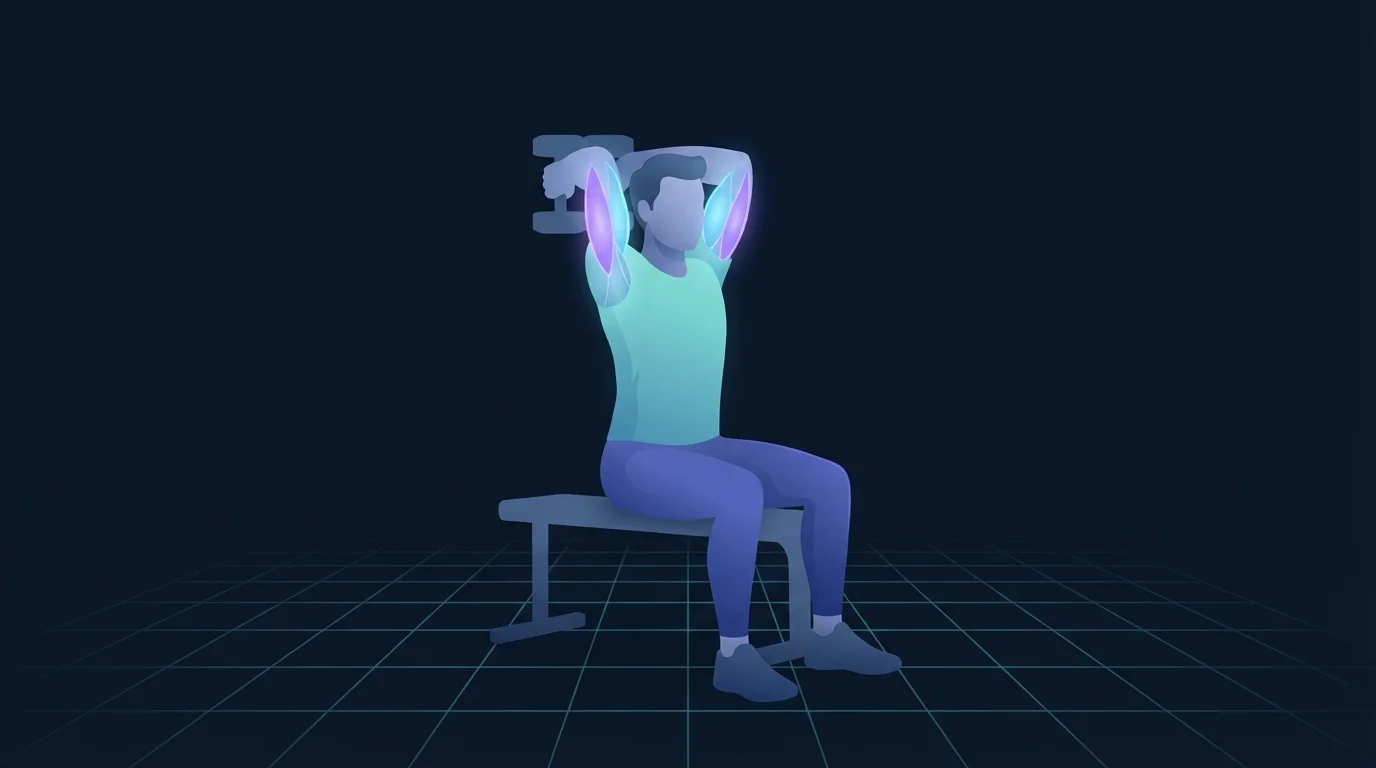
Sit or stand tall, take one dumbbell in both hands, press it overhead, then lower it behind your head by bending only the elbows. Keep the upper arms roughly vertical and close to your ears. Lower until you feel a real stretch at the back of the arm, then press back up without letting the elbows drift wide. Three sets of 8 to 12.
This is the default for the same reason a supine stretch is the default for hamstrings: the position does the hard part for you. The shoulder is flexed, so the long head is long before you have moved anything. Our overhead tricep press page has the setup, the two common faults and the fixes frame by frame.
2. Lying dumbbell extension
Lie on a bench or the floor with a dumbbell in each hand, arms pointed at the ceiling. Bend the elbows to bring the weights toward your forehead or slightly past it, keeping the upper arms still, then extend. Dumbbells beat a bar here because your forearms can rotate to whatever angle your elbows prefer. Three sets of 10 to 15. The skull crusher page covers the bar and dumbbell versions and where the elbow position goes wrong.
Angling the upper arms slightly back toward your head, rather than straight up, keeps a little tension on the long head at the top. Pointing them straight at the ceiling is the version that gives you a rest every rep.
3. Diamond push-up
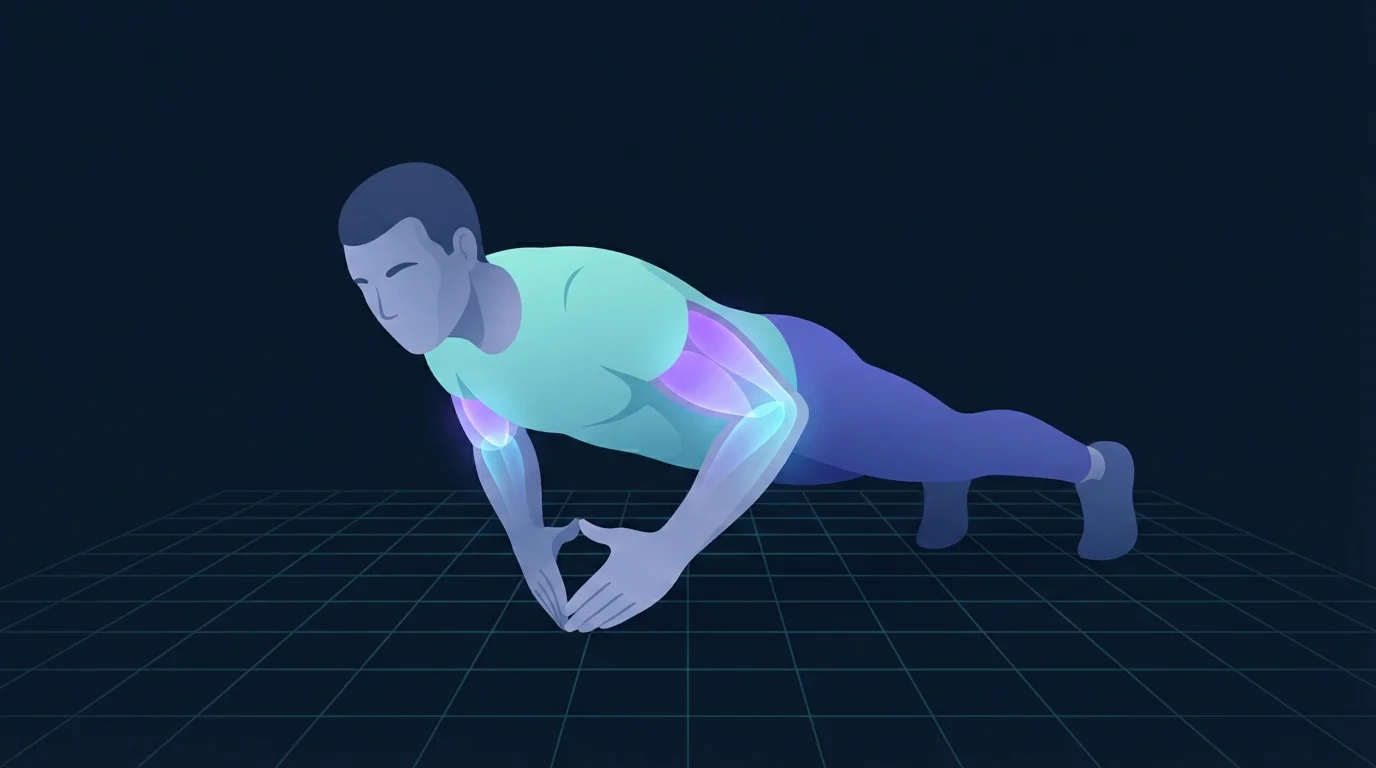
Hands under the chest with thumbs and index fingers touching, elbows tracking back along the ribs rather than flaring out, body in one line from head to heels. Lower until your chest touches your hands. Three sets of 8 to 15. Full setup on the diamond push-up page.
This is the hardest thing you can do for triceps with no equipment at all, and it's genuinely hard on wrists and elbows if you jump straight in. If five clean reps is out of reach today, start at number six on this list and come back.
4. Parallel bar dip
Support yourself on two bars, keep the torso close to vertical, lower until the upper arms are roughly parallel to the floor, then press up without locking out aggressively. Torso upright biases triceps; leaning forward shifts work to the chest. Three sets of 6 to 12, and once you pass 12, hang weight from a belt rather than chasing reps. See parallel bar dips for the shoulder-safe depth rule.
Find out what's really holding you back
FitCraft, our mobile fitness app, pairs you with an AI coach who builds you a personalized plan around your goals, schedule, and fitness level. Every FitCraft program is designed by Domenic Angelino, MPH (Brown University) and NSCA-CSCS, with research published in the Journal of Strength and Conditioning Research and Medicine & Science in Sports & Exercise.
Take the Free Assessment Free • 2 minutes • No credit card5. Bench dip
Hands on the edge of a chair or bench behind you, hips hovering, legs out in front. Bend the elbows to lower, keeping your back close to the bench, then press up. Three sets of 10 to 20. Straighten the legs or put your heels on a second chair to make it harder. Details on the bench dip page.
The honest limitation: this position puts the shoulder into a lot of extension, so if the front of your shoulder complains before your triceps do, that's the exercise telling you to move on to a different one rather than to push through.
6. Close-grip push-up
A standard push-up with hands at shoulder width instead of touching, elbows tucked. It keeps most of the triceps emphasis while being far more manageable than a diamond, which makes it the rung most people should actually be standing on. Three sets of 10 to 20. See close-grip push-ups for the hand placement that keeps the wrists happy.
7. Band or cable pushdown
Anchor a band overhead or use a cable, elbows pinned at your sides, and extend to straight without letting the upper arms swing. Three sets of 12 to 20. This is the long head's short position, so it's an accessory rather than the centrepiece, but it's also the gentlest loaded option for a cranky elbow and the easiest place to chase high reps safely. A close-grip bench press belongs in the same category if you train in a gym: heavy, useful, and still not an overhead exercise.
8. Tate press
Lie on a bench with a dumbbell in each hand, palms facing your feet, and bring the weights down and inward toward your chest in an arc by flaring the elbows, then press back out. It looks strange and it spares the elbow joint the end-range position that straight-bar extensions punish. Three sets of 10 to 15. The Tate press page has the arc and the common error.
Bodyweight Tricep Exercises: Hand Position Does the Work
If you train at home with nothing, the whole question becomes how close your hands are and how high your feet are.
Intziegianni and colleagues (2026), publishing in Muscles, put 20 recreationally active men through standard, diamond and wide-hand push-ups with surface electrodes on the triceps and the chest. Triceps activity was significantly higher than chest activity in every variation, and normalised triceps activity was higher in the diamond and standard positions than in the wide one. Diamond and standard did not separate cleanly from each other, which is a more honest result than the round numbers you see quoted online, and it has a useful implication: a standard push-up with tucked elbows is already a serious tricep exercise, so you don't have to punish your wrists to get the stimulus.
The progression is simple. Start with whichever version lets you do 8 clean reps. Add reps each week. When a set passes 20, stop adding reps and change the load instead: narrow the hands, put your feet on a chair, or slow the lowering phase to three seconds. Our push-up progression guide lays out the eleven rungs and the standard for leaving each one, and the roundup of the best arm exercises without weights covers the biceps half of the same problem.
Best Tricep Exercises With Dumbbells
Dumbbells are the most useful tricep equipment there is, because they let your forearms rotate freely and because they're the only common way to load the overhead position at home. Five moves cover the whole muscle.
| Dumbbell exercise | Head emphasised | Why it earns a slot |
|---|---|---|
| Two-handed overhead extension | Long head | Most stable way to load the stretched position |
| Single-arm overhead extension | Long head | Fixes side-to-side differences, easier on the low back |
| Lying dumbbell extension | Lateral and medial | Heaviest elbow-only loading you can do at home |
| Tate press | Lateral and medial | Elbow-friendly substitute when extensions bite |
| Close-grip dumbbell floor press | All three, plus chest | Lets you go heavy without a bench or a spotter |
A complete dumbbell tricep workout is three of those: one overhead exercise for 3 sets of 8 to 12, one lying extension or Tate press for 3 sets of 10 to 15, and one press for 3 sets of 8 to 12. That's nine hard sets, twenty minutes, twice a week. If you want the full arm session with the curl work built in and the elbow-pain rules spelled out, our dumbbell arm workout has the 30-minute version.
One note on kickbacks, which show up on every dumbbell list. They put the long head in its shortest position and the resistance curve drops to almost nothing at the bottom of the rep, where the muscle is longest. They're not useless, they're just the least efficient way to spend a set, so use them as a finisher rather than a main course.
Training with dumbbells at home is mostly a programming problem rather than an equipment problem, which is what a good dumbbell workout app is for: it puts the overhead work, the pressing and the weekly set count in the same plan so you're not rebuilding the session every Monday.
Why Overhead Extensions Grow the Long Head Faster
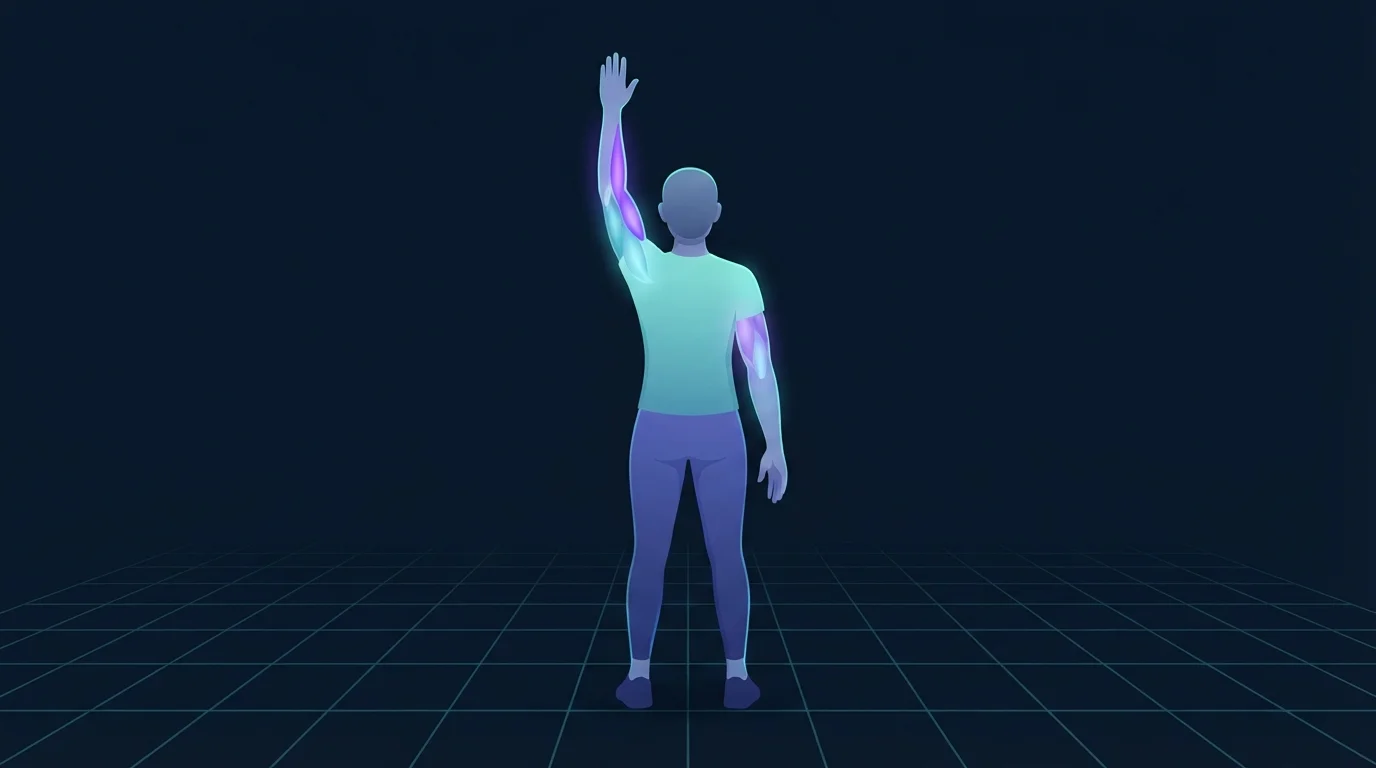
This is the finding that should reorganise your session. Maeo and colleagues (2023), in the European Journal of Sport Science, ran a within-person design: 21 adults trained one arm with the shoulder flexed overhead and the other arm with the shoulder neutral at the side, both doing cable elbow extensions through the same 90 to 0 degree range, at 70 percent of that arm's one-rep max, 10 reps per set, 5 sets per session, twice a week for 12 weeks. Same person, same diet, same sleep, same sets.
The long head gained 28.5 percent muscle volume in the overhead arm against 19.6 percent in the neutral arm. The lateral and medial heads gained 14.6 percent against 10.5 percent. Across the whole triceps it was 19.9 percent against 13.9 percent. The overhead arm did all of that while lifting less absolute weight, because you're simply weaker with the arm overhead.
That last detail is the one people miss, and it's why the finding survives the obvious objection. The overhead arm got the same stimulus delivered at a longer muscle length, and the muscle responded to length rather than to the number on the weight. That pattern now shows up across several muscle groups, which we cover in our review of stretch-mediated hypertrophy.
You don't have to abandon anything you like. You have to reorder. Put an overhead exercise first in the session, when you're fresh and can load it honestly, and let pushdowns or a press take the second and third slots.
Tricep Workout: Sets, Reps and How Often to Train Triceps
Exercise choice sets the ceiling. Dose decides whether you get anywhere near it.
Schoenfeld, Ogborn and Krieger (2017), pooling 34 treatment groups from 15 studies in the Journal of Sports Sciences, found a graded dose-response between weekly sets and muscle growth, with the curve flattening around 10 sets per muscle group per week. Below that you're leaving growth on the table. Far above it, the returns get small and the elbows get loud.
Frequency is the cheap upgrade. Schoenfeld and colleagues (2016), meta-analysing training frequency in Sports Medicine, found that when weekly volume is matched, muscles trained twice a week grew more than muscles trained once a week. Ten to fifteen sets split across two sessions beats the same sets crammed into one arm day.
Load matters less than most people assume. Morton and colleagues (2016), in the Journal of Applied Physiology, trained 49 resistance-trained men for 12 weeks on either heavy sets of 8 to 12 or lighter sets of 20 to 25, all taken to failure, and found the same hypertrophy in both groups. For triceps that's liberating: a set of 15 on an overhead extension with a weight your elbows tolerate grows the muscle as well as a set of 8 that makes you wince.
How close to failure? Close, but you don't have to live there. Refalo and colleagues (2023), reviewing 15 hypertrophy studies in Sports Medicine, found only a trivial advantage for training to momentary failure over stopping short of it. Leaving one or two reps in reserve on extensions is the sensible trade, because the elbow is the thing that stops most tricep progress, not the muscle. Our breakdown of training to failure versus reps in reserve works through where the line sits.
One accounting note. Every press you do already trains triceps. If your week includes three sets of bench press and three sets of overhead press, count roughly half of those as tricep volume before you add direct work. Six direct sets on top of a normal pressing week usually lands you in the right range.
Five Ways Tricep Training Goes Wrong
- Everything happens with the elbows pinned at your sides. Pushdowns, kickbacks and close-grip presses all keep the shoulder neutral. That's the long head's short position for the entire session.
- The weight is chosen for the bottom of the rep. On lying extensions the hard part is the stretch. Pick a load you can control there and the lockout takes care of itself.
- Elbows flare on push-ups. Flared elbows hand the work to the chest and the front of the shoulder. Tucked elbows are what makes a push-up a tricep exercise.
- Reps keep climbing past 25. Past that point you're buying endurance you didn't ask for. Change the leverage instead: elevate the feet, narrow the hands, or slow the descent.
- Pain gets trained through. Triceps tendon irritation at the back of the elbow responds well to reduced load and slower lowering, and badly to another week of heavy skull crushers.
What Twelve Weeks of This Actually Looks Like
Weeks one to three are mostly skill. The overhead position feels unstable, you will use embarrassingly little weight, and your triceps will be sore in a place they have not been sore before, right up near the armpit. That soreness is the long head telling you it has been sitting out.
Weeks four to eight are where the load starts moving. Most people add weight to overhead extensions faster than to anything else in this list, simply because they were starting from zero in that position.
By week twelve, the arm in the Maeo trial had gained about 20 percent in triceps volume. Your mileage depends on how trained you already are, since trained lifters move slower than the beginners who supply most trial data. What you should expect is a visible change in the profile of the arm from the side and a sleeve that fits differently, which is the practical version of long-head growth. If you want the wider picture of arm development, including the biceps side and how to count everything, our guide to how to build bigger arms covers the programming around these exercises.
The Bottom Line
The best exercises for triceps are an overhead dumbbell extension first, a lying dumbbell extension or Tate press second, and a dip or diamond push-up for heavy bodyweight loading. Add a band pushdown if your elbows want volume without strain. Ten to fifteen hard sets a week across two sessions, one or two reps left in reserve on the extensions.
You have not been training your triceps badly. You have been training one third of them very well. Move the arm overhead and give it twelve weeks.
Frequently Asked Questions
What are the best exercises for triceps?
An overhead dumbbell extension is the best single choice, because the long head only stretches when the arm is overhead and that's where it grows fastest. Build the rest around it: a lying dumbbell extension for the lateral and medial heads, a diamond push-up and a parallel bar dip for heavy bodyweight loading, a bench dip and a close-grip push-up as the easier entries, a band or cable pushdown for high reps with no elbow strain, and a Tate press when your elbows dislike straight-bar work. Three or four of those, twice a week, covers everything.
What are the best tricep exercises with dumbbells?
Five cover the whole muscle: the two-handed overhead extension, the single-arm overhead extension, the lying dumbbell extension, the Tate press and the close-grip dumbbell floor press. The overhead versions matter most, because they're the only dumbbell moves that put the long head on stretch. A complete dumbbell tricep workout is one overhead exercise for 3 sets of 8 to 12, one lying extension for 3 sets of 10 to 15, and one press for 3 sets of 8 to 12, done twice a week.
How often should you train triceps?
Twice a week. Schoenfeld and colleagues (2016) meta-analysed training frequency and found that when weekly sets are matched, muscles trained twice a week grew more than muscles trained once. Ten to fifteen hard sets a week is the range where the dose-response curve flattens, so five to eight sets per session across two sessions is the simplest way to hit it without wrecking your elbows.
What is the best tricep workout without weights?
Diamond push-ups, bench dips and close-grip push-ups, in that order of difficulty. Intziegianni and colleagues (2026) measured triceps activity in 20 men across three push-up hand positions and found diamond and standard positions both produced more triceps activity than a wide stance. Pick the hardest version you can do for 8 clean reps, do 3 sets, and add reps each week until you pass 20, then make the movement harder by elevating your feet rather than adding reps.
Are pushdowns enough to build triceps?
They build two of the three heads well and shortchange the biggest one. Maeo and colleagues (2023) trained 21 adults for 12 weeks with one arm overhead and one arm at the side, matched for sets and reps, and the overhead arm gained 28.5 percent long-head volume against 19.6 percent for the arm at the side, with 19.9 percent against 13.9 percent across the whole triceps. Keep pushdowns if you like them, but put an overhead exercise first in the session.
Why do my elbows hurt after tricep exercises?
Usually load and speed at the bottom of a straight-bar extension, where the elbow is most flexed and the tendon is least happy. Three fixes work: drop the weight and slow the lowering phase to three seconds, swap the straight bar for dumbbells or a rope so the forearms can rotate, and stop the set two reps short of failure on extensions rather than grinding. If a sharp pain persists for more than two weeks or shows up during everyday reaching, get it looked at rather than training around it.