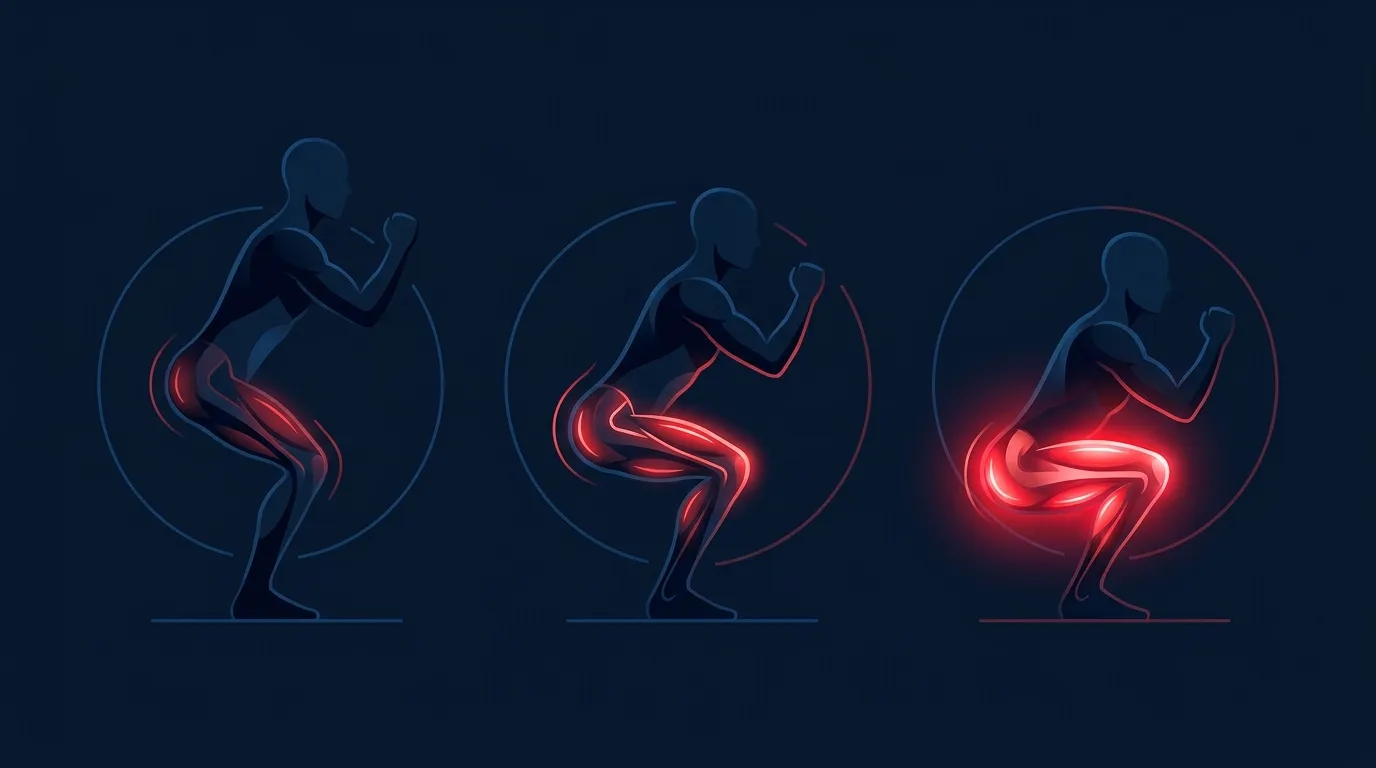
Five years ago, "do every rep through a full range of motion" was settled advice. It still mostly is. But a wave of new research between 2021 and 2025 has changed the conversation in one important way. We now know which part of the range of motion is doing the heavy lifting for muscle growth, and it is not the part most people emphasize.
It is the bottom. The deep stretch. The position you might be cutting short to "save your joints" or to do another rep.
The shorthand for this idea is stretch-mediated hypertrophy: muscle growth driven by training fibers in their lengthened position. The evidence stack now includes hamstring trials, quadriceps trials, calf trials, triceps trials, and two systematic reviews. The signal is consistent. Where you load the muscle inside the rep matters as much as how much you load it.
Here is what the studies actually found, why the deep position grows muscle differently, and how to apply this without barbells or special equipment.
The Research: What Studies Show
Maeo et al. (2021): Seated Leg Curls Grew Hamstrings ~50% More
Sumiaki Maeo and colleagues at Ritsumeikan University ran a within-subject trial published in Medicine & Science in Sports & Exercise. Twenty healthy adults trained one leg with seated leg curls (hip flexed, hamstrings stretched) and the other with prone leg curls (hip extended, hamstrings short), at 70% of one-rep max, 5 sets of 10 reps, twice per week, for 12 weeks.
MRI measurements of muscle volume told the story:
- Whole hamstrings: +14% (seated, long length) vs +9% (prone, short length)
- Biarticular hamstrings (semitendinosus, semimembranosus, biceps femoris long head): +8% to +24% long vs +4% to +19% short
- Monoarticular short head of biceps femoris: +10% vs +9% (no meaningful difference)
The takeaway is clean. When the same muscle was trained at a longer length versus a shorter length, the long-length training won by roughly 50% in total growth. The short head of the biceps femoris, which crosses only one joint and was already at similar lengths in both conditions, grew the same in both groups. That control finding strengthens the interpretation. It is the muscle length, not just the exercise variation, that drove the gap.
Citation: Maeo S, Huang M, Wu Y, et al. Greater Hamstrings Muscle Hypertrophy but Similar Damage Protection after Training at Long versus Short Muscle Lengths. Med Sci Sports Exerc. 2021;53(4):825-837. doi:10.1249/MSS.0000000000002523
Pedrosa et al. (2022): Partial Reps in the Deep Position Beat Full ROM
Pedrosa and colleagues, including Brad Schoenfeld, published a knee-extension trial in the European Journal of Sport Science. Forty-five untrained women were randomized to one of four training groups (or a control):
- Full ROM: 100° to 30° of knee flexion
- Initial Partial: 100° to 65° (the deep, lengthened portion)
- Final Partial: 65° to 30° (the shortened portion at the top)
- Varied: alternated daily between Initial and Final
After the training block, the Initial Partial group (training only in the deep, stretched position) produced greater muscle growth at the distal portion of the quadriceps than every other group, including the Full ROM group. Translated: less range of motion, more muscle growth, when the partial reps were done in the lengthened half of the movement.
Doing the same partials at the top of the movement (shortened position) produced the worst growth. Half the range, all of it bad.
Citation: Pedrosa GF, Lima FV, Schoenfeld BJ, et al. Partial range of motion training elicits favorable improvements in muscular adaptations when carried out at long muscle lengths. Eur J Sport Sci. 2022;22(8):1250-1260. doi:10.1080/17461391.2021.1927199
Kassiano et al. (2023): Calf Raises in the Stretched Position Doubled Growth
Witalo Kassiano and colleagues at Londrina State University ran a calf-training trial published in the Journal of Strength and Conditioning Research. Forty-two young women did 8 weeks of leg-press calf raises, 3 days per week, 3 sets of 15 to 20 reps. The variable was foot ROM:
- Initial ROM (stretched position only): +15.2% medial gastrocnemius
- Full ROM: +6.7%
- Final ROM (top portion only): +3.4%
The lateral gastrocnemius showed the same pattern, with initial-ROM training producing 14.9% growth versus 6.2% for final ROM. Calves trained in the stretched position grew more than twice as much as calves trained through the full range, and four to five times as much as calves trained only in the shortened range.
Calves are notorious for being stubborn. This study is one of the cleanest published demonstrations that the standard advice (more sets, more frequency) was missing the real lever. Where the load lives inside the rep is the lever.
Citation: Kassiano W, Costa B, Kunevaliki G, et al. Greater Gastrocnemius Muscle Hypertrophy After Partial Range of Motion Training Performed at Long Muscle Lengths. J Strength Cond Res. 2023;37(9):1746-1753.
Wolf et al. (2023, 2025): The Meta-Analyses
Milo Wolf and a team including Brad Schoenfeld and James Steele published a systematic review in the International Journal of Strength and Conditioning. The 2023 meta-analysis pooled trials comparing partial and full ROM training. The headline finding: partial and full ROM produced similar growth on average. But when partials were done at long muscle lengths, the effect shifted in their favor (standardized mean difference of -0.28 versus full ROM, with the negative number indicating partial-ROM superiority).
Wolf and colleagues followed up in 2025 with a direct trial in trained individuals, published in the Journal of Strength and Conditioning Research. They compared lengthened partials to a full range of motion and found similar muscular adaptations between the two. In other words, lengthened partials were not worse than full ROM, even though they covered less distance per rep.
Read together, the message is consistent. Full ROM is still a fine default. But you can replicate most of its hypertrophy benefit by training only the bottom portion of the movement, which means the bottom portion is doing most of the work in the first place.
Citations: Wolf M, et al. Partial Vs Full Range of Motion Resistance Training: A Systematic Review and Meta-Analysis. Int J Strength Cond. 2023;3(1). | Wolf M, et al. Lengthened partial repetitions elicit similar muscular adaptations as a full range of motion. J Strength Cond Res. 2025.
Why the Stretched Position Builds More Muscle
The data converged before the mechanism did. Researchers are still untangling exactly why long muscle lengths drive more growth, but several pieces are clear.
More Mechanical Tension Per Active Fiber
When a muscle is stretched and contracting against load, individual fibers experience higher mechanical tension than they do at short lengths. Mechanical tension is the primary signal that tells the muscle to grow. This is the same mechanism that gives eccentric training its hypertrophy advantage: more force per active fiber, more tension, more growth signal.
Sarcomere Length and Active Force
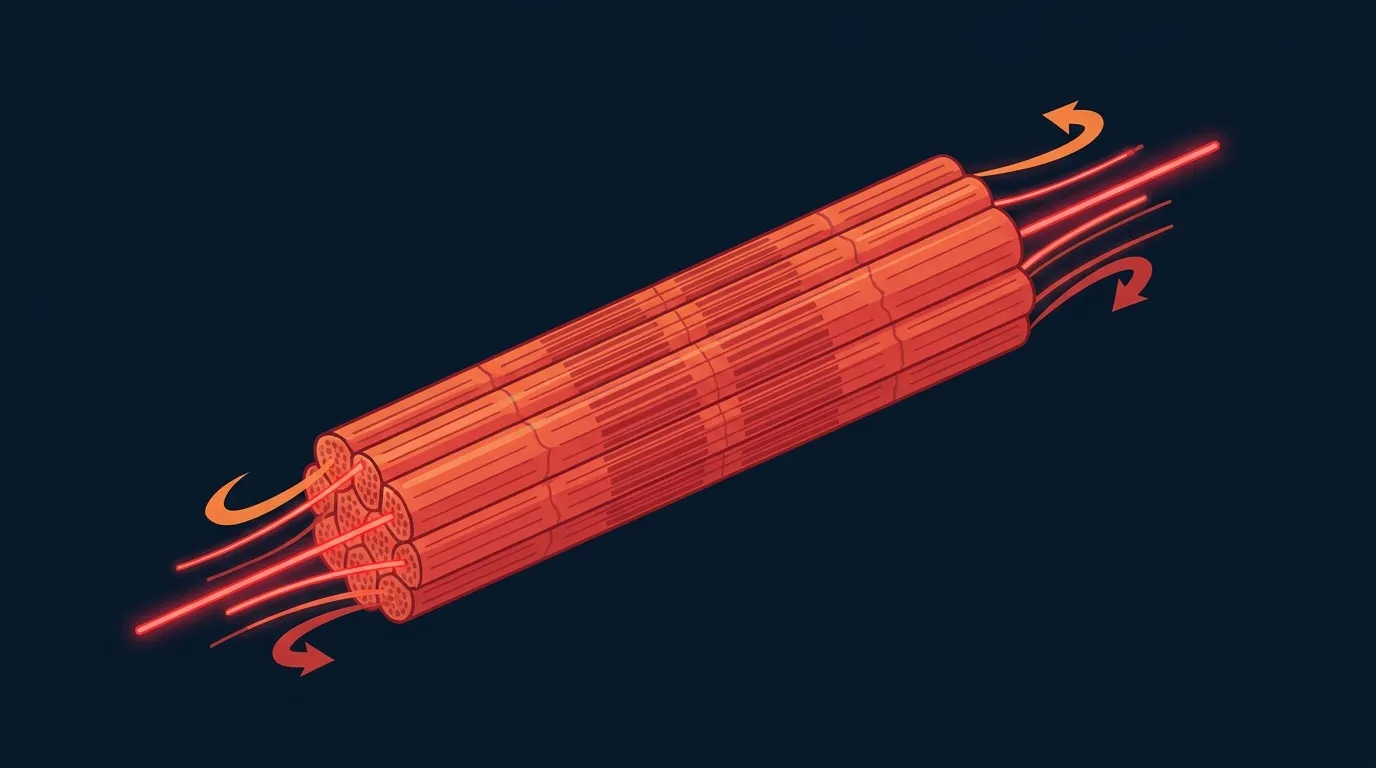
Skeletal muscle has an optimal length where the contractile machinery (the actin and myosin filaments) overlap most efficiently. Training near that optimum, which often falls in the stretched portion of human exercises, lets the fibers produce force closely tied to actual muscle damage and growth signaling. At very short muscle lengths, much of the force you produce comes from passive structures rather than actively contracting fibers, and that does less for growth.
Longer Fascicles, Different Architecture
Long-length training tends to produce a different structural adaptation than short-length training: longer fascicles, meaning the muscle adds sarcomeres in series. This is the same architectural change that eccentric training drives. Longer fascicles let you produce force across a greater range of motion and at higher contraction velocities, which is functionally meaningful beyond just looking bigger.
The Repeated Bout Effect Still Applies
Stretched-position training is more damaging early on. You will be sorer after your first deep-squat or deficit push-up session than after a comfortable middle-range one. The repeated bout effect, one of the most reliable findings in exercise science, means that soreness drops dramatically by the second or third session. The growth advantage persists.
Enjoying the article?
Start a new fitness routine today, written by me and coached by the AI I designed.
Take the Free Assessment Free • 2 minutes • No credit cardHow to Apply This at Home, Without Barbells
The research keeps using machines (leg curls, knee extensions, leg-press calf raises) because labs need precise ROM control. The principle, though, transfers to bodyweight and dumbbell training. Here is the practical pattern.
Pick Bodyweight Variations That Load the Deep Position
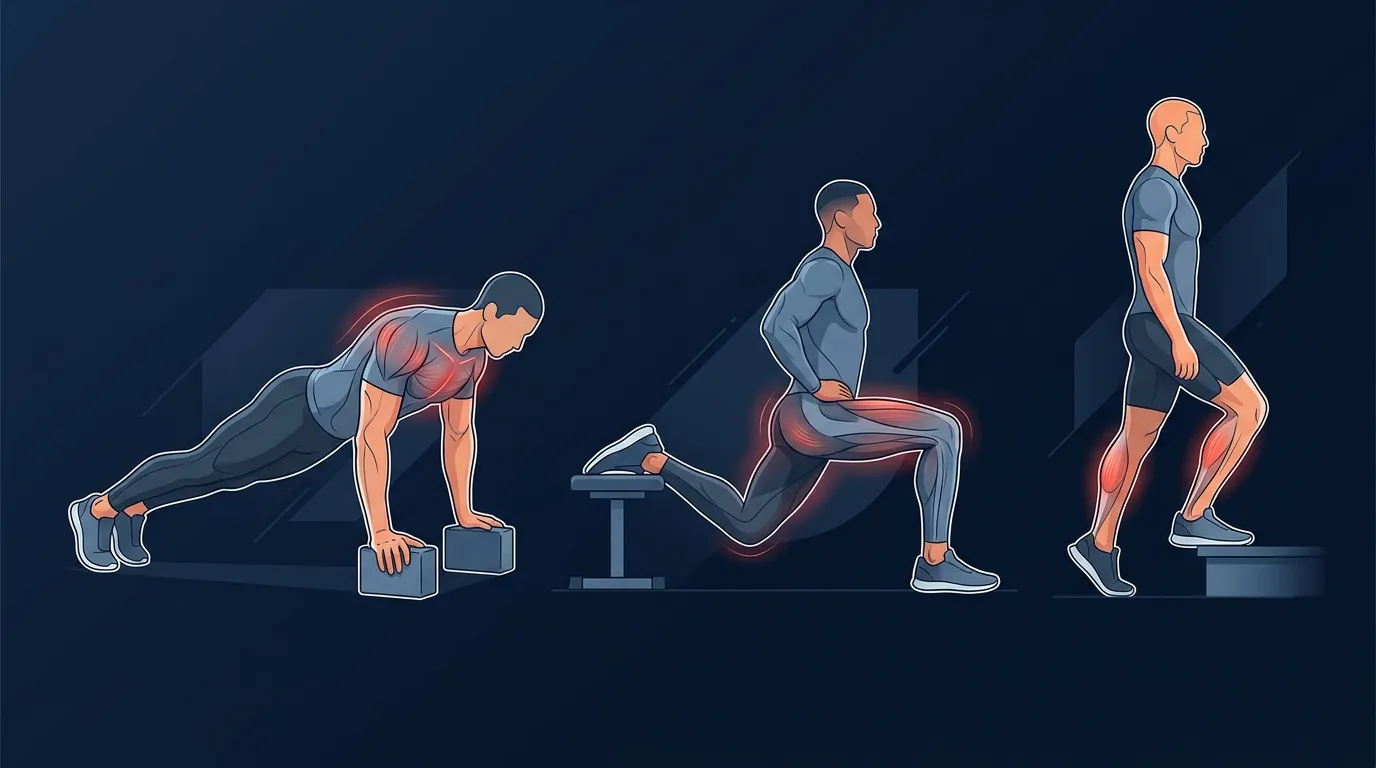
- Deficit push-ups: hands on low blocks, books, or yoga blocks so your chest can drop below hand level. The bottom of the rep is now deeper, and your chest fibers are loaded in a stretched position.
- Bulgarian split squats with the back foot elevated: the front-leg quad and glute reach a deeper stretch than a regular lunge. Pause for one second at the bottom.
- Romanian deadlifts (bodyweight or banded): hinge with a soft knee bend until you feel the hamstrings stretch. That is the position the Maeo data points to.
- Calf raises off a step: let your heels drop below the step before pressing up. The Kassiano data is most directly transferable here.
- Pull-up negatives or full-range pull-ups: the dead-hang position is the long-length position for the lats. Lower yourself slowly and stop trying to "rest" at the bottom.
Slow the Eccentric, Pause in the Stretch
Two simple cues do most of the work:
- Take 3 to 4 seconds to lower into the deep position.
- Pause for half a second to a second at the bottom, with the muscle stretched and loaded, before reversing.
This is the home-training equivalent of "lengthened partials." You spend more time under load in the position the research keeps highlighting. Plus, it makes lighter loads feel meaningfully harder, which is useful when you do not have a rack of dumbbells.
Build Up Depth Gradually
Do not try to hit maximum stretch on day one. The first session of deep-position work will leave you sore. Start with bodyweight, a comfortable range, and a 3-second descent. Add depth across two or three sessions. By the second week the soreness will be mild. By the third week the work feels normal. That is the repeated bout effect doing its job.
Pair It with Progressive Overload
Stretched-position training does not replace progressive overload. It is a way to make each rep do more work. You still need to add reps, sets, depth, or load over time for muscles to keep adapting. The research-backed lever here is "where in the rep" the load lives, not "how much" load. Both still matter.
Common Misconceptions
"Lengthened partials are a shortcut so I can skip full ROM."
Not exactly. The data shows lengthened partials produce similar growth to full ROM, not that full ROM is bad. Full ROM still trains the muscle through positions where joint health, mobility, and movement quality matter. The honest reading is that the deep portion is doing most of the growth work inside a full-ROM rep, so if you are short on time or struggling to load a full range, lengthened partials are a legitimate option, not a compromise.
"I need a barbell or machine to train at long muscle lengths."
The studies used machines because labs need controlled ROMs. The mechanism (loaded fibers in a lengthened position) does not care about the equipment. Bodyweight movements can hit the same positions if you set them up right. Deep deficit push-ups, paused split squats, dead-hang pull-up negatives, and heel-drop calf raises all load the lengthened position. You can also use the 3-second eccentric protocol with bodyweight movements.
"More stretch is always better."
There is a point of diminishing returns. None of the studies pushed people into a passive, painful stretch. They loaded a muscle that was lengthened but still actively producing force. If you are dropping into a position where the joint hurts or where the muscle disengages and your tendons or ligaments are taking the load, you are no longer training stretch-mediated hypertrophy. You are just stretching, which is a different stimulus with different effects (see our review of static versus dynamic stretching).
What the Research Does Not Yet Tell Us
The pattern is consistent across muscle groups and populations, but several open questions remain.
How Big Is the Effect in Trained People?
Most of the strongest individual studies (Maeo 2021, Pedrosa 2022, Kassiano 2023) used untrained or recreationally active participants. The Wolf 2025 trial in trained individuals found similar (not greater) gains for lengthened partials versus full ROM. The likeliest reading is that long-length training still works in trained lifters, but the relative advantage shrinks as people accumulate years of training experience.
Do These Findings Apply to Every Muscle?
The data covers hamstrings, quadriceps, calves, triceps, and biceps reasonably well. Glutes, lats, deltoids, and pecs have less direct evidence. The mechanism (mechanical tension at long muscle length) should generalize, but the magnitude could differ by muscle group based on architecture and the joint positions available.
What About Long-Term Adaptation?
Most trials run 8 to 12 weeks. We do not have great data on what happens at 6 months or a year. It is plausible that the long-length advantage shrinks as both approaches produce diminishing returns, or that it compounds because of the architectural differences (longer fascicles). Both stories are consistent with what we currently know.
What This Means for Your Training
You do not have to overhaul your program. Two changes capture most of the benefit:
- Stop cutting reps short at the bottom. Whatever your exercise, lower yourself fully into the deep position. Do not bounce out. Do not chase rep counts by skipping the bottom inch.
- Add a deliberate pause at the stretched position. One half-second pause at the bottom of every rep. That is it. The load is still on. The muscle is still working. You are giving the position the research highlights more time to do its job.
Combined with a slow 3 to 4 second descent, this is the home-training translation of stretch-mediated hypertrophy. No barbells, no machines, no special equipment. The principle does the work. For more on getting recovery right between hard sessions, see our review of rest periods and muscle growth.
How FitCraft Applies This Research
FitCraft programs are designed by exercise scientist Domenic Angelino (MS, MPH, CSCS) and built around the same evidence base. Stretch-mediated hypertrophy shows up in a few practical ways inside the app:
- Full-ROM exercise demonstrations. Ty, the 3D AI coach, demonstrates the deep, lengthened position on every movement so you know what end-range looks like before you try it.
- Slow-eccentric tempos. Programs prescribe controlled descents on key bodyweight, dumbbell, and resistance-band exercises so the lengthened position gets time under load.
- Progressive depth and load. As you advance through a program, the workouts adapt to add depth (deficit push-ups, paused split squats) and load, instead of just adding reps.
- Bodyweight-friendly programming. Most of FitCraft's strength programs work with no equipment, using positions and tempos that load the stretched range without needing barbells.
Take the free FitCraft assessment to get a program built around progressive, full-range work designed by an exercise scientist.
References
- Maeo S, Huang M, Wu Y, Sakurai H, Kusagawa Y, Sugiyama T, Kanehisa H, Isaka T. "Greater Hamstrings Muscle Hypertrophy but Similar Damage Protection after Training at Long versus Short Muscle Lengths." Med Sci Sports Exerc. 2021;53(4):825-837. doi:10.1249/MSS.0000000000002523
- Pedrosa GF, Lima FV, Schoenfeld BJ, Lacerda LT, Simões MG, Pereira MR, Diniz RCR, Chagas MH. "Partial range of motion training elicits favorable improvements in muscular adaptations when carried out at long muscle lengths." Eur J Sport Sci. 2022;22(8):1250-1260. doi:10.1080/17461391.2021.1927199
- Kassiano W, Costa B, Kunevaliki G, et al. "Greater Gastrocnemius Muscle Hypertrophy After Partial Range of Motion Training Performed at Long Muscle Lengths." J Strength Cond Res. 2023;37(9):1746-1753. PubMed: 37015016
- Wolf M, Androulakis-Korakakis P, Fisher J, Schoenfeld B, Steele J. "Partial Vs Full Range of Motion Resistance Training: A Systematic Review and Meta-Analysis." Int J Strength Cond. 2023;3(1). Open access
- Wolf M, Androulakis-Korakakis P, Piñero A, et al. "Lengthened partial repetitions elicit similar muscular adaptations as a full range of motion during resistance training in trained individuals." J Strength Cond Res. 2025. PubMed: 39959841
Frequently Asked Questions
What is stretch-mediated hypertrophy?
Stretch-mediated hypertrophy is muscle growth driven by training a muscle while it is in a lengthened position, where the fibers are stretched under load. Research from 2021 to 2025 shows that emphasizing the stretched portion of an exercise, either through full range of motion or partial reps in the deep position, can produce significantly more muscle growth than training at short or middle lengths. The Maeo et al. (2021) hamstring study found 14% growth at long lengths versus 9% at short lengths.
Do lengthened partials build more muscle than full range of motion?
The evidence is mixed but trending in favor of lengthened partials. The Wolf et al. (2023) meta-analysis found partial-ROM training at long muscle lengths showed a trend toward greater hypertrophy than full ROM. The follow-up Wolf et al. (2025) trial in trained individuals found lengthened partials produced similar gains to full ROM. The strongest claim the data supports right now is that the lengthened portion of the rep matters more than the rest of it, so full ROM and lengthened partials both work as long as you train the deep position.
Which exercises best target stretched-position training at home?
Bodyweight movements that load the stretched position work well. Deficit push-ups (hands elevated on books or low blocks), deep split squats with the back foot elevated, full-range pull-ups or assisted negatives, deep lunges, calf raises off a step, and Romanian deadlifts with bodyweight or bands all hit the long-muscle-length position. The depth and slow control matter more than load.
Is training at long muscle lengths safe?
For most healthy adults, yes. The deep position recruits more muscle fibers and creates more mechanical tension, but it also produces more delayed-onset muscle soreness in the first few sessions. The repeated bout effect kicks in quickly. By the third or fourth session, soreness drops sharply. Start with bodyweight or light load, control the descent, and build up depth over a few weeks rather than going to maximum stretch on day one.
Does FitCraft program training at long muscle lengths?
Yes. FitCraft's bodyweight, dumbbell, and resistance band programs include full-ROM movements and slow-eccentric tempos that load the stretched position. Ty, the 3D AI coach, demonstrates the deep range on every exercise so you can see exactly where the lengthened position is. As you progress, the workouts adapt with progressions like deficit push-ups and deeper split squats.