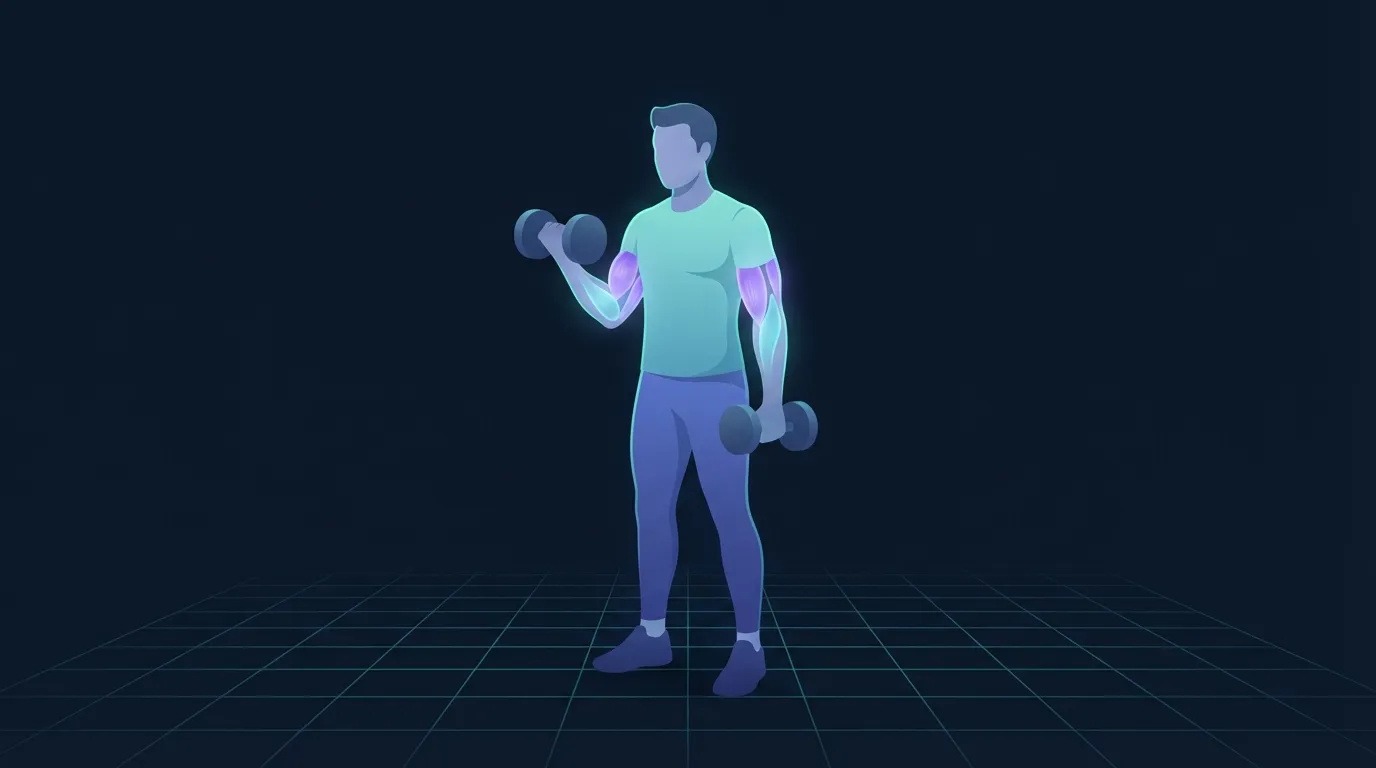
Most home arm sessions are the same set of alternating dumbbell curls repeated four times, sometimes an extension at the end. Arms grow a little, and then they stop. The reason is almost never load; the load is what most home lifters obsess over. It's that the session hits one head of the biceps out of two and one head of the triceps out of three, and never asks either muscle to work in its lengthened position.
The fix is boring and short. Two curl variations that between them cover the whole biceps and the brachialis. Two triceps movements that between them cover the long head and the two shorter heads. Enough total work per week to actually stress the tissue. And a load progression that is not "I'll go heavier when I feel like it." That is the session below.
What the Arm Actually Is, in Two Paragraphs
The biceps brachii has two heads. The long head runs over the top of the shoulder and attaches high up on the shoulder blade; it stretches most when the elbow is behind the torso, which is why an incline curl grows the biceps peak more than a standing curl does. The short head attaches lower on the shoulder blade and does not care as much about shoulder position; it just wants elbow flexion under load. Underneath both sits the brachialis, a muscle that runs from the upper arm to the forearm bone. When the brachialis grows, it pushes the biceps up and out, which is where "arm width" from the side actually comes from. The hammer curl trains the brachialis harder than any supinated curl because the neutral grip removes some of the biceps' mechanical advantage.
The triceps brachii has three heads. The long head runs from behind the shoulder down the back of the arm, so it stretches when the arm is overhead; that is why overhead extension work builds the visible size on the back of the upper arm faster than any pressdown does. The lateral head and the medial head both attach to the upper arm bone and do not care about shoulder position; they grow from any hard elbow extension. Miss the overhead work, and the back of the arm looks flat no matter how many pressdowns you rack up. Miss the horizontal or overhead press work, and the outer sweep of the tricep never really fills in.
Dumbbells vs Cables: What You Actually Trade
Cables give you constant tension through the full range of motion and let you angle the pull however the anatomy needs it. That is a genuine advantage on the biceps peak, where the load falls off a standing dumbbell curl at the top of the rep as gravity stops pulling straight down. It is also useful for triceps pressdowns, where a cable keeps the load on the muscle through the lockout.
Dumbbells give you unilateral loading, a deeper range of motion in extension work, and the ability to angle the wrist through the rep (supinate at the top of a curl, rotate to neutral on the way down) in a way a cable attachment does not. They also cost about a hundred dollars for an adjustable pair. For arm growth in the first several years of training, that trade is fine. Schoenfeld, Ogborn and Krieger (2017) pooled 15 volume studies and found that total weekly hard sets, not equipment choice, was the driver of hypertrophy. If you own a pair of adjustable dumbbells and a bench, you have the equipment to grow arms for the first several years of training.
If you're picking a training app to run the whole plan for you rather than build it yourself, our roundup of the best dumbbell workout apps compares how the leading options handle programming, progression, and progression logging so the session doesn't drift.
The 30-Minute Dumbbell Arm Workout
Four exercises, 3 to 4 working sets each, roughly 30 to 40 minutes with warm-up and rest. Do this twice a week, at least 48 hours apart. Everything is written for a general trainee; scale loads to your own two-reps-in-reserve.
Warm-up (4 minutes)
- 2 minutes of light rowing or brisk walking to raise core temperature
- 10 arm circles forward, 10 back
- 10 light band pull-aparts or open-book stretches on the floor
- One warm-up set of the first exercise, half your working weight for 8 reps
A) Standing Dumbbell Curl: 4 sets of 8 to 12 reps
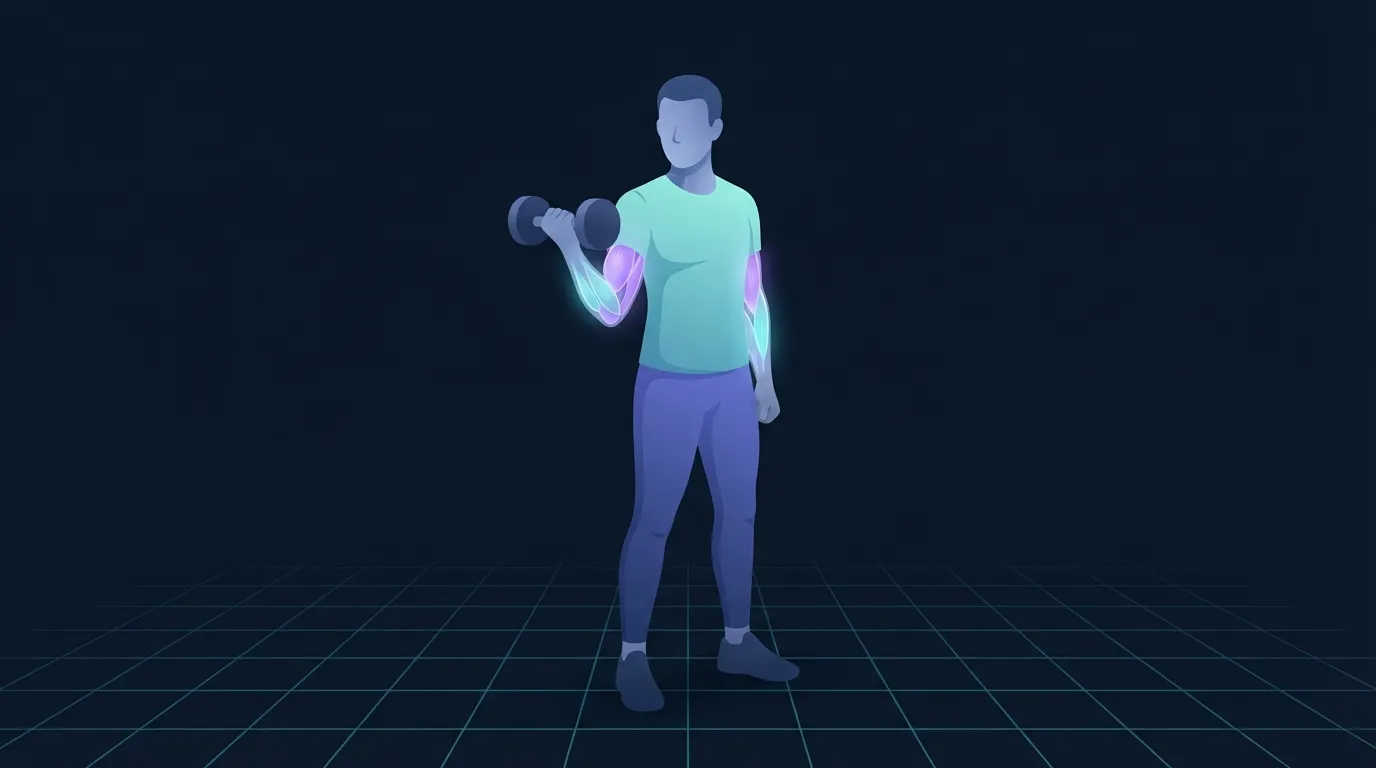
Stand tall, dumbbells at your sides, palms turned forward. Curl one or both dumbbells up by flexing the elbow, keeping the upper arm pinned to the ribs. The elbow does not travel forward. At the top, the dumbbells should be at shoulder height with the biceps fully contracted; hold for a beat. Lower under control on a two-count. Two reps in reserve on all sets except the last, where you can go to one rep in reserve on the final set of the day. If you get all four sets with two in reserve two sessions in a row, add 5 pounds per hand next time. See our dumbbell bicep curl exercise page for the muscles worked, common form errors, and video-ready progressions.
B) Incline Dumbbell Curl: 3 sets of 10 to 12 reps
Set an adjustable bench to roughly 60 degrees. Sit back, let the arms hang straight down beside the bench; the shoulder is now in slight extension, which pre-stretches the long head of the biceps. Curl each dumbbell up without letting the elbow drift forward at the top. This is a more mechanically difficult curl than the standing version because the long head starts stretched, which is where hypertrophy signaling is highest, but also where the muscle is weakest. Expect the load to be roughly 60 to 70 percent of your standing curl weight. If you don't have an incline bench, substitute a bench-supported bayesian curl: kneel behind a bench with your working arm hanging off the edge, elbow slightly above shoulder height, and curl from there.
C) Overhead Triceps Extension (dumbbell held with both hands): 4 sets of 8 to 12 reps
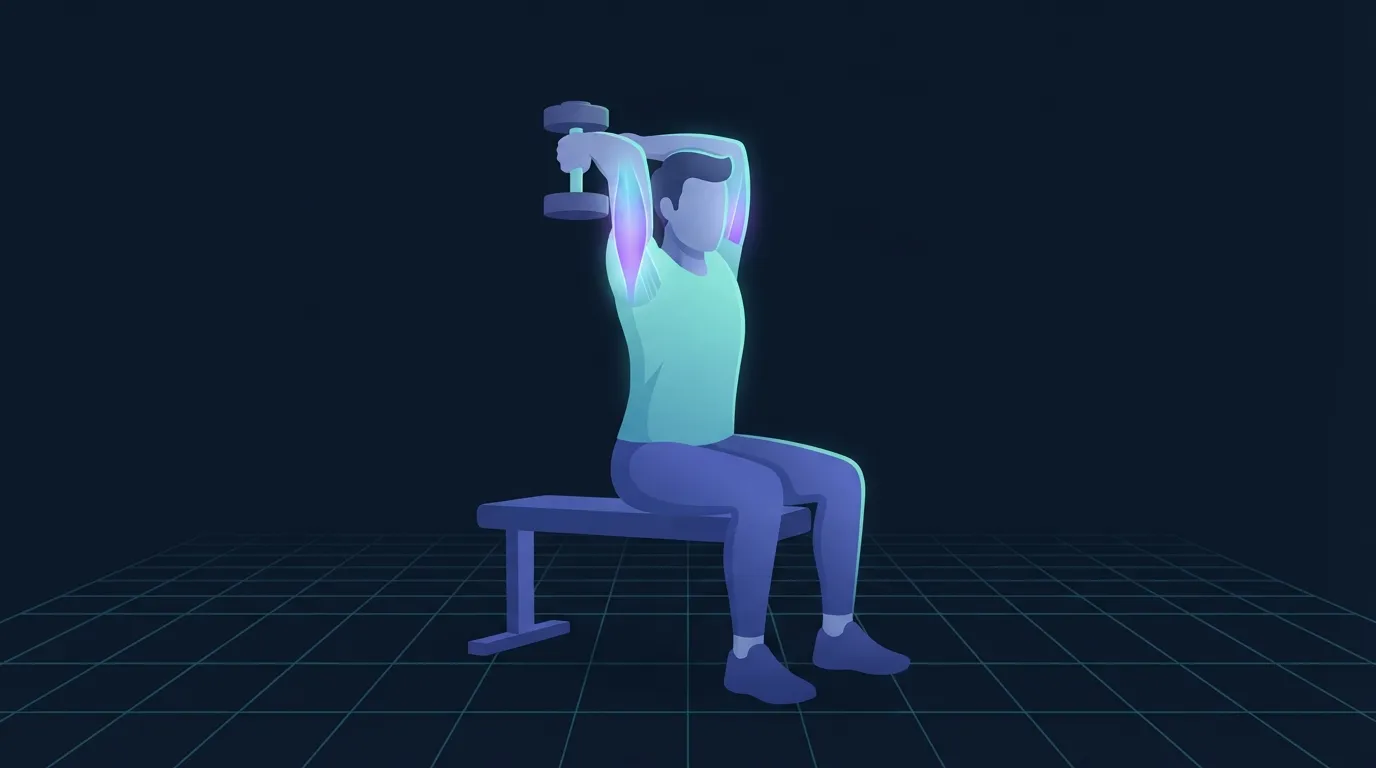
Sit or stand with a single dumbbell held vertically overhead with both hands, palms cupping the top head of the dumbbell. Lower behind the head by bending only at the elbows, upper arms pinned in place; the dumbbell descends until you feel a strong stretch along the back of the arms. Press back up by extending the elbows. The overhead position pre-stretches the long head of the triceps, which is why this movement grows the visible mass on the back of the upper arm faster than any pressdown. Two reps in reserve on all working sets. See our overhead triceps press exercise page for setup cues and how to protect the elbows on heavier work.
Find out what's really holding you back
FitCraft, our mobile fitness app, pairs you with an AI coach who builds you a personalized plan around your goals, schedule, and fitness level. Every FitCraft program is designed by Domenic Angelino, MPH (Brown University) and NSCA-CSCS, with research published in the Journal of Strength and Conditioning Research and Medicine & Science in Sports & Exercise.
Take the Free Assessment Free • 2 minutes • No credit cardD) Lying Dumbbell Triceps Extension (skull crusher): 3 sets of 10 to 15 reps
Lie on a bench with a dumbbell in each hand, arms extended straight up over the shoulders, palms facing each other. Bend at the elbows only, lowering the dumbbells to the sides of the head. Keep the upper arms as vertical as you can; if the elbows drift back over the face, the load starts moving toward the shoulder and away from the triceps. Press back up by extending the elbows. The lying angle emphasizes the medial and lateral heads of the triceps, complementing the long-head work above it. If skull crushers bother your elbows, swap for a tate press (dumbbells travel to the outside of the chest with a bent-elbow arc) or a close-grip dumbbell floor press. See our dumbbell triceps extension exercise page for the form cues.
Sets, Reps and Rest: What the Numbers Actually Are
Volume is the driver. Schoenfeld, Ogborn and Krieger (2017) pooled 15 studies and found a clear dose-response between weekly hard sets per muscle group and hypertrophy, with growth continuing up to at least 10 sets per muscle per week. For biceps and triceps, that lands most trainees between 10 and 16 hard sets a week per muscle, distributed across two sessions. Small muscles recover fast; the total set count can push higher than a chest or leg count without becoming a recovery problem.
Load and rep range are more flexible than the internet suggests. Schoenfeld and colleagues (2017) meta-analysed 21 trials comparing low-load (roughly under 60 percent of 1RM, 15+ reps) against high-load (over 60 percent, under 15 reps) training and found hypertrophy was comparable when sets were taken close to failure. Strength was higher in the high-load groups. For arm isolation work that gives you room to swing between 6 and 20 reps, though 8 to 15 is where most of the productive work lives.
Rest between sets is not optional, but the requirement is smaller than on multi-joint pressing. Grgic and colleagues (2018) systematically reviewed rest-interval studies and found strength gains suffer meaningfully below 60 seconds of rest between sets, and are roughly equivalent between 90 seconds and 3 minutes. For the four exercises above, take 60 to 90 seconds between hard sets. On a burnout-style set at the end of a session, superset opposing muscles (curl into extension) with no rest and take a full 90 seconds after the pair.
How Often to Train Arms
Schoenfeld, Grgic and Krieger (2019) pooled 25 studies and found that training a muscle twice a week produced meaningfully more hypertrophy than training it once, with no additional benefit past three weekly sessions when weekly set volume was equated. Twice is the sweet spot. Space the two arm days at least 48 hours apart. Because the biceps and triceps also work on any pressing and pulling day, most trainees can get their weekly arm set count with one dedicated arm day plus one arm-heavy finisher after a chest or back session.
If you're on a beginner full-body split, direct arm work does not need to live in its own session. Add 3 sets of standing curls and 3 sets of overhead triceps extensions to two of your three weekly workouts, right after the compound pressing and pulling, and you'll cover the volume ranges above without adding a session.
How to Progress Without Overthinking It
Two-reps-in-reserve progression, session by session. Keep the sets and reps fixed. When you finish all working sets in the prescribed rep range with two reps clean in reserve on the last set, in two consecutive sessions, add the smallest possible load next time. For most people that is 5 pounds per hand on curls and overhead extensions, 2.5 pounds per hand on lighter isolation work. If you don't have that jump available, add a rep to every set until you top the range, then jump.
Write it down. A phone note, a printout, a spreadsheet. The lifters who progress most reliably at home are the ones who look at last week's numbers before they start today's set. If keeping the log yourself is what keeps falling off, that's the specific job programmable fitness apps do well. For a broader comparison against the field, see our roundup of the best strength training apps, which walks through how the leading options handle logging, progression, and progressive overload.
Common Mistakes That Waste the Session
Swinging the curl. If the hips are helping the dumbbell up, the biceps aren't. Keep the upper arm pinned to the ribs. If you can't hit the rep target with clean form, the load is too heavy; drop 5 pounds and finish the sets.
Elbows flaring out on the skull crusher. When the elbows drift out and back, the working muscle stops being the triceps and starts being the front deltoid. Keep the upper arms as close to vertical as your shoulder mobility allows. If your shoulders don't let you get there, swap the skull crusher for a tate press or a close-grip dumbbell floor press.
Skipping overhead triceps work. The long head of the triceps sits behind the shoulder and only fully lengthens when the arm is overhead. Kickbacks and pressdowns do not stretch it. If the back of your arm looks flat and you've been training triceps for a year, this is almost always the reason.
Chasing failure on every set. Two reps in reserve on every working set, occasionally one on the last set of the day. Training to grinding failure on every set adds recovery cost without a growth dividend, and it wrecks form on the last set of the day. Total weekly hard sets drives growth; a set two reps past what you needed does not add more of it.
Only doing one grip. The hammer curl (neutral grip) hits the brachialis harder than any supinated curl. If you've never included one, add a set of 10 hammer curls at the end of your standing curl block for a session or two and see whether width improves after a month. It usually does. If you'd rather also fix the softness on the back of the upper arm without a new session, our guide to losing arm fat covers the diet side (spot reduction does not work; overall body-fat percentage is the visible variable) and how arm training fits into it.
A Two-Day Arm Split That Actually Progresses
The single-session template above is one of two arm days a week. Rotate the emphasis so both the biceps and the triceps get one heavy day and one higher-rep day. Written the way it would appear in an app log:
| Day | Emphasis | Structure |
|---|---|---|
| Arm day 1 (heavier) | Compound curl and extension primary | Standing curl 4×6-8 · Overhead extension 4×6-8 · Incline curl 3×10-12 · Skull crusher 3×10-12 |
| Arm day 2 (lighter, higher volume) | Peak and finish work | Incline curl 4×10-12 · Skull crusher 4×10-12 · Hammer curl 3×12-15 · Overhead extension 3×12-15 |
Total weekly hard sets: 14 on the biceps, 14 on the triceps. Well inside the volume range Schoenfeld's dose-response work identified as productive, and low enough that recovery is not the limiter for most trainees.
The Bottom Line
A working dumbbell arm workout is not complicated. Two curl variations that cover both heads of the biceps and the brachialis. Two triceps movements, one overhead for the long head and one horizontal for the medial and lateral heads. Done twice a week for 10 to 16 total hard sets per muscle, with two reps in reserve and 60 to 90 seconds of rest. Load goes up when you own the rep range with clean form. Everything else is decoration.
What decides whether the session grows anything is showing up twice a week for the next 12 weeks. If that's the part that keeps slipping, it's a program-design and adherence problem, not an arms problem. Our comparison of the best dumbbell workout apps walks through how the leading options handle programming and adherence for lifters who train at home with a rack of dumbbells and a bench.
Frequently Asked Questions
Can you build big arms with just dumbbells?
Yes. The biceps and triceps respond to total weekly hard sets and load close to failure, not to any single piece of equipment. Schoenfeld and colleagues (2017) found a dose-response between weekly set volume and hypertrophy up to at least 10 hard sets per muscle per week, and their low-load vs high-load meta-analysis the same year showed rep ranges from about 6 to 20 grow muscle similarly when sets are taken close to failure. Adjustable dumbbells cover both ends of that range. What you cannot do with dumbbells alone is match a cable stack for constant tension on the biceps peak, but that's a small residual, not a wall.
How many sets and reps should a dumbbell arm workout have?
Aim for 10 to 16 hard sets per week for biceps and another 10 to 16 for triceps, split across two sessions. Inside a session, 3 to 4 working sets per exercise across two or three arm exercises is enough. Rep ranges of 6 to 15 work well: heavier compound curl and extension work in the 6 to 10 range on one day, higher-rep pump work in the 10 to 15 range on the second day. Keep two reps in reserve on all working sets except the last one of the day.
How often should I train arms with dumbbells?
Twice a week is the sweet spot. A 2019 meta-analysis by Schoenfeld, Grgic and Krieger found that training a muscle twice a week produced meaningfully more hypertrophy than once a week when weekly set volume was equated, with no additional benefit past three weekly sessions. Arms also get indirect work from pressing and pulling on other days, so if you already do a couple of upper-body sessions, one dedicated arm day plus one arm-heavy finisher on a push or pull day usually covers it.
What are the best dumbbell exercises for biceps?
For biceps growth, prioritize three movement patterns. The standing dumbbell curl trains the biceps with the arm hanging beside the body. The incline dumbbell curl puts the shoulder into extension, which lengthens the long head and biases growth toward the biceps peak. The hammer curl uses a neutral grip and targets the brachialis, the muscle underneath the biceps that adds width when it grows. Rotating a heavy day between all three across a two-day arm split covers the whole muscle.
What are the best dumbbell exercises for triceps?
For triceps growth, prioritize an overhead extension for the long head and a close-grip press or skull crusher variation for the medial and lateral heads. Overhead work lengthens the long head, which sits behind the arm and drives most of the visible size on the back of the upper arm. Elbow-flexed extension work at horizontal (skull crushers, tate presses, lying triceps extensions) hits the other two heads. A dumbbell kickback is fine as a finisher but should not be your main triceps lift; the load is limited by the position, so it does not stimulate the whole muscle as well as a stretched overhead press.
How long should a dumbbell arm workout take?
30 to 40 minutes of actual work covers it. Four exercises, 3 to 4 sets each, 60 to 90 seconds of rest between sets. Grgic and colleagues (2018) systematically reviewed rest-interval studies and found strength gains suffer meaningfully below 60 seconds of rest between sets but level off between roughly 90 seconds and 3 minutes. For arm isolation work the systemic fatigue cost is lower than heavy pressing, so the shorter end of that range is fine as long as your form on the last rep of each set stays clean.