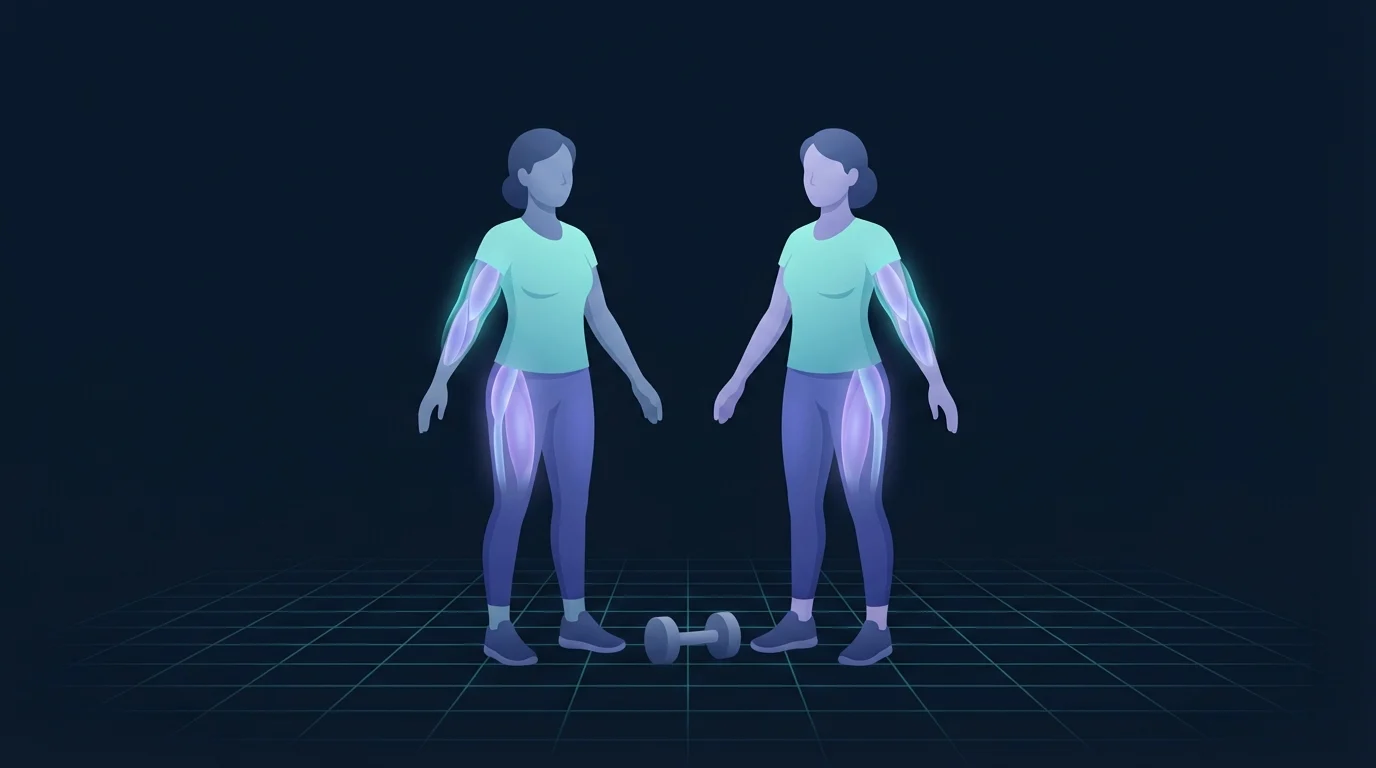
Arms get judged in a specific way. Nobody asks you to lift your shirt, but every short-sleeved top, every wave, every photo with your arm around someone puts the back of your upper arm on display at an angle you never chose.
And arms are the body part where the gap between what training can do and what people expect it to do is widest. The expectation is that triceps work removes the softness over the triceps. The reality is that triceps work builds the triceps, whole-body fat loss removes the softness, and skin does its own thing entirely.
Three levers, three different timelines. Here's how each one actually behaves.
Why Upper-Arm Fat Sits Where It Does
Regional fat distribution isn't random and it isn't a consequence of how you train. It's under hormonal control, and the pattern is one of the most reliable sex differences in human physiology.
Karastergiou and colleagues (2012), reviewing the field in Biology of Sex Differences, describe how sex steroids shape where fat goes: women carry more total body fat than men and preferentially store it in the lower body, the pear-shaped pattern, which is associated with lower cardiometabolic risk. Men and post-menopausal women store proportionally more in the abdomen. The differences run all the way down to the cell, with preadipocytes from different depots behaving differently in culture.
The upper arm is an interesting case because it sits between the two patterns. It's an upper-body depot, so it doesn't behave quite like the hips, but its subcutaneous fat is relatively protected compared with the abdomen. In practice that means it's one of the first places many women notice gain and one of the later places to visibly change during loss. The triceps skinfold is also one of the standard sites body composition researchers measure precisely because it's a stable, representative subcutaneous depot.
Two implications, both worth internalising before you start.
- The order of fat loss is genetic and hormonal. You can pick the total. You can't pick the sequence, and no exercise selection changes the queue.
- The pattern shifts across the lifespan. After menopause the bias moves toward the trunk, so it's entirely possible to gain at the waist while the upper arms stay the same. That's a hormonal transition, not a training failure. Our guide to strength training after menopause covers what changes and what to do about it.
What Triceps and Shoulder Training Actually Changes
Here is the part that does respond, quickly, and that most arm advice undersells.
An upper arm is mostly triceps. The triceps brachii is the larger of the two arm muscles by a wide margin, accounting for roughly two thirds of upper-arm muscle volume, and it sits exactly where people are unhappy: along the back and side of the arm. The biceps, which gets the overwhelming majority of the attention and the curl variations, is on the front and contributes far less to the silhouette you see in a mirror from behind.
How much can that change? Hubal and colleagues (2005) put 585 adults across eight centres through twelve weeks of unilateral elbow flexor training and measured muscle cross-sectional area by MRI. Changes ran from minus 2 percent to plus 59 percent. Dynamic strength gains ran from zero to plus 250 percent. Men gained about 2.5 percent more cross-sectional area on average, while women showed greater relative strength increases. The headline is the spread: two people can run the same program for the same twelve weeks and get wildly different tissue responses, which is why comparing your arms to someone else's progress photos is a bad use of your attention.
The other half of the outline is the side deltoid. Widening the shoulder slightly makes the whole arm read as more tapered without changing a thing about the upper arm itself, because the eye judges the arm relative to what's above it. Lateral raises earn their place in an arm plan for that reason and not for any fat-related one.
None of this is "toning", which isn't a physiological process. It's fat loss plus hypertrophy happening at the same time, and the reason the result surprises people is that the two together change shape more than either does alone. We take that word apart in is toned a real thing.
The Arm Exercises Worth Doing
Everything here works with a pair of dumbbells, a band, or nothing at all. Pick two triceps movements, one shoulder movement and one pulling movement, and rotate them every few weeks.
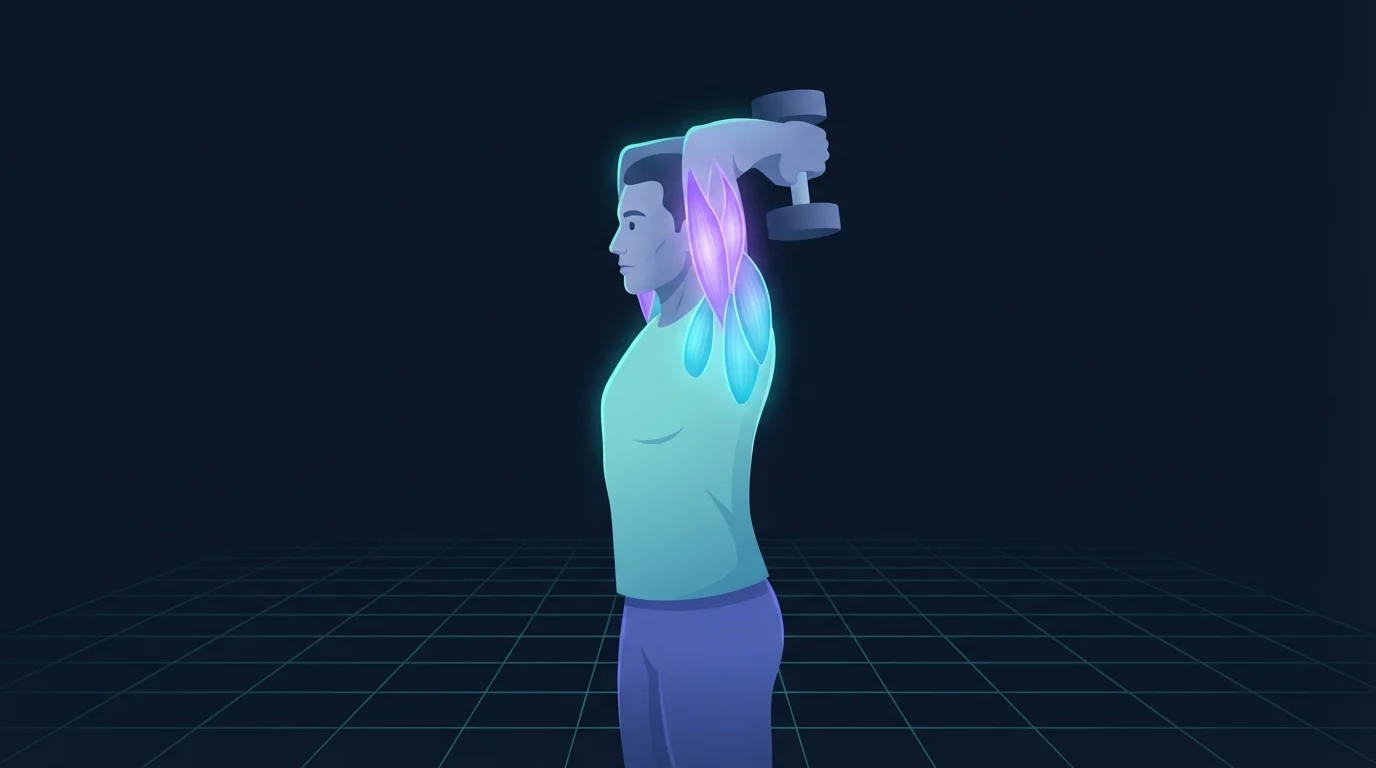
Triceps, long head emphasis. The long head of the triceps crosses the shoulder, so it's loaded best with the arm overhead. Overhead triceps press and dumbbell skull crushers both hit it. This is the head that fills the back of the upper arm, and it's the one most commonly undertrained.
Triceps, lateral and medial head. Triceps kickbacks, floor triceps dips and close-grip push-ups load the arm in a more extended shoulder position. Close-grip push-ups are the highest value of the three because they let you progress by changing leverage rather than by buying heavier weights.
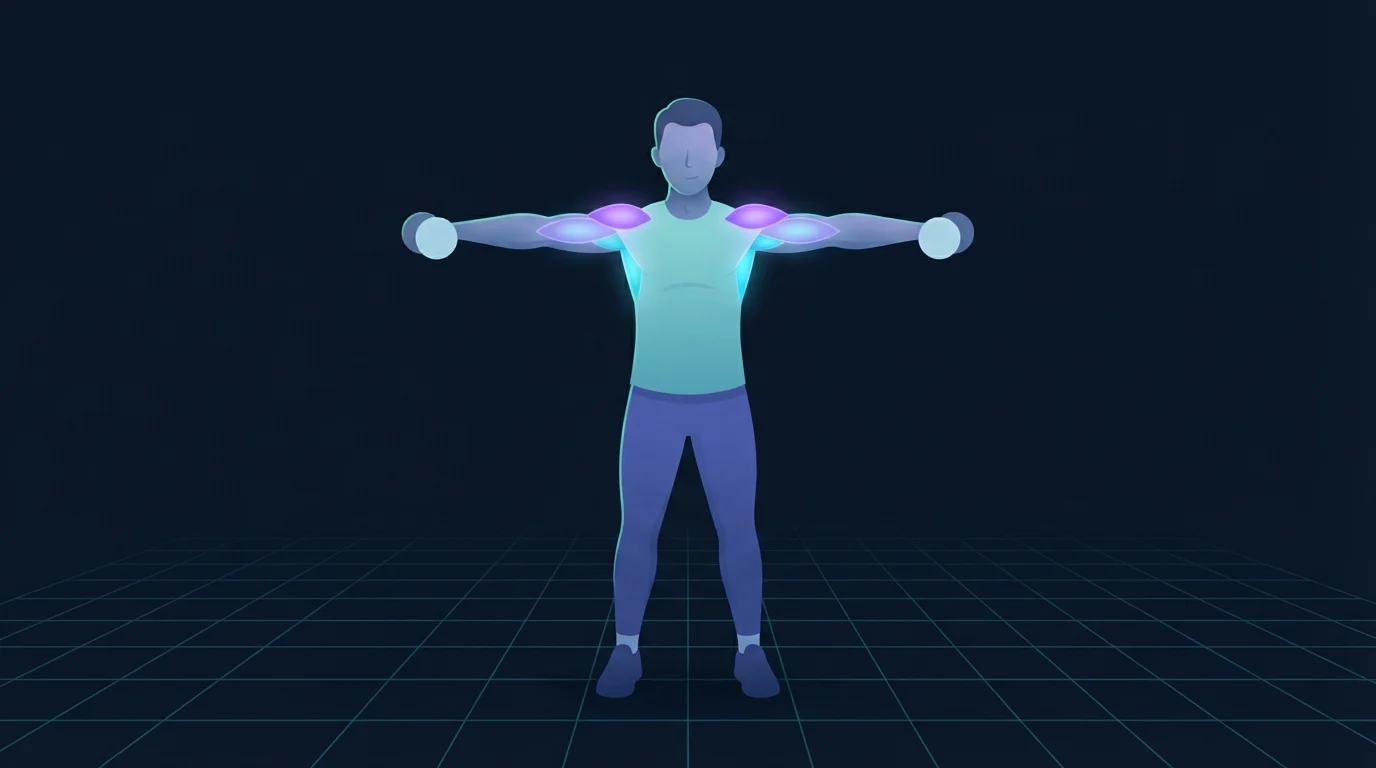
Side deltoids. Lateral raises with a light weight and strict form, plus rear delt raises for the back of the shoulder. Both are low-load, high-repetition movements. Going heavy turns them into a shrug.
Pulling. Rows and band pull-aparts build the upper back, which changes how the arm hangs and how the shoulder sits. This is the most commonly skipped part of an arm plan and one of the most visually useful.
If you have no equipment at all, our list of the best arm exercises without weights covers the bodyweight progressions in more detail, including how to keep loading the triceps once push-ups stop being hard.
Find out what's really holding you back
FitCraft, our mobile fitness app, pairs you with an AI coach who builds you a personalized plan around your goals, schedule, and fitness level. Every FitCraft program is designed by Domenic Angelino, MPH (Brown University) and NSCA-CSCS, with research published in the Journal of Strength and Conditioning Research and Medicine & Science in Sports & Exercise.
Take the Free Assessment Free • 2 minutes • No credit cardSkin Laxity Is a Different Problem From Fat
This gets conflated with arm fat constantly, and the conflation wastes a lot of people's time, because the two respond to completely different things.
Skin is not contractile tissue. It has elastic recoil, which is a passive property of its collagen and elastin content, and that content is not trainable. Shuster, Black and McVitie (1975) established in the British Journal of Dermatology that skin collagen declines with age and is lower in women at every age, with a direct relationship between collagen content and dermal thickness. That's the whole explanation for why a 25-year-old and a 55-year-old can lose the same 15 kilograms and get very different arms.
Scale matters enormously here, and most people overestimate their own case. Modest fat loss, in the range of 5 to 10 percent of body weight, very rarely produces true excess skin. Large weight loss is a different category: in 210 post-bariatric patients studied by Klassen and colleagues (2018), 93 percent reported excess skin and 80 percent wanted body contouring surgery, with greater weight loss associated with more excess skin and worse quality-of-life scores.
What genuinely helps, in order of how much it helps:
- Build the muscle underneath. Triceps and deltoid hypertrophy fills volume that fat used to occupy. It's the only lever that changes the arm from the inside.
- Lose fat at a moderate rate. Slower loss gives connective tissue time to remodel. This is a real effect and a modest one, so don't expect it to save a very large weight loss.
- Protect the skin you have. Adequate protein, not smoking, and sun protection on the arms. None of these reverse laxity, they just avoid accelerating it.
- Accept the ceiling. True redundant skin after major weight loss is a surgical question. No cream, wrap, device or exercise closes that gap, and every product sold on that promise is selling a mechanism that doesn't exist.
The One Rule You Cannot Train Around
No amount of arm work removes the fat sitting over your arm. The cleanest test of this was done on arms specifically: Kostek and colleagues (2007) trained the non-dominant arm of 104 adults for twelve weeks and imaged both arms, and the MRI data showed generalised subcutaneous fat loss across the body rather than a loss confined to the trained side. Trials that trained one leg or the abdomen alone found the same thing. Our guide to the best exercises to lose belly fat carries the full evidence on spot reduction, including the one honest complication in it, and applies equally to arms.
A 6-Week Arm Plan
Two arm-focused sessions a week, layered on top of whatever full-body training and walking you're already doing. Nothing here needs more than a pair of adjustable dumbbells.
| Weeks | Session A | Session B |
|---|---|---|
| 1 to 2 | Close-grip push-ups 3 x 8, overhead triceps press 3 x 12, lateral raises 2 x 15, band pull-aparts 2 x 20 | Triceps kickbacks 3 x 12, floor triceps dips 3 x 10, rear delt raises 2 x 15, dumbbell rows 3 x 10 |
| 3 to 4 | Close-grip push-ups 4 x 8, overhead triceps press 3 x 12 heavier, lateral raises 3 x 15, pull-aparts 3 x 20 | Dumbbell skull crushers 3 x 10, floor triceps dips 3 x 12, rear delt raises 3 x 15, dumbbell rows 3 x 10 |
| 5 to 6 | Decline close-grip push-ups 4 x 8, overhead triceps press 4 x 10, lateral raises 3 x 12 heavier, pull-aparts 3 x 20 | Dumbbell skull crushers 4 x 10, floor triceps dips 3 x 15, rear delt raises 3 x 15, dumbbell rows 4 x 10 |
Add either one repetition per set or a small increase in load each week, never both at once. Leave one or two repetitions in reserve on every set except the last of each exercise. If a week feels flat, repeat it rather than pushing through, because six honest weeks beats ten inconsistent ones.
The fat-loss half runs in parallel and is the same for every body part: a moderate deficit, protein around 1.6 to 2.2 grams per kilogram, and enough weekly training volume. Our guide to losing fat without losing muscle covers that side properly. If you want the progression tracked for you, our roundup of the best dumbbell workout apps compares how the main options handle load progression on a small home setup.
How Long Until Your Arms Look Different?
Weeks one to three are neural. You'll get noticeably stronger on every movement without much visible change, because early strength gains come from recruitment rather than tissue.
Weeks three to six is when the triceps starts to show a shape at the back of the arm when the elbow is extended. This is usually the first visible win, and it arrives before any meaningful fat loss has happened.
Weeks six to twelve is where fat loss and muscle change compound. The arm circumference may barely move while the outline changes a lot, because you replaced volume rather than only removing it.
Beyond twelve weeks the shape keeps improving as long as you keep progressing the load. Arms are one of the few body parts where a year of consistent work looks obviously different from three months of it, which is either encouraging or annoying depending on the week you're having.
The Bottom Line
How to lose arm fat comes down to accepting a split. Fat leaves on a whole-body schedule set by hormones and genetics, and you influence the total, not the order. Muscle responds locally and fast, and the triceps and side deltoid change an arm's outline more than any other tissue. Skin does neither, and pretending otherwise sells a lot of wraps.
Run a moderate deficit, eat your protein, train the back of your arm twice a week and give it six weeks before you judge anything. The arms are usually the first place people notice the work. They're just not the first place the fat leaves.
Frequently Asked Questions
How do you lose arm fat?
Arm fat leaves when total body fat leaves, so the plan is a moderate calorie deficit, enough protein to hold on to muscle, and three to five sessions of training a week. Arm-specific work doesn't drain the fat above the muscle, but it does change the shape underneath it, and on a limb as thin as an arm that shape change is visible early. Train the triceps and side deltoids two to three times a week and let whole-body fat loss handle the layer on top.
Do arm exercises get rid of arm fat?
No. In a trial of 104 adults who trained only the non-dominant arm for twelve weeks, MRI showed generalised subcutaneous fat loss across the body rather than a loss confined to the trained arm. What arm exercises do is build the triceps and deltoids underneath, which changes the outline of the arm at any given body fat level. That's a real and worthwhile result. It just isn't fat removal.
Why do women store fat on the back of the upper arms?
Regional fat storage is under hormonal control, and estrogen biases storage toward the hips, thighs and buttocks while lower estrogen exposure biases it toward the abdomen. The back of the upper arm sits in between, which is why it's one of the first places many women gain and one of the last to change. After menopause the pattern shifts toward the trunk, so upper-arm and thigh fat can hold while the waist grows. None of this is a training error, and none of it can be overridden by choosing different exercises.
Will lifting weights make my arms bigger?
In the sense most people fear, no. In a study of 585 adults doing twelve weeks of unilateral arm training, muscle cross-sectional area changes ranged from minus 2 percent to plus 59 percent, with men gaining about 2.5 percent more than women on average. Those are gains measured in millimetres on an arm that's simultaneously losing fat, and fat occupies more volume per unit of mass than muscle. The usual outcome of lifting during a fat-loss phase is an arm that's smaller in circumference and more defined in outline.
How do you fix loose skin on the arms?
Exercise can't tighten skin, because skin isn't contractile tissue. Skin collagen falls steadily with age and is lower in women at every age, so the same weight loss leaves more laxity at 55 than at 25. Modest fat loss rarely produces true excess skin. After very large weight loss it's close to universal: in 210 post-bariatric patients, 93 percent reported excess skin. Building the triceps and deltoids fills some of the space, losing fat slowly helps at the margins, and genuine excess skin is a surgical question rather than a training one.
How long does it take to lose arm fat?
Strength improves in two to three weeks, visible shape change in the triceps and shoulders takes six to ten weeks of consistent training, and measurable arm circumference change tracks total fat loss at roughly 0.5 to 1 percent of body weight a week. Arms are thin limbs, so a small absolute fat loss reads as a large visible change, which is why arms often look different before the scale has moved much.