You want to be stronger. You want to look better in a t-shirt or a tank top. You want a little shape to your arms, your shoulders, your legs. You do not want to look like a bodybuilder.
So you tell a trainer, or a friend, or yourself: "I just want to tone up, not bulk up." Maybe you avoid lifting anything heavier than 5-pound dumbbells, because heavier weights "make you bulky." Maybe you skip strength training entirely and just do cardio because lifting feels too risky. The whole strategy is built around avoiding a thing you don't want.
Here's the catch. The strategy is based on a category that doesn't exist. There's no "toning" muscle and no "bulking" muscle. The training avoidance is solving the wrong problem.
This article explains what "toned" actually means physiologically, why the toning-vs-bulking distinction is a fitness-industry myth, what the research says about how to get the look you actually want, and why the path involves a lot less worry about lifting too heavy.
What "Toned" Actually Means
"Toned" is a colloquial word. It is not a term anyone uses in exercise physiology. The closest scientific concepts:
- Muscle tone (in clinical contexts): the slight involuntary tension in resting muscle. Everyone has it. It's a neurological setting, not a visual look. You can't change it through workouts.
- Hypertrophy: muscle fiber growth from resistance training. This is what makes muscles bigger, regardless of load.
- Body composition: the ratio of fat mass to lean mass. Less fat means more visible muscle.
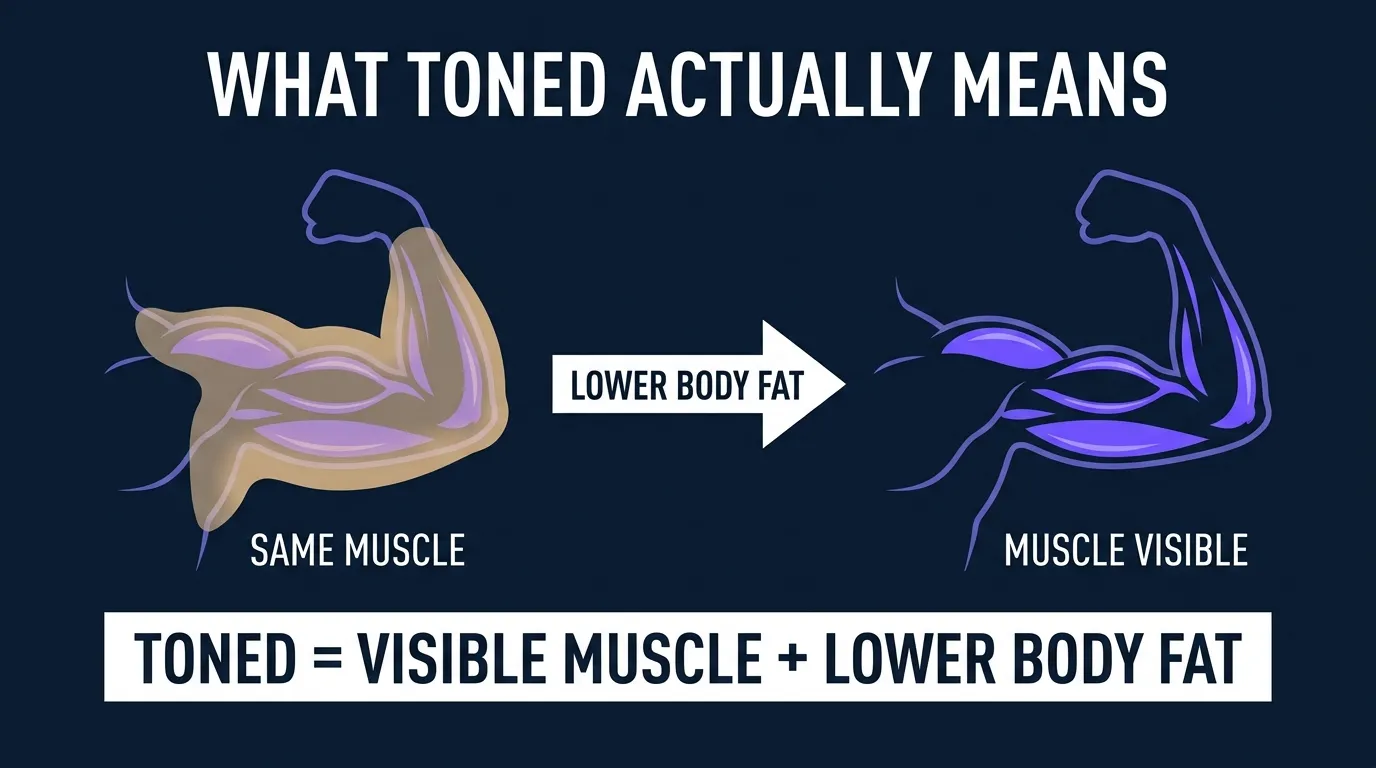
When someone says "I want to be toned", they almost always mean one of two things. They want to see some shape in their arms, shoulders, and legs (visible muscle). Or they want their body to look firm rather than soft (lower body fat over existing muscle). The look is the intersection of those two: enough muscle to have shape, and a body fat level that lets the shape show. For the arms specifically, our guide to how to lose arm fat covers how much of that shape is triceps and how much is the layer sitting over it.
That intersection is what fitness magazines call "lean" or "athletic" or "defined". They use "toned" because it sounds less intimidating than "lower body fat plus moderate hypertrophy". But the underlying biology is the same.
The "Toning vs Bulking" Myth
Here's the version of fitness culture that ruins this. The idea that there's one kind of training (light weights, high reps, lots of repetitions) that produces a "long lean toned" look, and another kind (heavy weights, low reps) that produces "bulky" muscle. Pick the right kind based on which look you want.
That's not how muscle works. Muscle fibers can grow (hypertrophy), stay the same, or shrink (atrophy). They don't have a "tone mode" and a "bulk mode." Schoenfeld and colleagues' 2017 systematic review and meta-analysis in the Journal of Strength and Conditioning Research pooled 21 controlled studies comparing low-load training (under 60% of one-rep max) to high-load training (over 60%). When all sets were taken to muscular failure, hypertrophy was statistically equivalent. Strength gains were greater for the high-load group, but the muscle that grew looked the same regardless of load.
Morton et al. (2016), published in the Journal of Applied Physiology, ran a 12-week trial directly comparing 8-12 rep heavy training to 20-25 rep light training in resistance-trained men. The result: equivalent hypertrophy in both groups, equivalent satellite cell activation, equivalent fiber-type adaptations. The muscle didn't know whether the stimulus came from heavy weights or many reps. It only knew it had been pushed close to its limit.
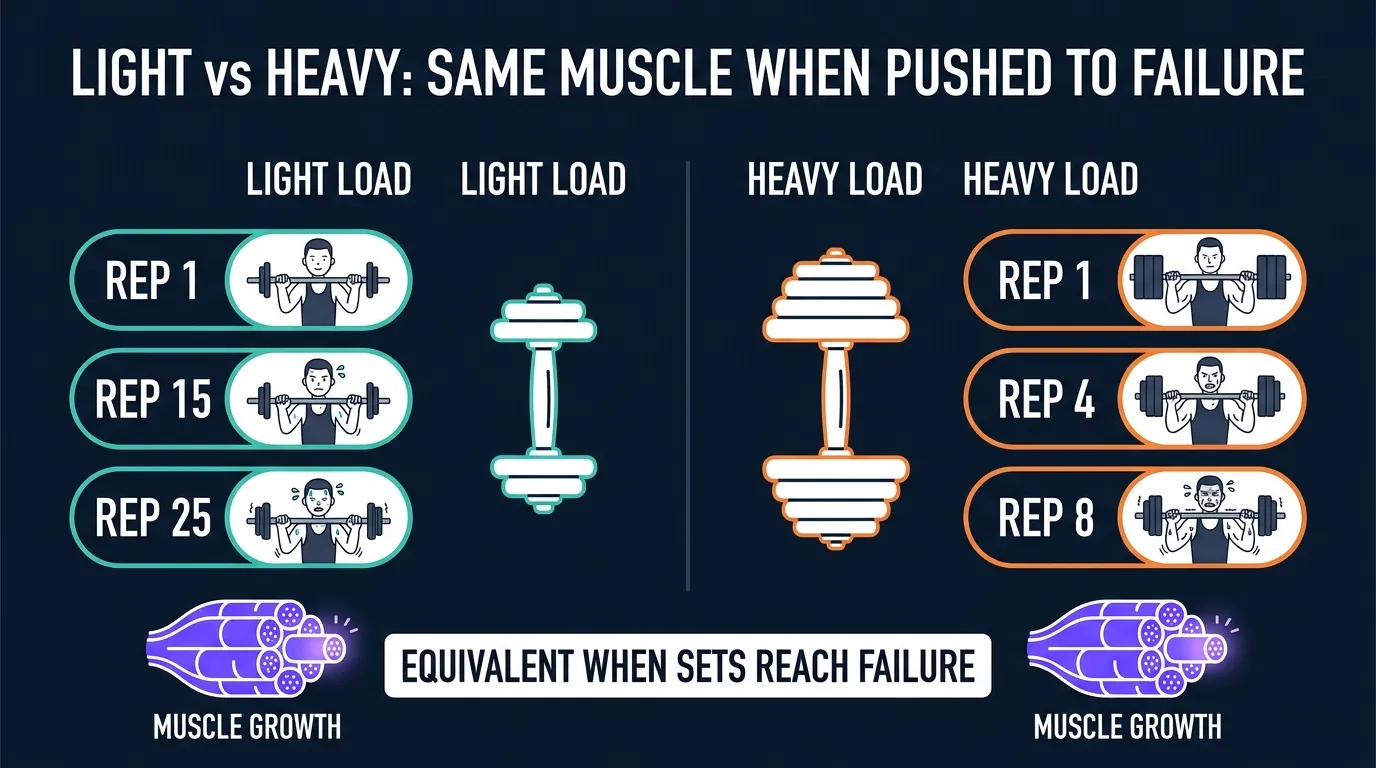
So "lift light to tone, lift heavy to bulk" is just wrong as a physiological claim. The light-rep version builds the same muscle. Our full research review walks through the evidence in detail.
Why bulking is intentional, not accidental
The other half of the myth is that women, in particular, need to be careful with weights because heavy lifting will "bulk them up." The biology pushes hard against this. Women have roughly 10-20 times less testosterone than men, the primary hormone driving male muscle accumulation. Roberts et al. (2020), in a systematic review and meta-analysis of sex differences in resistance training, found that women gain muscle at the same relative rate as men but with much smaller absolute increases. After a year of consistent training, a beginner woman might add 4-8 pounds of lean mass. Visibly different. Not "bulky".
Getting to a physique that reads as overtly muscular, the look people associate with bodybuilding, requires a deliberate combination: years of progressive resistance training (typically 4-6 sessions per week with focus on specific muscle groups), a sustained calorie surplus, and often performance-enhancing substances at the highest levels. Recreational lifters, even ones who train hard, do not accidentally end up there. Bulking is a multi-year project. You don't fall into it by adding push-ups to your routine.
What Actually Produces the "Toned" Look
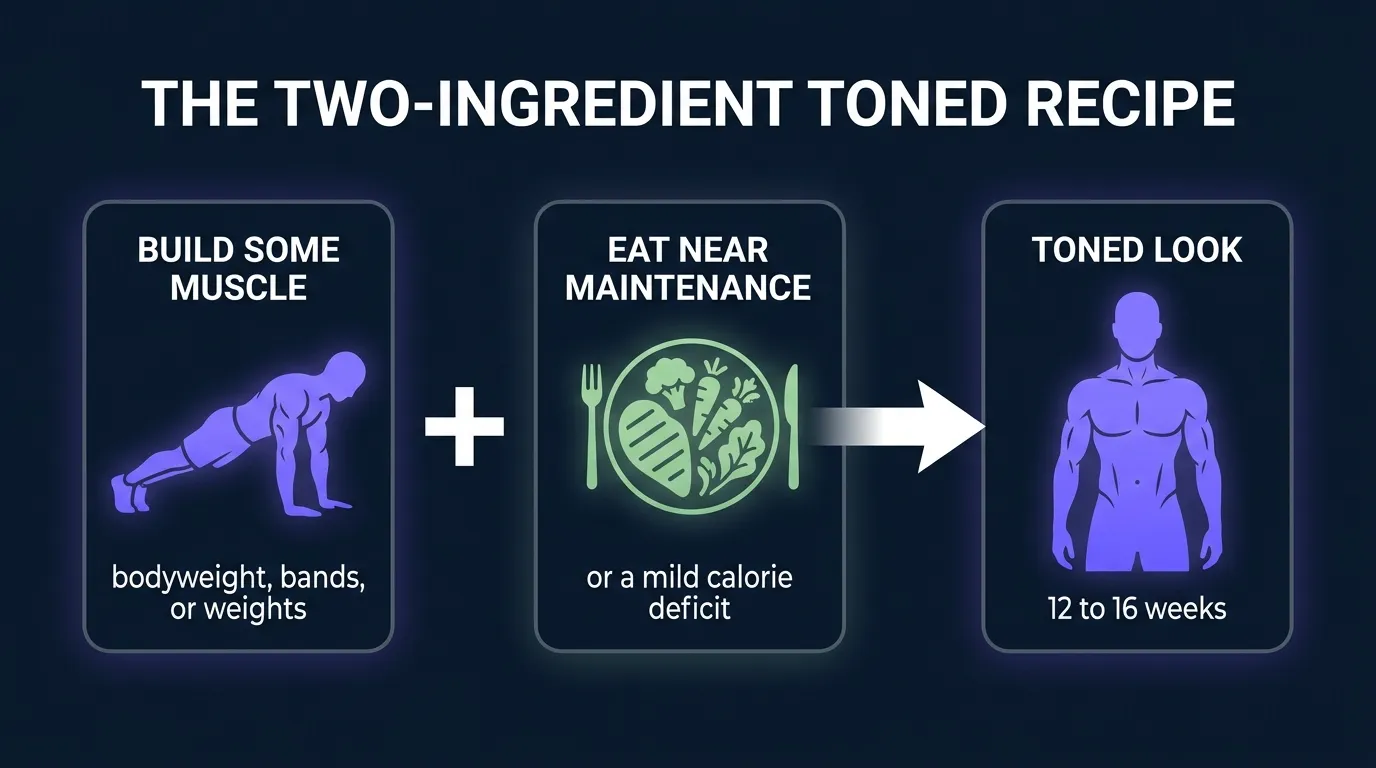
The recipe is two ingredients. Neither is mysterious.
1. Build some muscle
Any resistance training stimulus that pushes muscles close to failure for 6-30 reps will do this. The specifics matter less than people think:
- Bodyweight movements: push-ups, squats, lunges, rows on a sturdy table, glute bridges, planks. Free, available, effective.
- Resistance bands: cheap, portable, scale infinitely. A small band stash covers years of progressive overload.
- Light dumbbells: a pair of 5s, 10s, 15s, 20s covers most upper-body work for years.
- Heavier weights: also fine, if you have access and want to train that way. Not required.
The variable that matters most is proximity to failure. A set of 25 squats that ends because you genuinely can't do one more rep is a real hypertrophy stimulus. A set of 25 squats that ends because the timer ran out, with 10 more reps in the tank, is not. Bodyweight training works when you push close to your limit.
2. Keep body fat at a level where the muscle shows
This is the part fitness marketing under-discusses. You can build all the muscle in the world and nobody will see it if there's a thick layer of fat over it. Conversely, a person with relatively little muscle but very low body fat will look "toned" because what muscle they have is visible.
"Body fat where the muscle shows" doesn't mean extreme. For most people, a moderately healthy body composition (somewhere in the WHO-recommended healthy weight range plus regular activity) is enough for the kind of definition people are picturing when they say "toned." Getting there isn't about eating salads forever. It's about eating in a sustainable pattern that puts you slightly below maintenance for long enough to lose the layer that's hiding the muscle.
Knowing what to do is the easy part.
Take the free FitCraft assessment and get a personalized plan based on behavioral science, not willpower.
Take the Free Assessment Free • 2 minutes • No credit cardCommon Toning Myths Worth Skipping
"I just need to do a lot of light reps to get toned"
The first part isn't wrong. Light reps do build muscle (Schoenfeld 2017). But the framing is off. You're not "toning" the muscle by doing lots of reps. You're building it. The same as anyone doing heavier weights with fewer reps. The light-rep approach is fine. It's just not a different physiological pathway.
"Cardio is what tones you"
Cardio burns calories, helps the body fat side, and supports cardiovascular health. It does not directly build the muscle that creates "toned" shape. A person doing only cardio with no resistance work will often end up with lower body fat but very little visible muscle, which reads as "skinny", not "toned." Both ingredients matter.
"I'll do yoga and Pilates to tone instead of lifting"
Yoga and Pilates are great. They build mobility, balance, core strength, and (when taken near failure, especially with longer holds and harder progressions) some hypertrophy. They tend to under-stimulate the bigger leg, back, and chest muscles for most practitioners compared to resistance training. If you love them, do them. If your goal is a specifically "toned" look in arms, shoulders, or glutes, adding 20-30 minutes of resistance work twice a week alongside will get you there faster.
"5-pound dumbbells are 'toning weights' and 20-pound dumbbells are 'bulking weights'"
The weight is just the weight. What matters is how hard the set is relative to your capacity. A 20-rep set of bicep curls with 5-pound dumbbells that ends in failure is a real muscle stimulus. A 5-rep set of bicep curls with 20-pound dumbbells that ends in failure is also a real muscle stimulus. The first builds endurance plus some hypertrophy; the second builds strength plus similar hypertrophy. Neither one is "for toning" or "for bulking." Pick the load you can train consistently with.
The Real Strategy
If your honest goal is to look more defined, more athletic, more like the "toned" image in your head, the simplest version of the plan looks like this:
- Resistance training 2-4 times a week. Bodyweight, bands, dumbbells, whatever you'll actually use. Focus on big movements: squats and variations, push-ups and variations, rows or pull-ups, hinges (glute bridges, deadlifts if you have the equipment), and direct arm and shoulder work if you want defined arms.
- Push close to failure. The last 1-3 reps of a set should be genuinely hard, the kind of hard where one more would compromise form. That's the stimulus.
- Be patient with body fat. Most people see noticeable visible change in 12-16 weeks of consistent eating slightly below maintenance plus consistent training. Crash dieting doesn't speed it up; it just costs you the muscle you're trying to build.
- Sleep, walk, eat enough protein. Roughly 1.2-1.6 grams of protein per kilogram of body weight per day supports the muscle-building side. Walking supports the fat side. Sleep supports both, and most people are under-sleeping.
- Don't fear heavier weights. If you start lifting heavier as you get stronger, your physique doesn't suddenly switch from "toned" to "bulky". You just get stronger and look more athletic.
The boring secret of "getting toned" is that it's the same project as "building a little muscle and losing a little fat." Both halves are real work, neither requires equipment most people don't have, and the timeline is months, not weeks.
Why This Matters for Quitting Cycles
The reason this myth is worth dismantling is that it traps people in a pattern of doing the wrong thing forever. Someone who believes light weights "tone" and heavy weights "bulk" often spends years doing 20-minute high-rep circuits and seeing no real change, because they're not pushing close enough to failure to actually produce hypertrophy. They blame their genetics, their age, their hormones. They quit and restart the same losing strategy.
What actually breaks the cycle is shifting from "I should be doing toning workouts" to "I should be doing resistance training I can actually sustain, hard enough to matter." The freedom that comes from realizing heavy weights aren't going to ruin your physique (and that bodyweight movements absolutely count) is what lets a lot of people finally make progress.
Frequently Asked Questions
What does toned actually mean?
Toned describes a visual appearance, not a separate type of muscle or a separate type of training. It's the combination of having enough muscle to see shape and having low enough body fat for that shape to be visible. Physiologically there's no special "toning" adaptation. The same muscle, with less fat covering it, looks toned.
Is toning vs building muscle a real distinction?
No. Muscle fibers grow (hypertrophy) or they don't. There's no separate "toning" adaptation that lengthens muscle without making it bigger. What people call toning is the visual result of moderate muscle growth combined with fat loss. The training is the same as building muscle; the diet is what changes the appearance.
How do you get toned arms without bulking up?
Train arms with resistance and reduce body fat. Bulking up requires intentional training cycles, calorie surpluses, and (for most women) years of consistent effort because of biological differences in testosterone and muscle building rate. Schoenfeld et al. (2017) found light loads at 10-30 reps build the same muscle as heavy loads when sets are taken near failure. You can't accidentally bulk up by doing 15 push-ups.
Do light weights or bodyweight workouts build a toned look?
Yes. The 2017 Schoenfeld meta-analysis of 21 studies found low-load training (under 60% of one-rep max) produced equivalent hypertrophy to high-load training when sets approached muscular failure. Bodyweight movements like push-ups, squats, lunges, and rows produce real muscle adaptation when taken near failure for 10-30 reps. The look comes from those adaptations plus moderate body fat.
Will FitCraft help me get toned?
FitCraft programs combine strength training (bodyweight, bands, dumbbells, your choice) with cardio and mobility to build the muscle that creates the toned look, while supporting the lifestyle habits that reduce body fat. Take the free FitCraft assessment to get a personalized plan.
Sources
- Schoenfeld BJ, Grgic J, Ogborn D, Krieger JW. Strength and Hypertrophy Adaptations Between Low- vs. High-Load Resistance Training: A Systematic Review and Meta-analysis. Journal of Strength and Conditioning Research. 2017;31(12):3508-3523. PubMed 28834797
- Morton RW, Oikawa SY, Wavell CG, et al. Neither load nor systemic hormones determine resistance training-mediated hypertrophy or strength gains in resistance-trained young men. Journal of Applied Physiology. 2016;121(1):129-138. PubMed 27174923
- Roberts BM, Nuckols G, Krieger JW. Sex Differences in Resistance Training: A Systematic Review and Meta-Analysis. Journal of Strength and Conditioning Research. 2020;34(5):1448-1460. PubMed 32218059
- Bull FC, Al-Ansari SS, Biddle S, et al. World Health Organization 2020 guidelines on physical activity and sedentary behaviour. British Journal of Sports Medicine. 2020;54(24):1451-1462. PubMed 33239350