If you've ever lost weight and watched your face, arms and waist change while your thighs stayed almost exactly the same, you weren't imagining it and you weren't doing anything wrong. You were watching normal human fat physiology run in the normal order.
The frustrating part is how the internet responds to that. Inner thigh exercises, thigh gap routines, wraps, creams, foam rollers sold as a fat treatment. All of it sells the idea that the order is negotiable.
It isn't. But the biology behind it is genuinely interesting, and once you know what you're dealing with, the plan gets both simpler and more patient.
Thigh Fat Is Metabolically Protective
Start here, because it reframes everything that follows.
Manolopoulos, Karpe and Frayn (2010), reviewing the field in the International Journal of Obesity, describe gluteofemoral fat, the fat of the hips, buttocks and thighs, as a distinct depot with its own behaviour. Population studies link greater gluteofemoral fat mass to a protective lipid and glucose profile and lower cardiovascular and metabolic risk. At the tissue level it acts as a long-term fatty acid store rather than a rapid-turnover one. Leptin and adiponectin levels associate positively with it, while inflammatory cytokines associate negatively. And when the depot is lost, as happens in Cushing's syndrome, risk goes up, because fatty acids that had nowhere safe to go end up deposited in the liver and muscle.
The epidemiology is blunter. Heitmann and Frederiksen (2009), in the BMJ, followed 1,436 men and 1,380 women from the Danish MONICA cohort and found that a small thigh circumference predicted cardiovascular disease, coronary heart disease and total mortality, with a threshold effect: risk rose substantially below roughly 60 centimetres. That held independently of other obesity measures and cardiovascular risk factors.
Earlier, Snijder and colleagues (2003) studied 2,484 adults aged 50 to 75 and found that thigh circumference in women and hip circumference in both sexes were negatively associated with markers of glucose metabolism, independently of waist circumference, BMI and age. Bigger thighs, better glucose handling.
None of this means you should want more thigh fat, and none of it invalidates a cosmetic goal. It means the tissue you're trying to remove is doing a job, and the resistance you're running into is the job being done well.
Why Thigh Fat Is the Last to Go
Fat cells aren't identical. What differs between depots is how readily they release stored fat when the hormones that trigger release show up.
Fat mobilisation is governed mostly by catecholamines, adrenaline and noradrenaline, acting on adrenergic receptors on the fat cell. Beta receptors trigger release. Alpha-2 receptors block it. The ratio of those receptors differs by depot, and gluteofemoral fat carries a profile that favours holding on. Manolopoulos and colleagues describe the net effect as a lower lipolytic response in the lower body than in the abdomen, combined with efficient uptake of circulating fatty acids. It is, functionally, a one-way valve.
Three practical consequences follow, and they explain most of the frustration.
- The queue is real and the order is largely fixed. Abdominal and visceral fat mobilise first, then the upper body, then the lower body. A deficit that produces a visible change in your waist in six weeks may need six months to produce a comparable change in your thighs.
- Getting leaner overall is the only way through it. Because lower-body fat is the last to be recruited, reaching a noticeably leaner thigh usually means reaching a lower total body fat percentage than you needed for a flatter stomach.
- Quitting at the eight-week mark guarantees you never see it. The thighs are exactly the body part that changes after the point where most people conclude nothing is happening.
The Estrogen Storage Pattern and What Menopause Changes
Sex hormones set the storage bias, and the clearest natural experiment is the menopausal transition.
Lovejoy and colleagues (2008) followed 156 women through perimenopause over four years in the International Journal of Obesity. Women who became postmenopausal showed a significant increase in visceral abdominal fat, while all women gained subcutaneous abdominal fat regardless of menopausal status. Fat oxidation fell by 32 percent in the women who became postmenopausal, and sleeping energy expenditure declined more steeply in that group. The conclusion was that menopause itself, not just ageing, was associated with increased total body fat and visceral fat.
That's the mechanism behind a pattern a lot of women describe and few get explained. Before menopause, the storage bias points at the hips and thighs. After it, the bias shifts toward the trunk. The lower body doesn't necessarily shrink, it just stops being where new fat goes, so the waist grows while the thighs hold steady and the overall shape changes without the scale doing anything dramatic.
Two useful implications. Training the lower body hard during and after this transition protects the muscle you have when the hormonal support for keeping it is falling away. And if your thigh measurement hasn't moved while your waist has grown, the variable that changed is hormonal, not motivational. Our guide to strength training after menopause covers the programming side in full.
Cellulite, Honestly
Cellulite gets bundled into the thigh fat conversation constantly, and it's a different problem with a much worse evidence base.
Luebberding, Krueger and Sadick (2015) reviewed the treatment literature in the American Journal of Clinical Dermatology and reported two things worth knowing. Cellulite is present in 80 to 90 percent of post-pubertal women, which makes it a normal anatomical variant rather than a condition. And across every treatment they evaluated, no clear evidence of good efficacy could be identified, with only limited potential benefit for acoustic wave therapy and one minimally invasive laser.
The reason is structural. Cellulite reflects the arrangement of the fibrous septa that tether skin to deeper tissue, which in women run perpendicular to the skin and allow fat lobules to bulge between them. That architecture is inherited. It's not a sign of body fat level, which is why lean women get it and why losing weight often reduces its visibility without removing it.
What genuinely helps at the margins: losing fat reduces the volume pushing against the septa, and building the muscle underneath tightens the platform the skin sits on. What doesn't help: creams, wraps, dry brushing, foam rolling as a cellulite treatment, or any device sold on a mechanism the review above couldn't find evidence for.
Find out what's really holding you back
FitCraft, our mobile fitness app, pairs you with an AI coach who builds you a personalized plan around your goals, schedule, and fitness level. Every FitCraft program is designed by Domenic Angelino, MPH (Brown University) and NSCA-CSCS, with research published in the Journal of Strength and Conditioning Research and Medicine & Science in Sports & Exercise.
Take the Free Assessment Free • 2 minutes • No credit cardQuad, Hamstring and Glute Training That Changes the Shape
Since you can't choose where the fat goes, the lever you do control is what sits underneath it. On a leg, that lever is unusually powerful, because the muscles are large enough to change an outline.
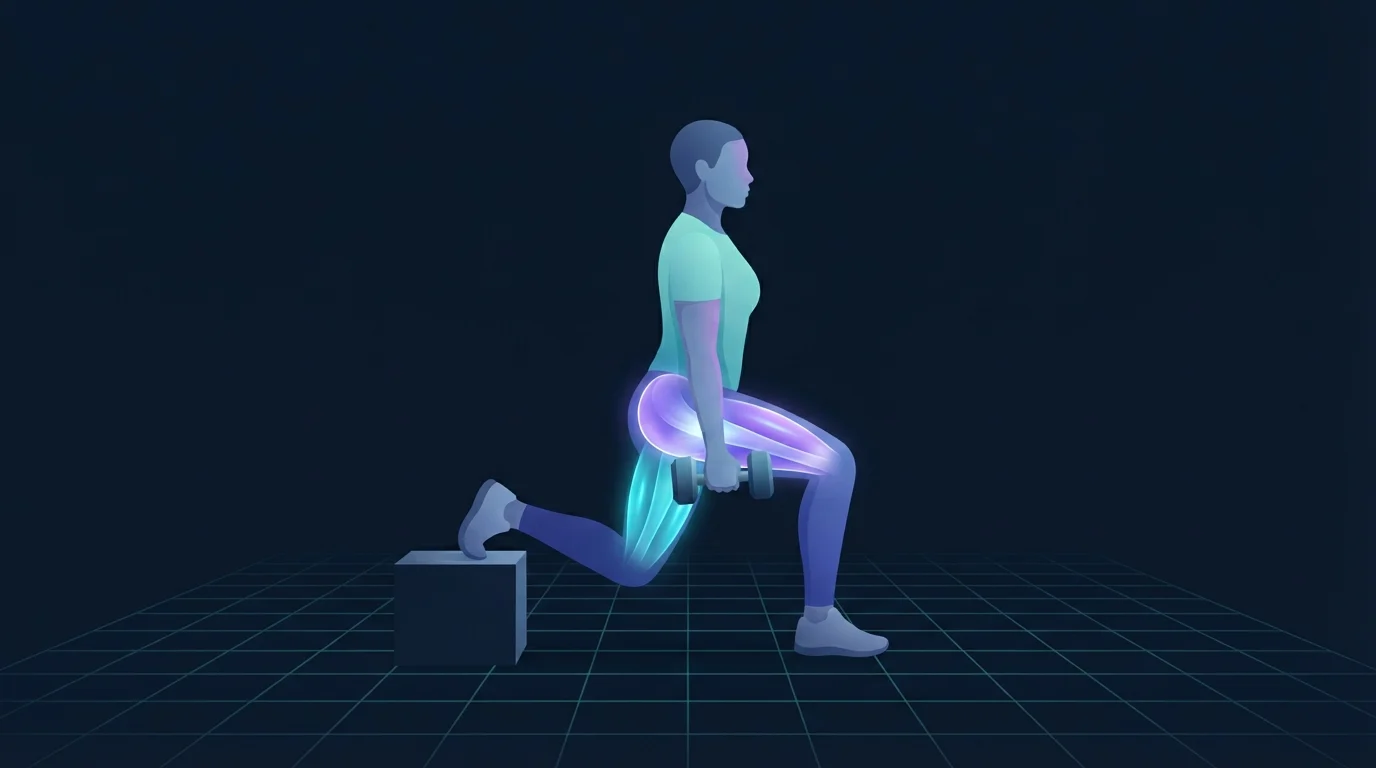
Hinge before you squat. Most people's legs are quad-dominant and hamstring-poor, and the back of the thigh is what separates a leg that looks trained from one that doesn't. Romanian deadlifts and single-leg deadlifts are the highest-value movements in this whole list.
Single leg over double leg. Bulgarian split squats and split squats load one side at a time, which means you need less weight for the same stimulus and you correct the side-to-side differences that double-leg work hides. Our review of single-leg training research covers why that matters beyond appearance.
Glutes, directly. Glute bridges and curtsy lunges reach the gluteus medius and maximus in ways squats alone don't. Building the glute changes the line where the hip meets the thigh, which is the transition most people are actually looking at. There are more options in our list of the best glute exercises at home.
Skip the inner thigh machine logic. Adductor work is worth doing for hip health and for sport, and it will not thin the inner thigh. Nothing thins a specific region.
Walking Volume Is the Lever Most People Skip
If lower-body fat only moves when total fat moves, and total fat moves with total training volume, then the highest-leverage thing you can add is the training you'll actually repeat. For almost everyone, that's walking.
A high weekly step count adds a large amount of energy expenditure at close to zero recovery cost, which is what makes it stack with strength work instead of competing with it. It's also the one form of lower-body training that carries no risk of adding size, which is the fear that stops a lot of people from training legs at all.
Pick a daily step target you can hit six days a week for three months, not a heroic number you'll hold for ten days and abandon. Our breakdown of whether you can lose weight by walking covers the arithmetic and where the realistic ceiling sits.
The One Rule You Cannot Train Around
No exercise removes fat from the region it trains. Trials that trained one leg for twelve weeks and then measured fat in both legs found the fat came off the trunk and the arms, with the trained leg showing no advantage over its untrained twin. That's why inner thigh routines, thigh gap challenges and adductor machines don't do what they promise. Our guide to the best exercises to lose belly fat carries the full spot-reduction evidence, including the one honest complication in it, and the leg study is the cleanest test in the set.
A 10-Week Lower-Body Plan
Two lower-body sessions a week plus daily walking. Ten weeks because eight is not enough time for this depot to show you anything.
| Weeks | Session A (hinge focus) | Session B (squat focus) | Walking |
|---|---|---|---|
| 1 to 3 | Romanian deadlifts 3 x 10, glute bridges 3 x 12, split squats 2 x 10 per side, calf raises 2 x 15 | Goblet squats 3 x 10, curtsy lunges 2 x 10 per side, wall sits 3 x 30s, single-leg deadlifts 2 x 8 per side | Baseline steps plus 1,500 a day |
| 4 to 7 | Romanian deadlifts 4 x 8 heavier, glute bridges 3 x 15, Bulgarian split squats 3 x 8 per side, calf raises 3 x 15 | Goblet squats 4 x 8 heavier, curtsy lunges 3 x 10 per side, wall sits 3 x 45s, single-leg deadlifts 3 x 8 per side | Baseline steps plus 3,000 a day |
| 8 to 10 | Romanian deadlifts 4 x 8, single-leg glute bridges 3 x 12 per side, Bulgarian split squats 4 x 8 per side, calf raises 3 x 20 | Goblet squats 4 x 10, walking lunges 3 x 12 per side, wall sits 3 x 60s, single-leg deadlifts 3 x 10 per side | Hold, and keep it six days a week |
Progress one variable a week, either load or repetitions, and leave one or two repetitions in reserve on everything except the last set. Expect your thigh measurement to rise slightly in weeks one to three as the muscles hold more fluid and glycogen. That settles, and mistaking it for fat gain is the single most common reason women abandon a leg program in the first month.
The nutrition half is the same for every body part: a moderate deficit and enough protein. Our guide to losing fat without losing muscle covers it properly, and our roundup of the best fitness apps for women compares how the main options handle lower-body programming and progression tracking.
How Long Until Your Thighs Change?
Weeks one to three often look like the wrong direction. New training adds fluid to working muscle, so the tape measure can go up. Ignore it.
Weeks four to eight is where strength and firmness change while circumference barely moves. You'll feel the difference in how stairs and hills read long before you see anything.
Weeks eight to sixteen is where the shape starts to shift, mostly through the glute and hamstring tie-in rather than the thigh narrowing. This is where the muscle you built becomes visible under a thinner layer.
Months four to twelve is when the fat itself gives ground, because by then total body fat has dropped far enough for the last depot in the queue to be recruited. This is the horizon almost nobody is given honestly, and it's the reason patience is the actual intervention here.
The Bottom Line
How to lose thigh fat is the wrong question in one specific way: it implies the thighs are a separate project with a separate lever, and they aren't. They're the last stop on a whole-body process, held by a depot that is biologically built to hold, and that holds because it protects you.
So run a moderate deficit for longer than feels reasonable. Train the hinge, the single leg and the glute twice a week. Walk a lot. Let your thigh measurement drift up for three weeks without panicking. And judge the outcome at month four, not at week six, because week six is when the plan looks like it's failing and month four is when it isn't.
Frequently Asked Questions
How do you lose thigh fat?
Thigh fat comes off when total body fat comes off, and it usually comes off last, so the plan is a moderate deficit held for longer than you expect plus enough training volume to protect muscle. Two lower-body strength sessions a week and a high weekly step count do the most work. There's no exercise that removes fat from the thigh specifically, and the lower-body depot is the most resistant to mobilisation in the body, which is a biological feature rather than a personal failing.
Why is thigh fat so hard to lose?
Gluteofemoral fat is built for long-term storage rather than quick release. It has a lower lipolytic response to the hormones that mobilise fat than abdominal fat does, and it takes up fatty acids efficiently, which is exactly what makes it metabolically protective. Reviews of the depot describe it as a long-term fatty acid trap associated with a better lipid and glucose profile. The trait that frustrates you is the same trait that lowers your cardiometabolic risk.
Do squats and lunges burn thigh fat?
They don't burn the fat sitting over the thigh, and controlled trials that trained one leg and imaged both found fat came off the whole body rather than the trained limb. What squats and lunges do is build quadriceps, hamstring and glute tissue, which changes the shape and firmness of the leg at any body fat level, and they burn meaningful energy because they use the largest muscles you own. Train them for those reasons, not for spot reduction.
Does walking slim your thighs?
Walking won't make a leg smaller on its own, but it's the highest-volume, lowest-cost training most people can sustain, and total training volume is what moves total fat. It also doesn't build enough muscle to add noticeable size, which is what people are usually worried about. Aim for a step count you can hit six days a week for months rather than a heroic number you can hold for ten days.
Can you get rid of cellulite?
Not reliably, and an evidence-based review of the treatment literature found no clear evidence of good efficacy for any evaluated cellulite treatment, with only limited signals for acoustic wave therapy and one minimally invasive laser. Cellulite is present in 80 to 90 percent of post-pubertal women and reflects the structure of the connective tissue septa in the skin rather than the amount of fat underneath. Fat loss and muscle gain often reduce how visible it is. Neither removes it.
Will leg training make my thighs bigger?
During a fat-loss phase, almost never. Muscle is denser than fat, so replacing fat volume with muscle volume usually lowers thigh circumference while making the leg look firmer. Meaningful thigh hypertrophy requires a calorie surplus, heavy progressive loading and time. If your thighs measured larger after starting a program, the usual explanation is the fluid and glycogen that new training brings with it, which settles within two to three weeks.