Search for an inner thigh workout and you'll find the same handful of moves: squeeze a ball between your knees, lift the bottom leg a few inches off the floor, pulse in a wide stance. They're not useless. They're just aimed at a muscle group in the position where it's weakest and least challenged, which is why people do them for months and feel nothing change.
The adductors are not small stabilisers. Adductor magnus alone is one of the largest muscles in the lower body, and the group gets hit hard every time you lunge sideways, squat to depth, or catch yourself stepping off a kerb. They're the reason a change of direction doesn't dump you on the floor.
Which means the question isn't really which exercises for inner thighs feel like they're working. It's which ones put the adductors under load while they're long. Those two lists barely overlap, and the second one is what follows.
The 8 Best Inner Thigh Exercises
Ranked by how much adductor loading each one actually produces, not by how much burn you feel. The top of the list is where the evidence is strongest: Serner and colleagues (2014), in the British Journal of Sports Medicine, put surface EMG on the adductor longus of 40 male footballers across a battery of hip adduction exercises and classified only two as dynamic high-intensity. The rest of the list earns its place by loading the adductors as part of a bigger movement, which is how they get trained in real life anyway.
| # | Exercise | Best for | Dose |
|---|---|---|---|
| 1 | Copenhagen adduction | Maximum adductor loading, long-length eccentric | 3 x 3-8 per side |
| 2 | Standing band hip adduction | High intensity with a controllable load | 3 x 10-12 per side |
| 3 | Sliding lateral lunge | Eccentric length at home, no equipment | 3 x 8 per side |
| 4 | Side-lying hip adduction | The true beginner entry point | 3 x 12-15 per side |
| 5 | Lateral lunge | Frontal-plane strength you can load heavy | 3 x 8-10 per side |
| 6 | Full-depth goblet squat | Adductor magnus size, through full range | 3 x 8-10 |
| 7 | Sumo squat | Adduction bias inside a familiar pattern | 3 x 10-12 |
| 8 | Curtsy lunge | Adduction under a rotating pelvis | 3 x 10 per side |
1. Copenhagen adduction
Lie on your side with a chair seat or low bench beside you. Rest the inside of your top ankle on it, prop up on your bottom forearm, then press the top leg down into the bench hard enough to lift your hips and bring the bottom leg up to meet it. Lower slowly. Three sets of three to eight reps per side, twice a week.
This is the highest-yield inner thigh exercise there is, and it needs nothing but furniture. It also produces genuinely memorable soreness in the first fortnight, so start with the bench under your knee rather than your ankle and hold isometrically for two weeks before adding the slow lowers. Our review of the Copenhagen plank research has the full trial-by-trial evidence and the six-stage progression.
2. Standing band hip adduction
Anchor a resistance band at ankle height, loop it around the ankle of the leg nearest the anchor, and step away so the band pulls that leg outward. Stand tall on the other leg, then draw the banded leg across your body against the resistance and control it back out. Three sets of ten to twelve per side.
Serner's EMG data put this in the same dynamic high-intensity bracket as the Copenhagen, and it's far easier to dose: step further from the anchor for more tension, closer for less. It also trains you to keep a level pelvis while standing on one leg, which is how you use adductors outside a gym. If bands are your main equipment, our band workout for legs builds a full session around them.
3. Sliding lateral lunge
Stand with a towel under one foot on a smooth floor, or a sock on carpet. Keep the sliding leg straight and push it out to the side, letting your weight settle onto the bent standing leg as the other leg slides away. Pull it back in by dragging the heel toward you. Three sets of eight per side.
The slide is the point: the adductor lengthens under load on the way out and does the work of pulling you back. That's the same quality the Copenhagen trains, at a fraction of the difficulty, which makes this the best bridge between a beginner and a real adductor exercise.
4. Side-lying hip adduction
Lie on your side, cross the top leg over in front of you with the foot flat on the floor, then lift the bottom leg as high as it will go and lower it slowly. Three sets of twelve to fifteen per side.
Low intensity, honestly. It sits at the bottom end of the EMG range, which is exactly why it's useful as a starting point for someone who's never trained adductors, or as a warm-up set before the harder work. Do not expect it to be the whole programme.
5. Lateral lunge
From standing, step wide to one side, sit the hip of that leg back and bend that knee while the trailing leg stays straight with the foot flat. Push back to the middle. Add a dumbbell held at the chest when bodyweight gets easy. Three sets of eight to ten per side, and side lunges has the form cues in detail.
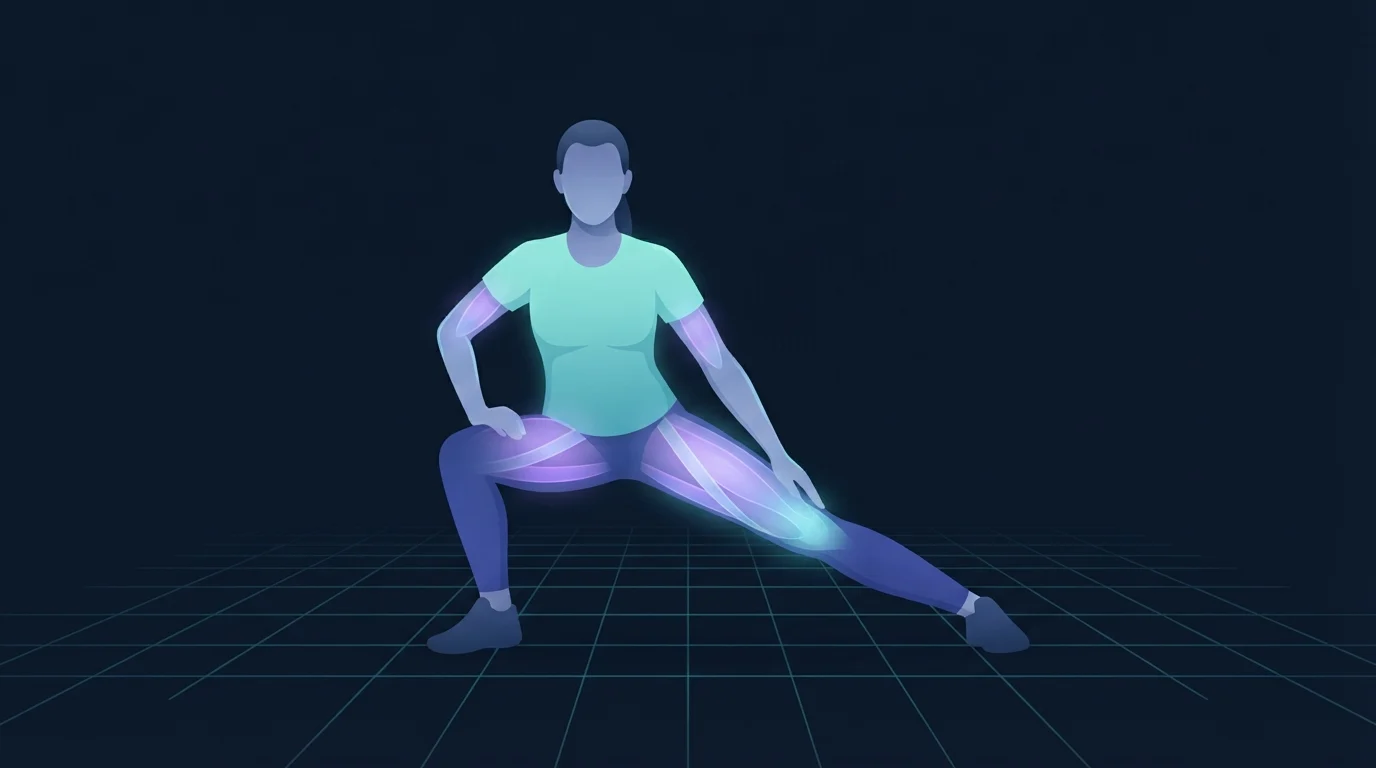
The straight trailing leg is where the adductor stretch happens, and the bent leg's adductors work hard to pull you back to centre. It's the most loadable frontal-plane exercise most people have access to. A side lunge with a lean extends the same idea if you want more range.
6. Full-depth goblet squat
Hold a dumbbell or kettlebell at your chest, feet a little wider than shoulder width, toes turned slightly out, and squat as deep as you can while keeping your heels down and your spine neutral. Three sets of eight to ten, and goblet squats covers the setup.
Depth is not a stylistic preference here. Kubo, Ikebukuro and Yata (2019), in the European Journal of Applied Physiology, randomised 17 men to ten weeks of full squats or half squats, twice a week, and measured muscle volumes by MRI. The full squat group grew their adductors and gluteus maximus significantly more. Neither group changed their hamstring or rectus femoris volume. If you only change one thing about your leg training for inner thigh purposes, change the depth.
7. Sumo squat
A wide stance with the toes turned out, squatting straight down between the hips. Three sets of ten to twelve. Sumo squats shift more of the work toward the adductors and glutes than a shoulder-width squat does, simply because the stance puts the adductors in a longer position from the start.
It shows up on every inner thigh list for a reason. Just don't let the wider stance shorten the depth, which is the usual trade people make without noticing.
8. Curtsy lunge
Step one leg diagonally back and across behind the other, then lower into a lunge and return. Three sets of ten per side. Curtsy lunges load the adductors of the front leg while the pelvis is rotating, which is a demand none of the other seven exercises reproduce.
It's last on the list because the adductor loading is moderate and the balance requirement is high, so form fails before the muscle does. Treat it as a finisher rather than a main course.
Find out what's really holding you back
FitCraft, our mobile fitness app, pairs you with an AI coach who builds you a personalized plan around your goals, schedule, and fitness level. Every FitCraft program is designed by Domenic Angelino, MPH (Brown University) and NSCA-CSCS, with research published in the Journal of Strength and Conditioning Research and Medicine & Science in Sports & Exercise.
Take the Free Assessment Free • 2 minutes • No credit cardWhat Muscles Are in the Inner Thigh?
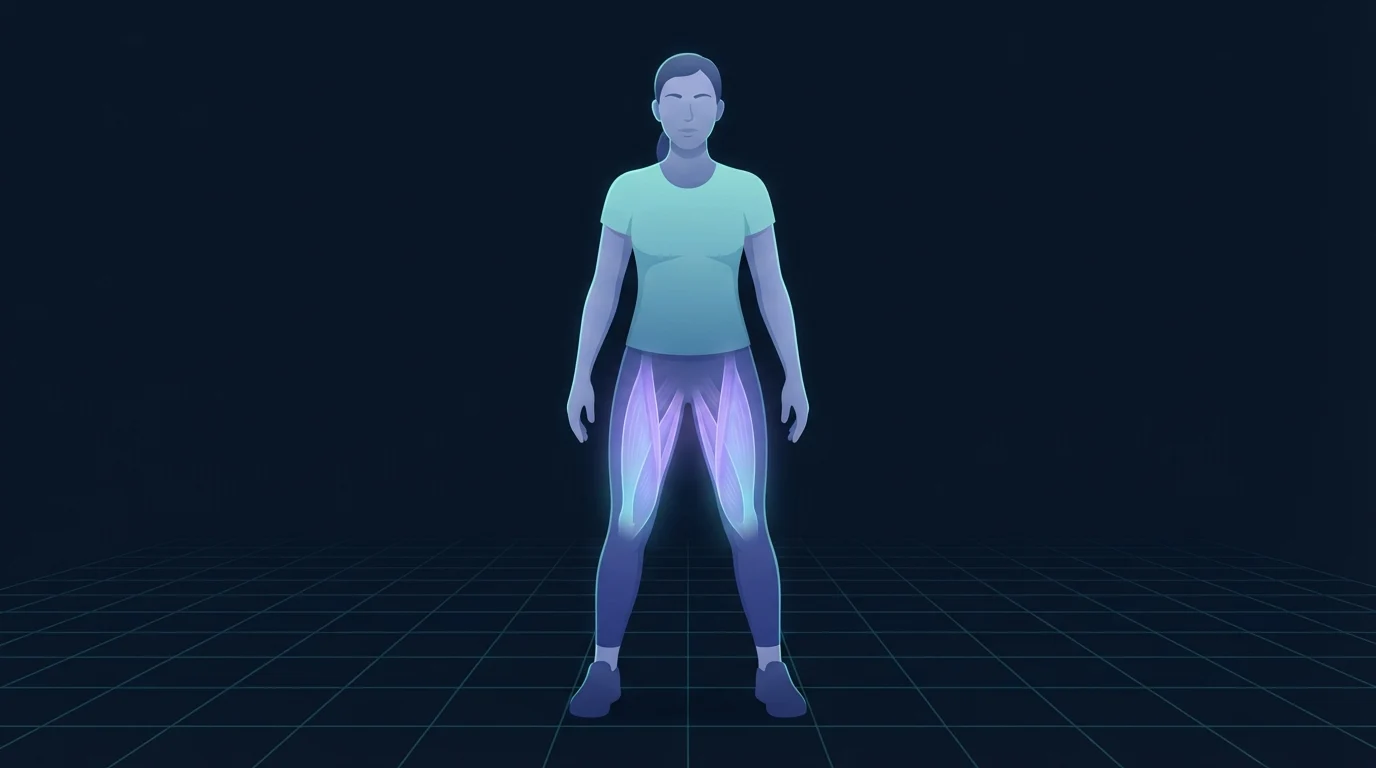
The inner thigh muscles are five adductors running from the pubic bone and the sit bone down the inside of the femur.
- Adductor magnus. The big one, and the reason this group deserves better than a pillow squeeze. It's large enough to rival the glutes in cross-sectional area and its posterior fibres act as a hip extensor, which is why it grows from deep squats and hinges rather than from isolation work.
- Adductor longus. The one that gets strained. It sits most superficially at the front of the group and takes the brunt of sudden lateral loading, which is why it's the muscle almost every groin injury study measures.
- Adductor brevis. Deep and short, working underneath longus through the same range.
- Gracilis. The long thin one that crosses both the hip and the knee, so it contributes to knee flexion and internal rotation too.
- Pectineus. Up at the top, adducting and flexing the hip, and often confused with the hip flexors it sits beside.
Three jobs, then. They pull the thigh toward the midline. They keep the pelvis level when you're standing on one leg, which makes them a walking and running muscle group as much as a lateral one. And through adductor magnus, they contribute real force to hip extension out of the bottom of a squat.
Why Squeezing Is Not Enough
Muscles grow and get stronger in response to mechanical tension, and tension depends on load and on the length the muscle is at when it's loaded. A ball squeeze fails both tests. It loads the adductors at their shortest position with whatever force you can voluntarily generate, and voluntary squeezing peaks well below what an external load produces. Serner's battery put exercises like the ball squeeze near the bottom of the activation range and the Copenhagen adduction near the top.
Length is the second half. Kubo's squat depth trial is the cleanest demonstration available: same lifters, same frequency, same ten weeks, and the only variable was how far down they went. The adductors grew in the group that went deep. Going halfway grew the quadriceps and left the adductors behind.
Put those two findings side by side and the rule falls out. Train the adductors when they're long, under load you can measure and increase. Everything at the top of the list above does that. The pulses and the pillow squeezes do not, which is why people who have done them for a year still feel nothing on the first Copenhagen rep.
An Inner Thigh Workout You Can Do at Home
Two sessions a week, run alongside your normal lower-body training. The first session is the strength one, the second is lighter and more about range.
| Session | Exercise | Sets and reps |
|---|---|---|
| A | Full-depth goblet squat | 3 x 8-10 |
| A | Lateral lunge, dumbbell at chest | 3 x 8 per side |
| A | Copenhagen adduction, short lever | 3 x 15-30 sec per side |
| A | Glute bridge, feet wide | 3 x 12 |
| B | Sumo squat | 3 x 10-12 |
| B | Sliding lateral lunge | 3 x 8 per side |
| B | Standing band hip adduction | 3 x 10-12 per side |
| B | Bulgarian split squat | 2 x 8 per side |
Progress it the boring way. Weeks one and two, hold the Copenhagen with the bench under your knee. Weeks three and four, add slow lowers in that short-lever position. Weeks five onward, move the support to your ankle. Everything else progresses by adding load or a rep at a time.
If putting a week together yourself is the part that stalls you, a no-equipment workout app will sequence the sessions and handle the progression so you only have to show up. For the rest of the lower body, our glute activation exercises guide pairs naturally with this, since the glutes and adductors share most of the same movements.
Can Inner Thigh Exercises Reduce Inner Thigh Fat?
No, and the cleanest test of that happens to have been run on legs. Ramirez-Campillo and colleagues (2013), in the Journal of Strength and Conditioning Research, had participants train a single leg with high-repetition endurance work for twelve weeks. Fat mass dropped, in the trunk and upper body. The trained leg's fat didn't move.
That's worth knowing before you spend three months on inner thigh pulses expecting a gap between your thighs. What adduction training actually delivers is a bigger, stronger, better-controlled muscle under the fat, plus everything in the injury section below.
There's also a reason the inner thigh is stubborn. Manolopoulos, Karpe and Frayn (2010), reviewing gluteofemoral fat in the International Journal of Obesity, describe hip and thigh fat as metabolically protective and slower to mobilise than abdominal fat. It's the depot your body defends, which is why it's usually last to change. Our guide to losing thigh fat covers that side properly, including the timeline.
Strong Adductors Are Injury Insurance
This is the part of adductor training with the best evidence behind it, and it's not about appearance at all.
Ishoi and colleagues (2016), in the Scandinavian Journal of Medicine and Science in Sports, randomised 24 male under-19 footballers to eight weeks of progressive Copenhagen adduction twice a week or to usual training. The trained group made large gains in eccentric hip adduction strength and improved the adduction-to-abduction strength ratio, a marker linked to groin injury risk.
Haroy and colleagues (2019), in the British Journal of Sports Medicine, then ran it at scale: 35 semi-professional teams and 652 players, cluster-randomised to an adductor strengthening programme built on one exercise or to normal training. Groin problems affecting performance fell by roughly 41% across the season.
If you play anything that involves changing direction, that's the most efficient preventive work available to you: one exercise, once a week in season. If you don't, the case is softer but still real, because sitting a lot and training only in straight lines leaves the adductors underprepared for the one time you step sideways in a hurry.
Adductor Mobility: Stretching the Inner Thigh
Stretching doesn't build the muscle, but the loaded exercises above only pay off through the range you actually have. Three positions cover it.
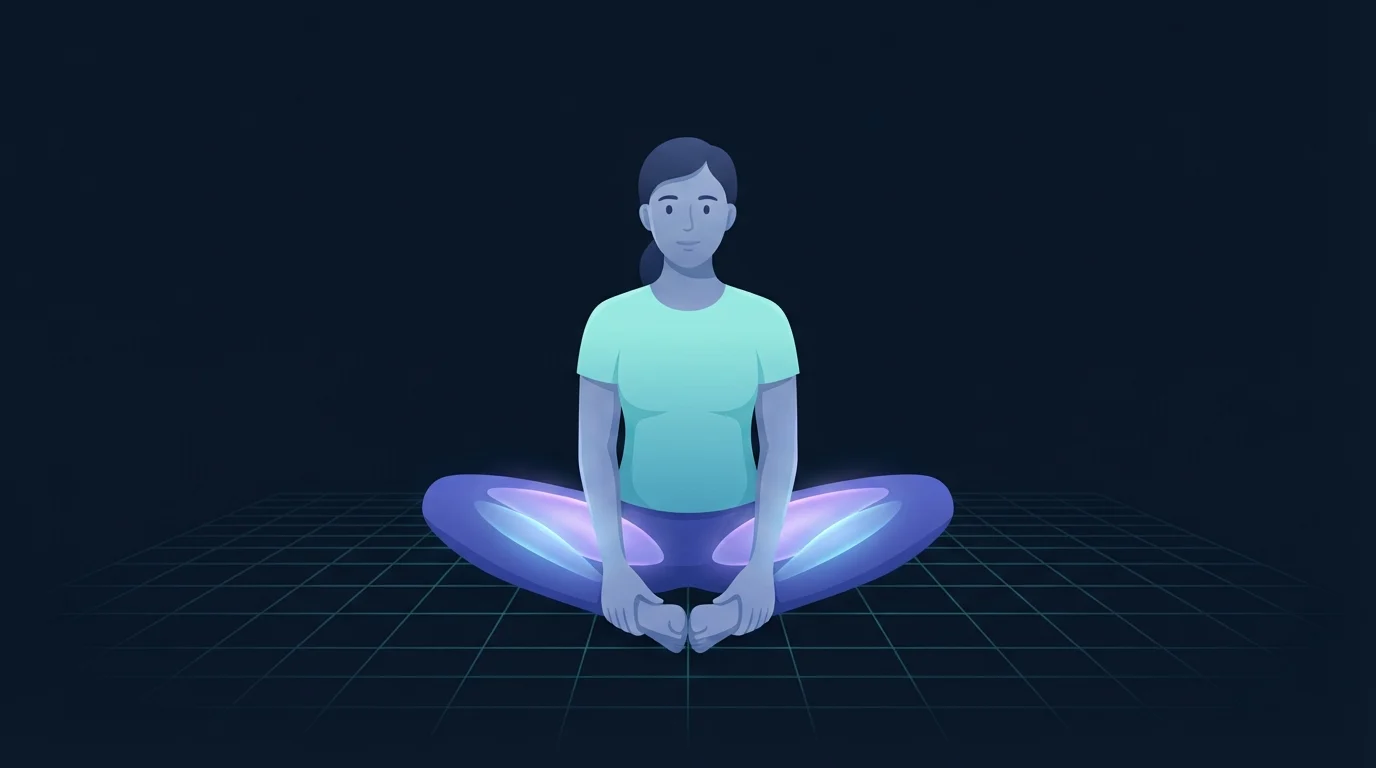
- Butterfly. Seated, soles together, knees dropping wide. Butterfly pose is the least demanding entry and the easiest to hold for a real duration.
- Half-kneeling adductor rock. On all fours, take one leg out straight to the side with the foot flat, then rock the hips back and forward. This one you can dose by how far back you rock, which makes it the most progressable of the three.
- Cossack squat. A deep lateral squat on one leg with the other straight. It's a stretch and a strength exercise at the same time, which is why it sits at the end of the progression rather than the start.
On dose, the chronic stretching literature is consistent: Konrad and colleagues (2024), in the Journal of Sport and Health Science, found meaningful range gains across protocols with no strong evidence that one stretch type wins. Roughly ten minutes a week per muscle group, in holds of about 30 seconds, is the practical target. Our guide to hip mobility exercises covers how adductor range interacts with the rest of the hip.
How Long Until You Feel a Difference
Week one, everything is soreness. Adductors are rarely loaded eccentrically at length, so the first two sessions produce the kind of soreness that makes stairs interesting. That's normal and it fades quickly, and Polglass, Burrows and Willett (2019), in BMJ Open Sport and Exercise Medicine, showed a ramped progression gets the same strength gains with much less of it. Our review of delayed onset muscle soreness explains why the first exposure is always the worst one.
By week three the soreness is mostly gone and the Copenhagen holds get noticeably longer. By weeks six to eight, which is the window Ishoi's trial measured, eccentric adduction strength has changed substantially and single-leg work feels more stable. Visible change in thigh shape runs on the hypertrophy clock instead, so think three to four months, and only if the training is progressing.
The Bottom Line
The best inner thigh exercises are the Copenhagen adduction, standing band adduction and the sliding lateral lunge for direct work, plus full-depth goblet squats, lateral lunges, sumo squats and curtsy lunges for the loaded compound side. Two sessions a week, two or three sets per side, progressed slowly from short-lever holds to the full versions.
You don't need a machine and you don't need a gap between your thighs to justify it. Adductors are a big, strong, chronically under-trained muscle group, and giving them eight weeks of honest loading changes how your legs feel long before it changes how they look.
Frequently Asked Questions
What are the best inner thigh exercises?
The best inner thigh exercises are the ones that load the adductors at long muscle lengths rather than squeezing them at short ones. Ranked by how much adductor work they actually produce, that means the Copenhagen adduction exercise first, then standing band hip adduction, a sliding lateral lunge, side-lying hip adduction, the lateral lunge, a full-depth goblet squat, the sumo squat and the curtsy lunge. Serner and colleagues (2014) measured adductor longus activity across a battery of adduction exercises and classified only the Copenhagen adduction exercise and standing band adduction as dynamic high-intensity.
What muscles are in the inner thigh?
The inner thigh muscles are the five hip adductors: adductor magnus, adductor longus, adductor brevis, gracilis and pectineus. Adductor magnus is by far the largest and doubles as a powerful hip extensor, which is why deep squats and hinges train it hard. Adductor longus is the one most often strained in change-of-direction sport. Together they pull the thigh toward the midline, stabilise the pelvis when you stand on one leg, and help control side-to-side movement.
How can I work my inner thighs at home without equipment?
Three moves cover it with nothing but a floor and a chair. Side-lying hip adduction needs no equipment at all. A sliding lateral lunge needs a towel on a smooth floor or a sock on carpet, and it loads the adductor eccentrically as the leg slides out. The Copenhagen adduction exercise needs only a chair seat or a low bench for the top leg, and it produces more adductor activity than anything else tested. Two sessions a week is enough to change strength in six to eight weeks.
How often should I train my inner thighs?
Twice a week is the dose almost every adductor trial uses, and it's enough. Ishoi and colleagues (2016) ran two supervised sessions a week for eight weeks and produced large increases in eccentric hip adduction strength in sub-elite footballers. Keep direct adductor work to two or three sets per side and put it after your main lower-body lifts, because the adductors are already working during squats and lunges.
Can inner thigh exercises reduce inner thigh fat?
No. Training a muscle doesn't empty the fat sitting over it. Ramirez-Campillo and colleagues (2013) had participants train one leg with high-repetition endurance work for twelve weeks and found fat mass fell in the trunk and upper body while the trained leg was unchanged. Inner thigh exercises change the muscle's size, strength and shape, which is worth having. The fat layer responds to an energy deficit across the whole body, and for most women the thigh is a late-stage depot rather than an early one.
Why are my inner thighs so sore after adductor exercises?
Because most people have never loaded their adductors eccentrically at long lengths, and unfamiliar eccentric work is the single biggest driver of delayed onset muscle soreness. The Copenhagen adduction exercise is notorious for it in the first two weeks. Polglass and colleagues (2019) showed a ramped progression, starting with short-lever isometric holds and building to the full long-lever version over several weeks, delivers the same strength gains with far less soreness. Start short, progress weekly, and the soreness stops being a problem by week three.