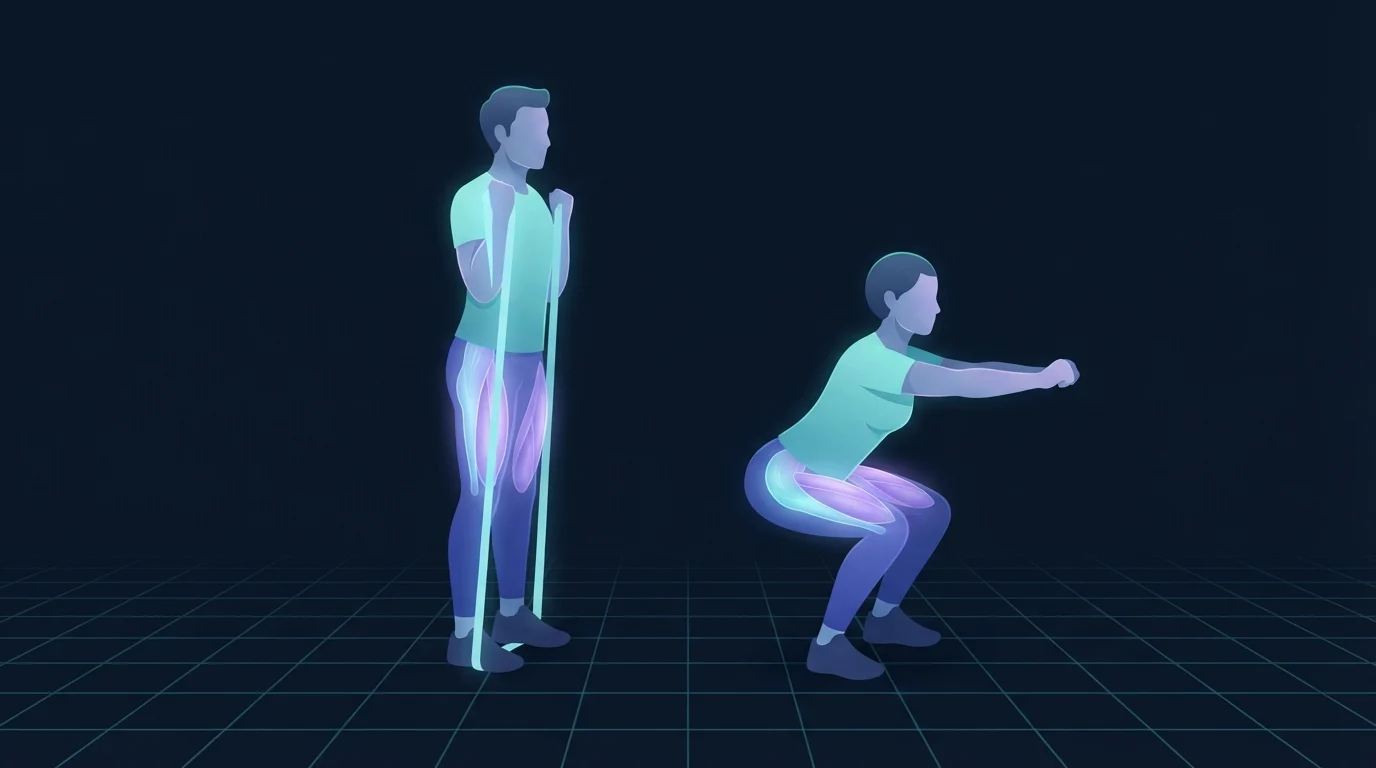
You bought the bands because they cost almost nothing, they live in a drawer, and the gym was never realistically happening on a Tuesday night. Then you did a set of band squats, felt close to nothing at the bottom, felt your quads burn at the top, and quietly filed bands under warm-up equipment.
That conclusion is half right, and the half you got wrong is costing you the entire modality. Bands are not weak. They are shaped differently from a dumbbell, and nobody hands you the instructions for that shape.
So here is the shape, what the controlled trials actually found when they put elastic resistance up against machines and free weights, and a 25-minute leg session designed around the resistance curve instead of pretending it isn't there.
What a Band Workout for Legs Actually Loads
A dumbbell weighs the same at every point in a rep. Gravity doesn't care what your knee angle is. A band works differently: tension is a function of how far the elastic has been stretched, so resistance climbs steadily through the lifting phase and drains away through the lowering phase.
Run that through a squat. You stand on the middle of a long loop and hold the ends at your shoulders. At the bottom, the distance from your feet to your shoulders is at its shortest, so the band is nearly slack. At the top, that distance is longest, so the band fights hardest. Your quadriceps and glutes are at their longest and most stretched at the bottom, which is exactly where the band has decided to leave.
That's a real cost, not a technicality. Long-muscle-length work is not interchangeable with short-muscle-length work. Pedrosa and colleagues (2022), publishing in the European Journal of Sport Science, randomised 45 untrained women to knee extension training through a full range, a partial range at long muscle lengths, a partial range at short muscle lengths, or a protocol that alternated the two. The long-length group showed greater relative growth than the short-length and full-range groups at several measurement sites along the femur. Loading a muscle where it's stretched is a genuine variable, not a rounding error, and it's the one bands handle worst. Our review of lengthened partials research goes further into that literature.
The three patches
All three of these are free, and they take the leg session from decent to honest:
- Pause two seconds at the bottom. The band is slack there, so the pause is held by your muscles rather than by the elastic. On a squat this is the difference between a set that burns and a set that trains the bottom position.
- Pre-tension the band. Step wider on the loop, or double it, so there's meaningful tension at the bottom of the rep instead of only at the top. You'll use fewer reps and the profile flattens.
- Pair each band movement with one bodyweight movement that loads the stretch. A rear-foot-elevated split squat, a slow step-down off a stair, a Nordic-style hamstring lower. Bodyweight is constant, so it fills in precisely where elastic resistance thins out.
Do Bands Actually Build Leg Strength?
The controlled trials are less ambiguous than the internet suggests. Lopes and colleagues (2019), in SAGE Open Medicine, pooled eight trials that directly compared elastic devices (tubes and therapy bands) against conventional devices (weight machines and dumbbells) and found no significant difference for lower limb strength (standardised mean difference -0.11, 95% CI -0.40 to 0.19) or upper limb strength (SMD 0.09, 95% CI -0.18 to 0.35). Their conclusion was that elastic resistance training promotes similar strength gains to conventional resistance training across different populations and protocols.
The individual trials underneath that number are worth knowing. Colado and Triplett (2008), in the Journal of Strength and Conditioning Research, randomised 45 sedentary middle-aged women into a band group (21), a weight-machine group (14) and a control group (10). Both training groups ran the same periodised program, six exercises twice a week for 10 weeks, with intensity matched by target reps and rate of perceived exertion rather than by load. The two equipment types produced comparable results.
In older adults the effect is larger still. Martins and colleagues (2013), reviewing progressive elastic resistance programs in Archives of Gerontology and Geriatrics, pooled 11 studies covering 834 adults aged 60 to 79 and found meaningful strength improvements from band training. We cover the full trial-by-trial picture in our resistance band training research review.
One honest boundary. Schoenfeld and colleagues (2017) pooled the low-load versus high-load literature and concluded that muscle growth is achievable across a wide spectrum of loads when sets are taken to failure, while maximal strength gains favour heavy loading. Bands mostly live in the lower-load, higher-rep end of that spectrum. If your goal is a bigger one-rep max on a barbell, bands are not the fastest route. If your goal is stronger, more muscular legs in a room with no equipment, the trials say you're fine.
The 25-Minute Resistance Band Leg Workout
Six movements, run as three pairs. Do the two exercises in each pair back to back with no rest between them, then rest 90 seconds before repeating the pair. Iversen and colleagues (2021), in their Sports Medicine review of time-efficient program design, list paired non-competing exercises as one of the cleanest ways to cut session length without cutting working sets. Pairing a lower-body movement with a hip or calf movement does exactly that.
| Pair | Exercise | Sets and reps | The cue that matters |
|---|---|---|---|
| A | Band squat, long loop under both feet | 3 x 12-15 | Two-second pause at the bottom, every rep |
| A | Banded glute bridge, short loop above the knees | 3 x 15-20 | Push the knees out against the loop the whole set |
| B | Band Romanian deadlift | 3 x 12-15 | Three seconds down, hips back, shins vertical |
| B | Band reverse lunge or split squat | 3 x 10-12 each side | Front shin stays over the mid-foot at the bottom |
| C | Band leg curl, loop anchored low around one ankle | 2 x 15-20 each side | Hips still, the knee is the only joint moving |
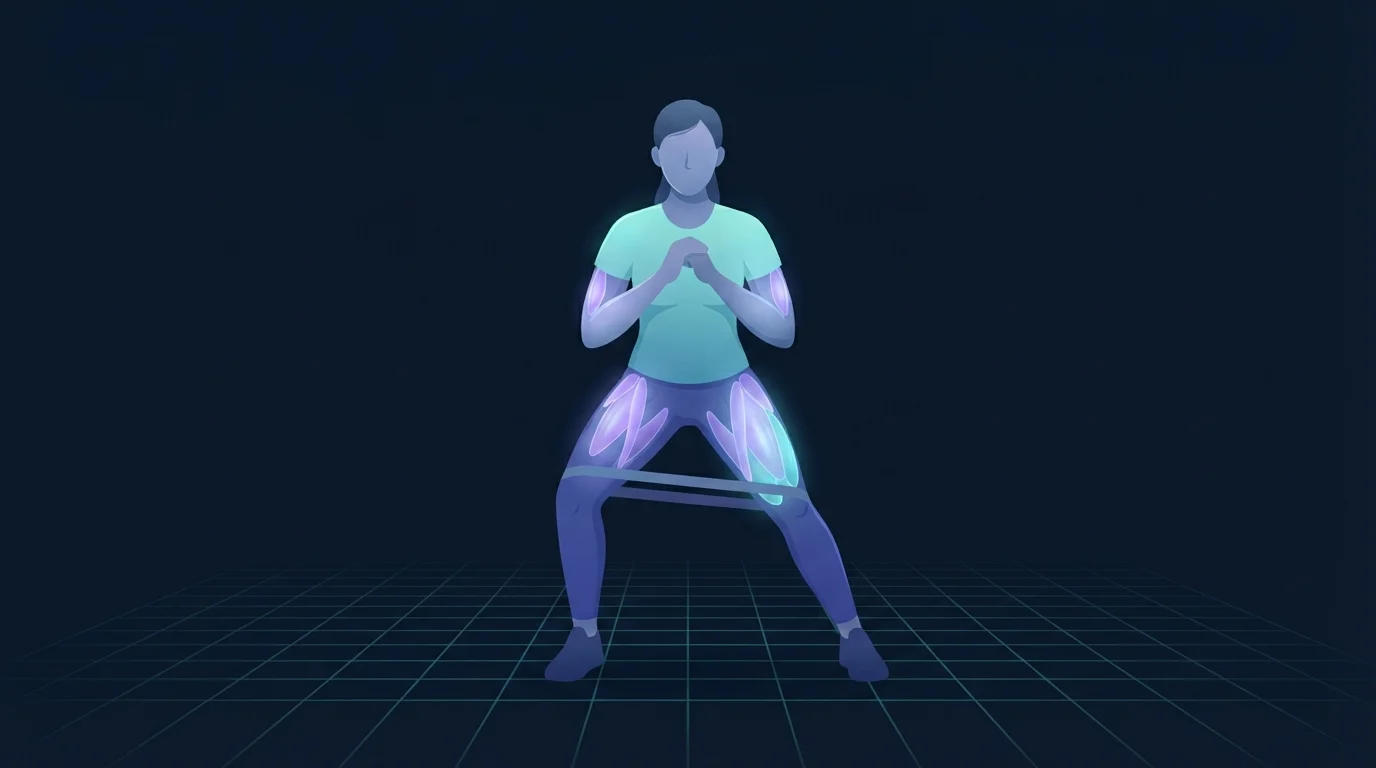
| C | Banded lateral walk in a half squat | 2 x 12 steps each way | Stay low, step wide, no bobbing up between steps |
Take every set to within one or two reps of failure. Because the band doesn't tell you what it weighs, reps in reserve is the only load gauge you have, and it's a good one: in the Andersen data below, perceived loading tracked measured muscle activity closely enough to prescribe intensity from feel alone.
Missing equipment is not a reason to skip a pattern. No short loop? Do the bridge without one and slow the lowering. No anchor for the leg curl? Swap in a single-leg hip hinge holding the long loop. The pattern matters more than the implement.
Find out what's really holding you back
FitCraft, our mobile fitness app, pairs you with an AI coach who builds you a personalized plan around your goals, schedule, and fitness level. Every FitCraft program is designed by Domenic Angelino, MPH (Brown University) and NSCA-CSCS, with research published in the Journal of Strength and Conditioning Research and Medicine & Science in Sports & Exercise.
Take the Free Assessment Free • 2 minutes • No credit cardMini-Band Glute Work: What the EMG Actually Shows
Short fabric loops have become the default warm-up for every home leg session, usually as clamshells. The measurement literature says that's the wrong default.
Distefano and colleagues (2009), in the Journal of Orthopaedic & Sports Physical Therapy, put surface electrodes on 21 healthy, physically active adults and compared gluteal activity across 12 common exercises. Gluteus medius activity was significantly greater during side-lying hip abduction (81 percent of maximum voluntary contraction) than during either clamshell variation (40 and 38 percent), lunges (48 percent) or hopping (48 percent). For gluteus maximus, the single-limb squat and the single-limb deadlift came out on top.
Posture changes the answer too. Berry and colleagues (2015) recorded hip muscle activity in 24 adults during resisted side stepping with a band around the ankles and compared an upright stance against a squat posture. Gluteal activity was greater in the squat posture and tensor fasciae latae activity was lower, and in both postures the stance limb worked harder than the moving limb. Hip abduction excursion was also greater at the stance hip.
Three practical reads come out of that. Sink into a half squat before you take a single side step. Count the leg standing still as the one being trained, which means both directions matter equally. And stop building the warm-up around clamshells, which reach the small deep rotators more than the big pelvic stabiliser. Our guide to glute activation exercises ranks the full list and explains how little time this work actually deserves.
How to Progress When You Can't Add Weight
This is where most band programs die. With dumbbells, progressive overload is obvious: pick up the heavier pair. With bands the knob is hidden, so people do the same session for four months and conclude bands don't work.
There are seven knobs. Use them roughly in this order, and change one at a time:
- Add reps until you hit the top of the range on every set.
- Slow the eccentric to three or four seconds. Same band, much more time under tension.
- Add a pause at the stretched position, where the band is slack and your muscles aren't.
- Step wider on the band or shorten the loop, which raises tension everywhere including the bottom.
- Go unilateral. One leg at a time roughly doubles the relative load without any new equipment.
- Double the band or add a second one.
- Add a set. Do this last, because it costs time and the other six don't.
The reason this works at all is that muscle growth isn't especially picky about absolute load once effort is high. The low-load side of the Schoenfeld analysis above reached similar hypertrophy to heavy training when sets went to failure, a pattern we unpack in our piece on whether light weights build muscle. Bands make you earn that effort with reps rather than plates, which is a fair trade if the alternative is not training.
Band Workout for Arms: The Other Half of the Same Kit
If you already own the bands for legs, the arm session costs you nothing but 15 minutes. And the upper-body evidence for elastic resistance is, if anything, cleaner than the lower-body evidence, because it comes with direct muscle-activity measurement rather than only strength outcomes.
Andersen and colleagues (2010), publishing in Physical Therapy, had participants perform matched upper-body exercises with dumbbells and with elastic tubing at each individual's maximal resistance for that exercise. Normalised prime-mover activity was not significantly different between the two: 59 to 87 percent for dumbbells, 64 to 86 percent for tubing. They also found perceived loading tracked measured activity strongly (r = 0.59 to 0.92), which is why rating your effort is a legitimate way to set band intensity.
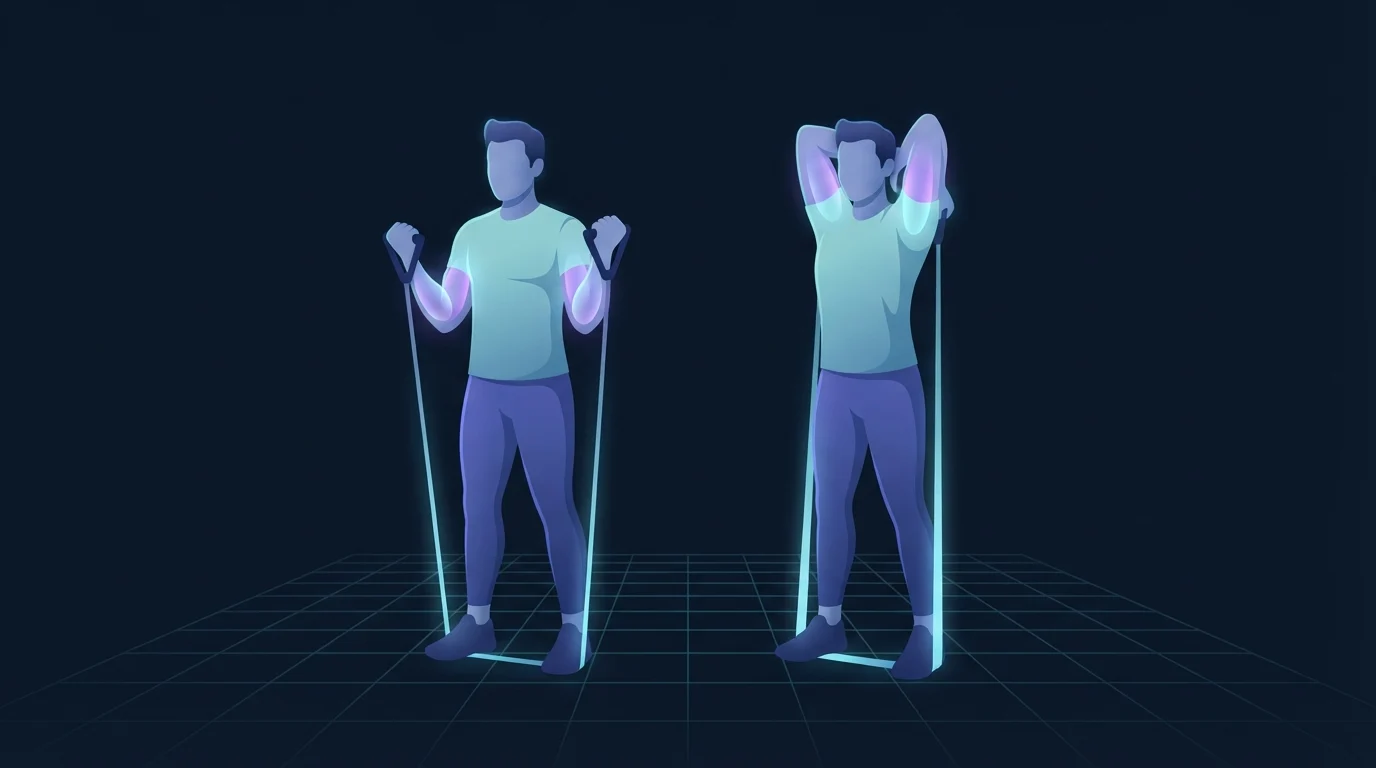
Arms carry the same resistance-profile problem as legs, flipped. On a curl the band is longest and hardest at the top, where the biceps is shortest, and slack at the bottom, where it's stretched. On an overhead triceps extension the same thing happens at lockout. The fix is identical: lower slowly, pause a beat in the stretched position, and don't let the band yank your arm back down.
| Exercise | Sets and reps | Setup |
|---|---|---|
| Band curl, both feet on the band | 3 x 12-15 | Elbows pinned to your sides, three seconds down |
| Band hammer curl | 2 x 12-15 | Neutral grip, same tempo, no swinging |
| Overhead triceps extension | 3 x 12-15 | Band anchored under one foot, elbows pointing forward |
| Triceps pushdown from a high anchor | 2 x 15-20 | Door anchor at head height, step back to pre-tension |
| Band pull-apart | 2 x 15-20 | Arms long, squeeze the shoulder blades, slow return |
The pull-apart isn't an arm exercise and it's on the list anyway. An arm day built purely out of curls and extensions leaves the rear shoulders and upper back untouched, and those are already the muscles a home training week under-serves.
Anchoring deserves 10 seconds of thought. Use a purpose-made door anchor on the hinge side of a door that opens away from you, or a heavy table leg. Never a bannister, a curtain rail, or a radiator pipe. Check every band for nicks and chalky patches before you load it, and retire anything that has either. If you'd rather have the sessions programmed and progressed for you instead of assembling them by hand, our roundup of the best fitness app for resistance band workouts covers what actually matters when you're choosing one. For band-friendly programs that progress the resistance for you, the best no-equipment workout apps roundup compares the options.
A Three-Day Week With Bands Only
| Day | Session | Time |
|---|---|---|
| Monday | Band leg workout, pairs A, B and C as written | 25 min |
| Wednesday | Band workout for arms plus rows and presses | 30 min |
| Friday | Band leg workout, lead with pair B and go unilateral | 25 min |
Two leg exposures a week is the target. Splitting 12 to 20 hard sets per muscle across two sessions keeps the quality of the later sets higher than cramming them into one long day. Swapping the pair order on Friday means the movements that get your freshest effort rotate week to week, which matters more with bands than with weights because band fatigue shows up as sloppy tempo long before it shows up as a missed rep. For the wider picture of how to build a week around no equipment, see our home workouts guide.
Six Ways a Band Leg Workout Goes Wrong
Treating it as a warm-up. If every set stops eight reps short of anything difficult, the session is a warm-up, and it will produce warm-up results. Get within one or two reps of failure or don't bother.
Letting the band pull you down. The eccentric is where the band is unloading, so it's very easy to just fall into the bottom position. That throws away half the rep. Three seconds down, always.
Standing up during lateral walks. Upright side stepping shifts work toward the tensor fasciae latae and away from the glutes. Sink first, then step.
Never changing the band. A medium band that was hard in January is a warm-up band in April. If you're still on the same loop at the same reps, you're maintaining, not training.
Skipping the hinge. Band squats are easy to set up and band hinges aren't, so people quietly drop the hamstring work. That's how you end up with sore quads and no posterior chain.
Anchoring somewhere unsafe. A band that lets go at full stretch travels fast and usually toward your face. Anchor points and band condition are the two safety items that matter here, and both take seconds to check.
The Bottom Line
A band workout for legs works when you build it around the resistance curve rather than in spite of it. Pause the bottom, slow the lowering, add one bodyweight movement that loads the stretch, and take the sets close to failure. Do that twice a week and the strength data says you'll get most of what a machine circuit would have given you, in a quarter of the space and none of the commute.
You didn't fail at bands. You were handed a tool with a resistance profile nobody explained and asked to use it like a dumbbell.
Frequently Asked Questions
Can you build leg muscle with just resistance bands?
Yes, within limits. A 2019 meta-analysis of eight controlled trials by Lopes and colleagues found no significant difference between elastic and conventional equipment for lower limb strength, and Colado and Triplett's 10-week trial in sedentary middle-aged women produced comparable results from bands and weight machines. The limit is top-end maximal strength, where heavy external load still wins, and the stretched bottom position of a squat or hinge, where a band goes nearly slack. Pauses, slow eccentrics and one loaded stretch per movement pattern cover most of that gap.
What does a good resistance band leg workout look like?
Six movements, roughly 25 minutes: a band squat, a band Romanian deadlift, a split squat or reverse lunge, a band leg curl, banded lateral walks in a half squat, and a glute bridge with a loop above the knees. Run 2 to 3 sets of 12 to 20 reps, stopping one or two reps short of failure, with 60 to 90 seconds of rest. Pause two seconds at the bottom of every squat and hinge, because that's the position where the band stops helping.
What does a good band workout for arms look like?
A band workout for arms is five movements and about 15 minutes: a two-foot band curl, a hammer curl, an overhead triceps extension, a triceps pushdown from a high anchor, and a band pull-apart for the rear shoulders. Andersen and colleagues (2010) measured prime-mover EMG during upper-body exercise at each person's maximal resistance and found no significant difference between dumbbells (59 to 87 percent) and elastic tubing (64 to 86 percent). The catch is the same as on legs: the band is heaviest at the top of a curl, where the biceps is already short, so the stretched bottom position needs a slow eccentric and a deliberate pause.
How often should you do a band workout for legs?
Twice a week for most people, with 48 hours between sessions. Bands produce less muscle damage than heavy eccentric loading, so recovery is usually quicker than a comparable dumbbell session, and two exposures a week lets you split 12 to 20 hard sets per muscle group across two quality sessions instead of one long one. A third leg day only makes sense once the first two are consistent and you have run out of ways to make the band harder.
Are mini-band lateral walks actually worth doing?
Yes, if you do them in a half squat rather than standing tall. Berry and colleagues (2015) recorded hip muscle activity in 24 adults during resisted side stepping and found gluteal activity was greater and tensor fasciae latae activity lower in the squat posture, and that the stance limb worked harder than the moving limb in both postures. So sink into a quarter or half squat, keep the band above the knees, and count the leg that is holding still as the one doing the work.
What bands do you need for a leg workout at home?
Two kinds. A long continuous loop in a medium and a heavy tension covers squats, hinges, lunges, rows and presses, and a set of short fabric loops covers lateral walks, bridges and hip abduction. Tubing with handles and a door anchor is the useful third piece, mostly for arms and pulling. Inspect every band before you load it, retire anything with a nick or a chalky patch, and never anchor to a bannister, a curtain rail or a door that opens toward you.