
Most band workouts for arms go the same way. You stand on the band, curl until your forearms burn, and a few weeks later your arms look exactly the same. It's easy to decide that real arm training needs a rack of dumbbells you don't have.
That's frustrating, because the effort was real. It also feeds a quiet doubt that working out at home is a second-best version of the gym.
The bands usually aren't the problem. The setup is. A band anchored under your feet goes slack at the exact point where your arm muscles are stretched, and the same band tends to get used for every exercise for months. This guide fixes both. You get 10 arm exercises, four ways to anchor a band, the band tension to use for each move and a 20-minute workout you can do twice a week.
10 Arm Exercises With Resistance Bands
The list covers your biceps (exercises 1 to 4), triceps (5 to 7) and shoulders (8 to 10). You need a long loop band or a tube band with handles, plus a door anchor for three of the moves. The table shows where each one is anchored, and the sections after it show how to do them.
| # | Exercise | Main muscles | Anchor | Sets x reps |
|---|---|---|---|---|
| 1 | Resistance band bicep curl | Biceps | Under both feet | 3 x 12-20 |
| 2 | Behind-the-back band curl | Biceps, long head | Low, behind you | 3 x 12-15 |
| 3 | Band hammer curl | Brachialis, brachioradialis | Under both feet | 3 x 12-20 |
| 4 | Reverse band curl | Forearms, brachialis | Under both feet | 2 x 15-20 |
| 5 | Overhead triceps extension | Triceps, long head | Under your back foot | 3 x 12-15 |
| 6 | Triceps pushdown | Triceps | High, on a door | 3 x 15-20 |
| 7 | Single-arm kickback | Triceps | Low, in front of you | 2 x 15-20 per arm |
| 8 | Band overhead press | Front and side shoulders, triceps | Under both feet | 3 x 10-15 |
| 9 | Band lateral raise | Side shoulders | Under both feet | 3 x 15-20 |
| 10 | Face pull | Rear shoulders, upper back | Face height, on a door | 3 x 15-20 |
Resistance Band Bicep Exercises
1. Resistance band bicep curl
Stand on the middle of the band with your feet hip-width apart and hold the ends or handles with your palms facing forward. Pin your elbows to your sides, curl your hands toward your shoulders, then lower over three seconds until your arms are straight. The band is lightest at the bottom, so don't let it yank your arms down. For more tension, stand with your feet wider, or cross a tube band into an X in front of your shins.
2. Behind-the-back band curl
Loop the band through a door anchor at the bottom of a closed door, or around a heavy table leg, and face away from it. Step forward until the band is taut with your arms hanging straight and slightly behind your body, then curl without letting your elbows drift forward. With your arms behind you, the long head of the biceps starts each rep stretched. Because you've stepped out to pre-stretch the band, it's already pulling hard at the bottom of the rep, the point where a curl with the band under your feet goes slack. Do it with both arms or one at a time.
3. Band hammer curl
Use the same setup as the bicep curl with your palms facing each other, and keep the same slow lowering. Holding the band thumbs-up moves more of the work to the brachialis and the brachioradialis, which add thickness to the side of your upper arm and the top of your forearm. Our hammer curls page shows the band and dumbbell versions and the common mistakes.
4. Reverse band curl
Hold the band with your palms facing down and curl with the same strict form, elbows pinned and wrists straight. You'll need a lighter band than for the regular curl. The overhand grip trains the brachioradialis and the muscles on the back of your forearm, which a week of palms-up curling leaves out.
Resistance Band Tricep Exercises
Three exercises cover the back of your arm from every angle: one with your arms overhead, one at your side and one behind you. Together they make a complete resistance band tricep workout.
5. Overhead triceps extension
Stand in a split stance with the band under your back foot. Hold the other end behind your head with both hands and point your elbows at the ceiling. Straighten your arms overhead, then lower your hands behind your head until you feel a stretch down the back of your arms. Raising your arms overhead stretches the long head of the triceps, the part that crosses your shoulder, so this is the triceps exercise to do first while you're fresh. Step the back foot farther behind you to add tension at the bottom.
6. Triceps pushdown
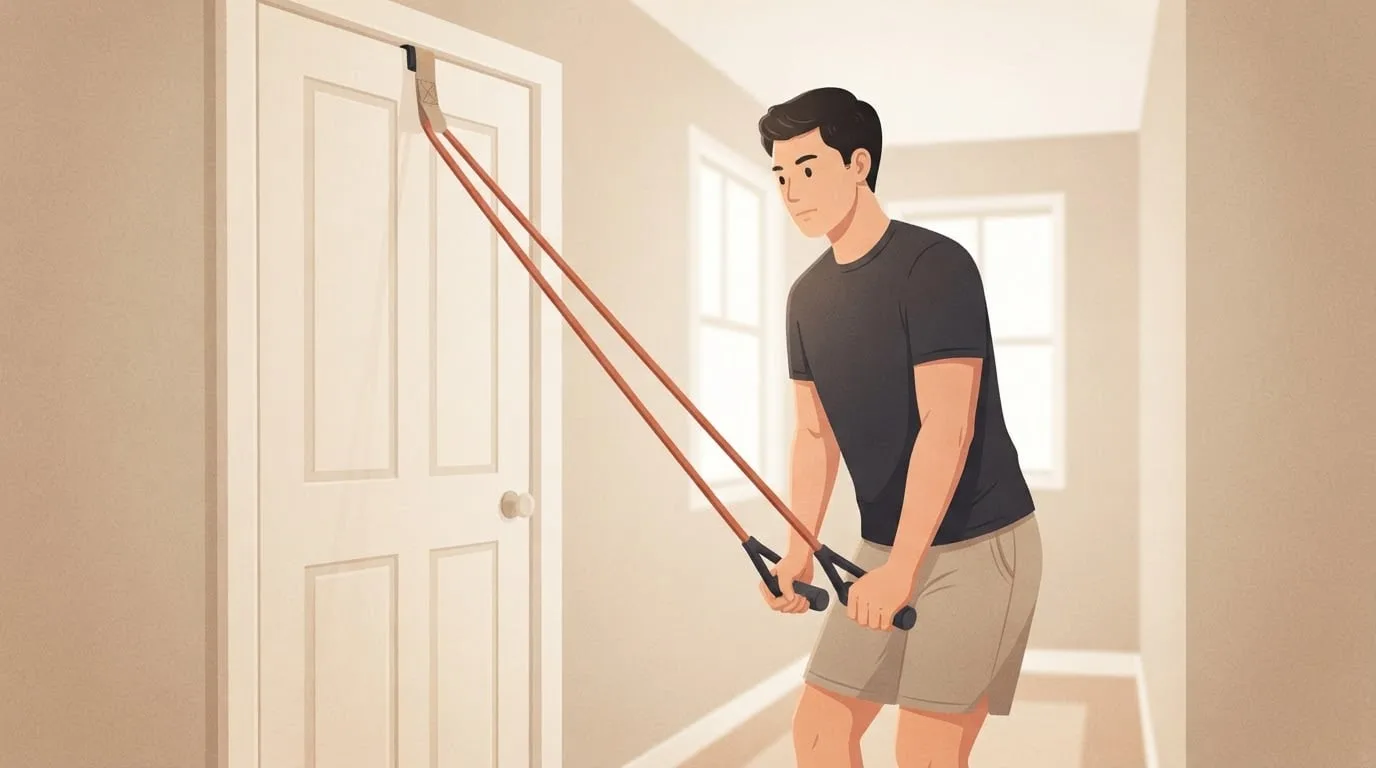
Anchor the band high on a closed door, face it, and hold the band with your elbows bent at your sides. Push your hands down until your arms are straight beside your thighs, then let the band pull your hands back up slowly. Only your forearms move. Our tricep extensions page covers this standing band pushdown step by step, and stepping back from the door adds tension.
7. Single-arm kickback
Anchor the band low in front of you, or stand on it with your front foot. Hinge forward with a flat back and hold your upper arm against your side, parallel to the floor. Straighten your elbow until your arm points straight back, squeeze for a second, then return slowly. The band is heaviest at full lockout, where the triceps is shortest, so use this one last as a finisher.
Resistance Band Shoulder Exercises
Shoulder work rounds out an arm workout. Your side shoulders give your upper body its width from the front, and your rear shoulders balance all the pressing and curling.
8. Band overhead press
Stand on the band with your feet hip-width apart and bring the ends to shoulder height with your palms facing forward. Press straight up until your arms are locked out beside your ears, then lower to your shoulders under control. Brace your stomach so your lower back doesn't arch. If the band is too strong near the top, stand on it with one foot or use a lighter band.
9. Band lateral raise
Stand on the band and hold an end in each hand at your sides. Raise your arms out to the sides to shoulder height with a slight bend in your elbows, leading with your elbows rather than your hands, and lower slowly. Most people need their lightest band here. In a study that included lateral raises, Andersen and colleagues (2010) found that elastic tubing at a 3-rep max produced muscle activity similar to dumbbells. Our lateral raises page covers the band version's form.
10. Face pull
Anchor the band at face height and hold it with your palms facing down. Pull toward your forehead while you spread your hands apart and drive your elbows back and out, pause for a second, then return slowly. Face pulls train the rear shoulders and the muscles that turn your upper arms outward, which pressing and curling leave out. No anchor? Do band pull-aparts instead, and our pull-apart page shows how.
How to Anchor a Resistance Band for Arm Exercises
Where the band is attached decides where in each rep it pulls hardest, so it pays to have all four options.
Under your feet
This is the simplest anchor, used for curls, presses, lateral raises and the overhead extension. Stand on the middle of the band with both feet for even tension, step wider to add tension, or use one foot for less. Keep the band flat under the middle of your foot rather than your toes, so it can't slip out mid-rep.
On a door
A door anchor is a fabric strap with a thick stopper that you shut in the door: at the top for pushdowns, at face height for face pulls, and at the bottom for behind-the-back curls and kickbacks. Use a solid door that closes and latches. Stand on the side the door swings away from, so every pull drags the door into its frame instead of opening it.
Around something fixed
A pull-up bar, a sturdy post or the leg of a heavy table also works. Test it with a hard tug before your first set. Anything that can tip, bend or roll isn't an anchor.
Your own body
For single-arm work, your other hand can be the anchor. Hold one end of the band at your opposite shoulder and push down with the working arm for a one-arm pushdown, or pin it at your opposite hip for a kickback. It's the fastest setup when you're traveling.
Before each session, run every band through your fingers to feel for nicks, tears or tacky spots, and throw out any band that has one. A band that snaps at full stretch can hit hard, so keep worn bands well away from face pulls and overhead work.
Find out what's really holding you back
FitCraft, our mobile fitness app, pairs you with an AI coach who builds you a personalized plan around your goals, schedule, and fitness level. Every FitCraft program is designed by Domenic Angelino, MPH (Brown University) and NSCA-CSCS, with research published in the Journal of Strength and Conditioning Research and Medicine & Science in Sports & Exercise.
Take the Free Assessment Free • 2 minutes • No credit cardThe 20-Minute Resistance Band Arm Workout
This arm workout with bands runs as three supersets: two exercises done back to back, then a short rest. The stretched-position exercises come first, while you're fresh. Do it twice a week on days that aren't back to back, and end each set 1 or 2 reps in reserve, the point just before your form would start to break.
Warm up for 2 minutes first: 30 seconds of arm circles in each direction, then one light set of 10 curls and 10 pushdowns.
| Superset | Exercise | Sets x reps | Rest |
|---|---|---|---|
| A | Behind-the-back band curl | 3 x 12-15 | None, go straight to the extension |
| A | Overhead triceps extension | 3 x 12-15 | 45 sec after the pair |
| B | Band hammer curl | 3 x 12-20 | None, go straight to the pushdown |
| B | Triceps pushdown | 3 x 15-20 | 45 sec after the pair |
| C | Band lateral raise | 3 x 15-20 | None, go straight to the face pull |
| C | Face pull | 3 x 15-20 | 45 sec after the pair |
That's 6 hard sets for your biceps and 6 for your triceps in each session, or 12 a week, plus shoulder work. Swap in the standard bicep curl, the reverse curl, the kickback or the overhead press from the list above every few weeks to keep the session fresh.
Resistance band arm workout for beginners
If you're new to training, do 2 rounds of each superset instead of 3, swap the behind-the-back curl for the standard bicep curl, and use bands light enough for 15 clean reps. After two weeks without joint pain, move up to 3 rounds. If you'd like a full-body band session to go with it, our guide to resistance band workouts has a beginner routine.
If you'd rather have your sessions planned and progressed for you, a home workout app with no equipment needed can take that part off your plate. FitCraft's strength workouts are built on bodyweight and dumbbells, with a handful of band exercises such as band hammer curls and band lateral raises, and your AI coach demonstrates each exercise on an interactive 3D model you can rotate and zoom. Workouts adjust as you progress, and streaks and calendar tracking help two short sessions a week keep happening.
Resistance Band Tension: Which Band to Use for Arms
Band colors only tell you the order within one maker's set, and the printed numbers can be optimistic. When Uchida and colleagues (2016) measured eight colors of one maker's flat exercise bands, the real tension ran 13 to 44 percent below the manufacturer's figures, and the two lightest colors pulled almost the same. Choose your bands by how they feel in each exercise, not by the label.
Tension also depends on how far you stretch the band. In the same study, the heaviest band pulled 5.7 kg when stretched to twice its resting length and 7.6 kg at three times its resting length, and across the eight colors tension rose 33 to 60 percent over that range. Every extra inch of stretch adds tension, which is why stepping wider or choking up on the band makes an exercise harder without a new band. Those were light flat bands; thick loop bands pull far more.
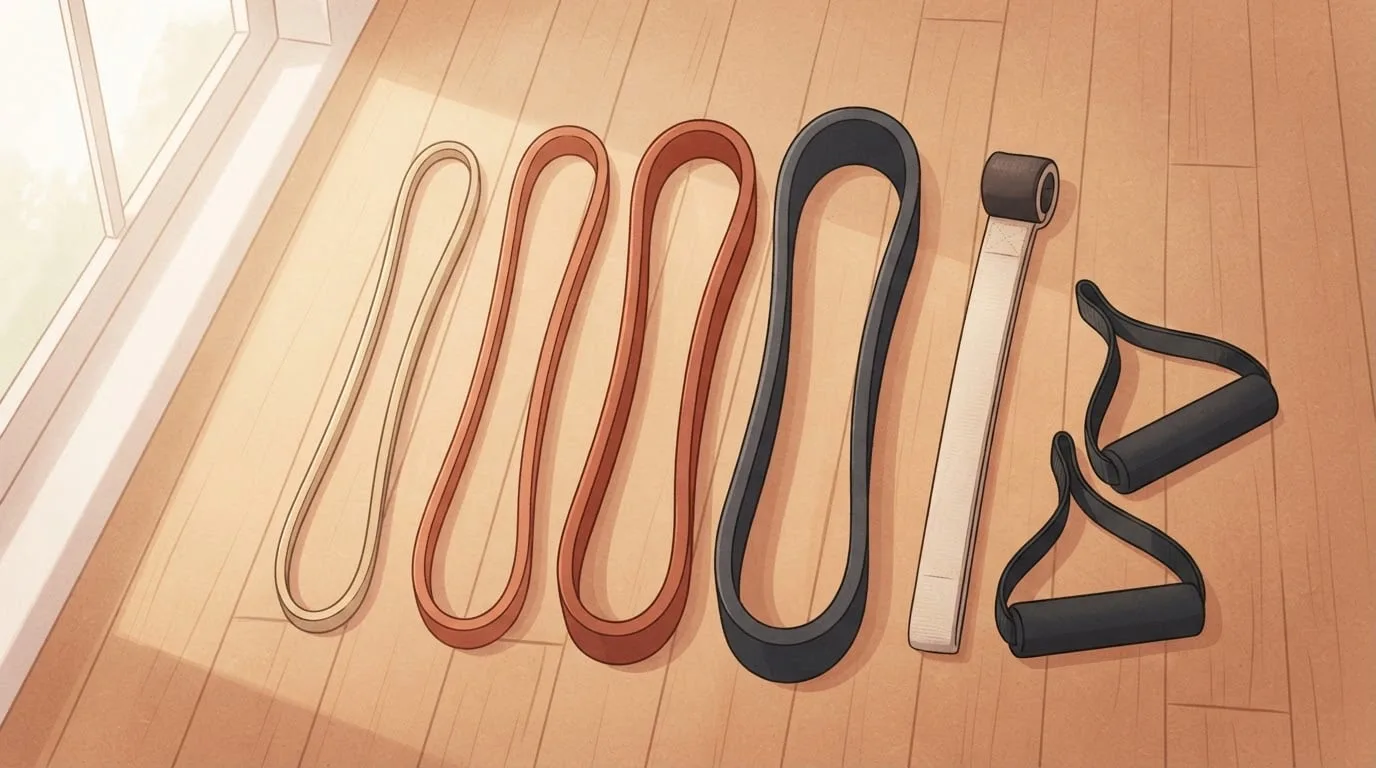
As a starting point, use your lightest band for lateral raises and kickbacks, a medium band for curls and face pulls, and your heaviest for pushdowns, overhead extensions and presses. The right band lets you finish 12 to 20 controlled reps with 1 or 2 left in reserve.
How to progress a band arm workout
A band has no number on it to remember, so note the band and the stance you used for each exercise. Then change one thing at a time.
| When this happens | Do this |
|---|---|
| You pass 20 reps on every set | Step wider, choke up on the band or stand farther from the anchor |
| The bottom of the rep feels slack | Pre-stretch the band and pause for a second in the stretch |
| A shorter band still feels easy | Add a second band or move up one band |
| Two-arm curls are easy with your heaviest band | Curl one arm at a time with the whole band |
| Your form breaks before 12 reps | Drop to a lighter band or a narrower stance |
Resistance Bands vs Weights for Arms: What the Trials Show
For strength, bands and weights come out even. Lopes and colleagues (2019) pooled 8 trials that compared elastic bands and tubes with dumbbells and machines, and found no difference in upper-body strength gains. Our review of resistance band training research walks through those trials one by one.
Muscle activity is similar too. A meta-analysis by Aboodarda and colleagues (2016) found no significant difference in activation of the main working muscles between elastic resistance and free weights or machines. Our band workout for legs has the numbers from the lateral raise study above, along with a shorter arm session that pairs with leg day.
Bands do add a balance demand. In a crossover study of 29 adults, Bergquist and colleagues (2018) matched bands and dumbbells at a 10-rep max for flyes and reverse flyes. The bands produced slightly lower activity in the target muscles and noticeably more in the shoulder muscles that steady the arm, which the authors linked to bands being a less stable resistance.
The real difference is the stretched position. Arm muscles grow more when they're loaded while long. In a trial by Sato and colleagues (2021), curls in the straight-elbow part of the range grew the elbow flexors 8.9 percent, against 3.4 percent for the bent-elbow part. Maeo and colleagues (2023) measured about 1.4 times the triceps growth from overhead extensions compared with extensions with the arms down. Our dumbbell arm workout covers both trials. A band anchored under your feet is lightest at exactly those stretched positions, which is why exercises 2 and 5 set the band up behind or below you so it pulls when your muscles are long.
What are the disadvantages of resistance bands?
Bands have four real downsides for arm training. They're lightest in the stretched part of most exercises unless you anchor them carefully. You can't read the load off the band, and the printed values can be wrong, as the tension study above showed. Strong lifters can outgrow a single band on presses, though stacking two helps. And bands wear out: the rubber dries and cracks with age, and a worn band can snap.
Is 20 Minutes of Resistance Training Enough?
Yes, 20 minutes is enough for your arms when the sets are hard. In a review of time-efficient training, Iversen and colleagues (2021) put the minimum at 4 weekly sets per muscle group. They noted that sets of 15 to 40 reps still work when they're taken to failure, which suits bands, and that supersets roughly halve the time a session takes. Two 20-minute band sessions a week give your biceps and triceps about 12 hard sets each, three times that minimum.
The Bottom Line
A resistance band arm workout works when the band is set up for each exercise, not just stood on. Anchor it so it pulls in the stretch, pick a band you can control for 12 to 20 reps, take each set close to failure and add tension as you get stronger. Twice a week for 20 minutes is enough to see your arms change.
Your bands were never the weak link. They just needed a better setup.
Frequently Asked Questions
Can you build arm muscle with resistance bands?
Yes. In a 2019 meta-analysis of 8 trials, elastic bands built upper-body strength as well as dumbbells and machines did, and muscle activity with bands matches free weights when the effort is matched. To grow your arms, take sets within 1 or 2 reps of failure, anchor the band so it pulls in the stretched position, and keep adding tension as you get stronger.
How many times a week should I use resistance bands?
Two or three times a week works for most people, with a day off between sessions. For your arms, two 20-minute sessions a week give your biceps and triceps about 12 hard sets each, three times the minimum of 4 weekly sets per muscle in a review of time-efficient training. Add a third session only if you recover well between them.
Which color resistance band is lightest?
It depends on the brand, because each maker uses its own color scale. In a lab test of one maker's eight colors of flat exercise band, tan and yellow were the lightest and pulled almost the same, and the measured tension was mostly below the printed values. Judge a band by feel: if you can't do 12 controlled curls with it, it's too heavy to start with.
Do resistance band exercises work for flabby arms?
Resistance band exercises firm up the muscles under the skin, but they can't burn fat from your arms alone. Fat comes off your whole body through your overall eating and activity, and your arms change as it does, as our guide on how to lose arm fat explains. Training your arms while you lose fat means there's more muscle to see when it goes.
Can you do an arm workout with a mini band?
Yes, but a mini band mostly trains your shoulders. A small loop around your wrists works well for lateral raises, pull-aparts and outward shoulder rotations. Curls and triceps extensions need a long loop band or a tube band, so your arms can move through their full range.
How long does it take to see results using resistance bands?
Measurable muscle growth can show up within about 5 weeks. In a trial of untrained adults, twice-weekly curls through the straight-elbow part of the range grew the elbow flexors 8.9 percent in 5 weeks, and their strength rose 16 to 21 percent. A visible change in arm shape depends on how much fat covers the muscle, so it can take longer.