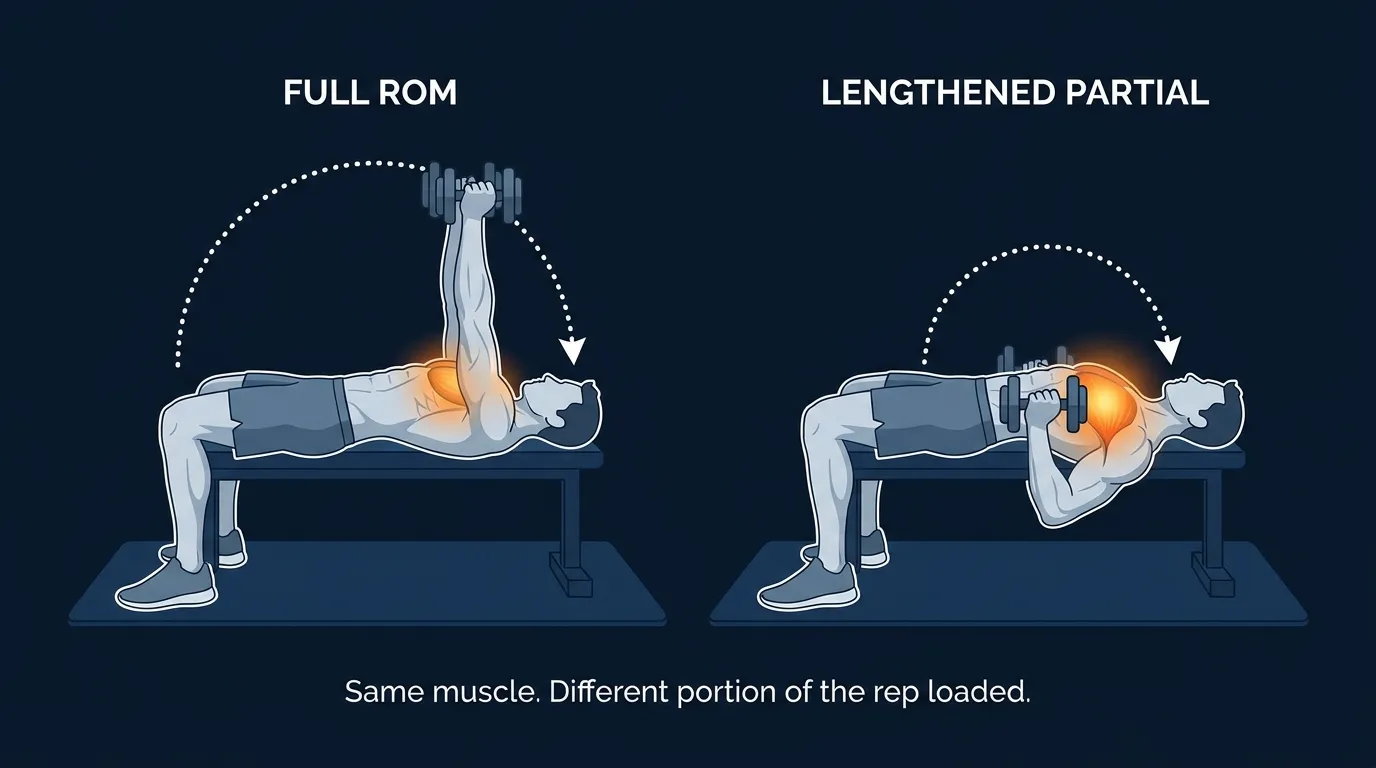
"Half-reps" used to be an insult in the gym. If you cut a squat above parallel or bounced a bench press off your chest, someone was going to tell you about it. Then the research caught up and quietly reversed course.
Not on every half rep. If you skip the bottom of a squat, you are still cheating yourself. But if you deliberately train the bottom half only, staying where the muscle is stretched and loaded, something different happens. You grow. Sometimes more than you would training the full range.
The technique has a name now. Lengthened partials. The research stack includes trials on hamstrings, quads, calves, biceps, and triceps, plus two systematic reviews. Here is what those studies actually found, why the effect happens, and how to use lengthened partials in a normal home program without barbells or machines.
What Lengthened Partials Actually Are
A full range of motion rep takes a joint through its complete usable arc. A push-up starts at lockout, drops until the chest is at hand level, and pushes back. A squat starts standing, drops to depth, and stands back up.
A lengthened partial rep is different. You perform only the deep half of the movement, staying inside the range where the working muscle is stretched. On a push-up, that means staying in the bottom half, chest close to the floor, and pressing up only partway before dropping back down. On a bicep curl, it means the bottom half of the curl where the biceps are long. On a calf raise, it is the descent below the step and the initial push out of the stretch.
The opposite (partials done at the top of the movement, where the muscle is short) is called a "shortened partial" and has consistently been the worst-performing option across studies. So when we say "lengthened partials," we mean specifically the bottom, stretched half, not just any partial rep.
The Research: What Studies Show
Wolf et al. (2025): Similar Gains in Trained Lifters
Milo Wolf and colleagues (including Brad Schoenfeld) ran a within-participant trial in PeerJ in 2025. Thirty resistance-trained adults trained one arm with full range of motion and the other with lengthened partials for eight weeks, two sessions per week, four exercises per session, four sets per exercise. All other training variables (load, weekly sets, effort) were matched.
Muscle thickness of the elbow flexors and extensors was measured with ultrasound. 10-rep max strength was tested at both a full and a partial range.
- Muscle thickness: similar increases for both conditions
- Full-ROM strength endurance: similar improvements
- Partial-ROM strength endurance: similar improvements
The headline: in trained lifters, lengthened partials matched full ROM on both growth and strength, even though each partial rep covered a shorter distance. That is a striking finding, because if two techniques produce the same outcome, the shorter-distance one is more time-efficient. Full text: peerj.com/articles/18904. Also indexed at PubMed 39959841.
Wolf et al. (2023): The Meta-Analysis
Two years earlier, the same lead author ran a systematic review and meta-analysis in the International Journal of Strength and Conditioning pooling every partial-versus-full-ROM trial they could find. When the partials were performed at long muscle lengths, the pooled effect favored partials with a standardized mean difference around 0.28. That is a small but meaningful effect in favor of lengthened partials, driven mostly by trials in less-trained populations.
Read together with the 2025 direct trial, the pattern is clear. In untrained people, lengthened partials tend to beat full ROM. In trained people, they roughly tie. Nobody in the literature is finding full ROM beats lengthened partials, as long as the partials are done in the stretched position.
Open access: Wolf et al. (2023) at IJSC.
Pedrosa et al. (2022): Half Range, More Growth
Pedrosa and colleagues (including Schoenfeld again) published a knee-extension trial in the European Journal of Sport Science. Forty-five untrained women were randomized to four training conditions or a non-training control:
- Full ROM: 100 degrees to 30 degrees of knee flexion
- Initial Partial: 100 degrees to 65 degrees (the deep, stretched half)
- Final Partial: 65 degrees to 30 degrees (the shortened top half)
- Varied: alternating between Initial and Final on different days
The Initial Partial group (lengthened partials only) produced greater muscle growth at the distal quadriceps than every other group, including the Full ROM group. The Final Partial group (shortened partials only) grew the least. Half the range of motion, done in the stretched position, beat the full range.
Full text: Pedrosa et al. (2022). doi:10.1080/17461391.2021.1927199.
Kassiano et al. (2023): The Calf Study
Kassiano and colleagues at Londrina State University ran a leg-press calf-raise trial published in the Journal of Strength and Conditioning Research. Forty-two women trained for eight weeks, three days per week, three sets of 15 to 20 reps, with the range set to one of three conditions:
- Initial ROM (stretched-half only, i.e. lengthened partials): +15.2% medial gastrocnemius
- Full ROM: +6.7%
- Final ROM (shortened-half only): +3.4%
Calves trained with lengthened partials grew more than twice as much as calves trained through the full range. The lateral gastrocnemius showed the same pattern. Calves are notorious for not responding to standard training. This study is one of the cleanest published demonstrations that the "where in the rep" lever matters more than the "how many reps" lever.
Kassiano et al. (2023) on PubMed.
Maeo et al. (2021): The Hamstring Reference Trial
Maeo and colleagues at Ritsumeikan University published the study that started much of the current interest in Medicine & Science in Sports & Exercise. Twenty adults trained one leg with seated leg curls (hip flexed, hamstrings stretched) and the other with prone leg curls (hip extended, hamstrings short), 5 sets of 10 reps, 70% of 1RM, twice a week, for 12 weeks. MRI measured whole-muscle growth.
- Long-length training (seated): +14% whole hamstring volume
- Short-length training (prone): +9%
Same weekly sets. Same weekly reps. Same load. About 50% more growth from training the same muscle at a longer length. This was not a lengthened-partial study strictly, but it established the mechanism the partials research is built on. Where you place the load inside the rep changes how much muscle you grow.
Maeo et al. (2021). doi:10.1249/MSS.0000000000002523.
Why Lengthened Partials Work
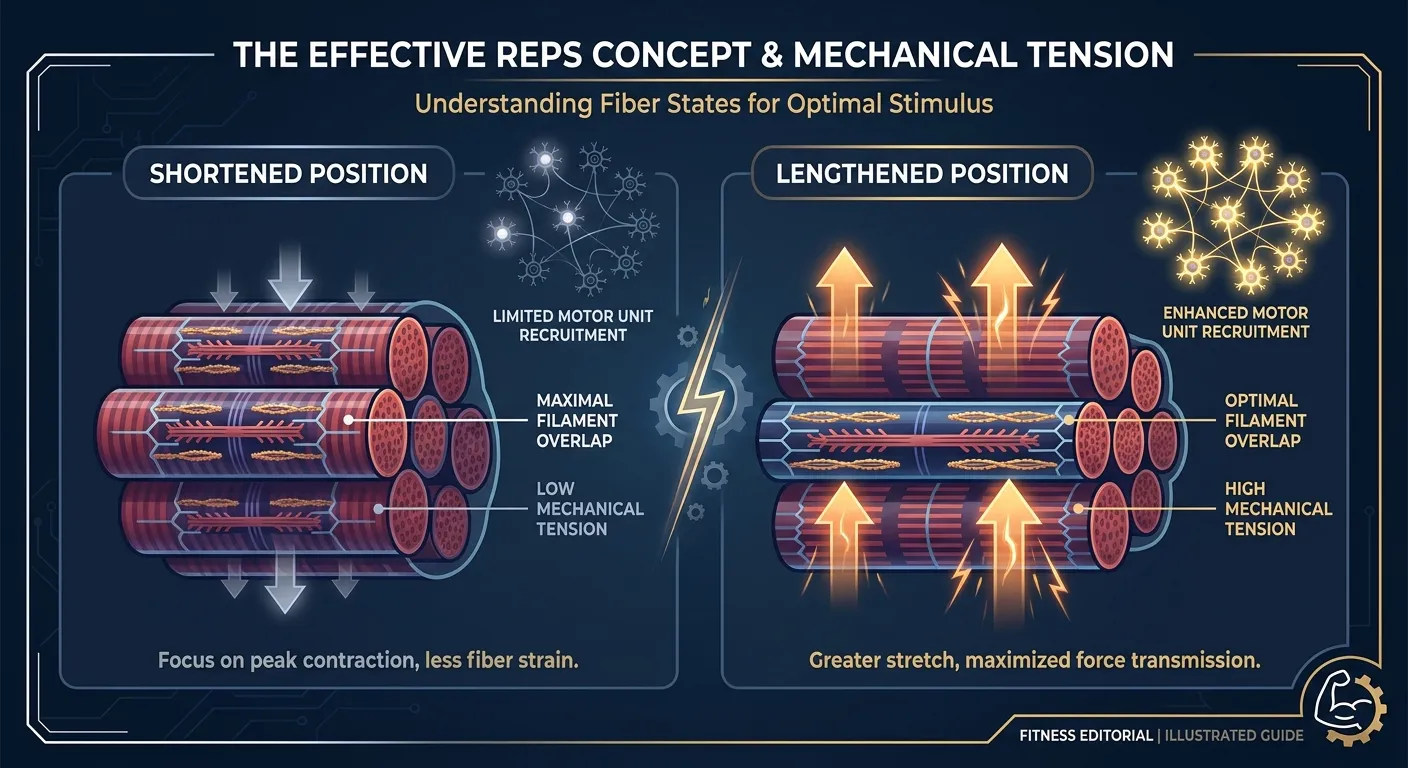
The data landed before the mechanism did. Researchers are still untangling exactly why the stretched half of the rep drives so much of the adaptation. A few pieces are clear.
More Mechanical Tension Per Active Fiber
Individual muscle fibers produce more force when they are contracting from a longer starting length. In the deep, stretched position of an exercise, the fibers you actively recruit are working against more load per unit of fiber. Mechanical tension is the primary signal that tells a muscle to grow, so more tension per fiber tends to mean more growth signal. This is the same mechanism behind the hypertrophy advantage of eccentric training.
The Effective Reps Hypothesis
One influential idea in hypertrophy research is that not every rep of a set contributes equally to growth. The last few reps before failure (roughly 5 reps in reserve or fewer) recruit high-threshold motor units that account for most of the muscle-building stimulus. Lengthened partials concentrate the working set inside the range where each rep is already loaded like a "hard" full-ROM rep. In effect, more of the reps in a lengthened-partial set are "effective."
Longer Fascicles, Different Architecture
Training at long muscle lengths tends to add sarcomeres in series, which lengthens the muscle fascicles. This changes the muscle's architecture, not just its size. Longer fascicles let the muscle produce force across a wider range of joint angles and at higher shortening velocities. This is the same architectural change eccentric training drives, and it has practical implications for injury resilience in movements that operate at end-range (sprinting, deep lunges, catching yourself on a fall).
Time-Efficient by Design
If lengthened partials produce similar hypertrophy to full ROM (in trained lifters) or more (in beginners), and each rep covers less distance, the technique is inherently time-efficient. You do less mechanical work for equal or better outcomes. That is rare in strength training. Most trade-offs run the other way.
Get an evidence-based plan built for you
FitCraft, our mobile fitness app, pairs you with an AI coach who builds you a personalized plan around your goals, schedule, and fitness level. Every FitCraft program is designed by Domenic Angelino, MPH (Brown University) and NSCA-CSCS, with research published in the Journal of Strength and Conditioning Research and Medicine & Science in Sports & Exercise.
Take the Free Assessment Free • 2 minutes • No credit cardHow to Program Lengthened Partials
There are three main ways to work lengthened partials into a normal program. All three are supported by the research.
1. As an Extension Set (The Easiest Way to Start)
Do a normal full-ROM set to failure or close to it. When you cannot complete another full rep, cut the range and keep going in the bottom half. Stop when you cannot complete another partial rep either.
Example: bodyweight push-ups. Do full-ROM reps until you can barely push yourself up. Then instead of stopping, do 3 to 8 more lengthened partials in the bottom half, chest close to the floor, small presses to about halfway up and back down. Each partial recruits fibers already fatigued from the full set. This is a home-training analog of a classic "myo-rep" set.
This is the safest starting point because you are not asking your joints to absorb load in an unfamiliar range as a fresh, cold muscle. You are just extending a set that was already working.
2. As Dedicated Lengthened-Partial Sets
Program entire sets as lengthened partials. Because each rep covers less distance and produces more tension, you typically need slightly higher rep counts to fatigue the muscle. A working set of 10 to 15 partials to failure is a reasonable target for most exercises.
Two to three lengthened-partial working sets per muscle, two sessions per week, is enough for most people. This is roughly the volume prescription Wolf's group used and it drove real growth in eight weeks.
3. As Contrast Sets in a Full Program
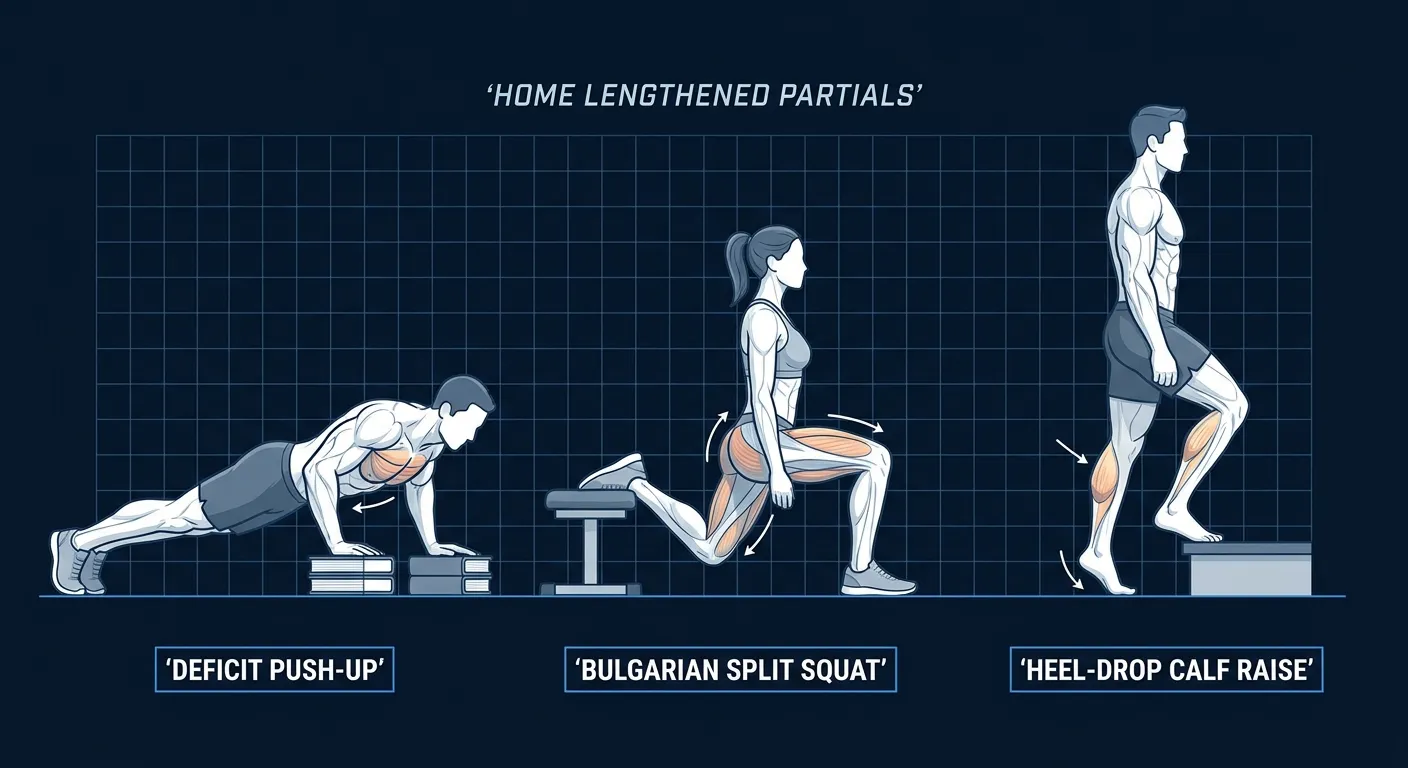
Mix full-ROM and lengthened-partial sets inside the same session. On chest day, do three sets of full-ROM push-ups followed by two sets of deficit push-up lengthened partials. On leg day, do three sets of Bulgarian split squats through a normal range followed by two sets held in the bottom, stretched position.
This preserves the joint-health and mobility benefits of a full range while adding the concentrated hypertrophy stimulus of the partials. It is what most of the studies actually programmed when they compared conditions inside the same body.
Best Home Exercises for Lengthened Partials
The trials all used machines because labs need precise ROM control. The mechanism does not care about equipment. Any exercise with a clear stretched position and a controllable descent can work.
- Deficit push-ups (chest, triceps): hands on low blocks, books, or yoga blocks so your chest can drop below hand level. Stay in the bottom half. This is the closest home analog to the studies.
- Bulgarian split squat holds (quads, glutes): back foot elevated, drop into a deep split squat, and press only halfway up before dropping back down. Pause for a beat at the bottom.
- Dumbbell Romanian deadlifts (hamstrings, glutes): hinge until you feel a firm stretch in the hamstrings, then stand only halfway before returning to the stretch. Bodyweight or a light band works if you don't own dumbbells.
- Calf raises off a step (calves): heels dropped below the step, press up about halfway and drop back to the stretch. This is directly transferable from the Kassiano data.
- Pull-up dead-hang holds and quarter reps (lats, biceps): from a full dead hang, pull yourself up a few inches and lower back to hang. If pull-ups are too hard, do slow eccentrics that end in a deep hang.
- Dumbbell flyes at the bottom (chest): lie on the floor or a bench, let the arms stretch out wide, and bring them only partway back before returning to the stretch. Light dumbbells work fine.
- Split-stance dumbbell bicep curls (biceps): lean back slightly with the working arm behind the body line, and curl only the bottom half of the range.
Pair any of these with slow eccentrics. A 3-second descent into the stretched position, with a half-second pause at the bottom, does most of the technique work for you.
Common Misconceptions
"Lengthened partials mean I can skip warming up."
No. If anything, deep, loaded ranges need more warm-up than middle-range work. Get the joints moving, do a light bodyweight set or two through the full range, and only then start loading the lengthened position. The stretched half is where a cold joint is most vulnerable.
"Any partial rep counts."
Only if it is in the stretched half. Every study that tested partials at the top of the movement (shortened partials) found them dramatically worse than either full ROM or lengthened partials. Pedrosa 2022 found shortened partials produced the least quad growth of any condition. Kassiano 2023 found the same pattern for calves. Cutting the top of a squat is fine. Cutting the bottom is not.
"Lengthened partials replace full ROM."
They do not have to. In trained lifters they roughly match full ROM, but full ROM still trains coordination and control through positions your joints will actually meet in daily life. Most people should use lengthened partials as an addition to a full-ROM base, not as a replacement. The one clear case for using them as a replacement is time efficiency, where you want to build muscle in the fewest possible minutes.
"More depth is always better."
There is a point of diminishing return. None of the studies pushed participants into passive, painful stretch. The muscle needs to be actively producing force in the deep position, not just being dragged into a stretch. If the joint starts hurting or the muscle turns off and your ligaments and tendons pick up the load, you are no longer training. You are just stretching, and the effect changes. See our review of static versus dynamic stretching for what stretching actually does and does not do.
What the Research Suggests Going Forward
The overall picture is more settled than most training-technique debates. Lengthened partials work. In beginners they tend to beat full ROM. In trained lifters they match it. Nobody is finding they underperform full ROM when the partials are done in the stretched half.
Several open questions remain. Most trials ran eight to twelve weeks. We have limited data on what happens at six months or a year. The magnitude of the beginner advantage might shrink as people accumulate training experience, which is the pattern the Wolf 2025 direct trial suggested. The mechanism (mechanical tension at long muscle length) should generalize to muscles that have not been directly studied (glutes, lats, delts), but the effect size could vary by muscle architecture. And we have no long-term joint-health data. Concentrating load in the stretched position is safe in eight-week trials, but whether it changes injury risk over years of training is not yet known.
The practical translation is simple. Add lengthened partials to what you are already doing. Do not overhaul your program. And if the deep position of a movement scares you a little, that is probably where the growth is hiding. For a deeper look at the broader science these findings sit inside, see our review of stretch-mediated hypertrophy. For guidance on how hard to push each set, see our review of training to failure versus reps in reserve. For efficient home programming that folds these techniques in, see our short-workouts guide.
References
- Wolf M, Androulakis-Korakakis P, Piñero A, Mohan A, Hermann T, Augustin F, Sapuppo M, Coleman M, Burke R, Refalo M, Swinton P, Schoenfeld B. "Lengthened partial repetitions elicit similar muscular adaptations as full range of motion repetitions during resistance training in trained individuals." PeerJ. 2025;13:e18904. doi:10.7717/peerj.18904
- Wolf M, Androulakis-Korakakis P, Fisher J, Schoenfeld B, Steele J. "Partial Vs Full Range of Motion Resistance Training: A Systematic Review and Meta-Analysis." Int J Strength Cond. 2023;3(1). Open access
- Pedrosa GF, Lima FV, Schoenfeld BJ, Lacerda LT, Simões MG, Pereira MR, Diniz RCR, Chagas MH. "Partial range of motion training elicits favorable improvements in muscular adaptations when carried out at long muscle lengths." Eur J Sport Sci. 2022;22(8):1250-1260. doi:10.1080/17461391.2021.1927199
- Kassiano W, Costa B, Kunevaliki G, et al. "Greater Gastrocnemius Muscle Hypertrophy After Partial Range of Motion Training Performed at Long Muscle Lengths." J Strength Cond Res. 2023;37(9):1746-1753. PubMed: 37015016
- Maeo S, Huang M, Wu Y, Sakurai H, Kusagawa Y, Sugiyama T, Kanehisa H, Isaka T. "Greater Hamstrings Muscle Hypertrophy but Similar Damage Protection after Training at Long versus Short Muscle Lengths." Med Sci Sports Exerc. 2021;53(4):825-837. doi:10.1249/MSS.0000000000002523
Frequently Asked Questions
What are lengthened partials?
Lengthened partials are partial-range-of-motion reps performed only in the deep, stretched half of a movement. Instead of doing a full push-up from lockout down to the chest and back up, you'd stay in the bottom half where the pecs are lengthened. Wolf et al. (2025) tested this technique in trained lifters over eight weeks and found lengthened partials produced similar muscle thickness gains to full range of motion training.
Do lengthened partials build more muscle than full range of motion?
It depends on training experience. In beginners, several studies (Pedrosa 2022, Kassiano 2023) found lengthened partials produced more growth than full ROM. In trained lifters, Wolf et al. (2025) found the two methods produced similar gains over eight weeks. The 2023 Wolf meta-analysis pooled the data and found a small effect (standardized mean difference around 0.28) favoring lengthened partials at long muscle lengths.
How do you program lengthened partials?
The most common approach is to use lengthened partials as an extension of a normal set. After reaching failure on full-range reps, cut the range and continue in the bottom, stretched half until you fail again. Another approach is to program entire exercises as lengthened partials for time efficiency, using slightly higher rep ranges (10 to 15) since each rep covers less distance. Two sessions per week per muscle is enough.
Which exercises work well for lengthened partials at home?
Deficit push-ups (hands on low blocks), the bottom half of a Bulgarian split squat, dumbbell Romanian deadlifts held in the stretched position, calf raises with the heels dropped below a step, dead-hang pull-up negatives, and dumbbell flyes at the bottom of the range. Any exercise with a clear stretched position and a controllable descent can work.
Are lengthened partials safe?
For most healthy adults, yes, with some caveats. The deep, loaded position creates more mechanical stress on tendons and connective tissue than middle-range training, and the first few sessions produce noticeably more soreness. The repeated bout effect kicks in quickly and soreness drops sharply by the third session. People with prior joint injuries, hypermobility, or connective tissue conditions should progress into the range gradually and consult a qualified provider first.