The clamshell is one of those exercises that doesn't look like much. You're lying on your side. You open one knee. That's it. But the gluteus medius (the muscle it targets) is the one most likely to be weak and most likely to cause knee pain, hip drop, and IT band issues when it is. Physical therapists prescribe clamshells more than almost any other hip exercise for that reason.
This guide covers proper form, Coach Ty's cues, the most common form mistakes, when to avoid the exercise, and how clamshells compare with fire hydrants and other glute medius work.
Quick Facts: Clamshells
- Equipment needed: None (mini resistance band optional for progression)
- Difficulty: Beginner
- Modality: Isolation, unilateral, hip abduction and external rotation
- Body region: Hips and glutes
- FitCraft quest category: Strength and activation
Muscles Worked
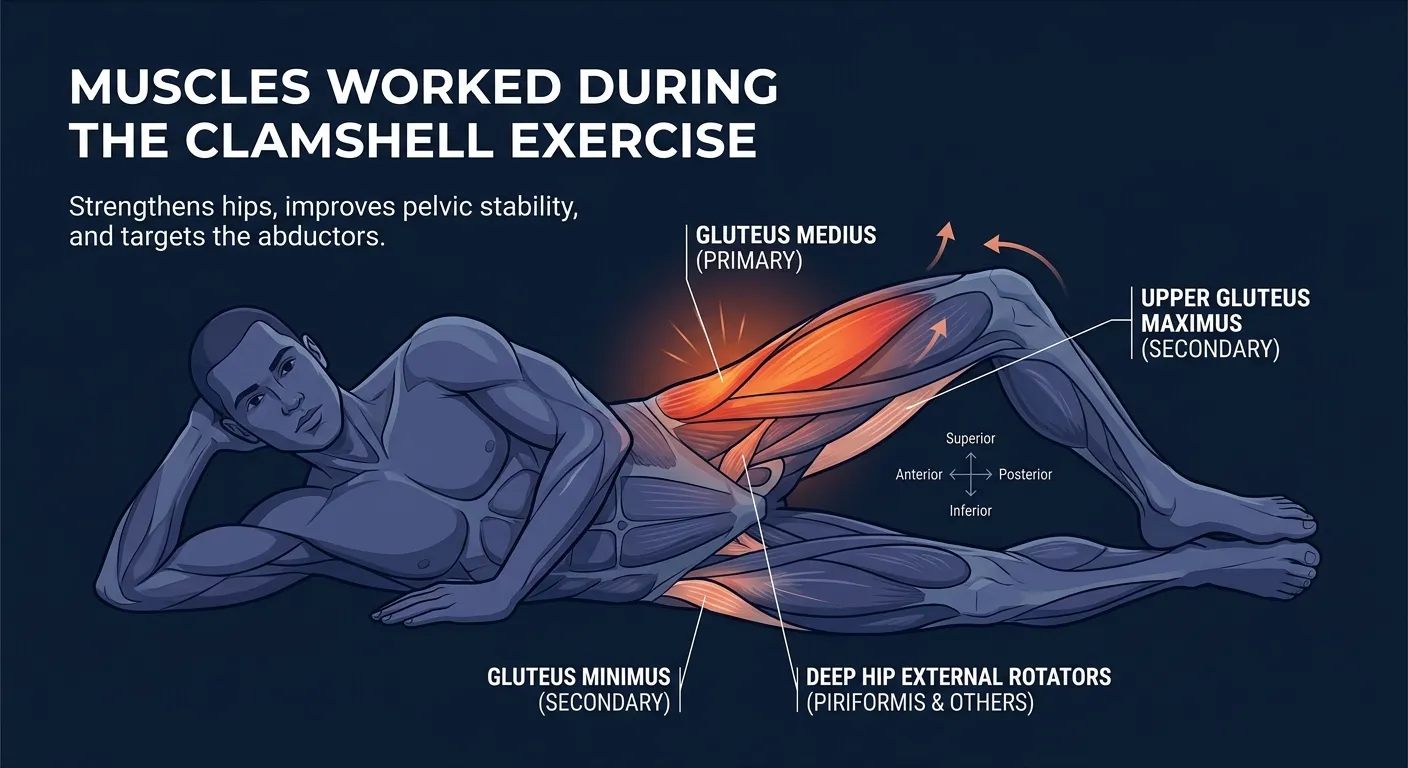
Primary movers. The gluteus medius does the lion's share of the work, abducting and externally rotating the hip concentrically as you open the top knee and controlling the descent eccentrically as you lower. This is the muscle that prevents your pelvis from dropping when you walk or run on one leg, which is why clamshells are a foundational running rehab exercise.
Secondary movers. The gluteus minimus sits underneath the medius and assists with the abduction. The deep hip external rotators (piriformis, gemelli, obturator internus and externus, quadratus femoris) fire because the femur is rotating outward in the hip socket, not just abducting. The upper fibers of the gluteus maximus also contribute, particularly at the end range.
Stabilizers. The lateral core (obliques on the down side, quadratus lumborum) works isometrically to keep the pelvis from rolling backward, which is the whole game with this exercise. The bottom shoulder and the supporting arm under your head also load lightly to keep the upper body stable.
Evidence. A 2012 systematic review in the International Journal of Sports Physical Therapy analyzed gluteus medius and maximus EMG activation across dozens of common rehabilitation and strengthening exercises (Reiman et al., 2012). Side-lying hip abduction exercises, including the clamshell, consistently ranked among the top exercises for gluteus medius activation. The high activation comes from the gravity-loaded abduction angle in side-lying and the absence of compensating muscle groups. The spine is unloaded and the supporting limbs are passive, so the working glute has nowhere to hide.
How to Do Clamshells (Step-by-Step)
- Lie on your side. On a mat with hips and shoulders stacked vertically. Bend your knees to about 45 degrees in front of you. Stack your knees and ankles, heels touching. Rest your head on your bottom arm and place your top hand on your top hip to monitor pelvic position.
- Brace your core and lock the pelvis. Engage your core and tilt your pelvis very slightly backward to lock it. The top hip should not roll backward at any point during the rep. Coach Ty's cue: "Imagine your top hip is glued to a wall behind you. If it peels off the wall, you've gone too far."
- Open the top knee. Keeping your heels glued together, slowly rotate the top knee open toward the ceiling. Lift only as high as you can without your pelvis rolling backward. Most people max out around 30 to 40 degrees of opening. Coach Ty's cue: "Heels glued, hips stacked. The knee moves; nothing else."
- Squeeze and hold. Hold the top position for a full second. Squeeze the side of the upper hip. You should feel the burn on the side of the hip, not in the lower back or front of the hip. Coach Ty's cue: "If you feel the front of the hip working, that's the TFL taking over. Smaller range, slower tempo, and the glute medius takes back the work."
- Lower slowly. Bring the top knee back down under control. Stop just before the knees touch, then open again. Don't rest at the bottom between reps. Complete all reps on one side before switching. Coach Ty's cue: "2 seconds up, 1 second hold, 2 seconds down. The slow tempo is what creates the mind-muscle connection."
Common Mistakes to Avoid
The clamshell is a beginner exercise, but the form errors are surprisingly common even among experienced lifters:
- Rolling the pelvis backward. Mistake number one. As the top knee opens, the entire pelvis tilts backward to help. The knee gets higher, but the glute medius barely fires because the pelvis is doing the work instead. Fix: place your top hand on your hip and stop the lift the instant the hip starts to roll.
- Letting the heels separate. Heels should stay glued together throughout the entire rep. If they separate, you've turned the exercise into something else and lost the external rotation component the gluteus medius needs.
- Going too fast. Clamshells aren't a speed exercise. If you're blasting through 30 reps in 20 seconds, you're not getting much out of it. Slow down. Feel each rep. The squeeze at the top is the point.
- Feeling it in the front of the hip. If you feel a strong contraction at the front of the upper hip (the tensor fasciae latae area), your gluteus medius is not engaging well. Reduce the opening angle and slow the tempo until you feel the side of the upper hip working.
- Lying with the bottom hip rolled back. Setup matters. If your hips aren't stacked vertically at the start (one hip rolled slightly behind the other), the working glute will fire weakly. Spend the first few reps making sure your hips are perfectly stacked before you focus on output.
- Letting the neck tense up. Resting your head on your bottom arm or a pillow keeps the neck neutral. Holding your head up creates tension in the neck and traps that has nothing to do with the working muscle.
Get this exercise in a personalized workout
FitCraft, our mobile fitness app, uses its AI coach Ty to program isolation exercises like this into your plan at the right volume and intensity, based on your level, goals, and equipment. Ty was designed and trained by Domenic Angelino, MPH (Brown University) and NSCA-CSCS, with research published in the Journal of Strength and Conditioning Research and Medicine & Science in Sports & Exercise.
Take the Free Assessment Free · 2 minutes · No credit card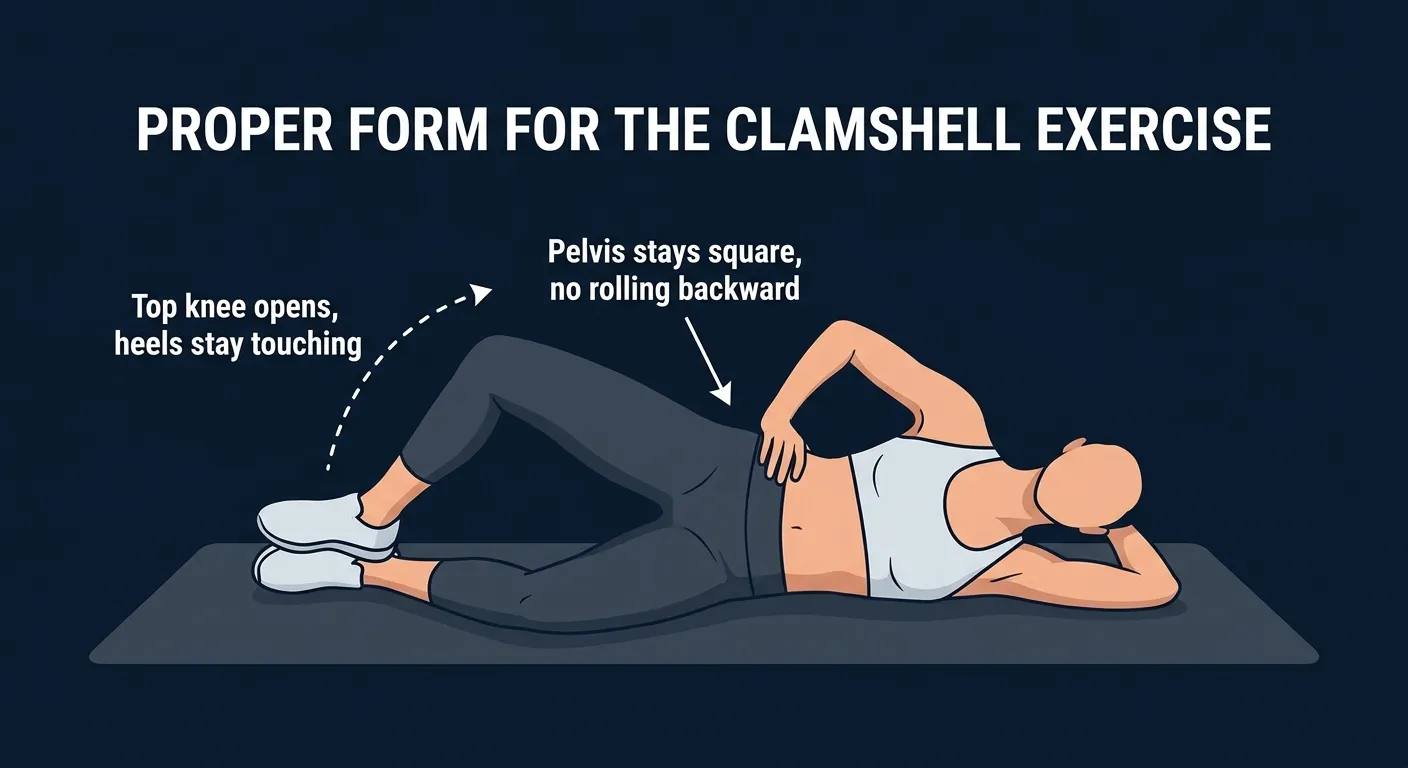
Variations and Progressions
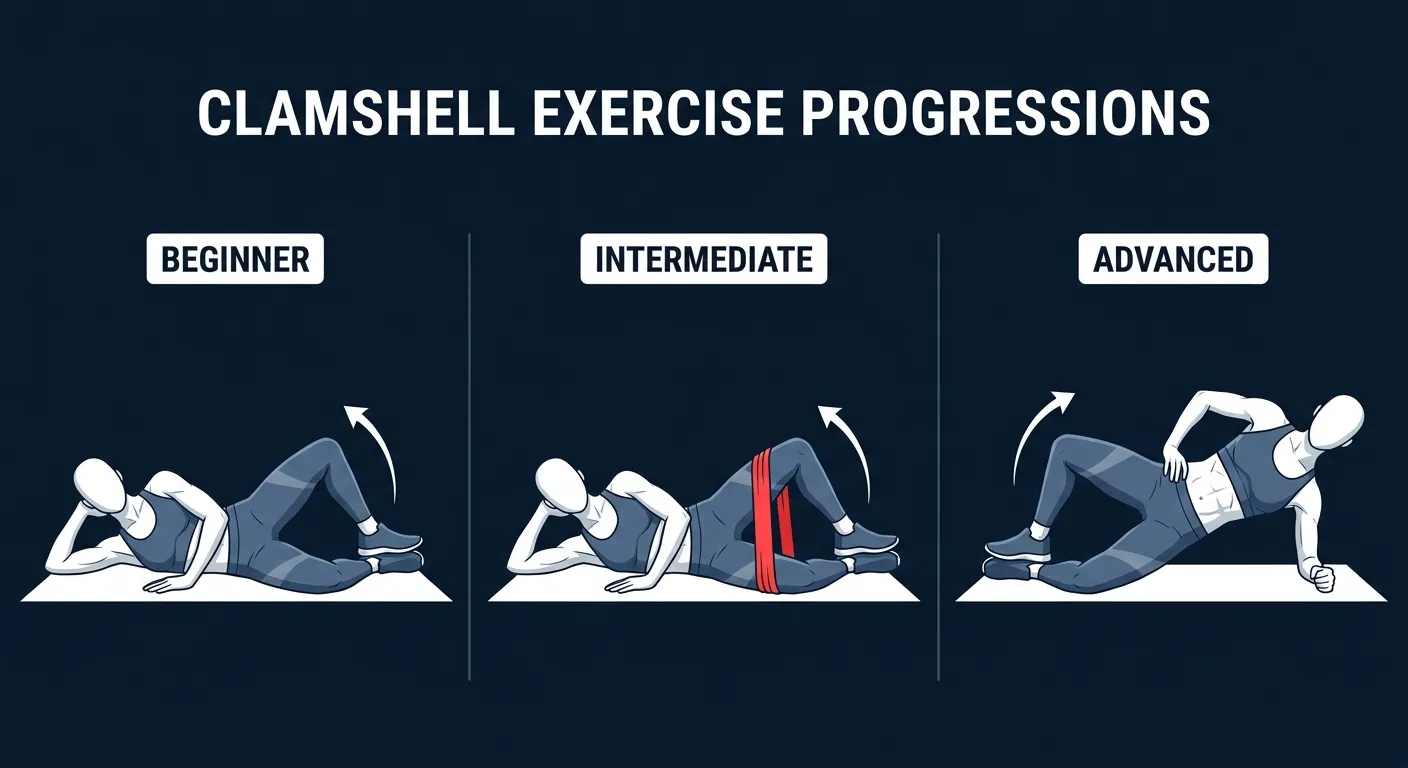
Standard Clamshell (Beginner)
The version described above. Bodyweight, side-lying, 45-degree knee bend, open the top knee while the heels stay glued. This is where everyone starts. Once you can do 3 sets of 20 per side with zero pelvic rolling, you're ready to add load.
Banded Clamshell (Intermediate)
Loop a mini resistance band around both thighs just above the knees. The band adds resistance through the working range and makes the squeeze at the top much harder. Start with a light band and work up. This is the most common progression and the one most rehab programs use.
Side-Plank Clamshell (Advanced)
Set up in a side plank on your forearm with knees bent. Open the top knee like a standard clamshell while holding the side plank. This adds significant lateral core demand alongside the hip abduction work, making it a great exercise for runners and lifters who need both glute medius and lateral core stability.
When to Avoid or Modify Clamshells
Clamshells are among the safest hip exercises out there and are widely used in physical therapy. Even so, a few situations warrant modification. Always consult a qualified healthcare provider or physical therapist before starting or returning to any exercise program, especially if any of the following apply.
- Acute sacroiliac joint pain. Asymmetric hip movement in side-lying can irritate an inflamed SI joint. Start with bilateral isometric glute work (glute bridges) before reintroducing unilateral patterns.
- Acute hip impingement (FAI) or labral tear. The combined abduction-plus-external-rotation movement can pinch impinged or torn tissue in some people. Stop if you feel sharp pain in the front of the hip and consult an orthopedic provider.
- Acute shoulder pain on the down-side shoulder. Side-lying puts the bottom shoulder under your bodyweight. Rest your head on a yoga block or pillow instead of your bottom arm to reduce shoulder load.
- Late-pregnancy comfort issues. Side-lying is generally pregnancy-friendly and often preferred for sleep, but late-term abdominal volume may make the position uncomfortable. Use a pillow between the knees to maintain neutral hip alignment.
- Recent hip surgery or labral repair. Wait for surgeon clearance before adding abduction and external rotation under load. Early rehab usually starts with bilateral isometric work and progresses to clamshells before fire hydrants or side-lying leg raises.
- Lower back pain that increases with the lift. Pain in the lower back during clamshells almost always means the pelvis is rolling backward. Anchor the pelvis with your top hand; if pain persists, build core stability with bird-dogs before returning.
Related Exercises
- Same muscle group (hip abductors): fire hydrants are the all-fours alternative that target the same gluteus medius with added anti-rotation core demand.
- Complementary glute pattern (hip extension): Donkey kicks work the gluteus maximus through hip extension. Pair them with clamshells in a warm-up superset for complete glute coverage.
- Compound glute strength: Glute bridges load the glutes heavier through hip extension; clamshells work well as a warm-up before bridges or any heavier glute work.
- Core and hip stability foundation: Bird-dogs train anti-rotation core stability in an all-fours position, which carries over directly to keeping the pelvis still during clamshells and fire hydrants.
How to Program Clamshells
Clamshells work best as activation, warm-up, or rehab work, not as a strength-building lift in their own right. Programming follows the general guidance for low-load isolation work in Ratamess et al., 2009 (American College of Sports Medicine Position Stand on Progression Models in Resistance Training), with the higher end of the rep ranges because the load is light.
| Level | Sets × Reps (per side) | Rest between sets | Frequency |
|---|---|---|---|
| Beginner | 2-3 × 12-15 | 30-45s | 3-5 sessions/week |
| Intermediate | 3 × 15-20 (banded) | 30-60s | 3-5 sessions/week |
| Advanced | 3 × 12-15 (banded or side-plank variant) | 45-60s | 3-5 sessions/week |
Where in your workout. Slot clamshells into your warm-up before any lower-body session that includes squats, lunges, deadlifts, or running. A common warm-up sequence is 2 sets of 15 clamshells per side paired with 15 donkey kicks per side, no rest between exercises and 30 seconds between rounds. You can also use them as an end-of-session accessory after compound work, or as a daily activation drill on rest days. Many running coaches program clamshells daily for runners with a history of IT band issues or knee pain.
Form floor over rep targets. The point of clamshells is glute medius isolation, and that only happens when the pelvis stays stacked. If your hip starts rolling backward in the last few reps, stop the set there. A clean 12 with anchored pelvis beats a sloppy 20 with pelvic rotation every time.
FitCraft's AI coach Ty programs clamshells as part of your warm-up sequence when your plan includes lower-body compound movements or running. Ty's 3D demonstrations show the opening angle for your level and the cueing emphasizes pelvic control rather than range of motion.
Frequently Asked Questions
Can I do clamshells with lower back pain?
Often yes. Clamshells are a staple of lower back and hip rehab programs because the side-lying position unloads the spine while training hip stability. The most common reason people feel clamshells in the lower back is that the pelvis is rolling backward. Anchor the pelvis (think: stack your hips vertically and keep them there), reduce the range of motion, and the lower back sensation usually disappears. If pain is sharp or radiates down the leg, stop and consult a physical therapist.
What muscles do clamshells work?
Clamshells primarily target the gluteus medius, the muscle on the side of the upper hip responsible for hip abduction and external rotation. Secondary muscles include the gluteus minimus underneath the medius, the deep hip external rotators (piriformis, gemelli, obturator internus and externus, quadratus femoris), and the upper fibers of the gluteus maximus. The lateral core (obliques, quadratus lumborum) works isometrically to keep the pelvis from rolling backward.
How many clamshells should I do?
3 sets of 15 to 20 reps per side for most people. Clamshells are a low-load isolation exercise, so higher rep ranges work better. Focus on the squeeze at the top and slow tempo rather than rushing through reps.
What's the difference between clamshells and fire hydrants?
Both target the gluteus medius. Clamshells are performed side-lying with the spine unloaded and the wrists free, which makes them better for anyone with wrist pain or back pain. Fire hydrants are performed on all fours, which loads the wrists and demands more anti-rotation core work. Most rehab programs start with clamshells before progressing to fire hydrants.
Are clamshells good for runners?
Yes. Weak gluteus medius is one of the most common contributors to runner's knee, IT band syndrome, and hip drop during single-leg stance. Clamshells are the most prescribed exercise in running rehab for this reason. Most running coaches program them as a daily activation drill rather than a once-a-week strength lift.
Why don't I feel clamshells in my glutes?
Either your pelvis is rolling backward (which lets larger muscles take over), or your range of motion is too large for your current strength (which recruits the wrong muscles). Fix both: stack your hips vertically and use a hand on your pelvis to check it isn't moving. Reduce the opening angle until you feel the side of the upper hip working. The smaller the range, the more isolated the gluteus medius.