Leg day is the session people skip. It's the hardest workout of the week, it leaves you breathing like you ran a hill, and the next morning the stairs make their opinion known. So it gets moved to tomorrow, then to next week, while the upper body keeps getting trained.
Skipping it has a cost you can't see right away. Your legs hold your biggest muscles, the ones that carry you up stairs, out of chairs and through every walk. A plan that keeps letting leg day slide isn't a willpower problem; it usually means the session was too long, too vague or too hard on your knees to want to repeat.
This guide fixes those three things with dumbbells and your body weight. You get seven leg exercises, a 50-minute routine, a no-equipment version, and what the research says about squat depth, knee position, hamstrings, calves and cardio. It's the third session in a set with our push day workout and pull day workout.
What Muscles Does Leg Day Work?
Leg exercises fall into two families, and a complete leg day needs both:
- Knee-dominant exercises such as squats, split squats and step-ups bend and straighten the knee under load. They mainly train the quadriceps on the front of the thigh, with the glutes and adductors helping when you go deep.
- Hip-dominant exercises such as Romanian deadlifts, hip thrusts and glute bridges hinge at the hip. They mainly train the glutes and the hamstrings on the back of the thigh.
Two muscle groups need extra attention. The hamstrings cross both the hip and the knee, so they need a hinge and ideally a knee-bending exercise too. The calves barely work in squats or hinges, so they need a calf raise of their own. Those two facts explain most of the exercise list below.
The 7 Best Leg Exercises With Dumbbells
These seven lower body exercises cover the squat, the hinge, single-leg work, the glutes, the hamstrings at the knee and the calves. All of them use dumbbells or body weight.
| # | Exercise | Pattern | Main muscles | Sets x reps |
|---|---|---|---|---|
| 1 | Goblet squat | Squat | Quads, glutes, adductors | 4 x 8-12 |
| 2 | Dumbbell Romanian deadlift | Hinge | Hamstrings, glutes, spinal muscles | 3 x 8-12 |
| 3 | Rear-foot-elevated split squat | Single leg | Quads, glutes, adductors | 3 x 8-12 per leg |
| 4 | Dumbbell step-up | Single leg | Quads, glutes | 2-3 x 10 per leg |
| 5 | Dumbbell hip thrust | Hip extension | Glutes | 3 x 10-15 |
| 6 | Slider hamstring curl | Knee bend | Hamstrings | 2-3 x 8-12 |
| 7 | Standing calf raise on a step | Ankle | Calves | 3 x 12-20 |
1. Goblet squat
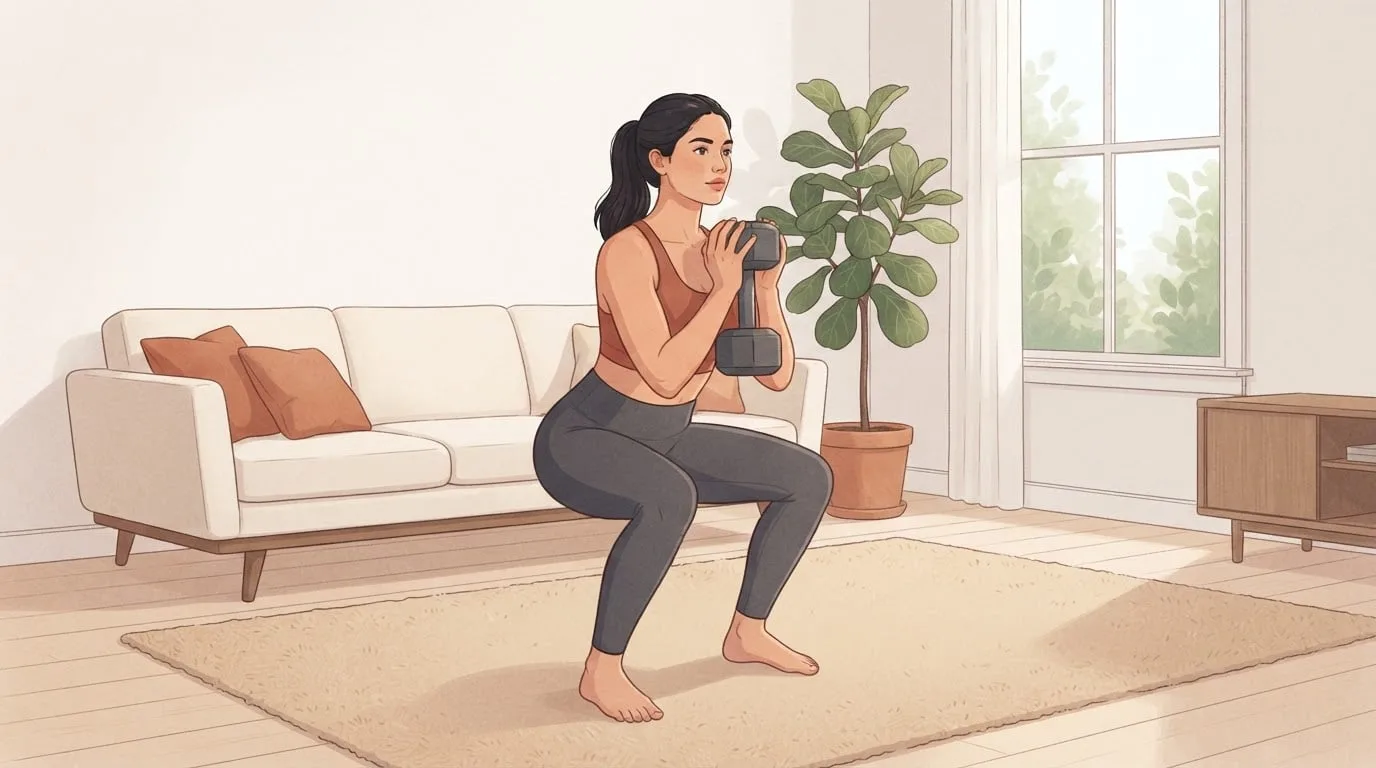
Hold one dumbbell upright against your chest with both hands. Stand with your feet a little wider than your hips and your toes turned out slightly. Sit down between your heels, letting your knees travel forward and out over your toes, until your hips are at or below knee height, then stand up by pushing the floor away. The weight in front of you works as a counterbalance, so most people squat deeper and more upright with a goblet squat than with any other loaded squat. Our goblet squat page covers the setup.
2. Dumbbell Romanian deadlift
Stand with a dumbbell in each hand in front of your thighs and a soft bend in your knees. Push your hips straight back, keeping your back flat and the dumbbells close to your legs, until you feel a strong pull in your hamstrings, usually around mid-shin. Drive your hips forward to stand up. Your knees barely move; the hip does the work.
3. Rear-foot-elevated split squat
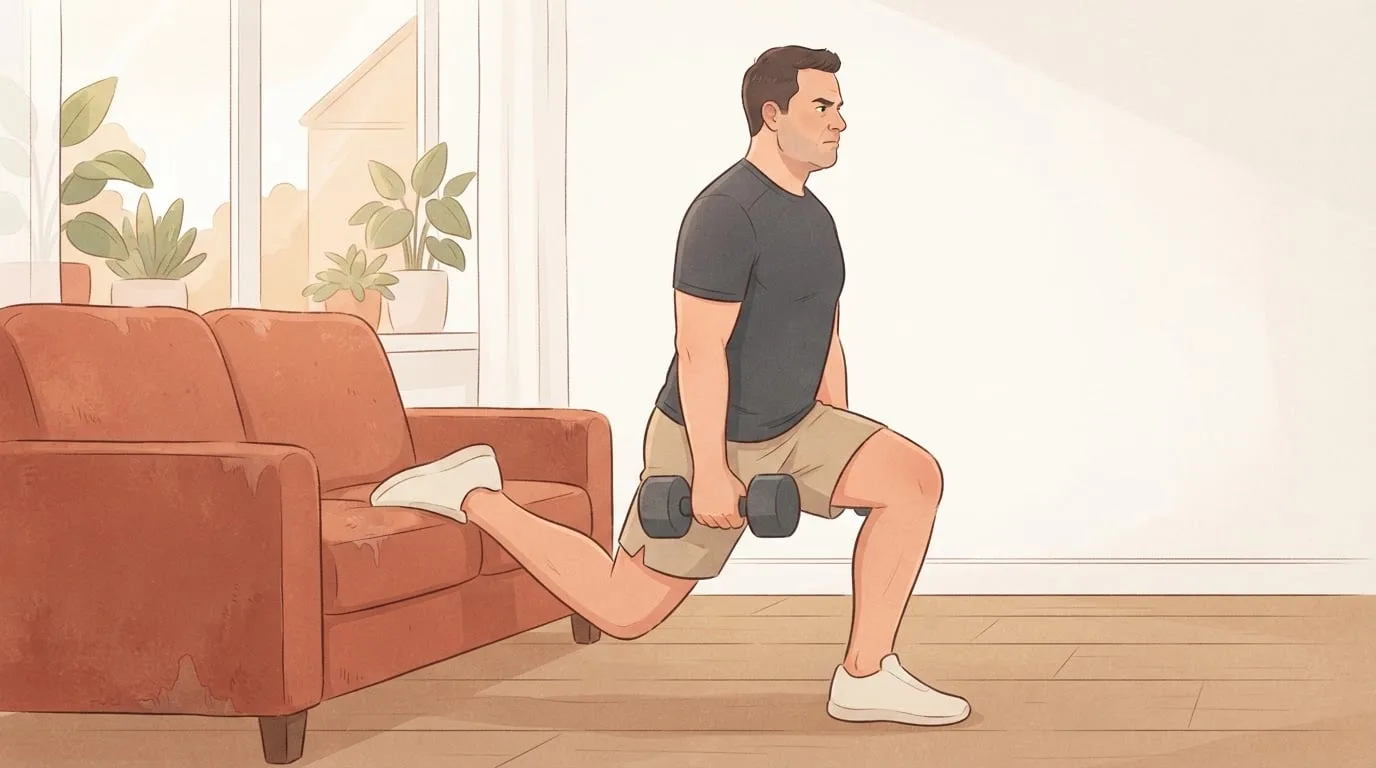
Stand about two feet in front of a bench or sofa and rest the top of your back foot on it. Holding a dumbbell in each hand, lower straight down until your back knee nearly touches the floor and your front thigh is about parallel, then drive up through your front foot. A longer stance shifts work to the glutes, and a shorter one shifts it to the quads.
4. Dumbbell step-up
Face a sturdy step, bench or stair about knee height. Place one whole foot on it, lean forward slightly, and step up by pressing through that foot without pushing off the back leg. Lower slowly. It's the gentlest single-leg exercise on most knees and a good swap for the split squat.
5. Dumbbell hip thrust
Sit with your upper back against the long edge of a sofa or bench, a dumbbell across your hips. With your feet flat and shins vertical at the top, drive your hips up until your body is level from shoulders to knees, squeeze your glutes for a second, and lower. In a 9-week trial, Plotkin and colleagues (2023) found hip thrusts and squats grew the glutes by similar amounts, while squats also grew the quads and adductors more. So the hip thrust adds glute work to leg day, but it doesn't replace the squat.
6. Slider hamstring curl
Lie on your back with your heels on sliders, or on a towel on a smooth floor. Lift your hips into a bridge, then slide your heels away until your legs are nearly straight, keeping your hips up, and pull them back in by bending your knees. Start with both legs and move to one leg at a time when 12 reps feel easy.
7. Standing calf raise on a step
Stand with the balls of your feet on the edge of a step and your heels hanging off, one hand on a rail for balance. Lower your heels below the step until your calves stretch, pause for a second, then rise as high as you can. Hold a dumbbell in your free hand, or do one leg at a time, once 20 reps are easy. Our calf raise page shows the foot position.
The Leg Day Workout: A 50-Minute Routine
Here's the full leg workout routine in order. The heaviest, most demanding exercises come first, and the longer rests sit after them.
| Order | Exercise | Sets x reps | Rest |
|---|---|---|---|
| Warm-up | 5 minutes of brisk walking or cycling, 10 bodyweight squats, 10 hip hinges, 1 light goblet squat set | 6-8 min | None |
| 1 | Goblet squat | 4 x 8-12 | 2-3 min |
| 2 | Dumbbell Romanian deadlift | 3 x 8-12 | 2 min |
| 3 | Rear-foot-elevated split squat, or step-up | 3 x 8-12 per leg | 90 sec between legs |
| 4 | Dumbbell hip thrust | 3 x 10-15 | 90 sec |
| 5 | Slider hamstring curl | 2 x 8-12 | 60 sec |
| 6 | Standing calf raise on a step | 3 x 12-20 | 60 sec |
That's 18 working sets, with each leg's split squat counted once. If you're new or short on time, run the first three exercises plus calf raises, about 13 sets, and add the rest after a few weeks. Move up a dumbbell when you reach the top of the rep range on every set with a rep or two in reserve. When your heaviest dumbbell is too light for the goblet squat, slow the lowering to three seconds or switch that slot to a single-leg exercise.
Leg Day Workouts at Home With No Equipment
Body weight alone gives your legs less load than dumbbells, so the no-equipment version leans on single-leg work and slow lowering to keep each set hard.
| Order | Exercise | Sets x reps | Rest |
|---|---|---|---|
| 1 | Bodyweight squat, 3-second lowering | 3 x 15-25 | 90 sec |
| 2 | Bulgarian split squat | 3 x 10-15 per leg | 90 sec |
| 3 | Single-leg glute bridge | 3 x 10-15 per leg | 60 sec |
| 4 | Step-up onto a stair or sturdy chair | 3 x 10-15 per leg | 60 sec |
| 5 | Towel hamstring curl on a smooth floor | 3 x 8-12 | 60 sec |
| 6 | Single-leg calf raise on a step | 3 x 10-20 per leg | 45 sec |
Once bodyweight squats pass 25 slow reps, they've stopped being a strength exercise, so move that time to more split squat sets. If you own resistance bands, our band workout for legs adds load to the same patterns.
How Deep Should You Squat?
As deep as you can with a flat back and your heels down, for most people at or below parallel. Two training studies compared depths directly.
Kubo, Ikebukuro and Yata (2019), in the European Journal of Applied Physiology, had 17 men squat twice a week for 10 weeks, either to full depth or to half depth, and measured muscle volume with MRI. The quadriceps grew about the same in both groups, near 5 percent. The glutes grew 6.7 percent with full squats against 2.2 percent with half squats, and the adductors grew 6.2 against 2.7 percent.
Bloomquist and colleagues (2013), in the same journal, trained 17 male students for 12 weeks with deep squats to about 120 degrees of knee bend or shallow squats to 60 degrees. The deep squat group gained 4 to 7 percent in front-thigh muscle size, more than the shallow group, along with more squat-jump height.
For a home leg day, that makes the goblet squat to full depth the anchor and the half squat a variation, not a substitute. If your hips or ankles stop you above parallel, squat to a box or the edge of a sofa at the lowest height you can control and lower it over the weeks.
Can Your Knees Go Past Your Toes?
Yes. Keeping your knees behind your toes moves the work to your hips and lower back rather than removing it. Fry, Smith and Schilling (2003), in the Journal of Strength and Conditioning Research, filmed seven trained men squatting with and without a barrier that stopped their knees moving forward. Blocking the knees cut knee torque by about a fifth, from 150 to 117 newton-metres, but raised hip torque from 28 to 303 newton-metres and made the men lean much further forward.
Depth worries follow the same pattern. Hartmann, Wirth and Klusemann (2013), in Sports Medicine, reviewed more than 160 studies on knee and spine loading in the squat. Compressive stress behind the kneecap peaks near 90 degrees of knee bend and falls as you go deeper, because the contact area grows and the tissues behind the knee share the load. They found no evidence that deep squats with good technique damage the knee, and they cautioned that very heavy partial squats may stress the joints more over time.
So let your knees travel forward as far as your ankles allow, keep your whole foot on the floor, and let your knees track in line with your toes rather than caving inward.
Find out what's really holding you back
FitCraft, our mobile fitness app, pairs you with an AI coach who builds you a personalized plan around your goals, schedule, and fitness level. Every FitCraft program is designed by Domenic Angelino, MPH (Brown University) and NSCA-CSCS, with research published in the Journal of Strength and Conditioning Research and Medicine & Science in Sports & Exercise.
Take the Free Assessment Free • 2 minutes • No credit cardTrain the Hamstrings at the Hip and the Knee
Your hamstrings straighten the hip and bend the knee, and they grow best when they're trained long. Maeo and colleagues (2021), in Medicine & Science in Sports & Exercise, had 20 adults train one leg with a seated leg curl, hips bent, and the other with a lying leg curl, hips straight, for 12 weeks. The seated leg's hamstrings grew 14 percent against 9 percent, because bending the hip stretches the hamstrings while the knee does the work.
You won't have a seated leg curl machine at home, but the lesson carries over. The Romanian deadlift loads the hamstrings with the hip bent and the muscle stretched, so it stays the main hamstring exercise. The slider curl adds the knee-bending job the hinge misses. Together they train both ends of the muscle, which a squat alone never does.
One Leg at a Time: Split Squats vs Squats
Single-leg exercises are the main reason a dumbbell leg day keeps working after your dumbbells feel light. Speirs and colleagues (2016), in the Journal of Strength and Conditioning Research, split 18 academy rugby players into two groups for five weeks of twice-weekly training. One group squatted only with the rear-foot-elevated split squat, and the other only with the barbell back squat. Both groups improved their back squat, their split squat, 40-metre sprint time and agility by similar amounts.
So a split squat with modest dumbbells can build strength that carries over to a two-leg squat. It also trains each leg on its own, which shows up any side-to-side difference. Start every set with your weaker leg and match its reps on the stronger side.
Calves: Spend Your Reps in the Stretch
Calves respond best when you train them at the bottom of the movement. Kassiano and colleagues (2023), in the Journal of Strength and Conditioning Research, had 42 young women train calf raises three times a week for eight weeks using either the full range, only the stretched bottom half, or only the top half. The inner calf muscle grew 15.2 percent in the bottom-half group, against 6.7 percent with the full range and 3.4 percent with the top half.
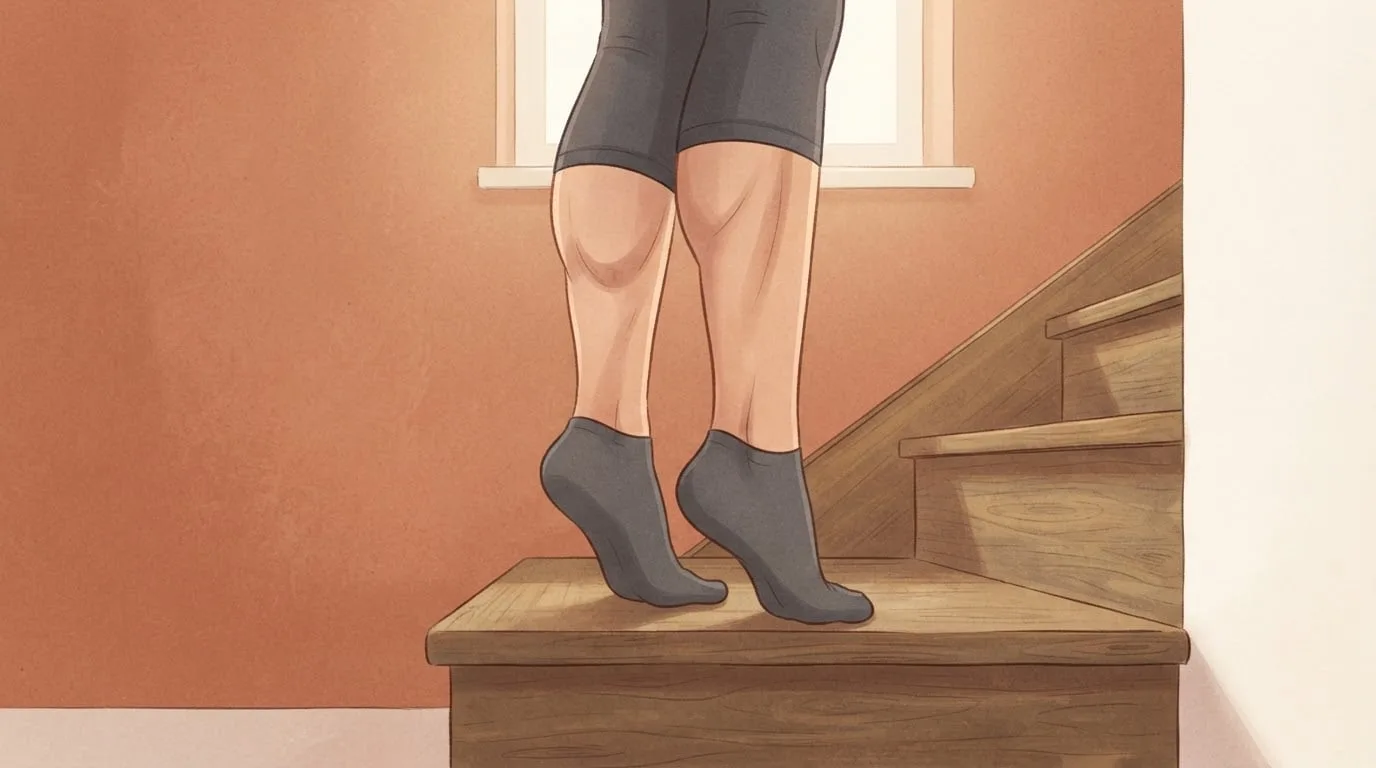
On a step, that means letting your heels sink below the edge on every rep, pausing for a second in the stretch, and not worrying if the top of the rep gets short late in the set. A flat-floor calf raise skips the part of the range that grew the most muscle.
Leg Day With Cranky Knees
Knee pain at the front of the knee is common in people who squat, run and climb stairs, and it rarely means leg day has to stop. The physical therapy guideline on patellofemoral pain by Willy and colleagues (2019), in the Journal of Orthopaedic and Sports Physical Therapy, recommends exercise therapy that combines hip-targeted and knee-targeted strengthening to reduce pain and improve function. Strong hips and strong thighs are part of the treatment, not a risk to avoid.
- Find a pain-free depth for squats and split squats, using a box or sofa edge as a depth marker, and lower it gradually over the weeks.
- Favor step-ups and hinges on bad days. Step-ups let you control knee bend precisely, and Romanian deadlifts barely bend the knee.
- Keep the hip work. Hip thrusts, glute bridges and side-lying leg raises train the hip side of the guideline's recommendation.
- Slow the lowering to three seconds. Controlled reps let you keep the load low while the muscles still work hard.
Mild discomfort that settles by the next day is usually acceptable. Sharp pain, swelling, locking or a knee that gives way means stop and get it assessed.
Why Are Legs So Hard to Train?
Legs feel harder to train than arms or chest for three reasons. They hold your largest muscles, so a hard set of squats moves more blood and oxygen than any upper-body set and leaves you out of breath. Sets often end because your lungs give out before the muscles are fully worked, which is why rest periods matter more on leg day. And lunges and split squats load the muscles hard while they lengthen, which tends to cause more next-day soreness than most upper-body exercises.
None of that means your legs are weak. It means leg day needs longer rests, a sensible exercise order with the hardest lifts first, and a first few weeks at moderate volume so the soreness settles.
Should I Do Cardio on Leg Day?
Some, kept short and easy. Wilson and colleagues (2012), in the Journal of Strength and Conditioning Research, pooled 21 studies of strength training done alongside endurance training. Running reduced the gains in muscle size and strength, cycling didn't, and longer and more frequent endurance sessions interfered more.
On leg day, that points to a 10 to 20 minute easy walk or bike ride, after your lifting rather than before, so your legs are fresh for the squats. Hard intervals and long runs belong on a different day from your heaviest leg training.
Sets, Reps and Rest: The Same Rules as Push Day
The rules for effort and rest don't change with the muscle. Rep ranges from about 6 to 20 all build muscle when the set ends close to failure, stopping one to three reps short is enough, and longer rests after the heavy lifts help both strength and size. The push day workout covers the studies behind each rule, so leg day simply applies them: 2 to 3 minutes after squats and Romanian deadlifts, and 60 to 90 seconds after everything else.
Where Leg Day Fits in Your Week
Leg day is the third session of a push pull legs split, and the one most likely to be skipped. Put it early in the week, when you're fresh and least likely to push it back, and keep at least one day between leg day and any hard running. The push pull legs routine shows how the three sessions fit a three-day or six-day week.
FitCraft's strength workouts use dumbbells and body weight. An AI coach demonstrates each squat, hinge and lunge on an interactive 3D model you can zoom in on, so you can check knee and hip position before your first rep, and your workouts adjust as you progress. Calendar tracking and streaks make it harder to let leg day slide. If you train without any equipment, our bodyweight workout app page shows how FitCraft plans home training.
The Bottom Line
A leg day workout needs a deep squat, a hip hinge, a single-leg exercise, a glute exercise, a hamstring curl and a calf raise: about 18 hard sets in 50 minutes. Squat as deep as you can control, let your knees travel forward, train the hamstrings at both the hip and the knee, and spend your calf reps in the stretch. Dumbbells and a sofa are enough to build strong legs at home.
Matt described what changes once the plan fits: "The real win is I actually want to work out now. That's never happened before." Make leg day short enough to repeat, and it stops being the day you skip.
Frequently Asked Questions
What are some good dumbbell exercises for the lower body?
Goblet squats, dumbbell Romanian deadlifts, rear-foot-elevated split squats, step-ups, dumbbell hip thrusts and standing calf raises on a step cover the quads, hamstrings, glutes, adductors and calves. A slider hamstring curl adds knee-bending work for the hamstrings without any weight.
Is 4 exercises enough on leg day?
Yes, if the four are a squat, a hip hinge, a single-leg exercise and a calf raise. Those cover every major leg muscle in about 12 to 14 hard sets. Add a hip thrust or a hamstring curl as a fifth or sixth exercise when you have the time and recovery for it.
Should I do cardio on leg day?
A little is fine. A 2012 meta-analysis found that running alongside strength training reduced muscle and strength gains while cycling didn't, and that longer, more frequent cardio interfered more. On leg day, keep cardio short and easy, choose walking or cycling, and lift first.
Why are legs so hard to train?
Your legs hold your largest muscles, so a hard set of squats or split squats pushes your heart rate and breathing far higher than a set of curls. Sets often end because you're out of breath before the muscles are fully worked, and lunges and split squats cause more next-day soreness than most upper-body exercises.
Does a 20 minute walk count as cardio?
Yes, a brisk 20-minute walk counts as moderate cardio. Done six days a week, it adds up to 120 of the 150 weekly minutes of moderate activity that public health guidelines recommend, and it's easy enough to do on leg day without hurting your recovery.
What is the 3-3-3 rule for gym?
The 3-3-3 rule is an informal social-media template rather than a research standard: three exercises for three sets each, three days a week. A leg version would be a goblet squat, a Romanian deadlift and a split squat. Add calf raises once the routine feels settled, since the three main lifts barely train the calves.
Is a leg day workout different for women?
No. Women have the same leg muscles and build them with the same exercises and rep ranges. Many women find leg day relatively easier than push day, because the muscle-mass gap between men and women is smaller in the lower body than in the upper body.