Pull day is the session most home workouts quietly skip. Pushing needs only a floor, but pulling needs something to pull, so the back gets a few rushed rows at the end of a chest session and the biceps get whatever is left. Months later the shoulders round forward and the pull-up you meant to learn still isn't there.
That gap isn't laziness. Most plans never give pulling its own day with its own structure, so you're left guessing which rows count, whether curls are a waste of time and why your grip gives out before your back does.
This guide gives pull day that structure with dumbbells, a doorway bar if you have one, and your body weight. It's the pulling half of a three-day set: the push day workout covers chest, shoulders and triceps, and the leg day workout covers the lower body.
What Do You Work on Pull Day?
Pull day trains every muscle that brings a weight toward your body or your body toward a bar. Pull day muscles fall into three groups:
- The back. The lats and teres major pull your upper arm down and back, which is the main job in pull-ups and in rows that finish at the hip. The middle and lower traps and the rhomboids squeeze your shoulder blades together and pull them down, which is the main job in rows that finish at the ribs.
- The rear delts. The back of the shoulder pulls your arm out and back. Rows train it a little, and a rear-delt raise trains it well.
- The arms and grip. The biceps, the brachialis underneath it and the brachioradialis along the forearm bend your elbow in every pull. The forearm flexors hold the bar or dumbbell, and on many pull days they tire first.
Those groups split pulling into two directions. A vertical pull brings your arms down from overhead, as in a pull-up. A horizontal pull brings them back from in front of you, as in a row. A complete pull day has at least one of each, because each direction loads the back in a different way.
The 6 Best Pull Day Exercises
These six upper body pull exercises cover both directions, the rear delts and the arms. Five use dumbbells or your body weight, and the first needs a doorway pull-up bar or an alternative from the list.
| # | Exercise | Direction | Main muscles | Sets x reps |
|---|---|---|---|---|
| 1 | Pull-up or chin-up (or negatives) | Vertical | Lats, lower traps, biceps | 4 x 5-10, or 4 x 3 slow negatives |
| 2 | One-arm dumbbell row | Horizontal, to the hip | Lats, middle traps, rhomboids | 3 x 8-12 per side |
| 3 | Chest-supported dumbbell row | Horizontal, to the ribs | Middle traps, rhomboids, rear delts | 3 x 10-12 |
| 4 | Chest-supported rear-delt raise | Horizontal, arms wide | Rear delts, middle traps | 3 x 12-20 |
| 5 | Incline dumbbell curl | Elbow bend | Biceps, especially the long head | 3 x 8-12 |
| 6 | Hammer curl | Elbow bend, thumbs up | Brachialis, brachioradialis, biceps | 2 x 10-15 |
1. Pull-up or chin-up
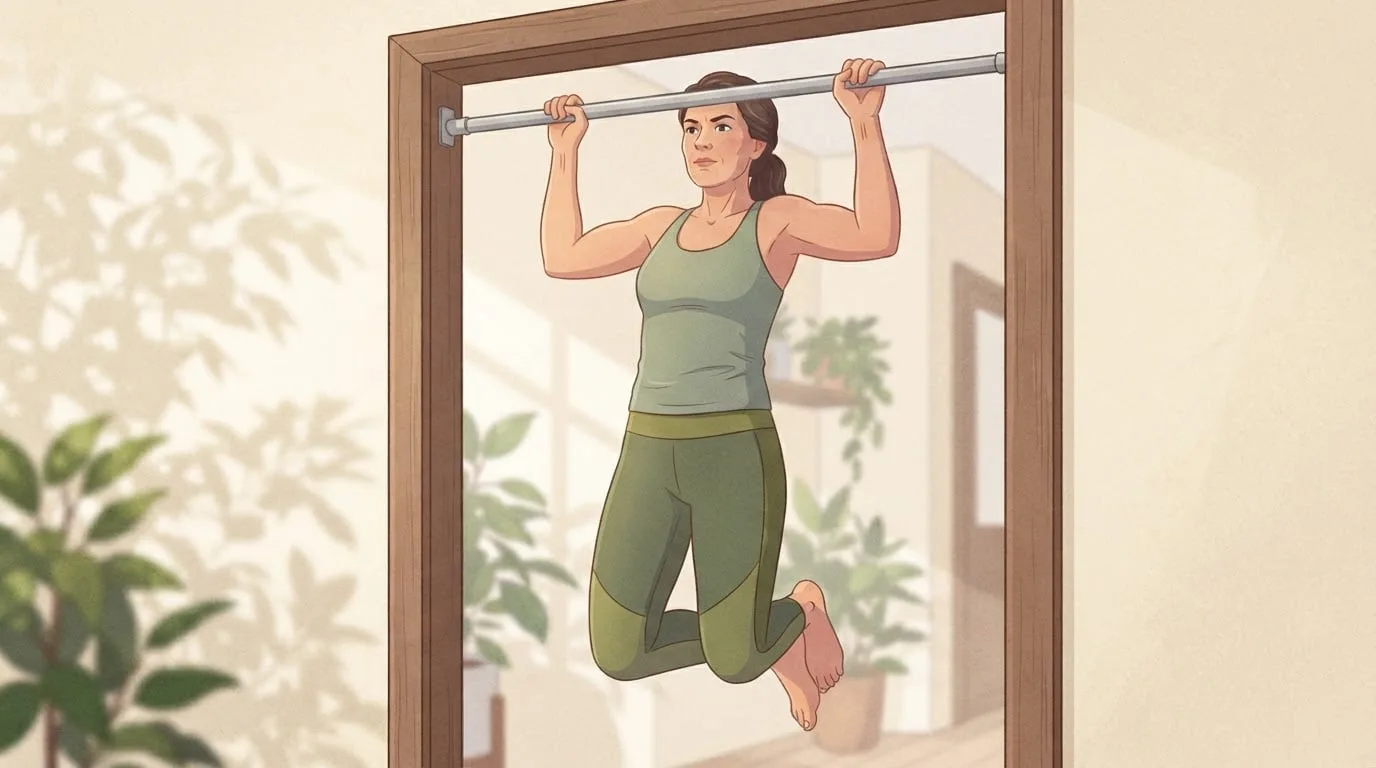
Hang from the bar with straight arms, then drive your elbows down toward your back pockets until your chin clears the bar. Lower all the way to straight arms before the next rep. A chin-up uses an underhand grip and is usually a little easier; a pull-up uses an overhand grip. If you can't do five clean reps yet, do chin-up negatives: step up so your chin is over the bar, then lower yourself over five seconds. No bar? Use a dumbbell pullover for this slot.
2. One-arm dumbbell row
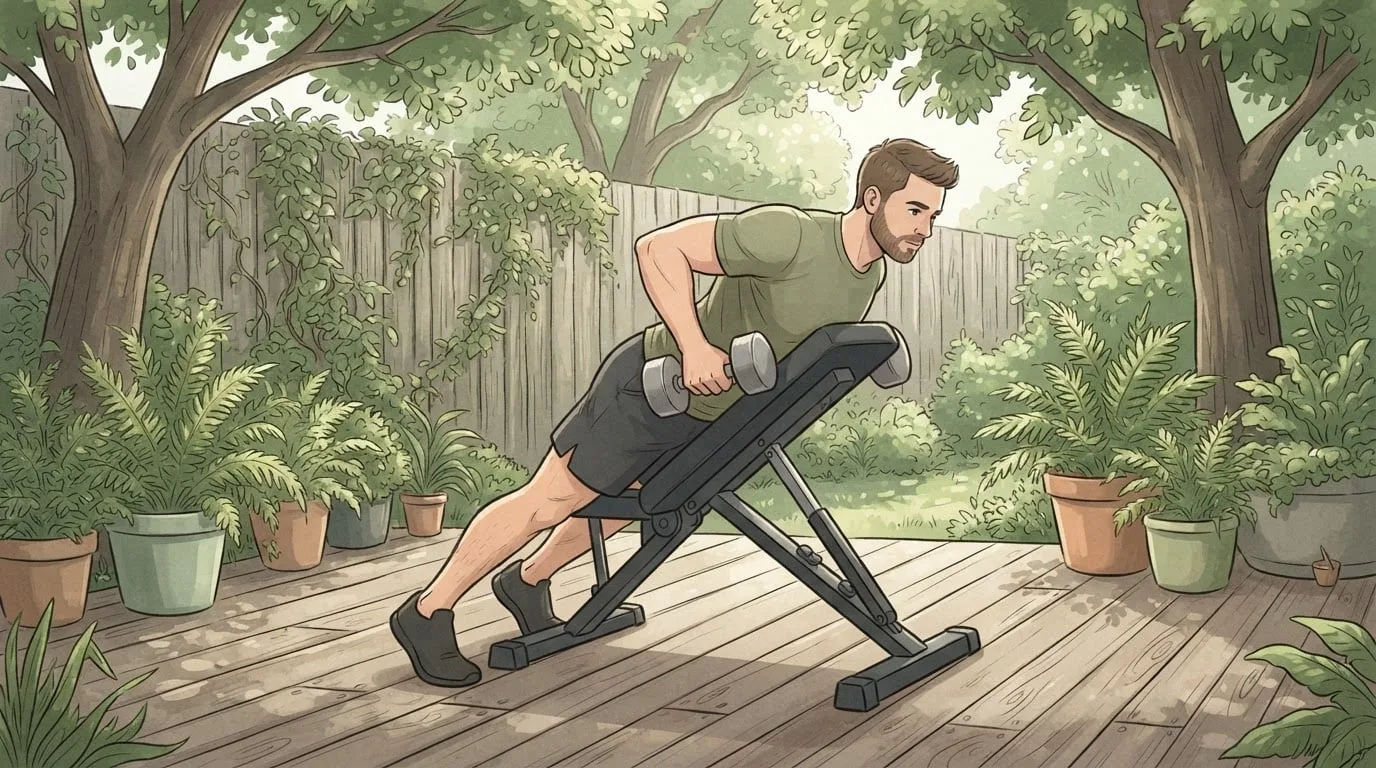
Brace one hand and the same-side knee on a bench, let the dumbbell hang under your shoulder, and pull it back in an arc toward your hip pocket. Pulling toward the hip rather than straight up keeps your upper arm moving down and back, which is the lats' job. Let the dumbbell stretch your shoulder forward at the bottom of each rep.
3. Chest-supported dumbbell row
Set a bench to about 30 to 45 degrees, lie face down on it with your chest on the pad, and let two dumbbells hang straight down. Row them toward your lower ribs, squeeze your shoulder blades together for a second, and lower. The bench holds your torso still, so your lower back rests and you can't cheat with momentum. Our supported row page shows the setup.
4. Chest-supported rear-delt raise
Stay face down on the same incline bench with light dumbbells. With a soft bend in your elbows, sweep your arms out to the sides until they're level with your body, thumbs pointing forward, then lower slowly. Keep your shoulder blades from pinching hard, so the rear delts do the lifting instead of the traps.
5. Incline dumbbell curl
Sit back on a bench set to about 45 to 60 degrees, with your arms hanging straight down behind your torso. Curl both dumbbells up without letting your elbows drift forward, then lower them all the way. Because your arm starts behind your body, the biceps long head works from a stretched position, and the curl stays hard through the whole range.
6. Hammer curl
Stand with dumbbells at your sides and your palms facing each other. Curl them up with your thumbs leading and your elbows pinned to your sides. The neutral grip shifts more of the work to the brachialis and the brachioradialis, the forearm muscle that thickens the top of the forearm. Our hammer curl page covers the common swing.
The Pull Day Workout: A 45-Minute Dumbbell Routine
Here's the full pull day workout routine in order. Take the long rest after the vertical pull, when your whole back and grip are working, and shorter rests after the rest.
| Order | Exercise | Sets x reps | Rest |
|---|---|---|---|
| Warm-up | Arm swings, 10 band or towel pull-aparts, 1 light set of rows | 5 min | None |
| 1 | Pull-up, chin-up or negatives (dumbbell pullover with no bar) | 4 x 5-10 | 2-3 min |
| 2 | One-arm dumbbell row | 3 x 8-12 per side | 90 sec |
| 3 | Chest-supported dumbbell row | 3 x 10-12 | 90 sec |
| 4 | Chest-supported rear-delt raise | 3 x 12-20 | 60 sec |
| 5 | Incline dumbbell curl | 3 x 8-12 | 60 sec |
| 6 | Hammer curl | 2 x 10-15 | 60 sec |
| Finisher | Dead hang from the bar, optional | 1-2 x as long as you can hold | 60 sec |
That's 18 working sets: 10 for the back, 3 aimed at the rear delts and 5 for the elbow flexors, which also work in every pull. Count each one-arm row set as one set, not two. If the session runs long, cut the hammer curls first and the second row next. When you reach the top of a rep range on every set, move up a dumbbell, or on pull-ups add a slower lowering phase until a loaded backpack becomes the next step.
Bodyweight Pull Day for Beginners
With a doorway bar and a sturdy table you can run a full pull day with no dumbbells at all. This version also suits beginners who can't do a pull-up yet.
| Order | Exercise | Sets x reps | Rest |
|---|---|---|---|
| 1 | Chin-up negatives, 5-second lowering | 4 x 3-5 | 2 min |
| 2 | Flexed-arm hang, chin over the bar | 3 x 10-30 sec | 90 sec |
| 3 | Inverted row under a heavy table | 3 x 6-12 | 90 sec |
| 4 | Prone T raise on the floor | 3 x 10-15 | 45 sec |
| 5 | Backpack curl, a loaded backpack held by its top strap | 3 x 10-15 | 60 sec |
The negatives and the flexed-arm hang build strength in the parts of a chin-up you can already control. Practiced twice a week, they're the usual route to a first full rep. Table rows need a heavy table that can't tip; our back workout at home lists the safety checks and other no-bar options.
Grip Width and Hand Position: What the Studies Show
Wide grip for a wide back is gym folklore. Three studies suggest grip choice matters far less than effort.
- Width barely matters. Andersen and colleagues (2014), in the Journal of Strength and Conditioning Research, tested 15 men on a lat pulldown at one, one and a half and two times shoulder width. Lat, trap and rotator cuff activity was similar across the whole movement, and the men lifted slightly more with the narrow and medium grips than with the wide one.
- Overhand may favor the lats a little. Lusk, Hale and Russell (2010), in the same journal, compared overhand and underhand grips at two widths in 12 men. The overhand grip produced more lat activity than the underhand grip at both widths. Grip had no effect on the middle traps or the biceps.
- Hand orientation on a pull-up evens out. Dickie and colleagues (2017), in the Journal of Electromyography and Kinesiology, recorded eight upper-body muscles in 19 strength-trained men doing underhand, overhand, neutral-grip and rope pull-ups. Activity across a full rep was similar for all four. The one clear difference was the middle traps, which worked harder with an overhand grip than with a neutral one.
The practical rule: use the grip that lets you do the most clean, full-range reps without elbow or shoulder pain, and rotate grips every few weeks if you like. Our comparison of pull-ups vs chin-ups goes deeper on the two most common bar grips.
Find out what's really holding you back
FitCraft, our mobile fitness app, pairs you with an AI coach who builds you a personalized plan around your goals, schedule, and fitness level. Every FitCraft program is designed by Domenic Angelino, MPH (Brown University) and NSCA-CSCS, with research published in the Journal of Strength and Conditioning Research and Medicine & Science in Sports & Exercise.
Take the Free Assessment Free • 2 minutes • No credit cardDo You Need Curls If You Already Row?
Your biceps bend your elbow in every row and pull-up, so it's fair to ask whether curls add anything. Two trials give different answers, and together they explain when curls matter.
Gentil and colleagues (2013), in Applied Physiology, Nutrition, and Metabolism, put 29 untrained young men on 10 weeks of lat pulldowns and bench presses, with or without added curls and triceps extensions. Elbow flexor thickness rose 6.5 percent without curls and 7.0 percent with them, a difference too small to matter. For true beginners, pulling alone grew the biceps.
Mannarino and colleagues (2021), in the Journal of Strength and Conditioning Research, compared the two exercises head to head within the same people. Ten untrained men trained one arm with one-arm dumbbell rows and the other with dumbbell curls, 4 to 6 sets to failure twice a week for 8 weeks. The curling arm's elbow flexors grew 11.1 percent and the rowing arm's grew 5.2 percent.
Rows build some biceps, and curls build more per set. That's why this pull day ends with two curls after the rows: the rows handle the back, and the curls give the biceps work the rows can't. If you're short on time, keep one curl and drop the hammer curl. Our guide to building bigger arms covers arm volume across the whole week.
Which Curl Belongs on Pull Day?
Pick a curl that loads the biceps through its full range. Oliveira and colleagues (2009), in the Journal of Sports Science and Medicine, recorded the biceps long head in 22 people during a standard dumbbell curl, an incline dumbbell curl and a preacher curl. The standard and incline curls kept the biceps highly active across the whole range of elbow motion, reaching about 95 percent of its peak activity near the top. The preacher curl was hard only over a short stretch of the movement.
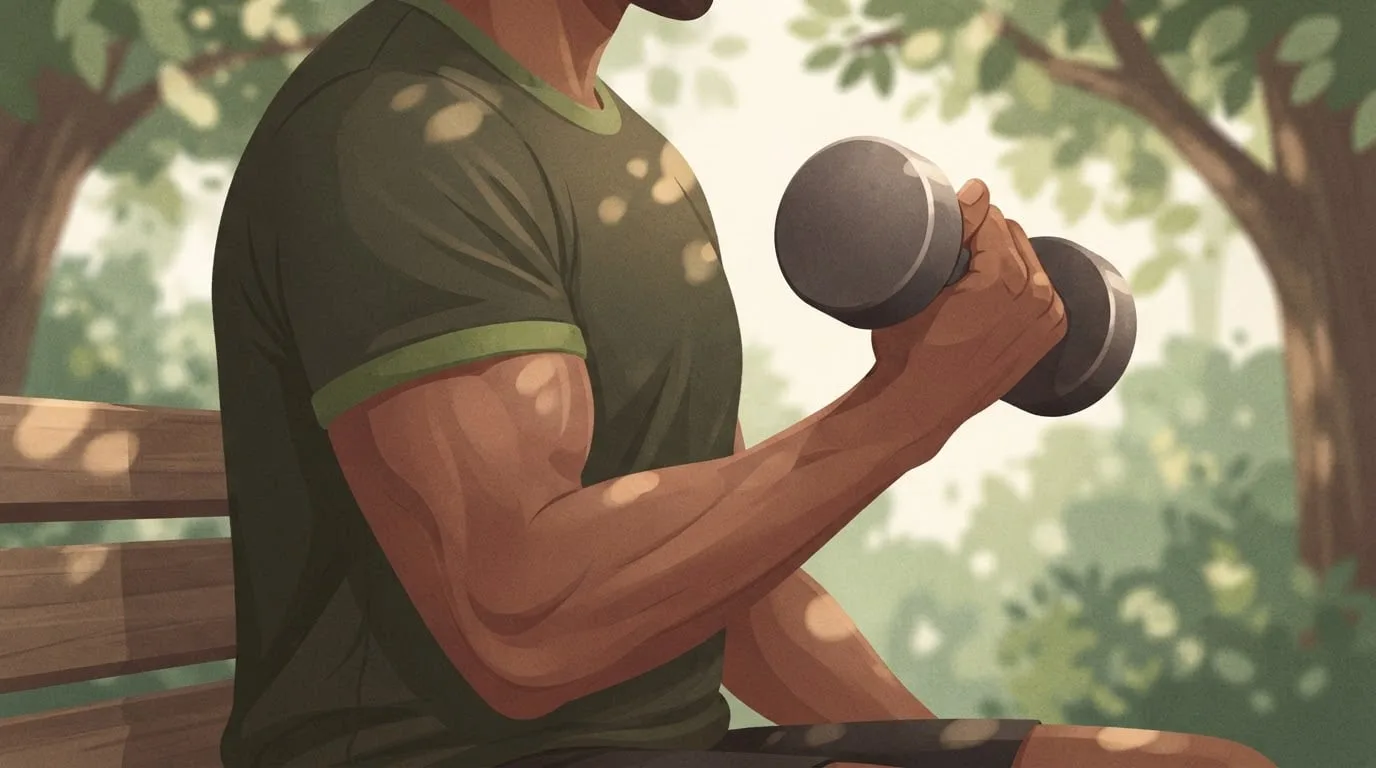
So use the incline curl as your main curl, with a standard standing curl as the swap when you have no bench, and add the hammer curl for the brachialis and forearm. Save the preacher curl for variety, not as the only curl you do.
Is 5 Exercises Enough for Pull Day?
Five exercises is enough when each one has a different job: one vertical pull, one row to the hip, one row to the ribs, one rear-delt raise and one curl. That's about 15 hard sets, which covers the back, the rear delts and the biceps for one session. The sixth exercise in the routine above is a second curl, useful but optional.
Where pull days go wrong is the opposite direction: four kinds of row, no rear-delt work and no curl. Adding a fifth row variation rarely builds more back. It mostly tires your grip, which then cuts your curls short.
When grip gives out first
If your hands fail before your back, train grip on purpose rather than skipping sets. End the session with a dead hang from the bar or a 30 to 45 second hold of your heaviest dumbbells, and keep curls after rows so tired forearms don't limit your back work. Chalk on dry hands helps too.
Is 3x10 or 5x5 Better for Pull Day?
For muscle size, both work. Schoenfeld and colleagues (2014), in the Journal of Strength and Conditioning Research, matched the total weight lifted between a bodybuilding-style group doing 3 sets of 10 with 90 seconds of rest and a powerlifting-style group doing 7 sets of 3 with 3 minutes of rest. After 8 weeks, well-trained men in both groups gained the same biceps thickness. The heavy group gained more maximal strength.
On a dumbbell pull day the choice makes itself. Your heaviest dumbbell usually isn't heavy enough for sets of 3 to 5 on a row, and moderate reps get the same growth in a fraction of the time. Use 5 to 10 reps on pull-ups, where body weight is already heavy, and 8 to 15 on rows and curls.
Sets, Reps and Rest: The Same Rules as Push Day
Effort and rest work the same way on every training day. Any rep range builds muscle when sets end close to failure, stopping one to three reps short is about as effective as grinding to failure, and longer rests after the heaviest exercise help both strength and size. The push day workout walks through the studies behind each of those rules, including the rest-interval trial and the proximity-to-failure review, so they aren't repeated here.
Where Pull Day Fits in Your Week
Pull day sits between push day and leg day in a push pull legs split, so your pushing muscles recover while you pull. Aim for roughly as many pulling sets as pressing sets across the week, which most lifters only reach once pulling has a day of its own. The push pull legs routine shows how to run the three days once or twice a week.
FitCraft's strength programs use dumbbells and body weight, plus a few band exercises such as stiff-arm pulldowns and band hammer curls, and an AI coach demonstrates every move on a 3D model you can zoom and turn. Your workouts adjust as your strength improves, and streaks keep the pull days from slipping. Our dumbbell workout app page shows how those programs progress you.
The Bottom Line
A pull day workout needs one vertical pull, two rows that finish in different places, a rear-delt raise and a curl or two, about 15 to 18 hard sets in 45 minutes. Grip width is a comfort choice, not a growth lever. Rows build some biceps, and curls build more per set. For a dumbbell pull day, sets of 8 to 12 build as much muscle as heavy triples in far less time.
Katie said it about the whole routine, not just pull day: "I've tried everything. This is the first time I've stuck with something past two weeks." Give pulling its own day, show up for it, and your back will catch up with your chest.
Frequently Asked Questions
What do you work on pull day?
Pull day works every muscle that draws a weight toward you: the lats, the middle and lower traps, the rhomboids, the rear delts, the biceps and the forearm muscles that grip. A vertical pull, two rows, a rear-delt raise and one or two curls cover all of them.
Is 5 exercises enough for pull day?
Yes. Five well-chosen exercises, one vertical pull, two rows, a rear-delt raise and a curl, give about 15 hard sets and train every pulling muscle. A sixth exercise, usually a hammer curl or a dead hang for grip, is optional.
What is a good pull day workout plan?
Start with pull-ups or chin-ups for 4 sets, then one-arm dumbbell rows and chest-supported dumbbell rows for 3 sets each, rear-delt raises for 3 sets of 12 to 20, and incline and hammer curls for 2 to 3 sets each. Rest 2 to 3 minutes after the first exercise and 60 to 90 seconds after the rest. It takes about 45 minutes.
Is 3X10 or 5X5 better?
For muscle size, both work when the total work is similar. A 2014 study in trained men found 3 sets of 10 and 7 sets of 3 built the same biceps thickness, while the heavy, low-rep group gained more maximal strength. On a dumbbell pull day, sets of 8 to 12 are usually more practical because dumbbells cap how heavy you can go.
Is it possible to get ripped in 3 weeks?
Not from a normal starting point. Three weeks of pull days will make you noticeably stronger, but new muscle is small and hard to see that early, and losing enough fat to look lean takes months for most people. Judge a pull day program over 8 to 12 weeks.
What is the 3-3-3 rule in the gym?
It's an informal template from social media: three exercises, three sets each, three days a week. A pull version would be a chin-up, a dumbbell row and a curl. It works as a beginner's minimum, but it leaves out the rear delts, so add a rear-delt raise once the three feel routine.
Should you do deadlifts on pull day?
You can, but it's a choice rather than a rule. In this push, pull and legs set the hip hinge, a dumbbell Romanian deadlift, sits on leg day so pull day stays focused on the back and arms and your lower back isn't loaded on both days.
Is a pull day workout different for women?
No. Women have the same pulling muscles and respond to the same exercises. Many start with chin-up negatives, flexed-arm hangs or table rows instead of full pull-ups, and progress to full reps the same way men do.