Push-ups need nothing but a floor. Pulling needs something to pull, and that's where most back workouts at home fall apart. You do push-ups, squats and planks for months, your chest and legs get stronger, and your upper back quietly falls behind, along with your posture.
Effort isn't the issue. A gym hands you a lat pulldown, a cable row and a pull-up bar, and your living room hands you a couch. So the at home back workout gets skipped, cut short or swapped for one more set of push-ups, and you start to wonder whether a strong back is even possible without a membership.
It is. This guide solves the pulling problem with what you already have: a dumbbell if you own one, a heavy table, a towel and a door, and the floor. You get eight back exercises, the muscles each one trains, a no-equipment plan, a dumbbell plan, how many sets a week to do and which moves to choose if your lower back complains.
The 8 Best Back Exercises at Home
These eight cover the whole back. The first four are rows, the next three are floor raises that need no equipment at all, and the last is the dumbbell move that comes closest to a pull-up. None of them needs a resistance band.
| # | Exercise | Equipment | Main muscles | Sets x reps |
|---|---|---|---|---|
| 1 | One-arm dumbbell row | One dumbbell, a bench or sturdy chair | Lats, middle traps, rhomboids, rear delts | 3 x 8-12 per side |
| 2 | Table row | A heavy, solid table | Lats, middle traps, rhomboids, rear delts, biceps | 3 x 6-12 |
| 3 | Towel door row | A bath towel and a solid door | Middle traps, rhomboids, rear delts, biceps | 3 x 10-15 |
| 4 | Bent-over dumbbell row | One or two dumbbells | Lats and the whole upper back; the lower back holds the hinge | 3 x 8-12 |
| 5 | Prone Y raise | Floor | Lower and middle traps | 2-3 x 10, 2-sec hold |
| 6 | Reverse snow angel | Floor | Middle and lower traps, rear delts | 2-3 x 8 |
| 7 | Superman hold | Floor | Erector spinae, glutes | 2 x 6 holds of 3 sec |
| 8 | Dumbbell pullover | One dumbbell, floor | Lats | 3 x 10-12 |
1. One-arm dumbbell row
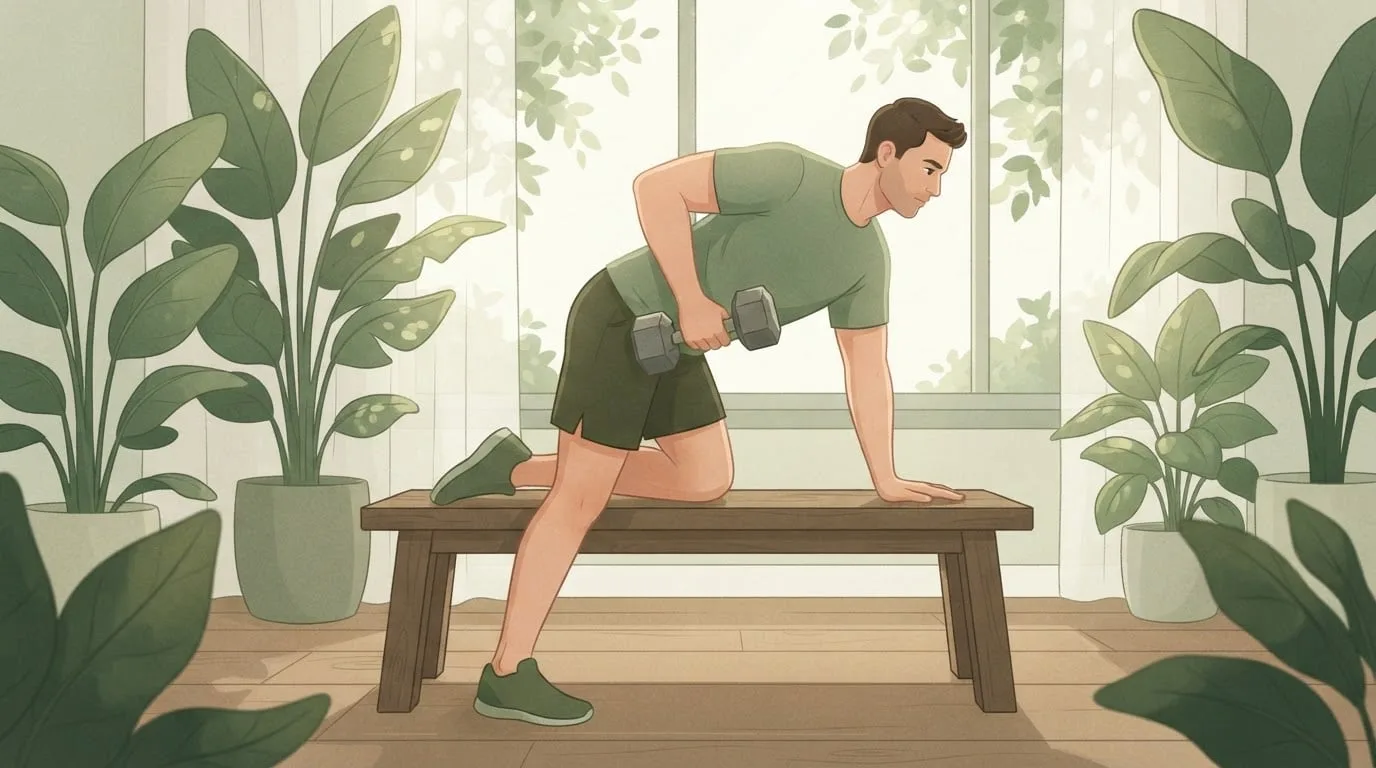
Put your left knee and left hand on a bench or a sturdy chair, with your back flat and your right foot on the floor. Let the dumbbell hang from your right hand, then pull it toward your hip, not your armpit, with your elbow close to your side. Lower it all the way until you feel a stretch under your arm. The supporting hand takes most of the load off your lower back, which makes this the safest heavy pull you can do at home. Our supported row page covers the setup and the common mistakes.
2. Table row
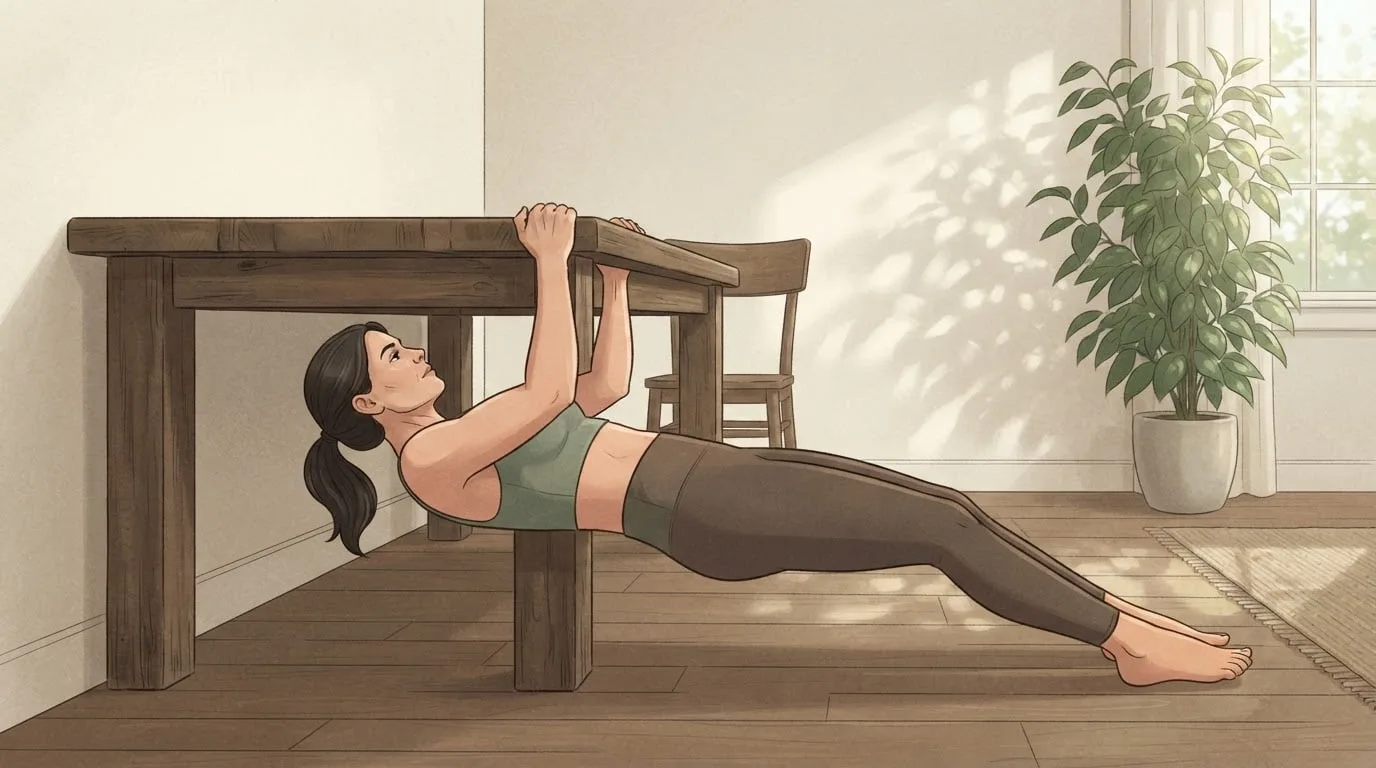
Lie on your back under a sturdy table with your chest under its long edge. Grip the edge with your hands about shoulder-width apart, make your body straight from shoulders to heels, and pull your chest up toward the table. Bend your knees and plant your feet to make it easier, or straighten your legs to make it harder. It's the home version of the inverted row, and it only works if the table is safe. Check it before you trust it with your body weight:
- Use a heavy, solid table with legs at the corners. Never use glass, a folding table, a table with extension leaves or a desk with a thin overhang.
- Stop it from tipping. Pulling down on one edge can lift the far legs of a light table and tip it toward you. Push the far side against a wall, or put something heavy on the far end.
- Test it first. Grip the edge and lean back with your knees bent and most of your weight still on your feet. If the table rocks, lifts or creaks, don't use it.
- Mind your head. Keep it clear of the legs and the frame under the top, and slide out slowly when you finish.
3. Towel door row
Close a solid door that opens away from you, so your pull seats it into the frame instead of swinging it open. Loop the middle of a bath towel around the handle on your side and hold one end in each hand. Walk your feet close to the door and lean back with straight arms. Row yourself upright by pulling your hands to your ribs and squeezing your shoulder blades together, then lower slowly. The closer your feet are to the door, the harder it gets.
- Never use a door that opens toward you. Your pull would open it, and you'd fall backward.
- Check the hardware. The latch should be fully engaged and the handle solidly fixed. A loose handle or a hollow, flimsy door isn't worth the risk.
- Lock it or warn people, so nobody opens the door from the other side mid-set.
- Prefer a post if you have one. A sturdy railing or a solid stair post is a safer anchor than any door.
4. Bent-over dumbbell row
Hold a dumbbell in each hand, or one dumbbell with both hands, and hinge at the hips until your torso is somewhere between flat and 45 degrees, with a flat back and soft knees. Row your elbows back toward your hips, pause, and lower under control. It trains the whole back at once, but holding the hinge is your lower back's job, which is why it gets a warning in the lower-back section below. Our bent-over row page shows the position.
5. Prone Y raise
Lie face down with your arms overhead in a Y and your thumbs pointing up. Lift both arms a few inches off the floor by drawing your shoulder blades down and back, hold for two seconds, then lower. Keep your forehead facing the floor so your neck stays long. The prone Y raise looks easy, and the first set usually proves it isn't.
6. Reverse snow angel
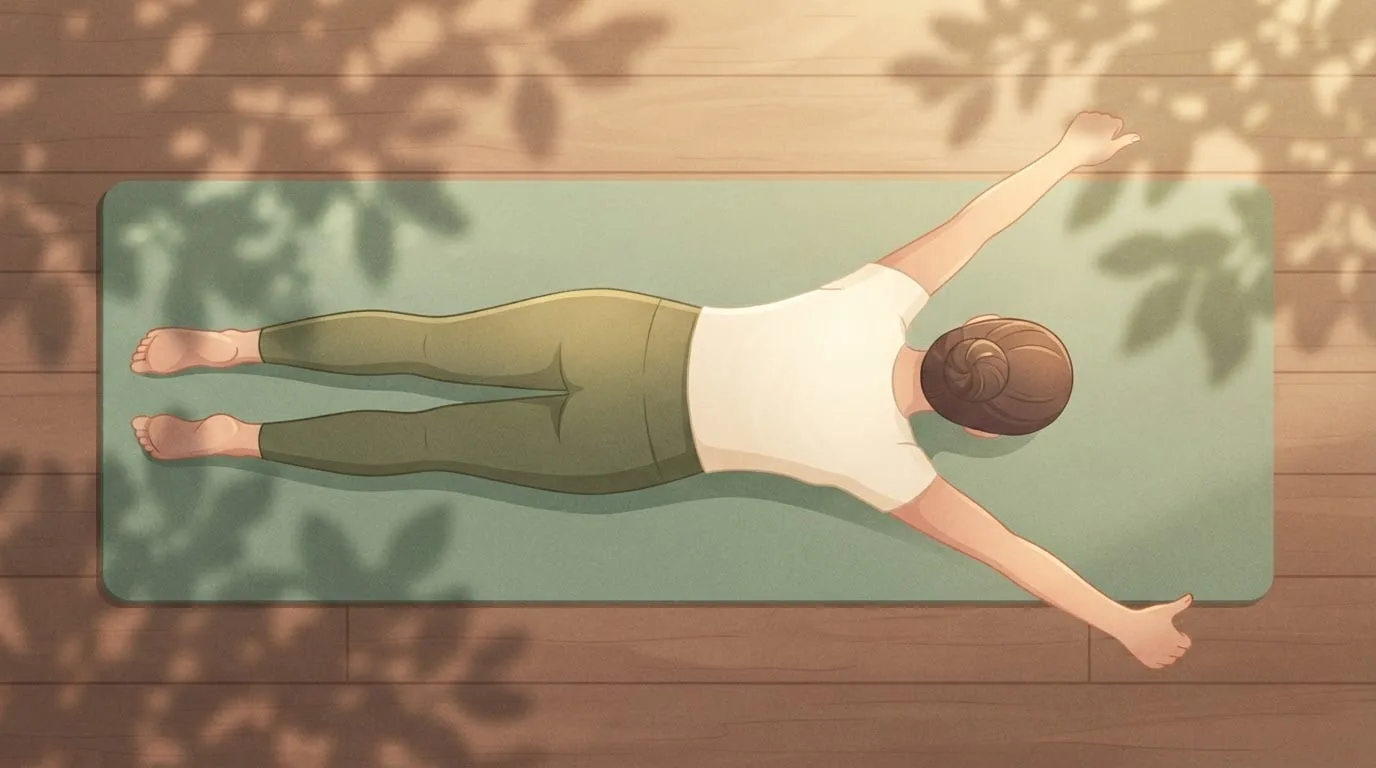
Lie face down with your arms by your sides and lift your chest and hands a little off the floor. Keeping your arms straight and off the floor, sweep them out to the sides and overhead in a wide arc, then sweep them back to your hips. Take about four seconds each way. It moves your shoulder blades through a bigger arc than any row, and it'll humble your rear delts quickly.
7. Superman hold
Lie face down with your arms overhead. Lift your arms, chest and legs a few inches off the floor at the same time, hold for 3 seconds, and lower. A few inches is enough. The superman hold is one of the strongest no-equipment exercises for the muscles along your spine, and it's also the one most likely to irritate a sensitive lower back, so read the lower-back section before you add it.
8. Dumbbell pullover
Lie on your back on the floor with your knees bent, holding one dumbbell in both hands over your chest with your elbows slightly bent. Lower it in an arc behind your head until your upper arms are close to the floor, then pull it back over your chest with your lats. The floor stops the range at a safe point. Our dumbbell pullover page covers the grip.
The Back Muscles and What Each Exercise Hits
Your back is a stack of muscles with different jobs. Some pull your arms down and back, some hold your shoulder blades in place, and some keep your spine upright. A good back workout at home gives each of them at least one exercise.
| Muscle | What it does | Best home exercises |
|---|---|---|
| Latissimus dorsi (lats) and teres major | Pull your arms down and back toward your body | One-arm row, table row, pullover, pull-up if you have a bar |
| Upper trapezius | Lifts and shrugs the shoulder blades | Dumbbell shrug, one-arm shrug |
| Middle trapezius and rhomboids | Squeeze the shoulder blades together | Every row, towel row, reverse snow angel, prone T raise |
| Lower trapezius | Pulls the shoulder blades down and helps rotate them for overhead reaching | Prone Y raise, reverse snow angel |
| Rear deltoids | Pull the arms out and back | Rows with the elbows wide, reverse snow angel, rear-delt raise |
| Erector spinae and multifidus | Straighten and steady the spine | Superman hold, back extension, dumbbell Romanian deadlift |
What the EMG studies show for the upper back
Ekstrom, Donatelli and Soderberg (2003), in the Journal of Orthopaedic and Sports Physical Therapy, recorded the upper, middle and lower trapezius in 30 healthy people across 10 exercises. The prone overhead arm raise in line with the lower trapezius, which is the prone Y raise, produced the highest lower trapezius activity of any exercise tested. The middle trapezius peaked in two exercises: that same Y raise and a prone arm raise out to the side with the thumb turned up, which is a T raise. The upper trapezius peaked in a one-arm shrug. Those floor raises earn their place in a home plan on the numbers, and they cost nothing.
What the EMG studies show for the lower back
Ekstrom, Osborn and Hauer (2008), in the same journal, measured the multifidus and longissimus, two of the muscles that run along the spine, in three groups of about 30 adults aged 21 to 35. The superman exercise drove them to 77 to 82 percent of a maximal contraction. Bridges, side bridges and arm or leg raises on hands and knees, the bird dog family, stayed below 50 percent. So the superman is a real strengthening exercise for the spinal muscles, and the bird dog is the gentler entry point.
Rows compared
Fenwick, Brown and McGill (2009), in the Journal of Strength and Conditioning Research, compared an inverted row, a standing bent-over row and a one-arm cable row in seven men. The inverted row produced the highest lat and upper back activity with the lowest lumbar spine load. The bent-over row produced large activity across the whole back and the largest spine load of the three. That trade-off shapes the lower-back advice later on this page.
How to Train Your Lats Without a Pull-Up Bar
The lats are the hardest back muscle to train at home, because their main job, pulling your arms down from overhead, normally needs a bar or a cable. When a bar is available, it's hard to beat. Youdas and colleagues (2010), in the Journal of Strength and Conditioning Research, recorded 25 people doing pull-ups and chin-ups. Lat activity averaged 117 to 130 percent of a maximal isometric contraction, the lower trapezius was more active in the pull-up, and the biceps and chest worked harder in the chin-up.
Without a bar, use three tools:
- The dumbbell pullover. It trains the lats through the same shoulder movement a chin-up uses, lying down instead of hanging.
- The one-arm row with the elbow driven to the hip. Pulling toward the hip rather than the chest shifts the work toward the lats.
- A towel pulldown hold. Hold a towel overhead with a wide grip, pull it apart as hard as you can, and drag your elbows down toward your ribs. Hold for 10 seconds. It's an isometric stand-in with no study behind it, so treat it as an extra, not the main lift.
If you can mount a doorframe pull-up bar, it's the single best upgrade for a home back workout. Our guide to pull-ups vs chin-ups compares the two grips, and how to do your first pull-up lays out the progression from zero.
Find out what's really holding you back
FitCraft, our mobile fitness app, pairs you with an AI coach who builds you a personalized plan around your goals, schedule, and fitness level. Every FitCraft program is designed by Domenic Angelino, MPH (Brown University) and NSCA-CSCS, with research published in the Journal of Strength and Conditioning Research and Medicine & Science in Sports & Exercise.
Take the Free Assessment Free • 2 minutes • No credit cardBack Workout at Home Without Equipment
To work out your back at home with no equipment, pair a row that uses your body weight, the table row or the towel door row, with floor raises for the shoulder blades and a hold for the spinal muscles. This session takes about 25 minutes.
| Order | Exercise | Sets x reps | Rest |
|---|---|---|---|
| 1 | Table row | 3 x 6-12 | 90 sec |
| 2 | Towel door row | 3 x 10-15 | 60 sec |
| 3 | Towel pulldown hold | 3 x 10-sec hold | 45 sec |
| 4 | Prone Y raise | 3 x 10, 2-sec hold | 45 sec |
| 5 | Reverse snow angel | 2 x 8 | 45 sec |
| 6 | Superman hold, or bird dog if your back is sensitive | 2 x 6 holds of 3 sec | 45 sec |
If you have neither a safe table nor a safe door, do four sets of the towel pulldown hold and the prone Y raise and add a dumbbell as soon as you can. Be honest about the gap: without any row, you'll train your shoulder blades well and your lats poorly.
Back Workout at Home With Dumbbells
One or two dumbbells turn a home back workout into something close to a gym session. This one takes about 30 to 35 minutes.
| Order | Exercise | Sets x reps | Rest |
|---|---|---|---|
| 1 | One-arm dumbbell row | 3-4 x 8-12 per side | 60-90 sec |
| 2 | Dumbbell Romanian deadlift | 3 x 8-12 | 90 sec |
| 3 | Dumbbell pullover | 3 x 10-12 | 60 sec |
| 4 | Bent-over rear-delt raise | 3 x 12-15 | 45 sec |
| 5 | Dumbbell shrug | 2 x 12-15 | 45 sec |
| 6 | Prone Y raise | 2 x 10 | 45 sec |
The Romanian deadlift is the hinge: push your hips back with a flat back and the dumbbells close to your legs, lower until you feel your hamstrings stretch, then stand up by driving your hips forward. It trains the spinal muscles while they hold still rather than lift. If your lower back is sensitive, read the swaps below before you load it. Once you're comfortable, swap the one-arm row for a bent-over row on alternate weeks if your back is healthy.
Are 25 lb dumbbells enough to build muscle?
Yes, for most beginners and many intermediate lifters, as long as each set ends close to failure. Schoenfeld, Grgic, Ogborn and Krieger (2017), in the Journal of Strength and Conditioning Research, pooled 21 studies that compared loads at or below 60 percent of a one-rep max with heavier loads, all taken to failure. Muscle growth was similar. Heavy loads still built more maximal strength. So 25 pounds builds a back as long as the last reps of each set are hard. When it allows 20 or more clean reps, slow the lowering to three seconds, pause at the top, or move to a harder variation.
How Often Should I Work Out My Back?
Twice a week suits most people. Schoenfeld, Ogborn and Krieger (2016), in Sports Medicine, compared training frequencies with the weekly volume held equal and found that training a muscle twice a week produced more growth than once a week, with effect sizes of 0.49 against 0.30. Whether three times beats two is still open.
The total number of hard sets matters at least as much. The same group's 2017 meta-analysis of 15 studies in the Journal of Sports Sciences found a graded dose-response: each extra weekly set was linked to about 0.37 percent more muscle growth. A practical target for your back:
- First two months: 6 to 9 hard sets a week, split across two sessions.
- After that: 10 to 16 hard sets a week across two or three sessions.
- What counts: rows, pull-ups and pullovers count fully. Floor raises and supermans are lighter, so count two of those sets as one.
If you also follow our chest workout at home, match your weekly pulling sets to your pushing sets so your back keeps pace with your chest.
Lower-Back Caution: Choose Exercises by Spine Load
Back exercises differ a lot in how hard they load the lumbar spine, and if your lower back is sensitive, that difference should decide your plan.
Callaghan, Gunning and McGill (1998), in Physical Therapy, measured spine load in 13 young men during common back-extension exercises. Exercises that actively lifted the trunk produced the highest compression and muscle activity. Lifting one leg while the spine stayed still produced low spine load with a mild challenge, and adding the opposite arm raised the demand. That's the logic of the bird dog: your limbs move while your spine holds still. Put that together with the Fenwick and Ekstrom findings above, and the swaps for a touchy lower back are clear:
| Higher spine load | Lower-load swap | Why |
|---|---|---|
| Bent-over row | One-arm row with a hand on a bench, or a table row | The support or the floor takes the hinge off your lower back |
| Superman hold | Bird dog | Your spine holds still while your limbs move |
| Romanian deadlift | Leave it out until it's pain-free, then start light | Holding a hinge under load is the lower back's hardest job here |
Mild discomfort that stays the same or eases as you warm up is usually fine to train through. Sharp pain, pain that spreads down a leg, numbness or weakness means stop and get it checked. Our guide to the best exercises for lower back pain covers the warning signs and a plan for when your back already hurts. The front of your trunk shares the job of protecting your spine, and our abs workout at home trains that side.
Back Muscles for Women: The Same Muscles, the Same Plan
Women have the same back muscles as men, and they respond to training in much the same way. Roberts, Nuckols and Krieger (2020), in the Journal of Strength and Conditioning Research, pooled studies that put men and women on the same program. Muscle growth showed no meaningful difference between the sexes across 10 studies. Relative upper-body strength gains were actually larger in women, across 17 studies. So the best back exercises for women are the same eight on this page, with weights and reps matched to your strength.
A toned back is two things together: muscle under the skin and a level of body fat that lets you see it. Rows and raises build the first. Your overall diet and activity set the second, and no back exercise burns fat from your back specifically.
How to Progress Back Workouts at Home
Muscles grow when the work keeps getting a little harder. At home, you have more ways to do that than you'd think:
- Table row: walk your feet farther forward, straighten your legs, then raise your feet on a chair. Add a two-second pause with your chest at the table.
- Towel door row: bring your feet closer to the door, slow the lowering to three seconds, or row one arm at a time.
- Dumbbell moves: add reps until you reach the top of the range on every set, then slow the tempo or move to a heavier dumbbell. A loaded backpack works as a second weight for rows.
- Floor raises: hold a full water bottle in each hand for Y raises and snow angels, or hold each rep for longer.
Change one thing at a time and keep the form clean. A row that turns into a jerk with your lower back is no longer training the muscles you meant to train.
FitCraft's strength workouts use dumbbells and bodyweight, plus a handful of resistance-band exercises such as band pull-aparts, and an AI coach demonstrates each move on an interactive 3D model you can rotate and zoom. Workouts adjust as you progress, and streaks and leaderboards help you keep showing up for the pulling days. If you're comparing ways to plan home training, our roundup of the best no-equipment workout apps lays out the options, FitCraft included.
The Bottom Line
A back workout at home comes down to solving the pulling problem: a dumbbell row or a safe table row for the lats and upper back, a towel row or floor raises for the shoulder blades, and a superman or bird dog for the spine. Do about 10 hard sets a week across two sessions, take each set close to failure, and choose the lower-load options when your lower back asks you to.
You don't need a gym to build a strong back. You need something to pull, a plan for the week, and enough sessions in a row for the work to add up.
Frequently Asked Questions
How to workout back at home with no equipment?
Use your body weight as the load: table rows under a heavy, solid table, towel rows on a door that opens away from you, prone Y raises, reverse snow angels and superman holds. Do 3 sets of each row and 2 to 3 sets of each raise, twice a week. Without any row at all, you'll train the shoulder blades well and the lats poorly.
How often should I workout my back?
Twice a week suits most people. In a 2016 meta-analysis, training a muscle twice a week produced more growth than once a week at the same volume. Aim for 6 to 9 hard sets a week for your back at first, and build toward 10 or more once you've trained for a couple of months.
What are some good dumbbell back exercises?
One-arm dumbbell rows, dumbbell Romanian deadlifts, dumbbell pullovers, bent-over rear-delt raises and dumbbell shrugs cover the lats, the middle and upper traps, the rear delts and the muscles along the spine. The one-arm row is the anchor, because the hand on a bench takes most of the load off your lower back.
What are the big 3 exercises for back?
A row, a vertical pull and a hip hinge. At home that means a one-arm dumbbell row or a table row, a pull-up or chin-up if you have a bar (a dumbbell pullover if you don't), and a dumbbell Romanian deadlift. Together they train the lats, the upper back and the muscles along the spine.
Are 25 lb dumbbells enough to build muscle?
Yes, for most beginners and many intermediate lifters, as long as each set ends close to failure. A 2017 meta-analysis of 21 studies found that light and heavy loads built similar muscle when sets were taken to failure, while heavy loads built more maximal strength. When 25 pounds allows 20 or more reps, slow the lowering, add a pause or switch to a harder variation.
What is the 3-3-3 rule for working out?
The 3-3-3 rule is a social-media workout template with no single definition. The most common version is three exercises, three sets each, three days a week, usually a squat, a press and a pull. Applied to your back, one pulling exercise for 3 sets on 3 days gives about 9 sets a week, a sensible dose for a beginner.
Is a back workout different for women?
No. Women have the same back muscles as men and, in a 2020 meta-analysis, built muscle at a similar rate on the same training programs. Use the same exercises and choose weights and reps to match your current strength.