Back pain has a way of shrinking your life quietly. You stop picking things up off the floor. You stop sitting through a film. You start planning the day around whether you'll be able to put your socks on, and none of it feels dramatic enough to mention to anyone.
Then you go looking for help and get buried. Stretch the hamstrings. Never stretch the hamstrings. Strengthen the core. The core is a myth. Get an MRI. Don't get an MRI. Everyone sounds certain, and most of them are selling something.
Here's the good news, and it is genuinely good: low back pain is one of the best-studied problems in all of musculoskeletal medicine, and the answer that keeps surviving contact with the data is boring. Move more, load the trunk and hips lightly and often, and keep doing it for longer than feels necessary. This page is the specifics.
What the Research Actually Supports
Exercise is the only conservative treatment for persistent low back pain with consistent top-tier guideline support. The American College of Physicians guideline (Qaseem 2017) recommends non-drug treatment first for both acute and chronic low back pain, with exercise named explicitly for the chronic case.
The size of the effect comes from Cochrane. Hayden and colleagues (2021) pooled 249 randomised trials covering 24,486 adults with chronic low back pain. Against no treatment or usual care, exercise reduced pain by a mean of 15.2 points on a 0 to 100 scale at short-term follow-up, moderate-certainty evidence, sitting right on the threshold most researchers treat as clinically meaningful. Against other conservative treatments the gap narrowed to about 9 points, which is a polite way of saying exercise is roughly as good as the other things that work and cheaper than all of them.
Which type wins, and by how little
The interesting question is whether the type matters. Hayden and colleagues (2021) ran a network meta-analysis on 217 of those trials, 20,969 participants and 507 treatment groups, and found it does, modestly. Pilates reduced pain more than every other exercise category tested (mean difference 4 to 12 points). McKenzie therapy, functional restoration and core strengthening each beat stretching, general aerobic training, flexibility work and yoga by roughly 4 to 8 points. A separate 2022 network meta-analysis by Fernandez-Rodriguez and colleagues landed in the same neighbourhood: Pilates, mind-body and core-based work led on pain, and Pilates, strength and core-based work led on disability.
Four to twelve points on a hundred-point scale is a real difference and a small one. The much larger variable is whether you do it at all. Trial protocols that produced these results typically ran two to three sessions a week for eight weeks or more, which is why this guide spends more space on dosing than on exercise selection.
If you want the full evidence picture, including the prevention and motor-control literature, our review of the research on exercise for lower back pain goes deeper into the trial data than this page does.
Red Flags: When Exercise Is Not the Answer
Almost all low back pain is non-specific, which means no single structure can be blamed and no imaging finding will change the plan. A small share is not. Read this list before you start anything.
Seek urgent care today for any of these:
- Numbness in the groin, buttocks or inner thighs, the area a saddle would touch.
- New trouble controlling your bladder or bowels, including difficulty starting or stopping urination, or not feeling when you need to go.
- Progressive weakness in a leg or foot, a foot that slaps or catches when you walk, or a leg that gives way.
Book a prompt appointment for any of these:
- Back pain that started with significant trauma, a fall, a crash, or any fall at all if you have osteoporosis or are older.
- Fever, chills or unexplained weight loss alongside the pain.
- Night pain that is constant, wakes you, or is not relieved by changing position.
- A history of cancer, long-term steroid use, injected drug use or a suppressed immune system.
- Pain, numbness or tingling that travels below the knee and has not improved after a few weeks.
- No improvement after six weeks of sensible self-management.
A word of context on that list. Downie and colleagues (2013) reviewed 14 studies evaluating 53 red flags in the BMJ and found most of them, taken alone, barely shift the probability of fracture or cancer at all. The ones above are the ones worth acting on, and the point of the list is not to frighten you into a scan. It's the opposite: if none of these apply, your back pain is very probably the ordinary, unglamorous kind that responds to movement.
Why Bed Rest Is the Wrong Instinct
Lying down is what the pain tells you to do, and for the first day it's fine. Past that it starts costing you. Dahm and colleagues (2010) reviewed the trials comparing advice to rest in bed with advice to stay active and found small improvements in both pain and function in favour of staying active for acute low back pain, and no benefit for bed rest in sciatica either. Moderate-certainty evidence, and it has been the guideline position for two decades.
The mechanism isn't mysterious. Trunk muscles lose conditioning fast, joints stiffen, sleep gets worse, and the longer you avoid a movement the more threatening it feels. That last part matters more than people expect. Fear of bending is a better predictor of long-term disability than most things visible on a scan.
So the instruction is not "push through it". It's reduce the load, don't remove it. Walk shorter distances more often. Do half the reps. Use a smaller range. Keep the shape of your week intact even when the volume drops to almost nothing.
Find out what's really holding you back
FitCraft, our mobile fitness app, pairs you with an AI coach who builds you a personalized plan around your goals, schedule, and fitness level. Every FitCraft program is designed by Domenic Angelino, MPH (Brown University) and NSCA-CSCS, with research published in the Journal of Strength and Conditioning Research and Medicine & Science in Sports & Exercise.
Take the Free Assessment Free • 2 minutes • No credit cardThe 10 Best Exercises for Lower Back Pain, With Dosing
Three jobs here. Walking restores general tolerance. The trunk drills teach the spine to stay quiet while the limbs work, which is the motor control idea Saragiotto and colleagues (2016) tested across 29 Cochrane-reviewed trials. The hip work moves load off the low back and onto the glutes and hamstrings, which is the part most home programs skip.
| Exercise | What it does | Dose |
|---|---|---|
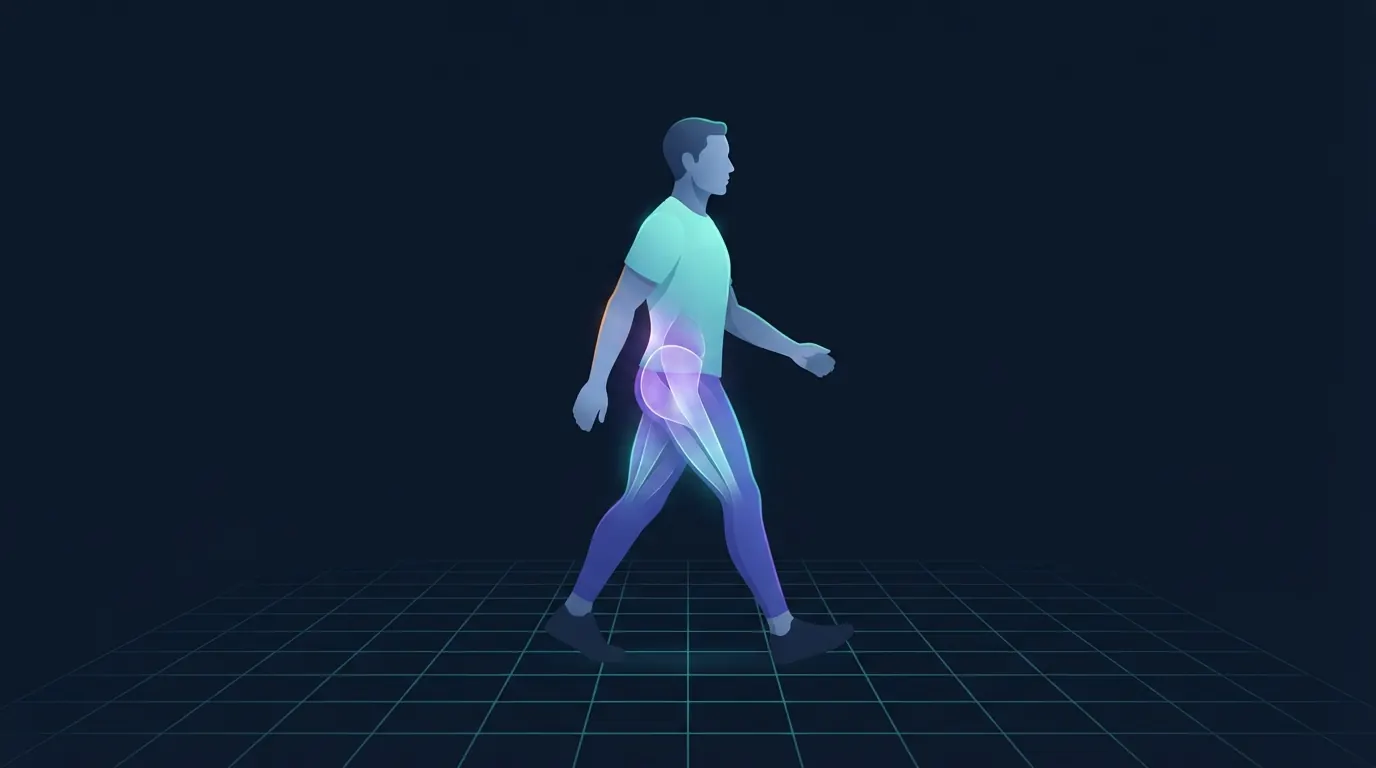
| Walking | The highest-value item on the list. Restores movement tolerance and has the best evidence for preventing the next episode | Build to 5 walks a week, 30 min. Start with 2 x 10 min if that's the ceiling |
| Cat-cow | Gentle, unloaded flexion and extension. Best used first thing as a check on what the spine will give you today | 8 to 10 slow reps, daily |
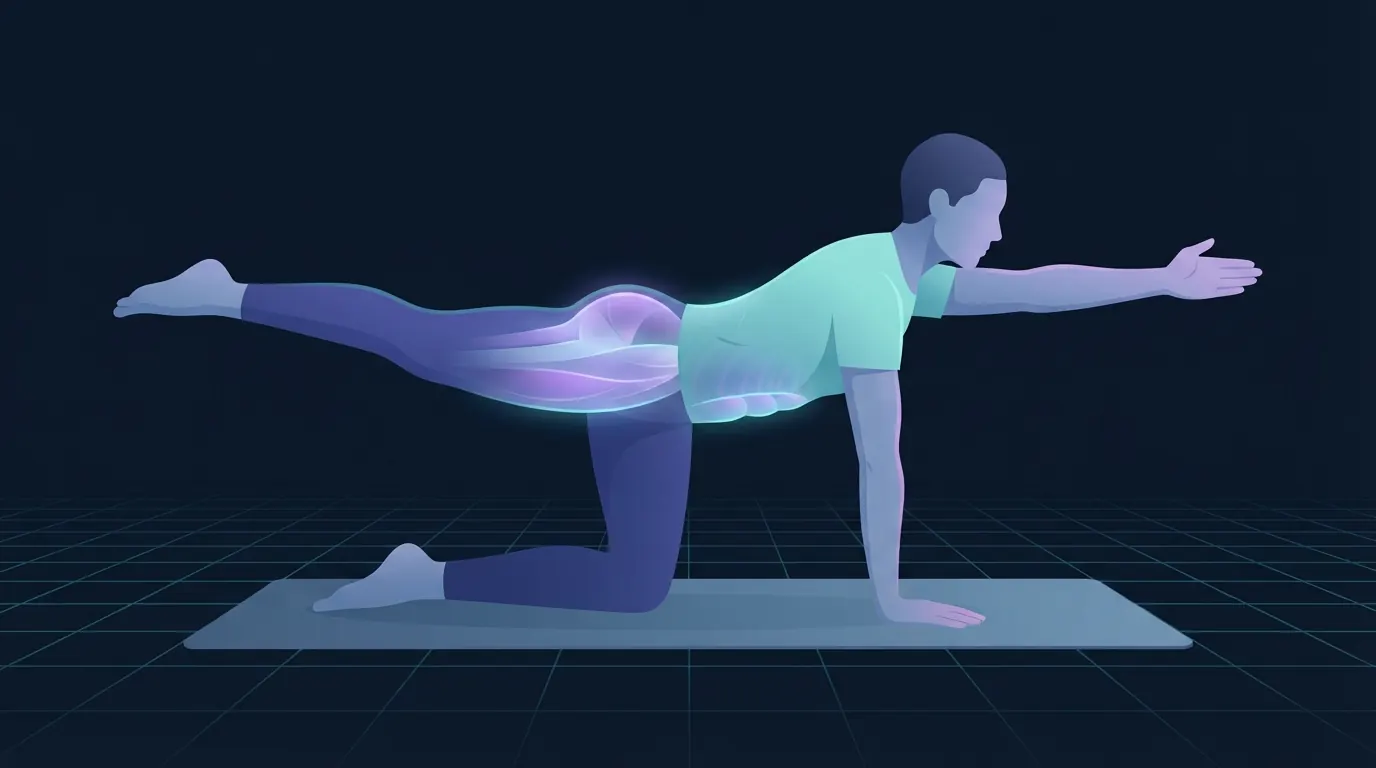
| Bird dog | Trains the trunk to stay level while an arm and the opposite leg move. Low load, high specificity | 2 to 3 x 6 to 8 per side, 3 days a week |
| Dead bug | The same idea lying face up, with the ribs pinned down. Easier on the wrists and knees than bird dog | 2 to 3 x 6 slow reps per side, 3 days a week |
| Glute bridge | Teaches hip extension to come from the glutes instead of the low back. Progress to one leg when 15 reps feel easy | 3 x 10 to 15, 3 days a week |
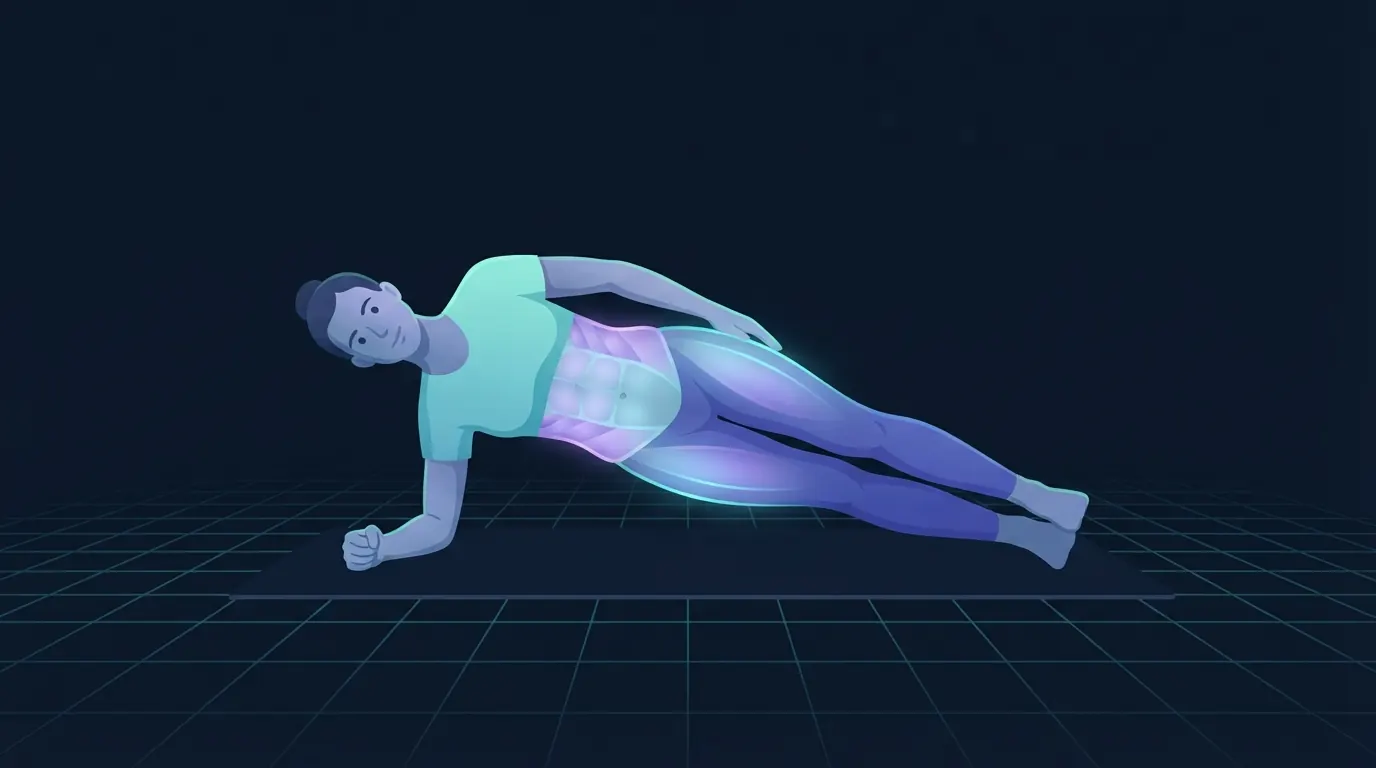
| Side plank | Loads the trunk laterally with no spinal bending. Start from the knees and build the hold | 3 x 15 to 45 sec per side, 3 days a week |
| Hip hinge with a dowel | The pattern that decides whether picking things up hurts. Broom handle along the back, three points of contact | 2 to 3 x 8, 3 days a week |
| Light Romanian deadlift | The loaded version of the hinge once the dowel version is clean. Light dumbbells, mid-shin depth | 3 x 8, 2 days a week |
| Prone press-up | The extension drill from the McKenzie method. Worth testing if bending forward is the movement that hurts | 10 reps, several times a day, only if symptoms improve |
| Half-kneeling hip flexor stretch | Restores hip extension so the low back stops borrowing range from it when you stand and walk | 2 x 30 to 45 sec per side, most days |
Two cues change the whole list. Breathe out during the effortful part of every rep instead of bracing and holding your breath. And make the side plank and the bird dog genuinely isometric: the reason they work is that nothing moves at the spine, so if your hips are dropping and rotating you're doing a different exercise.
The prone press-up is the odd one out, because it only helps a subgroup. If bending forward is what hurts and leaning back feels better, it's likely to be worth your time, and our guide to McKenzie exercises covers the full progression, the dosing and the rules for when to stop. If the hip and trunk drills are what you want to build on, our core stability exercises guide takes the same movements further.
A 4-Week Routine You Can Run at Home
Nothing here needs equipment beyond a mat, a broom handle and eventually a pair of light dumbbells. Three strength sessions a week, roughly 15 to 20 minutes each, plus walking on most days.
| Week | Walking | Strength block, 3 days a week | Goal |
|---|---|---|---|
| 1 | 2 x 10 min most days | Cat-cow 10 reps. Glute bridge 2 x 10. Dead bug 2 x 5 per side. Bird dog 2 x 5 per side | Finish every session no worse than you started |
| 2 | 1 x 20 min most days | Add side plank from the knees 3 x 15 sec per side and dowel hip hinge 2 x 8 | Get through a full hinge without hunting for the pattern |
| 3 | 1 x 25 to 30 min, 5 days | Bird dog 3 x 8 per side. Side plank 3 x 25 sec. Glute bridge 3 x 12. Hinge 3 x 8 | Add a little range, not a lot of load |
| 4 | 30 min, 5 days | Single-leg glute bridge 3 x 8 per side. Side plank 3 x 30 to 45 sec. Romanian deadlift 3 x 8 light | Load the hinge for the first time and keep it light |
The walking column is not filler. The WalkBack trial (Pocovi 2024) randomised 701 Australian adults who had just recovered from an episode of back pain to an individualised, progressive walking program with six physiotherapist coaching sessions, or to nothing. The walking group went a median of 208 days before their next activity-limiting episode against 112 days in the control group, a hazard ratio of 0.72 (95% CI 0.60 to 0.85). They also used about half as much healthcare and took about half as much time off work. Participants built up to roughly five walks a week of 30 minutes over six months, which is exactly the ramp in the table above.
After week four, keep going. Steffens and colleagues (2016) pooled 21 trials in JAMA Internal Medicine and found exercise, with or without education, cut the risk of a low back pain episode over the following year, but the protective effect faded once programs stopped. Back training behaves like brushing your teeth, not like a course of antibiotics. If the sticking part is the problem rather than the programming, our home workout app with no equipment page covers how a guided plan handles the part where week three arrives and you stop.
What to Do in a Flare, and What to Avoid
Flares happen, including to people doing everything right. A flare is not evidence that the program failed or that you damaged something.
Do this. Cut volume to roughly a quarter, not to zero. Keep walking, even if it's five minutes at a time. Keep cat-cow and glute bridges in whatever range doesn't provoke symptoms. Change position often. Use heat if it helps, because comfort measures buy you the ability to keep moving, which is the thing that actually matters.
Avoid this. Two or more days flat in bed. Loaded bending in the first hour after waking, when the discs are at their most hydrated and stiffest. Max-effort testing to see how bad it is. Sitting for long uninterrupted blocks. And the big one: dropping the program entirely and promising yourself you'll restart when it's better.
On the pain question specifically, Smith and colleagues (2017) pooled seven trials covering 385 people with chronic musculoskeletal pain and found protocols allowing painful exercise produced a small but significant short-term advantage over strictly pain-free protocols, with no difference by six months. Practical version: discomfort up to about 4 out of 10 during a set is fine if it settles within a day and you're not worse the next morning. Sharp pain, or pain that spreads further down the leg than it did before you started, means stop that movement.
When Imaging Helps, and When It Just Scares You
People want a scan because they want a name for it. The evidence says a scan mostly gives you a name for something that was already there.
Chou and colleagues (2009) pooled six randomised trials covering 1,804 patients in the Lancet and found that immediate lumbar imaging produced no improvement in pain, function, quality of life or any other clinical outcome compared with usual care without imaging, in patients with no signs of serious underlying disease.
The reason is in the second study. Brinjikji and colleagues (2015) reviewed 33 studies covering 3,110 people with no back pain at all. Disc degeneration showed up in 37 percent of 20-year-olds and 96 percent of 80-year-olds. Disc bulges ran from 30 percent at 20 to 84 percent at 80. Disc protrusions, annular fissures, facet changes: all common, all rising with age, all in people who felt fine. A report describing "degenerative disc disease" in a 45-year-old is describing the population norm.
Imaging is genuinely useful when a red flag is present, when there's progressive neurological loss, or when you and a surgeon are seriously weighing an operation. Outside those, the scan tends to hand you a scary vocabulary and no plan.
The Bottom Line
The best exercises for lower back pain are the unimpressive ones, done more often than feels interesting. Walk most days. Spend fifteen minutes three times a week on cat-cow, bird dog, dead bug, glute bridge, side plank and a hip hinge. Add load slowly to the hinge. Test the press-up if extension is what relieves you. Give it eight weeks before you judge it, because that's the shortest protocol that produced results in the trials.
You don't have a fragile spine. You have a back that has been asked to do very little and then occasionally asked to do everything, and the fix is spreading the asking out. If back pain arrived alongside a desk job and stiff hips, our guides on exercises for posture and tight hip flexors cover the two things that most often travel with it.
Frequently Asked Questions
What are the best exercises for lower back pain?
The exercises with the most support are walking, cat-cow, bird dog, dead bug, glute bridge, side plank, hip hinge patterning and light Romanian deadlifts, plus a directional preference drill such as a prone press-up if extension eases your symptoms. A 2021 network meta-analysis of 217 trials and 20,969 people found Pilates, McKenzie therapy, functional restoration and core strengthening reduced pain more than stretching, general aerobic work or yoga. The honest answer is that the category matters less than the repetition. Exercise you keep doing for eight weeks beats a better exercise you abandon in two.
Should I rest or exercise with lower back pain?
Stay active. A Cochrane review of advice to rest in bed versus advice to stay active found small improvements in pain and function in favour of staying active for acute low back pain, and no advantage for bed rest in sciatica. Bed rest beyond a day or two deconditions the trunk, stiffens the joints and raises fear of movement. Reduce load rather than removing it: short walks, gentle range of motion and easier versions of your usual exercises.
How long does it take for back exercises to work?
Most people notice less stiffness inside two weeks and measure a real change in pain somewhere between six and twelve weeks. The Cochrane review of exercise therapy for chronic low back pain pooled 249 trials and 24,486 participants and found exercise reduced pain by about 15 points on a 0 to 100 scale compared with no treatment at short-term follow-up, which is right at the threshold people describe as meaningful. Trial protocols typically ran two to three sessions a week for at least eight weeks.
Is it normal for exercise to hurt a bit when you have back pain?
Some discomfort is expected and is not a sign of damage. A 2017 review of seven trials in 385 people with chronic musculoskeletal pain found protocols that allowed painful exercise produced a small short-term advantage over strictly pain-free protocols. A practical rule: discomfort up to about 4 out of 10 during the set is acceptable if it settles within 24 hours and you are not worse the next morning. Sharp pain, or pain that travels further down the leg, is a reason to stop that movement.
Does walking help lower back pain?
It helps a lot, and it is the single most evidence-backed thing you can do to stop pain coming back. The WalkBack trial randomised 701 Australian adults who had recently recovered from an episode of back pain to a progressive walking and education program or to nothing. The walking group went a median of 208 days before a recurrence versus 112 days in the control group, a hazard ratio of 0.72. The target was five walks a week of about 30 minutes, built up over six months.
Do I need an MRI for lower back pain?
Usually not, and imaging early can make things worse. A Lancet meta-analysis of six trials and 1,804 patients found immediate lumbar imaging did not improve pain, function or any other clinical outcome in people without signs of serious disease. Disc changes are also extremely common in people with no symptoms at all: a review of 3,110 asymptomatic adults found disc bulges in 30 percent of 20-year-olds and 84 percent of 80-year-olds. Imaging earns its place when red flags are present or when surgery is genuinely on the table.
When should lower back pain be checked by a doctor?
Get urgent care for numbness in the groin or inner thighs, new trouble controlling your bladder or bowels, or progressive weakness in a leg or foot. Book a prompt appointment for back pain after a fall or crash, pain with fever or unexplained weight loss, pain that is constant and wakes you at night, a history of cancer or osteoporosis, or pain that is no better after six weeks of sensible self-management. Those patterns need a clinician, not a new exercise.