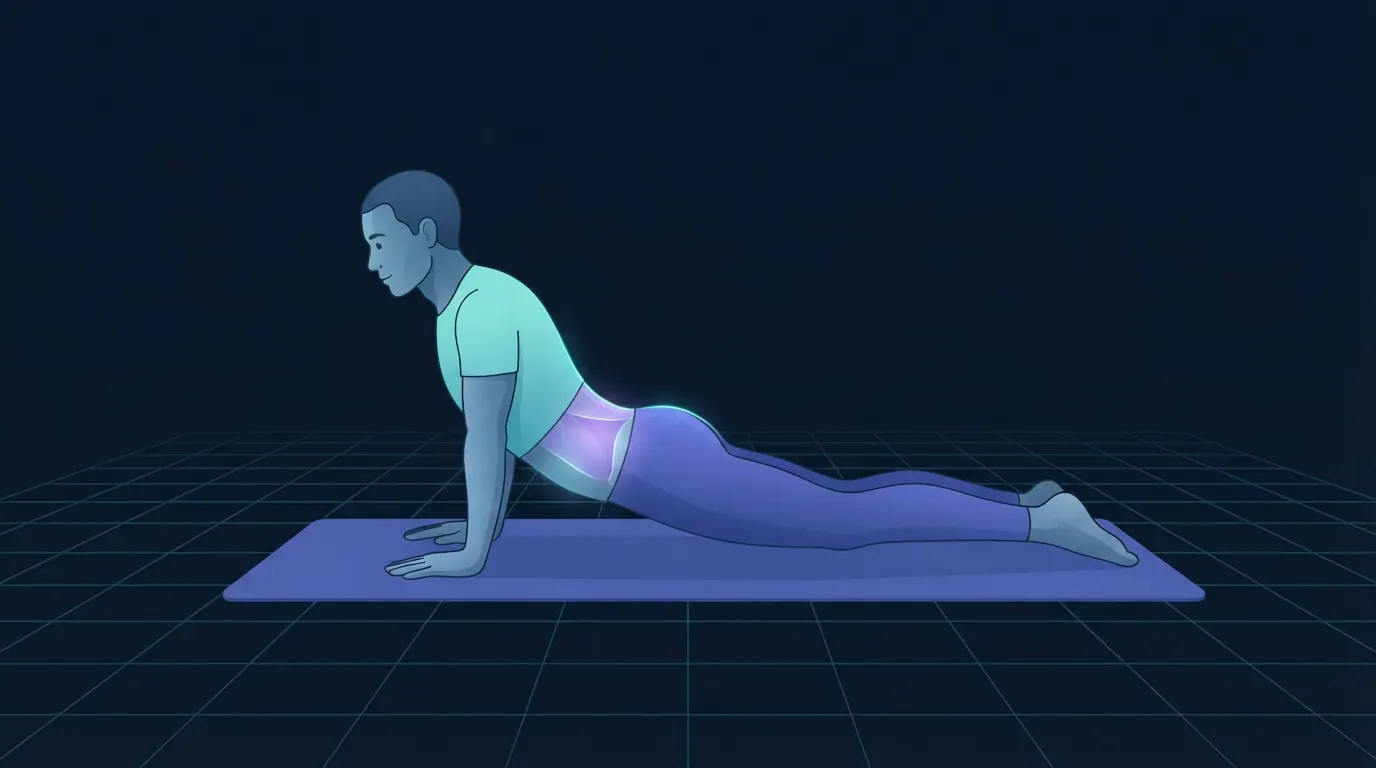
Someone tells you to do press-ups on the floor for your back. You try ten. Nothing obvious happens, or it feels worse, and you decide McKenzie isn't for you.
That's a reasonable conclusion from an unreasonable starting point, because the press-up on its own is not the method. Robin McKenzie's system is a mechanical assessment. You load the spine repeatedly in a chosen direction, you watch where the symptoms go, and the answer to that question decides your whole program. Some people should be doing extension. Some should be doing the opposite. Some shouldn't be self-treating at all, and the assessment is how you find out which one you are.
This page covers what the method is, how directional preference and centralization work, the four-step extension progression with dosing, the rules for stopping, what to do if flexion is your direction instead, and what the trial evidence honestly supports.
What the McKenzie Method Actually Is
The formal name is Mechanical Diagnosis and Therapy, usually shortened to MDT. It was developed in the 1950s and 60s by New Zealand physiotherapist Robin McKenzie and it has three parts, only one of which is exercise.
First, a mechanical assessment. A clinician takes a history, then has you perform repeated movements, typically 10 at a time, at the end of your available range: bending forward, bending back, side gliding. After each set they ask what happened to your symptoms and where they are now.
Second, a classification. MDT sorts people into syndromes rather than into structures. Derangement, the biggest group, describes symptoms that change rapidly and lastingly with repeated movement in one direction. Dysfunction describes pain reproduced consistently at end range with no lasting change. Postural describes pain from sustained end-range positions only. There's also an "other" category for everything that doesn't fit, which is where serious pathology gets flagged out.
Third, the exercise. Only after the first two steps do you get a direction and a dose, and the exercise is deliberately self-administered. That last part is the philosophical core of the method: McKenzie's position was that back pain patients should be able to manage their own episodes without needing a clinician's hands every time.
So "McKenzie exercises" as a phrase is a bit of a shortcut. What people usually mean is the extension progression, which is the most common direction, but the direction is an output of the assessment and not an assumption.
Directional Preference and Centralization, Explained
These are the two terms that make the method make sense, and they're different things.
Directional preference
Directional preference is when repeated movement one way rapidly and lastingly improves your symptoms, your range, or both, while the opposite direction makes them worse. It's a response, not a diagnosis, and it's common. May and Aina (2012) reviewed 62 studies and found directional preference in about 70 percent of 2,368 patients with back or neck pain across five studies. Their 2018 update, adding 43 further articles, put centralization and directional preference at roughly 60 to 70 percent of patients and confirmed both as prognostic indicators: people who show them tend to do better.
Centralization
Centralization is more specific. It's symptoms retreating from the periphery toward the midline of the low back during or right after repeated movement. Pain that ran to your calf now stops at the knee. Pain at the knee now stops in the buttock. Crucially, the pain in the centre often gets temporarily stronger while this happens, and that's still a good sign. What matters is the location, not the volume.
The opposite is peripheralization: symptoms spreading further from the spine and down the leg. That's the stop signal, and it is not something to push through.
Centralization is less common than directional preference. May and Aina found it in 44.4 percent of 4,745 patients across 29 studies, and it was far more frequent in acute presentations, at 74 percent, than in sub-acute or chronic ones, at 42 percent. So the longer pain has been around, the less likely a clean centralizing response becomes, which is one honest reason this method suits recent episodes better than ten-year histories.
Why does any of this matter for what you do on the floor? Because of Long, Donelson and Fung (2004). They assessed 312 patients with acute, sub-acute and chronic low back pain, found a directional preference in 74 percent of them, then randomised only those patients to three groups: exercises matching their direction, exercises in the opposite direction, or non-directional exercises. The matched group improved significantly and quickly on pain, medication use and every other outcome, and dropout in the two mismatched groups was high enough that the trial was stopped early. Same exercises, opposite instruction, opposite result.
The Extension Progression, Step by Step
This is the sequence most people mean by McKenzie exercises. Work through it in order and stay at the step that produces centralization or clear relief. There's no prize for reaching step four.
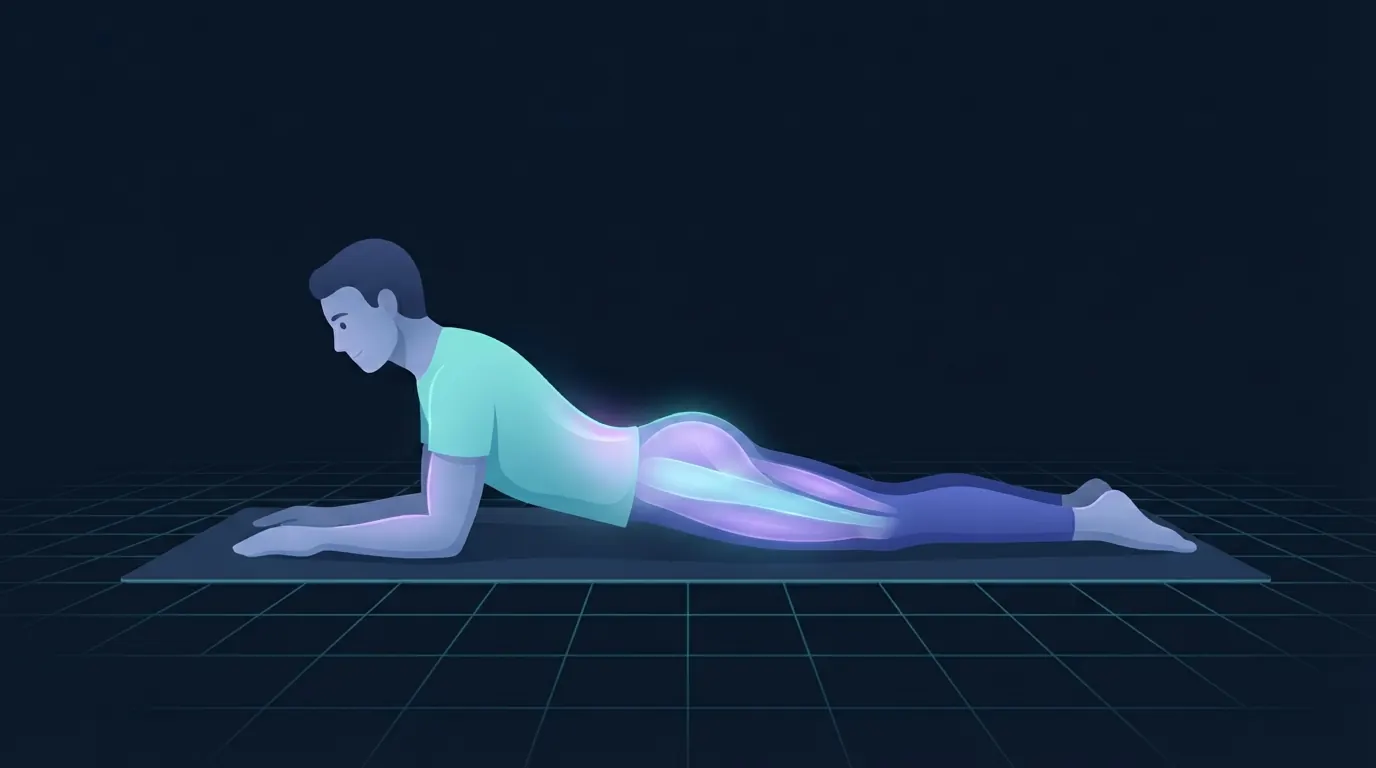
| Step | How to do it | Dose |
|---|---|---|
| 1. Prone lying | Lie face down, arms by your sides, head turned to one side. Breathe out and let the whole back go slack. That's it | 2 to 5 min, then reassess where your symptoms are |
| 2. Prone on elbows | Prop up on both forearms, elbows under the shoulders, hips and thighs staying on the floor. Let the low back sag rather than holding it braced | Start at 30 sec, build toward 5 min over several days |
| 3. Prone press-up | Hands flat under the shoulders, straighten the arms and lift the chest while the hips, thighs and pelvis stay down. Lower all the way between reps | 10 reps, roughly every 2 hours while awake |
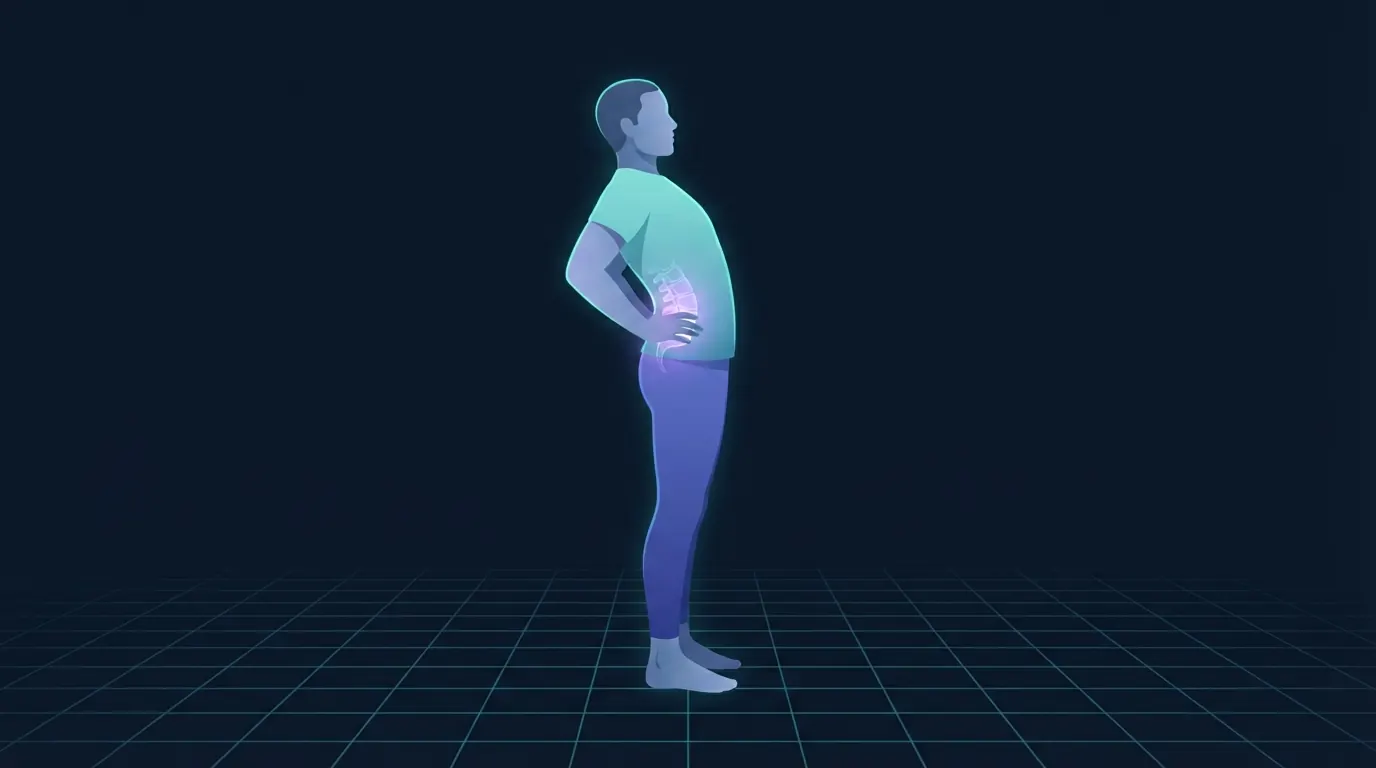
| 4. Standing extension | Feet hip-width, heels of both hands on the top of your pelvis, lean back over your hands and return upright | 10 reps, whenever you cannot get to the floor |
Four details decide whether this works.
- The hips stay down in step three. If your pelvis lifts off the mat, you've turned an extension drill into a plank and the spine barely extends at all.
- Go to the end of your available range. Half-hearted reps in the middle of the range are the most common reason people report "nothing happened". The last few degrees are where the response lives.
- Frequency beats duration. Ten reps every couple of hours, six to eight times a day, outperforms sixty reps once. Each session takes under two minutes.
- Reassess after every set. The question is never "did that hurt". It's "where is the pain now compared with before". Write it down for the first two days if you have to.
Standing extension is the one to keep in your pocket. It's the version you can do in an office, at an airport or in the middle of a long drive, and it's the main reason the method travels well once you know your direction.
The Stop Rules
An extension program with no stop rules is how people talk themselves into weeks of making things worse. These are not optional.
- Stop the set if symptoms peripheralize. Pain, numbness or tingling moving further down the leg during or after the reps means this direction is wrong today. Do not finish the ten.
- Stop if the flare-up doesn't settle. A brief increase in central low back pain that fades within 20 to 30 minutes is expected. Pain that's still elevated an hour later means too much range, too many reps, or the wrong direction.
- Stop and get assessed for anything new and neurological. New weakness in a foot or leg, new numbness, or a foot that catches when you walk.
- Stop and seek urgent care for numbness in the groin, buttocks or inner thighs, or any new difficulty controlling your bladder or bowels. That combination is a medical emergency and no exercise is appropriate.
- Stop the experiment after two days of nothing. If consistent extension produces no change in either direction after roughly two days of proper dosing, extension is probably not your preference. That's information, not failure.
Keep going when the pain centralizes, even if the central pain briefly gets sharper. That's the response the method is looking for, and it's the single most useful thing an untrained person can learn to recognise in their own back.
Find out what's really holding you back
FitCraft, our mobile fitness app, pairs you with an AI coach who builds you a personalized plan around your goals, schedule, and fitness level. Every FitCraft program is designed by Domenic Angelino, MPH (Brown University) and NSCA-CSCS, with research published in the Journal of Strength and Conditioning Research and Medicine & Science in Sports & Exercise.
Take the Free Assessment Free • 2 minutes • No credit cardWhen Flexion Is the Direction Instead
Extension gets the attention because it's the more common preference, but it isn't universal, and the method never claimed it was. A flexion preference shows up often enough that assuming extension is a real way to get people worse.
The pattern usually looks like this: standing and walking make it worse, sitting and leaning forward over a shopping trolley make it better, and symptoms are more about heaviness or aching in both legs than sharp pain in one. That presentation is common in older adults with lumbar spinal stenosis, where extension narrows the space the nerves travel through.
The flexion sequence mirrors the extension one:
- Single knee to chest, lying on your back, holding for a few seconds, alternating. 10 reps.
- Double knee to chest, both knees drawn up together. 10 reps.
- Seated flexion, sitting on a chair, feet apart, reaching down toward the floor between your knees and using your hands on your shins to return. 10 reps.
- Standing flexion, the last step and the one most likely to aggravate, added only once the earlier steps are comfortable.
Same dosing logic, same stop rules, same question after every set. One extra caution: flexion in the first hour after waking is the highest-risk time to load the spine into bending, so shift those sessions later in the day.
What the Evidence Shows
The honest summary is that McKenzie exercises are moderately effective for the right people and unremarkable for everyone else. Three pieces of evidence say it clearly.
Against other rehabilitation, for chronic pain. Lam and colleagues (2018) reviewed 17 studies, 11 of which yielded usable data, and found moderate to high quality evidence that MDT is superior to other rehabilitation interventions for reducing pain and disability in chronic low back pain, with small to moderate effect sizes, and moderate to high quality evidence that it is not superior for acute low back pain. That split is the most important single finding on this page.
Against placebo. Garcia and colleagues (2018) randomised 148 patients with chronic non-specific low back pain to MDT or a convincing placebo, 10 sessions over five weeks, with follow-up to 12 months. MDT came out slightly ahead on pain at the end of treatment, by an amount below most thresholds for clinical importance, and showed no advantage at all on disability. Useful calibration for anyone who has read the method described as transformative.
When the patient is selected properly. Hennemann and colleagues (2025) restricted their meta-analysis to five trials covering 743 patients who actually had a directional preference and were treated by credentialed MDT therapists. Short-term pain improved by a mean of 1.11 points on a 10-point scale against comparators, and by 1.53 points against general exercise, with intermediate-term disability favouring MDT at a standardised mean difference of 0.53. Certainty was low to moderate, which the authors say plainly. Still, the pattern is consistent: the method does better when you only give it to the people its own assessment says it's for.
Two more results worth knowing. Halliday and colleagues (2016) randomised 70 people with chronic low back pain and a directional preference to MDT or motor control exercises and found no significant between-group difference in pain or function, with perceived recovery slightly favouring MDT and the same picture holding at one year. And in the wider comparison of exercise types, the network meta-analysis by Hayden and colleagues (2021), drawing on 217 trials and 20,969 participants from the Cochrane review of exercise therapy, placed McKenzie therapy in the top group alongside Pilates, functional restoration and core strengthening, beating stretching, aerobic training, flexibility work and yoga by roughly 4 to 8 points on a 100-point pain scale. Our guide to the best exercises for lower back pain covers that broader evidence and how the other categories compare.
Who McKenzie Exercises Are For
Good candidates. Recent episodes of mechanical back pain. Pain that clearly changes with position. Symptoms that hurt more when you bend forward or sit and ease when you stand or arch. A leg component that moves up and down depending on what you've been doing. People who want something they can apply themselves during a flare rather than waiting for an appointment.
See a clinician first. Any of the red flags: numbness in the groin, buttocks or inner thighs, changes in bladder or bowel control, progressive weakness in a leg or foot, fever, unexplained weight loss, a history of cancer or osteoporosis, back pain after a fall or crash, or night pain that wakes you. Also worth an assessment before self-treating: pregnancy, recent spinal surgery, a known fracture, or symptoms that have run unchanged for more than six weeks.
Where a trained therapist adds the most. The tricky presentations are lateral shifts, where your torso is visibly offset to one side and the shift has to be corrected before extension does anything useful, and cases where the assessment keeps coming back ambiguous. Both benefit from someone who has done the credentialed training, which is the population the Hennemann meta-analysis restricted itself to.
How This Fits With the Rest of a Back Program
McKenzie exercises are a symptom tool. They're very good at moving pain out of your leg and back toward your spine, and they don't build any capacity. Something has to do that second job.
The usual sequence is: settle it, then build it. Use the directional work for the first days or weeks to get symptoms centralized and your movement confidence back. Then bring in walking, hip hinging and trunk work, because those are what keep the next episode further away. Our guide to the best exercises for lower back pain has the four-week version of that second phase, and if stiff hips are forcing your low back to supply range it shouldn't have to, the routine in our tight hip flexors guide fits alongside it.
Keeping either phase going for eight weeks is where most people come unstuck, not the exercise selection. If that's the honest obstacle, our home workout app with no equipment page covers how a guided plan handles the consistency problem.
The Bottom Line
McKenzie exercises are worth a two-day trial for almost anyone with mechanical back pain and no red flags, because the test is cheap and the answer is usually clear. Run the progression in order. Dose it at ten reps every couple of hours rather than one long session. Watch where the pain goes, not how loud it is. Keep going if it centralizes, stop if it peripheralizes, and stop entirely if anything neurological is new.
If extension is your direction, you've just found the most useful self-management tool in back pain. If it isn't, you've ruled something out in 48 hours, which is faster than most things in this field. Either way, the strength work still has to happen afterwards.
Frequently Asked Questions
What are McKenzie exercises?
McKenzie exercises are the treatment half of Mechanical Diagnosis and Therapy, a system developed by New Zealand physiotherapist Robin McKenzie. You perform repeated movements in one direction, most often lumbar extension, and track what happens to the location of your symptoms rather than only their intensity. The best-known sequence runs prone lying, prone on elbows, prone press-ups and standing extension. The exercises are only half the method: the assessment that decides which direction to load is the other half.
What is directional preference in the McKenzie method?
Directional preference means repeated movement in one direction rapidly and lastingly improves your symptoms while the opposite direction makes them worse. A systematic review by May and Aina found directional preference in about 70 percent of 2,368 patients with back or neck pain across five studies. In a randomised trial of 312 patients, 74 percent showed a directional preference, and those given exercises matching their preferred direction improved faster than those given the opposite or a non-directional program.
What does centralization mean?
Centralization is symptoms retreating from the leg toward the midline of the low back during repeated movement, even if the pain in the centre briefly gets stronger. It is the signal that you are loading in the right direction. The opposite, peripheralization, is symptoms spreading further down the leg, and it means stop. A review of 4,745 patients across 29 studies found centralization in 44 percent overall, and it was far more common in acute pain, at 74 percent, than in longer-standing pain, at 42 percent.
How many McKenzie exercises should I do per day?
The conventional dose is about 10 repetitions every two hours during waking hours, roughly six to eight short sessions a day, because frequency is what drives the response rather than long single bouts. Each session takes under two minutes. If you are using prone lying or prone on elbows as your entry point, hold those for two to five minutes instead of counting reps. Reassess after two days: if nothing has changed, extension is probably not your direction.
Do McKenzie exercises actually work?
For chronic low back pain they are modestly better than the alternatives, and for acute pain they are not. A 2018 meta-analysis of 17 studies found moderate to high quality evidence that the method beats other rehabilitation for chronic low back pain with small to moderate effect sizes, and no superiority in acute cases. A 2025 meta-analysis restricted to five trials with 743 patients who had a directional preference and were treated by credentialed therapists found larger gains, around 1.1 to 1.5 points on a 10-point pain scale, at low to moderate certainty.
When should I stop doing McKenzie extension exercises?
Stop immediately if symptoms move further down the leg, if you develop new numbness or weakness, or if the pain increase does not settle within about 30 minutes of finishing. Stop and seek urgent care for numbness in the groin or inner thighs, any change in bladder or bowel control, or progressive leg weakness. If two days of consistent extension produce no change in either direction, the direction is probably wrong for you and it is worth being assessed.
Are McKenzie exercises the same as core exercises?
No. McKenzie exercises use repeated end-range movement in one direction to change symptoms; core or motor control exercises train the trunk to stay stable while the limbs move. A randomised trial of 70 people with chronic low back pain and a directional preference compared the two and found no significant difference in pain or function, with perceived recovery slightly favouring the McKenzie group. Most people end up using the McKenzie work to settle symptoms and the strength work to build back capacity.