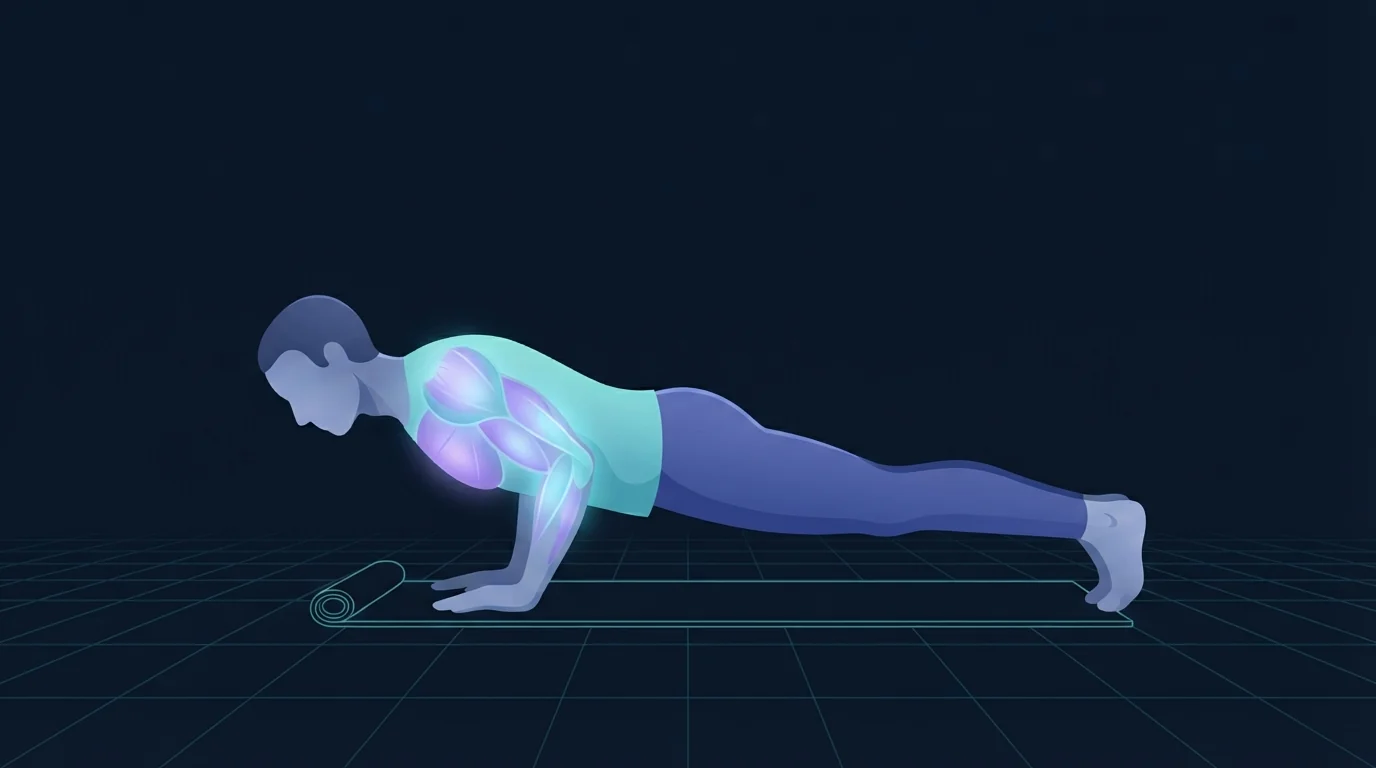
You can do 30 push-ups. Your chest looks exactly the same as it did when you could do 15. That's the complaint behind almost every search for a chest workout at home, and it isn't a motivation problem or an exercise-selection problem.
It's arithmetic. A barbell lets you add two and a half pounds. Your torso weighs what it weighs. Once you can press it comfortably, the only way to make the movement harder is to change the geometry, and almost nobody is taught which parts of the geometry actually matter.
Three of them do. How deep you can go, what angle your torso sits at, and how many arms are sharing the job. Here's what each one is worth, and the session that uses all three.
What a Chest Workout at Home Actually Loads
Start with the number, because it reframes everything downstream. Suprak, Dawes and Stephenson (2011), writing in the Journal of Strength and Conditioning Research, put subjects on force plates and measured what the hands carry. In a standard push-up it was 69.16 percent of body mass in the up position and 75.04 percent in the down position. Drop to the knees and it fell to 53.56 and 61.80 percent.
Gouvali and Boudolos (2005) measured the same thing a different way and landed close: 66.4 percent of body weight at the start of a standard rep against 52.9 percent from the knees. Two labs, two methods, one conclusion. A push-up is a fixed-percentage lift.
That fixed percentage is the whole reason the rep count keeps climbing while nothing else changes. At 170 pounds you're pressing something like 115 pounds every single rep, on rep 3 and on rep 30. Adding reps 31 through 40 doesn't raise it. If you want the full ladder of variations sorted by measured load, our push up progression guide lays out eleven rungs and the standard for leaving each one. This page is about what to do once you're already on the floor and the floor stopped being hard.
The Best Chest Exercises at Home, Ranked by Load
Six movements do the work. The ranking is by how much tension they put through the pectorals, not by how impressive they look.
| Movement | What it changes | Working range |
|---|---|---|
| Deficit push-up (hands on books) | Adds depth below hand level | 5-10 reps |
| Feet-elevated push-up | Shifts mass toward the hands, biases upper chest | 6-12 reps |
| Archer push-up | Loads one arm at a time | 4-8 per side |
| Close-grip push-up | Lengthens the triceps lever, keeps pec tension | 8-15 reps |
| Floor slide flye | Trains adduction the press never reaches | 6-10 reps |
| Palm-press squeeze | Pure isometric adduction, no joint stress | 20-30 seconds |
Notice what is missing. There's no wide-grip push-up on that list, and no hundred-rep finisher. Cogley and colleagues (2005) ran surface EMG on 40 adults across three hand widths and found greater activity in both the pectoralis major and the triceps at a narrow base than at a wide one. Spreading your hands out feels like it stretches the chest more. It measures lower.
Incline or Decline? The Push-Up Names Are Backwards
This is where most home chest programs get confused, and it's worth ten minutes of your attention because it decides which part of your chest you're building.
The pectoralis major is not one muscle with one job. It has a clavicular head running from the collarbone, a sternocostal head from the breastbone, and an abdominal portion below that. They attach at different heights, so they pull hardest at different torso angles. Rodriguez-Ridao and colleagues (2020), in the International Journal of Environmental Research and Public Health, recorded EMG in 30 trained adults pressing at five bench angles. The upper portion peaked at 30 degrees. The middle and lower portions were highest at a flat 0 degrees. At 60 degrees the anterior deltoid took over and the chest contribution dropped.
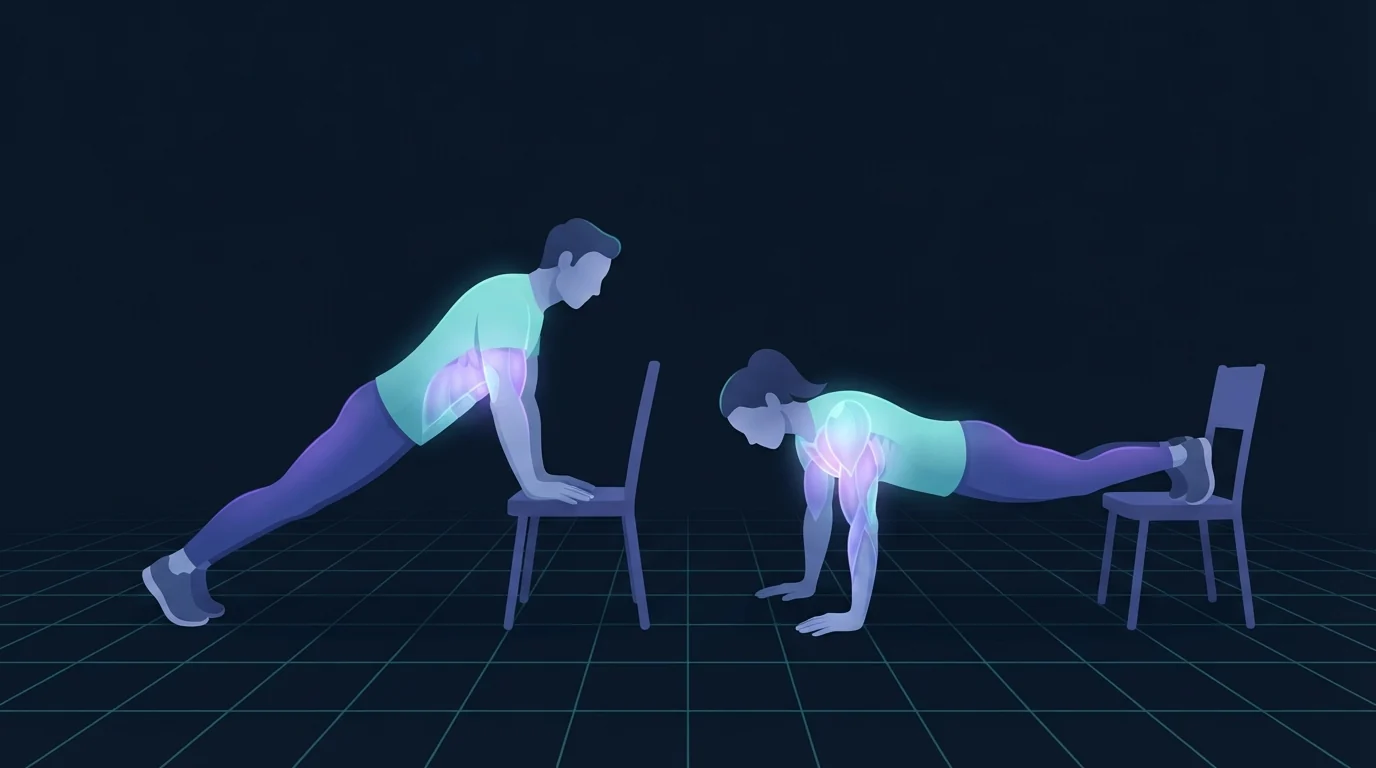
Now translate that to the floor, and watch the vocabulary flip. A decline push-up means your feet are up, which tips your torso head-down and puts your arms in the same relationship to your chest as an incline bench press. So the push-up everyone calls a decline is the one that biases the upper chest. And an incline push-up, hands on a chair, is the flat-bench equivalent made lighter.
The practical rule: if the gap under your collarbones is what bothers you, your main lift is the feet-elevated push-up, not the flat one. Keep the elevation modest. Knee height is plenty, and going higher mostly recruits the shoulders.
Find out what's really holding you back
FitCraft, our mobile fitness app, pairs you with an AI coach who builds you a personalized plan around your goals, schedule, and fitness level. Every FitCraft program is designed by Domenic Angelino, MPH (Brown University) and NSCA-CSCS, with research published in the Journal of Strength and Conditioning Research and Medicine & Science in Sports & Exercise.
Take the Free Assessment Free • 2 minutes • No credit cardThe Depth Ceiling: Why a Flat Floor Shortchanges Your Chest
A barbell bench press stops when the bar touches your ribs. A push-up stops when your chest touches the ground, which for most people arrives with the shoulders still well short of the stretched position where the pectorals are under the most tension.
That missing bottom inch matters. Kassiano and colleagues (2023), reviewing eleven training studies in the Journal of Strength and Conditioning Research, found that training at longer muscle lengths, whether through a full range or through partial reps performed in the stretched part of the range, produced more growth than partials done in the shortened part. Several muscles they looked at, including the triceps and the elbow flexors, responded best when the stretched position was included.
The fix costs nothing. Put each hand on a hardback book, a low step, a pair of push-up handles or a stack of magazines about three inches high, and let your chest sink between them. You have just added the range a bench press gets for free. Start with two inches, not six, because the deeper position is also where the front of the shoulder is most exposed. We covered the underlying evidence in more depth in our review of stretch-mediated hypertrophy.
Tempo and the Dead-Stop Rep
Bouncing off the floor is not a moral failing, but it's theft. The stretch-shortening reflex stores elastic energy in the tendons during a fast descent and gives it back on the way up, which makes the hardest inch of the rep easier. On a bench press that recoil is capped by the bar's mass. On a push-up, where the load is already fixed, you're handing back the only difficulty you had.
Two changes take it away:
- A three-second lowering phase. The chest descends under control instead of falling. Count it honestly, out loud if you have to, because three seconds feels like six the first week.
- A full stop at the bottom. One second with the chest hovering, no weight resting on the floor, then press. A dead-stop set of six is harder than a bouncing set of fifteen, and it's the single cheapest difficulty upgrade in this article.
Tempo is not magic on its own. What it buys you is the ability to reach a genuinely hard set inside a sensible rep range, which matters a great deal when you cannot add plates. The same time under tension logic runs through every bodyweight movement.
Unilateral Loading Is the Cheapest Resistance You Own
Here's the biggest lever of the three, and the most underused. If your hands carry about 70 percent of your body mass, then taking one hand mostly out of the equation roughly doubles what the other one holds. No equipment, no purchase, no progression chart.
You don't go straight to a one-arm push-up. The ladder runs:
- Staggered hands. One hand under the shoulder, the other six inches further forward. A quiet 60-40 split you can feel immediately.
- Uneven push-up. One hand on a book, the other on the floor, so the lower arm travels further and takes more.
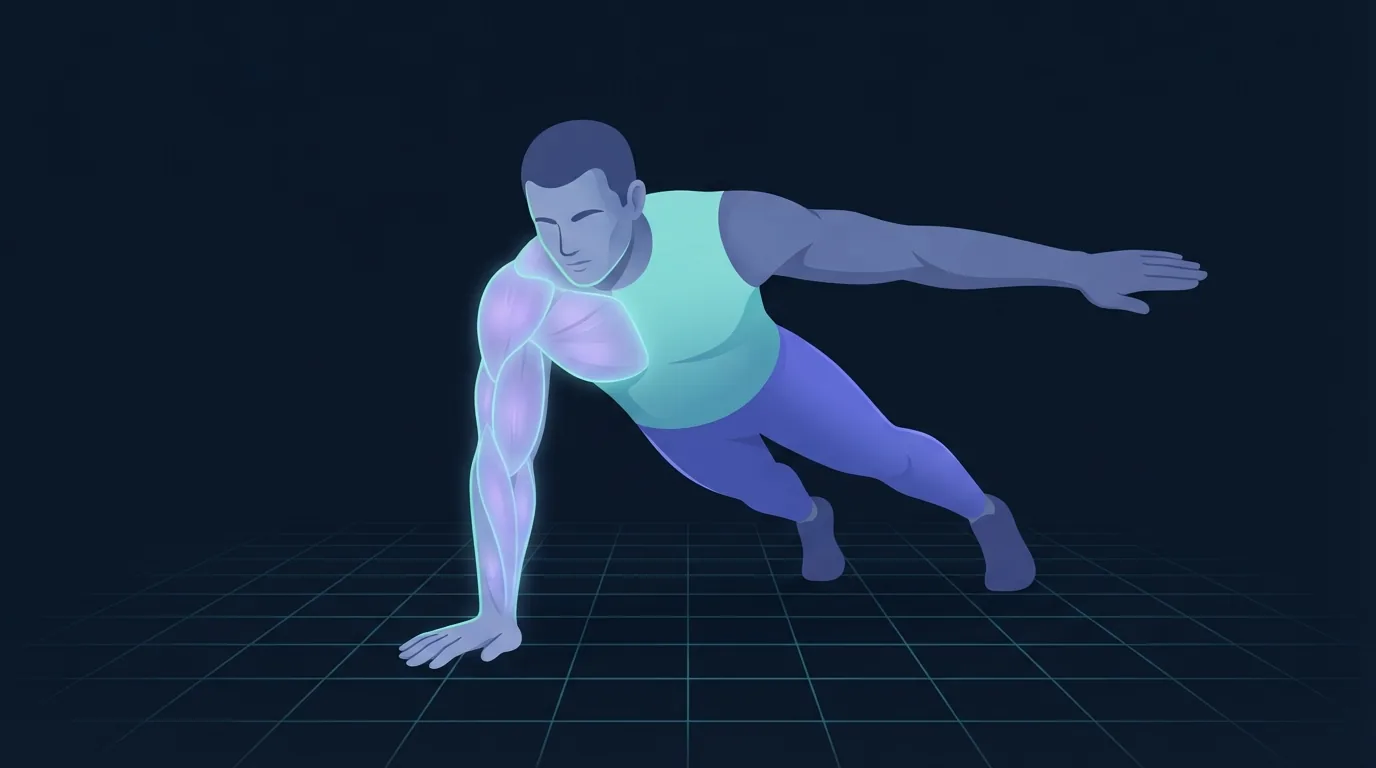
- Archer push-up. Slide one hand out wide and keep that arm nearly straight while you sink toward the bent side.
- Elevated one-arm. Hands-on-a-counter version first, feet wide for balance, working the height down over months.
One warning that belongs here rather than in a footnote. Unilateral pressing adds a large anti-rotation demand at the trunk and a large stability demand at the shoulder, and the shoulder is usually the part that complains first. If a variation produces a pinch at the front of the joint rather than a burn in the chest, back down a rung.
The Plateau Problem When You Cannot Add Weight
Two research findings sit in tension here, and reading them together is what tells you where the real ceiling is.
The optimistic one: load may matter less than everyone assumes. Counts and colleagues (2016), in Physiology and Behavior, had 13 people train one arm with no external resistance at all, contracting maximally through a full range, and the other arm at 70 percent of one-rep max. Across 18 sessions, muscle thickness rose similarly in both arms. Strength did not: the loaded arm gained significantly more one-rep max. Effort alone grows tissue. Effort alone does not make you strong.
The sobering one: grinding closer to failure is not the answer either. Refalo and colleagues (2023) pooled 15 studies in Sports Medicine and found only a trivial hypertrophy advantage for sets taken to failure over sets stopped short, with no advantage at all for momentary muscular failure specifically. So if your plan for breaking the plateau is to take every set to the point where your face hits the carpet, the evidence says you will mostly buy fatigue.
Put those together and the answer is the one this whole article has been building toward. When you cannot add weight, you change the variation until a hard set lands inside 5 to 12 reps, and you stop a rep or two short of collapse. That's what the successful push-up trials actually did. Calatayud and colleagues (2015) matched band-resisted push-ups to a 6-repetition-maximum bench press by muscle activity and got similar strength gains across five weeks in trained lifters. Kikuchi and Nakazato (2017) adjusted push-up position to match a light bench load and got comparable pectoral growth over eight weeks. In both cases somebody deliberately set the difficulty. Neither trial just let the reps climb.
The same principle governs every no-equipment plan on this site, core work included. Rather than repeat it here, our guide to the abs workout at home owns that shared argument about how to progress bodyweight training without load, and it applies to pressing without modification.
A 25-Minute Chest Workout at Home
Two sessions a week, at least two days apart. Everything below assumes you can already do 10 clean floor push-ups. If you cannot yet, build that first.
| Order | Movement | Sets and reps | Rest |
|---|---|---|---|
| Warm-up | Wall slides, wrist rocks, counter push-ups | 2 minutes | - |
| 1 | Deficit push-up, 3 second lower, 1 second pause | 4 x 5-10 | 90 sec |
| 2 | Feet-elevated push-up | 3 x 6-12 | 90 sec |
| 3 | Archer or staggered push-up | 3 x 4-8 per side | 75 sec |
| 4 | Floor slide flye | 2 x 6-10 | 60 sec |
| 5 | Palm-press squeeze | 3 x 20-30 sec | 30 sec |
Add one of the following each week, in this order, and only one: a rep per set, a second of pause, an inch of hand height for the deficit, or a rung on the unilateral ladder. When all four have been used up, the session is no longer a beginner session and you can drop the flat variations entirely.
If you own a pair of dumbbells, the calculus changes and you should use them, because adding five pounds beats every trick above. Our dumbbell chest workout covers that version, including what to do without a bench.
Back Workout at Home: The Half That Never Gets Programmed
Push-ups are the most programmed movement in home training and rows are the least, which is how people end up with round shoulders and a chest that has stopped responding. Your pressing strength is partly limited by how well your shoulder blades are anchored, and that anchoring is the job of the mid-back.
Fenwick, Brown and McGill (2009), in the Journal of Strength and Conditioning Research, instrumented seven men and compared the inverted row, the standing bent-over row and the one-armed cable row for muscle activation and spine load. The inverted row produced the highest latissimus dorsi, upper back and hip extensor activity, while keeping lumbar compression modest. That combination, high back demand and low spinal cost, is precisely what you want from the one pulling movement you can do under a kitchen table.
A back workout at home, in order of usefulness:
- Inverted rows under a sturdy table or a low bar. Walk your feet out to make them harder, bend your knees to make them easier. Same load dial as the push-up, running the other direction.
- Door-frame towel rows. Loop a towel around a door handle on both sides, lean back with straight arms and row yourself upright. Adjust difficulty by walking your feet closer.
- Backpack single-arm rows. Load a bag with books, hinge at the hips with one hand on a chair, row it to your ribs.
- Prone Y raises and T raises. Face down on the floor, no load needed at first. These hit the lower trapezius, which almost nothing else at home does.
Match your weekly pulling sets to your pressing sets. If the session above gives you 12 pressing sets a week, aim for 12 rowing sets. That single rule fixes most home-training shoulder complaints.
Arm Workout at Home Without a Single Dumbbell
Arms split cleanly into an easy half and a hard half, and knowing which is which saves a lot of wasted effort.
The triceps are easy. They're already doing a large share of every push-up, and moving your hands inward makes them do more. Cogley's EMG data showed the narrow base outperforming the wide base for triceps activity, so diamond push-ups, floor triceps dips, bench dips off a chair and skullcrusher push-ups give you a complete extensor program with zero equipment.
The biceps are the hard half, because they flex the elbow and nothing in a push-up asks them to. Rows handle some of it. For the rest, the Counts study above is unusually encouraging: unloaded maximal-effort elbow flexion, done with nothing but intent, produced muscle thickness gains comparable to training at 70 percent of one-rep max over 18 sessions. Slow self-resisted curls, where your free hand pushes down against the working arm, are the practical version. Add a loaded backpack and towel rows when you want the strength to follow the size.
An arm workout at home that works: three sets of close-grip push-ups, three sets of chair dips, three sets of backpack or towel curls, and one set of slow self-resisted curls to finish, twice a week on the days you already press and pull. If you later buy dumbbells, our dumbbell arm workout picks up where this leaves off.
The Bottom Line
The chest workout at home that finally works is the one that stops counting reps. Your body mass is the plate, and the three dials that change it are depth, angle and how many arms are holding you up. Use all three and a floor push-up stays productive for years.
Set expectations honestly. Bodyweight pressing builds real muscle, which the trials show clearly, and it builds less maximal strength than loaded pressing, which the same trials also show. That's a fine trade if a barbell was never on the table. Pair it with equal pulling volume, keep the sets hard but short of collapse, and give your wrists and shoulders the two minutes of warm-up they need.
If you'd rather have the progression chosen for you than track it yourself, that's what an app is for. FitCraft is built around bodyweight and dumbbell programs run by an AI coach as a 3D character, with interactive 3D exercise demos you can rotate and zoom to check what a rigid push-up line is supposed to look like, and calendar tracking that keeps the twice-a-week rhythm visible. We broke down what to look for in that category in our roundup of the best no-equipment workout apps.
Frequently Asked Questions
What is the best chest workout at home with no equipment?
Five movements run twice a week: deficit push-ups on books or handles so the chest can drop below hand level, feet-elevated push-ups for the upper chest, archer or staggered push-ups to load one arm harder, floor slide flyes for horizontal adduction, and a hard palm-press squeeze set to finish. That covers the full pressing range plus the one job the push-up cannot do, and it takes about 25 minutes including a wrist and shoulder warm-up.
What are the best bodyweight chest exercises?
Ranked by how much they load the pectorals: deficit push-ups, feet-elevated push-ups, archer and one-arm push-ups, close-grip push-ups, standard floor push-ups, floor slide flyes, and chair or bar dips if you have two stable surfaces. The best bodyweight chest exercises are the ones where you can still reach a genuinely hard set inside about 12 reps. Past that you're training endurance, and the fix is a harder variation rather than more reps.
Can you build a bigger chest with only push-ups?
Yes, up to a ceiling, and the trials that tested it are direct. Calatayud and colleagues trained advanced lifters for five weeks on either 6-repetition-maximum bench press or band-resisted push-ups matched for muscle activity, and both groups improved one-rep-max and 6RM strength by similar amounts. Kikuchi and Nakazato got comparable pectoral thickness gains over eight weeks from push-ups matched to a light bench press load. The catch in both studies is that the push-up load was deliberately adjusted, which is exactly what stops happening when you just add reps.
What does a back workout at home look like without a pull-up bar?
Rows under a sturdy table, rows off a door frame with a towel, single-arm rows using a loaded backpack, and prone Y and T raises on the floor. Fenwick, Brown and McGill compared three rowing patterns and found the inverted row produced the highest latissimus dorsi and upper back activation of the three while placing a modest compressive load on the lumbar spine, which makes the horizontal row the anchor of a back workout at home. Match your weekly pulling sets to your pressing sets.
What does an arm workout at home look like with no dumbbells?
Triceps are easy: Cogley and colleagues found a narrow hand base raised triceps and pectoral activation compared with a wide base, so close-grip and diamond push-ups plus chair dips and skullcrusher push-ups cover the extensors. Biceps are harder because they need a pull. Towel rows, backpack curls and slow self-resisted curls all work, and Counts and colleagues showed that unloaded maximal-effort elbow flexion over 18 sessions grew the muscle about as much as training at 70 percent of one-rep max, though strength lagged behind.
How do I do a shoulder workout at home?
Tip the pressing angle toward vertical. Pike push-ups, quarter pike push-ups and wall-supported handstand holds turn your body weight into an overhead press, and prone Y raises plus band pull-aparts cover the rear deltoid that pressing ignores. Rodriguez-Ridao and colleagues measured the highest anterior deltoid activity at a 60 degree bench angle, the steepest they tested, which is the bench-press equivalent of moving your hips up into a pike.
How many times a week should I train chest at home?
Twice a week with at least two days between sessions suits most people training without weights. Bodyweight pressing is low load and high rep by nature, so the elbows and wrists accumulate more total reps than a barbell program would, and two quality sessions leave room for that. If you're pressing five days a week and still stuck, the problem is variation difficulty, not frequency.