Dips train the backs of your arms with your own body weight. The versions most people know, bench dips and bar dips, put a lot of your body weight on your arms from the first rep.
The floor tricep dip needs nothing but the floor. Your knees stay bent and your feet share the load, so your arms lift less of your body weight than in bench dips, which makes it a good starting point. It is not automatically easier on your shoulders, though: your upper arms still reach well behind your body at the bottom, so the depth and shoulder cues below matter here too.
Once it feels easy, bench dips are the next step.
Quick Facts: Floor Tricep Dip
- Equipment needed: None
- Difficulty: Beginner, as rated in the FitCraft app
- Modality: Strength
- Body region: Upper body
Muscles Worked
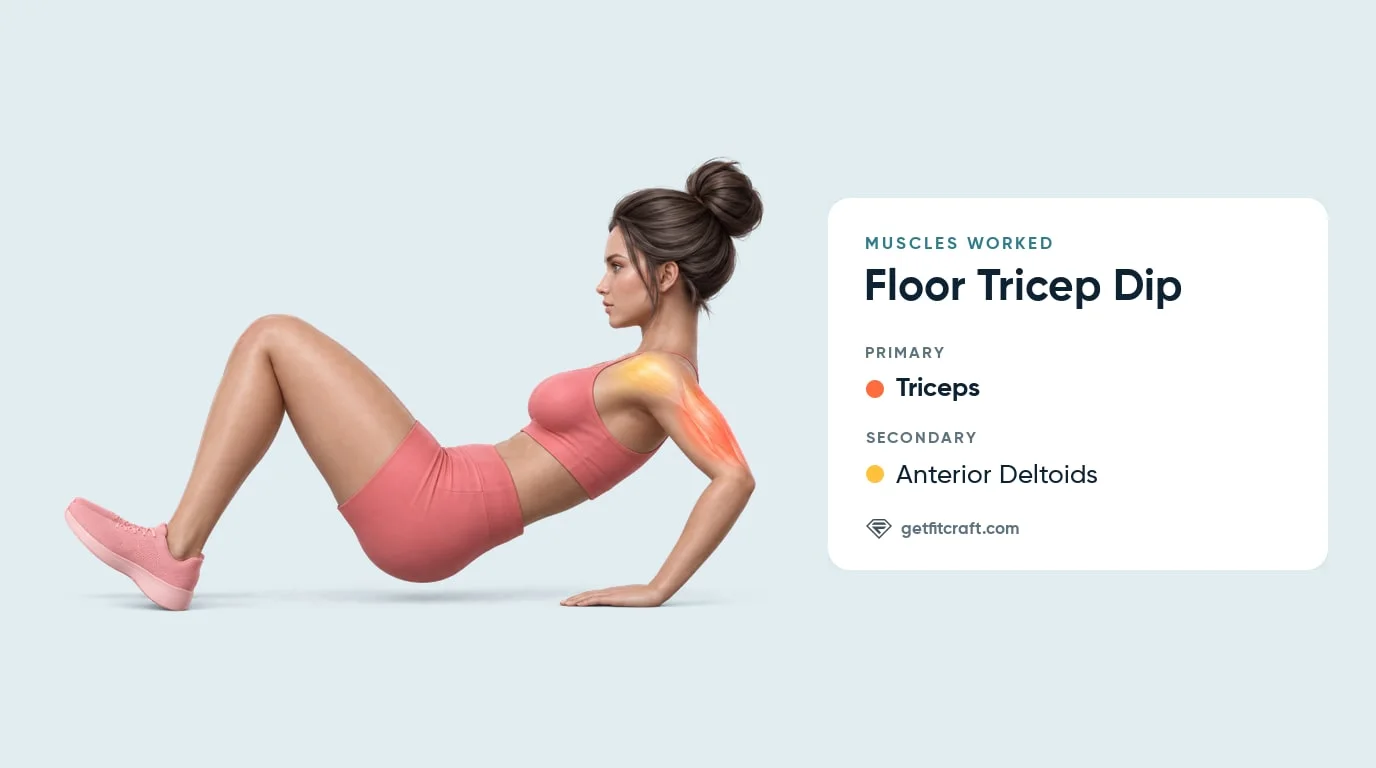
Primary mover: the triceps brachii, all three heads of the muscle running along the back of your upper arm. The triceps lengthen under tension as you bend the elbows on the way down and shorten to straighten the elbows and push you back up.
Secondary mover: the anterior deltoids (the fronts of your shoulders). They help bring your upper arms forward from behind your body as you rise.
Step-by-Step: How to Perform Floor Tricep Dips
Set the position before your first rep. The elbow and shoulder cues below carry over to bench dips.
Step 1: Set Your Starting Position
Sit on the floor with your knees bent and your feet about hip-width apart, flat on the floor or resting on your heels with your toes up. Place your hands flat on the floor behind your hips, about shoulder-width apart or a little wider, with your fingers pointing toward your feet.
Tip: keep your fingers pointing toward your feet. That one detail sets your elbows up to bend straight back.
Step 2: Lift Your Hips
Press through your hands to lift your hips about 6 inches (15 cm) off the floor, arms straight or nearly straight. Keep your shoulders down and your upper back tall so your chest stays open and your neck stays long.
Tip: if your shoulders creep toward your ears, reset before you start dipping.
Step 3: Lower Yourself with Control
Inhale as you bend your elbows straight back behind you, lowering your body slowly until your hips hover just above the floor or lightly touch it. Either one is fine. The elbows stay close to your body the entire way down. Stop sooner if the fronts of your shoulders feel stretched.
Tip: point your elbows at the wall behind you, never out to the sides. Flaring them puts more stress on your shoulders.
Step 4: Press Back Up
Exhale as you press through your palms and straighten your elbows to lift your hips back up. Squeeze the back of your arms as you rise. Straighten your arms, or nearly, without snapping your elbows.
Tip: let your arms do the lifting, not your hips or legs.
Step 5: Repeat with Control
Use the same tempo and depth on every rep: about two seconds down, then a smooth press back up. When your shoulders start shrugging or you can no longer control the way down, the set is over.
Tip: never drop into the bottom or bounce out of it.
Get this exercise in a personalized workout
FitCraft, our mobile fitness app, uses an AI coach to program pressing exercises like this into your plan at the right volume and intensity, based on your level, goals, and equipment. Every FitCraft program is designed by Domenic Angelino, MPH (Brown University) and NSCA-CSCS, with research published in the Journal of Strength and Conditioning Research and Medicine & Science in Sports & Exercise.
Take the Free Assessment Free · 2 minutes · No credit card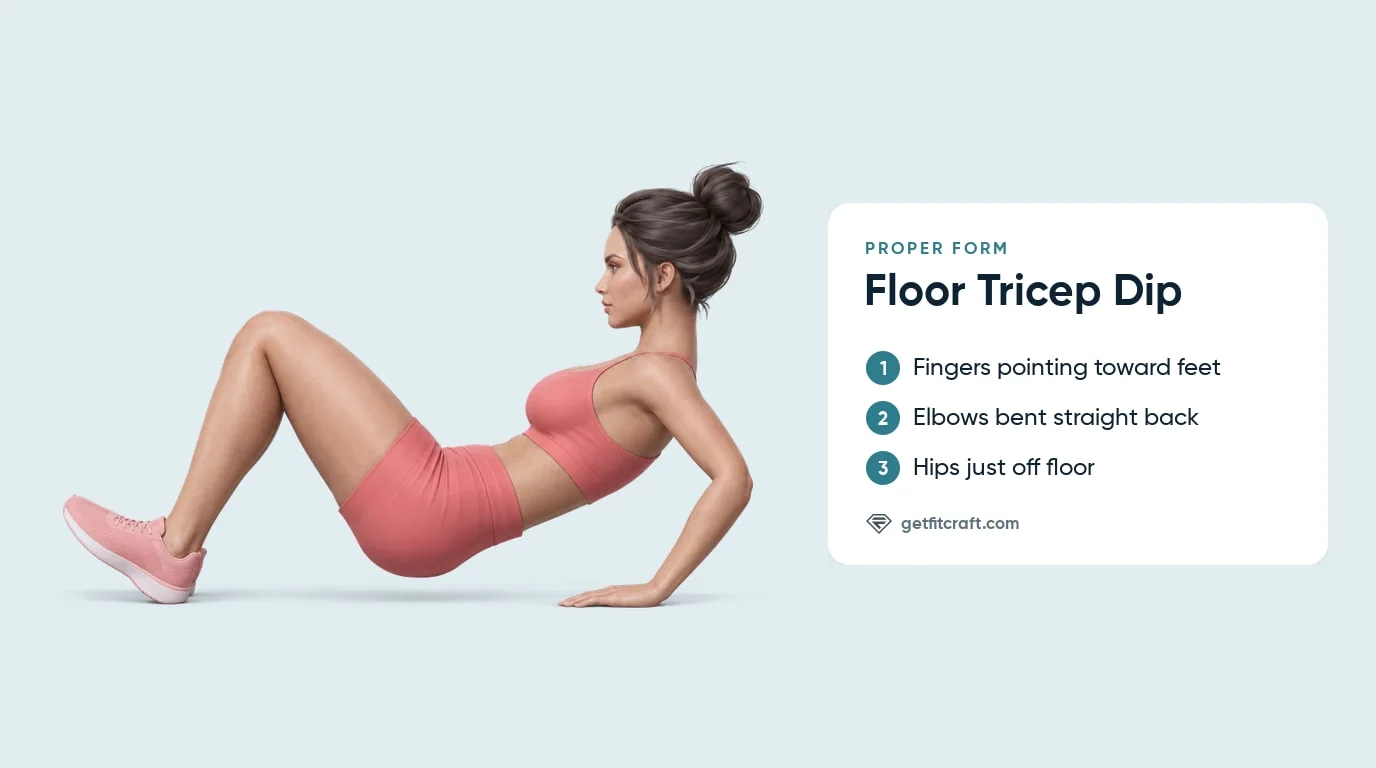
Common Mistakes (and How to Fix Them)
Here are the mistakes to watch for.
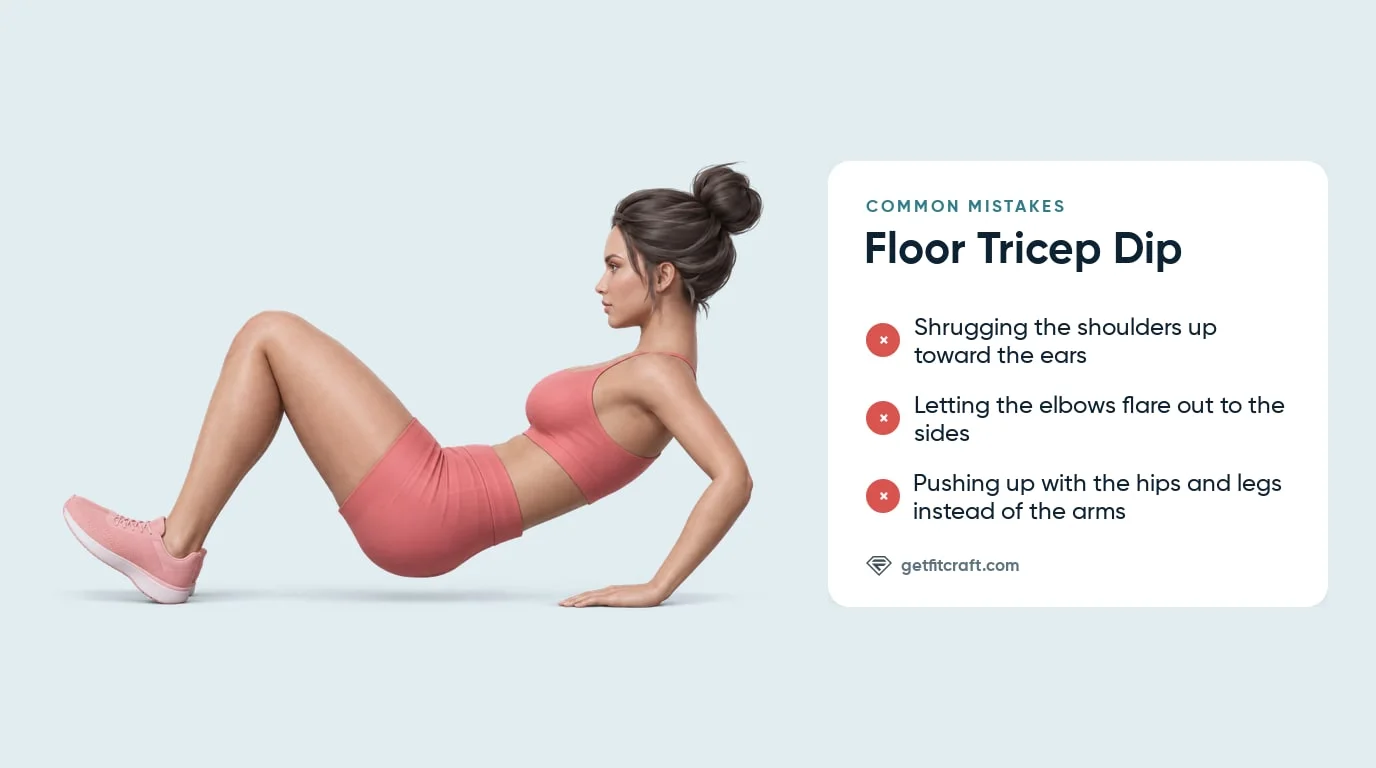
- Elbow flare. Elbows drift out to the sides on the way down, which puts more stress on the shoulders. Fix: point your elbows at the wall behind you on every rep.
- Shrugging shoulders. The shoulders ride up toward the ears as you tire, which adds stress to the shoulders. Fix: set your shoulders down, away from your ears, before the set, and reset the position if it slips.
- Pushing up with the hips and legs. Driving your hips up with your legs instead of straightening your arms takes the work off your triceps. Fix: press through your palms and let your arms lift you. A light touch of the hips on the floor at the bottom is fine.
- Fingers pointing backward or out to the sides. Turning the hands that way twists the elbows out of line. Fix: keep your fingers pointing toward your feet.
- Rounding the upper back. Letting the upper back round forward as you lower. Fix: keep your upper back tall and your chest open through the whole rep.
- Bouncing through reps. Speed uses momentum instead of muscle and hides form breakdown. Fix: lower over about two seconds and press back up smoothly, without snapping your elbows straight.
Floor Tricep Dip Variations: Regressions and Progressions
Start where you are and progress when your form is solid at the current level.
Partial Floor Dip (Easier)
Lift your hips as usual, but lower only partway, as far as you can control, and build up the depth over time. Move on once 3 sets of 10 feel smooth.
Floor Tricep Dip (Beginner in the FitCraft App)
Lower until your hips hover just above the floor or lightly touch it, then straighten your arms. Once you can do 3 sets of 12 with your shoulders down and no shrug, you have earned the next step.
Slow Floor Dip (Harder)
Take about three seconds to lower yourself to the same depth, then press back up smoothly.
Bench Dips (Harder)
Your hands move up onto the edge of a sturdy box or bench beside your hips and your legs stretch out in front, so your arms carry more of your body weight. The FitCraft app rates bench dips Beginner too. Lower only until your upper arms are about level with the floor, or stop sooner if the fronts of your shoulders feel stretched.
Parallel Bar Dips (Beyond Bench Dips)
On two bars you hold your whole body weight on your arms, with no help from your legs. Bar dips are not in the FitCraft app; build up through bench dips first.
When to Avoid Floor Tricep Dips
If any of the following applies to you, check with your physician or a physical therapist before you do floor tricep dips. During a set, a burn in the backs of your arms is normal; any pain in a joint, your lower back or your neck means stop.
- Acute shoulder impingement or anterior shoulder instability. Every dip variation takes the upper arms back behind the body under load, which stresses the front of the shoulder joint. See a doctor or physical therapist first, and do floor dips only once they clear you. Any shoulder pain during a set means stop.
- Wrist pain or carpal tunnel. The crab position puts part of your body weight on your hands with your wrists bent back. See a doctor or physical therapist before you do floor dips, and stop if your wrist hurts.
- Recent shoulder, wrist, or elbow surgery. Get clearance from your surgeon or physical therapist before any dip variation.
- Tricep or elbow tendinitis. Dips load the triceps tendon at the back of the elbow. See a doctor or physical therapist first, and stop if your elbow hurts during a set.
- Pregnancy, the first weeks after giving birth, or diastasis recti. Ask your doctor or a physical therapist whether floor dips suit you before you start.
Related Exercises
If floor tricep dips are part of your routine, these movements complement or extend the same training pattern:
- Dip progressions: Bench Dips and Parallel Bar Dips are the next two rungs on the same ladder, each putting more of your body weight on your arms.
- Same muscle with a band or dumbbells: Tricep Extensions (a resistance band pushdown), Skull Crushers, and the Overhead Tricep Press train the triceps with resistance you can adjust.
- Tricep-biased pressing: Close-Grip Push-Ups and Diamond Push-Ups hit the same elbow-extension pattern from a plank position instead of a crab position.
- Other no-equipment basics: Glute Bridges and Forearm Planks pair well with floor dips in a bodyweight routine.
How to Program Floor Tricep Dips
The American College of Sports Medicine (ACSM) Position Stand on resistance training recommends progressing volume and intensity gradually as you adapt (Ratamess et al., 2009). It gives no set and rep ranges for the floor tricep dip itself, so treat the table below as a practical starting point.
| Level | Sets × Reps | Rest between sets | Frequency |
|---|---|---|---|
| Easier (partial range, lower only partway) | 2-3 × 5-10 | 60-90 seconds | 2-3 sessions/week |
| Beginner (full floor dips, as rated in the FitCraft app) | 3-4 × 8-15 | 60-90 seconds | 2-4 sessions/week |
| Harder (three-second lowering, or bench dips) | 3-5 × 6-12 | 90-120 seconds | 3-4 sessions/week |
Where in your workout: floor tricep dips slot naturally into the middle or end of an upper-body or push session. Do your compound pressing (push-ups, chest press) first while you're fresh, then use dips to finish the triceps directly. In a circuit, they pair well immediately after a pulling or lower-body station so the arms get a brief break before pressing again.
Stop when your form breaks: as soon as a rep breaks form (shrugging shoulders, flaring elbows, or your hips or legs doing the lifting), end the set there. Fewer clean reps beat a rep target hit with broken form.
How FitCraft Programs This Exercise
FitCraft starts with a personalized diagnostic assessment that maps your fitness level, goals, and available equipment. The app has the floor tricep dip as a Beginner strength exercise, shown in a 3D demonstration.
The app also has the bench dip, with your hands on a box and your legs extended, for when the floor version gets easy.
Frequently Asked Questions
How many floor tricep dips should a beginner do?
Start with 3 sets of 8 to 15 controlled reps, two or three times per week. If a full rep is too hard, do 2 to 3 sets of 5 to 10 lowering only partway, as far as you can control, and build up the depth over time. Clean elbow tracking matters more than the rep count.
What muscles do floor tricep dips work?
Primarily the triceps brachii, the muscle along the back of the upper arm, which straightens your elbows to push you back up. The anterior deltoids, the fronts of your shoulders, help by bringing your upper arms forward from behind your body as you rise.
Are floor tricep dips easier than bench dips?
Usually, yes. On the floor your knees stay bent and your feet share the load, while bench dips put your hands up on a box or bench and stretch your legs out, so your arms carry more of your body weight. Don't assume the floor version is easier on your shoulders, though: your upper arms still reach well behind your body at the bottom, so keep the same depth and shoulder cues. Master 3 sets of 12 clean floor dips before moving your hands up to a bench.
Why do my wrists hurt during floor tricep dips?
Your hands carry part of your body weight with your wrists bent back, but your wrists should never hurt. Any wrist pain means stop. See a doctor or physical therapist before you do floor dips again.
Can I do floor tricep dips with shoulder pain?
No. Any pain in your shoulder means stop. Dipping takes your upper arms back behind your body, which stresses the front of the shoulder joint. See a doctor or physical therapist first, and do floor dips only once they clear you.