Most home chest sessions look the same. A shaky flat bench press for four sets, a set of push-ups until the arms burn, done. Chest grows a little for a few months and then stalls, because the top half of the pec never really got trained and nothing changed from session to session.
The fix is boring and short. Three moves that between them cover the whole pec, a load you can add to over time, and enough total work per week to actually stress the tissue. That is what the trials point to, and that is what the session below builds.
What the Pec Actually Is, in One Paragraph
The pectoralis major has two functional heads: the clavicular head (upper chest), which pulls the arm up and across from below, and the sternocostal head (mid and lower chest), which pulls the arm down and across from above. That is why a single press angle only hits half of it. Rodriguez-Ridao and colleagues (2020) measured surface EMG across five bench angles from a 30 degree decline to a 45 degree incline and found the upper-chest fibers were most active on incline, the sternocostal head was most active on flat and slight decline, and the anterior deltoid took a bigger share of the load as the angle climbed past 45 degrees. Two press angles per week, one flat-ish and one at roughly 30 to 45 degrees, is what fixes the upper-pec gap most home lifters walk into after year one.
Dumbbells vs Barbell: What You Actually Trade
Saeterbakken and colleagues (2011) put trained lifters through the barbell bench press, the dumbbell bench press and the Smith machine chest press and measured 1RM and muscle activity via surface EMG. The pec fired similarly across the barbell and dumbbell versions. The barbell moved more absolute weight (1RM was roughly 17 percent higher than dumbbells), and the biceps worked considerably harder on the dumbbells to stabilize the load. For chest development the two are close to interchangeable. For maximum absolute strength the barbell wins.
Two things you actually gain with dumbbells. The range of motion is roughly a fist deeper because the wrists can travel past the ribcage rather than stopping on a bar. And each arm works independently, which surfaces side-to-side imbalances the barbell hides for years. The trade you accept is a slightly lower ceiling on maximal load and a more awkward setup at the heaviest weights.
None of that changes for beginners. If you own a pair of adjustable dumbbells and a bench, you have the equipment to build a strong, thick chest for the first several years of training. Whether you want a curated version of that plan or something you build yourself, our roundup of the best dumbbell workout apps compares how the leading options handle programming, progression and progression logs so the session doesn't drift.
The 30-Minute Dumbbell Chest Workout
Three exercises, 3 to 4 working sets each, roughly 30 to 40 minutes with warm-up and rest. Do this twice a week, at least 48 hours apart. Everything is written for a general trainee; scale the loads to your own two-reps-in-reserve.
Warm-up (5 minutes)
- 2 minutes light rowing or brisk walking to raise core temperature
- 10 arm circles forward, 10 back
- 10 push-ups on your knees or from the floor, slow tempo
- One warm-up set of the first exercise, half your working weight for 8 reps
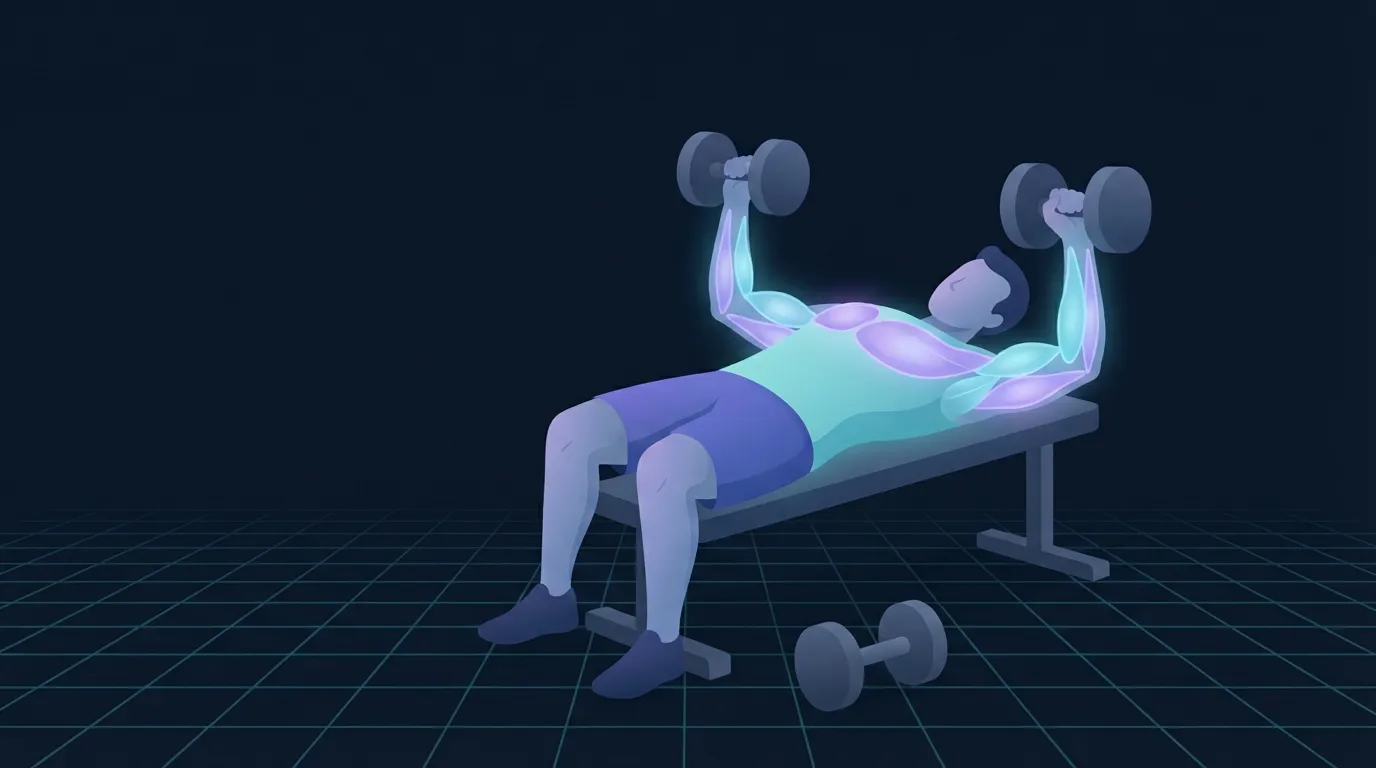
A) Flat Dumbbell Bench Press: 4 sets of 6 to 10 reps
Lie flat with the dumbbells resting on your thighs. Kick them up one at a time as you lie back, then drive them to arms' length with the palms facing forward. Lower under control to the sides of the ribcage, elbows tucked to roughly 45 degrees from the torso rather than flared to 90. The bottom of the rep is when the dumbbells are level with your chest wall, not when the elbows hit a hard end range. Press back up. Two reps in reserve on the last set. If you get all four sets with two in reserve two sessions in a row, add 5 pounds per hand next time.
See our dumbbell chest press exercise page for the muscles worked, common form errors and video-ready progressions.
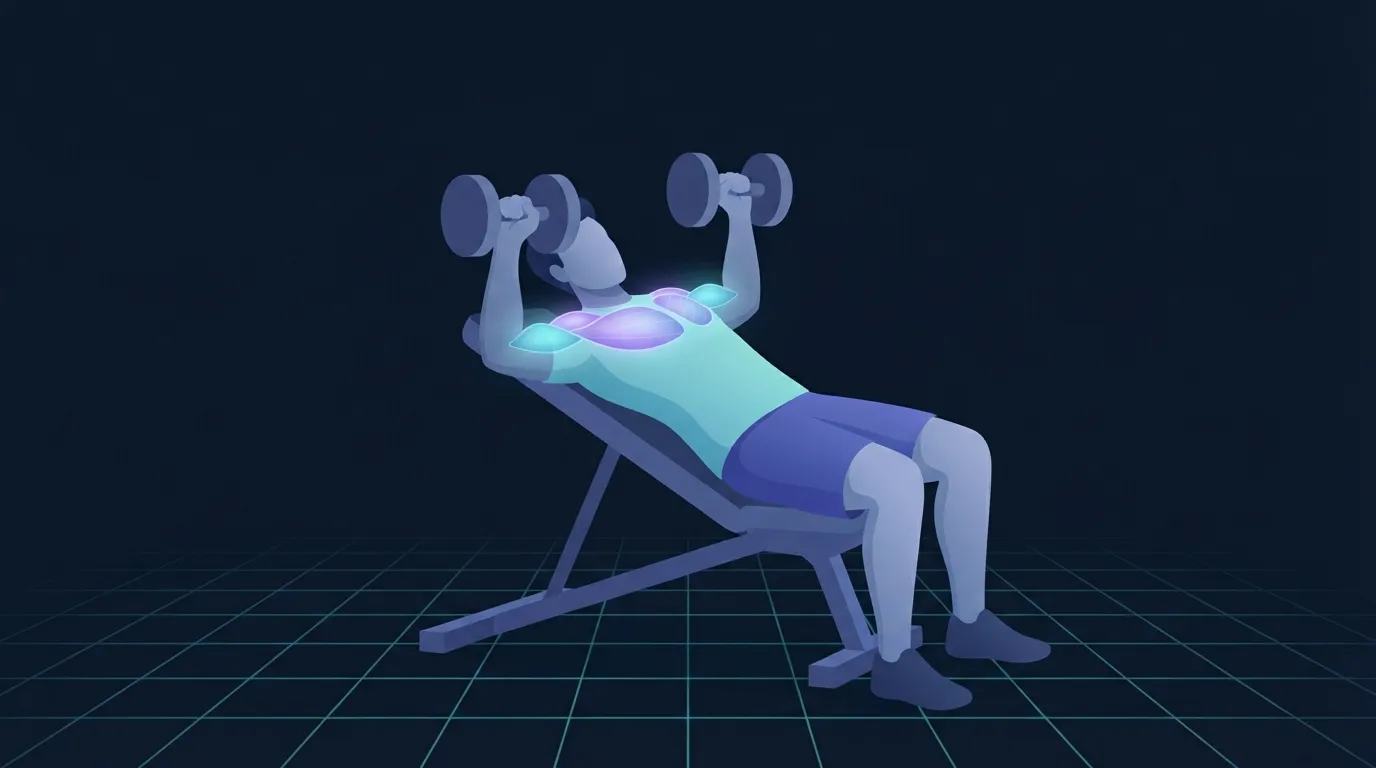
B) Incline Dumbbell Press: 3 sets of 8 to 12 reps
Set the bench to roughly 30 degrees. 45 works for taller lifters who feel their upper chest less at 30. Any higher and the anterior deltoid steals the set, which is what Rodriguez-Ridao et al. (2020) saw in the EMG numbers above. Same setup and tempo as the flat version. Expect the load to be roughly 60 to 70 percent of your flat working weight the first few weeks; incline pressing has its own strength curve and progresses on its own timeline.
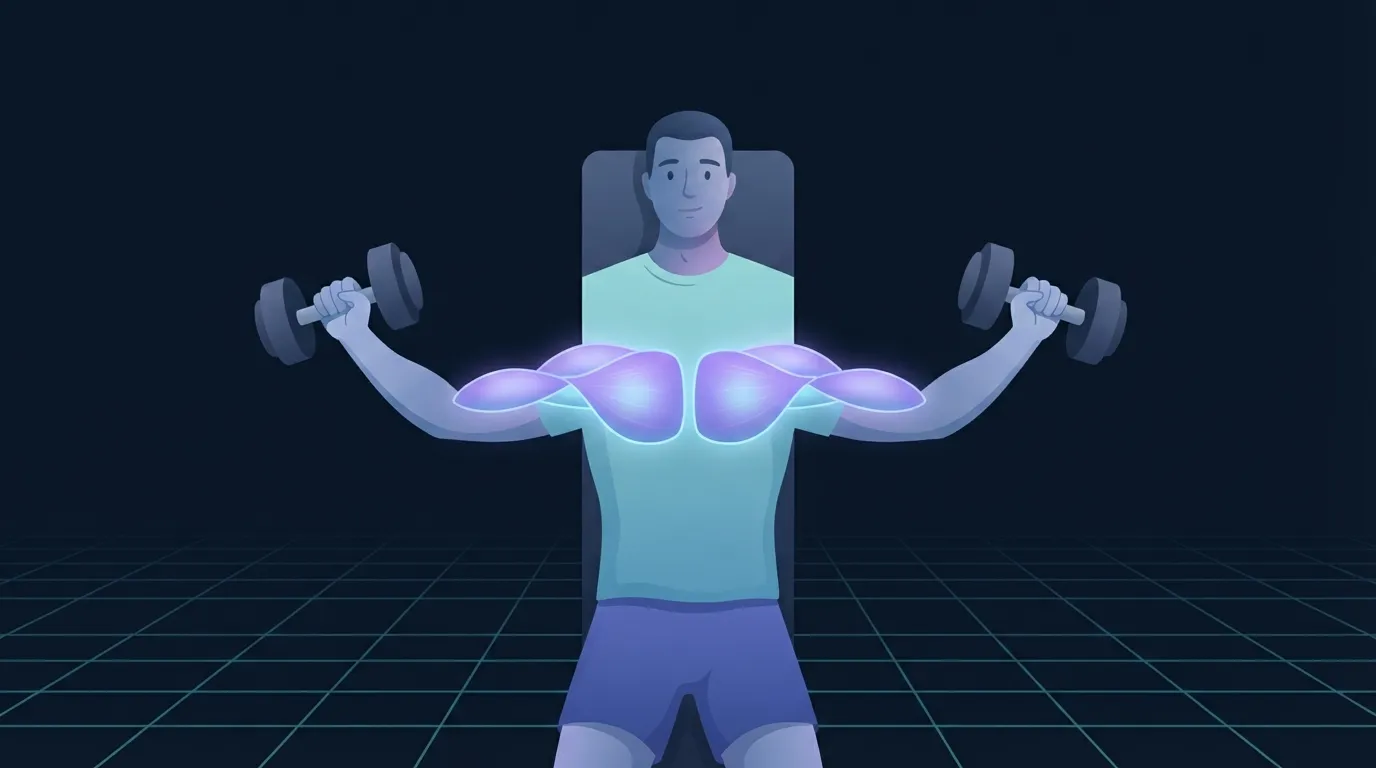
C) Dumbbell Flye or Squeeze Press: 3 sets of 10 to 15 reps
Pick one based on shoulder tolerance. The dumbbell flye, elbows softly bent, arms opening out to roughly the plane of the shoulder and no lower, works the pec through its lengthened range. Solstad and colleagues (2020) measured EMG on the dumbbell flye against the barbell bench press at matched 6RM loads and found the bench press produced higher average pec activation across the movement, with the flye contributing meaningful loaded work in the lengthened position. Both belong in a chest program. If flyes bother your shoulders, use the squeeze press instead: two dumbbells held together end to end, pressed straight up while you actively squeeze them into each other. Same target, no shoulder loading at end range.
See our dumbbell chest fly exercise page for the position of the arms, the common overextension error, and how to blend flye and press work in one session.
Find out what's really holding you back
FitCraft, our mobile fitness app, pairs you with an AI coach who builds you a personalized plan around your goals, schedule, and fitness level. Every FitCraft program is designed by Domenic Angelino, MPH (Brown University) and NSCA-CSCS, with research published in the Journal of Strength and Conditioning Research and Medicine & Science in Sports & Exercise.
Take the Free Assessment Free • 2 minutes • No credit cardSets, Reps and Rest: What the Numbers Actually Are
Volume is the driver. Schoenfeld, Ogborn and Krieger (2017) pooled 15 studies and found a clear dose-response between weekly hard sets per muscle group and hypertrophy, with growth continuing up to at least 10 sets per muscle per week and probably beyond in trained lifters. For chest, that lands you between 10 and 20 hard sets a week, distributed across two sessions of 5 to 10 sets each. The session above hits the low end. If your recovery holds, add a third exercise or a fourth set to two of them.
Load and rep range are more flexible than the internet suggests. Schoenfeld and colleagues (2017) meta-analysed 21 trials comparing low-load (roughly under 60 percent of 1RM, 15+ reps) against high-load (over 60 percent, under 15 reps) training and found hypertrophy was comparable when sets were taken close to failure. Strength was higher in the high-load groups. That gives you room to swing between 6 and 20 reps depending on the day and the exercise, as long as the last set of each is genuinely hard.
Rest between sets is not optional. Grgic and colleagues (2018) systematically reviewed rest-interval studies and found strength gains were meaningfully worse with rest periods below 60 seconds compared to 2 to 3 minutes, especially on multi-joint lifts. For the two press exercises above, take 90 seconds to 2 minutes between hard sets. On the flye or squeeze press you can trim it to 60 to 90 seconds because the systemic fatigue is lower.
How to Progress Without Overthinking It
Two-reps-in-reserve progression, session by session. Keep the sets and reps fixed. When you finish all working sets in the prescribed rep range with two reps clean in reserve on the last set, in two consecutive sessions, add the smallest possible load next time. For most people that is 5 pounds per hand on the flat press and 2.5 to 5 on the other two exercises. If you don't have that jump available, add a rep to every set instead until you top the range, then jump.
Write it down. A phone note, a printout, a spreadsheet. The lifters who progress most reliably at home are the ones who look at last week's numbers before they start today's set. If keeping the log yourself is what keeps falling off, that is the specific job programmable fitness apps do well. For a broader comparison against the field, see our roundup of the best strength training apps, which walks through how the leading options handle logging, progression and progressive overload.
Common Mistakes That Waste the Session
Flaring the elbows to 90 degrees. This is the fastest way to trade a working chest set for irritated shoulders. Keep the upper arm at roughly 45 degrees from the torso at the bottom of every press. It looks less impressive and feels a lot better in year three.
Bouncing the dumbbells off the chest. The bottom of the rep is the working position. If you drop into it and rebound, you skipped the hardest inch of the movement. Lower under control for a two-count, then drive up. The load looks smaller. That is fine.
Only pressing flat. The upper chest is where most home lifters end up thin. If you're skipping the incline work because the flat press is what you know, you're leaving the whole clavicular head of the pec undertrained. Do the incline set.
Chasing failure on every set. Two reps in reserve on every working set, occasionally one on the last set of the day. Training to grinding failure on every set of every exercise just adds recovery cost without a growth dividend, and it wrecks your form on the last set of the day. The dose-response work from Schoenfeld and colleagues above already covers this: total hard sets across the week is what drives growth, and grinding a set two reps past what you needed does not add more of it.
Skipping the second session of the week. One chest day a week can produce growth, but two matches or beats it when total set volume is equated. If you can only train chest once, that's fine, but move the whole session's set count up to compensate. If you're on a beginner split, our beginner-friendly best dumbbell exercises for beginners shows how chest fits into a two-day full-body week without stealing your leg-day recovery.
No Bench? Two Substitutions That Still Work
If you only have dumbbells and no bench, the flat press becomes a dumbbell floor press. Lie on the floor, press up as usual. You lose the last few inches of the descent when the elbows contact the floor, which is where the shoulder is most vulnerable, and you keep most of the useful range of the movement. Load progression is unchanged.
The incline press becomes an elevated push-up plus a squeeze press. Do 3 sets of push-ups with the hands elevated on a low bench or step until close to failure, then take a minute and knock out 2 sets of squeeze presses on the floor. It's a downgrade on the pure incline stimulus, but it covers enough of the upper-pec fibers that you keep progress moving until you find a bench.
A Two-Day Chest Split That Actually Progresses
The single-session template above is one of two chest days a week. Rotate the emphasis so both fiber directions get a heavy day and a lighter, higher-rep day. Written the way it would appear in an app log:
| Day | Emphasis | Structure |
|---|---|---|
| Chest day 1 (heavier) | Flat press primary | Flat DB press 4×6-8 · Incline DB press 3×8-12 · Flye 3×10-15 |
| Chest day 2 (lighter, higher volume) | Incline press primary | Incline DB press 4×8-12 · Flat DB press 3×10-15 · Squeeze press 3×12-15 |
Total weekly hard sets on the chest: 10 on the low end, 12 with a full complement. Well inside the volume range Schoenfeld's meta-analysis identified as productive, and low enough that recovery isn't the limiter for most trainees.
The Bottom Line
A working dumbbell chest workout is not complicated. Two press angles, one flye or squeeze press, done twice a week for 10 to 20 total hard sets, with two reps in reserve and enough rest between sets to hit the next one hard. Load goes up when you own the rep range with clean form. Everything else is decoration.
What actually decides whether the session grows anything is showing up two days a week for the next 12 weeks. If that's the part that keeps slipping, that's a program-design and adherence problem, not a chest problem. Our comparison of the best dumbbell workout apps walks through how the leading options handle programming and adherence for lifters who train at home with a rack of dumbbells and a bench.
Frequently Asked Questions
Is a dumbbell chest workout as effective as barbell bench press?
For chest development, yes. Saeterbakken and colleagues (2011) measured pectoralis major activity across the barbell bench press, the dumbbell bench press and the machine chest press and found no meaningful difference in pec EMG between the barbell and dumbbell versions. The barbell moves more absolute load, which is why powerlifters use it, but the pec sees a similar training stimulus from dumbbells with a wider range of motion and less shoulder strain.
How many sets and reps should I do for a dumbbell chest workout?
Aim for 10 to 20 hard sets per week across the chest, spread over two sessions. Inside a session, 3 to 4 working sets per exercise across two or three exercises is enough. Schoenfeld and colleagues (2017) found a dose-response between weekly set volume and muscle growth up to at least 10 sets per muscle per week. Rep ranges from 6 to 20 grow muscle similarly when sets are taken close to failure, so pick a load that lets you hit that rep target with two reps in reserve on your last set.
How often should I train chest with dumbbells?
Twice a week is the sweet spot for most trainees. Once weekly works, but twice matches or beats it when weekly set volume is equated, and the second session gives you another shot at technique and a lower per-session fatigue cost. Space the two chest days at least 48 hours apart, and if you also do heavy pressing on other days, count those sessions toward the weekly chest total.
Do I need an incline bench for a dumbbell chest workout?
An adjustable bench earns its space. Rodriguez-Ridao and colleagues (2020) measured pectoralis EMG across five bench angles and found the upper-chest fibers activated most at roughly a 30 to 45 degree incline, while the mid and lower chest were best hit at flat or a slight decline. If you have no bench at all, floor presses and push-up variations cover the flat pressing pattern and still drive growth; you just lose the incline stimulus, which is where most home lifters end up underdeveloped.
What dumbbell weight should I use for chest exercises?
Use the load that lets you finish the prescribed rep range with two clean reps left in the tank on your last set. For a general strength trainee that usually lands somewhere between 15 and 45 pounds per hand on the flat bench press, and 5 to 15 pounds lighter on incline pressing and dumbbell flyes. If you can bang out 20 reps at a load, it is too light; if you fail before rep 6 with clean form, it is too heavy.
How long should a dumbbell chest workout take?
30 to 45 minutes of actual work covers it comfortably. Three exercises, 3 to 4 sets each, 90 seconds to 2 minutes of rest between hard sets. Grgic and colleagues (2018) reviewed rest-interval studies and found strength gains are meaningfully worse below 60 seconds of rest between heavy sets, and roughly equivalent between 2 and 3 minutes. Under-resting to save time is a false economy.