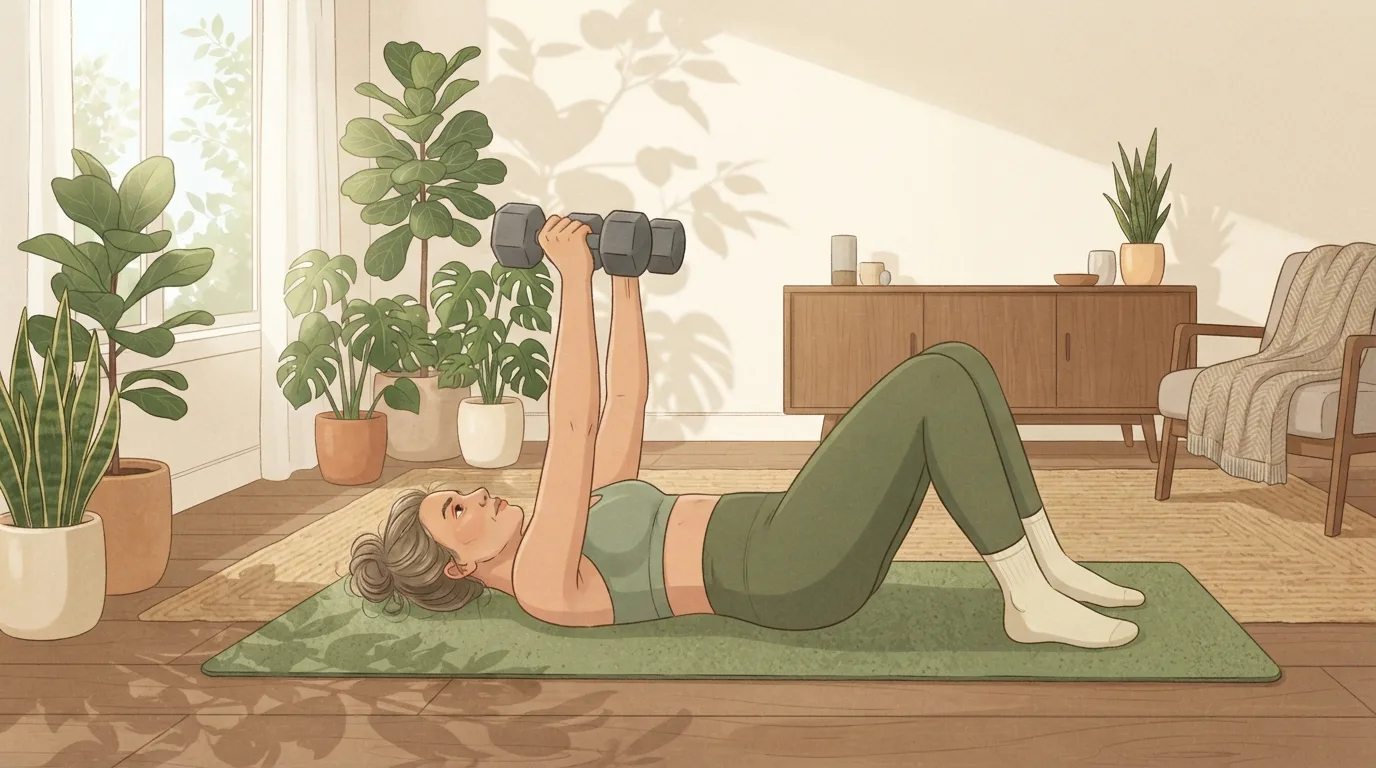
Maybe the bench is always taken at your gym. Maybe you train at home and a bench doesn't fit in the room, or your shoulder grumbles at the bottom of every barbell rep. Whatever the reason, you're looking for bench press alternatives that still build a real chest.
It's easy to feel like chest day doesn't count without the bench. Fitness culture treats it as the measure of upper-body strength, so a session of dumbbell chest presses and push-ups can feel like a consolation prize. And when a workout feels second-rate, it's the first one you skip.
Your chest muscles don't know what's in your hands. They respond to tension and to sets taken close to failure. The ten alternatives below use dumbbells or your bodyweight, and the studies further down show what each one can and can't replace.
The 10 Best Bench Press Alternatives at a Glance
Here's the full list. Each exercise replaces a specific version of the barbell bench press, and each one is explained below with its own page where we have one.
| Alternative | Equipment | Replaces | Best for |
|---|---|---|---|
| 1. Dumbbell bench press | Dumbbells and a flat bench | Flat barbell bench press | The closest overall match |
| 2. Dumbbell floor press | Dumbbells | Flat bench press, with no bench | Home training, a fixed safe depth |
| 3. Diamond (squeeze) press | Dumbbells | Close-grip bench press | Triceps and lockout |
| 4. Explosive floor press | Dumbbells | Speed bench work | Pressing power |
| 5. Push-ups | None | Flat bench press | Training anywhere |
| 6. Decline push-ups | A step or box | Incline bench press | Upper chest, a heavier push-up |
| 7. Deficit push-ups | Two dumbbells or sturdy blocks | Full-range bench press | A deep chest stretch |
| 8. Weighted push-ups | A loaded backpack or vest | Heavy bench sets | Adding load without a barbell |
| 9. Close-grip push-ups | None | Close-grip bench press | Triceps |
| 10. Parallel bar dips | Dip bars | Decline bench press | Lower chest and triceps |
Dumbbell Bench Press Alternatives
Dumbbells are the most direct swap, because they keep the bench press movement and let you add weight in small steps.
1. Dumbbell bench press
If you have a flat bench and a pair of dumbbells, this is your bench press. Saeterbakken and colleagues (2011), in the Journal of Sports Sciences, tested 12 trained men on the barbell, dumbbell and Smith machine versions. The men lifted about 17 percent less with dumbbells than with the barbell, yet chest and front-shoulder activity didn't differ between the two. The triceps worked a little less with dumbbells and the biceps worked more to steady them.
Dumbbells also let your hands travel lower than a bar allows, and each arm has to press its own weight. Our dumbbell chest workout covers the full session, the sets and reps, and the incline angle.
2. Dumbbell floor press
No bench? Lie on the floor with your knees bent and press from there. The dumbbell chest press on the floor works the chest and triceps, with the front shoulders helping. The floor stops your upper arms level with your body, so every rep has the same depth and the shoulders never drop into the deepest stretch.
That fixed depth is also the trade-off. The floor press skips the bottom few inches of a bench press, which matters for long-term strength, as the range section below explains.
3. Diamond (squeeze) press
The diamond press is a dumbbell stand-in for the close-grip bench press. You lie on the floor and press two dumbbells that stay squeezed together, palms facing each other. The narrow hand position and tucked elbows shift more of the work to the triceps, so use it for lockout strength and bigger arms rather than as your main chest press. Expect to use lighter dumbbells than on a standard press.
4. Explosive floor press
The explosive floor press replaces speed work on the bench. You lower the dumbbells until your upper arms rest on the floor, pause for about a second, then press up as fast as you can with a light to moderate weight. It trains how quickly you produce force, which is useful for athletes and anyone who needs fast, powerful pushing.
Find out what's really holding you back
FitCraft, our mobile fitness app, pairs you with an AI coach who builds you a personalized plan around your goals, schedule, and fitness level. Every FitCraft program is designed by Domenic Angelino, MPH (Brown University) and NSCA-CSCS, with research published in the Journal of Strength and Conditioning Research and Medicine & Science in Sports & Exercise.
Take the Free Assessment Free • 2 minutes • No credit card
Bodyweight Bench Press Alternatives
Push-ups are a bench press turned upside down: your hands push away from your chest while your body, instead of a bar, provides the load. The six options below get progressively more specific.
5. Push-ups
The standard push-up is the default bodyweight bench press alternative. Keep one straight line from head to heels and lower until your chest nearly touches the floor. If you can't do 10 good reps yet, raise your hands on a bench or counter, then lower the surface over the weeks. Our push-up progression lays out every rung from wall to floor and beyond.
6. Decline push-ups
Put your feet on a step or box and your body tilts at roughly the angle of an incline press, which shifts work toward the upper chest and front shoulders. Ebben and colleagues (2011), in the Journal of Strength and Conditioning Research, measured six push-up variations on a force plate and found the feet-elevated versions loaded the hands the most. That makes decline push-ups both an incline bench substitute and the next step once standard push-ups get easy.
7. Deficit push-ups
Grip a pair of hexagonal dumbbells, or set your hands on two sturdy blocks, so your chest can drop below your hands. That extra depth gives the chest the full stretch a bench press reaches at the bottom, and it's exactly the range a floor press leaves out. Start with a small deficit and add height only while your shoulders stay comfortable.
8. Weighted push-ups
When you can do more than about 15 clean reps, add load. A backpack packed with books and strapped tight high on your back works, and so does a weight vest. Van den Tillaar (2019), in Sports Medicine International Open, had 20 trained lifters do push-ups with 0 to 30 kg vests and bench presses at 50 to 80 percent of their max. Muscle activation across eight upper-body muscles and the movement speed showed no differences between the two exercises at matched loads.
9. Close-grip push-ups
Bring your hands in to about shoulder width or a little narrower for close-grip push-ups, or touch your thumbs and index fingers for diamond push-ups. Cogley and colleagues (2005) recorded 40 adults and found a narrow hand position drew more chest and triceps activity than a wide one. These are your bodyweight close-grip bench press.
10. Parallel bar dips
If you have dip bars, parallel bar dips press your full bodyweight and load the lower chest and triceps, much like a decline bench. Lower only until your upper arms are about level with the floor, because sinking deeper strains the front of the shoulder. Skip dips if they bother your shoulders; decline push-ups cover similar ground.
Can I Build My Chest Without Bench Press? What the Training Studies Show
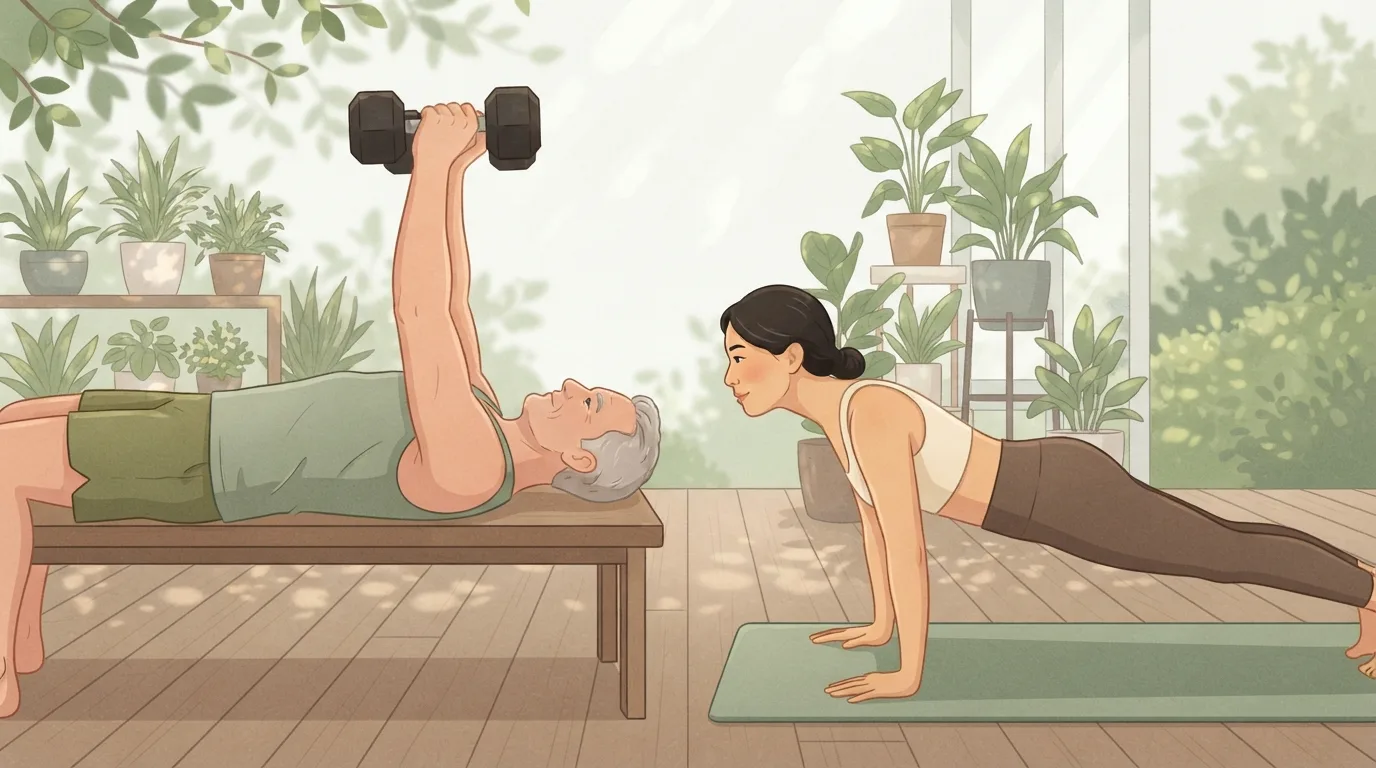
Yes. Three training studies and one lab comparison tested push-ups against the bench press, and each found the push-up held its own when it was made hard enough.
- Strength in trained lifters. Calatayud and colleagues (2015) first matched elastic-band push-ups to a 6-rep-max bench press by muscle activity. Then 30 university students with advanced training experience trained one of the two for five weeks, or not at all. Both training groups improved their 1-rep and 6-rep maxes by similar amounts, roughly 14 to 22 percent, while the control group didn't change.
- Muscle growth. Kikuchi and Nakazato (2017) had 18 young men train twice a week for eight weeks. One group benched at 40 percent of their max, and the other did push-ups with the body position adjusted, kneeling if needed, to match that load. Both groups grew their chest and triceps, and bench press strength rose from 60.0 to 65.0 kg in the bench group and from 61.1 to 64.2 kg in the push-up group.
- Progressive push-ups. Kotarsky and colleagues (2018) trained 23 moderately trained men three days a week for four weeks, on either the bench press or push-up variations that got harder as they improved. Bench press strength increased in both groups. Four weeks was too short for either group to show measurable muscle growth.
- Matched loads. In van den Tillaar's 2019 study above, loaded push-ups and bench presses looked the same in muscle activation and speed.
One detail runs through all four. The push-ups were deliberately made hard, with bands, a vest, a changed body position or a harder variation. A set of 40 easy push-ups isn't the same stimulus as a hard set of 8. Calatayud's team used elastic bands, but at home a backpack, a step under your feet or a slower tempo does the same job. For a complete bodyweight plan built on that idea, see our chest workout at home.
How Much Bench Press Is a Push-Up Worth?
A push-up has you press part of your own body weight. Suprak and colleagues (2011) put 28 strength-trained men on a force plate and found the hands held about 69 percent of body mass at the top of a standard push-up and about 75 percent at the bottom. From the knees it was about 54 and 62 percent.
That converts into a rough bench press equivalent:
| Your body weight | Standard push-up load | Knee push-up load |
|---|---|---|
| 130 lb (59 kg) | About 90 to 98 lb (41 to 44 kg) | About 70 to 81 lb (32 to 37 kg) |
| 160 lb (73 kg) | About 110 to 120 lb (50 to 55 kg) | About 86 to 99 lb (39 to 45 kg) |
| 190 lb (86 kg) | About 131 to 143 lb (59 to 65 kg) | About 103 to 118 lb (46 to 53 kg) |
| 220 lb (100 kg) | About 152 to 165 lb (69 to 75 kg) | About 119 to 136 lb (54 to 62 kg) |
The comparison isn't exact. In a push-up your shoulder blades move freely and your core holds a plank, which a bench press doesn't ask for. But it shows why push-ups work for most people: a standard push-up is already a moderate bench press load. Once you can do 15 or more, you've outgrown it, and the decline, deficit and weighted versions above take over.
Chest Exercises With Dumbbells, No Bench
With dumbbells and a floor, you have four chest exercises: the floor press, the diamond press, the explosive floor press and the floor chest fly. All four stop when your upper arms reach the floor. That's a comfortable depth for most shoulders, but it's a partial range compared with a bench press.
Range matters for strength. Martínez-Cava and colleagues (2022) trained 50 men for 10 weeks on the full bench press, a two-thirds range or a one-third range. The full-range group made the biggest strength gains, and the gains shrank as the range got shorter. The floor press isn't one of those partial versions, but it does cut off the bottom of the movement.
The fix is simple. Pair your floor presses with deficit push-ups in the same week, so your chest still trains through its deepest stretch. If you use a floor press as your main lift, that pairing covers both ends of the range.
What can you use instead of a workout bench? The floor is the safest substitute. A sturdy step or low box works for decline push-ups. Avoid pressing on a sofa, an ottoman or a bed, because soft or wobbly surfaces shift under the load.
Incline Bench Press Alternative Without a Bench
The incline bench press aims at the upper chest. Without an adjustable bench, decline push-ups are the best replacement, because raising your feet puts your body at a similar pressing angle. Start with your feet on a low step and raise them as you get stronger. Push-ups with your feet much higher than your hands turn into pike push-ups, which work the shoulders more than the chest, so stop before that point.
Which Bench Press Alternative Should You Pick?
Pick by the equipment you have and the job you want done:
| Your situation | Best pick |
|---|---|
| Dumbbells and a flat bench | Dumbbell bench press |
| Dumbbells, no bench | Dumbbell floor press, plus deficit push-ups for range |
| No equipment at all | Push-ups, progressed to decline and weighted versions |
| The bottom of the bench press bothers your shoulders | Dumbbell floor press, and get the pain checked |
| Bigger triceps or a stronger lockout | Diamond press or close-grip push-ups |
| More pressing power | Explosive floor press |
| You can't do a push-up yet | Hands-raised push-ups, then knee push-ups |
Whatever you pick, two or three chest exercises twice a week, with every set ending a rep or two short of failure, is plenty for most people.
If you want those sessions planned for you, FitCraft's strength workouts use dumbbells and bodyweight, the same tools this list relies on. An AI coach demonstrates each exercise on an interactive 3D model you can pinch to zoom and says your name as you train. The workouts adjust as you progress, and streaks keep chest day from quietly disappearing. Our comparison of the best dumbbell workout apps shows how FitCraft stacks up against the other options.
The Bottom Line
The best bench press alternatives are the dumbbell bench press when you have a bench, the dumbbell floor press when you don't, and push-ups made progressively harder when you have nothing at all. Training studies found these alternatives built strength and muscle about as well as the bench press when the sets were equally hard.
So the bench isn't what builds your chest. Hard sets, done twice a week for months, are. As Katie, a FitCraft user, put it: "I've tried everything. This is the first time I've stuck with something past two weeks."
Frequently Asked Questions
What exercise can I replace bench press with?
The dumbbell bench press is the closest replacement for the barbell bench press: it drives the chest just as hard with about 17 percent less weight. With dumbbells but no bench, use the dumbbell floor press. With no equipment, use push-ups, made harder with raised feet or a loaded backpack until each set ends close to failure.
Can I build my chest without bench press?
Yes. In an 8-week study, push-ups adjusted to match a light bench press load grew the chest and triceps and raised bench press strength about as much as the bench press itself. In another, band-loaded push-ups matched a heavy bench press for strength gains in trained lifters. The alternative works when each set is hard.
What can I substitute for a workout bench?
The floor is the best substitute for a workout bench. Lie on it for dumbbell floor presses, squeeze presses and chest flys, and use a sturdy step or low box under your feet for decline push-ups. Avoid pressing on soft or wobbly furniture such as a sofa or an ottoman, because it can shift under the load.
Are push-ups as good as bench press?
For building chest muscle, yes, once the push-up is hard enough. A 2019 study found no differences in muscle activation or bar and body speed between push-ups with a 0 to 30 kg vest and bench presses at 50 to 80 percent of max. For testing or peaking a one-rep max bench, the bench press itself is still the most specific practice.
Is the floor press as good as the bench press?
The floor press works the same muscles but stops when your upper arms touch the floor, so it skips the bottom of the bench press range. In a 10-week study, full-range bench pressing built more strength than partial-range pressing. Pair the floor press with deficit push-ups or a dumbbell bench press so you still train the deep range.
Is the dumbbell chest press better than the bench press?
For the chest, they're about equal. Trained men lifted about 17 percent less with dumbbells than with a barbell, yet chest and front-shoulder activity didn't differ. Dumbbells allow a deeper range and make each arm work on its own. The barbell lets you lift more total weight, which matters most if maximal strength is the goal.