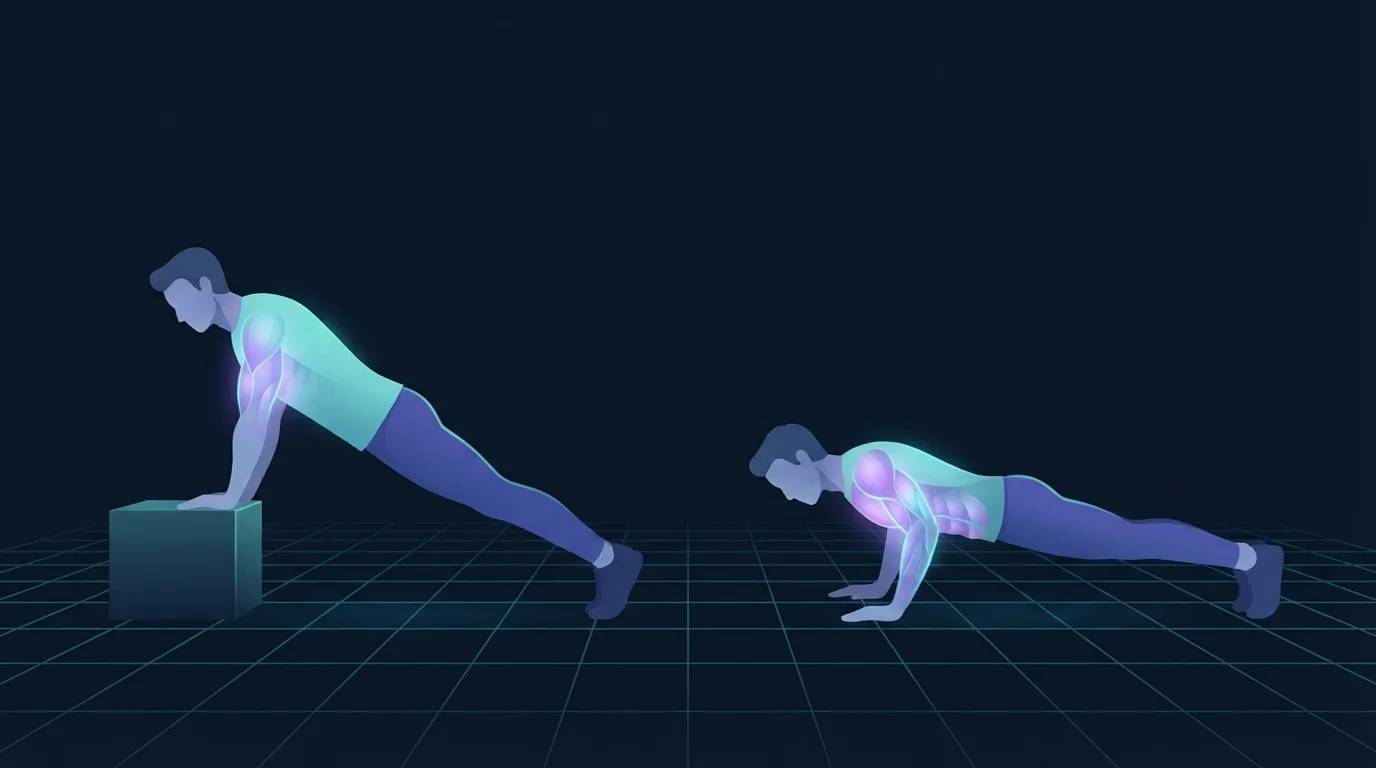
A push-up is a barbell bench press where your body is the bar and the angle is the plate. That single reframe fixes most of what goes wrong with push-up training, because it turns a demoralizing binary (can you do one or not) into a dial you turn a few degrees at a time. You're never stuck at zero. You're just standing too close to vertical.
The usual experience is worse than that. You try a push-up, your hips drop, your chest never reaches the floor, and you decide you're weak. Then you start doing knee push-ups forever, because nobody ever told you what has to be true before you graduate. Two months later you're still doing knee push-ups and still not sure why.
That's a programming gap, not a strength gap. A ladder with defined rungs and a defined standard for leaving each one solves it, and the research on push-up loading gives us the rungs.
How Heavy Is a Push-Up, Really?
This is the number that makes the whole ladder legible. Ebben, Wurm, VanderZanden, Spadavecchia, Durocher, Bickham and Petushek (2011) put 23 recreationally trained adults on a force platform and measured peak ground reaction forces across six push-up variations for the Journal of Strength and Conditioning Research. The standard push-up came in at about 64 percent of body mass. The knee push-up came in at about 49 percent. Push-ups with the hands elevated produced lower forces than every other variation, and push-ups with the feet elevated produced the highest.
Translate that into pounds and the ladder stops feeling vague. At 170 pounds of body weight you're pressing roughly 109 pounds from the floor and roughly 83 pounds from your knees. If the floor version is currently impossible, you aren't failing at push-ups. You're attempting a 109-pound press without having built up to it, which nobody would do with a barbell.
The practical consequence: the height of your hands is a weight stack you already own. A kitchen counter is a light setting. A dining chair is a middle setting. The floor is the standard setting. Your feet on a bench is the heavy setting. Nothing else about the movement needs to change.
The Push-Up Ladder, Rung by Rung
Eleven rungs, running from a wall to a one-arm rep. The time estimates assume two or three sessions a week and are honest ranges rather than promises, because the starting point varies enormously.
| Rung | Relative load | Own this before moving up | Typical time here |
|---|---|---|---|
| 1. Wall push-up | Lightest | 3 × 15, chest to wall, body rigid | 1 to 2 weeks |
| 2. Counter or high incline | Light | 3 × 12, chest touching, elbows at 45 degrees | 2 to 3 weeks |
| 3. Bench or chair incline | Moderate | 3 × 12, full depth, no hip sag | 3 to 4 weeks |
| 4. Knee push-up | About 49% of body weight | 3 × 12, straight line from head to knees | 2 to 4 weeks |
| 5. Full floor push-up | About 64% of body weight | 3 × 12, chest a fist from the floor | 4 to 8 weeks |
| 6. Tempo or paused floor | About 64%, longer under tension | 3 × 8 with a 3-second lower and 1-second pause | 3 to 4 weeks |
| 7. Decline push-up | Highest of the standard variations | 3 × 10 with feet on a bench | 4 to 6 weeks |
| 8. Diamond push-up | Same body weight, shorter triceps lever | 3 × 10, elbows tight to the ribs | 4 to 6 weeks |
| 9. Pseudo-planche push-up | More load shifted forward onto the shoulders | 3 × 8 with hands at hip height, shoulders past the wrists | 6 to 12 weeks |
| 10. Archer push-up | Most of the load on one arm | 3 × 6 per side, trailing arm nearly straight | 2 to 4 months |
| 11. One-arm push-up | Near-maximal, plus anti-rotation | Elevated first, then floor | Months to years |
Two things about that table are worth arguing with, so here they are up front. Rung 8 isn't strictly heavier than rung 7, it's harder in a different way, and plenty of people find the diamond easier than a decline. And rungs 9 through 11 are genuinely optional. Almost nobody needs a one-arm push-up. They are on the list because the ladder should keep going past the point where most guides stop.
What "Master It" Actually Means
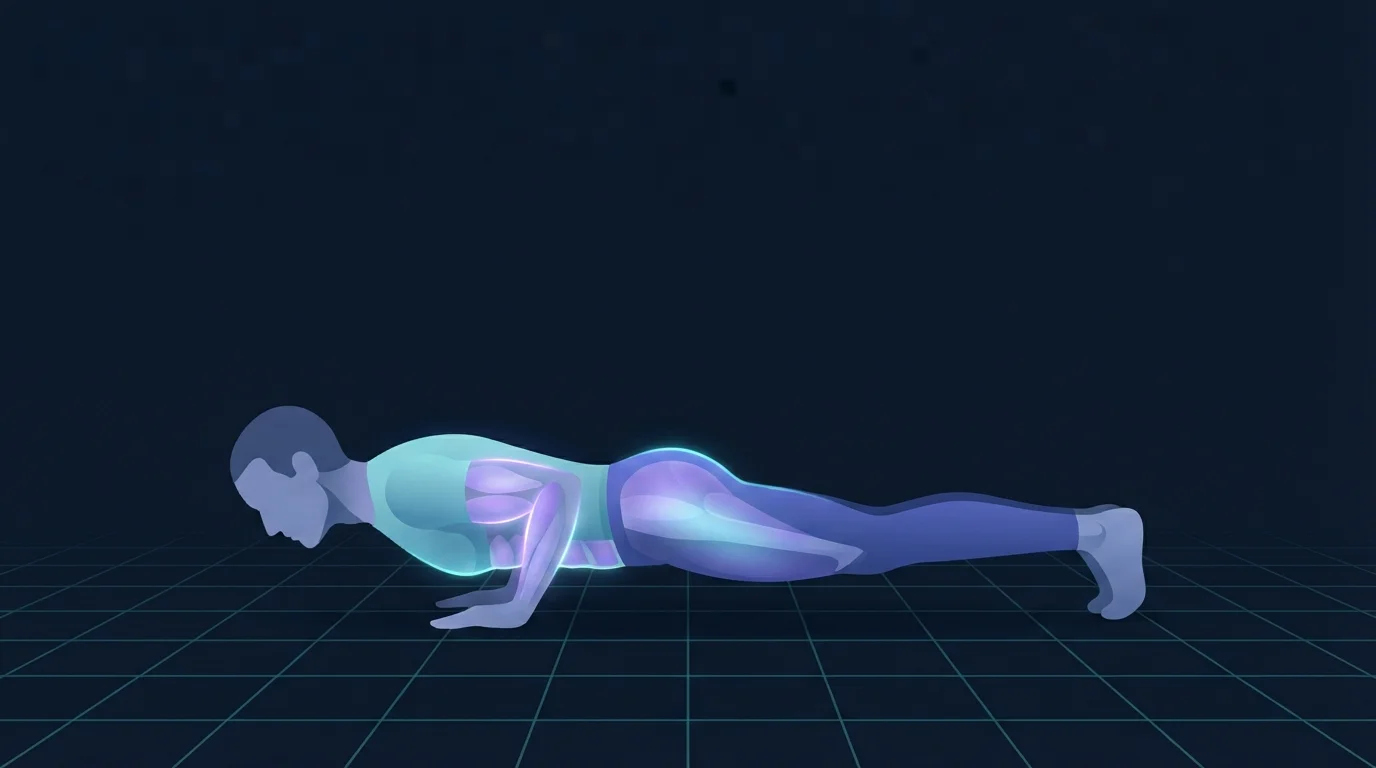
Three sets of 12 is the headline, but the four criteria underneath it are what actually gate the ladder. Check them honestly, ideally on video, because nobody can feel their own hip position reliably.
- One rigid line. Head, ribs, hips and heels travel together. Hips leading down or drifting up both mean the trunk gave out before the arms did.
- Full range. Chest ends about a fist's height from the surface, arms fully straight at the top without locking aggressively.
- Elbows at roughly 45 degrees. Not flared to 90, which loads the front of the shoulder, and not pinned to the ribs unless you're deliberately training the triceps.
- A controlled last set. If set three turns into a grind with two-second sticking points, you own the rung for endurance but not for strength.
If you want the full form breakdown with a video walkthrough, our push-up exercise page covers the setup, the common faults and the fixes frame by frame. The regressions have their own pages too: incline push-ups for rungs 2 and 3, and kneeling push-ups for rung 4.
Find out what's really holding you back
FitCraft, our mobile fitness app, pairs you with an AI coach who builds you a personalized plan around your goals, schedule, and fitness level. Every FitCraft program is designed by Domenic Angelino, MPH (Brown University) and NSCA-CSCS, with research published in the Journal of Strength and Conditioning Research and Medicine & Science in Sports & Exercise.
Take the Free Assessment Free • 2 minutes • No credit cardDo Push-Ups Actually Build Muscle?
Yes, and the trials that tested it are unusually direct. Kikuchi and Nakazato (2017), writing in the Journal of Exercise Science and Fitness, randomly assigned 18 young men to either bench press at 40 percent of one-rep max or push-ups adjusted by position to the same load, twice a week for eight weeks. In the push-up group, pectoralis major thickness rose from 17.0 mm to 20.8 mm and triceps thickness from 27.7 mm to 30.4 mm, and bench press one-rep max climbed from 61.1 kg to 64.2 kg. The bench press group improved too, and the differences between the groups were not significant.
Kotarsky, Christensen, Miller and Hackney (2018) ran the same question with progression built in. Twenty-three moderately trained men trained three days a week for four weeks, 14 doing progressive calisthenic push-up variations and nine doing bench press. Both groups significantly raised one-rep max bench press. The push-up group's progression score rose significantly more, which is what you would expect from specificity. The authors concluded that push-up progressions produced strength and thickness gains comparable to traditional bench press training over short-term training.
The mechanism sits in a broader meta-analysis. Schoenfeld, Grgic, Ogborn and Krieger (2017) pooled 21 studies and found that low-load training taken close to failure builds muscle comparably to heavy training, while maximal strength still favors heavy loads. A push-up is a low-load exercise for most people. Taken close to failure, it grows muscle. For an untrained person it isn't even low load, which is why the first eight weeks feel so productive. Our review of what bodyweight training actually delivers covers where that ceiling sits.
One more reason to care about the number you can do. Yang et al. (2019) followed 1,104 active male firefighters in JAMA Network Open and found men who completed more than 40 push-ups had a 96 percent lower incidence of cardiovascular events over ten years than men who managed fewer than 10. That cohort was active, male and middle-aged, so the exact 40-rep cutoff does not transfer cleanly to everyone. We unpacked the caveats in our breakdown of the push-up test research. The direction of the finding is solid even where the threshold is not.
The Hard Rungs, and What Each One Is Really Training
Decline push-up
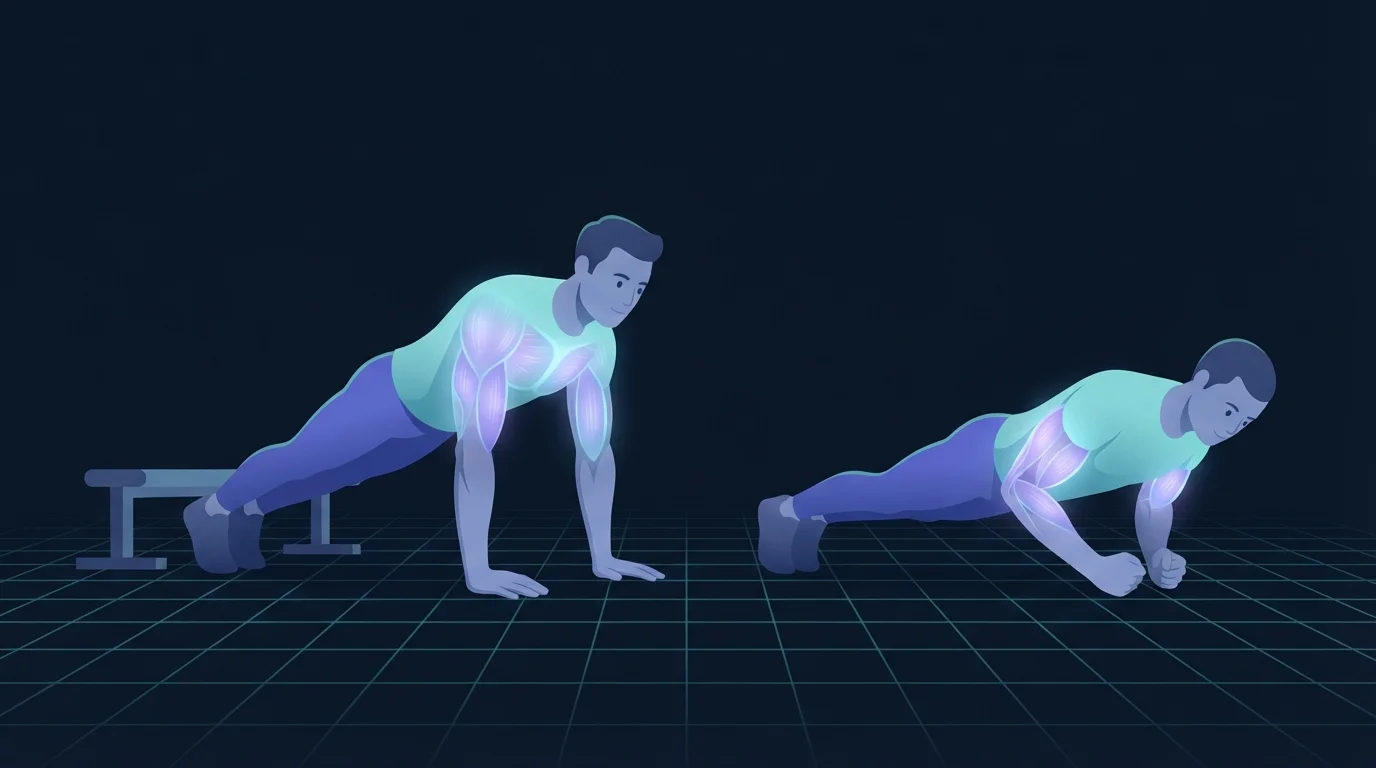
Feet on a bench, hands on the floor. This was the highest-force variation Ebben's group measured, and it biases the upper chest and front shoulders. Start on a step no higher than your knee. Our decline push-up page has the setup detail, including why the neck position matters more here than on the floor.
Diamond push-up
Hands close together under the sternum, elbows tracking tight to the ribs. Body weight is unchanged, but the triceps take a much longer lever, so the same load feels dramatically heavier. It's the cheapest way to make a floor push-up hard again without any equipment at all. See the diamond push-up page for the wrist-friendly hand position, which is the part most people get wrong.
Pseudo-planche push-up
Hands down by the hips, shoulders travelling past the wrists, which tilts more of your mass forward onto the shoulders and the upper chest. This is the first rung that genuinely requires shoulder and wrist preparation, and the pseudo-planche push-up page walks through the lean progression that gets you there without wrecking your wrists.
Archer and one-arm
The archer shifts most of the load onto one arm while the other stays nearly straight for balance. The one-arm push-up then removes the counterweight, which makes it as much an anti-rotation trunk exercise as a pressing one. Train both with the hands elevated first, and stop treating the floor version as a deadline.
Why You Plateau, and the Three Fixes
Nearly every push-up plateau is the same plateau. You reach 20 or 25 reps in a set, keep adding reps, and stop getting stronger. That isn't a failure of effort. Past roughly that point you're training muscular endurance, and endurance and strength are different adaptations. The load has been constant the entire time.
Three fixes, all of which change the load rather than the volume:
- Raise your feet. The measured jump to the feet-elevated version is the biggest single load increase available without equipment.
- Slow the lowering phase. A three-second descent with a one-second pause at the bottom turns a 20-rep set into an 8-rep set at the same body weight, and kills the bounce out of the bottom.
- Move your hands. Narrower gives the triceps a longer lever. Further back gives the shoulders more of your mass. Both raise difficulty with no change in weight.
Frequency helps too, within reason. Grgic et al. (2018) pooled 22 studies in Sports Medicine and found that when weekly volume is equal, training frequency does not much change strength gains, but higher frequency allows more total weekly volume in practice. In plain terms, three moderate push-up sessions a week beat one heroic one, mostly because you finish more good reps that way. That logic is the basis of greasing the groove, where you do frequent submaximal sets through the day instead of one exhausting session.
An 8-Week Push Up Progression Plan
This plan assumes you're starting at rung 3 or 4, the most common entry point, and that your goal is a clean set of floor push-ups. Train three non-consecutive days a week. If a week feels easy, skip ahead and move on early. If a week feels brutal, repeat it. The calendar is the least important column here.
| Week | Main work | Sets and reps | Second exercise |
|---|---|---|---|
| 1 to 2 | Bench or chair incline push-up | 3 × 8 to 12, 90 seconds rest | Plank, 3 × 20 to 30 seconds |
| 3 to 4 | Low incline, then knee push-up | 4 × 8 to 12 | Plank, 3 × 40 seconds |
| 5 | Knee push-up plus 2 floor negatives per set | 4 × 10, then 2 slow lowers | Plank, 3 × 45 seconds |
| 6 | Floor push-ups first, knees to finish the set | 4 sets, as many floor reps as clean, then knees to 10 | Side plank, 2 × 20 seconds each side |
| 7 | Floor push-ups only | 4 × 5 to 8, full rest between sets | Side plank, 2 × 30 seconds each side |
| 8 | Floor push-ups, test on the last day | 3 × 8 to 12, then one max clean set | Side plank, 2 × 30 seconds each side |
The floor negative in week 5 is the hinge of the whole plan. Start at the top of a floor push-up, lower yourself as slowly as you can, drop to your knees to come back up, repeat. You can control far more weight on the way down than you can press on the way up, which is why negatives bridge a gap that extra knee reps never will.
Wondering where your finishing number should land? How many push-ups you should be able to do has the published norm tables by age and sex, which are a much fairer benchmark than whatever number your gym friend quotes. And if you would rather not sequence any of this yourself, FitCraft's no-equipment home workout programs sequence the bodyweight sessions and the rest days for you.
The Bottom Line
A push up progression works because the angle is the weight. A standard push-up is roughly 64 percent of your body weight and the knee version roughly 49 percent, so every surface height between a wall and a bench is a load setting you already own. Move up when you own three sets of 12 with a rigid line and a full range, not when a calendar says so.
Practical rule: when reps pass 20 in a set, stop adding reps and change the load instead. Raise your feet, slow the descent, or narrow your hands. Rep counts past 25 buy endurance you did not ask for.
The thing worth holding onto is that none of the research here was done on people with special genetics. Kikuchi's group trained twice a week for eight weeks. Kotarsky's trained three days a week for four. The push-ups did the work. The schedule is what actually decides whether you get the result, which is the part of the plan most people never write down.
Frequently Asked Questions
How long does it take to go from knee push-ups to full push-ups?
Most people who train the pattern two or three times a week cross from knee push-ups to a clean full push-up in four to eight weeks. The gap is smaller than it looks: force-plate data puts the knee version at roughly 49 percent of body weight and the full version at roughly 64 percent, so you are adding about a quarter more load. Start testing full reps at the front of your first set once you own three sets of 12 clean knee reps.
How much of your body weight do you lift in a push-up?
Roughly 64 percent of your body weight in a standard push-up and roughly 49 percent from the knees, measured on a force platform by Ebben et al. (2011) across six push-up variations. For a 170-pound person that is about 109 pounds per rep standard and about 83 pounds from the knees. Elevating your hands lowers the figure and elevating your feet raises it, which is exactly why the height of the surface is your load dial.
How many push-ups should I do before moving to the next variation?
Three sets of 12 clean reps with a rigid head-to-heels line and a full range of motion, with the last set still controlled rather than a grind. That standard matters more than the number. If your hips sag, your elbows flare past 60 degrees or your chest stops short of a fist's height from the floor, you are not ready for the next rung no matter how many reps you count.
Do push-ups build muscle or just endurance?
They build real muscle when the load is hard enough. Kikuchi and Nakazato (2017) trained 18 men twice a week for eight weeks and the push-up group's pectoralis major thickness rose from 17.0 mm to 20.8 mm with triceps from 27.7 mm to 30.4 mm, no different from a bench press group training at 40 percent of one-rep max. Once a variation lets you pass roughly 20 to 25 reps, though, you are training endurance and need a harder rung.
Why have my push-ups stopped improving?
Almost always because the load stopped changing while the rep count kept climbing. A push-up has one fixed weight, so past about 20 reps per set you are adding endurance rather than strength. The three fixes are all load, not volume: raise your feet, slow the lowering phase to three seconds, or shift your hands to a narrower or more forward position. Adding a fourth set of the same easy variation does almost nothing.
Is a one-arm push-up realistic for most people?
It is realistic for most healthy trainees who are patient, and it is not a reasonable eight-week goal. The one-arm push-up asks one side to press most of your body weight while your trunk resists rotation, so it is as much an anti-rotation skill as a pressing one. Expect the archer and the elevated one-arm variations to take several months each, and treat the full-range floor version as a multi-year project rather than a milestone you are late for.