Most answers to this question online are made up. They quote a table with no source, or they quote a military pass mark, which is a minimum standard for soldiers rather than a norm for the general population. There is real published norm data, it covers ages 20 to 69 by sex, and it has been the basis of the Canadian fitness appraisal protocol for two decades.
Here is the short version before the table. A man in his twenties who can do 22 to 28 push-ups rates Good. A man in his thirties needs 17 to 21 for the same rating. A woman in her twenties who can do 15 to 20 knee push-ups rates Good, and a woman in her thirties needs 13 to 19. At or above those numbers you're in the upper half of the reference population for your decade. Below them is a starting point, not a crisis, and it moves faster than almost any other fitness metric.
What Are the Published Push Up Norms by Age and Sex?
The reference data comes from Payne, Gledhill, Katzmarzyk, Jamnik, and Keir (2000), "Canadian musculoskeletal fitness norms," in the Canadian Journal of Applied Physiology. The team measured push-ups alongside partial curl-ups, vertical jump, grip strength, trunk flexion, and body composition in 571 healthy participants (312 women, 259 men) aged 15 to 69, and stratified the results by sex and age band. Those norms were carried into the Canadian Physical Activity, Fitness and Lifestyle Approach appraisal manual, which is where most fitness professionals meet them.
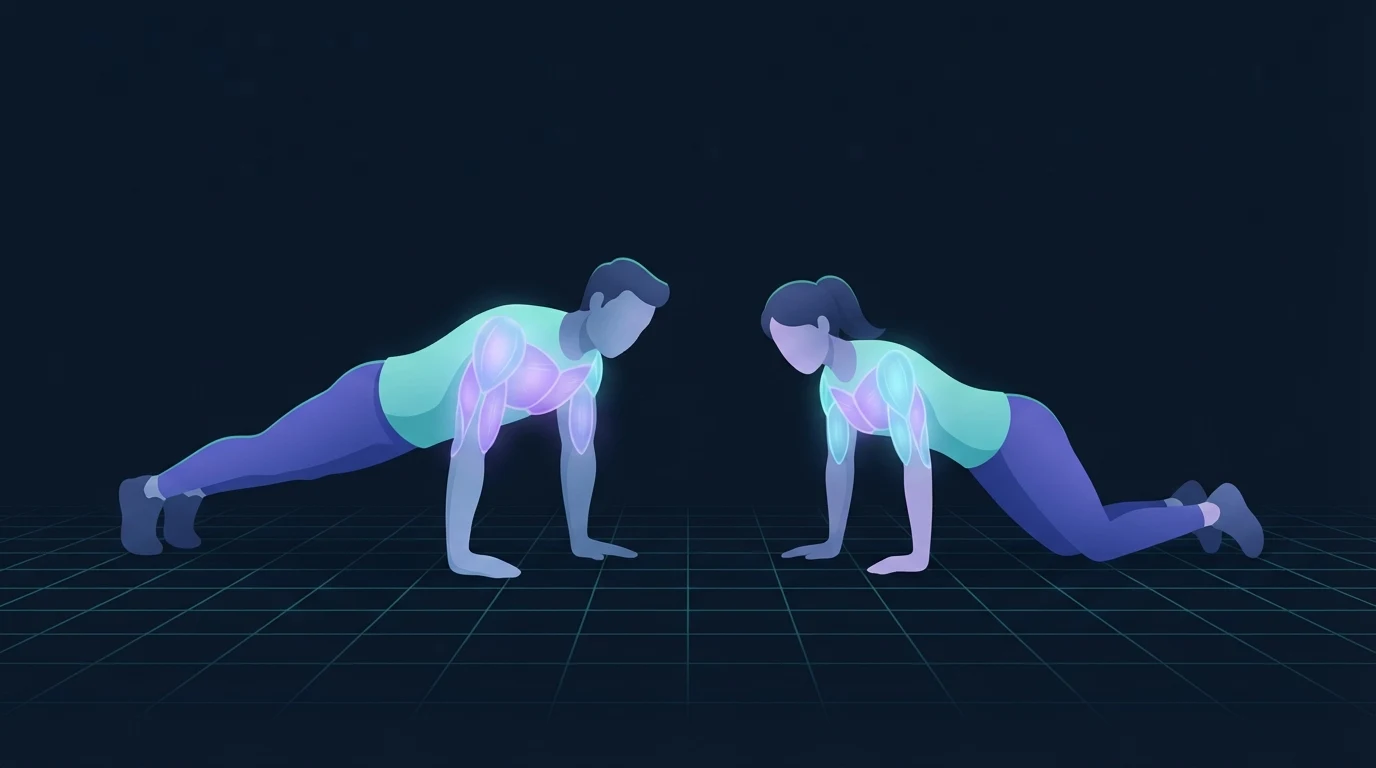
Two protocol details decide whether your own number is comparable. Men are tested from the standard position on the toes. Women are tested from the modified knee position, with the lower legs on the mat and the back straight. In both cases you perform as many consecutive reps as you can without resting, lowering until the chin touches the mat, and the test stops when form breaks down for two reps in a row. No pausing at the top, no bouncing off the floor, no sagging hips.
Push-up norms for men (standard push-up, maximum consecutive reps)
| Age | Needs improvement | Fair | Good | Very good | Excellent |
|---|---|---|---|---|---|
| 20-29 | 16 or fewer | 17-21 | 22-28 | 29-35 | 36 or more |
| 30-39 | 11 or fewer | 12-16 | 17-21 | 22-29 | 30 or more |
| 40-49 | 9 or fewer | 10-12 | 13-16 | 17-24 | 25 or more |
| 50-59 | 6 or fewer | 7-9 | 10-12 | 13-20 | 21 or more |
| 60-69 | 4 or fewer | 5-7 | 8-10 | 11-17 | 18 or more |
Push-up norms for women (modified knee push-up, maximum consecutive reps)
| Age | Needs improvement | Fair | Good | Very good | Excellent |
|---|---|---|---|---|---|
| 20-29 | 9 or fewer | 10-14 | 15-20 | 21-29 | 30 or more |
| 30-39 | 7 or fewer | 8-12 | 13-19 | 20-26 | 27 or more |
| 40-49 | 4 or fewer | 5-10 | 11-14 | 15-23 | 24 or more |
| 50-59 | 1 or fewer | 2-6 | 7-10 | 11-20 | 21 or more |
| 60-69 | 1 or fewer | 2-4 | 5-11 | 12-16 | 17 or more |
Read the age drop carefully, because it's the part people misread. At the Excellent line, men lose about 6 reps between their twenties and thirties, then roughly 4 to 5 reps per decade after that. Women lose a similar proportion. That decline is normal loss of muscle mass and neural drive with age, and it's also the part you can push back hardest against with training. A trained 55 year old will beat the untrained 25 year old column comfortably. If your number sits below the line you want, our push up progression guide maps every rung from the wall to the floor and tells you what to own before each step up.
One caveat on the women's table. Because it's scored on the knee variation, it doesn't tell a woman who trains standard push-ups where she stands. There is no equally well-established published female norm for the standard version. If you train on your toes, use the men's table as a rough reference target and accept that it's a harder bar, not a fair one.
Why Does the Number Matter?
Push-up capacity is unusually informative for a test that needs no equipment. Yang, Christophi, Farioli, Baur, Moffatt, Zollinger, and Kales (2019) in JAMA Network Open followed 1,104 active male firefighters in Indiana for 10 years after a baseline physical that included a push-up test and a submaximal treadmill test. Thirty-seven cardiovascular events occurred over the follow-up. Sorted by baseline push-up capacity, the incidence rates split hard. To build your number a day at a time, the 30 day workout challenge has a push-up plan and a 100 push-ups a day option at four levels.
| Baseline push-ups | CVD events | Rate per 100,000 person-years | Incidence rate ratio |
|---|---|---|---|
| 0-10 | 8 | 1,757 | 1.00 (reference) |
| 11-20 | 9 | 625 | 0.36 |
| 21-30 | 9 | 288 | 0.16 |
| 31-40 | 10 | 433 | 0.25 |
| 41 or more | 1 | 79 | 0.04 |
Men who could complete more than 40 push-ups had a 96 percent lower rate of cardiovascular events over the decade than men who could complete fewer than 10. All but one of the 37 events happened in men who did 40 or fewer at baseline. Push-up capacity was more strongly associated with future risk than the treadmill test result was, which is the finding that made the study famous. It was an occupational cohort of active men, so the exact numbers don't transfer to everyone. The direction does.
The broader strength literature agrees. Garcia-Hermoso and colleagues (2018) pooled 38 cohorts and roughly 2 million adults in Archives of Physical Medicine and Rehabilitation and found higher handgrip strength was associated with a 31 percent lower risk of all-cause mortality (HR 0.69), with a similar signal for knee extension strength. Katzmarzyk and Craig (2002) tracked 8,116 Canadian adults from the Canada Fitness Survey for 13 years in Medicine and Science in Sports and Exercise using the same musculoskeletal battery the norm table comes from. In that cohort the strongest mortality signal came from the sit-up score rather than the push-up score, a useful reminder that no single field test is the whole picture. Our grip strength and longevity review covers the parallel evidence for the other easy at-home strength marker.
There's also a plain fitness reason to care. Vaara et al. (2012) tested 846 young men in the Journal of Strength and Conditioning Research and found push-up performance correlated strongly with maximal isometric bench press strength (r = 0.61) and also tracked cardiorespiratory fitness. Your push-up number is a cheap proxy for upper-body strength you'd otherwise need a barbell to measure.
Knowing what to do is the easy part.
FitCraft, our mobile fitness app, pairs you with an AI coach who builds you a personalized plan around your goals, schedule, and fitness level. Every FitCraft program is designed by Domenic Angelino, MPH (Brown University) and NSCA-CSCS, with research published in the Journal of Strength and Conditioning Research and Medicine & Science in Sports & Exercise.
Take the Free Assessment Free • 2 minutes • No credit cardHow Do You Test Yourself Properly?
Self-reported push-up numbers are inflated more often than any other home fitness test, because depth and hip position quietly drift. Run the test the way the protocol does and your number will mean something.
- Warm up first. Five minutes of easy movement plus 8 to 10 slow reps at an easier angle. A cold max test undercounts you and irritates shoulders.
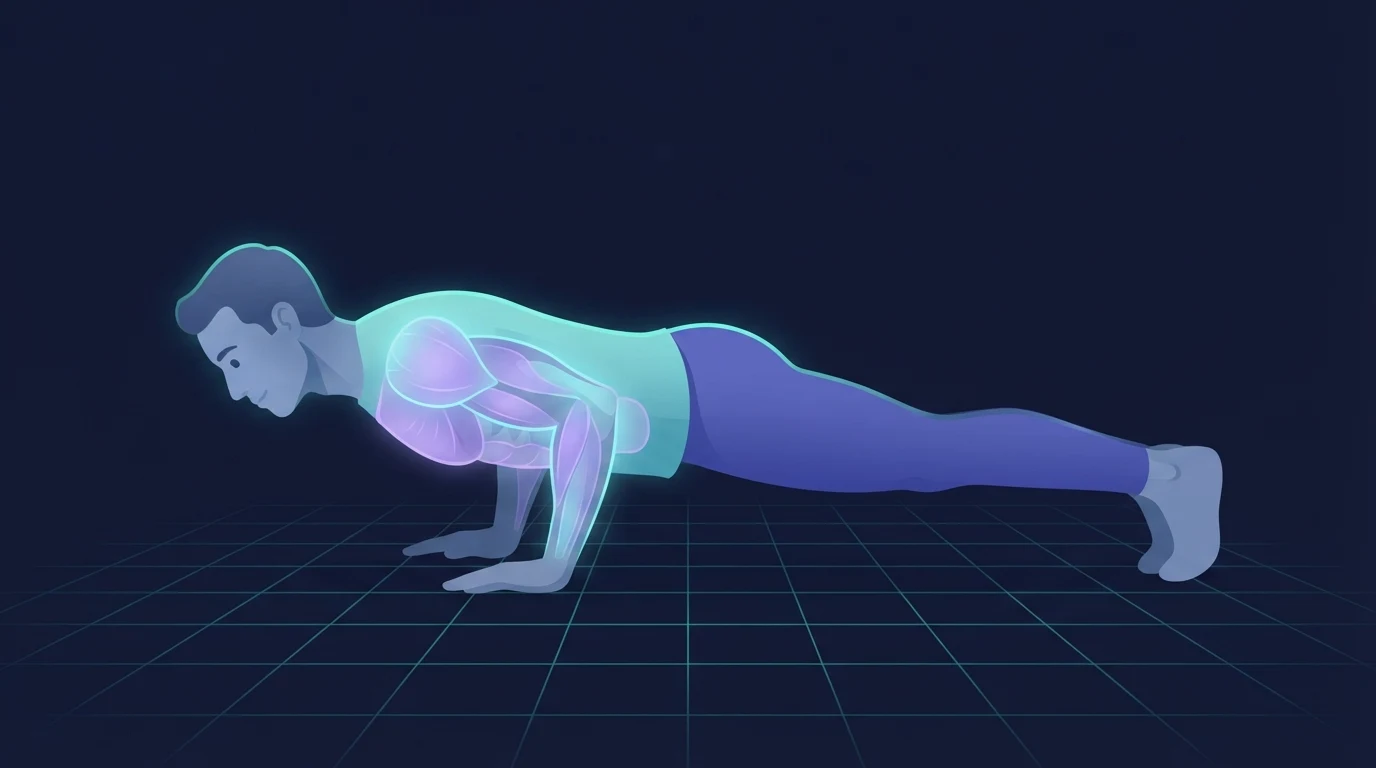
- Set the position. Hands under the shoulders and pointing forward. Body in one line from heels to head. Squeeze the glutes so the hips don't drop.
- Set the depth. Lower until the chest is roughly a fist off the floor. The protocol uses the chin touching the mat. Half reps don't count.
- No rest at the top. Continuous reps. Once you pause to shake out an arm, the set is over.
- Stop at two bad reps. The moment your hips sag or you stop reaching depth for two reps in a row, the test ends. Don't count those two.
- Retest every 3 to 4 weeks, not weekly. Max testing is fatiguing, and weekly testing turns into training you didn't plan.
Film one set from the side once. Almost everyone discovers their depth is shallower than it feels. Our push-ups exercise page has the full setup, the common form errors, and the muscles the movement actually loads.
What If You Cannot Do a Single Push Up?
Then you pick an easier lever instead of grinding out a rep with a collapsing spine. Ebben, Wurm, VanderZanden, Spadavecchia, Durocher, Bickham, and Petushek (2011) measured ground reaction forces across six push-up variations in 23 recreationally fit adults for the Journal of Strength and Conditioning Research. Push-ups with the hands elevated and push-ups from the flexed knee position produced lower forces than every other variation tested, and feet-elevated push-ups produced the highest. That gives you a measured load ladder rather than a guess.
| Step | Variation | Move on when you can do |
|---|---|---|
| 1 | Wall push-up, feet close to the wall | 3 sets of 15 |
| 2 | Countertop or windowsill push-up | 3 sets of 15 |
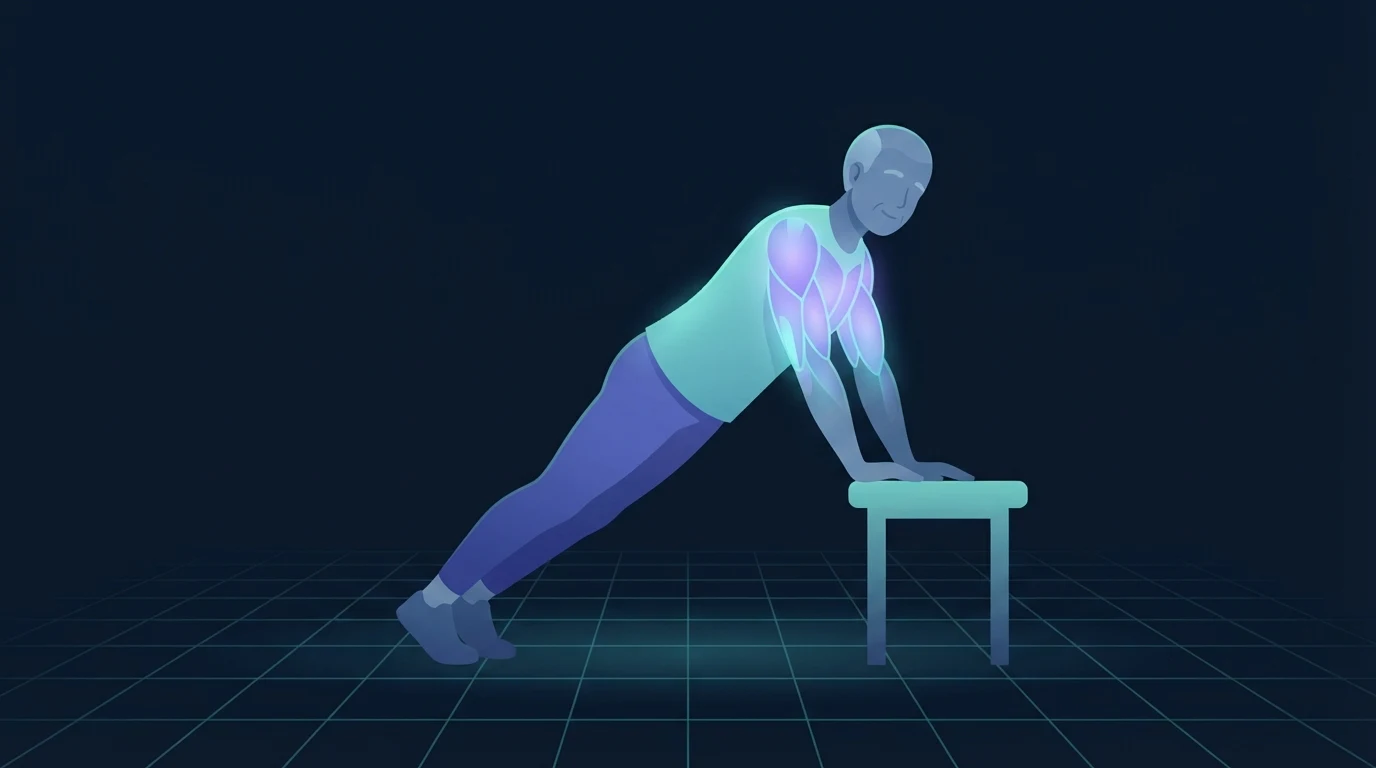
| 3 | Sturdy chair, bench, or bottom stair push-up | 3 sets of 12 |
| 4 | Knee push-up on the floor | 3 sets of 12 |
| 5 | Negative-only floor push-up, 4 seconds down | 3 sets of 5 |
| 6 | Standard floor push-up | Start counting for the table |
Work at the step where 8 to 12 controlled reps is genuinely hard by the last two. Add a rep or two per session. When you clear the move-on target, drop to the next step and expect your rep count to fall by half, which is the whole point. The same logic drives our first pull-up guide, and it's just progressive overload applied to your own bodyweight.
How Do You Add Reps Fastest?
Push-up numbers respond quickly. Kotarsky, Christensen, Miller, and Hackney (2018) randomized 23 moderately trained men to either progressive calisthenic push-up training or bench press training, 3 days a week for 4 weeks. Both groups significantly increased their 1RM bench press. The push-up group increased its push-up progression significantly more than the bench group did. Four weeks. Three sessions a week. No equipment.
What that translates to in practice:
- Train push-ups 3 days a week with at least one full day between sessions. More frequency without more recovery stalls people out.
- Do 3 to 5 sets, stopping 2 to 3 reps short of failure on all but the last set. Grinding every set to failure raises fatigue faster than it raises reps.
- Add total volume weekly, not intensity. If you did 4 sets of 8 this week, aim for 4 sets of 9 or 10 next week. Volume is the driver at this rep range.
- Use greasing the groove on off days if you're impatient. Several easy sets of roughly half your max, spread across the day, never near failure.
- Train the back too. Push-ups load the chest, front shoulders, and triceps. Rows and band pull-aparts keep the shoulder balanced and reduce the front-shoulder ache that shows up around week 3.
A simple 8-week template: test your max, then train 3 sets at 50 percent of that max on day one, 4 sets at 50 percent on day two, and one all-out set plus 2 sets at 50 percent on day three. Add one rep to every working set each week. Retest at week 4 and week 8, and reset the percentages. Most people add 8 to 15 reps to their max over that block. Our bodyweight workout results review covers what else changes over an 8 to 12 week bodyweight block, and if you want a plan that handles the progression for you, the best no-equipment workout apps roundup compares the options honestly.
Bottom Line
If you want one number: 22 or more clean standard push-ups for a man in his twenties, 17 or more in his thirties, and 15 or more knee push-ups for a woman under 40, puts you in the upper half of the published reference population. Adjust down by roughly 5 reps per decade after 30. Forty or more standard push-ups is where the cardiovascular association in Yang et al. (2019) got dramatic, and it's a realistic target for a healthy man who trains for it. Below your band is a training problem with a fast, well-documented fix. Test honestly, pick the step of the ladder where 10 reps is hard, and retest in a month. To check your push-ups along with your flexibility, core and cardio, take our free at-home fitness test, which counts your reps and scores them for your age and sex.
Frequently Asked Questions
How many push ups should I be able to do?
It depends on your age and sex, and the published reference table is specific. Using the CSEP norms built on Payne et al. (2000), a man aged 20 to 29 rates Good at 22 to 28 standard push-ups and Excellent at 36 or more. A man aged 30 to 39 rates Good at 17 to 21 and Excellent at 30 or more. A woman aged 20 to 29 rates Good at 15 to 20 modified knee push-ups and Excellent at 30 or more. A woman aged 30 to 39 rates Good at 13 to 19 and Excellent at 27 or more. As a single rough answer for a healthy adult under 40: 22 or more clean reps for men in their twenties, 17 or more in their thirties, and 15 or more knee reps for women puts you in the upper half of the reference population.
How many push ups should a man be able to do by age?
The CSEP standard push-up thresholds for the Good rating are 22 to 28 reps at ages 20 to 29, 17 to 21 at 30 to 39, 13 to 16 at 40 to 49, 10 to 12 at 50 to 59, and 8 to 10 at 60 to 69. The Excellent thresholds are 36, 30, 25, 21 and 18 reps for those same decades. The drop is roughly 5 reps per decade at the Excellent line, which reflects the normal age-related loss of muscle mass rather than anything you did wrong.
How many push ups should a woman be able to do?
The published norms for women use the modified knee push-up, not the standard version, so the numbers are not directly comparable to the men's column. A woman aged 20 to 29 rates Good at 15 to 20 knee push-ups and Excellent at 30 or more. Ages 30 to 39 rate Good at 13 to 19 and Excellent at 27 or more. Ages 40 to 49 rate Good at 11 to 14 and Excellent at 24 or more. If you train standard push-ups, there is no published female norm table for them, so treat the men's table as a stretch target rather than a fair benchmark.
Is 20 push ups good?
Twenty clean standard push-ups rates Fair for a man aged 20 to 29, Good for a man aged 30 to 39, Very good for a man aged 40 to 49, Very good for a man aged 50 to 59, and Excellent for a man aged 60 to 69. So the same 20 reps means something different at 25 than it does at 55. For a woman doing 20 knee push-ups, that rates Good at 20 to 29, Very good at 30 to 39, and Very good at 40 to 49. Twenty is a solid working number for most adults and a reasonable first milestone if you are starting from zero.
What if I cannot do a single push up?
Start with an easier lever rather than trying to grind out a bad rep. Ebben et al. (2011) measured ground reaction forces across six push-up variations and found that push-ups with the hands elevated and push-ups from the flexed knee position produced lower forces than every other variation, while feet-elevated push-ups produced the highest. That gives you a load ladder: hands on a wall, then a kitchen counter, then a sturdy chair or bench, then the floor from the knees, then the floor on your toes. Work at the height where you can do 8 to 12 controlled reps, add reps weekly, and drop the surface height once you clear 15.
How long does it take to go from 10 push ups to 30?
For most untrained adults training push-ups 3 times a week, 8 to 16 weeks is a realistic range. Kotarsky et al. (2018) trained 23 moderately trained men 3 days a week for only 4 weeks and saw significant gains in push-up progression, larger than the bench press group's gains, so the early progress is fast. Going from 10 to 30 usually means adding roughly 2 to 3 reps to your best set every 2 weeks. Progress stalls when total weekly volume stays flat, so add a set or a few reps per session rather than repeating the same workout.
Do knee push ups count?
They count as training and they are the official protocol for the women's column of the published norm table, but they are not interchangeable with standard push-ups when you compare numbers. Ebben et al. (2011) confirmed the knee position produces lower ground reaction force than the standard position, so a knee rep is a lighter rep. Use knee push-ups to build the pattern and the volume, then retest on the floor from your toes every 3 to 4 weeks to see where your standard number actually sits.
References
- Payne N, Gledhill N, Katzmarzyk PT, Jamnik VK, Keir PJ. "Canadian musculoskeletal fitness norms." Canadian Journal of Applied Physiology 25.6 (2000): 430-442. doi:10.1139/h00-028.
- Yang J, Christophi CA, Farioli A, Baur DM, Moffatt S, Zollinger TW, Kales SN. "Association between push-up exercise capacity and future cardiovascular events among active adult men." JAMA Network Open 2.2 (2019): e188341. doi:10.1001/jamanetworkopen.2018.8341.
- Katzmarzyk PT, Craig CL. "Musculoskeletal fitness and risk of mortality." Medicine and Science in Sports and Exercise 34.5 (2002): 740-744. doi:10.1097/00005768-200205000-00002.
- Vaara JP, Kyrolainen H, Niemi J, Ohrankammen O, Hakkinen A, Kocay S, Hakkinen K. "Associations of maximal strength and muscular endurance test scores with cardiorespiratory fitness and body composition." Journal of Strength and Conditioning Research 26.8 (2012): 2078-2086. doi:10.1519/JSC.0b013e31823b06ff.
- Kotarsky CJ, Christensen BK, Miller JS, Hackney KJ. "Effect of progressive calisthenic push-up training on muscle strength and thickness." Journal of Strength and Conditioning Research 32.3 (2018): 651-659. doi:10.1519/JSC.0000000000002345.
- Ebben WP, Wurm B, VanderZanden TL, Spadavecchia ML, Durocher JJ, Bickham CT, Petushek EJ. "Kinetic analysis of several variations of push-ups." Journal of Strength and Conditioning Research 25.10 (2011): 2891-2894. doi:10.1519/JSC.0b013e31820c8587.
- Garcia-Hermoso A, Cavero-Redondo I, Ramirez-Velez R, Ruiz JR, Ortega FB, Lee DC, Martinez-Vizcaino V. "Muscular strength as a predictor of all-cause mortality in an apparently healthy population: a systematic review and meta-analysis of data from approximately 2 million men and women." Archives of Physical Medicine and Rehabilitation 99.10 (2018): 2100-2113.e5. doi:10.1016/j.apmr.2018.01.008.