
Am I fit? This at-home fitness test answers that with numbers instead of a guess. Press Start above and the page walks you through each test one at a time, with a picture, a one-line how-to and its own timer or counter. It counts the beat for the step test, times your pulse count, counts your push-ups and times your holds. At the end you get a profile of your strength, flexibility, core and cardio, the date to retest, and on a retest, the change since last time.
The 5 tests in this fitness test
- 3-minute step test (cardio). Step on a 12-inch step to a beat for 3 minutes, then count your pulse for 1 minute. A lower count means fitter.
- Sit and reach test (flexibility). Reach forward past your toes with straight legs. It mostly measures your hamstrings.
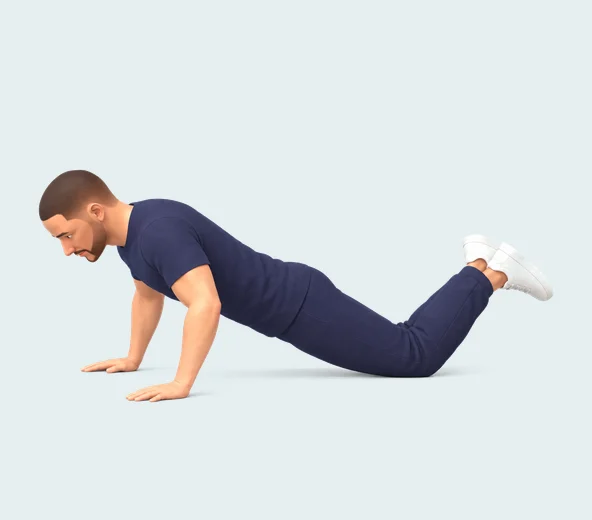
- Push-up test (upper-body strength). As many push-ups in a row as you can: men on the toes, women on the knees, as the published table is set up.
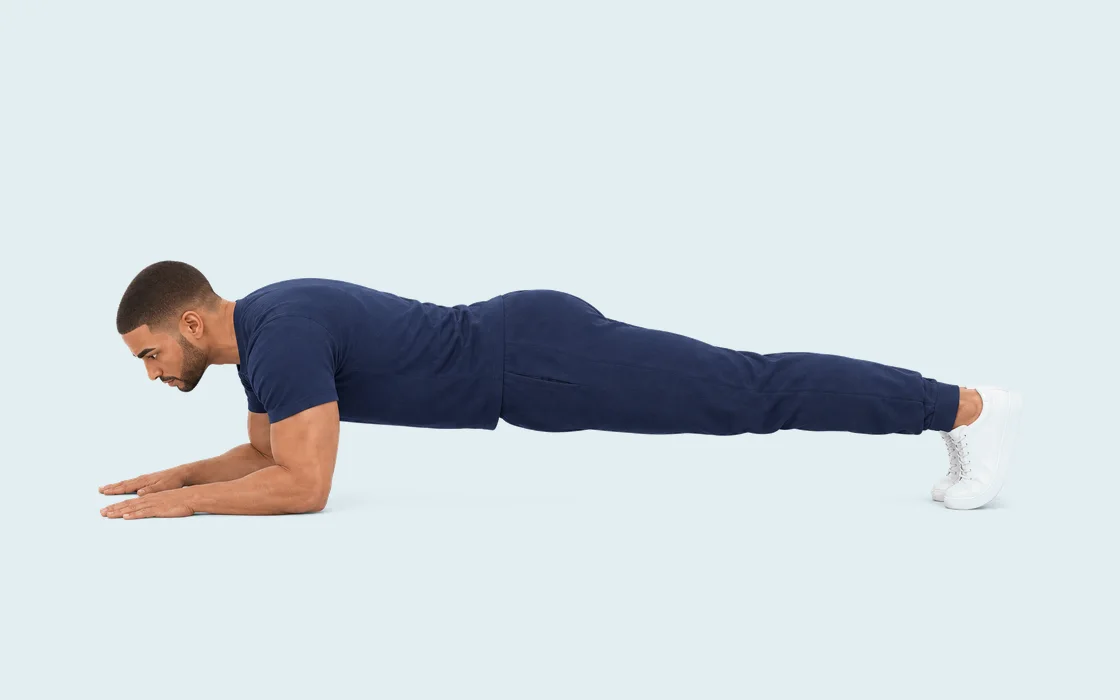
- Plank test (core). Hold a forearm plank as long as you can in a straight line.
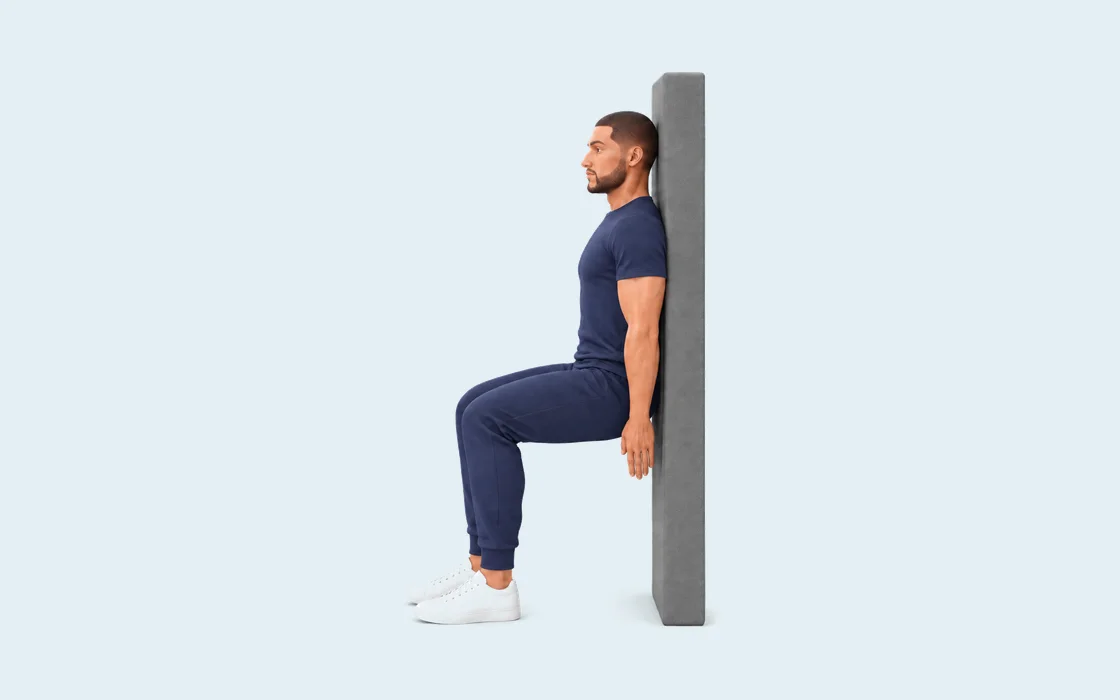
- Wall sit test (legs). Hold a wall sit with your thighs level with the floor as long as you can.
These are the same kinds of exercise tests that fitness professionals use, chosen because each one needs only household items and has a clear protocol. Three of them have published norms you can compare yourself with. The plank and the wall sit do not, so the tool shows your time and saves it as the number to beat.
How this at-home fitness test works
- Answer the health check. Seven yes-or-no questions based on the PAR-Q+. If you answer yes to any, check with a doctor first.
- Warm up for about 2 minutes. Side kicks and downward dog, 45 seconds each.
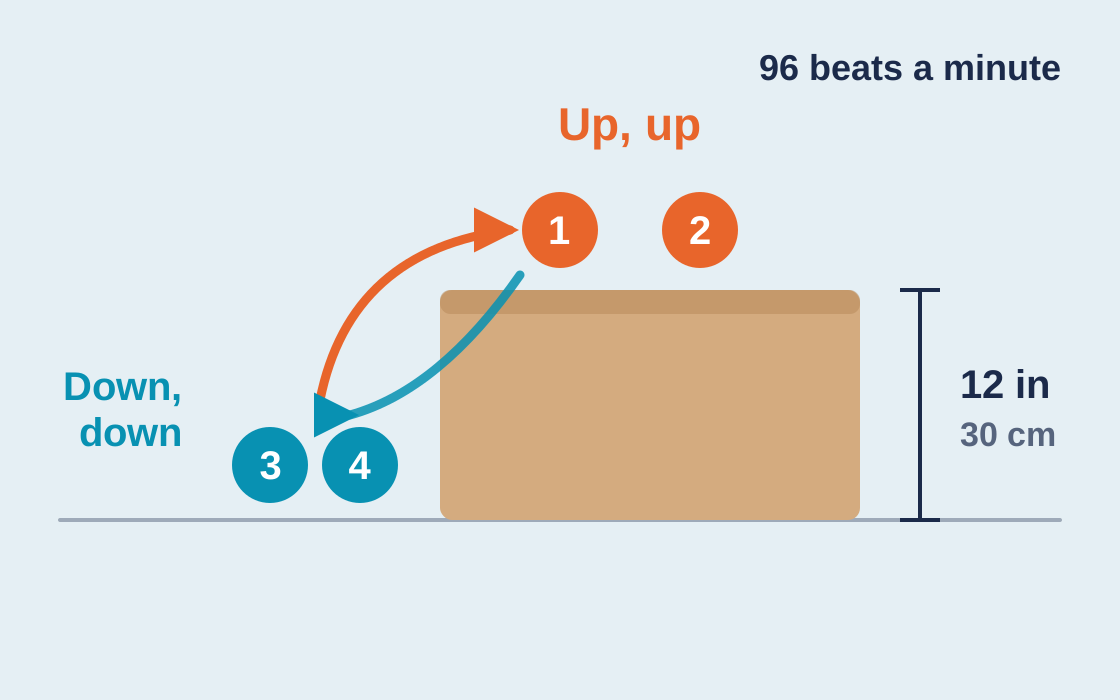
- Do the 3-minute step test. Step up, up, down, down on a 12-inch (30 cm) step to a beat of 96 a minute for 3 minutes, then sit and count your pulse for 1 minute.
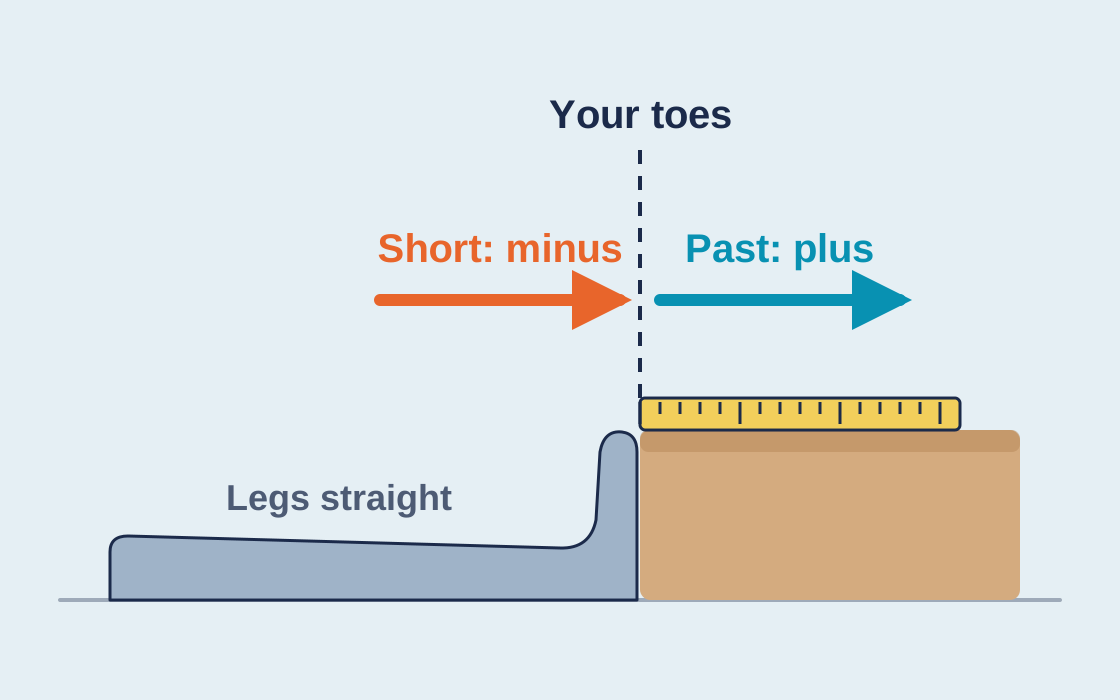
- Do the sit and reach test. Sit with your bare feet flat against the step and reach forward along a ruler on top of it. Keep the better of two reaches.
- Do the push-up test. Men do standard push-ups and women do kneeling push-ups, as many in a row as possible with the chin touching the floor.
- Hold a forearm plank, then a wall sit. Hold each as long as you can, with a 45-second rest before each.
- Cool down and read your profile. Two stretches, then your results by strength, flexibility, core and cardio, and a date to retest in 4 to 6 weeks.
Here is the whole session in order. Every move and stretch links to its form guide.
| Part | Step | What you do | Time |
|---|---|---|---|
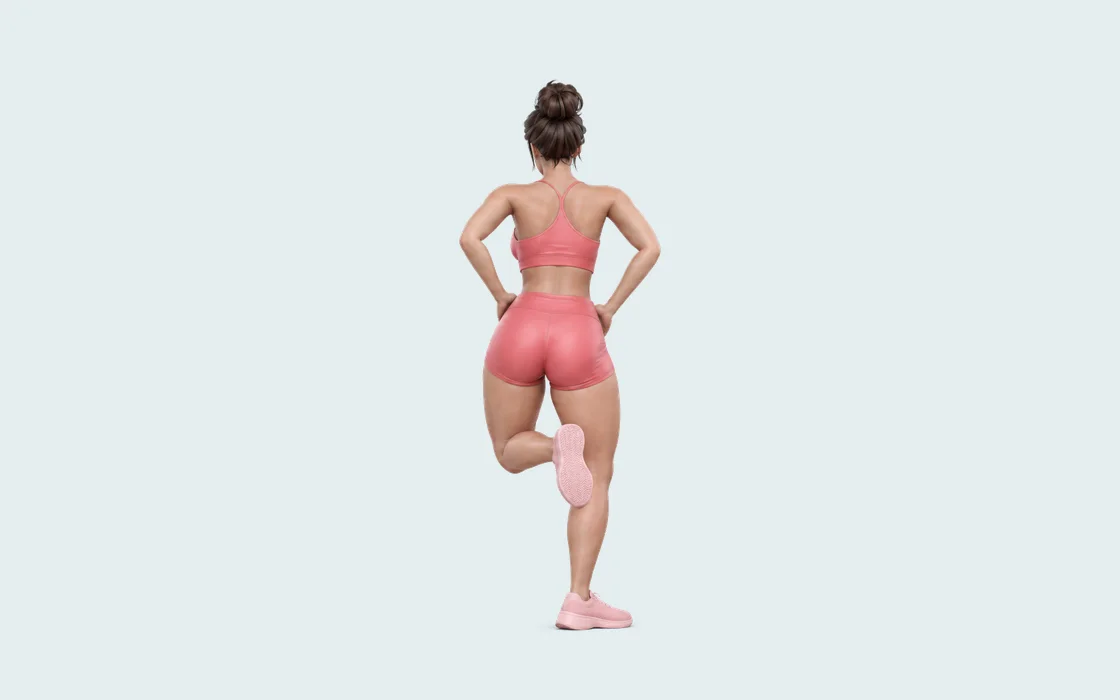
| Warm-up | Side kicks | Hands on hips, chest tall | 45 s |
| Warm-up | Downward dog | Hips high, upside-down V | 45 s |
| Test 1 | 3-minute step test | Step up, up, down, down to the beat for 3 minutes, then sit and count your pulse for 1 minute. | 3 min of stepping, then a 1-minute pulse count |
| Test 2 | Sit and reach test | Sit with bare feet flat against the step, reach forward slowly with both hands and hold for 2 seconds. | About 1 min for two reaches |
| Test 3 | Push-up test | Men: standard push-ups. Women: kneeling push-ups. Chin to the floor each rep. | As many as you can, no time limit |
| Rest | Rest | Shake out your arms and breathe | 45 s |
| Test 4 | Plank test | Hold a forearm plank as long as you can, body in one straight line from head to heels. | As long as you can |
| Rest | Rest | Shake out your arms and breathe | 45 s |
| Test 5 | Wall sit test | Slide down the wall until your thighs are level with the floor and hold as long as you can. | As long as you can |
| Cool-down | Half kneeling stretch | Front knee over ankle, switch sides halfway | 50 s |
| Cool-down | Straight leg pull-back | Head and shoulders on floor, switch sides halfway | 50 s |
How the scores work. Each scored test is compared with people of your age and sex. The push-up test uses the five categories of the Canadian Society for Exercise Physiology (CSEP), from Needs improvement to Excellent, for ages 20 to 69. The sit and reach test gives a percentile from Canada's national fitness survey for ages 18 to 69 (Hoffmann et al. 2019): the 60th percentile means you reached farther than about 60 in 100 people your age and sex. The tool calls the middle fifth of scores Average. The step test uses the seven ratings of the YMCA Fitness Testing and Assessment Manual, from Very poor to Excellent, for ages 18 and up. There is no single overall score, because a great push-up count does not make up for tight hamstrings. Your results stay in this browser: nothing is sent to FitCraft, and the FitCraft app does not see them.
Train for your retest with workouts customized to you in detailed 3D
The FitCraft app builds workouts around your goals, shows every move with a 3D AI coach and adjusts as you progress. Earn XP, keep your streak and level up.
Take the Free Assessment Free • Takes 2 minutes • Personalized to youThe push-up test
The push-up test measures upper-body muscular endurance: how many times your chest, shoulders and triceps can move your body weight. The tool uses the protocol and categories from the Canadian Society for Exercise Physiology (CSEP), which ACE and ACSM materials reprint:
- Men start on the toes. Women start on the knees with the lower legs on the mat, ankles flat and legs together. These are the positions the published table uses.
- Hands shoulder-width apart under the shoulders, back straight, head up.
- Lower until your chin touches the mat without your stomach touching it, then push back up to straight arms.
- Do as many as you can in a row with no rest. There is no time limit.
- Stop when you strain hard or cannot keep good form for two reps in a row.
Tap the big button once for each push-up, or have someone tap for you, and fix the count at the end if you missed one. Here are the categories by age:
| Age | Excellent | Very good | Good | Fair | Needs improvement |
|---|---|---|---|---|---|
| 20 to 29 | 36 or more | 29 to 35 | 22 to 28 | 17 to 21 | 16 or fewer |
| 30 to 39 | 30 or more | 22 to 29 | 17 to 21 | 12 to 16 | 11 or fewer |
| 40 to 49 | 25 or more | 17 to 24 | 13 to 16 | 10 to 12 | 9 or fewer |
| 50 to 59 | 21 or more | 13 to 20 | 10 to 12 | 7 to 9 | 6 or fewer |
| 60 to 69 | 18 or more | 11 to 17 | 8 to 10 | 5 to 7 | 4 or fewer |
| Age | Excellent | Very good | Good | Fair | Needs improvement |
|---|---|---|---|---|---|
| 20 to 29 | 30 or more | 21 to 29 | 15 to 20 | 10 to 14 | 9 or fewer |
| 30 to 39 | 27 or more | 20 to 26 | 13 to 19 | 8 to 12 | 7 or fewer |
| 40 to 49 | 24 or more | 15 to 23 | 11 to 14 | 5 to 10 | 4 or fewer |
| 50 to 59 | 21 or more | 11 to 20 | 7 to 10 | 2 to 6 | 1 or fewer |
| 60 to 69 | 17 or more | 12 to 16 | 5 to 11 | 2 to 4 | 1 or fewer |
The women's column is for kneeling push-ups. If you are a woman who trains standard push-ups, there is no matching published table, so treat the men's numbers as a stretch target rather than a fair comparison. The number matters for more than your arms: in Yang et al. 2019, 1,104 male firefighters who could do more than 40 push-ups had 96% fewer cardiovascular events over 10 years than those who managed fewer than 10. Our article on the push-up test and heart health covers that study, and how many push-ups you should be able to do covers the norms in more depth. For form, see the guides to push-ups and kneeling push-ups.

The sit and reach test
The sit and reach test measures how far you can reach past your toes with straight legs, which mostly reflects the flexibility of your hamstrings. A meta-analysis of 34 studies found it is a moderate measure of hamstring flexibility and a poor one for the lower back (Mayorga-Vega et al. 2014). Here is how to do the sit and reach test at home with a step:
- Take your shoes off and sit on the floor facing a step or sturdy box, legs straight, the soles of your feet flat against it about 6 inches (15 cm) apart.
- Lay a ruler or tape measure on top of the step, its end level with the front edge, pointing away from you.
- Put one hand on top of the other and reach forward slowly, breathing out, as far as you can. Hold for 2 seconds. Do not bounce.
- Keep your knees straight but do not press them down.
- Reach twice and keep the better one: how far past the edge of the step your fingertips got, or how far short of it they stopped.
The tool asks how far past the edge of the step you reached, or how far short of it you stopped, in inches or centimeters. It scores you against Canada's national fitness survey, which tested Canadians aged 6 to 69 on a sit and reach box where a reach to the toes scores 26 cm (Hoffmann et al. 2019). The table below shows that survey's percentiles turned into distance past the toes.
| Age | Men 20th | Men 50th | Men 80th | Women 20th | Women 50th | Women 80th |
|---|---|---|---|---|---|---|
| 18 to 19 | -10.4 | -1.5 | +7.4 | -2.9 | +5.1 | +12.5 |
| 20 to 24 | -10.5 | -1.4 | +7.5 | -3.1 | +5.1 | +12.8 |
| 25 to 29 | -10.6 | -1.5 | +7.4 | -3.5 | +5.1 | +13.1 |
| 30 to 34 | -10.7 | -1.8 | +6.9 | -4 | +5 | +13.3 |
| 35 to 39 | -10.9 | -2.2 | +6.3 | -4.6 | +4.7 | +13.2 |
| 40 to 44 | -11.1 | -2.7 | +5.6 | -5.2 | +4.2 | +12.8 |
| 45 to 49 | -11.4 | -3.3 | +4.7 | -5.9 | +3.6 | +12.3 |
| 50 to 54 | -11.7 | -3.9 | +3.8 | -6.4 | +3.1 | +11.8 |
| 55 to 59 | -12 | -4.5 | +2.9 | -6.8 | +2.8 | +11.5 |
| 60 to 64 | -12.3 | -5.1 | +2 | -6.9 | +2.8 | +11.6 |
| 65 to 69 | -12.6 | -5.7 | +1.1 | -7 | +2.9 | +11.7 |
The survey only tested people who passed a health screening, so its numbers may run a little higher than the general population. Women reach farther than men at every age. If your reach is short, our guides on how to touch your toes and the best stretches for your hamstrings show how to improve it.
The plank test
The plank test measures core muscular endurance. Hold a forearm plank with your elbows under your shoulders and your body in one straight line, and stop when your hips sag or lift. There are no published plank norms by age and sex for adults in general, so the tool shows your time and saves it as your baseline. For a rough comparison, a study of 471 college students with an average age of about 20 found a middle time of 110 seconds for men and 72 seconds for women (Strand et al. 2014). Older adults usually hold for less time.
The wall sit test
The wall sit test measures the endurance of your thigh muscles. Slide down a wall until your thighs are level with the floor and your knees are over your ankles, then hold. There is no published adult table for the wall sit by age and sex, so this is a test against yourself: the tool shows your time and, on a retest, how much longer you held. See the wall sit guide for form.

The 3-minute step test
The YMCA 3-minute step test estimates cardio fitness from how fast your heart rate recovers after a set amount of work. Fitter hearts slow down faster, so a lower count is better. The tool plays the beat and times both parts:
- Use a sturdy step or box 12 inches (30 cm) high, or the bottom stair with a rail to hold.
- Step to a beat of 96 a minute: up, up, down, down. That is 24 full steps a minute. Either foot can lead.
- Keep going for exactly 3 minutes.
- Sit down at once and start counting your pulse at your wrist or neck within 5 seconds.
- Count every beat for one full minute. That number is your score: lower is fitter.
Here are the ratings from the YMCA Fitness Testing and Assessment Manual:
| Rating | 18 to 25 | 26 to 35 | 36 to 45 | 46 to 55 | 56 to 65 | 66 and older |
|---|---|---|---|---|---|---|
| Excellent | 76 or fewer | 76 or fewer | 76 or fewer | 82 or fewer | 77 or fewer | 81 or fewer |
| Good | 77 to 84 | 77 to 85 | 77 to 88 | 83 to 93 | 78 to 94 | 82 to 92 |
| Above average | 85 to 93 | 86 to 94 | 89 to 98 | 94 to 101 | 95 to 100 | 93 to 102 |
| Average | 94 to 100 | 95 to 102 | 99 to 105 | 102 to 111 | 101 to 109 | 103 to 110 |
| Below average | 101 to 107 | 103 to 110 | 106 to 113 | 112 to 119 | 110 to 117 | 111 to 118 |
| Poor | 108 to 119 | 111 to 121 | 114 to 124 | 120 to 126 | 118 to 128 | 119 to 126 |
| Very poor | 120 or more | 122 or more | 125 or more | 127 or more | 129 or more | 127 or more |
| Rating | 18 to 25 | 26 to 35 | 36 to 45 | 46 to 55 | 56 to 65 | 66 and older |
|---|---|---|---|---|---|---|
| Excellent | 81 or fewer | 80 or fewer | 84 or fewer | 91 or fewer | 92 or fewer | 92 or fewer |
| Good | 82 to 93 | 81 to 92 | 85 to 96 | 92 to 101 | 93 to 103 | 93 to 101 |
| Above average | 94 to 102 | 93 to 101 | 97 to 104 | 102 to 110 | 104 to 111 | 102 to 111 |
| Average | 103 to 110 | 102 to 110 | 105 to 112 | 111 to 118 | 112 to 118 | 112 to 121 |
| Below average | 111 to 120 | 111 to 119 | 113 to 120 | 119 to 124 | 119 to 127 | 122 to 126 |
| Poor | 121 to 131 | 120 to 129 | 121 to 132 | 125 to 132 | 128 to 135 | 127 to 133 |
| Very poor | 132 or more | 130 or more | 133 or more | 133 or more | 136 or more | 134 or more |
The ratings only apply to a 12-inch (30 cm) step, which is taller than most stairs (about 7 inches). On a stair, the tool saves your count as a baseline, which still shows your change if you use the same stair next time. In a validation study of 30 adults aged 19 to 35, fitness estimated from this step test matched treadmill-measured VO2 max closely (r = 0.80, Van et al. 2020). For a fuller cardio test, try the VO2 max calculator, the Cooper test calculator or the beep test.
Am I fit? How to read your results
You are in good shape for your age when your scored tests land in the middle or higher: Good or better on the push-up test, around the 40th percentile or higher on the sit and reach, and Average or better on the step test. Read each area on its own. Most people are stronger in one area than another, and the weakest one is usually where training pays off fastest. A Needs improvement or Below average result is a starting point, not a verdict. The norms come from Canadian and American reference groups, so treat them as a guide.
The plank and wall sit are your own baselines. Write down every result or keep using the same browser, and aim to beat each number at your retest. If you are just starting out, our guide to working out from zero fitness covers the first weeks, and the 7 minute workout is an easy way to train between tests.
When to retest
Retest every 4 to 6 weeks. Training changes take a few weeks to show up in these tests, and testing more often mostly measures day-to-day noise. Keep the conditions the same: the same time of day, the same warm-up, the same step and ruler, and no hard workout the day before. The finish screen gives your retest dates. When you come back on the same device, it shows the change in every test and awards a badge for each new best.
Who should check with a doctor first
The step test, push-up test, plank and wall sit are hard efforts, so the tool starts with a short health check based on the PAR-Q+. If you answer yes to any question, talk to a doctor or a qualified exercise professional first and fill in the full PAR-Q+ with them.
- Heart disease or high blood pressure. Get cleared first. Holds like the plank and wall sit raise blood pressure while you hold them, as our article on isometric exercise and blood pressure explains.
- Joint pain or a current injury. Skip any test that hurts. The tool has a Skip button for every test.
- Pregnancy. Follow your care team on which tests to do.
- The step. Use a sturdy step that cannot slide, and hold a rail or wall if your balance is not steady.
Stop any test at once if you feel chest pain or pressure, dizziness, unusual shortness of breath or sharp joint pain.
Related reading
References
- Canadian Society for Exercise Physiology. The Canadian Physical Activity, Fitness and Lifestyle Approach (CPAFLA): CSEP-Health and Fitness Program's Health-Related Appraisal and Counselling Strategy. 3rd ed. Ottawa: CSEP; 2003. Push-up categories reprinted in ACE Group Fitness Instructor Fitness Assessment Protocols.
- Hoffmann MD, Colley RC, Doyon CY, Wong SL, Tomkinson GR, Lang JJ. "Normative-referenced percentile values for physical fitness among Canadians." Health Reports. 2019;30(10):14-22. doi:10.25318/82-003-x201901000002-eng
- YMCA of the USA. YMCA Fitness Testing and Assessment Manual. 4th ed. Champaign (IL): Human Kinetics; 2000. Step test norms reprinted in ACE Group Fitness Instructor Fitness Assessment Protocols.
- Strand SL, Hjelm J, Shoepe TC, Fajardo MA. "Norms for an isometric muscle endurance test." Journal of Human Kinetics. 2014;40:93-102. doi:10.2478/hukin-2014-0011
- Yang J, Christophi CA, Farioli A, et al. "Association between push-up exercise capacity and future cardiovascular events among active adult men." JAMA Network Open. 2019;2(2):e188341. doi:10.1001/jamanetworkopen.2018.8341
- Mayorga-Vega D, Merino-Marban R, Viciana J. "Criterion-related validity of sit-and-reach tests for estimating hamstring and lumbar extensibility: a meta-analysis." Journal of Sports Science and Medicine. 2014;13(1):1-14. PMID 24570599
- Van KNT, Jung SJ, Shin SW, et al. "The validity of the YMCA 3-minute step test for estimating maximal oxygen uptake in healthy Korean and Vietnamese adults." Journal of Lifestyle Medicine. 2020;10(1):21-29. doi:10.15280/jlm.2020.10.1.21
- The White House. "President's Council on Sports, Fitness, and Nutrition, and the Reestablishment of the Presidential Fitness Test." Executive order, July 31, 2025. whitehouse.gov
How this fitness test differs from typical at-home fitness tests
Most at-home fitness test articles list a handful of exercises and leave you to time them and guess what your number means. Many of the score charts that circulate online have no source at all. This one runs the tests for you, with a metronome for the step test, a pulse-count timer, a push-up counter and timers for the holds, and it scores only against tables it can name: the Canadian Society for Exercise Physiology for push-ups, Statistics Canada's national survey for the sit and reach, and the YMCA for the step test. Where no adult norms exist, as for the plank and wall sit, it says so and shows your time instead of inventing a rating.
It also keeps the parts of fitness apart. You get a profile across strength, flexibility, core and cardio rather than one blended score, a retest window 4 to 6 weeks out, and, on the same device, the change in every test with a badge for each new best. It starts with a health check based on the PAR-Q+, includes a warm-up and a cool-down from the FitCraft app, and keeps every result in your browser.
Frequently Asked Questions
What is a physical fitness test?
A physical fitness test is a set of simple exercises that measure the parts of fitness linked to health: cardio fitness, muscular strength and endurance, and flexibility. Each result is compared with published norms for people of your age and sex. This one has five tests and takes about 15 minutes at home.
How to check your fitness level at home?
Do a few standard tests with published norms and write the numbers down: a push-up test for upper-body endurance, a sit and reach test for flexibility, a plank for your core and a 3-minute step test for cardio fitness. The tool on this page runs all of them with timers and scores each one for your age and sex. Repeat the same tests in 4 to 6 weeks to see your change.
How many push-ups am I supposed to be able to do?
It depends on your age and sex. In the Canadian Society for Exercise Physiology table, a man aged 20 to 29 rates Good at 22 to 28 standard push-ups in a row, and a man aged 40 to 49 at 13 to 16. A woman aged 20 to 29 rates Good at 15 to 20 kneeling push-ups, and a woman aged 40 to 49 at 11 to 14. The test has no time limit.
Is 20 pushups in 1 minute good?
The usual adult push-up norms count push-ups in a row with no time limit, not push-ups in a minute. On that table, 20 standard push-ups in a row rates fair for a man in his 20s, good in his 30s, very good in his 40s and 50s, and excellent in his 60s. For a woman, 20 kneeling push-ups rates good in her 20s and very good from her 30s to her 50s.
What is a good score on the sit and reach test?
In Canada's national fitness survey (Hoffmann et al. 2019), the middle score for adults aged 20 to 24 was 1.4 cm short of the toes for men and 5.1 cm past the toes for women. Reaching past that puts you above the middle for your age and sex. The tool on this page gives your percentile for ages 18 to 69.
How do I improve my sit and reach test?
Stretch your hamstrings and lower back most days, for example with a straight leg pull-back, a downward dog and a seated forward reach, holding each for 30 to 60 seconds without bouncing. Warm up before you test, and test the same way each time, on the same step and ruler, so the change you see is real.
What are the FitnessGram assessments?
FitnessGram is the school fitness test from The Cooper Institute. It includes the PACER shuttle run or a one-mile run for aerobic capacity, curl-ups, 90-degree push-ups, a trunk lift, the back-saver sit and reach and a shoulder stretch, plus body composition. Results are compared with Healthy Fitness Zone standards for each age and sex. It is built for children and teens, while this page is for adults.
What president got rid of the Presidential Fitness Test?
The Presidential Physical Fitness Test was dropped from schools in 2012, under President Barack Obama, when it was replaced by the Presidential Youth Fitness Program, which focuses on health rather than athletic feats. President Donald Trump brought the test back with an executive order on July 31, 2025.
What is a maximal test?
A maximal test pushes you to your limit, like a treadmill test that gets harder until you cannot go on, which measures VO2 max directly. A submaximal test stops below your limit and estimates fitness from your heart rate, like the 3-minute step test here. The push-up, plank and wall sit tests on this page go until your form breaks, so do them only if you are healthy and cleared to exercise.
How often should I retest my fitness?
Every 4 to 6 weeks. That gives a training program time to make a measurable change. Retest at the same time of day, after the same warm-up, on the same step and ruler. The tool shows your retest dates and, on this device, the change since your last test.