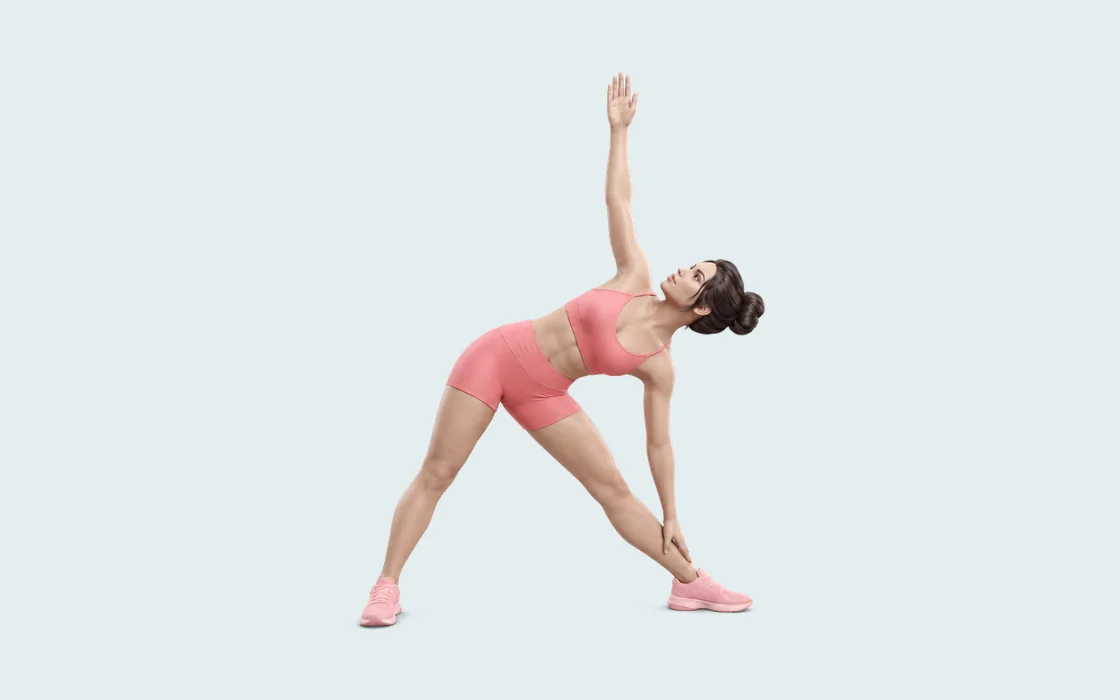

Tabata is simple to explain and hard to do: 20 seconds of work, 10 seconds of rest, eight times in a row. The Tabata timer above takes care of the counting. Press start and it times every interval and beeps at 3-2-1. You see each round's move on screen, along with a picture and a form tip. An AI coach from the FitCraft app calls out what is coming.
If you already have your own workout, turn on the Just the timer switch. The moves go away and you keep the countdown and the beeps, so the page works as a plain 20/10 timer for your own exercises or for an exercise bike.
How the Tabata timer runs a session
Every session runs in the same order. It opens with 1 minute of easy mobility moves to warm up. You can switch the warm-up off, but it is on by default. A 5-second get-ready comes next, then the first Tabata: 8 rounds of 20 seconds of work and 10 seconds of rest, 4 minutes in all. If you chose more than one Tabata, a 1-minute rest comes before each new one. A 1-minute stretch always ends the session.
Each Tabata alternates two moves for its 8 rounds, in the order A, B, A, B and so on. Tabatas 1 and 3 use your level's first pair of moves, and Tabatas 2 and 4 use the second pair, so with one Tabata, the default, you only do the first pair. The 20/10 clock never changes, so the number of Tabatas sets the length: 1, 2, 3 or 4 Tabatas take 4, 9, 14 or 19 minutes, plus the warm-up and stretch. The default, one Intermediate Tabata with the warm-up and stretch, takes 6 minutes.
While you work, an AI coach from the FitCraft app calls out the next move and the timer beeps at 3-2-1. One mute button turns the sound off. Every move comes with a picture and a form tip, links to its own exercise page, and can be swapped with a tap. The Just the timer switch drops the moves and keeps only the countdown and the beeps. Where your browser allows it, the screen stays awake, and the timer keeps counting if you switch to another app.
The game layer pays XP for each 20-second work interval: 10 XP at Beginner, 15 at Intermediate, 20 at Advanced and 25 at Expert. Unbroken intervals build a combo bonus, a finished session adds 50 XP, and a session without a skip adds another 25. Your badges, player level, daily streak and personal bests live only on your device.
The moves come from the fat-loss circuits in the FitCraft app. This timer puts those moves on a 20/10 clock. Here are the moves and times at each level.
| Level | Tabatas 1 and 3 | Tabatas 2 and 4 |
|---|---|---|
| Beginner | Running in place and sumo squats | Butt kicks and step-n-clap |
| Intermediate | High knees and calf hops | Ventral jacks and mountain climbers |
| Advanced | Jumping jacks and squat kicks | Burpees and plank jacks |
| Expert | Burpees and jump lunges | Drop squats and jump squats |
Where the 20/10 Tabata format comes from
A Tabata is 8 rounds of 20 seconds of all-out work and 10 seconds of rest, 4 minutes in all, not counting a warm-up and cool-down. It takes its name from Izumi Tabata, whose group at the National Institute of Fitness and Sports in Kagoshima, Japan, was studying training methods for the Japanese national speed skating team. The 20/10 pattern was the team coach's design. Tabata's lab measured what it did to fitness.
In the original study, riders pedaled an exercise bike at about 170% of their VO2 max, the level of effort at which the body takes in and uses as much oxygen as it can. That is more power than the aerobic system can sustain, which is why true Tabata is so hard. Tabata is one kind of HIIT, at the short and intense end of the range.
Tabata is only one way to run intervals. For longer work periods in one-minute rounds, such as 30 seconds on and 30 off, use the interval timer. To do a set number of reps at the start of every minute, use the EMOM timer.

What the Tabata studies found
No study has tested the bodyweight sessions on this page. Most of the studies below tested the original cycling protocol at full effort, and one measured a bodyweight version.
- The original trial. In Tabata et al. 1996, 7 physically active college-aged men did the 20/10 protocol on an exercise bike 4 days a week for 6 weeks, plus a fifth day of 30 minutes of moderate cycling and 4 more rounds. Their VO2 max rose about 13%, from about 48 to 55 mL/kg/min, and their anaerobic capacity rose about 28%. Another 7 men cycled for 60 minutes at 70% of VO2 max, 5 days a week. Their VO2 max rose about 10%, and their anaerobic capacity did not change.
- Why it worked. In Tabata et al. 1997, the same lab measured a single session. It pushed both the aerobic and the anaerobic energy systems close to their measured peaks, and few four-minute workouts load both that hard at the same time.
- The effort matters most. In a 2019 review, Tabata explains that the protocol was built around that power output of about 170% of VO2 max. At a lower effort the clock is the same, but the training effect is not.
- A bodyweight version. Emberts et al. 2013 measured 16 healthy adults aged 20 to 47 during a 20-minute Tabata-style workout of push-ups, split squats, box jumps, burpees, jumping rope and jumping jacks. Their heart rate averaged about 86% of maximum, and they burned about 14.5 kcal a minute. That counts as vigorous exercise, but it is far below the cycling effort of the original study.
- People who were not training. Foster et al. 2015 split 55 untrained college students among a Tabata format, steady-state exercise and a longer interval format, 3 sessions a week for 8 weeks. VO2 max rose about 18 to 19% in all three groups, with no significant difference between them, and the Tabata sessions were rated less enjoyable than the other two.
Put plainly, the original study used an exercise bike at a very hard, all-out effort. A bodyweight Tabata like the sessions on this page is a looser version, so the study's results don't transfer to it one to one. Treat it as a short, time-efficient cardio session. Our review of the Tabata research covers each study in more detail.
Every move in this timer has a 3D coach in the FitCraft app
The FitCraft app builds workouts customized to you and shows every move with a 3D AI coach. Earn XP, keep your streak and level up.
Take the Free Assessment Free • 2 minutes • No credit cardWhich level and how many Tabatas to choose
Choose the level whose moves you can do with clean form for the full 20 seconds.
- Beginner pairs running in place with sumo squats, then butt kicks with step-n-clap. It has no jumping moves. Start here if intervals are new to you or you are returning after time off.
- Intermediate, the default, pairs high knees with calf hops, then ventral jacks with mountain climbers. It suits people who exercise regularly and are comfortable with small hops.
- Advanced pairs jumping jacks with squat kicks, then burpees with plank jacks. Pick it when burpees and jumping jacks already feel routine.
- Expert pairs burpees with jump lunges, then drop squats with jump squats. Pick it only if you can land every jump softly and quietly through the last round.
Start with one Tabata and pace it so your last rounds match your first. By round 6 you should wonder whether you can finish, and by round 8 you should be glad it is over. If you breeze through, push harder or move up a level. If you cannot finish round 5, you started too fast.
Change one thing at a time, about every two weeks: add a Tabata or move up a level, not both. If a move bothers you, tap it to swap it. For a session closer to the original study, turn on Just the timer and use an exercise bike or an air bike, because bodyweight moves cap your peak effort sooner than a bike does.
How many Tabata sessions to do each week
For most people, two or three Tabata sessions a week is a reasonable dose, with at least a day between them and easier cardio and strength training on the other days. If you go truly all-out on a bike, as in the original study, once a week is plenty. The 1996 trial used the protocol 4 days a week, which worked in a controlled study but is a lot for most people who exercise for health. If your other workouts start to feel flat, back off. If you want more work, add a Tabata to a session instead of adding a fourth hard day, which usually leaves your easy days feeling tired.
The Physical Activity Guidelines for Americans (Piercy et al. 2018) recommend 150 to 300 minutes a week of moderate activity, or 75 to 150 minutes of vigorous activity, along with muscle-strengthening work on at least 2 days. One Tabata lasts 4 minutes, so three one-Tabata sessions add up to 12 minutes a week, well short of either target. Count your Tabatas toward the week, add walks or longer workouts, and keep 2 days of strength training, which Tabata does not replace.

Who should check with a doctor first
The timer is built for healthy adults. A Tabata briefly drives your heart rate and blood pressure up hard, and the jumping moves add repeated impact, so adjust the session, or get a professional's advice first, if any of these apply to you.
- New to exercise or back after a long break. Start at Beginner with one Tabata. If you have been inactive for a long stretch, spend four to six weeks on easy cardio first, such as a brisk walk most days, and then add intervals. Our guide for people who have never exercised before shows how to begin.
- High blood pressure or heart disease. Ask your doctor before your first Tabata. You need medical clearance first if you have known or suspected heart disease, uncontrolled high blood pressure, chest pain or unusual shortness of breath during effort, or a history of heart symptoms.
- Joint pain or a current injury. Jumping moves such as jump lunges, burpees, drop squats and jump squats add impact on every landing. If they hurt, drop to a lower-impact level such as Beginner, which has no jumping moves, or tap a move to swap it. Just the timer with an exercise bike is another option. Our guide to exercise with joint pain covers low-impact options.
- Pregnancy and the months after birth. Follow your care team on how hard to work and which moves to use. After birth, build up easy cardio and moves without jumping before you try intervals. Our guide to exercise after pregnancy has more.
Stop right away if chest pain, dizziness or sharp joint pain shows up.
The drawbacks of Tabata
Most of the downsides of Tabata come from how hard and how short it is.
- The real version is hard to reach. The original effort was an all-out ride on an exercise bike. Bodyweight moves cap your peak effort sooner than a bike does, so most home Tabatas are a looser version of the protocol.
- It can be hard to enjoy. In Foster et al. 2015, people rated Tabata sessions as less enjoyable than steady-state exercise or a longer interval format, even though all three raised fitness by about the same amount.
- Jumps add impact. The Advanced and Expert levels include jumps and landings. A lower level, or an exercise bike with Just the timer, cuts the impact.
- It is short. A few Tabatas a week cover only a small part of the activity guidelines, and Tabata does not replace strength training, mobility work or everyday activity.
- It does not suit everyone. The high peak effort makes it a poorer fit for people with heart disease, uncontrolled high blood pressure or a long inactive stretch, and it lacks the long safety record in patients that the Norwegian 4x4 has.
- Gains shrink as you get fitter. The Tabata group in the 1996 study started at a VO2 max of about 48 mL/kg/min, which left room to improve. People who are already fit tend to see smaller gains.
Related reading
References
- Tabata I, Nishimura K, Kouzaki M, Hirai Y, Ogita F, Miyachi M, Yamamoto K. "Effects of moderate-intensity endurance and high-intensity intermittent training on anaerobic capacity and VO2max." Medicine & Science in Sports & Exercise 28.10 (1996): 1327-1330. PMID: 8897392
- Tabata I, Irisawa K, Kouzaki M, Nishimura K, Ogita F, Miyachi M. "Metabolic profile of high-intensity intermittent exercises." Medicine & Science in Sports & Exercise 29.3 (1997): 390-395. PMID: 9139179
- Tabata I. "Tabata training: one of the most energetically effective high-intensity intermittent training methods." Journal of Physiological Sciences 69.4 (2019): 559-572. doi:10.1007/s12576-019-00676-7
- Emberts T, Porcari J, Doberstein S, Steffen J, Foster C. "Exercise Intensity and Energy Expenditure of a Tabata Workout." Journal of Sports Science & Medicine 12.3 (2013): 612-613. PMID: 24137082
- Foster C, Farland CV, Guidotti F, Harbin M, Roberts B, Schuette J, Tuuri A, Doberstein ST, Porcari JP. "The Effects of High Intensity Interval Training vs Steady State Training on Aerobic and Anaerobic Capacity." Journal of Sports Science & Medicine 14.4 (2015): 747-755. PMID: 26664271
- Piercy KL, Troiano RP, Ballard RM, et al. "The Physical Activity Guidelines for Americans." JAMA. 2018;320(19):2020-2028. doi:10.1001/jama.2018.14854
How this Tabata timer differs from other Tabata timers
A basic Tabata interval timer counts 20 seconds, then 10, eight times over, and beeps. What you do in each round is up to you. This one fills the rounds with bodyweight moves at four levels, two per Tabata. Each move shows a picture and a form tip and links to its full exercise guide, and an AI coach from the FitCraft app calls out the next one. The intervals sit between an optional 1-minute warm-up and a 1-minute closing stretch, and the Just the timer switch removes the moves when you bring your own. The screen stays on where the browser permits it, and the clock keeps running correctly while you use another app. A game layer sits on top: XP for every work interval, a combo bonus for unbroken intervals, bonuses for finishing and for no skips, plus badges, personal bests, a daily streak and a player level, all stored only on your device. The page is also honest about the evidence: the original study used an exercise bike at an all-out effort, so a bodyweight Tabata is a looser version.
Frequently Asked Questions
How often should you do Tabata?
For most people, two or three Tabata sessions a week is a reasonable dose, never on back-to-back days, with easier cardio and strength training in between. If you go truly all-out on an exercise bike, as in the original study, once a week is plenty. If your other workouts start to feel flat, cut back.
What are the disadvantages of Tabata?
The original protocol needs an all-out effort on an exercise bike, which is hard to reach with bodyweight moves, and people in one trial rated Tabata less enjoyable than steady exercise or longer intervals (Foster et al. 2015). Jumping versions add impact on every landing, and a few 4-minute sessions cover only a small part of the weekly activity guidelines. People with heart disease or uncontrolled high blood pressure should get medical clearance first.
What is harder, HIIT or Tabata?
Tabata is one type of HIIT, so the answer depends on which HIIT workout you compare it with. The original Tabata, an all-out ride at about 170% of VO2 max, sits at the short and intense end of HIIT, and people in one trial rated it less enjoyable than a longer interval format (Foster et al. 2015). A bodyweight Tabata is usually easier than that: in one study it averaged about 86% of maximum heart rate, which is vigorous but not all-out (Emberts et al. 2013).
Is 30 seconds on 30 seconds off HIIT?
It can be. Working for 30 seconds and resting for 30 counts as HIIT when the work is truly hard, an 8 or 9 on a 10-point effort scale, and the rest lets you reach that effort again in the next round. The clock alone does not make a workout HIIT; how hard you work does. It is not Tabata, which uses 20 seconds of work and 10 seconds of rest.
Is there a free app for Tabata workouts?
This page is a free Tabata timer that runs in your browser, with nothing to download and no signup. It picks bodyweight moves at four levels, shows a picture and a form tip for each, and has an AI coach call out the next move. The FitCraft app is a full workout app: it builds workouts customized to you and shows every move with a 3D AI coach.
Is this Tabata timer free?
Yes. It is free to use, with no signup and nothing to install. Everything the game tracks, from XP and badges to your streak and personal bests, stays on your device.
How long is a Tabata workout?
One Tabata is 4 minutes: 8 rounds of 20 seconds of work and 10 seconds of rest. This timer runs 1, 2, 3 or 4 Tabatas, which take 4, 9, 14 or 19 minutes with a 1-minute rest between them. The default session of one Tabata takes 6 minutes with the warm-up and stretch.