The ventral jack keeps the best part of a jumping jack: simple rhythm, fast heart-rate rise, and no equipment. The difference is the arm path. Your arms move from straight ahead to wide at shoulder height instead of swinging overhead, which makes the drill a useful option when classic jacks feel rough on the shoulders.
Quick Facts: Ventral Jacks
- Equipment needed: None
- Difficulty: Intermediate to advanced
- Modality: Cardio / HIIT / bodyweight conditioning
- Body region: Full body, with legs, shoulders, and core emphasis
- FitCraft quest category: Cardio
Muscles & Systems Worked
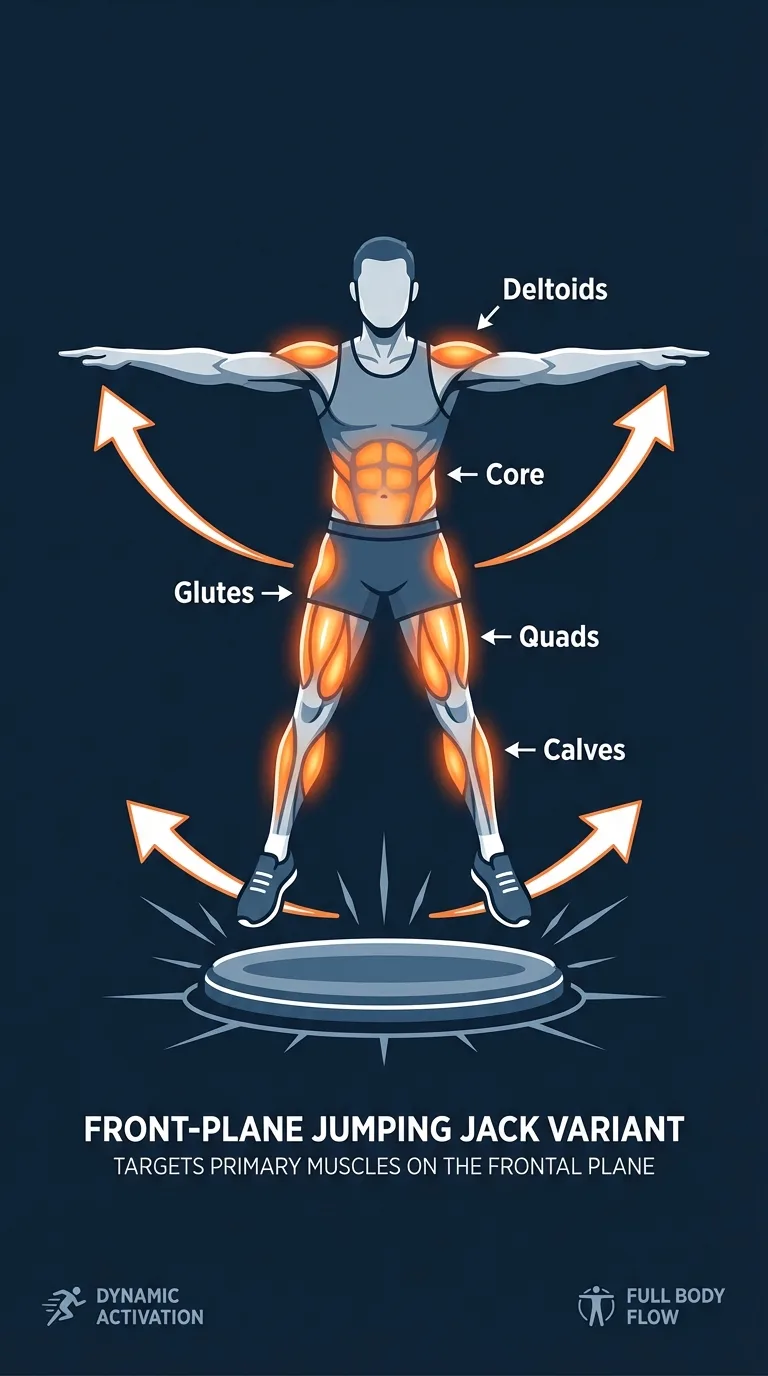
Primary movers: The quadriceps, gluteus maximus, and calves create the repeated foot-out and foot-in jumps. The deltoids move the arms from the front position to a wide T and back, with the anterior and middle deltoid doing most of the visible shoulder work.
Secondary movers: The hip abductors help drive the feet wide, while the adductors help pull the legs back toward midline. The hamstrings help control each landing, and the upper back helps keep the arms wide without letting the shoulders collapse forward.
Stabilizers: The rectus abdominis, transverse abdominis, obliques, spinal erectors, and ankle stabilizers keep your trunk and foot strike organized while the limbs move quickly. Good ventral jacks should feel springy, not sloppy.
Conditioning mechanism: No ventral-jack-specific PubMed, PMC, or DOI citation is listed in the verified FitCraft citation library, so this section uses mechanism-based anatomy. The drill raises demand across the phosphocreatine, glycolytic, and oxidative systems because large muscle groups repeat a low-amplitude plyometric pattern with minimal rest.
Step-by-Step: How to Do the Ventral Jack
- Set your stance. Stand tall with your feet together, knees soft, and weight balanced over the midfoot. Hold your arms straight out in front of you at shoulder height with palms facing each other.
- Brace before you move. Pull your ribs down slightly, tighten your midsection, and keep your gaze forward. Coach Ty's cue: "Long spine, soft knees, arms straight ahead."
- Jump out and sweep wide. Hop your feet to a stance slightly wider than shoulder-width. At the same time, sweep your arms out to the sides until they make a T shape with your torso.
- Land quietly and return. Land on the balls of your feet with your knees bent just enough to absorb impact. Hop the feet back together as your arms return to the front position. Coach Ty's cue: "Open and close like one spring."
- Repeat until quality drops. Keep the same rhythm for the whole interval. Stop when the shoulders hike, the knees cave, landings get loud, or your breathing gets too ragged to control the next rep.
Get this exercise in a personalized workout
FitCraft, our mobile fitness app, uses its AI coach Ty to program conditioning work like this into your plan at the right volume and intensity, based on your level, goals, and equipment. Ty was designed and trained by Domenic Angelino, MPH (Brown University) and NSCA-CSCS, with research published in the Journal of Strength and Conditioning Research and Medicine & Science in Sports & Exercise.
Take the Free Assessment Free • 2 minutes • No credit card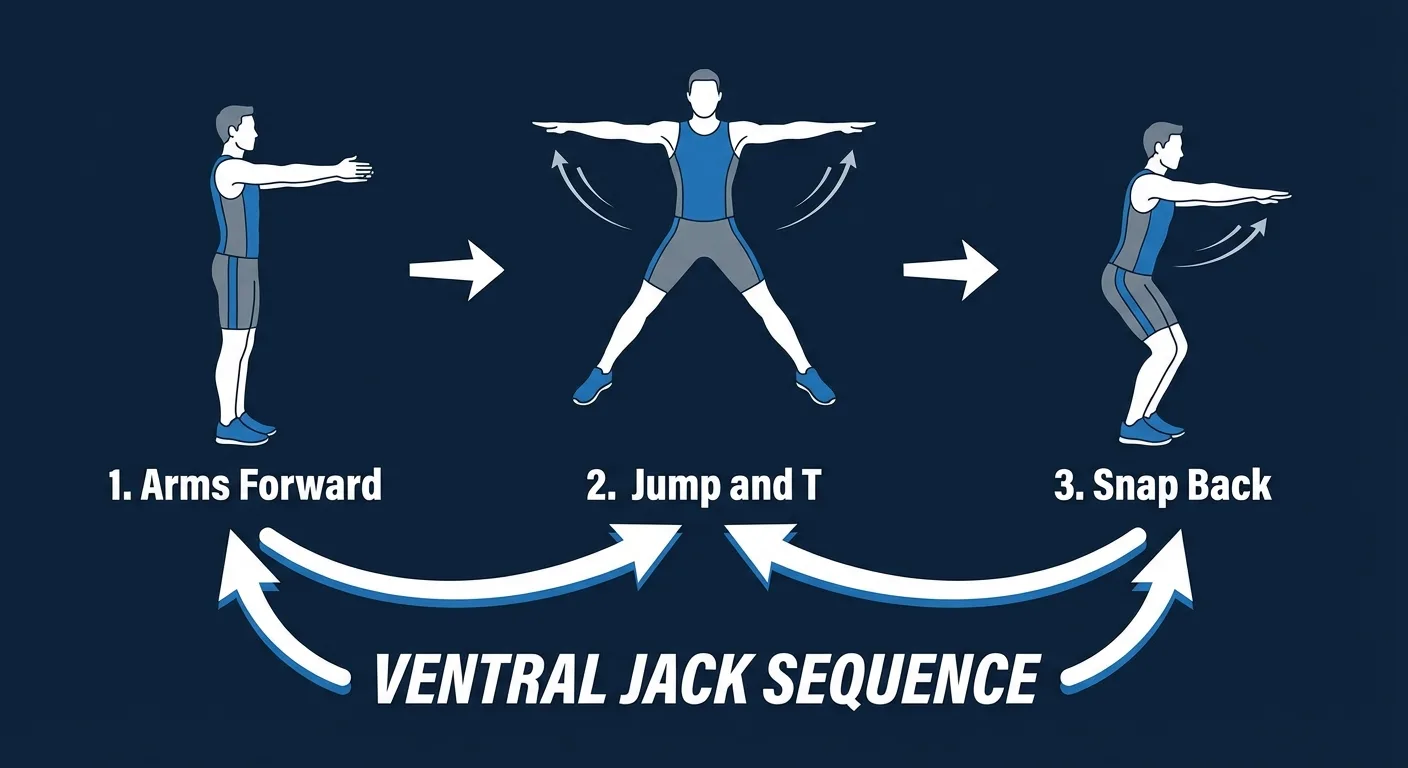
Common Mistakes and Fixes
Letting the arms drift overhead
What it looks like: The first few reps stay at shoulder height, then the arms slowly turn the exercise back into a classic jumping jack.
Why it's a problem: The ventral jack exists to keep the arm path lower. If overhead motion feels good, standard jumping jacks are fine. If it feels pinchy, the lower arm path matters.
The fix: Treat shoulder height as your ceiling. Sweep wide, pause your hands at the T shape, then pull them back to the front position.
Landing heavy
What it looks like: Your feet slap the floor, knees stay stiff, and each rep sounds louder as the interval goes on.
Why it's a problem: Heavy landings increase stress through the ankles, knees, hips, and pelvic floor.
The fix: Bend the knees slightly, land through the balls of the feet, and shorten the jump distance until the reps sound quiet.
Losing arm-leg timing
What it looks like: The feet jump first, then the arms catch up, or the arms sweep wide before the feet move.
Why it's a problem: The movement turns into a coordination drill instead of a smooth conditioning exercise.
The fix: Slow the cadence for 10 clean reps. Once the timing locks in, increase speed without changing the pattern.
Shrugging the shoulders
What it looks like: Your upper traps lift toward your ears each time the arms sweep wide.
Why it's a problem: Shoulder hiking adds neck tension and makes the arm path feel cramped.
The fix: Think "wide collarbones." Keep the neck long and the shoulder blades gently down as the arms move.
Ventral Jack Variations: Regressions and Progressions
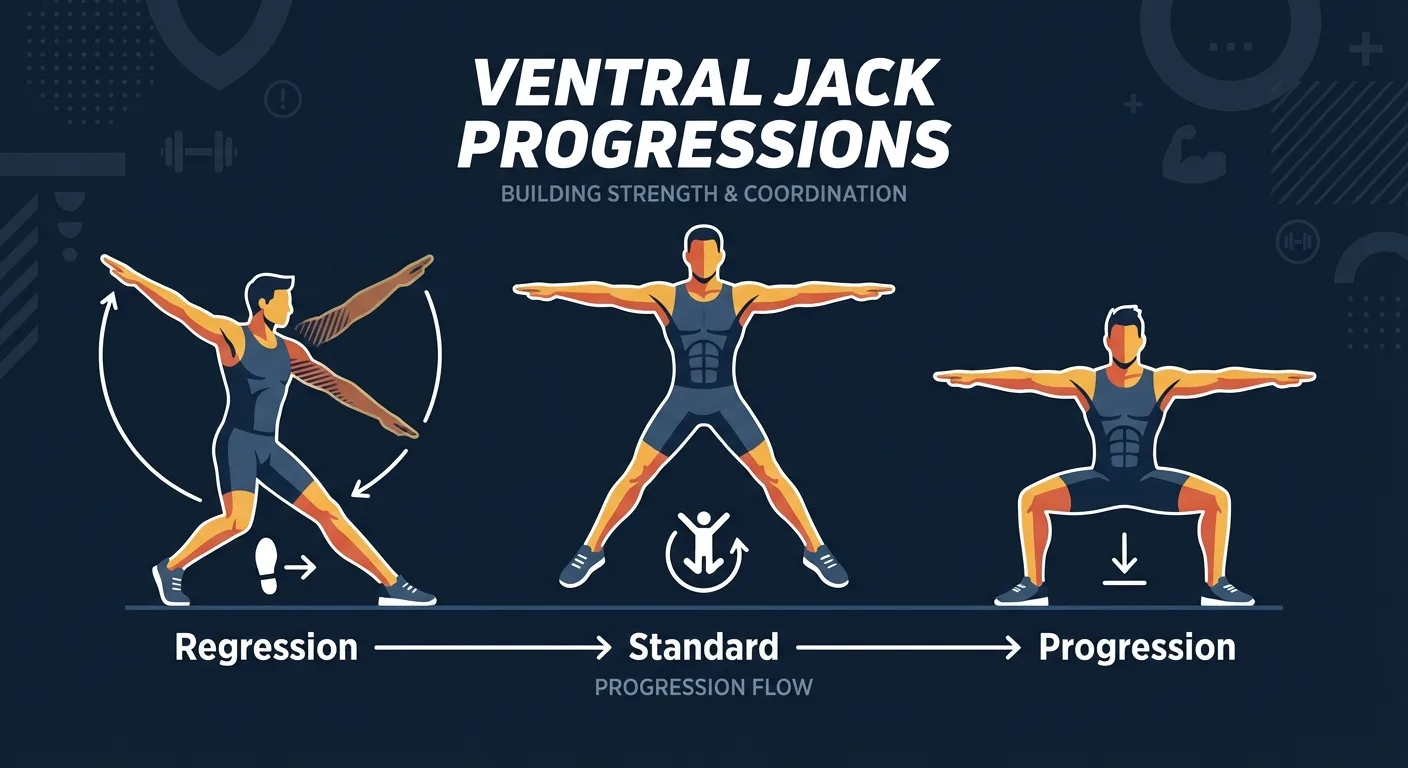
Step-out ventral jack
Step one foot out at a time instead of jumping both feet. This keeps the same arm path with much less impact.
Arms-only ventral sweep
Stand still and practice moving the arms from the front position to a T shape and back. Use this when the arm path feels confusing before adding footwork.
Standard ventral jack
Use the full jumping version when you can land quietly and keep the shoulders down for the whole interval.
Squat ventral jack
Add a shallow squat each time the feet land wide. Keep the squat small at first because this progression adds quad demand quickly.
Ventral jack finisher
Alternate 20 seconds of ventral jacks with 20 seconds of high knees or mountain climbers for a short cardio block.
When to Avoid or Modify Ventral Jacks
Ventral jacks are safe for many healthy adults, but the jumping pattern and fast cadence raise the stakes. Always consult your physician or a qualified healthcare provider before starting or returning to high-intensity exercise, especially if any of the scenarios below apply.
- Known cardiovascular disease or uncontrolled hypertension. HIIT can spike heart rate and blood pressure quickly. Get medical clearance and stay within prescribed intensity limits.
- Knee, ankle, hip, shin, or foot pain. Replace jumping reps with step-out ventral jacks, walking in place, or marching in place.
- Pregnancy or early postpartum recovery. Jumping can stress joints and the pelvic floor. Use low-impact stepping options and follow guidance from a qualified clinician.
- Stress incontinence or pelvic-floor symptoms. Choose step-based conditioning such as step-n-clap until impact is well tolerated.
- Vertigo, balance disorders, or vestibular symptoms. Fast side-to-side footwork can raise fall risk. Keep one foot on the floor or use stationary low-impact drills.
- Asthma or exercise-induced bronchoconstriction. Warm up gradually, keep rescue medication accessible if prescribed, and stop if breathing feels unsafe.
Related Exercises
- Lower-impact alternative: Step-N-Clap keeps the cardio rhythm without jumping.
- Classic pattern: Jumping Jacks use the overhead arm path when shoulder mobility is comfortable.
- Core stability foundation: Hand Planks build trunk stiffness for faster conditioning moves.
- Ankle and calf prep: Calf Raises strengthen the lower-leg tissues that handle repeated foot strikes.
- Higher-intensity progression: Burpees add a squat, plank, and jump to the conditioning demand.
How to Program Ventral Jacks
Ratamess et al. (2009), the ACSM resistance-training progression position stand, supports progressing exercise dose by training status, fatigue, rest, and movement quality. For ventral jacks, use time-based intervals rather than chasing a fixed rep count.
| Level | Work interval | Rest between sets | Frequency |
|---|---|---|---|
| Beginner | 20-30 seconds, step-out or low-impact | 60-90 seconds | 2-3 sessions/week |
| Intermediate | 30-45 seconds, standard jumping reps | 45-60 seconds | 3-4 sessions/week |
| Advanced | 45-60 seconds or 20-second HIIT rounds | 30-45 seconds, or 10 seconds for Tabata-style rounds | 3-5 sessions/week |
Place ventral jacks in a standalone HIIT session, after resistance training, or as a short 5- to 10-minute finisher. Avoid doing hard intervals before heavy strength work because the fatigue can reduce power and landing control.
Use a form floor over time targets. Stop the interval when landings get loud, arm height changes, shoulders shrug, knees cave inward, or breathing gets too rushed to reset the next rep.
Frequently Asked Questions
What is a ventral jack?
A ventral jack is a jumping jack variation where your arms move from straight in front of your chest to a T shape at shoulder height while your feet jump wide and back together. The arm path stays in front of the body instead of going overhead.
What muscles do ventral jacks work?
Ventral jacks train the quadriceps, glutes, calves, deltoids, upper back, and core. They also challenge the heart, lungs, and energy systems because the movement is continuous and rhythmic.
How are ventral jacks different from jumping jacks?
A standard jumping jack sends the arms overhead. A ventral jack keeps the arms at shoulder height, moving from in front of the chest to a T shape, which can be easier to tolerate if overhead shoulder motion feels uncomfortable.
Can I do ventral jacks with high blood pressure?
Avoid HIIT ventral jacks if you have uncontrolled hypertension or known cardiovascular disease unless a qualified clinician clears you for vigorous intervals. Use lower-intensity stepping drills and stay within any prescribed heart-rate limits.
How many ventral jacks should I do?
Start with 20 to 30 seconds of work followed by 60 to 90 seconds of rest for 2 to 3 rounds. Build toward 30 to 45 second rounds, then use shorter HIIT intervals only when landings, posture, and breathing stay controlled.